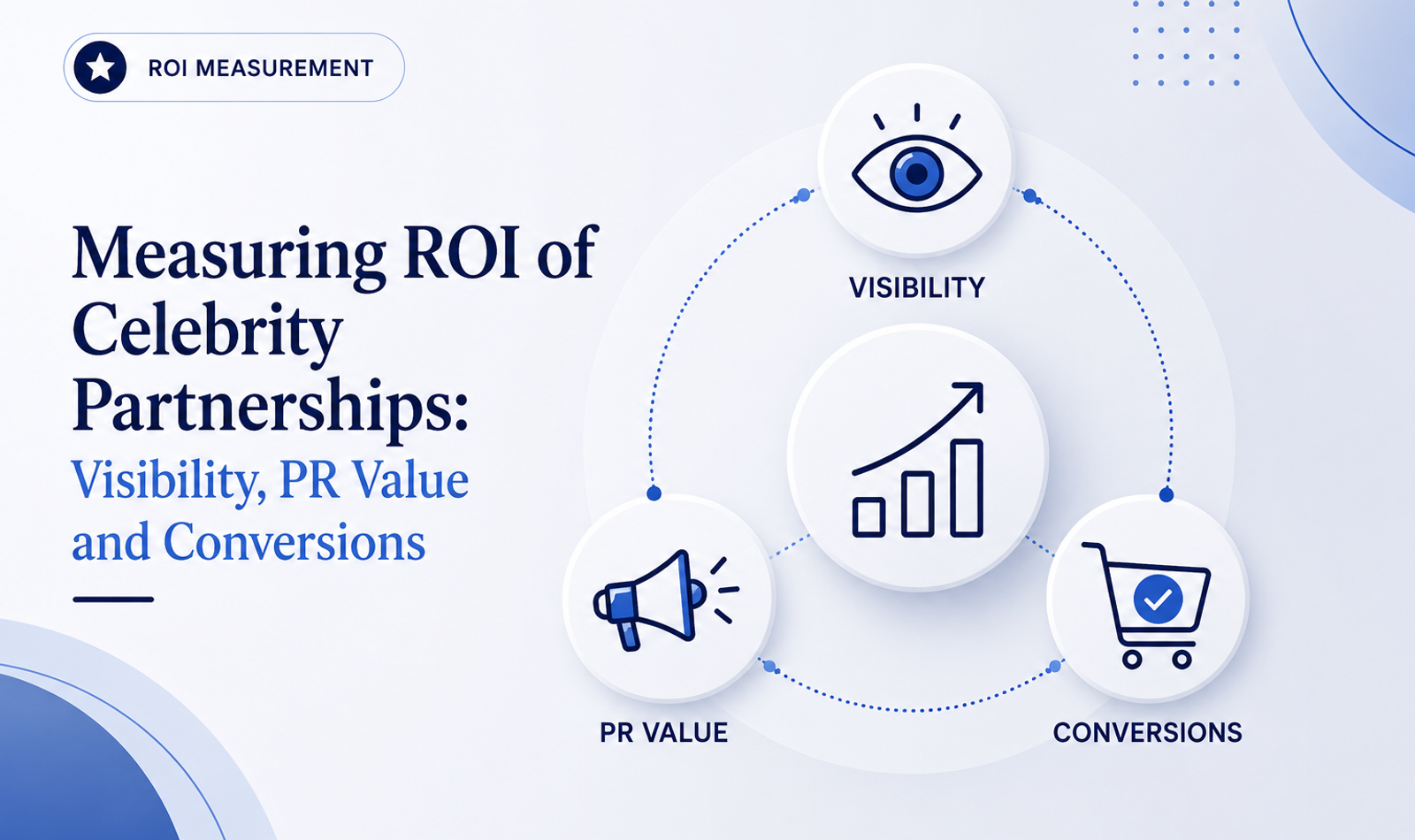
Measuring ROI of Celebrity Partnerships: Visibility, PR Value and Conversions
Celebrity partnerships can generate immediate attention, social conversation and media coverage, but visibility alone does not prove that the investment was commercially successful.
A campaign may receive millions of views while producing limited brand recall. A celebrity appearance may attract extensive press coverage but generate few qualified customers. A brand ambassador may increase public familiarity gradually without creating an immediate increase in sales.
These outcomes should not be measured in the same way.
Celebrity partnership return on investment depends on the reason the celebrity was hired, the role they performed, the audience reached and the business result the brand expected.
A national endorsement campaign may be designed to improve awareness and brand consideration over several months. A celebrity event appearance may be intended to attract media, increase attendance and create valuable stakeholder relationships.
A social collaboration may focus on website traffic, product purchases or lead generation. A luxury ambassadorship may aim to change how customers perceive the brand rather than produce immediate transactions.
The measurement framework must reflect the actual objective.
Brands frequently make one of two errors. They either focus only on easily available visibility metrics, or they demand immediate revenue from partnerships designed primarily to build long-term brand value.
Both approaches create an incomplete assessment.
Professional celebrity ROI measurement connects communication exposure with audience response and commercial action.
It examines how many relevant people encountered the partnership, whether they understood and remembered the brand, whether their perception changed and whether they completed a valuable action.
The process also accounts for the full cost of the partnership. The celebrity fee is only one part of the investment. Production, usage rights, media, travel, security, events, public relations and internal resources all affect the final return.
The objective is not to force every form of celebrity value into one artificial number.
It is to build a credible measurement system that shows what the partnership achieved, what contributed to the result and how future investments can be improved.
Begin With the Business Objective
ROI measurement should begin before the celebrity is selected or the contract is signed.
The brand must identify the business problem the partnership is expected to solve.
It may need to build awareness in a new market, reposition itself as premium, introduce a product, increase hotel bookings, attract event registrations, generate qualified property enquiries or strengthen trust.
These objectives lead to different metrics.
A campaign designed for national awareness may be evaluated through relevant reach, brand recall, search interest and consideration.
A celebrity appearance at a luxury property launch may be evaluated through media quality, event attendance, private-viewing requests and eventual bookings.
A social endorsement for an ecommerce product may be evaluated through product-page visits, purchases, revenue and customer-acquisition cost.
The brand should avoid using vague objectives such as creating buzz or increasing visibility.
These statements do not explain what success means.
A more useful objective would specify the intended audience, expected change and timeframe.
For example, the brand may want to increase awareness among premium travellers in selected Indian cities during a six-month campaign.
Another objective may be to generate a defined number of qualified consultation requests from a celebrity-led launch.
Clear objectives make later reporting more meaningful.
Distinguish Outputs, Outcomes and Business Impact
Celebrity measurement becomes clearer when campaign results are divided into stages.
Outputs describe what the brand and campaign produced.
These may include films, photographs, social posts, interviews, event appearances, press releases and media placements.
Visibility metrics such as impressions, video views and article volume are also usually associated with campaign output and distribution.
Audience outcomes describe what happened among the people exposed to the campaign.
These may include awareness, recall, engagement, website visits, product consideration, enquiries and changes in perception.
Business impact describes the organisational value that followed.
This may include revenue, bookings, qualified opportunities, market share, retailer demand, customer acquisition or long-term brand equity.
The stages are connected but not interchangeable.
A high number of media articles does not automatically prove increased trust. Increased website traffic does not automatically prove qualified demand. A large number of leads does not automatically prove profitable revenue.
The brand should show how performance moved from one stage to the next.
This creates a stronger measurement story than presenting disconnected numbers.
Define the Complete Investment
A valid ROI calculation must use the complete cost of the partnership.
The celebrity’s professional fee is only the starting point.
The investment may include talent-agency commission, taxes, legal review, campaign production, photography, editing, styling, travel, accommodation, hospitality, security and technical production.
Usage rights and category exclusivity can add substantial cost.
The brand may also invest in paid media, public relations, landing pages, event venues, content adaptation, influencer support and sales follow-up.
Internal employee time should be considered when the partnership requires significant management.
For event appearances, the complete investment may include vehicles, green rooms, crowd control, backstage coordination, media management and guest hospitality.
For long-term ambassadorships, the cost may include several shoots, appearances, renewals and asset localisation.
A campaign cannot be evaluated accurately by comparing sales only with the celebrity fee while ignoring the rest of the activation budget.
The brand should maintain one consolidated cost record from the beginning. A structured event budgeting and cost-control framework can help ensure that every associated expense is included.
Use More Than One Definition of Return
Return does not always mean immediate sales.
A celebrity partnership can create financial, reputational, strategic and content value.
Financial return may include direct revenue, attributed bookings, qualified pipeline and retail orders.
Reputational return may include stronger trust, improved premium perception or increased consideration.
Strategic return may include entry into a new market, access to media, distributor confidence or stakeholder engagement.
Content return may include campaign assets that can be used across advertising, ecommerce, sales presentations and social media.
The brand should identify which forms of return are relevant before combining them into an overall evaluation.
Direct revenue should remain separate from estimated communication value.
A theoretical media value should not be presented as though it were money received by the business.
Transparency makes the final report more credible.
Establish a Measurement Baseline
The brand needs a baseline to understand what changed during the partnership.
The baseline may include average website traffic, branded search volume, social engagement, enquiries, bookings or sales before the campaign.
Brand-awareness research may establish how many people recognise or consider the company before the celebrity activity begins.
For events, the baseline may come from similar previous launches without celebrity participation.
The brand can compare attendance, press interest, lead quality and sales follow-up.
The comparison period should be selected carefully.
Seasonality, festivals, discounts, product launches and distribution changes can affect performance.
Comparing a festive campaign with an ordinary month may create a misleading conclusion.
The objective is not to create a perfect experiment in every situation.
It is to establish a reasonable point of comparison so that the celebrity’s likely contribution can be interpreted more accurately.
Build a Campaign Measurement Map
A measurement map connects each objective with indicators, data sources and responsibilities.
For an awareness objective, the map may include relevant reach, video completion, brand recall and branded search.
For a consideration objective, it may include website engagement, product-page visits, guide downloads, consultation-page activity and message association.
For a conversion objective, it may include purchases, bookings, qualified leads, application completions and attributed revenue.
The map should identify where each metric will come from.
Data may be collected through social platforms, website analytics, customer relationship management systems, ecommerce platforms, booking engines, media monitoring and customer surveys.
The brand should also identify who is responsible for collecting and validating the information.
A metric that cannot be collected reliably should not become a central campaign objective.
Measuring Celebrity Partnership Visibility
Visibility measures how widely the celebrity partnership was distributed and encountered.
Common visibility metrics include impressions, reach, views, frequency, media circulation, event attendance and search interest.
These metrics are useful because a campaign cannot influence people who never encounter it.
However, visibility should be relevant rather than merely large.
A luxury brand targeting high-value customers in Mumbai, Delhi and Bengaluru should not treat every international impression as equally valuable.
The reporting system should separate audiences by geography, language, platform and customer relevance where possible.
The brand should also distinguish between reach and frequency.
Reach estimates the number of different people exposed. Frequency estimates how often they were exposed.
Repeated exposure may improve memory, but excessive frequency can create waste or fatigue.
Measure Unique Reach Carefully
Social platforms and media partners may use different definitions of reach.
Adding all platform figures together can exaggerate the total audience because the same person may encounter the campaign several times.
A customer may see the celebrity film on Instagram, YouTube, an outdoor display and a news website.
These exposures are valuable, but they do not represent four separate people.
The brand should present platform-level reach honestly and avoid claiming a precise unique total unless suitable deduplication is available.
Reported potential media circulation should also be distinguished from confirmed content views.
A publication’s total monthly audience does not mean every reader saw one particular article.
Measure Video Quality, Not Only Views
Video views are often reported as the main evidence of celebrity campaign success.
However, platforms may count views differently, and very short exposure may not produce meaningful attention.
Brands should examine view duration, completion rate and audience retention.
A ten-second view of a forty-five-second film provides different value from a complete view.
The brand should identify where viewers stop watching and whether the product or brand appears before that point.
A celebrity may attract the initial click, but the campaign needs to hold attention long enough to communicate the brand message.
Video reporting should also examine sound-on behaviour, replays, shares and traffic generated after viewing.
Brands producing campaign content can also evaluate the efficiency and performance of their AI video and VFX assets across multiple formats.
Measure Brand Attribution
A successful celebrity campaign should make the brand memorable, not only the celebrity.
Brand attribution measures whether people connect the content with the correct company or product.
A campaign can become highly visible while viewers remember only the actor, athlete or musician.
This often occurs when the celebrity’s personality dominates the creative and the brand appears briefly at the end.
Brand-lift research can ask exposed audiences which brand they remember, what message they associate with it and whether they understood the offering.
Social comments and search behaviour can provide supporting evidence.
If people repeatedly ask which company the celebrity is promoting, the creative may have generated attention without sufficient attribution.
Track Branded Search
Branded search can provide useful evidence of increased interest.
The brand can examine whether searches for its name, product, property or campaign increased after the announcement and media distribution.
Search growth should be compared with a suitable baseline and relevant external events.
A celebrity controversy, unrelated news story or product promotion may also affect search activity.
The brand can examine searches combining the celebrity and brand names.
This indicates whether audiences are making the intended association.
Branded search is particularly useful when customers do not click directly from social content but later look for the company independently.
Brands that are new to organic measurement can review the fundamentals in this beginner’s guide to search engine optimisation.
Measure Social Conversation
Celebrity partnerships can generate substantial online discussion.
The brand should examine conversation volume, sentiment, themes and relevance.
A large number of mentions does not automatically indicate positive brand impact.
People may be discussing the celebrity’s appearance, personal life or unrelated work rather than the partnership.
Conversation analysis should identify how often the brand, product and campaign message are mentioned.
It should also distinguish positive, neutral and negative discussion.
Automated sentiment systems can help organise large datasets, but nuanced comments may require human review.
Sarcasm, mixed language and cultural context can reduce automated accuracy.
Measuring PR Value
Public relations value should be evaluated through the quality and effect of media coverage.
The number of articles is one starting point, but it is not sufficient.
A copied press release appearing on several low-relevance websites may provide less value than one detailed feature in a respected business, luxury or hospitality publication.
The brand should examine publication authority, audience relevance, geographic reach, prominence, message accuracy and inclusion of key brand information.
Coverage should also be assessed according to whether it was earned, sponsored, syndicated or owned.
Paid editorial arrangements should not be presented as independent earned media.
Measure Message Inclusion
A media article may mention the celebrity without communicating the brand’s intended message.
The brand should track whether coverage includes its name, product, location, launch details, positioning and call to action.
Message inclusion shows whether public relations activity communicated the strategic story.
For a hotel launch, the desired message may involve destination, design, opening date and booking availability.
For a luxury product, it may involve craftsmanship, collection concept and availability.
An article focused only on what the celebrity wore may create visibility but limited commercial understanding.
The brand should separate celebrity-focused coverage from brand-rich coverage.
Measure Prominence
Media prominence examines how visibly the brand appears within the coverage.
A headline naming the brand and celebrity provides different value from a passing mention near the end of an article.
The report may consider headline inclusion, opening-paragraph inclusion, photograph placement, backlinks and share of the article devoted to the brand.
Broadcast coverage can be evaluated according to duration, placement and message inclusion.
Prominence should be interpreted with audience relevance.
A prominent feature in a small but highly relevant trade publication may be more valuable than a minor mention in a large general outlet.
Avoid Using Advertising Value Equivalency as ROI
Advertising value equivalency attempts to estimate what equivalent editorial space might have cost as paid advertising.
This figure can appear attractive because it converts media coverage into currency.
However, it does not prove revenue, profit, customer action or genuine communication impact.
Editorial coverage and advertising are not identical products.
The estimate may also be inflated through arbitrary multipliers that claim earned media is several times more valuable than paid advertising.
Brands may retain equivalent-media estimates for limited internal comparison, but they should not present them as verified financial return.
A stronger PR report examines media quality, audience response, website referrals, search activity and business outcomes.
Track Referral Traffic From Media
Media coverage can produce measurable website activity.
The brand should examine referral traffic from publication links and campaign landing pages.
Referral reporting may include sessions, engaged visits, time on page, key actions and conversions.
Some media influence will not appear as direct referral traffic because readers may search for the brand later or visit through another device.
Nevertheless, referral data helps identify which publications generated active interest rather than passive exposure.
The quality of the traffic matters.
A smaller number of visitors who explore services or submit enquiries may be more valuable than a large number who leave immediately.
Measure Earned Social Amplification
Celebrity partnerships often spread beyond official campaign posts.
Fan accounts, entertainment pages, media outlets, guests and creators may republish or discuss the content.
This earned amplification can increase visibility without equivalent paid-media spending.
The brand should track the volume, relevance and quality of this secondary distribution.
It should distinguish authorised reuse from copyright violations or misleading edits.
The report may identify influential accounts that contributed to the discussion.
However, the brand should avoid adding every repost’s follower count to create an unrealistic reach total.
Measuring Audience Engagement
Engagement indicates that people did more than passively encounter the campaign.
Common engagement actions include likes, comments, shares, saves, clicks, profile visits, video completions and direct messages.
Not every engagement has equal value.
A like requires little effort. A save may indicate future consideration. A share can extend distribution. A click moves the customer closer to the brand environment.
The measurement system should prioritise actions relevant to the campaign objective.
For high-value luxury services, consultation-page visits and direct enquiries may matter more than general reactions.
The brand should also examine the content of comments and messages.
Questions about availability, price, location or booking suggest greater commercial interest than general celebrity admiration.
Measure Engagement Quality
Engagement rate alone can be misleading.
A smaller campaign may have a high percentage rate but reach too few relevant customers to create business value.
A major celebrity may have a lower engagement percentage but generate a larger absolute number of useful actions.
The brand should evaluate both rate and volume.
It should also assess whether engagement comes from the intended market.
Comments from irrelevant geographies, automated accounts or fan communities with no category interest may have limited value.
The campaign should be judged according to the quality of the audience response rather than one platform benchmark.
Brands comparing different personality-led campaigns can also review this detailed celebrity versus influencer marketing breakdown.
Measure Website Behaviour
Website analytics help show what happened after people left the celebrity content.
The brand can examine campaign sessions, landing-page engagement, product views, service exploration, booking searches and form starts.
A dedicated campaign page can make this analysis clearer.
The page should continue the visual and verbal identity of the campaign and provide a direct next step.
Traffic should be tagged consistently through campaign parameters.
Different links can be used for the celebrity’s account, brand channels, media partners and paid advertisements.
This helps the brand compare which sources contributed to useful behaviour.
The website should be tested before launch so that broken links or slow pages do not waste celebrity-generated attention.
Define Key Customer Actions
The brand should identify the actions that matter most to its business.
These may include a completed purchase, hotel reservation, consultation request, private-viewing booking, brochure download, telephone enquiry or showroom appointment.
Supporting actions can also be measured.
A customer may view several property pages, save a product or begin a booking before converting later.
The brand should distinguish between primary and secondary actions.
A page view is not equivalent to a confirmed reservation.
A form start is not equivalent to a qualified lead.
Clear definitions prevent inflated reporting.
Measuring Leads
Lead generation is often an important objective for high-value celebrity partnerships.
The brand should track the number of enquiries generated through forms, calls, messaging channels, events and direct sales teams.
Each lead should be associated with the campaign where possible.
This can be achieved through dedicated forms, tracking numbers, source fields, promotional codes and customer questions.
However, lead volume alone does not prove success.
A celebrity may attract many curiosity-driven enquiries that do not match the brand’s service, location or investment level.
The sales team should evaluate lead quality.
Define a Qualified Lead
A qualified lead meets criteria that indicate realistic commercial potential.
The criteria depend on the business.
A luxury property lead may need the correct location interest, budget range, purchase timeline and decision-making authority.
A premium event-management lead may need a confirmed date, suitable scale and realistic investment.
A hospitality lead may involve an actual booking period, guest count or event requirement.
The brand should agree on these criteria before the campaign.
Marketing and sales teams should use the same definition.
The report can then distinguish total enquiries, marketing-qualified leads, sales-qualified opportunities and completed customers.
This provides a more accurate view of celebrity-driven demand.
Measure Lead-to-Sale Conversion
The brand should track what happens after the initial enquiry.
A campaign may generate fewer leads but produce a higher percentage of qualified customers.
Another may create a large lead volume that requires substantial sales effort and produces limited revenue.
Lead-to-sale conversion measures the percentage of leads that become paying customers.
The brand can also examine the average time required to convert, the average transaction value and the sales resources used.
This is especially important for luxury and hospitality categories with longer buying cycles.
The celebrity partnership should not be judged only during the week of launch when final conversion may occur months later.
Brands can strengthen this journey through a structured luxury brand funnel from awareness to conversion.
Measure Sales and Revenue
Direct revenue is the clearest commercial outcome when it can be attributed credibly.
Ecommerce brands may use campaign links, promotional codes, tagged products and purchase events.
Hotels may use dedicated packages, booking codes or campaign landing pages.
Ticketed events may measure registrations and ticket sales.
High-value service brands may connect the campaign source to customer relationship management records and eventual contracts.
Revenue reporting should distinguish gross revenue from profit.
A campaign may generate substantial sales but still provide weak financial return when discounts, fulfilment, media and talent costs are high.
The brand should understand the contribution margin associated with the converted business.
Calculate Basic Financial ROI
A basic financial ROI formula compares net return with total investment.
The business subtracts the complete campaign cost from the financial value generated and then compares the result with the investment.
This formula is useful when revenue can be linked reasonably to the partnership.
However, it should not be applied carelessly to estimated media value, impressions or brand awareness.
Those outcomes can be reported separately.
For longer-term endorsements, financial evaluation may require several time periods because brand effects and customer conversion continue after the initial launch.
The report should explain which revenue is included and why it is attributed to the partnership.
Measure Customer Acquisition Cost
Customer acquisition cost compares the campaign investment with the number of new customers acquired.
This metric is useful when the brand can identify first-time customers generated through the campaign.
The calculation should use the complete activation cost rather than the celebrity fee alone.
The result can be compared with the brand’s normal acquisition cost through other channels.
However, the value of the customers should also be considered.
A celebrity campaign may acquire fewer customers at a higher initial cost, but those customers may have greater order value, retention or referral potential.
Acquisition cost should therefore be interpreted together with customer value.
Measure Customer Lifetime Value
Celebrity partnerships may attract customers who continue purchasing after the campaign.
Customer lifetime value estimates the future commercial value of the customer relationship.
This is particularly relevant for hotels, luxury retail, beauty, membership programmes and recurring services.
The brand can compare celebrity-acquired customers with customers from other channels.
It may examine repeat purchases, average booking value, retention and referrals.
Lifetime value should be calculated conservatively and based on actual historical behaviour rather than optimistic assumptions.
Use Promotional Codes Carefully
Promotional codes can provide direct evidence of campaign-driven transactions.
The celebrity may share a unique code through social content, event material or campaign pages.
However, code use does not capture every influenced customer.
Some people may view the campaign and purchase later without using the code. Others may find the code through coupon websites without seeing the celebrity content.
Codes are therefore one source of evidence rather than the complete attribution system.
For luxury brands, discount codes may also conflict with positioning.
A private booking link, limited package or invitation code may be more suitable.
Measure Offline Conversions
Celebrity campaigns often influence offline actions.
Customers may visit a store, telephone the sales team, attend a showroom, meet a property adviser or book through an offline agent.
These actions should be connected to the campaign where possible.
Sales forms can include a source field, and staff can ask customers how they discovered the brand.
Tracking telephone numbers and appointment links can provide additional evidence.
Offline data can later be connected with digital campaign records where suitable systems and privacy controls are in place.
The brand should train customer-facing teams before launch so that source information is collected consistently.
Understand Attribution
Attribution is the process of assigning credit to the marketing touchpoints that contributed to a conversion.
Celebrity partnerships often influence customers across several interactions.
A person may first see a campaign film, later read a media article, search for the brand, visit the website and finally convert through a direct sales conversation.
Giving all credit to the final direct visit ignores the earlier role of the celebrity.
Giving all credit to the celebrity also ignores the contribution of search, retargeting, sales follow-up and customer experience.
The brand should examine the complete journey where data permits.
Attribution is an analytical model, not a perfect record of human decision-making.
Avoid Depending Only on Last-Click Attribution
Last-click attribution gives conversion credit to the final recorded source before the action.
This is simple, but it can undervalue awareness and public relations.
Celebrity campaigns frequently operate near the beginning of the customer journey.
A person may become aware through a celebrity advertisement but convert later through organic search or a direct website visit.
The brand should review assisted paths, campaign exposure and branded-search changes in addition to last-click results.
Customer surveys can also ask which communication first introduced the brand and which factors influenced the decision.
Use Campaign Parameters Consistently
Campaign parameters help identify traffic from specific links.
The brand can create tagged links for celebrity posts, Stories, media partnerships, emails and paid campaigns.
Naming conventions should be agreed before launch.
Inconsistent campaign names can divide one partnership into several unrelated entries within analytics reports.
The brand should avoid allowing agencies and teams to create their own uncoordinated labels.
Campaign links should also be tested before publication.
A tracking link that redirects incorrectly can damage both the customer experience and measurement accuracy.
Connect Analytics With Customer Relationship Management
Website analytics may show that a lead form was completed, but the customer relationship management system shows whether the lead became commercially valuable.
Connecting the systems allows the brand to evaluate lead quality, sales stage, revenue and time to conversion.
The campaign source should remain attached to the lead as it moves through the sales process.
Sales teams should not overwrite or remove the original source when updating records.
This connection is particularly important for celebrity campaigns promoting property, events, luxury services and other high-value offerings.
Use Post-Purchase Surveys
Customers do not always follow trackable digital paths.
A short post-purchase or post-booking survey can ask how they first heard about the brand and what influenced their decision.
The question should avoid forcing customers to choose only one channel when several contributed.
The survey may ask for first discovery and most influential touchpoint separately.
Responses can reveal the role of celebrity advertising, social media, press, recommendations and offline activity.
Survey data is based on memory and should not be treated as perfectly precise, but it provides useful evidence that analytics may miss.
Measure Brand Lift
Brand lift examines whether the campaign changed awareness, perception, consideration or preference.
Research can compare people exposed to the campaign with a suitable control group or compare results before and after the partnership.
Questions may test unaided awareness, aided awareness, message recall, premium perception, trust and purchase consideration.
The research should identify whether respondents recognise the correct brand and celebrity association.
It should also examine whether the desired quality transferred.
For example, a luxury brand may want the celebrity to strengthen perceptions of modernity, craftsmanship or exclusivity.
Brand-lift measurement is particularly valuable for endorsements that are not designed to generate immediate direct-response sales.
Measure Sentiment and Reputation
Celebrity partnerships can affect the tone of conversation surrounding the brand.
The business can monitor positive, neutral and negative mentions before, during and after the campaign.
It should examine the themes associated with each category.
Negative conversation may relate to poor celebrity fit, campaign claims, overexposure, pricing or unrelated celebrity controversy.
Positive sentiment may reflect admiration for the creative, relevance of the partnership or interest in the product.
Sentiment should be interpreted carefully.
A controversial campaign may create significant conversation without improving trust.
The brand should examine whether the discussion supports or damages the intended positioning.
Brands should also prepare for unexpected issues through a structured celebrity crisis-management and brand-protection plan.
Measure Premium Perception
Luxury brands may use celebrity partnerships to strengthen premium positioning.
This outcome cannot be measured through impressions alone.
Customer research can examine whether the brand is perceived as more desirable, exclusive, culturally relevant or trustworthy after the campaign.
The business can also monitor changes in average transaction value, premium-product interest, private enquiries and customer profile.
An increase in broad low-intent traffic may not represent successful luxury repositioning.
The desired outcome may be a smaller but more qualified audience with greater willingness to engage at the intended price level.
Measure Event Appearance ROI
Celebrity event appearances require a specialised framework.
Visibility metrics may include attendance, press coverage, social mentions and event-content views.
Engagement metrics may include guest participation, photographs, media interviews and event-app activity.
Commercial outcomes may include ticket sales, sponsorship revenue, qualified meetings, store visits, private-viewing requests or bookings.
The complete cost should include the appearance fee, travel, accommodation, vehicles, security, hospitality, production and content rights.
The brand should also consider the value of event assets and public relations.
However, the report should distinguish direct revenue from estimated communication value.
For operational planning, brands can review this guide to celebrity appearance logistics, security and coordination.
Measure Sponsor Value
When a celebrity appears at a sponsored event, the organiser should measure the value delivered to sponsors.
This may include logo exposure, approved photographs, stage acknowledgements, media inclusion, guest access and digital content.
Sponsor satisfaction can be evaluated through interviews and renewal interest.
The organiser should also track whether the celebrity increased sponsorship demand or allowed premium packages to be sold.
Sponsor value should be based on confirmed benefits rather than unauthorised assumptions about celebrity endorsement.
Measure Hospitality and Property Campaigns
For hospitality campaigns, the brand can track destination-page visits, booking searches, completed reservations, package sales and loyalty enrolments.
It may also examine booking value, length of stay and acquisition source.
Celebrity activity may influence future travel rather than immediate booking.
The measurement window should reflect the normal planning cycle.
For property campaigns, the brand can track brochure downloads, calls, private viewings, site visits, qualified opportunities and eventual sales.
A celebrity launch may attract substantial general interest, but the most important result is the quality and value of the buyer pipeline.
Brands in this category can also study existing celebrity integrations in luxury hospitality.
Measure Content Asset Value
Celebrity partnerships often produce valuable creative assets.
The brand should record the number, format, quality and usable duration of approved assets.
These may include campaign films, photographs, social edits, interviews, event highlights and behind-the-scenes content.
The value of the assets depends on the rights obtained.
A film licensed for twelve months of paid media has different commercial value from a social post that cannot be reused.
The brand can compare the content with the cost of producing alternative assets, but this should remain a separate content-efficiency measure rather than being presented as direct revenue.
Account for Usage Duration
A long-term partnership may continue producing value after the initial launch.
The same campaign assets may support social media, advertising, ecommerce, public relations and sales for several months.
Measurement should examine performance across the full licensed term.
The brand should not judge a twelve-month endorsement only through the first week of activity.
At the same time, performance may decline as audiences become familiar with the content.
The team should analyse when assets become less effective and whether new campaign phases restore attention.
Compare Celebrity Performance With Other Channels
Celebrity ROI should be considered within the wider marketing mix.
The brand can compare acquisition costs, traffic quality, content performance and brand impact with search, paid social, creator marketing, public relations and events.
The objective is not to force every channel to perform the same role.
Search may capture existing demand, while celebrity activity creates new awareness.
Influencers may provide detailed social proof, while the celebrity creates broad prestige.
The analysis should identify how the channels support one another.
A celebrity campaign may increase branded search and improve the performance of later advertising even when it does not receive final-click credit.
Measure Incremental Impact
Incrementality asks what happened because of the celebrity partnership that would not otherwise have happened.
The brand may compare exposed and non-exposed audiences, campaign and non-campaign locations or performance before and after activation.
For regional retail campaigns, selected stores may receive the celebrity activation while comparable stores act as a reference group.
For digital campaigns, controlled media tests may compare exposed and unexposed audiences.
Perfect experimental design is not always possible, but even simple comparison groups improve confidence.
The brand should also account for promotions, pricing changes and distribution expansion that occurred at the same time.
Choose an Appropriate Measurement Window
Different outcomes require different timeframes.
Social engagement and media coverage may appear immediately.
Website traffic and enquiries may continue for several weeks.
High-value purchases and bookings may take months.
Brand perception may change gradually through repeated exposure.
The report should use short-, medium- and long-term windows where relevant.
An early campaign report can describe visibility and audience response.
A later report can examine qualified leads, sales and customer value.
This prevents the brand from declaring failure or success before the full buying cycle has developed.
Create a Celebrity Partnership Dashboard
A dashboard can bring together the most important metrics without overwhelming decision-makers.
The first section may show total investment and campaign scope.
The second may show relevant reach, frequency, video completion and media performance.
The third may show audience response, website engagement and brand-lift results.
The fourth may show leads, qualified opportunities, sales and revenue.
The final section can explain insights, limitations and recommendations.
The dashboard should avoid presenting dozens of unrelated vanity metrics.
Every number should connect to an objective or help explain performance.
Report Confidence and Limitations
Celebrity ROI reports should be honest about what the available data can and cannot prove.
Direct code-based sales may provide strong attribution evidence.
Brand awareness and public relations influence may require surveys and informed interpretation.
Media reach may involve estimates rather than confirmed individual exposure.
The report should identify missing data, tracking limitations, audience overlap and external factors.
Clear limitations do not weaken the report.
They increase trust and prevent decision-makers from treating estimates as certainty.
Avoid Double Counting
One customer or media exposure can appear in several datasets.
A celebrity post may generate social reach, media coverage, website traffic and a sale.
These stages describe the same journey and should not be added together as though each were a separate financial return.
The same content may also be counted within paid, owned and earned distribution.
The report should explain overlap and avoid presenting combined totals that exaggerate scale.
Direct financial return, estimated content value and communications outcomes should remain clearly separated.
Common Celebrity ROI Measurement Mistakes
One common mistake is defining success after the campaign has ended.
Another is treating follower count or impressions as proof of business impact.
Brands may report every media article equally without considering publication quality or message inclusion.
Advertising-value equivalency may be presented incorrectly as revenue.
Another mistake is calculating ROI using only the celebrity fee while ignoring production, rights, media and event costs.
Brands may track total leads without examining quality or final conversion.
They may rely entirely on last-click attribution and undervalue awareness and PR.
Some reports add reach figures from several platforms without accounting for duplicated audiences.
Others claim every sales increase during the campaign resulted from the celebrity.
A further mistake is measuring a long-term brand campaign only through immediate purchases.
These problems can be reduced through pre-campaign planning and transparent reporting.
Brands should also evaluate fees, rights and commercial obligations through a structured celebrity fee, rider and contract negotiation process.
A Practical Celebrity ROI Measurement Process
The process begins with a clear business objective and defined audience.
The brand identifies the expected communication, behavioural and commercial outcomes.
A baseline is recorded before launch.
The complete campaign investment is documented, including talent, production, rights, media and operations.
A measurement map connects every objective with suitable indicators and data sources.
Tracking links, website events, booking codes, source fields and customer relationship management systems are prepared and tested.
Brand research is commissioned where awareness or perception is a major objective.
Media monitoring is configured to analyse coverage volume, quality, prominence and message inclusion.
During the campaign, the brand monitors visibility, engagement, sentiment and technical performance.
After launch, website behaviour, enquiries and conversions are analysed.
Sales teams classify lead quality and update opportunities through the full buying cycle.
Event and sponsor feedback is collected where relevant.
Short-term results are reported separately from longer-term commercial outcomes.
The brand then compares performance with its baseline, reference groups and other channels.
The final report explains results, limitations and recommended changes for future celebrity partnerships.
Improving ROI Through Measurement
Measurement should not be treated only as a final reporting exercise.
Early performance data can improve the campaign while it remains active.
If video viewers leave before the brand appears, shorter edits can be produced.
If media coverage focuses entirely on the celebrity, future interviews can place greater emphasis on the brand story.
If traffic is high but form completion is low, the landing page may require clearer information or a simpler process.
If lead volume is high but quality is weak, targeting and qualification can be adjusted.
The purpose of measurement is not only to justify expenditure.
It is to improve commercial decisions.
Conclusion
Measuring the ROI of celebrity partnerships requires more than counting impressions, views and press mentions.
Visibility is important because it shows whether the campaign reached an audience.
However, visibility becomes commercially meaningful only when the audience notices the brand, understands the message and moves towards a valuable action.
Public relations value should be measured through media relevance, prominence, message inclusion, sentiment and audience response.
The number of articles alone does not prove influence.
Advertising-value equivalency should not be presented as verified revenue.
Digital measurement should connect celebrity content with website behaviour, key customer actions, qualified leads and conversions.
Campaign parameters, dedicated landing pages, booking codes, tracked calls and customer relationship management records help create this connection.
Attribution should recognise that celebrity partnerships often influence the beginning of the customer journey.
Last-click reports may assign the final conversion to search or direct traffic even when celebrity exposure created the original interest.
Brand-lift research, customer surveys and branded-search analysis provide additional evidence.
Luxury and high-ticket businesses should pay particular attention to lead quality.
A smaller number of suitable enquiries may create greater value than a large volume of curiosity-driven responses.
The complete investment must include talent fees, rights, production, media, travel, events and internal resources.
Financial ROI should use verified revenue and profit-related measures where possible.
Brand value, public relations and content assets should be reported separately rather than converted into unsupported financial claims.
Different outcomes require different measurement windows.
Visibility appears quickly, while high-value sales and brand effects may develop over several months.
The strongest reporting framework connects objectives, activities, outputs, audience outcomes and organisational impact.
It also states its limitations honestly.
Celebrity ROI measurement is not about finding one impressive number.
It is about understanding how the partnership created attention, how that attention influenced the audience and whether the influence generated meaningful value for the business.
When brands plan measurement before launch, they can select better celebrities, negotiate more useful rights, improve campaign distribution and make future partnerships more commercially accountable.
📩 info@dtsworld.in | 📞 +91 80000 06021 | 📍 Andheri West, Mumbai
Need this for your brand?
Let DTS build your next campaign.
From PR, celebrity management and events to websites, social media, SEO and AI video production — Double Trouble Studio helps brands grow with strategy and execution.
Discuss Your Requirement →