
Digital PR vs Traditional PR (What Works Better for Luxury Brands Today)
In 2026, the distinction between digital public relations and traditional public relations is no longer defined simply by platforms or channels. It reflects a deeper shift in how brands communicate, how audiences consume information, and how perception is shaped across interconnected environments. For luxury brands, this distinction becomes even more critical because communication is not just about visibility; it is about control, context, and credibility, as explored in brand narrative and story-led PR.
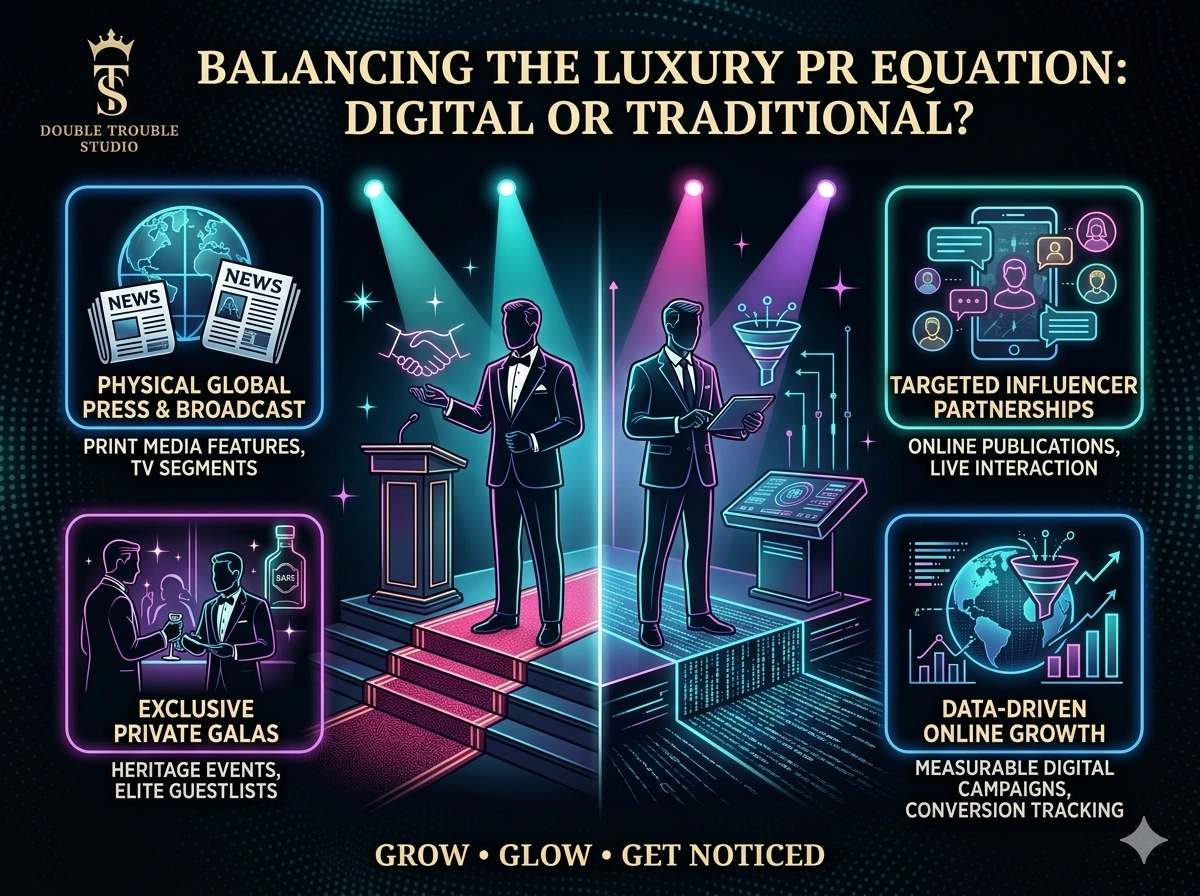
Traditional PR has historically been associated with print media, television features, editorial placements, and curated events. It operates within controlled environments where narratives are carefully constructed and distributed through established channels. Digital PR, on the other hand, encompasses online publications, social platforms, influencer collaborations, and real-time content distribution. It operates within a dynamic ecosystem where information spreads rapidly and audiences engage interactively.
For luxury brands, the question is not simply which approach works better. It is how each approach contributes to positioning, perception, and long-term brand value. Both digital and traditional PR offer distinct advantages, but they also present unique challenges. Understanding how these systems function and how they can be integrated is essential for building an effective communication strategy, often supported by PR and digital marketing services.
Because in luxury branding, PR is not about choosing channels.
It is about shaping perception across them.
The Foundations of Traditional PR in Luxury Branding
Traditional PR has long been the cornerstone of luxury brand communication. Its strength lies in its association with credibility, authority, and exclusivity. High-end publications, print magazines, and curated media platforms have historically served as gatekeepers of culture and taste. Being featured in these environments signals that a brand meets a certain standard of quality and relevance.
One of the defining characteristics of traditional PR is its curated nature. Content is selected, edited, and presented within a controlled framework. This ensures consistency and alignment with the publication’s identity. For luxury brands, this level of control is valuable because it reinforces positioning, similar to strategies in luxury brand positioning.
Traditional PR also benefits from perceived authority. Established publications carry a sense of trust that is built over time. When a luxury brand is featured in such platforms, it inherits a portion of that credibility. This is particularly important in premium markets where reputation plays a central role in decision-making.
Another advantage is the longevity of traditional media. Print features, for example, have a lasting presence. They can be revisited, referenced, and preserved, contributing to long-term brand value.
However, traditional PR also has limitations. The process of securing coverage can be slow, and the ability to adapt to changing narratives is limited. Once content is published, it cannot be easily modified.
Traditional PR is therefore defined by stability and authority.
But it operates within a structured framework.
The Rise of Digital PR and Its Influence
Digital PR has emerged as a powerful force in modern communication, driven by the growth of online platforms and the changing behavior of audiences. It offers speed, scalability, and the ability to engage with audiences directly.
One of the most significant advantages of digital PR is its immediacy. Content can be created, distributed, and updated in real time. This allows brands to respond quickly to trends, events, and opportunities, similar to approaches in integrated PR and digital strategies.
Digital PR also enables broader reach. Online publications, social platforms, and digital communities allow brands to connect with global audiences. This expands visibility and creates opportunities for engagement.
Another key aspect is interactivity. Unlike traditional PR, which is largely one-directional, digital PR allows for two-way communication.
Data and analytics further enhance digital PR. Brands can track performance, understand audience behavior, and refine their strategies based on insights, as explained in measuring PR performance.
However, digital PR also presents challenges. The speed of content distribution can lead to overexposure, which may reduce exclusivity.
Digital PR is therefore defined by flexibility and reach.
But it requires careful management to maintain positioning.
Perception and Credibility: Controlled Authority vs Dynamic Visibility
For luxury brands, perception and credibility are the most important factors in evaluating PR strategies. Traditional PR and digital PR influence these elements in different ways.
Traditional PR provides controlled authority. The curated nature of print and established media ensures that content aligns with specific standards. This creates a sense of exclusivity and trust.
Digital PR, on the other hand, provides dynamic visibility. It allows brands to create and distribute their own narratives, reaching audiences directly, similar to strategies discussed in content strategy development.
The challenge lies in balancing these two approaches. Relying solely on traditional PR may limit reach and adaptability, while relying solely on digital PR may reduce perceived exclusivity.
Luxury brands must therefore consider how each approach contributes to perception.
Together, they create a more comprehensive perception.
Speed, Adaptability, and Control
Speed is one of the defining differences between digital and traditional PR. Digital PR operates in real time, allowing brands to respond quickly to opportunities and challenges.
For luxury brands, speed must be balanced with control. While digital PR enables rapid communication, it also increases the risk of inconsistency.
Adaptability is another important factor. Digital PR allows brands to adjust their strategies based on performance and feedback.
Control, however, remains a strength of traditional PR. The structured nature of print and curated media ensures consistency, often supported by structured strategic roadmap planning.
The interplay between speed and control defines the effectiveness of PR strategies.
Audience Engagement and Interaction
Audience engagement has become a central aspect of modern PR. Digital PR excels in this area by enabling direct interaction with audiences.
Traditional PR, in contrast, offers limited interaction. It is primarily a one-way communication channel. However, this limitation also contributes to its exclusivity.
For luxury brands, engagement must be managed carefully. While interaction can enhance connection, excessive engagement can reduce exclusivity, especially when compared with influencer marketing strategies.
Engagement is not about volume.
It is about quality.
Integration: The Hybrid PR Model
The most effective approach for luxury brands is not choosing between digital and traditional PR, but integrating both into a cohesive strategy.
Traditional PR can be used to establish authority and credibility. Digital PR can amplify these achievements and extend their reach.
Integration also allows for consistency. The narrative presented in traditional media can be reinforced through digital channels, ensuring alignment, as seen in integrated PR and events strategy.
This approach requires coordination and planning.
A hybrid model creates balance.
It combines stability with flexibility.
Challenges in Modern PR Strategies
Luxury brands face several challenges in managing PR strategies. One of the most significant is maintaining consistency across channels.
Another challenge is managing visibility. Excessive exposure can reduce exclusivity, while insufficient visibility can limit reach.
There is also the challenge of differentiation, as explained in competitive strategy for luxury brands.
Addressing these challenges requires strategic clarity and disciplined execution.
Frequently Asked Questions (FAQs)
What is the difference between digital PR and traditional PR?
Ans: Digital PR focuses on online platforms and real-time engagement, while traditional PR focuses on print and curated media.
Which is better for luxury brands?
Ans: Both are effective when integrated strategically to balance authority and visibility.
Why is traditional PR important?
Ans: It provides credibility, authority, and exclusivity.
What are the benefits of digital PR?
Ans: Speed, reach, and interactive engagement.
Can luxury brands rely only on digital PR?
Ans: No, a balanced approach is essential for maintaining perception and credibility.
Conclusion: Strategy Over Channels
The debate between digital PR and traditional PR is not about which is better.
It is about how they are used.
Luxury brands must approach PR as a strategic system that integrates multiple channels to create a cohesive narrative. Traditional PR provides authority and credibility, while digital PR offers reach and adaptability.
Together, they create a balanced approach that supports positioning and long-term growth.
Because in premium markets, success is not defined by the channels used.
It is defined by the perception created.
Build Your PR Strategy
If you are developing your brand’s communication strategy, integrating digital and traditional PR is essential.
From positioning and media outreach to digital amplification and performance analysis, our team helps you create strategies that align with your brand’s identity and deliver meaningful results.
📩 hello@dtsworld.in 📞 +91 80000 06021 📍 Andheri East, Mumbai
👉 Build Your PR Strategy