How to Source and Approach Celebrities: Talent Agencies vs Direct Contact in 2026
Sourcing and approaching a celebrity for a brand campaign, live event, wedding, corporate appearance, digital collaboration or public relations initiative requires more than locating a social media profile and sending a message.
Celebrities usually operate through a network of professional representatives. Depending on the opportunity, communication may be handled by a talent agent, personal manager, publicist, business manager, digital manager, legal representative or specialised celebrity-management company.
The correct contact depends on what the brand is proposing.
A talent agent may be responsible for securing and negotiating paid professional engagements. A manager may evaluate whether the opportunity fits the celebrity’s long-term image and career direction. A publicist may review press interviews, media appearances or reputation-sensitive requests. A digital representative may manage social collaborations, while a specialised event or celebrity-management agency may coordinate appearances, performances and on-ground logistics.
Direct contact can sometimes work, particularly when the celebrity has made a business email publicly available or when the approach comes through a credible personal referral. However, direct outreach should not be confused with casual messaging.
A celebrity collaboration is a commercial and reputational transaction. The proposal must explain who is making the request, what is being offered, how the celebrity will be involved, where the content or appearance will be used and why the association makes sense.
The brand must also verify that it is communicating with an authorised representative. Fake managers, impersonated accounts and unauthorised intermediaries can create serious financial and reputational risks.
In 2026, the growing use of artificial intelligence, manipulated media and convincing online impersonation makes verification more important than ever.
The most effective sourcing process combines research, strategic fit, professional communication, commercial clarity and careful contracting. The objective is not merely to obtain access to a famous person. It is to build a collaboration that makes sense for the celebrity, the brand and the intended audience.
What Celebrity Sourcing Really Means
Celebrity sourcing is the process of identifying suitable talent, locating authorised representation, evaluating availability and suitability, and beginning a professional commercial discussion.
It should not begin with a random list of famous names.
A brand should first define the purpose of the association. A celebrity may be required for a one-day event appearance, an advertising campaign, a long-term ambassadorship, a social media collaboration, a performance, a product launch, a wedding appearance or a media initiative.
Each format requires a different type of talent and commercial arrangement.
A person who is highly effective at generating digital engagement may not be the right choice for a premium corporate event. A respected actor may strengthen brand credibility but may not provide the strongest immediate social reach. A musician may be suitable for a live performance but not for a detailed product endorsement.
Sourcing should therefore begin with the brand’s objective, audience and desired outcome.
The celebrity’s reputation, audience profile, previous associations, professional category, communication style and market relevance should be evaluated together.
The most famous available celebrity is not automatically the most suitable celebrity.
A strategically aligned personality can produce stronger recall and credibility than a larger name with little connection to the brand.
Define the Objective Before Contacting Anyone
The first step is to define exactly what the brand wants the celebrity to do.
A vague request for a “collaboration” creates unnecessary confusion. Representatives need to understand the scope before they can assess interest, availability and commercial terms.
The request may involve an appearance at an event, a stage performance, a brand film, a photoshoot, a social media post, a long-term endorsement, an interview, a store visit or participation in a public initiative.
The brand should also define where the activity will take place and how the resulting material will be used.
A celebrity appearing at a private event is different from a celebrity appearing in a national advertising campaign. A photograph posted once on the brand’s social account is different from content used across paid media, outdoor advertising, packaging and ecommerce pages.
These differences directly affect approvals, fees, usage rights and scheduling.
Before sourcing talent, the team should prepare a clear internal brief explaining the objective, deliverables, date, location, duration, media usage, target audience and approximate budget.
This prevents the brand from contacting representatives before it is ready to conduct a serious conversation.
Identify the Right Celebrity Profile
Celebrity selection should be based on strategic fit.
The brand should consider whether the personality naturally represents the values, lifestyle and audience associated with the campaign.
A luxury hospitality company may benefit from a celebrity known for travel, culture or refined lifestyle. A youth-focused technology product may require a younger entertainer, creator or athlete with strong digital relevance.
A social-impact initiative may require a public figure whose past work and personal reputation support the cause.
The celebrity’s audience should also be examined carefully.
A large follower count does not guarantee that the audience is relevant, active or commercially valuable. Geography, age, language, interests and platform behaviour matter.
A regional celebrity may create greater impact for a location-specific campaign than a national celebrity with a broader but less concentrated audience.
The brand should also examine previous endorsements and commercial associations. Existing contracts may prevent the celebrity from supporting competing products.
Reputation should be reviewed across reliable news coverage, recent public activity and previous partnerships.
The objective is not to search for a person with no controversy or criticism. Public figures naturally receive varied attention. The brand should evaluate whether any known issue creates a material risk or conflict with the proposed association.
Create a Structured Talent Shortlist
A strong shortlist should contain more than names and follower counts.
Each potential celebrity can be evaluated according to relevance, audience, credibility, availability, expected commercial range and risk.
The brand may create several tiers.
The first tier includes ideal names with strong strategic alignment. The second tier includes credible alternatives with similar audience value. The third tier includes emerging or specialised talent who may provide greater flexibility or stronger digital engagement.
This tiered approach is useful because celebrity availability can change quickly.
A brand should not build an entire campaign around one name before availability and commercial terms have been confirmed.
The shortlist should also identify the likely route of contact for each person. One celebrity may be represented by a major agency, while another works through a personal manager or family-managed office.
A structured shortlist makes the sourcing process more efficient and gives decision-makers realistic alternatives.
Understand the Different Celebrity Representatives
The term “celebrity manager” is often used loosely, but professional representatives perform different functions.
A talent agent generally focuses on professional opportunities, engagements and contract negotiation. Depending on the market and type of talent, the agent may represent acting, appearances, endorsements, live work or other commercial assignments.
A personal manager generally focuses more broadly on the celebrity’s career direction, positioning and long-term decisions. The manager may evaluate whether a brand or project fits the celebrity’s image.
A publicist manages media relations, publicity and reputation-sensitive communication. A request for an interview, press appearance or editorial feature may need to go through the publicist rather than the booking agent.
A business manager may handle financial administration but may not be the person who approves new commercial work.
A legal representative reviews contractual rights, liabilities, usage and commercial protections.
A digital or social manager may coordinate creator-style content, but a larger endorsement may still require approval from the main management and legal teams.
Specialised celebrity-management agencies can represent the brand or event organiser during the complete sourcing and booking process. They may identify suitable talent, communicate with authorised representatives, negotiate terms and coordinate logistics.
Understanding these roles prevents the brand from sending the right proposal to the wrong person.
Talent Agencies as a Sourcing Route
Talent agencies provide one of the most formal and reliable routes for approaching established celebrities.
An agency may represent several actors, musicians, athletes, creators or public personalities. Its team generally has an organised process for receiving briefs, checking availability and communicating commercial expectations.
Approaching an authorised agency can reduce uncertainty because the agency is expected to understand the celebrity’s professional commitments, category restrictions and standard contracting process.
Agencies can also help clarify whether the requested activity falls within the celebrity’s current work strategy.
A brand should still verify the agency relationship. Representation can change, and online directories or old articles may contain outdated information.
The celebrity’s official website, verified professional profile, current agency directory or established industry source may help confirm the representative.
The brand should contact the agency through an official business address rather than relying only on a phone number forwarded through an unknown individual.
A talent agency is particularly valuable when the campaign involves extensive usage rights, long-term association, paid advertising or multiple deliverables.
Advantages of Working Through a Talent Agency
The main advantage of an agency is structured access.
A professional agency can usually identify whether the celebrity is available and interested without requiring the brand to reach the celebrity personally.
It can also provide a clearer negotiation process.
The agency is likely to ask for the campaign brief, deliverables, proposed dates, media usage, geography, duration and budget. These questions allow it to evaluate the commercial value and operational requirements.
Agencies may also understand category exclusivity. A celebrity already associated with one automobile brand may not be available for another company in the same category.
Formal representation can make contracting more efficient because the authorised signing entity, invoicing structure and approval process are easier to identify.
For major campaigns, this structure reduces the risk of misunderstanding.
The agency also serves as a professional boundary. The celebrity does not need to review informal or incomplete requests personally.
Limitations of the Talent Agency Route
Working through an agency can be more formal and sometimes slower than direct contact.
The agency may receive a high number of enquiries and prioritise briefs that are complete, commercially realistic and clearly aligned.
A vague message may receive no response.
There may also be several layers of approval. The agent may review the opportunity before presenting it to the celebrity or manager. The legal and brand teams may then examine rights and conflicts.
The agency may require a defined budget before entering serious discussion.
Some brands avoid providing a budget because they fear weakening their negotiation position. However, refusing to indicate any realistic commercial range can make the request appear speculative.
The brand can provide an approximate range or ask whether the representative can indicate expected terms based on the brief.
Another limitation is that the agency may focus primarily on the talent’s professional and commercial interests rather than designing the complete brand strategy.
The brand remains responsible for creating a meaningful concept and ensuring that the celebrity association is used effectively.
Approaching a Personal Manager
A personal manager can be an important contact when the opportunity involves image, long-term alignment or a more personalised relationship.
Managers often understand the celebrity’s broader career objectives and may evaluate whether the association fits their current direction.
A manager may be particularly relevant for ambassadorships, cause-related campaigns, strategic collaborations or opportunities that require the celebrity to become deeply involved.
The manager may also coordinate with the agent, publicist, legal adviser and other representatives.
The brand should not assume that a manager alone can finalise every agreement. The celebrity may still have separate agents for different types of work or territories.
The approach should therefore ask whether the manager is the appropriate person for the opportunity and whether any additional representative needs to be involved.
This is more professional than demanding a direct response or assuming authority.
Approaching a Publicist
Publicists are generally appropriate for editorial, media and reputation-related opportunities.
A request for a press interview, profile, media appearance, quote or event coverage may be reviewed by the publicist.
A commercial brand endorsement is usually not handled only by the publicist, although the publicist may still need to approve how the association affects public image.
The proposal should clearly distinguish between editorial and advertising activity.
A publication asking a celebrity for an interview is different from a brand asking the celebrity to appear in sponsored content.
Attempting to present commercial advertising as editorial coverage can damage trust and create compliance concerns.
When a campaign includes both endorsement and media activity, several representatives may need to coordinate.
The talent agent or manager may negotiate the commercial engagement, while the publicist approves messaging and press activity.
Working With a Celebrity-Management Company
A celebrity-management company can work on behalf of the brand, event organiser or client.
This is different from the celebrity’s own talent agent.
The management company may source talent across multiple agencies and personal networks. It can translate the brand brief into a professional enquiry and compare available options.
This route is especially useful when the brand does not already understand the talent market or when several celebrities must be evaluated quickly.
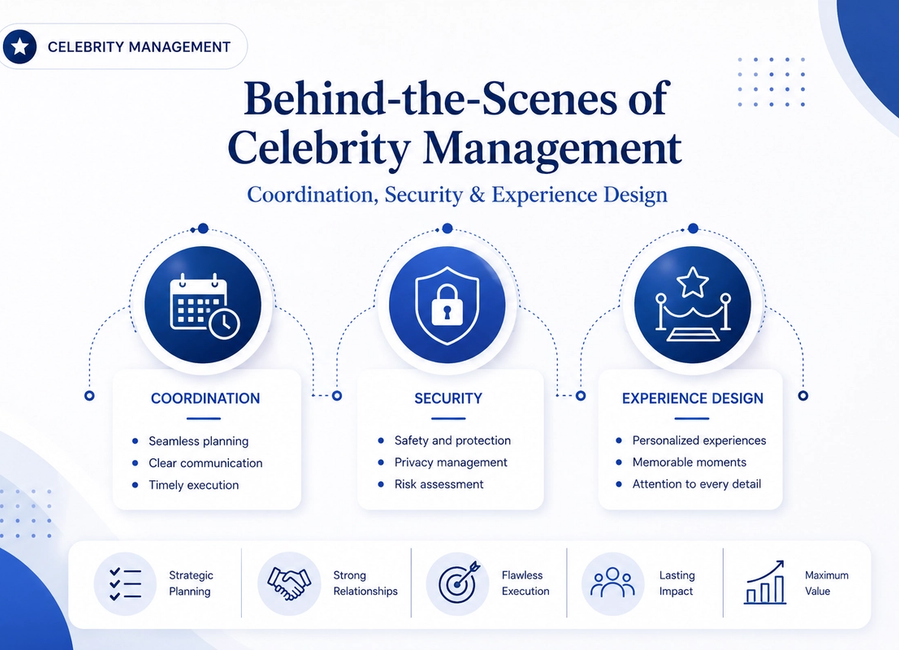
A celebrity-management partner may also coordinate negotiations, contracts, hospitality, travel, security, stage requirements, content approvals and on-ground movement.
For weddings, public events and corporate appearances, logistics can be as important as the booking itself.
The company should disclose its role clearly. The brand should understand whether it represents the talent, represents the client or is acting as an intermediary.
Fees, commissions and payment flows should be transparent.
The brand should also verify the company’s previous work, legal identity and authorised relationship with the final representative.
What Direct Celebrity Contact Means
Direct contact means approaching the celebrity without beginning through a traditional talent agency.
This may happen through a publicly listed business email, verified social media profile, personal referral, known professional connection or direct introduction.
Direct contact does not necessarily mean bypassing representation.
A celebrity may receive the message personally and then forward it to their manager or agent. The final commercial discussion may still take place through professional representatives.
Direct outreach can be effective when the request is highly relevant, personal and well introduced.
It can also work with emerging celebrities, creators, regional personalities and professionals who manage some opportunities independently.
However, direct contact should remain respectful and concise.
The objective is to create a professional introduction, not to force an immediate decision through a private communication channel.
Advantages of Direct Contact
Direct contact can create a more personal beginning.
When the celebrity already knows the founder, client, organiser or mutual connection, the opportunity may receive attention more quickly.
A strong personal referral can also provide credibility.
The celebrity may understand the concept before formal representatives become involved, reducing the risk that a distinctive idea is lost within a generic inbox.
Direct contact may be especially useful for purpose-led initiatives, creative collaborations or highly personalised events where the emotional connection matters.
It can also help smaller brands reach emerging personalities who have not yet developed a complex management structure.
However, the initial access should not be mistaken for final commercial approval.
Even when the celebrity responds positively, the team should still confirm terms through an authorised professional process.
Risks of Direct Contact
Direct outreach can appear unprofessional when the message is incomplete, overly familiar or sent repeatedly.
A celebrity’s personal social media account is not automatically an invitation for commercial proposals.
Sending long scripts, confidential plans or payment details through direct messages can also create security and privacy risks.
The celebrity may not monitor the account personally. An assistant, social team or impersonator may be handling communication.
A positive message from an unverified account should therefore not be treated as proof of authorisation.
Direct contact can also create confusion about negotiation.
A celebrity may express general interest without agreeing to fees, rights or dates. The brand should not announce the association until a formal agreement has been signed.
The brand must also avoid placing the celebrity in an uncomfortable position by attempting to bypass their representative after being directed to the official team.
Professional boundaries protect both parties.
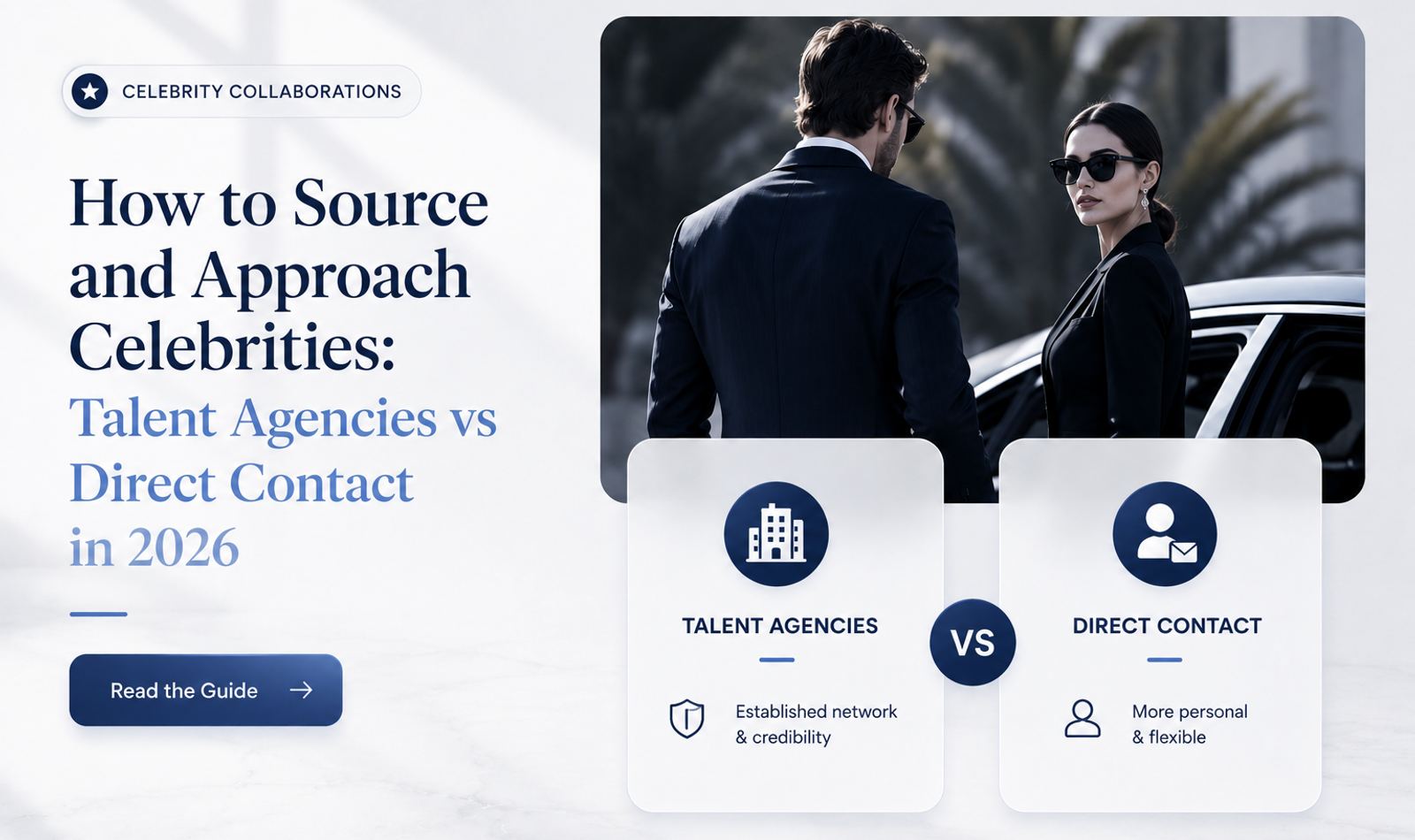
Talent Agencies vs Direct Contact
The right route depends on the scale, sensitivity and nature of the opportunity.
A formal national advertising campaign usually benefits from authorised agency representation. The campaign may involve extensive usage rights, category exclusivity, production obligations and legal review.
A personal invitation to a private event may begin through a known direct relationship, but the commercial and logistical details should still be formalised.
A long-term ambassadorship may require both the talent agent and manager because it affects income, reputation and career positioning.
A press request may begin with the publicist.
A social collaboration with an emerging creator-celebrity may be handled through a public business email or digital manager.
Direct contact is strongest when a real relationship or clearly published professional channel exists.
Agency contact is strongest when the brand requires verified authority, structured negotiation and complex rights management.
The two approaches are not always competitors. Direct contact may open the conversation, while the agency completes the agreement.
How to Find Authorised Contact Information
Contact research should rely on professional and verifiable sources.
The celebrity’s official website may list management, booking or press contacts. A verified social account may include a business email.
Current agency websites and professional representative directories can help identify authorised agents.
Recent credible press materials may also identify the publicist or representative involved in a project.
The brand should compare more than one source when possible.
Representation changes are common. A contact listed in an old interview or event brochure may no longer be valid.
Generic online databases can provide leads, but the information should be verified independently before confidential or financial information is shared.
Search results may also contain websites designed to appear like official booking services.
A professional-looking page does not prove that the company is authorised.
The safest approach is to confirm the relationship through the celebrity’s verified channel or the representative’s official organisation.
Verify the Representative Before Sharing Money
Verification should happen before deposits, contracts or confidential campaign information are exchanged.
The brand should confirm the representative’s full name, company, official email domain, office contact and relationship to the celebrity.
Communication from a free email address is not automatically fraudulent, particularly for independent managers, but it requires additional checking.
The brand can ask for formal company details, invoicing information and the authorised contracting entity.
It may also confirm the representative through the celebrity’s verified profile or another known professional contact.
Bank-account details should match the contracting party or approved payment instruction.
Any sudden request to change payment details should be verified through a separate communication channel.
The brand should be cautious when an intermediary demands an immediate payment while refusing to provide documentation.
Genuine urgency can occur because celebrity schedules change quickly, but urgency should not replace verification.
Prepare a Professional Celebrity Brief
A professional brief makes it easier for the representative to evaluate the opportunity.
It should identify the brand or client, the objective, proposed celebrity role, date, location, required duration and expected deliverables.
For an endorsement campaign, the brief should explain the product or service, content format, production requirements and intended media usage.
For an event, it should explain whether the celebrity is required to attend, perform, speak, present an award, interact with guests or create content.
The brief should identify whether travel, accommodation, security, styling and hospitality will be provided.
It should also explain the target audience and why the celebrity is being considered.
A representative is more likely to engage seriously when the brand demonstrates strategic reasoning.
The brief should remain concise enough to review quickly. Detailed scripts, storyboards and legal documents can follow after initial interest is established.
Write a Strong First Outreach Message
The first message should be professional, specific and easy to understand.
The subject line should identify the brand, opportunity and approximate timing.
The opening should introduce the sender and organisation briefly.
The message should explain why the celebrity has been selected and what the opportunity involves.
It should include the proposed date or campaign period, location, major deliverables and whether the engagement is paid.
The sender can then ask whether the celebrity is available and whether the recipient is the appropriate representative.
The message should not begin by requesting the celebrity’s personal number.
It should also avoid emotional pressure, exaggerated praise or long descriptions of the brand’s complete history.
The objective is to begin a business conversation.
A useful first message may read:
“Hello, I am contacting you on behalf of [Brand/Organisation]. We are planning a premium campaign for [brief objective] during [period] and would like to explore [Celebrity Name] for [specific role]. The proposed scope includes [key deliverables], with usage across [main channels] for [duration]. Please let us know whether you are the appropriate representative and whether the opportunity can be considered.”
This format provides enough information for an initial response without overwhelming the recipient.
Explain Why the Celebrity Fits
Representatives receive many proposals, and a generic request may appear as though the brand is contacting several names without strategy.
The outreach should explain why the association makes sense.
The reason may involve audience alignment, personal style, professional credibility, regional relevance or an authentic connection to the campaign theme.
The brand should avoid excessive flattery.
Specific strategic relevance is more persuasive than saying the celebrity is the company’s favourite or the biggest star in the industry.
For example, a wellness brand may reference the celebrity’s recognised association with fitness and disciplined living.
A hospitality campaign may value the celebrity’s travel-oriented public image and premium audience.
This reasoning also helps the representative assess reputational fit.
Discuss Budget Professionally
Celebrity fees vary according to the person, type of engagement, usage, exclusivity, time commitment, production demands and market conditions.
A one-hour event appearance cannot be priced in the same way as a twelve-month national endorsement.
The brand should prepare a realistic budget before making contact.
When asked for a budget, it can provide a range or explain that the final commercial proposal depends on the confirmed scope.
The brand should avoid expecting the representative to provide a final fee before the deliverables are clear.
It should also avoid presenting exposure as the main compensation for an established celebrity.
Value exchanges, charitable participation and relationship-based support may occur, but they should never be assumed.
Commercial discussions should include professional fees, taxes, agency commission where applicable, travel, accommodation, security, styling and production-related expenses.
The total cost of the engagement is often greater than the headline appearance or endorsement fee.
Understand Usage Rights
Usage rights determine where, how and for how long the brand can use the celebrity’s name, image, voice, performance and content.
These rights are central to endorsement negotiations.
A social post on the celebrity’s account does not automatically give the brand permission to use the content in paid advertisements, outdoor media, packaging or television.
The agreement should identify the platforms, territory, duration and formats.
It should also explain whether the brand can edit, resize, translate or adapt the content.
Paid-media usage is often treated differently from organic use.
A campaign limited to India may have different terms from a global campaign.
A one-month digital campaign is different from a permanent website asset.
The brand should request only the rights it genuinely needs. Extremely broad or permanent rights can increase fees and create unnecessary negotiation.
Define Category Exclusivity
Category exclusivity prevents the celebrity from endorsing competing brands during an agreed period.
The category should be defined carefully.
A broad restriction covering every type of food, fashion or technology product may be commercially unreasonable.
The agreement can identify the specific product category, territory and duration.
Existing endorsements must also be reviewed.
The representative should disclose relevant conflicts, while the brand should conduct its own public research.
Exclusivity affects the commercial value of the agreement because it limits other opportunities available to the celebrity.
The brand should therefore treat it as a paid contractual right rather than a casual expectation.
Establish Content and Approval Processes
The agreement should define how scripts, concepts, wardrobe, captions, edits and final assets will be approved.
Celebrities and their representatives generally need to protect image, reputation and accuracy.
The brand also needs enough certainty to produce the campaign efficiently.
Approval deadlines should be realistic and documented.
The agreement can define how many review rounds are included and who has final authority over different elements.
A celebrity should not be presented as making a claim they did not approve.
The final content should also comply with advertising and endorsement requirements.
Clear approval processes reduce last-minute disputes and production delays.
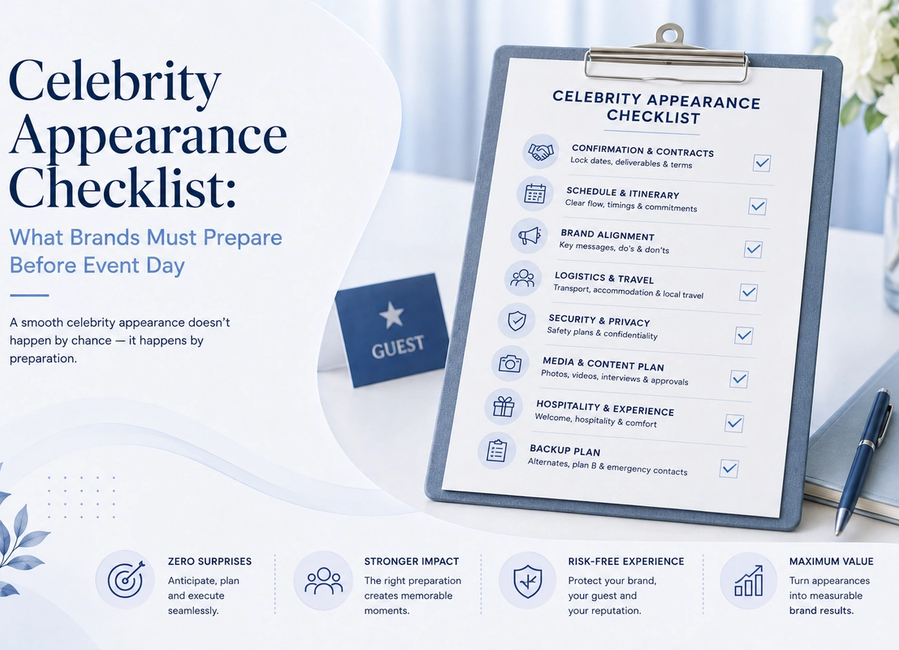
Plan Event Appearance Requirements
Celebrity appearances require operational planning beyond the commercial booking.
The team should confirm arrival time, appearance duration, stage role, speaking requirements, performance needs and departure expectations.
Travel and accommodation should match the agreed standard.
The celebrity may require local transport, security, a green room, hospitality, styling support and a private movement route.
The organiser should control access and avoid unapproved guest interaction.
Photography, media interviews and meet-and-greet activity should be agreed in advance.
A one-hour appearance does not necessarily mean the celebrity is available for unlimited photographs or interviews.
The event team should also prepare for delays, crowd management and schedule changes.
A premium celebrity experience depends on precise coordination.
Plan Performance Bookings Separately
A celebrity performance involves different requirements from an appearance.
The artist may require musicians, dancers, technical crew, sound checks, rehearsal time and specialised production.
A technical and hospitality rider may define stage size, sound system, lighting, instruments, travel, rooms, food and backstage requirements.
The organiser should review the rider before confirming that the venue can support it.
Performance duration, number of sets and song restrictions should be documented.
Recording and livestream rights require separate approval.
The organiser should not assume that payment for a live performance includes the right to publish the complete performance online.
Technical coordination should begin early because production failures can affect both the audience experience and the artist’s reputation.
Conduct Brand-Safety and Reputation Review
Before confirming a celebrity, the brand should conduct a proportionate reputation review.
This can include recent news coverage, public controversies, previous endorsements, audience sentiment and known category conflicts.
The review should focus on reliable information rather than unverified rumours.
The brand should also evaluate whether the celebrity’s public image is compatible with the intended audience and campaign message.
Reputation review is not only about finding negative information.
It can identify opportunities for stronger alignment, such as a genuine interest, professional achievement or regional connection relevant to the campaign.
The agreement may include carefully drafted conduct and reputation provisions.
These clauses should be reviewed by qualified legal advisers because they affect both parties significantly.
Address Advertising Disclosures
Paid endorsements and material brand relationships should be disclosed clearly according to the applicable rules and platform requirements.
The exact obligation depends on the territory, content format and nature of the relationship.
The brand should not assume that audiences automatically understand a celebrity has been paid.
Disclosure should be included in the campaign planning and approval process.
It should be visible and understandable rather than hidden among unrelated hashtags or placed where viewers are unlikely to notice it.
The brand and celebrity team should agree on the appropriate wording before publication.
Responsibility should also be addressed in the contract.
Compliance is not only the celebrity’s concern. Advertisers and agencies may also have monitoring and approval responsibilities.
Protect Against Fake Endorsements and AI Misuse
In 2026, celebrity identity can be imitated through manipulated images, cloned voices and synthetic video.
Brands should never create or publish content that makes a celebrity appear to endorse a product without clear authorisation.
The agreement should define whether artificial intelligence can be used to alter, translate, recreate or generate the celebrity’s image or voice.
It should also define whether digital replicas, synthetic dubbing or automated variations are permitted.
These rights should not be assumed from general filming permission.
The celebrity team may require approval for every AI-assisted use.
Brands should also monitor for unauthorised third parties using campaign assets to create misleading content.
A genuine endorsement can be damaged when fake advertisements circulate using the same celebrity.
The campaign should maintain verified official sources and clear documentation.
Use Written Contracts
No celebrity engagement should depend only on informal messages or verbal understanding.
The written agreement should identify the parties, scope, deliverables, dates, fees, taxes, payment schedule, cancellation terms, usage rights, exclusivity and approvals.
It should also address confidentiality, intellectual property, travel, security, force majeure, postponement and breach.
The authorised representative and contracting entity should be clear.
The agreement should define what happens if the celebrity becomes unavailable because of illness, production commitments or circumstances beyond their control.
The brand should understand whether payments are refundable, adjustable or transferable to another date.
Complex agreements should be reviewed by legal professionals familiar with entertainment, advertising and intellectual-property matters.
A clear contract protects the relationship by reducing ambiguity.
Follow Up Without Becoming Aggressive
Representatives may not reply immediately because they are checking schedules, discussing the proposal or handling other commitments.
A professional follow-up can be sent after a reasonable period.
The follow-up should remain concise and refer to the original brief.
Repeated daily messages, calls from several team members and contact through personal family accounts can damage the opportunity.
When timing is genuinely urgent, the first message should explain the decision deadline clearly.
The brand should also know when to stop.
No response may indicate lack of availability, lack of interest or insufficient information.
The team can move to the next shortlisted option rather than allowing one name to delay the complete campaign.
Common Celebrity Outreach Mistakes
One common mistake is approaching the celebrity before preparing a clear brief.
Another is sending a generic message that does not explain deliverables, dates or commercial intent.
Brands may also contact the wrong representative, such as sending a paid endorsement proposal only to a publicist.
Some businesses treat a social media reply as a confirmed booking.
Others share money or confidential information with unverified intermediaries.
Unrealistic budgets and requests for extensive unpaid work can prevent serious consideration.
Another common mistake is ignoring usage rights. The brand receives one approved post and later assumes it can use the celebrity’s image across every advertising channel.
Poor event planning can also damage the relationship. Inadequate security, unapproved photographs and changing schedules create avoidable problems.
Celebrity sourcing requires professional preparation from the first enquiry through final execution.
When an Agency Is the Better Choice
An agency route is generally stronger when the engagement involves a major advertising campaign, extensive media usage, category exclusivity, high fees or complex production.
It is also useful when the brand has no existing relationship with the celebrity and requires verified access.
Brands managing several options or short timelines may benefit from a specialised celebrity-management partner that can coordinate across representatives.
An agency can bring structure, but the brand must still provide a strong concept and realistic commercial terms.
The intermediary cannot compensate for an unclear campaign.
When Direct Contact Can Work
Direct contact can work when the celebrity has publicly provided a business channel, when there is a trusted mutual introduction or when the opportunity is highly personal and relevant.
It may also work for emerging talent who manage commercial communication directly.
The initial message should still be professional.
Once interest is confirmed, authorised representatives should be included for negotiation, contracts and payment.
Direct access should be treated as a relationship advantage rather than a reason to avoid proper process.
A Practical Celebrity-Sourcing Process
The process begins with a clear campaign or event objective.
The brand defines the role, audience, date, location, usage and budget.
A shortlist is then created according to strategic fit, not fame alone.
Current representation is researched and verified.
A concise brief and professional outreach message are prepared.
The authorised representative checks interest, availability, conflicts and commercial expectations.
The parties clarify deliverables, rights, exclusivity, logistics and approvals.
Due diligence is completed before deposits are transferred.
A written contract is signed, and a structured payment schedule is followed.
Production or event planning then continues through one central communication system.
Content is approved before release, and required advertising disclosures are included.
After completion, payments, usage periods and campaign obligations are monitored.
This structured approach protects both the commercial outcome and the relationship.
Conclusion
Sourcing and approaching celebrities in 2026 requires strategy, verification and professional communication.
The process should begin with the brand objective rather than the celebrity name.
A suitable celebrity is one whose audience, reputation and public identity support the campaign’s purpose.
Talent agencies provide structured access, authorised negotiation and clearer management of contracts and commercial rights.
Managers help evaluate career and reputation fit, while publicists coordinate media and public-image considerations.
Specialised celebrity-management companies can help brands identify talent, communicate with representatives and coordinate complex event or campaign requirements.
Direct contact can be effective when a genuine business channel, personal relationship or trusted introduction exists.
However, direct contact should not bypass verification, contracting or authorised representation.
The proposal should explain the scope clearly. Dates, deliverables, usage, geography, exclusivity and budget all influence whether the opportunity can be considered.
Brands should verify every intermediary before sharing confidential information or transferring money.
They should also define image, voice, content and artificial-intelligence rights carefully.
A celebrity’s identity must never be extended into new formats or synthetic media without explicit permission.
Endorsements should be disclosed according to the applicable advertising requirements.
The strongest celebrity associations are not created only through access or high fees. They are created through alignment.
The celebrity should make sense for the brand, and the opportunity should make sense for the celebrity.
When sourcing, negotiation, contracting and execution are handled professionally, the collaboration can create credibility, attention and long-term brand value.
When these stages are rushed or treated casually, the same association can create financial loss, legal uncertainty and reputational damage.
A disciplined approach allows brands to move from identifying a suitable celebrity to building an authentic, secure and commercially effective partnership.
At Double Trouble Studio, we help brands source, approach and manage celebrities for campaigns, events, weddings, launches, public relations initiatives and premium appearances with professional coordination, verified communication and complete execution support.
Connect with Double Trouble Studio to source the right celebrity for your next campaign or event.
📩 info@dtsworld.in | 📞 +91 80000 06021 | 📍 Andheri West, Mumbai
Need this for your brand?
Let DTS build your next campaign.
From PR, celebrity management and events to websites, social media, SEO and AI video production — Double Trouble Studio helps brands grow with strategy and execution.
Discuss Your Requirement →