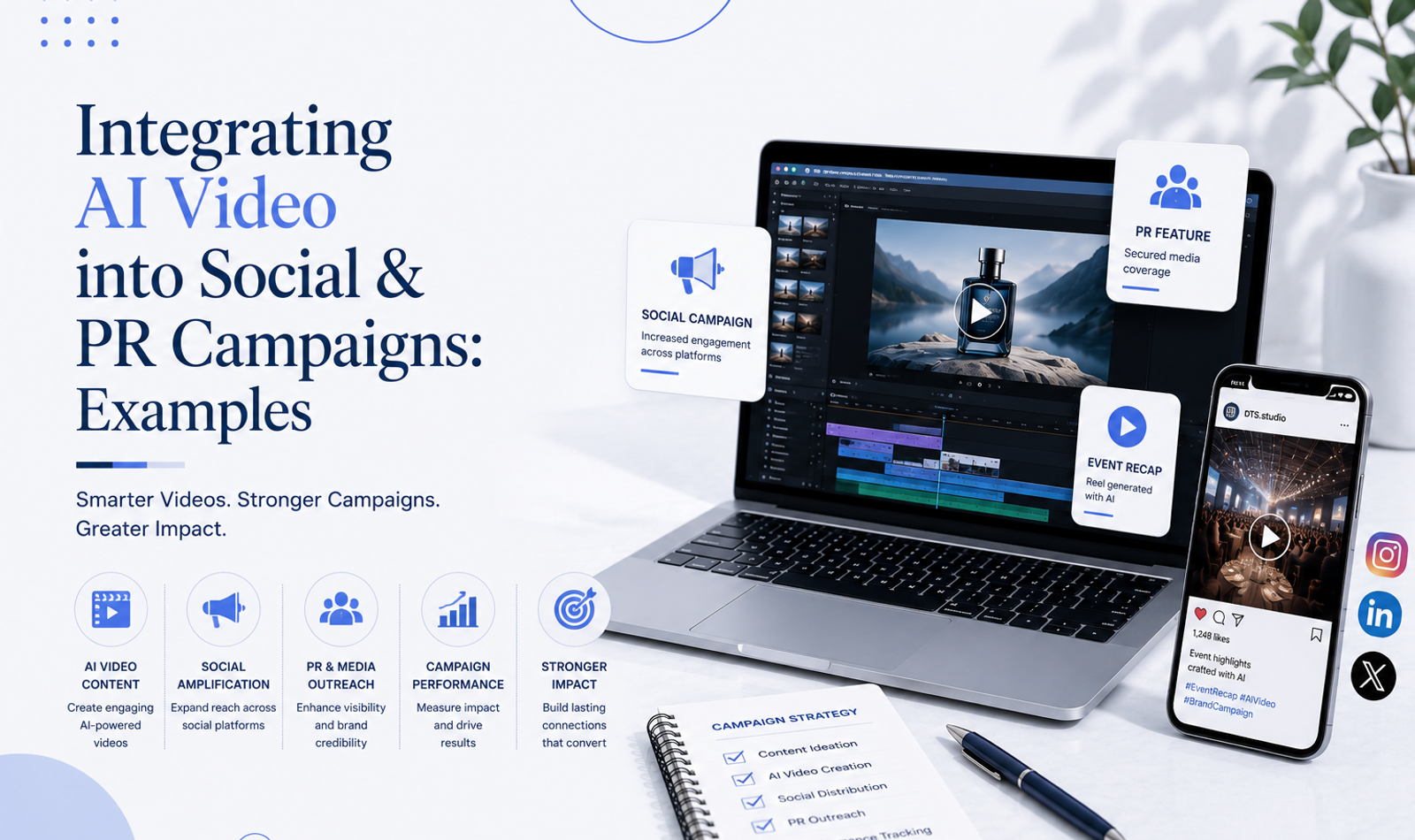
AI video has become one of the most useful tools for brands that want faster, sharper and more memorable social and PR campaigns.
A social media campaign needs regular content, strong hooks, platform-specific formats and fast creative testing.
A PR campaign needs storytelling, media relevance, audience trust, founder visibility, visual assets and clear communication.
AI video can support both.
It can turn a campaign idea into teasers, motion posters, concept films, animated explainers, launch reels, event previews, product visuals, founder cutdowns, influencer-style clips and paid ad variations.
But AI video should not be used randomly.
It works best when it is connected to a campaign story.
A brand should not create an AI video only because the format looks impressive.
The video should help the audience understand something, feel something or take action.
For social media, AI video can create scroll-stopping visuals and faster content variations.
For PR, AI video can make brand stories easier to explain, visualise and distribute.
When used together, social media and PR become more connected.
A press announcement can become a teaser reel.
A founder quote can become a short video.
A media feature can become a social proof asset.
An event recap can become PR evidence.
A product launch can become a full content series instead of one post.
The strongest campaigns use AI video as part of a full communication system.
AI can create visual imagination.
Professional editing creates structure and polish.
PR strategy provides credibility and media relevance.
Social media distribution creates reach, engagement and audience response.
When these elements work together, a campaign becomes more than content.
It becomes a complete brand visibility engine.
What Does It Mean to Integrate AI Video into Social and PR?
Integrating AI video into social and PR means using AI-assisted video content across different stages of a campaign, from planning and pre-launch to media outreach, social engagement, paid amplification and post-campaign reporting.
It does not mean replacing every creative asset with AI-generated visuals.
It means using AI where it improves speed, imagination, clarity or content volume.
For example, AI can help create a pre-launch teaser for social media.
The same campaign can use professionally edited founder commentary for PR outreach.
A media feature can then be converted into short social clips.
An event recap can become proof for both future PR and paid campaigns.
AI video supports this ecosystem by making more visual assets possible.
Instead of producing one hero film and stopping, brands can create several versions for different audiences and platforms.
The campaign becomes more flexible and more measurable.
Why AI Video Works for Social Media
Social media platforms reward attention, clarity and consistency.
Brands need content that can stop viewers quickly and deliver a message before the audience scrolls away.
AI video helps by creating strong visual hooks.
A still image can become motion.
A product can be placed inside a cinematic scene.
A launch concept can become a short teaser.
A campaign line can be turned into an animated visual.
AI also helps brands create more variations.
One idea can become a Reel, Story, carousel animation, paid ad, teaser, countdown and website banner.
This is valuable because social media rarely depends on one post.
Campaigns need repeated touchpoints.
AI makes it easier to produce those touchpoints without starting from zero every time.
Why AI Video Works for PR Campaigns
PR campaigns need stories that feel relevant, credible and easy to understand.
Journalists and audiences respond better when the idea is clear.
AI video can help visualise a brand story before it becomes abstract.
A sustainability initiative can be explained through a short animated film.
A luxury event concept can be previewed through AI-generated mood visuals.
A technology launch can be simplified through an explainer.
A founder’s point of view can be turned into short video clips for LinkedIn and media sharing.
AI video also helps PR teams package stories visually.
A press release alone may feel dry.
A short campaign film, founder video, product animation or behind-the-scenes edit can make the story easier to remember.
This is especially useful for digital PR, where online articles, social amplification and search discovery work together.
AI Video Should Support the Campaign Narrative
The most important rule is that AI video must support the campaign narrative.
The campaign narrative is the central idea the brand wants people to remember.
For a luxury hotel, the narrative may be private escape, refined hospitality or destination culture.
For an event company, it may be seamless execution, emotional experience or premium guest management.
For a digital agency, it may be better branding, stronger visibility and smarter growth.
For a fashion brand, it may be craftsmanship, identity or modern luxury.
Every AI video should connect to this narrative.
If the visuals look beautiful but do not strengthen the message, they may create temporary attention without long-term value.
A strong AI video should make the brand story clearer, not more confusing.
AI Video in Campaign Planning
AI video can be useful before the campaign is even launched.
Brands can use AI to visualise creative directions, test different moods and align teams around one idea.
Instead of presenting only written concepts, the agency can show short visual references.
A luxury product launch can be visualised through cinematic AI scenes.
An event theme can be shown through animated moodboards.
A social campaign can be tested with several opening hooks.
A PR story can be supported with a short visual explainer.
This helps decision-makers understand the campaign faster.
It also reduces confusion later because the creative direction is clear from the beginning.
AI video becomes a planning tool as much as a publishing tool.
AI Video for Pre-Launch Teasers
Pre-launch teasers are one of the easiest ways to use AI video in social and PR campaigns.
A teaser does not need to reveal everything.
It needs to create curiosity.
For a luxury brand, the teaser may show shadows, textures, movement and a few words.
For an event, it may show animated venue concepts, countdown visuals or an abstract mood.
For a digital campaign, it may show a problem and hint at the solution.
AI works well here because pre-launch content often depends on imagination rather than full product footage.
A brand can create anticipation before the final shoot, event or launch assets are ready.
The teaser should still feel connected to the real campaign.
It should not create expectations the final launch cannot fulfil.
Example: Luxury Fashion Launch
A luxury fashion brand preparing a new collection can use AI video to build anticipation before the campaign shoot is released.
The first teaser may show fabric movement, close-up textures, soft lighting and a mysterious line such as “A new silhouette is coming.”
The second teaser may show AI-generated editorial motion inspired by the collection’s colour palette.
The third teaser may combine real behind-the-scenes footage with AI-generated visual transitions.
For PR, the brand can prepare a short designer video explaining the inspiration behind the collection.
The same visuals can support media outreach, Instagram Reels, Stories and website launch banners.
After the collection launch, professional editing can turn campaign footage into short product films, styling reels and paid social cutdowns.
AI supports the atmosphere.
Editing creates the final story.
Example: Luxury Hospitality Campaign
A premium hotel or resort can integrate AI video into a destination-led social and PR campaign.
Before the campaign, AI can help visualise the feeling of the destination through light, landscape, architecture and slow cinematic movement.
A pre-launch teaser may show the emotion of arrival rather than the full property.
For social media, the brand can create reels around privacy, dining, wellness, rooms and destination culture.
For PR, the hotel can create a short visual story around the theme of modern luxury travel.
Founder or general manager commentary can be edited into LinkedIn clips, media assets and website content.
After media coverage appears, the article can be shared through short social proof videos.
For paid ads, the strongest AI-supported and real-footage clips can be tested with different audience segments.
This creates one connected campaign rather than isolated posts.
Example: Event Launch Campaign
An event company launching a luxury gala, wedding showcase or corporate experience can use AI video at several stages.
Before the event, AI can create mood films showing the theme, stage direction, lighting concept and guest experience.
Countdown reels can use animated invitations, AI-generated décor previews and motion graphics.
For PR, the campaign can position the event around culture, hospitality, design, entertainment or business networking.
A short video can explain why the event matters and what guests can expect.
During the event, real footage becomes important.
The team should capture arrivals, décor, performances, speeches, guest reactions and sponsor moments.
After the event, professional editing creates the official recap.
AI can then support social cutdowns, sponsor edits, animated highlights and follow-up PR assets.
The result is a campaign that lives before, during and after the event.
Example: AI Video for a PR Announcement
A PR announcement often begins as a written press note.
AI video can make the announcement more engaging.
For example, a brand announcing a new service can create a short explainer showing the problem, solution and customer benefit.
A founder can record a real message, while AI-generated visuals support key points.
The video can be shared with media as a supporting asset.
It can also be posted on LinkedIn, Instagram and the company website.
The same content can be cut into 15-second, 30-second and 60-second versions.
This makes the PR announcement more useful for digital distribution.
Instead of relying only on text, the brand gives audiences a visual way to understand the development.
Example: Founder Thought Leadership
Founder-led PR is more powerful when the founder has a clear point of view.
AI video can support this by turning founder ideas into short, shareable content.
The founder can record one long conversation about an industry trend.
Professional editing can create several short clips from it.
AI can generate supporting visuals, subtitles, animated titles and concept scenes.
For LinkedIn, the clips can be more direct and professional.
For Instagram, they can be shorter and more visual.
For PR outreach, the founder’s strongest points can support expert commentary pitches.
This creates consistency between social media and media relations.
The founder does not need to repeat the same idea separately for every channel.
One strong perspective becomes a content system.
Example: Product Education Campaign
AI video can help brands explain products more clearly.
A beauty brand can create animated ingredient explainers.
A jewellery brand can show craftsmanship stages through AI-assisted visuals and real product footage.
A technology company can use motion graphics and AI visuals to explain complex features.
A luxury food brand can animate layers, textures and preparation details.
For social media, these videos create education-led engagement.
For PR, they provide journalists with clearer context.
For paid ads, they help customers understand product value quickly.
Professional editing ensures the final video remains accurate, clear and visually polished.
AI should not exaggerate product results.
The explanation should remain truthful and brand-safe.
Example: Regional PR Campaign
Regional campaigns need local relevance.
AI video can help create location-specific visual content quickly.
A brand entering Chandigarh, Mumbai, Delhi, Goa or Jaipur can create short videos that reference local culture, architecture, hospitality or customer behaviour.
For social media, these videos can be adapted to local audiences.
For PR, the campaign can explain why the brand’s entry matters to the region.
A regional launch video can include founder commentary, AI-supported city visuals, real store or event footage and local-language subtitles where appropriate.
The key is authenticity.
AI should support the local story, not create fake cultural references.
Regional audiences notice when content feels generic.
Example: Celebrity or Influencer Campaign
AI video can support celebrity and influencer campaigns, but it must be used carefully.
The brand can create teaser visuals before the celebrity reveal.
It can animate campaign posters, create countdown reels and generate stylised backgrounds.
Influencer content can be edited into multiple platform versions.
AI can help create motion graphics, subtitles and visual transitions.
However, the brand should not use a celebrity’s likeness, face, voice or synthetic appearance without permission.
It should not create fake celebrity participation.
If AI-generated visuals are used around a real personality, the approval process should be clear.
For PR, the story should explain the partnership’s relevance rather than depending only on the celebrity’s fame.
Example: Event Recap as PR Proof
An event recap can become a powerful PR asset when edited strategically.
The recap should not only show glamour.
It should show execution.
For a luxury event agency, the video can highlight guest arrivals, stage design, décor details, performances, hospitality, crowd energy and client satisfaction.
This video can support future media pitches, sponsor decks, social posts and sales presentations.
AI can help create animated titles, section transitions, sponsor versions and vertical cutdowns.
The official recap should remain based on real footage.
AI should not create fake attendance or exaggerated scale.
The strongest event recap proves what the brand can actually deliver.
AI Video for Media Kits
Media kits are usually built with text, images and facts.
AI video can make them more dynamic.
A brand can include a short video introduction, founder message, product animation, campaign preview or event highlight.
For journalists, this can make the story easier to understand.
For digital PR, video assets can support online coverage.
A media kit video should be concise.
It should not feel like a long advertisement.
It should provide useful context, visual proof and access to the story.
A strong media kit may include a written fact sheet, high-resolution images, spokesperson details and one short video asset.
AI can support the video, but accuracy and clarity are essential.
AI Video for Press Events
Press events can use AI video as part of the experience.
A launch screen can show AI-generated campaign visuals.
An animated opener can introduce the theme.
A product reveal can use AI-supported visual transitions.
A short founder film can set the context before live remarks.
For social media, these assets can become reels and stories.
For PR, the same visuals can help journalists understand the brand world.
However, AI visuals should not distract from the real experience.
The product, spokesperson and event purpose should remain central.
AI works best when it enhances the atmosphere.
It should not become the entire event unless the event itself is about AI.
AI Video for Crisis-Safe Communication
AI video can support crisis communication, but brands should be cautious.
Sensitive communication usually requires real human accountability.
A founder, spokesperson or senior leader speaking directly may be more appropriate than an AI avatar.
However, AI can still assist with captions, translation, accessibility, visual explainers and internal training.
For example, after a service issue, a brand may publish a real spokesperson message and use simple graphics to explain corrective action.
AI should not be used to create artificial emotion, fake apologies or synthetic leaders in serious moments.
Crisis communication depends on trust.
The more serious the issue, the more important real human presence becomes.
AI Video for Internal PR Alignment
Before a major campaign goes public, internal teams need alignment.
AI video can help create internal explainers for sales, customer service, event teams and leadership.
These videos can explain the campaign theme, key message, media plan, social content, customer talking points and launch timeline.
This prevents confusion.
A customer-service team should know what campaign is live.
A sales team should know which video or media feature prospects may mention.
An event team should know which moments must be captured for recap content.
AI-assisted internal videos can make this alignment faster and clearer.
Internal communication is often overlooked, but it affects campaign quality.
AI Video for Paid Amplification
Once a campaign has strong organic and PR assets, paid amplification can extend reach.
AI video can support ad variations for different audiences.
A launch film can become several ad cutdowns.
A founder clip can become a thought-leadership ad.
A media feature can become a credibility-focused creative.
An event recap can become a lead-generation asset.
Meta’s Advantage+ creative can generate and enhance ad variations across formats, but brands should preview and review AI-enhanced assets carefully before publishing.
Paid ads should not distort the brand’s message.
AI variations must still be accurate, on-brand and safe.
Performance should never come at the cost of credibility.
AI Video for LinkedIn PR Campaigns
LinkedIn is useful for founder visibility, B2B communication, professional services, corporate events and leadership storytelling.
AI video can support LinkedIn by turning long ideas into short thought-leadership clips.
Professional editing can make these clips clear and polished.
A founder’s post can be supported by a short video explaining the idea.
A PR feature can be repurposed into a professional social proof clip.
LinkedIn Thought Leader Ads allow companies to sponsor eligible thought-leader posts with permission, which can extend executive or expert content beyond the original organic audience. (LinkedIn)
For LinkedIn, the tone should remain credible.
The video should be informative, not overly dramatic.
AI Video for Instagram Campaigns
Instagram is highly visual, making it a strong platform for AI video.
Brands can use AI for reels, teasers, launch countdowns, animated product visuals, motion posters and creator-style content.
Luxury brands should use AI with restraint.
The visuals should feel premium, not gimmicky.
An event company may show a stage transformation.
A fashion brand may show fabric movement.
A digital agency may show a concept becoming a finished campaign.
Instagram videos need strong openings and clean captions.
AI can help create the visual hook, while editing makes the video platform-ready.
The brand should also check whether AI-generated content needs disclosure when it appears realistic.
AI Video for YouTube Campaigns
YouTube is useful for longer explanations, brand films, founder stories, tutorials, event films and campaign case studies.
AI video can support YouTube through animated sections, visual examples, script development, subtitles and editing assistance.
YouTube requires disclosure for realistic altered or synthetic content when viewers could mistake it for real people, places, scenes or events. It does not require disclosure for clearly unrealistic content, special effects or production assistance such as scripts and captions.
Brands should plan YouTube content carefully.
A longer video needs structure, not only visuals.
AI can help with chapters, story flow and cutdowns, but professional editing is still essential for retention.
AI Video for Website Campaign Pages
Campaign landing pages often need video.
A short hero video can make the campaign feel alive.
AI video can create cinematic loops, motion graphics, animated product visuals or abstract brand films.
For PR campaigns, the website page can host the full story, media assets, founder quotes, product information and campaign videos.
For social campaigns, the page can capture traffic from ads and reels.
The website video should be optimised for loading speed and silent viewing.
It should also match the brand’s visual identity.
A heavy or distracting video can reduce user experience.
The goal is to support the campaign, not slow down the page.
AI Video for Email and WhatsApp Campaigns
AI video can also support direct communication.
A short video teaser can be shared through email campaigns, WhatsApp Business, client proposals or event invitations.
For luxury brands, the video should feel polished and minimal.
For event campaigns, animated invites and save-the-date videos can create anticipation.
For PR outreach, a short visual preview can support a journalist pitch if it is relevant and lightweight.
The video should not be too large or difficult to open.
Direct channels require practical formatting.
A beautiful video that does not load easily may reduce impact.
Creating a Campaign Content Ladder
A campaign content ladder helps brands organise AI video assets by purpose.
At the top is the hero video.
This may be a cinematic launch film, campaign manifesto or event teaser.
The next layer includes platform cutdowns for Instagram, LinkedIn, YouTube and ads.
The third layer includes supporting clips such as founder quotes, product close-ups, behind-the-scenes visuals and media proof.
The final layer includes short reminders, Stories, GIF-style assets and post-campaign highlights.
AI video helps create more assets across this ladder.
Professional editing ensures that each version feels consistent and useful.
Connecting AI Video With Earned Media
Earned media becomes stronger when supported by clear visual assets.
A journalist may not publish the AI video directly, but the video can help them understand the campaign story.
For online features, a short brand video may be embedded or linked where editorially appropriate.
For social sharing, the brand can use edited clips from the media story.
For thought leadership, founder videos can support expert positioning.
The key is not to confuse promotional video with editorial coverage.
The video should support the story.
It should not pressure journalists to repeat the brand’s script.
Repurposing PR Coverage Into Social Video
When a brand receives media coverage, AI and editing can help turn it into social content.
A feature headline can become a motion graphic.
A founder quote can become a short video.
A product mention can become a social proof reel.
A media logo can be included carefully where usage is permitted.
The brand should link to the original article and avoid copying large portions of copyrighted text.
The video should respect the publication’s meaning.
It should not imply endorsement beyond what the article actually says.
Responsible amplification extends PR value without misrepresenting it.
Using AI Video for Campaign Storytelling
AI video is most effective when it helps tell a story.
A campaign should have a beginning, middle and end.
The beginning introduces the problem, desire or curiosity.
The middle shows experience, proof or transformation.
The end delivers the brand message and next step.
AI visuals can support each stage.
A social teaser may open the story.
A PR video may explain the idea.
An event recap may prove the experience.
A paid ad may drive action.
Together, these videos create a complete campaign journey.
Editing AI Videos for Brand Consistency
AI-generated visuals may come from different prompts, styles or tools.
Professional editing is needed to make them feel consistent.
The editor can match colour, adjust pacing, add brand typography, include logos, balance sound and create smooth transitions.
Without editing, AI clips may feel disconnected.
A brand campaign should feel like one visual world.
This is especially important for luxury and premium brands.
Consistency builds trust.
If every AI video looks different, the campaign may feel random rather than strategic.
Managing Disclosure and Transparency
AI video integration should include disclosure planning.
Not every use of AI needs public labelling.
Using AI for internal scripting, subtitles or rough ideas may not change audience understanding.
But realistic altered or synthetic content may require disclosure, especially when viewers could mistake it for real people, places, events or statements.
Brands should review platform policies before publishing.
They should also consider audience trust.
If disclosure would change how viewers interpret the content, the brand should strongly consider being transparent.
Responsible disclosure protects credibility.
Copyright and Rights in AI Campaigns
AI video campaigns often use many assets.
These may include prompts, reference images, music, voiceovers, stock footage, fonts, templates, event footage, creator content and brand materials.
Each asset should be cleared for the intended use.
A social post, paid ad, website hero and event screen may require different rights.
AI-generated content should not imitate competitors, artists, celebrities or copyrighted campaigns.
Music should be licensed for the platform and purpose.
Creator and influencer content should have usage rights clearly defined.
A campaign that performs well can create problems later if the rights were not handled properly.
Brand Safety and Product Accuracy
AI video can distort products, people and settings.
This creates brand-safety risk.
A product may appear in the wrong colour.
A logo may become unreadable.
A face may look unnatural.
A venue may appear larger than reality.
A service result may be exaggerated.
Before publishing, the brand should review AI videos carefully.
Product teams should check accuracy.
Marketing teams should check message clarity.
Creative teams should check visual quality.
Legal or compliance teams should review high-risk claims.
Brand safety should be part of the production workflow, not a last-minute reaction.
Measuring AI Video in Social Campaigns
Social campaign measurement should connect with the objective.
For awareness, the brand can track reach, views, watch time and completion.
For engagement, it can track saves, shares, comments, profile visits and direct messages.
For traffic, it can track link clicks and landing-page behaviour.
For leads, it can track form submissions, enquiries, calls and bookings.
For brand perception, it can review comments, sentiment and qualitative feedback.
AI video should not be judged only by visual style.
A beautiful video that reaches the wrong audience may not create business value.
Performance and brand quality should both be reviewed.
Measuring AI Video in PR Campaigns
PR campaign measurement should include both media and digital outcomes.
The brand can track media mentions, publication quality, message pull-through, spokesperson inclusion and article depth.
It can also track branded search, website visits, social engagement, video views and qualified enquiries.
AI video may help increase attention, but the report should not exaggerate its role.
The video is part of a larger campaign.
It supports storytelling, distribution and recall.
Measurement should show how the AI video contributed to awareness, understanding, engagement or action.
Common Mistakes When Integrating AI Video
One common mistake is creating AI videos without a campaign strategy.
Another is using AI effects that do not match brand tone.
Brands may also create too many disconnected assets instead of one connected campaign system.
Some teams use AI to exaggerate product performance or event scale.
Others forget disclosure, rights, music licensing or platform rules.
A common PR mistake is sending AI videos to journalists as if the visuals alone are the story.
The video should support a relevant editorial angle.
It should not replace the need for a real story.
A Practical AI Video Campaign Workflow
The workflow begins with campaign strategy.
The brand defines the objective, audience, message, platforms and desired action.
The team creates the campaign narrative and identifies where AI video can add value.
Scripts and storyboards are developed.
AI visuals are generated for teasers, explainers, concept films or supporting assets.
Real footage is captured where authenticity matters.
Professional editing brings everything together.
Versions are created for Instagram, LinkedIn, YouTube, paid ads, PR outreach, website pages and internal communication.
Disclosure, rights and brand safety are reviewed.
The campaign is published in stages.
Performance is measured and insights are used to improve future videos.
How Double Trouble Studio Integrates AI Video into Campaigns
Double Trouble Studio integrates AI video into social and PR campaigns through strategy, storytelling, creative direction, editing and platform-ready delivery.
For social media, we create AI-assisted reels, teasers, launch visuals, motion graphics, ad cutdowns and content variations.
For PR campaigns, we create founder videos, announcement explainers, event recap assets, media-kit visuals and social proof content.
For luxury brands, we focus on restraint, polish, product accuracy and premium visual language.
For events, we combine AI concept visuals with real recap footage to build visibility before and after the event.
Our approach is not only about making content look futuristic.
It is about making campaigns more memorable, more consistent and more useful for brand growth.
Frequently Asked Questions
Q1. What is ethical AI video in marketing?
Ethical AI video in marketing means using AI-generated or AI-assisted video content in a way that is honest, transparent, rights-safe and respectful of the audience. It allows brands to use AI for creativity, speed and visual storytelling, but not to mislead viewers, fake proof, copy identities or create false expectations.
Q2. Why does authenticity matter in AI video marketing?
Authenticity matters because audiences want to trust what they see. A video can be cinematic, edited and polished while still remaining honest. For brands, especially luxury and premium brands, authenticity protects credibility by ensuring that products, events, testimonials, founder messages and customer experiences are represented truthfully.
Q3. When should brands disclose AI-generated video content?
Brands should consider disclosure when AI materially changes what the viewer believes they are seeing. If the video includes a realistic synthetic person, cloned voice, AI-generated event scene, fictional product result or artificial testimonial-style content, disclosure is usually safer. Labels like “AI-generated visual,” “AI-assisted video” or “concept visual” help maintain trust.
Q4. Is AI video always unethical?
No, AI video is not automatically unethical. AI can be used responsibly for concept visuals, animated posters, campaign teasers, explainer videos, internal communication and social reels. The ethical issue begins when AI is used to misrepresent reality, fake proof, use identities without consent or create misleading claims.
Q5. Can brands use AI avatars in marketing videos?
Yes, brands can use AI avatars for training, onboarding, explainers and multilingual communication. However, avatars should not pretend to be real customers, founders, employees or experts unless clearly approved and disclosed where needed. They work best for neutral information, not emotional testimonials.
Q6. Why is voice cloning risky in marketing?
Voice cloning is risky because it can make it appear that a person said something they never recorded. Brands should never clone the voice of a founder, employee, customer, influencer or public figure without clear permission and documented consent on usage.
Q7. Can AI be used for customer testimonials?
AI can assist with subtitles, translation, transcript cleanup and editing, but the testimonial itself must come from a real customer experience. Fake AI-generated testimonials or synthetic reviews are not ethical because testimonials must be genuine to be trusted.
Q8. How can AI video affect product accuracy?
AI video can sometimes distort product details like colour, logo, size, material or performance. This can mislead customers and damage trust. Brands must carefully review AI-generated product visuals to ensure accuracy, especially in luxury, fashion, beauty, hospitality and high-value categories.
Q9. What is ethical editing in professional video production?
Ethical editing means improving clarity, emotion and visual quality without changing the truth of the content. It should not exaggerate results, misrepresent events or manipulate testimonials. Editing should enhance storytelling while preserving honesty.
Q10. Why is transparency important in AI-assisted marketing?
Transparency helps audiences understand when AI has influenced content. It builds trust and avoids misleading viewers. Clear communication about AI use can actually strengthen brand credibility when done responsibly.
Q11. What should brands check before publishing AI-assisted videos?
Brands should check product accuracy, claims, consent, likeness rights, voice permissions, copyright, music licenses, platform rules, disclosure requirements, subtitles, and overall brand tone. Every AI video should go through human review before publishing.
Q12. How can brands protect trust while using AI video?
Brands should use AI for creativity but keep real-world proof honest. Real customers, real events, real products and real founder messages must remain authentic. AI should enhance storytelling, not replace truth.
Conclusion
Ethical AI video and professional video editing are now essential for modern marketing. AI helps brands produce faster, more creative and scalable video content across social media, PR campaigns, advertising, events and digital storytelling.
However, speed and creativity must always be balanced with truth and responsibility. Audiences only trust brands that stay honest about what they show and communicate.
AI should never be used to fake testimonials, product results, customer experiences, event scale or founder statements. Where real proof is needed, real footage and genuine communication must remain central.
Transparency also plays a critical role. When AI is used to create or significantly alter realistic visuals, clear disclosure helps maintain trust and protects brand credibility in the long term.
Professional editing ensures all content—AI-assisted or real—feels structured, polished and consistent across platforms. It connects visuals, sound, pacing and storytelling into a unified campaign experience.
The future of marketing is not AI replacing reality. It is AI enhancing creativity while human judgment ensures truth, ethics and brand integrity remain intact.
Call to Action
Looking to create powerful, ethical and high-performing AI video content for your brand?
At Double Trouble Studio, we specialize in AI video production, professional video editing, PR campaigns, social media content, brand storytelling, event films and digital marketing strategy.
We help brands combine AI creativity with real storytelling, strong editing and ethical production practices to build campaigns that are visually impactful and commercially effective.
📩 info@dtsworld.in 📞 +91 80000 06021 📍 Andheri (West), Mumbai
Need this for your brand?
Let DTS build your next campaign.
From PR, celebrity management and events to websites, social media, SEO and AI video production — Double Trouble Studio helps brands grow with strategy and execution.
Discuss Your Requirement →