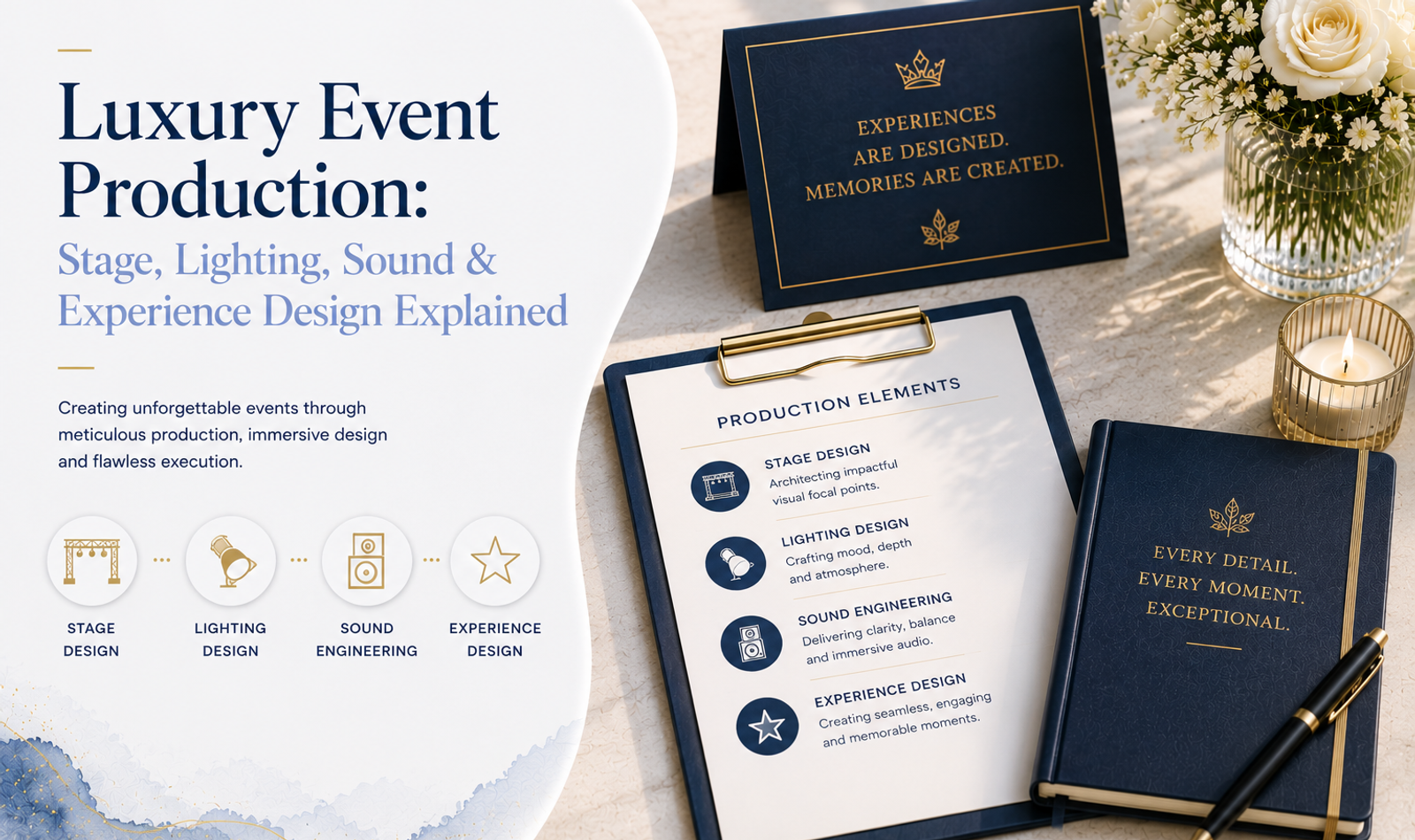
Luxury Event Production: Stage, Lighting, Sound & Experience Design Explained
Luxury events are often remembered through their most visible moments: a dramatic stage reveal, a perfectly timed entrance, an immersive lighting transformation, a live performance or a beautifully designed venue.
But behind those moments is a much larger production system.
Luxury event production is not simply about installing a stage, placing speakers around a venue or adding decorative lights. It is the process of bringing creative direction, technical planning, entertainment, hospitality and guest experience together so that every part of the event feels intentional.
Whether the occasion is a destination wedding, corporate celebration, product launch, awards night or private event, professional events and wedding management requires production decisions to work as one connected experience.
Stage design determines where attention goes. Lighting creates atmosphere. Sound controls energy and clarity. Screens and visual content communicate information and emotion. Entertainment creates memorable moments. Guest management ensures that people move comfortably through the experience.
When these elements are planned independently, an event may look impressive but feel disconnected.
When they are designed together, production becomes part of the storytelling.
What Is Luxury Event Production?
Luxury event production is the creative and technical process of transforming an event concept into a complete physical experience.
It can include:
- Stage and scenic design
- Lighting design
- Professional sound
- LED screens and projection
- Audio-visual systems
- Rigging
- Special effects
- Entertainment infrastructure
- Technical direction
- Power management
- Show calling
- Rehearsals
- Backstage coordination
- Guest experience planning
Production should also work alongside décor, hospitality, entertainment and guest management.
A luxury event should never feel like a collection of separate vendors.
The stage, lighting, flowers, furniture, screens, music, food service, performances and guest movement should appear to belong to the same creative world.
Why Production Matters in a Luxury Event
Production affects much more than the appearance of a venue.
It influences how guests experience every important moment.
Atmosphere
Lighting, sound and scenic elements establish the emotional character of the space.
A ballroom can feel formal and cinematic, warm and intimate or energetic and contemporary depending on the production approach.
Attention
Good production directs attention naturally.
When a speaker enters, the lighting changes. When a performance begins, the audience knows where to look. When a product is revealed, every technical element supports that moment.
Emotion
Music, lighting transitions, visual content and timing can completely change how a moment feels.
Entertainment
Even an exceptional performer can appear underwhelming when sound, lighting or stage infrastructure is poorly planned.
This becomes especially important when working with professional performers or celebrity management, where technical riders, rehearsals, security and backstage requirements need to be coordinated carefully.
Content
Luxury events are increasingly experienced twice: once by the people physically attending and again through photographs, reels, films, media coverage and social content.
Production therefore needs to consider how the event appears both in person and on camera.
Stage Design for Luxury Events
The Stage Is the Visual Anchor
The stage is usually one of the strongest architectural elements within an event.
For weddings, it may frame the couple, performances or ceremonies.
For corporate events, it may support presentations, leadership conversations and awards.
For a luxury product launch, the stage may become part of the product reveal itself.
This is why stage design should begin with the purpose of the event rather than decoration alone.
Stage Scale and Proportion
A stage should feel proportional to the venue.
An oversized stage in an intimate venue can dominate the room and reduce guest comfort. A small stage inside a large ballroom can make performances feel distant and visually weak.
Designers should consider:
- Venue dimensions
- Ceiling height
- Guest count
- Seating layout
- Performance requirements
- LED dimensions
- Camera positions
- Viewing distance
Scale is especially important for large corporate and brand events, where hundreds of guests may need clear visibility.
Stage Architecture
Luxury stages do not necessarily need to be elaborate.
Depending on the creative direction, the stage may incorporate layered structures, sculptural forms, scenic panels, fabric, floral elements, LED screens, architectural frames or branded installations.
The objective is coherence.
A minimalist luxury event may benefit from a restrained architectural stage, while a large wedding celebration may require a more immersive environment.
Stage Sightlines
Guests should be able to see important moments comfortably.
Sightlines need to consider pillars, tables, screens, production equipment, cameras and decorative installations.
This is particularly important for large weddings, award ceremonies and conferences where poor seating geometry can prevent entire sections of the audience from seeing the stage.
Stage Entrances and Backstage Movement
What guests see is only one side of the stage.
Behind it, performers, hosts, speakers, technical teams and VIP guests need controlled movement.
Backstage planning should include:
- Artist entry
- Holding areas
- Dressing rooms
- Technical access
- Equipment storage
- VIP routes
- Stage entry and exit
- Security
For high-profile appearances, coordination between production and celebrity management services becomes particularly important.
Lighting Design for Luxury Events
Lighting Changes How Guests Experience Space
Lighting is one of the most powerful production tools because it can transform the same physical venue throughout an event.
A room may begin with warm architectural lighting during cocktails, transition into dramatic stage lighting for performances and become more energetic during an after-party.
Lighting is therefore not simply about visibility.
It creates atmosphere.
Ambient Lighting
Ambient lighting establishes the general mood of the venue.
For luxury events, it is usually carefully balanced rather than excessively bright.
The objective is to make guests, tables, architecture and décor feel comfortable and visually refined.
Architectural Lighting
Architectural lighting highlights important physical features such as:
- Columns
- Walls
- Ceilings
- Arches
- Trees
- Landscapes
- Building façades
This can be particularly effective at destination celebrations where the venue itself is part of the experience.
For example, a professionally planned destination wedding should use lighting to enhance the character of the property rather than cover it completely.
Stage Lighting
Stage lighting must ensure that hosts, speakers, performers and important moments remain visible.
The lighting team should understand the programme in advance so that different scenes can be programmed for speeches, performances, ceremonies, awards and entertainment.
Decorative Lighting
Visible lighting elements may include chandeliers, suspended installations, candles, lamps and custom light sculptures.
These elements function as both décor and illumination.
They should therefore be coordinated with the overall event aesthetic.
Intelligent and Moving Lighting
Moving fixtures can create dynamic changes during:
- Concerts
- DJ sets
- Sangeet performances
- Award ceremonies
- Product reveals
- Celebrity entrances
The key is restraint.
Luxury production does not mean using every lighting effect available.
It means using the correct effect at the correct moment.
Lighting for Photography and Video
Lighting that looks beautiful to the human eye does not automatically look beautiful on camera.
Production teams should therefore coordinate with photography and video teams.
Faces need suitable exposure. LED screens should work correctly on camera. Important moments should not happen in poorly illuminated areas.
For events designed to generate social and campaign content, production can also coordinate with AI video and VFX production and post-production teams to extend the visual life of the event.
Sound Design for Luxury Events
Luxury Sound Should Be Powerful Without Becoming Uncomfortable
Professional event sound is not about maximum volume.
It is about clarity, consistency and control.
Guests at the front, middle and rear of the venue should experience balanced audio without uncomfortable differences in volume.
A professional system may include:
- Main speakers
- Delay speakers
- Subwoofers
- Amplification
- Mixing consoles
- Wireless microphones
- Stage monitors
- DJ equipment
- Performer-specific systems
Venue acoustics must also be considered.
A system designed for an outdoor lawn cannot simply be copied into a reflective ballroom.
Sound for Speeches
At weddings, conferences and corporate events, speech clarity is essential.
Guests should be able to understand the host, family members, executives and presenters without distortion or echo.
Microphone selection, speaker placement and sound mixing all contribute to this.
Sound for Live Music
Live performers often have detailed technical requirements.
Bands may require individual microphones, stage monitors, instruments, mixing inputs and dedicated sound checks.
Celebrity performers may also provide technical riders specifying equipment and production requirements.
These requirements should be reviewed early during the celebrity booking and management process rather than after the stage has already been designed.
Sound for DJs and Entertainment
The audio requirements of a dinner reception are very different from those of a dance floor.
Good production allows the sound environment to evolve during the event.
Background music can remain comfortable during networking or dining before transitioning into a more powerful entertainment setup later.
LED Screens and Visual Production
Screens Have Become Part of Event Architecture
LED screens are now common at weddings, corporate events, conferences and product launches.
They may display:
- Motion graphics
- Brand films
- Wedding films
- Presentations
- Live camera feeds
- Artist visuals
- Interactive content
- Product demonstrations
But bigger is not always better.
A large LED wall that does not fit the visual language of the event can dominate the space.
The strongest productions integrate screens into the stage architecture so that technology feels intentional.
This is particularly important for luxury brand and corporate experiences, where every visible element contributes to brand perception.
What Is Event Experience Design?
Experience design looks beyond the stage.
It considers the complete journey:
Invitation → Arrival → Welcome → Registration → Hospitality → Main Event → Entertainment → Dining → Departure
Each stage influences how guests remember the occasion.
A spectacular stage cannot compensate for a chaotic arrival.
Excellent entertainment cannot completely repair poor hospitality.
This is why luxury production needs to work alongside professional guest management services.
Design the Guest Arrival
The event experience begins before guests reach the main venue.
Arrival planning may involve:
- Airport coordination
- Transportation
- Valet
- Parking
- VIP arrival
- Welcome desks
- Registration
- Hostesses
- Entrance installations
- Welcome drinks
- Music
- Directional signage
For destination celebrations, guest management in Mumbai and across India can involve travel, accommodation, transportation and hospitality coordination before the event itself begins.
The transition from arrival to the main experience should feel effortless.
Create Reveal Moments
Some of the most memorable luxury events are built around controlled moments of surprise.
These might include:
- Curtain reveals
- Product unveilings
- Celebrity entrances
- Bride and groom entrances
- Lighting transformations
- Projection reveals
- Entertainment transitions
- Special effects
The audience may experience the moment for only thirty seconds.
The production team may have spent hours rehearsing it.
That difference is what professional execution looks like.
Entertainment Production
Entertainment must be integrated into production planning rather than added at the end.
A singer, DJ, band, celebrity, dancer or international performer may require specific:
- Stage dimensions
- Lighting
- Audio
- Instruments
- Rehearsal time
- Dressing rooms
- Security
- Transportation
- Backstage access
Working with an experienced celebrity management company in Mumbai can help coordinate artist requirements with event production, hospitality and scheduling.
Technical riders should be reviewed before equipment is finalised.
Production for Luxury Weddings
Luxury weddings often involve several events rather than one production setup.
A welcome evening may require atmospheric lighting and relaxed entertainment.
A mehendi may rely more heavily on daylight, interactive spaces and live entertainment.
A sangeet may require a high-production stage, choreography, LED content, professional sound and programmed lighting.
The wedding ceremony may use more architectural and emotionally restrained production.
The reception may shift again towards sophisticated entertainment and formal staging.
Professional wedding and event management ensures these experiences remain connected while each maintains its own identity.
Destination weddings add another layer of complexity because equipment, artists, guests and teams may all need to travel.
For locations such as Goa, professional event and wedding management in Goa becomes particularly valuable when coordinating venues, vendors and production logistics across multiple functions.
Production for Corporate Events
Corporate production has different priorities.
Events may include:
- Conferences
- Award ceremonies
- Product launches
- Dealer meets
- Leadership events
- Annual celebrations
- Employee events
- Brand experiences
These events frequently require stronger integration between presentations, screens, microphones, speaker management, brand identity and show control.
Production must support communication rather than overwhelm it.
A beautifully designed corporate stage is unsuccessful if the presentation cannot be read clearly from the back of the room.
Production for Luxury Brand Launches
Luxury product launches require production to reinforce brand positioning.
A premium brand may not need an enormous stage or constant entertainment.
Instead, the production might use controlled lighting, minimal architecture, immersive projection, a carefully timed reveal and a curated guest experience.
The event can then be extended through PR, media and marketing so that the launch reaches journalists, creators, customers and digital audiences beyond the physical guest list.
This is where event production becomes part of a larger communication strategy.
Technical Production Planning
Conduct a Venue Recce
Production planning should begin with a detailed venue inspection.
The team should evaluate:
- Venue dimensions
- Ceiling height
- Rigging possibilities
- Power availability
- Loading access
- Backstage areas
- Acoustics
- Guest movement
- Emergency access
- Weather exposure
- Equipment restrictions
A beautiful creative concept must still be physically achievable.
Create Technical Drawings
Large productions should not rely only on verbal instructions.
Technical plans may include:
- Stage drawings
- Lighting plots
- LED layouts
- Seating plans
- Speaker positions
- Rigging plans
- Electrical distribution
- Camera positions
These documents allow different teams to coordinate before installation begins.
Power Planning
Lighting, sound, LED screens, catering, air-conditioning and other event systems can require significant electrical capacity.
Power requirements should be calculated carefully.
Backup systems should also be considered for critical production elements.
A luxury experience should never depend on a single point of failure.
Rigging and Safety
Suspended lighting, screens, trusses and scenic structures require professional rigging.
Weight limits, structural capacity, venue regulations and safety procedures must be respected.
A visual concept should never take priority over guest, performer or crew safety.
Show Calling and Event Direction
Luxury production requires someone to coordinate what happens and when.
A show sequence might look like:
House lights lower → Opening film begins → Host enters → Presentation starts → Film plays → Stage reset → Celebrity entrance → Performance begins → Dinner announcement
Each transition may involve several departments.
The show caller coordinates these cues so that lighting, sound, video, performers and stage teams respond together.
When executed correctly, guests should not notice the technical coordination.
They should simply experience a smooth event.
Rehearsals and Technical Checks
Luxury events should be tested before guests arrive.
This can include:
- Sound checks
- Lighting programming
- LED testing
- Presentation testing
- Speaker rehearsals
- Artist rehearsals
- Choreography rehearsals
- Cue-to-cue runs
- Backup-system checks
Rehearsals are particularly important when events involve celebrity appearances, live entertainment or complex AV sequences.
Production may look spontaneous to the audience.
It rarely is.
Outdoor Luxury Event Production
Outdoor events introduce additional variables.
Teams need to consider:
- Weather
- Wind
- Rain protection
- Ground stability
- Electrical safety
- Power
- Sound restrictions
- Lighting
- Equipment protection
- Emergency alternatives
Destination locations may also create transport and accommodation requirements for production teams and equipment.
This is why event management in Udaipur, Goa and other destination markets requires careful local and logistical planning alongside creative production.
A contingency plan should exist before bad weather appears.
How Much Does Luxury Event Production Cost in India?
There is no universal price for luxury event production.
The final budget depends on:
- Venue size
- Guest count
- Stage complexity
- Scenic fabrication
- Lighting inventory
- Sound requirements
- LED screen size
- Entertainment
- Rigging
- Special effects
- Electrical infrastructure
- Location
- Transportation
- Labour
- Setup days
- Event duration
A client should therefore avoid comparing production proposals only according to the number of speakers, lights or square feet of LED.
The better question is whether the proposed system can deliver the required experience reliably.
Common Luxury Event Production Mistakes
Some common mistakes include:
- Building a stage that is disproportionate to the venue
- Using excessive LED without a creative reason
- Making sound unnecessarily loud
- Ignoring sightlines
- Lighting the décor beautifully but guests poorly
- Failing to consider photography and video
- Ignoring venue acoustics
- Providing insufficient backup power
- Skipping technical rehearsals
- Poor backstage planning
- Allowing production and décor to conflict
- Having no weather contingency
Luxury is not created through excess.
It is created through control, detail and consistency.
How to Choose a Luxury Event Production Partner
A production partner should be evaluated on more than equipment inventory.
Look at:
- Relevant experience
- Creative understanding
- Technical expertise
- Venue knowledge
- Production drawings
- Vendor management
- Safety planning
- Backup systems
- Show management
- Communication
- On-ground execution
The right production team should understand not only how to operate equipment but also why each element is being used.
You can also review Double Trouble Studio's selected work to understand how creative, event and digital disciplines can work together across brand experiences.
A Practical Luxury Event Production Process
A structured production process generally follows these stages:
- Define the event objective.
- Understand the audience and guest count.
- Finalise the venue.
- Conduct the venue recce.
- Develop the creative and experience concept.
- Design the stage and guest environment.
- Develop the lighting strategy.
- Design the sound system.
- Plan LED and visual content.
- Coordinate entertainment requirements.
- Create technical drawings.
- Plan power, rigging and safety.
- Build the production schedule.
- Install and programme technical systems.
- Conduct rehearsals and technical checks.
- Execute the event through coordinated show calling.
- Manage breakdown and post-event requirements.
Each stage affects the next.
Production becomes more efficient when major creative, technical and operational decisions are made early rather than during installation.
Frequently Asked Questions
Q1. What is luxury event production?
Luxury event production combines stage design, lighting, sound, AV systems, entertainment infrastructure, technical planning and show direction to create a coordinated premium event experience.
Q2. What is the difference between event décor and event production?
Décor primarily establishes visual styling, while production handles technical and experiential elements such as stages, lighting, sound, screens, rigging, power and live show execution. Premium events require both disciplines to work together.
Q3. How much does luxury event production cost in India?
There is no standard price. Costs depend on the venue, guest count, stage design, sound, lighting, LED requirements, entertainment, location, logistics and duration of the event.
Q4. Why is lighting important for luxury events?
Lighting establishes atmosphere, highlights décor and architecture, directs attention and affects how guests, performers, photographs and videos look.
Q5. What equipment is required for professional event sound?
Requirements may include speakers, subwoofers, amplifiers, mixing consoles, microphones, stage monitors, DJ systems and performer-specific audio equipment.
Q6. What is event experience design?
Event experience design considers the complete guest journey, including invitation, arrival, hospitality, environment, entertainment, dining and departure.
Q7. Why are technical rehearsals important?
Rehearsals allow teams to test sound, lighting, screens, presentations, performances, speeches, entrances and show cues before guests arrive.
Q8. What is a technical rider?
A technical rider is a document specifying a performer's stage, sound, lighting, equipment and backstage requirements.
Q9. What is show calling?
Show calling is the live coordination of event cues so that lighting, sound, video, speakers, performers and stage transitions happen at the correct time.
Q10. How early should luxury event production planning begin?
Complex productions should begin planning well in advance. Venue restrictions, technical infrastructure, artists, creative concepts, equipment availability and logistics all need to be coordinated before the event.
Conclusion
Luxury event production is not about adding more lights, bigger screens or louder speakers.
It is about controlling how guests experience a space.
Stage architecture establishes focus. Lighting creates atmosphere. Sound provides energy and clarity. Visual systems support storytelling. Entertainment creates memorable moments. Guest management connects the experience from arrival to departure.
The most successful luxury events can be technically complex behind the scenes while feeling completely effortless to the guest.
That is the purpose of professional production.
Planning a Luxury Event?
At Double Trouble Studio, we bring together luxury event and wedding management, guest hospitality, celebrity coordination, creative production, PR and digital communication to create events that work as complete experiences rather than disconnected elements.
Whether you are planning a luxury wedding, corporate event, private celebration or premium brand experience, contact Double Trouble Studio to discuss the creative, technical and guest experience requirements for your event.
📩 info@dtsworld.in 📞 +91 80000 06021 📍 Andheri (West), Mumbai
Need this for your brand?
Let DTS build your next campaign.
From PR, celebrity management and events to websites, social media, SEO and AI video production — Double Trouble Studio helps brands grow with strategy and execution.
Discuss Your Requirement →