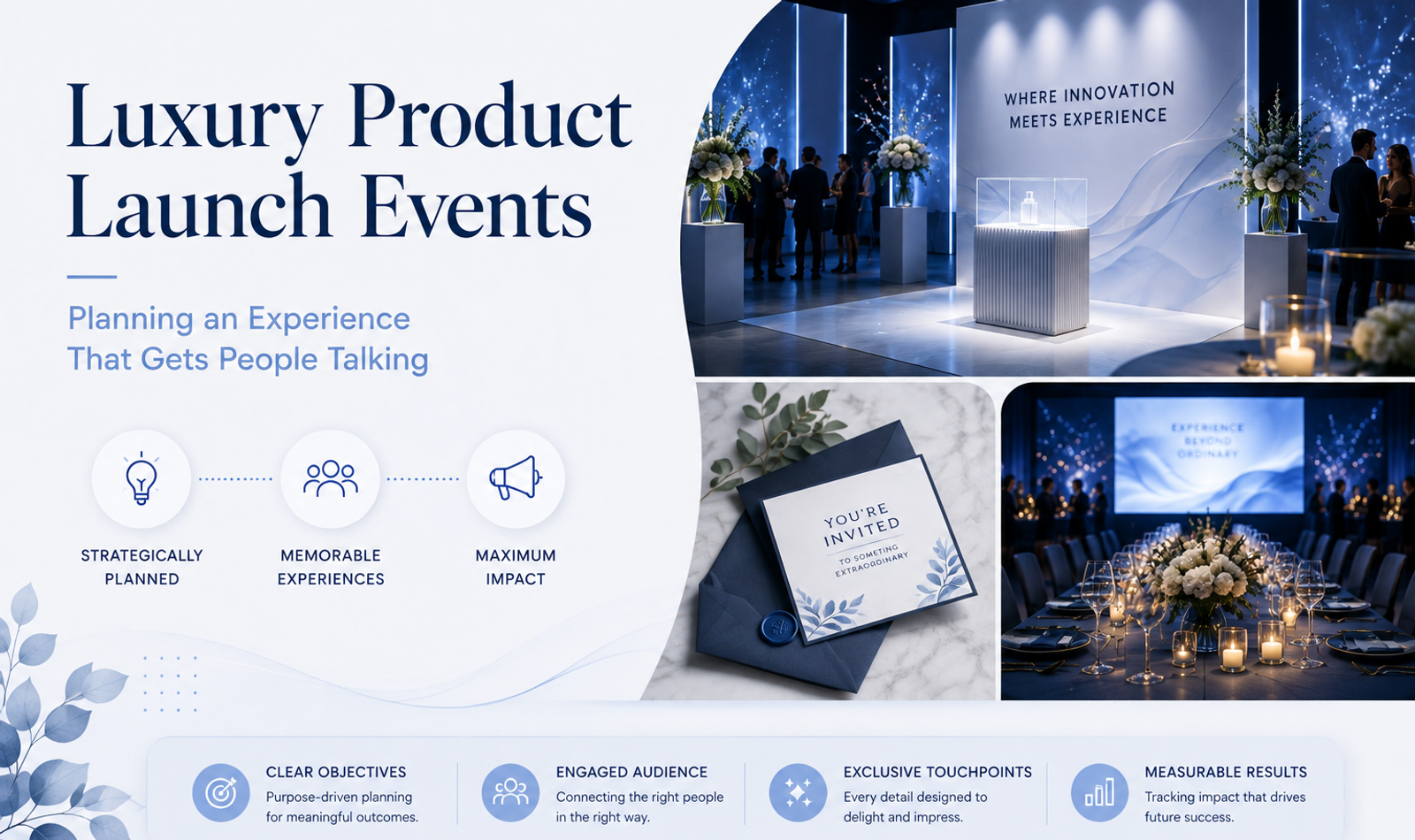
Luxury Product Launch Events: Planning an Experience That Gets People Talking
A luxury product launch is not simply an event where a new product is unveiled.
It is the moment when a brand turns its positioning, personality and promise into a physical experience.
For premium and luxury brands, this distinction matters.
Guests are not attending only to see what has been launched. They are experiencing how the brand makes them feel. The venue, invitation, lighting, music, hospitality, guest list, product presentation, entertainment and even the way people enter the space contribute to that perception.
A beautifully designed launch can turn a new product into a conversation.
It can generate media coverage, influencer content, social engagement, customer interest and valuable relationships while strengthening the overall positioning of the brand.
But creating that kind of impact requires much more than an impressive venue and an expensive production setup.
Successful luxury product launch events are built around strategy, storytelling and carefully designed experiences.
This guide explains how brands can plan a product launch that feels exclusive, creates meaningful attention and gives guests something worth talking about after the event ends.
What Makes a Luxury Product Launch Different?
A conventional product launch often focuses on communicating features, pricing and availability.
A luxury launch has another responsibility: it must communicate value before the audience even interacts with the product.
Luxury is influenced by perception.
The way guests receive their invitation, the location they arrive at, the people they meet, the service they experience and the environment surrounding the product all influence how valuable and desirable that product appears.
For this reason, a premium launch should never feel like a generic event with luxury decoration added to it.
The entire experience needs to reflect the identity of the brand.
A minimalist technology brand may require a completely different launch environment from a heritage jewellery house. A luxury automobile launch will have different experiential requirements from a premium fragrance, fashion collection, hospitality property or beauty product.
The objective is not to make everything extravagant.
The objective is to make everything intentional.
Start With the Purpose of the Launch
Before selecting venues, entertainment or décor, brands need to define what the launch is expected to achieve.
Different launches may have very different objectives.
A company might want to:
- Introduce a completely new product category
- Reposition an existing premium product
- Generate press and media coverage
- Build relationships with influencers and creators
- Engage high-value customers
- Attract distributors or business partners
- Create social media conversations
- Generate product trials or demonstrations
- Strengthen luxury brand positioning
- Enter a new market or city
The event strategy should be built around the primary objective.
For example, if media coverage is important, the event needs strong photography opportunities, spokesperson access, press information and clearly communicated brand stories. A structured event PR strategy can help brands plan visibility before, during and after the launch.
If influencer amplification is the priority, the venue should provide visually interesting environments where creators can naturally produce content. A focused influencer marketing strategy for luxury brands can also help align creator selection with campaign goals and measurable outcomes.
If customer conversion is important, guests may need private product demonstrations, consultations or opportunities to interact with specialists.
Defining the objective early prevents the launch from becoming an expensive event without a measurable purpose.
Build the Launch Around a Strong Brand Story
People rarely remember every feature mentioned during a product presentation.
They remember stories, emotions and moments.
That is why storytelling should sit at the centre of luxury product launch event planning.
Ask a simple question:
What should guests understand or feel about the product when they leave?
The answer becomes the creative foundation of the launch.
A fragrance inspired by a particular destination might transform the venue into a sensory interpretation of that place.
A premium automobile could be introduced through a journey built around performance, craftsmanship and design.
A jewellery collection inspired by architecture could use light, geometry and installations to bring the inspiration behind the collection into the physical environment.
Instead of explaining the story only through speeches, allow guests to experience it. A strong luxury brand positioning strategy can help ensure that every event touchpoint reinforces the desired perception of the brand.
Choose a Venue That Supports the Brand
Venue selection can immediately influence how people perceive an event.
Luxury launches often work particularly well in spaces that already have a distinctive character.
Depending on the product and audience, this might include:
- Luxury hotels
- Private villas
- Heritage properties
- Art galleries
- Rooftops
- Premium restaurants
- Design studios
- Private clubs
- Museums
- Industrial spaces transformed for the event
- Destination properties
- Temporary experiential installations
However, prestige alone should not determine the venue.
The space also needs to work operationally.
Consider guest arrival, parking or valet service, security, production access, backstage areas, product installation, sound restrictions, lighting possibilities, branding permissions and media requirements.
The best venue is one that supports both the creative concept and the practical execution of the event. Brands planning premium experiences can also explore these considerations in greater detail through this guide to venue selection and negotiation for premium events.
Curate the Guest List Carefully
At luxury events, the quality of the room can matter more than the number of people inside it.
A launch attended by 150 highly relevant guests can create significantly more value than an event attended by 700 people with little connection to the product.
Depending on the brand, the guest list may include:
- Existing high-value customers
- Prospective customers
- Industry leaders
- Journalists and editors
- Influencers
- Content creators
- Celebrities
- Stylists
- Designers
- Entrepreneurs
- Retail partners
- Distributors
- Investors
- Cultural tastemakers
Each group can play a different role in the launch ecosystem.
Media can create editorial visibility.
Creators can translate the experience into social content.
Celebrities can increase public attention.
Customers can provide advocacy and commercial value.
Industry leaders can strengthen credibility.
Guest management therefore needs to be strategic rather than simply focused on filling the venue. For complex premium launches, a structured approach to managing high-profile guest lists can improve segmentation, communication and the overall guest experience.
Make the Invitation Part of the Experience
The launch experience begins before guests arrive.
An invitation can establish curiosity, exclusivity and anticipation.
For certain luxury launches, brands may use personalised physical invitations, premium packaging, private digital invitations or teaser experiences that reveal the event gradually.
A beauty brand might send a mysterious ingredient associated with an upcoming fragrance.
A fashion label might provide a beautifully designed object connected with the collection.
A technology brand might use an interactive digital invitation.
Whatever format is chosen, it should communicate that the upcoming event deserves attention.
Design a Memorable Arrival
The first few minutes influence how guests perceive everything that follows.
Arrival should therefore be considered a designed experience rather than an operational necessity.
Elements can include:
- Valet or chauffeur coordination
- Personalised guest check-in
- Dedicated VIP arrival
- Elegant signage
- Hostesses or guest relations teams
- Welcome beverages
- Atmospheric music
- Lighting transitions
- Branded installations
- Photography moments
For VIPs, celebrities and media personalities, arrival planning also needs coordination between security, photographers, PR teams and event managers.
The objective is to make entry smooth while creating an immediate sense of occasion. Careful guest journey design for luxury events can help brands map every interaction from invitation and arrival through departure.
Make the Product the Hero
One of the most common mistakes in premium event production is allowing décor to overpower the actual product.
The product should remain the visual and emotional centre of the experience.
Lighting, installations, technology and entertainment should guide attention towards it rather than compete with it.
Depending on the product, the reveal might involve projection mapping, moving installations, cinematic content, live performance, dramatic lighting, curtains, sound design or interactive technology.
However, complexity does not automatically create impact.
Sometimes a single product displayed beautifully in a carefully controlled environment can feel more luxurious than an elaborate production.
Luxury often comes from restraint.
Let Guests Interact With the Product
A successful product launch should not end with a reveal.
Guests should have an opportunity to experience what has been introduced.
For automobiles, this could involve vehicle exploration, technology demonstrations or test-drive experiences.
For beauty products, guests might receive personalised consultations or sampling.
For fashion, private styling sessions or collection walkthroughs may work well.
Technology launches can use interactive demonstration zones.
Food and beverage brands can create guided tasting experiences.
The more naturally guests interact with the product, the easier it becomes for them to understand its value.
Create Content-Worthy Moments Without Making Them Feel Forced
Modern events exist simultaneously in physical and digital spaces.
A guest may spend three hours at the venue, but content from that evening could circulate online for several weeks.
This makes social-first event design important.
However, simply placing a branded backdrop at the entrance is no longer enough.
Consider creating visual moments that people genuinely want to photograph.
These might include immersive installations, dramatic product displays, interactive environments, personalised elements or unexpected design details.
The best social moments feel like part of the experience rather than advertisements disguised as photo opportunities.
Use Influencers and Celebrities Strategically
Celebrity attendance can create visibility, but visibility alone does not guarantee relevance.
The people associated with the launch should make sense for the brand.
A premium skincare company may benefit more from respected beauty creators, dermatologists and lifestyle personalities than from an unrelated celebrity with a large following.
Similarly, a luxury automobile launch might invite entrepreneurs, athletes, designers, business leaders and automotive creators whose audiences naturally align with the product.
When working with influencers, consider:
- Audience relevance
- Brand compatibility
- Content quality
- Engagement
- Reputation
- Previous brand partnerships
- Geographic relevance
- Creative style
The objective should be credible association rather than simply maximum reach. Professional celebrity management can also help brands coordinate suitable talent, appearances and event logistics.
Integrate PR and Media From the Beginning
PR should not be added after the event has already been planned.
It should influence the launch strategy from the beginning.
A strong media plan may include pre-event announcements, exclusive interviews, embargoed information, press previews, spokesperson opportunities, press kits, professional photography and post-event releases.
Journalists should also have access to clear product information.
Provide essential details such as:
- Product story
- Key features
- Brand background
- Pricing
- Availability
- Founder or spokesperson quotes
- High-resolution images
- Relevant contact information
Making information easily accessible improves the likelihood of accurate and useful coverage. An integrated PR, media and marketing strategy can extend the launch beyond the venue and connect event activity with broader brand visibility.
Use Entertainment to Support the Atmosphere
Entertainment can significantly shape the energy of an event.
But it should never feel disconnected from the brand.
Depending on the concept, entertainment might include DJs, live musicians, fashion performances, immersive theatre, digital art, dancers, celebrity appearances or interactive installations.
The choice should support the desired mood.
A sophisticated cocktail launch might benefit from an intimate live performance.
A youth-focused luxury fashion event may require a completely different musical and cultural direction.
Entertainment should strengthen the world being created around the product.
Pay Attention to Food and Beverage
Hospitality is an important part of luxury event perception.
Guests may not consciously analyse every service detail, but they notice when service feels slow, chaotic or poorly considered.
Menus should complement the event rather than simply provide refreshments.
Brands can explore customised cocktails, product-inspired desserts, tasting menus, premium beverage partnerships or personalised service.
Timing also matters.
Food and beverage service should be planned around presentations and product reveals so that service activity does not distract from important moments.
Personalisation Makes Luxury Feel Personal
Luxury experiences increasingly move beyond generic VIP treatment.
Personalisation can create stronger emotional connections.
This could include:
- Invitations addressed personally
- Customised gifts
- Engraving or monogramming
- Personal styling
- Individual product consultations
- Personalised tasting experiences
- Guest-specific welcome notes
- Curated gift boxes
The objective is to make guests feel recognised rather than processed.
Small, thoughtful details often create stronger memories than large decorative installations. These principles can be developed further through guest personalisation strategies for luxury events.
Plan the Event Timeline Carefully
Luxury should appear effortless.
Behind that appearance is detailed planning.
A typical launch journey might include:
Guest arrival → Welcome experience → Networking → Brand introduction → Product story → Product reveal → Demonstration → Entertainment → Product interaction → Dining or cocktails → Gifting → Departure
Every transition should feel natural.
Avoid keeping guests waiting too long for the reveal or filling the programme with unnecessary speeches.
The event should maintain momentum while giving guests enough time to interact, network and explore.
Prepare for VIP, Celebrity and Media Management
If celebrities, senior executives, influencers or high-profile guests are attending, additional planning is required.
This can include separate entrances, security coordination, green rooms, holding areas, dedicated handlers, photographer management, interview scheduling and departure coordination.
Without proper planning, a celebrity appearance can easily disrupt the guest experience.
Professional guest management allows important personalities to receive appropriate attention without making the rest of the event feel secondary. For celebrity-led launches, detailed celebrity appearance logistics, security and coordination can reduce operational risks.
Use Technology Where It Adds Value
Technology can make product launches more immersive, but it should solve a creative or functional problem.
Useful applications may include:
- Projection mapping
- AR experiences
- Interactive displays
- RFID or NFC interactions
- Digital product configurators
- LED installations
- Immersive screens
- AI-powered experiences
- Personalised digital content
Technology should support storytelling.
Adding technology simply because it appears futuristic can make an experience feel gimmicky rather than premium.
Capture Professional Content During the Event
A launch event creates a large amount of potential marketing material.
Plan photography and video production before the event rather than treating documentation as an afterthought.
Capture:
- Venue details
- Product shots
- Guest arrivals
- Celebrity interactions
- Product demonstrations
- Speeches
- Brand installations
- Crowd atmosphere
- Influencer content
- Customer reactions
- Behind-the-scenes moments
Short-form vertical content can be produced alongside traditional event photography and films.
This content can later support PR, social media, paid advertising, websites, sales presentations and future campaigns. Brands can also combine event footage with an end-to-end AI video production and professional editing workflow to create multiple campaign assets from the launch.
Extend the Launch Beyond One Evening
One of the biggest opportunities in modern event marketing is extending the lifespan of the launch.
The event itself may last only a few hours.
The campaign around it can last weeks.
Before the event, brands can build anticipation through teasers, invitations, creator collaborations and PR announcements.
During the event, content can be distributed through Stories, Reels, live updates and media coverage.
Afterwards, brands can publish event films, interviews, creator content, press coverage, behind-the-scenes material and product-focused stories.
This transforms a single launch into a broader communication campaign. Connecting events, PR and digital marketing can help the launch contribute to a longer-term brand roadmap instead of ending when the venue closes.
Measure More Than Attendance
Attendance numbers alone do not determine whether a product launch succeeded.
Brands should measure results against the original objective.
Relevant metrics can include:
- Confirmed guest attendance
- VIP attendance
- Media coverage
- Quality of publications
- Influencer content generated
- Social media reach
- Engagement
- Brand mentions
- Website traffic
- Product enquiries
- Leads
- Product trials
- Sales
- Retail enquiries
- Content assets generated
- Post-event customer engagement
Luxury events should ultimately contribute to brand value or commercial objectives rather than exist purely for visibility.
Common Mistakes to Avoid in Luxury Product Launch Events
Choosing Spectacle Over Strategy
An impressive event without a clear objective may generate photographs but little business value.
Inviting Everyone
Exclusivity becomes difficult when guest selection is based only on numbers.
Over-Branding the Venue
Luxury branding is often strongest when integrated subtly into the environment.
Ignoring Guest Comfort
Poor parking, long queues, inadequate seating, bad temperature control or slow service can quickly damage an otherwise beautiful experience.
Using Irrelevant Influencers
Follower numbers cannot compensate for poor audience alignment.
Making the Product Secondary
Guests should leave remembering what was launched, not only the party surrounding it.
Forgetting Post-Event Marketing
Without an amplification strategy, much of the content and attention generated during the launch disappears within days.
Why an Integrated Event Strategy Matters
A product launch involves several disciplines working simultaneously.
Event production, creative direction, guest management, celebrity coordination, influencer marketing, PR, social media, photography, video production and digital amplification all affect the final result.
When these activities are handled independently, the experience can become fragmented.
An integrated strategy ensures that the physical event and the communication campaign support the same objective.
The venue reflects the campaign.
The guest list supports PR.
The installations create social content.
The celebrity strategy strengthens positioning.
The photography supports future advertising.
The event therefore becomes more than a gathering.
It becomes a complete brand communication platform.
Frequently Asked Questions About Luxury Product Launch Events
What is a luxury product launch event?
A luxury product launch event is a carefully curated brand experience designed to introduce a premium product to selected customers, media, influencers, celebrities, industry professionals or business partners. Unlike a standard launch, it focuses heavily on exclusivity, storytelling, hospitality, design and overall brand perception.
How do you plan a successful luxury product launch event?
Start by defining the launch objective and target audience. Develop a creative concept around the product story, choose an appropriate venue, curate the guest list and plan the product reveal, hospitality, entertainment, PR, influencer activity and content production as one connected strategy.
What type of venue is best for a luxury product launch?
The best venue depends on the product and brand identity. Luxury hotels, heritage properties, galleries, private villas, rooftops, premium restaurants, private clubs and unusual experiential spaces can all work effectively. The venue should support both the creative concept and operational requirements.
How important is the guest list for a product launch?
The guest list is extremely important, particularly for premium brands. A smaller group of relevant customers, journalists, influencers, celebrities and industry leaders can create more value than a much larger but poorly targeted audience.
Should celebrities be invited to a luxury product launch?
Celebrities can increase visibility when there is a genuine connection between their image, audience and the brand. The objective should be strategic relevance rather than celebrity attendance purely for publicity.
How can influencers help a product launch?
Relevant influencers can introduce the product to targeted communities, create authentic event content and extend the launch beyond the physical venue. Brands should evaluate audience relevance, engagement, content quality and brand compatibility before selecting creators.
How can PR be integrated into a product launch?
PR planning should begin before the event. Brands can use launch announcements, press previews, exclusive interviews, press kits, spokesperson interactions, professional photographs and post-event releases to create broader editorial visibility.
How can a product launch generate social media content?
Design the event with visually compelling and interactive moments that guests naturally want to capture. Professional photography, vertical video, creator collaborations, behind-the-scenes footage and real-time social coverage can extend the launch across multiple platforms.
How long does it take to plan a luxury product launch event?
Timelines depend on the scale, venue, production complexity, guest profile and creative requirements. Smaller launches may require several weeks, while large-scale premium events involving custom installations, celebrities, complex production or destination logistics should ideally begin planning several months in advance.
How do you measure the success of a luxury product launch?
Success can be measured through attendance quality, media coverage, influencer reach, social engagement, website traffic, enquiries, leads, product trials, sales, brand mentions and the amount of useful marketing content generated from the event.
Conclusion
The most successful luxury product launch events are not remembered simply because they were expensive.
They are remembered because everything felt connected.
The invitation created anticipation.
The venue established the mood.
The guest list created the right room.
The product reveal delivered a moment.
The hospitality made people feel valued.
The content extended the experience online.
And the story gave people something worth discussing afterwards.
For luxury brands, an event should never exist only for the evening itself.
It should create a ripple effect across customers, media, influencers, social platforms and future marketing campaigns.
That requires combining event strategy with creative direction, guest management, PR, celebrity and influencer partnerships, production and digital amplification.
When these elements work together, a product launch becomes much more than an announcement.
It becomes an experience people remember, photograph, share and talk about — which is ultimately what a great luxury launch should achieve.
📩 info@dtsworld.in 📞 +91 80000 06021 📍 Andheri (West), Mumbai
Need this for your brand?
Let DTS build your next campaign.
From PR, celebrity management and events to websites, social media, SEO and AI video production — Double Trouble Studio helps brands grow with strategy and execution.
Discuss Your Requirement →