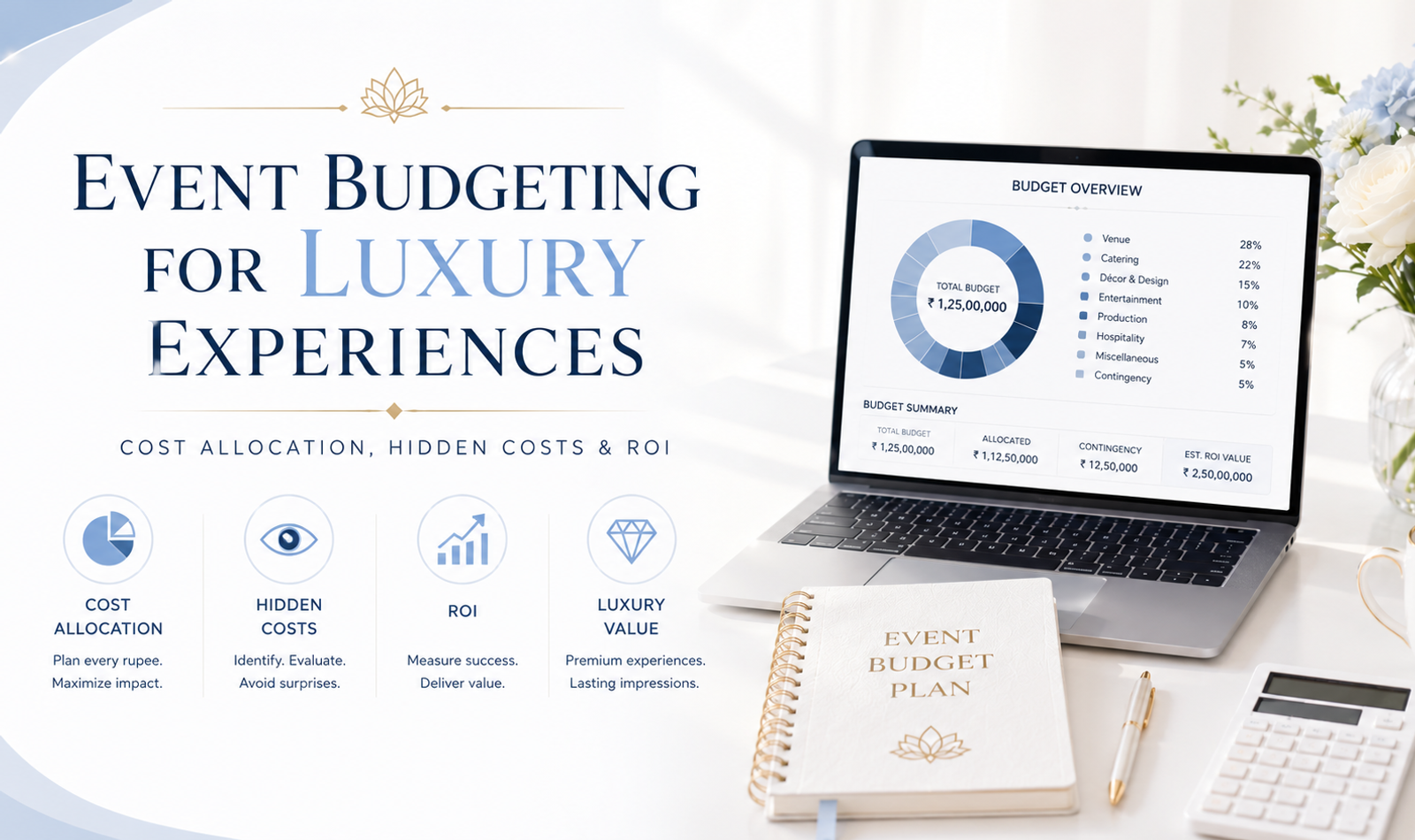
Event Budgeting for Luxury Experiences: Cost Allocation, Hidden Costs & ROI
Luxury event budgeting is not simply about deciding how much money can be spent. It is the strategic process of determining where investment will create the greatest emotional, experiential, reputational or commercial value.
A luxury wedding, corporate gala, private celebration, destination event or premium product launch may involve a substantial financial commitment. However, a high overall budget does not automatically protect the event from overspending, hidden expenses or poor allocation.
Luxury events often involve multiple venues, several guest categories, elaborate production, high-profile entertainment, hospitality teams, security and more than twenty specialist vendors. A single change in the guest count or programme can affect several financial categories simultaneously.
Strong budgeting provides visibility before commitments are made. It shows what has been approved, what has already been committed, what remains flexible and which costs are still uncertain.
The objective of cost control is not to reduce the ambition of the experience. It is to ensure that every major investment supports guest comfort, storytelling, relationship value, brand positioning or measurable business outcomes.
This guide explains how to plan and manage budgets for luxury experiences. It covers cost allocation, hidden expenses, vendor quotations, cash flow, contingency reserves, change control and event ROI.
Quick Answer
Luxury event budgeting should begin with a clearly defined objective, realistic guest count, venue strategy and list of experience priorities. The total budget should then be divided into detailed categories covering venue, catering, accommodation, design, production, entertainment, hospitality, transport, security, content and management fees.
Every quotation should be converted into its complete payable value. Taxes, travel, labour, installation, dismantling, accommodation, overtime and exclusions should be added before vendors are compared.
Hidden costs should be identified during the initial forecast rather than discovered during execution. Venue overtime, room guarantees, equipment freight, artist riders and last-minute guest additions can create significant increases.
Event ROI should be measured according to the purpose of the experience. Corporate events may evaluate leads, revenue, media and stakeholder relationships, while weddings may evaluate guest comfort, family satisfaction, emotional value and reduced stress.
What Is Luxury Event Budgeting?
Luxury event budgeting is a complete financial management process that forecasts, allocates, approves, tracks and reconciles all event-related expenditure.
The process begins before the venue is selected and continues until vendor invoices, deposits, refunds and post-event deliverables have been closed.
A professional event budget should explain more than one expected total. It should show where funds are allocated, which assumptions have been used, when payments are due and what financial exposure remains.
It should also distinguish approved expenditure from estimated expenditure. This prevents uncertain costs from being treated as confirmed savings.
The budget should function as a decision-making tool throughout the planning process rather than becoming a document reviewed only when costs increase.
Why Luxury Events Require Stronger Financial Control
Luxury events involve a greater number of creative and operational dependencies. Décor affects production, guest count affects hospitality and venue selection influences almost every other category.
High expectations can also create continuous scope expansion. A family may add another hospitality detail, while a corporate client may request an additional experience zone or performance.
Each request may appear manageable when considered individually. However, the combined impact of several additions can significantly change the final cost.
Luxury events also involve higher cancellation and change exposure. Custom fabrication, entertainment advances, room guarantees and destination travel may be partially or completely non-refundable.
Financial control allows the event to remain creative and flexible without becoming unstructured.
Budgeting as an Experience Strategy
A luxury event budget should express what the organiser values most. It should show which parts of the guest journey deserve the greatest investment.
One wedding may prioritise food, hospitality and music, while another may focus on destination design, photography and cultural storytelling.
A corporate gala may invest more heavily in stage production, stakeholder engagement, media content and sponsor experience. A private dinner may prioritise service, cuisine and exclusivity.
When priorities are unclear, expenditure becomes spread across too many elements without creating one powerful experience.
Strategic allocation allows the planning team to protect the elements that matter while controlling low-value additions.
The Three Financial Dimensions of an Event
A complete event budget should consider cost, value and risk. Evaluating only the cost produces an incomplete financial decision.
Cost explains how much the event element will require. Value explains what the expenditure is expected to contribute.
Risk identifies what may change, fail or become more expensive. Weather, guest growth, travel disruption and technical complexity all create financial exposure.
Every major decision should therefore answer three questions: what does it cost, what value does it create and what risk does it introduce?
This process is particularly important for custom structures, high-profile entertainment, destination venues and technology-led experiences.
Luxury Event Budgeting Framework
Budgeting Area
Primary Question
Planning Output
Event objective
What should the event achieve?
Success definition
Budget ceiling
What can responsibly be spent?
Approved limit
Cost allocation
Where should money be invested?
Category budgets
Hidden-cost planning
What expenses may be missing?
Risk register
Vendor procurement
What is the complete supplier cost?
Comparison sheet
Change control
How will additions be approved?
Approval system
Cash flow
When are payments required?
Payment calendar
ROI measurement
What value did the event create?
Performance report
Every area should be defined before the event reaches detailed production and procurement.
Begin with the Event Objective
The event objective should be documented before the first major financial commitment. The organiser must understand why the experience is being created.
A corporate launch may aim to generate qualified leads, secure media coverage and demonstrate a new product. A luxury wedding may prioritise family connection, cultural meaning and exceptional guest hospitality.
The objective determines where the budget should be concentrated. A product launch may require greater investment in technology, demonstration and content.
A wedding may justify stronger hospitality, accommodation and guest-management allocations. The correct budget structure is therefore different for every event.
When the purpose is clear, it becomes easier to reject expensive additions that do not support the intended outcome.
Define Success Before Allocating Money
Success should be described in measurable or observable terms before expenditure begins. A general goal such as creating a memorable event is too broad to guide difficult decisions.
A wedding may define success as smooth guest travel, meaningful ceremonies, strong food quality and minimal stress for the family.
A corporate gala may define success through attendance, senior stakeholder engagement, sponsor satisfaction and qualified business conversations.
Not every success measure must be financial. Emotional value, relationship quality and reputation can be meaningful outcomes.
However, the measures should be clear enough to influence budgeting, programme and vendor choices.
Establish the Preferred and Maximum Budgets
The organiser should distinguish between the preferred budget, approved maximum and emergency financial limit.
The preferred budget is the target around which the event should be designed. The maximum budget provides controlled flexibility for justified requirements.
The emergency limit should not be communicated as available spending. It exists only to protect the event during exceptional circumstances.
Every budget ceiling should include taxes, professional fees and contingency. A pre-tax figure creates a misleading impression of available capacity.
Payment timing should also be reviewed. An event may be affordable overall while still creating short-term cash-flow pressure.
Create a Detailed Cost Architecture
The event budget should be divided into major categories and detailed subcategories. This allows the organiser to see exactly where costs are increasing.
Venue rental should remain separate from catering, accommodation, power, service charges and overtime.
Décor should be divided into concept, fabrication, furniture, florals, labour, transport and dismantling. Production should show sound, screens, lighting, stage, rigging and power.
Hospitality, guest management, transport, security and content should also remain visible.
The level of detail should match the complexity of the event. A multi-day destination wedding requires a more detailed structure than a single-evening private dinner.
Typical Luxury Event Cost Allocation
Budget Category
Main Components
Common Financial Risk
Venue and spaces
Rental, setup and overtime
Restricted access
Food and beverages
Menus, bar and service
Guest-count changes
Accommodation
Guests, hosts and vendor rooms
Unused guarantees
Design and décor
Concept, structures and styling
Scope expansion
Florals
Flowers, foliage and labour
Seasonal availability
Production
Stage, sound, lights and screens
Additional equipment
Entertainment
Artists, hosts and performances
Riders and travel
Guest management
Invitations, RSVPs and seating
Late additions
Hospitality
Airport, hotel and guest support
Staffing increases
Transport
Cars, coaches and luggage vehicles
Overtime
Content
Photography, film and social edits
Extended coverage
Security
Access, VIP protection and medical support
Extra deployment
Planning fees
Strategy and event management
Unclear scope
Contingency
Weather and emergencies
Premature use
The allocation should not follow one universal percentage formula. It should reflect the event’s purpose, format and guest journey.
Understanding Fixed Costs
Fixed costs generally remain unchanged when the number of guests changes. These may include the main venue rental, stage structure, creative fee and artist retainer.
A fixed cost may still change when the programme or design changes. Adding another event day may increase venue, production and staffing requirements.
Understanding fixed costs helps the organiser evaluate where reductions are genuinely possible.
Reducing the guest list may lower catering and transport expenditure but may not affect stage, venue or entertainment costs.
The budget tracker should identify fixed commitments clearly so they are not confused with flexible spending.
Understanding Variable Costs
Variable costs increase according to attendance, consumption or usage. Catering, rooms, gifts and transport are common examples.
The cost of one additional guest may include food, seating, invitations, hospitality, gifts and transport.
Destination guests may also require accommodation and airport assistance. Their cost is therefore different from that of a local reception guest.
Variable costs should be calculated by guest type and function wherever possible.
The guest-confirmation deadline is therefore one of the most important financial control points in the event timeline.
Understanding Semi-Variable Costs
Semi-variable costs change when the event crosses a particular capacity or operational threshold.
An additional group of guests may require another coach, buffet station, registration counter or service team.
The cost may remain stable until the threshold is crossed and then increase suddenly.
Simple per-person calculations often fail to capture these jumps. This can create unexpected budget increases after seemingly small guest additions.
The planner should identify important thresholds during the initial forecast.
Create Multiple Budget Scenarios
Luxury events benefit from expected, reduced and maximum cost scenarios.
The expected scenario should reflect the most realistic guest count and approved experience. The maximum scenario may include higher attendance, complete weather backup and additional technical needs.
A reduced scenario can show how the event changes when the budget must be lowered. It is more useful than reducing every category by the same percentage.
Corporate organisations may require several options for internal approval. Families may also benefit from seeing how different choices affect guest experience.
All scenarios should use the same category structure so that comparisons remain clear.
Budget Scenario Checklist
• Expected guest count
• Maximum guest count
• Core experience
• Optional enhancements
• Weather protection
• Travel exposure
• Tax assumptions
• Contingency level
The scenarios should be updated whenever the venue, guest count or event programme changes materially.
Separate Core Costs from Enhancements
The core budget should include everything necessary to deliver the approved event safely, professionally and at the expected quality.
Optional enhancements should remain separate. These may include another artist, upgraded floral styling, custom gifting or extended content production.
The separation protects hospitality, safety and production from being reduced to fund optional visual additions.
It also gives the decision-maker a clear view of how each enhancement affects the total.
An optional element should only be approved when core delivery and contingency remain secure.
Venue Cost Allocation
Venue cost includes more than rental. Setup time, overtime, power, furniture, valet, security and mandatory services may all create additional expenditure.
Hotels may also require minimum food, beverage or room commitments. These guarantees can create liability when guest numbers decline.
Some venues include infrastructure that reduces other expenses. A higher-rental property may provide better total value when stages, screens or furniture are included.
Venue options should therefore be compared according to complete event cost.
The contract should explain every included and chargeable service before payment is made.
For more detailed planning, see venue selection and negotiation for premium weddings and events.
Food and Beverage Allocation
Food and beverages are often among the largest variable expenses. Cost is influenced by guest count, menu complexity, service format, beverages and event duration.
A larger number of dishes does not automatically create a stronger luxury experience. Quality, presentation and service speed may produce greater value.
The organiser should confirm what the per-person price includes. Water, tableware, speciality counters and service staff may be billed separately.
The final guarantee should be based on realistic attendance information rather than the total invitation list.
Overestimating food can create both unnecessary expense and waste.
Accommodation Cost Allocation
Destination weddings, conferences and retreats may require rooms for guests, speakers, artists, planners and vendors.
The rooming budget should distinguish guest rooms from working-team accommodation. It should also include taxes, breakfast, early arrival and late departure where applicable.
Guaranteed room inventory should be monitored against confirmation data. Unused rooms may remain payable after the release deadline.
Vendor rooms should also be planned according to working hours and venue distance.
Accommodation decisions can affect transport, staffing and programme timing, making them part of the wider event strategy.
Design and Décor Allocation
The design budget can expand rapidly because creative concepts often continue evolving after initial approval.
The planner should identify signature areas where investment will create the strongest guest and content impact.
Existing venue architecture should be used wherever appropriate. Covering a strong environment with unnecessary temporary structures increases cost without always improving the experience.
The décor budget should separate design fees, structures, furniture, materials, labour, freight and dismantling.
This allows the organiser to understand which decisions are creating the greatest expenditure.
For a deeper approach to concept planning, see designing luxury event themes.
Floral Cost Allocation
Floral expenditure depends on variety, season, quantity, transport, wastage and installation complexity.
Imported flowers may carry higher freight, storage and replacement risk. Local or seasonal botanicals can sometimes provide stronger quality and value.
Foliage, branches, grasses and sculptural materials may be used to create scale without depending entirely on premium flower volume.
The quotation should clarify labour, refrigeration, transport, installation and disposal.
Any material substitution should be approved when it affects the agreed colour, quality or design direction.
Production Cost Allocation
Production includes stage structures, sound, lighting, screens, rigging, power and technical operators.
The system should be designed according to venue size, audience, programme and content requirements.
Underpowered production can lead to poor guest experience and expensive emergency additions. The cost should therefore be evaluated against coverage and reliability.
Artist technical riders and last-minute content requirements can expand the scope significantly.
Backup power, playback and microphones should be treated as risk protection rather than unnecessary duplication.
Entertainment Cost Allocation
Entertainment cost may include performance fees, travel, accommodation, hospitality, technical riders and security.
Celebrity attendance and performance are different services and should be defined separately.
The planner should evaluate whether the entertainment suits the audience and event purpose. A recognisable name may not create value when the format is unsuitable.
The total financial commitment should be reviewed rather than only the talent fee.
Several curated performers may sometimes create a better guest journey than one expensive headline act.
For high-profile appearances, professional celebrity management can help coordinate fees, riders, logistics and on-ground requirements.
Hospitality Cost Allocation
Hospitality can include airport representatives, hotel desks, guest coordinators, luggage handling, room support and communication.
The staffing plan should reflect arrival waves, hotel locations and guest complexity.
Luxury hospitality depends on accurate information and responsive people. Reducing staff excessively can create visible service problems.
Uniforms, meals, transport and long working hours should be included in supplier quotations.
Hospitality often produces greater guest value than an additional decorative installation.
Transport Cost Allocation
Transport expenditure depends on vehicle categories, routes, minimum hours, luggage, waiting time and driver requirements.
Premium cars may be required for selected guests, while group coaches and shuttles can manage larger movements efficiently.
Tolls, parking, overtime and empty return trips should be included in the forecast.
Vehicle allocation should be based on the actual movement schedule rather than general estimates.
Uncontrolled last-minute requests can create duplicate bookings and premium charges.
Photography and Content Allocation
Photography and content services may include traditional coverage, candid photography, films, drone footage, social edits and press assets.
The number of functions, event hours and simultaneous locations will determine the required team.
Post-production, data storage, album design and revision rounds should appear in the quotation.
Corporate events may require rapid social and media content, while weddings may prioritise long-form films and archives.
The budget should match the intended use and delivery timeline of the content.
For brands extending event content into campaigns, AI video and VFX can also support post-event content production and repurposing.
Security and Compliance Allocation
Security, medical support, licences and compliance should remain protected categories.
High-profile attendees may require additional personnel, secure routes and private holding areas.
Sound, alcohol service, temporary structures and drones may require approvals depending on the event and destination.
Emergency support should reflect guest count, event duration and venue access.
Compliance expenditure should never be removed simply to preserve a decorative enhancement.
Planning and Management Fees
Professional planning and management fees protect the complete event investment.
The planner may coordinate vendors, schedules, budgets, guests, venues, rehearsals and live execution.
The scope should explain whether production, design, hospitality and guest management are included.
A lower planning fee may not provide the leadership or team size required for a complex event.
Management value should be evaluated according to responsibility, capability and risk rather than price alone.
What Are Hidden Event Costs?
Hidden event costs are expenses that were missing, excluded or unclear inside the initial estimate.
They may result from incomplete quotations, changing requirements, venue restrictions or operational assumptions.
Some hidden costs are unpredictable, while many can be identified through stronger research and documentation.
The budget should contain provisional lines for areas that remain uncertain. This creates a more honest forecast.
Hidden-cost planning protects both the organiser and vendors from last-minute financial disputes.
Hidden Event Costs Table
Hidden Cost
Why It Appears
Cost-Control Method
Taxes
Base prices shown first
Track payable value
Venue overtime
Setup or programme delays
Confirm hourly rates
Vendor travel
Excluded from professional fee
Calculate landed cost
Staff accommodation
Long destination schedules
Build vendor room plan
Equipment freight
Intercity transport required
Include logistics budget
Power
Venue capacity is insufficient
Conduct technical audit
Internet
Dedicated streaming required
Test and quote early
Crew meals
Long supplier shifts
Collect headcounts
Rehearsal hours
Not included in live-event scope
Add to contracts
Permissions
Required by programme or venue
Maintain tracker
Damage deposits
Venue or rentals require security
Track refundable amounts
Room attrition
Unused guaranteed rooms
Monitor release dates
Corkage
External beverages brought in
Review venue policy
Backup systems
Reliability requires duplication
Include risk budget
Waste removal
Supplier or venue excludes disposal
Assign ownership
Urgent printing
Information changes late
Freeze content early
The hidden-cost register should be reviewed throughout planning and before every major financial approval.
Taxes and Service Charges
Vendor prices may be communicated before taxes, service charges or other applicable additions.
The central budget should show the expected payable amount rather than only the base fee.
Corporate finance teams may also require documentation, vendor registration and statutory deductions. Appropriate professionals should review these matters.
Families should understand the complete payment before approving a vendor.
A tax-inclusive forecast gives decision-makers a more accurate view of remaining budget.
Venue Overtime
Venue overtime may be charged for extended setup, rehearsals, live programme delays or breakdown.
A complex event may require earlier access than the venue’s standard package provides.
If additional access is negotiated only after design approval, the venue may charge a premium.
Programme delays can also activate overtime across production, transport, staffing and security.
The planner should identify how each supplier calculates overtime before finalising the run of show.
Vendor Travel and Accommodation
Travelling vendors may require flights, road transport, luggage, freight, accommodation and meals.
Some suppliers include these costs while others leave them open until later.
Vendor quotations should therefore be compared according to total delivered cost.
Local suppliers may reduce logistics, but quality and capacity should still be assessed.
The best structure may combine specialist creative leadership with reliable local execution.
For supplier coordination, see vendor management for coordinating event suppliers.
Freight and Handling
Large structures, equipment, furniture and fragile materials may require specialised transport.
Freight may include packing, insurance, tolls, loading teams and storage.
Destination venues may have restricted roads or loading access that require smaller secondary vehicles.
These requirements should be identified before fabrication begins.
Urgent freight is usually more expensive and carries greater delivery risk.
Power and Technical Infrastructure
The venue’s power system may not support production, kitchens, lighting and climate control simultaneously.
Temporary generators, cabling, distribution and operators may be required.
The production team should conduct a technical audit before confirming equipment.
Backup power should also be included where a failure would significantly damage the event.
Power cost should be treated as essential infrastructure rather than a last-minute technical addition.
Dedicated Internet
Hybrid events, live streaming and digital registration may require dedicated connectivity.
Public guest Wi-Fi should not be treated as the only professional broadcast connection.
Temporary internet lines, network equipment and backup systems can create additional cost.
The connection should be tested inside the actual event space.
Connectivity requirements should be confirmed before selecting platforms and production suppliers.
For events combining physical and digital participation, see hybrid luxury events.
Rehearsal Costs
Rehearsals can require venue access, production equipment, technical teams, artists and security.
These hours may not be included in the live-event quotation.
Family performances, award ceremonies and corporate presentations can require several rehearsal sessions.
The schedule and contracts should include realistic rehearsal time.
The cost of a proper rehearsal may be far lower than the reputational or operational cost of a failed live moment.
Crew Meals and Welfare
Vendor teams may work long hours during setup, operation and breakdown.
Meals, water, washrooms and rest areas should be planned according to shift patterns.
Crew counts may include planners, production technicians, decorators, photographers, drivers, security and hospitality staff.
Ignoring these requirements can create emergency food orders and poor working conditions.
Vendor welfare contributes directly to performance, safety and service quality.
Room Attrition
Hotels may require a guaranteed number of rooms. Inventory not released before the deadline may remain payable.
The rooming team should track confirmed, pending, released and cancelled rooms separately.
Informal guest changes should be reflected in the official list quickly.
Room attrition can become a major hidden cost in destination weddings and corporate retreats.
Negotiated flexibility may create more value than a small reduction in the room rate.
Corkage and Beverage Charges
Venues may charge for external beverages through corkage, service, glassware and storage fees.
Licensing and bartender costs may also be separate.
The organiser should compare venue beverage packages with externally supplied stock using complete costs.
Consumption tracking may be required for high-value products.
The final bar budget should include both beverage and service infrastructure.
Damage Deposits
Venues, furniture companies and equipment providers may require refundable security deposits.
Temporary structures and large guest volumes can create restoration risk.
Before-and-after inspections should document existing conditions.
Vendor contracts should define responsibility for damage caused during installation or removal.
Deposits should remain visible in the budget until the refund is received.
Permissions and Licences
Sound, alcohol service, drones, temporary structures and public performances may require approvals.
The planner should maintain a tracker with authority, deadline, cost and status.
Late applications may lead to additional fees or programme restrictions.
Requirements differ by location and event format. Appropriate professional advice should be obtained.
Permission costs should never be hidden inside an unverified assumption.
Weather Protection
Outdoor events may require temporary roofing, flooring, cooling, heating or an indoor alternative.
Weather backup should be budgeted during the first forecast rather than added after the design is approved.
The alternative may involve additional venue space, labour, décor and production.
A decision deadline should be established so that both options do not remain incomplete.
Weather protection should support guests, food and programme as well as technical equipment.
Last-Minute Guest Additions
Late guest additions affect several cost categories simultaneously.
A destination guest may require accommodation, airport transport, food, gifting and seating.
The organiser should calculate cost according to the guest’s attendance pattern rather than using one general per-person rate.
A clear addition deadline and approval process should be established.
The complete financial impact should be understood before the guest is confirmed.
Programme Extensions
Adding another session, event, performance or after-party can increase venue, catering, transport, production and staffing costs.
The visible cost of the activity may represent only part of the total impact.
The planner should review every department before approving a programme extension.
Combining similar experiences may sometimes create better value.
Programme discipline is an important part of event cost control.
What Is Event ROI?
Event return on investment compares the value created by the event with the resources used to deliver it.
For commercial events, value may include revenue, leads, partnerships, sponsorship and customer retention.
For weddings and private celebrations, ROI is primarily experiential rather than financial. It may include guest satisfaction, emotional memory and reduced family stress.
A complete evaluation should consider financial, relationship, brand and experience outcomes.
The ROI model should be selected according to the event objective.
Financial ROI
Financial ROI may compare attributable revenue or funds raised against the total cost of the event.
However, event influence is not always immediate. A relationship established at a gala may convert into business several months later.
The organisation should define how event-sourced and event-influenced revenue will be tracked.
Ticket income, sponsorship and fundraising should also be evaluated against delivery costs.
Financial claims should remain supported by realistic attribution.
Lead and Pipeline ROI
Corporate events often create value through qualified business opportunities rather than immediate revenue.
The organiser can track meetings, demonstrations, decision-maker interactions and sales follow-ups.
Lead quality should receive greater attention than the total number of scans or registrations.
Sales and event teams should agree on ownership and follow-up timelines before the event.
Pipeline reporting should distinguish new opportunities from existing relationships influenced by the experience.
Relationship ROI
Premium events can strengthen relationships with clients, partners, investors, employees and communities.
Relationship value may be assessed through senior meetings, feedback, collaboration and future opportunities.
These outcomes can be documented even when they are not immediately financial.
The programme and layout should support meaningful conversation when relationship development is a priority.
An expensive performance may create less relationship value than a well-designed networking environment.
Media and Content ROI
Events can generate press features, photographs, films, interviews and social-media content.
The organiser should evaluate the relevance and quality of coverage rather than only the quantity.
Content may also support future campaigns, sales presentations, recruitment and investor communication.
Usage rights and delivery timelines should be confirmed before the event.
Media value should not rely only on inflated advertising-equivalent calculations.
For brands, an event PR strategy can help extend the value of media coverage before, during and after the event.
Sponsor ROI
Sponsors may evaluate audience access, visibility, leads, hospitality and content.
The budget should include the cost of delivering promised sponsor benefits.
Branding, tables, activations, tickets and reports all require resources.
The net value of a sponsorship is therefore different from the gross amount received.
A clear post-event report can improve future sponsor retention.
Experiential ROI
Experiential ROI measures how effectively the event influenced guest perception, emotion or behaviour.
Surveys, session attendance, dwell time, interaction and feedback can provide useful evidence.
The organiser should compare these outcomes with the event objective.
An expensive visual installation may generate photographs but limited participation. Its value depends on what it was designed to achieve.
Experience measurement helps future budgets allocate funds more intelligently.
Wedding Experience ROI
A wedding should not be forced into a commercial ROI model.
Its value may include family connection, cultural meaning, guest comfort, memories and reduced stress.
Professional planning also allows the couple and families to remain emotionally present.
A visually impressive feature may create less value than reliable transport, strong food and thoughtful hospitality.
The correct wedding budget reflects the couple’s own priorities rather than external comparison.
Brand ROI
Product launches and corporate galas may influence brand positioning, trust and message recall.
The organiser can evaluate media coverage, audience feedback, content use and stakeholder perception.
Brand value may continue developing after the event through campaigns and conversations.
The event environment should communicate the brand through experience rather than relying only on logo placement.
A strong event transforms brand values into physical interactions.
Employee Event ROI
Internal events may support recognition, engagement, motivation and culture.
Attendance, participation and employee feedback can provide useful indicators.
The budget should be directed towards what employees genuinely value.
Awards, accessibility, content and networking may contribute more than decorative scale.
An internal event should also connect with wider organisational actions rather than functioning as one isolated celebration.
Event ROI Measurement Table
Event Objective
Relevant ROI Measure
Example Indicator
Product launch
Leads and product interest
Demonstrations and enquiries
Corporate gala
Relationship development
Senior meetings
Fundraising event
Net funds raised
Income after expenses
Employee celebration
Engagement and recognition
Feedback and participation
Brand event
Perception and media value
Recall and coverage
Luxury wedding
Guest and family experience
Hospitality satisfaction
Conference
Knowledge and networking
Session engagement
Sponsor event
Partner value
Leads and visibility
The measurement approach should be established before the event so that relevant information can be collected.
Build One Central Budget Tracker
Every contract, payment, addition and forecast should enter one controlled financial tracker.
The document should show approved budget, committed cost, paid amount and forecast final cost.
These figures are different. A category may appear under budget simply because an approved balance has not yet been invoiced.
Taxes, deposits, due dates and refunds should also remain visible.
One source of financial truth prevents departments from working with different assumptions.
Track Committed Cost
Committed cost includes signed contracts and approved additions even when payment has not been completed.
This is one of the most important measures in luxury event budgeting.
Relying only on paid amounts can make the remaining budget appear higher than it really is.
Every approved change should update the committed amount immediately.
Optional enhancements should not be approved using funds already committed to another category.
Track Actual Cost
Actual cost includes invoices received, payments completed and confirmed final charges.
It becomes more accurate after overtime, consumption and damage information is available.
Actual expenditure should be compared with both the original budget and latest forecast.
Major differences should be explained clearly.
The budget should not be closed until every liability, deposit and refund has been resolved.
Forecast Final Cost
Forecast final cost combines confirmed commitments with expected pending expenses.
It provides the clearest current view of where the event is likely to finish financially.
Expected transport additions, guest changes and overtime should be included.
The forecast should be updated frequently during the final planning stage.
Senior decision-makers should review the forecast before approving further expenditure.
Create a Cash-Flow Calendar
The total event budget may be approved while individual payments create timing pressure.
Venue, artist, décor and production advances may become due close together.
The cash-flow calendar should show invoice requirements, approval lead time and payment deadlines.
Corporate procurement systems may require purchase orders and vendor registration.
Missing an essential payment can affect vendor readiness and event delivery.
Compare Vendor Quotations Properly
Vendor proposals should be compared according to equal scopes and assumptions.
The planner should examine quantities, quality, labour, transport, taxes, backup and overtime.
A lower quotation may exclude installation, technical operators or destination travel.
The comparison should also evaluate capability, service and financial flexibility.
The cheapest initial price may become more expensive once missing items are added.
Vendor Comparison Table
Comparison Area
Vendor A
Vendor B
Financial Question
Base fee
Included
Included
Is the scope equal?
Labour
Included
Additional
What is payable?
Transport
Additional
Included
Is freight covered?
Taxes
Excluded
Excluded
What is the total?
Setup access
One day
Two days
Is the timing sufficient?
Backup
Included
Limited
What risk remains?
Overtime
Hourly
Fixed block
Which suits the programme?
Cancellation
Partial refund
Non-refundable
What is the exposure?
Vendor selection should reflect complete value rather than the lowest headline amount.
Use Formal Change Control
Every scope change should enter one approval process.
The request should explain the reason, cost, schedule impact and affected departments.
A stage modification may affect screens, lighting, seating, rigging and photography.
The organiser should understand the combined cost before approval.
Approved changes should update contracts, schedules and budget forecasts.
Change-Control Checklist
• Change requested
• Reason provided
• Cost impact
• Timing impact
• Vendor dependencies
• Funding source
• Final approver
• Updated documents
No major addition should remain only inside a verbal conversation.
Set Financial Approval Limits
Different cost levels should have different approval authorities.
Department leads may manage small operational costs, while large creative additions require senior approval.
Contingency use should usually require separate authorisation.
Vendors should know who can confirm chargeable work.
Clear limits prevent delays and accidental financial commitments.
Protect the Contingency Reserve
The contingency reserve should remain protected until major risks become clearer.
It should not be used automatically when a creative category exceeds its budget.
A desired enhancement should be approved transparently as an increase or reallocation.
Contingency use should be tracked separately.
The available balance should appear inside every senior budget report.
Budget Variance Reporting
Budget variance is the difference between the approved category amount and forecast or actual expenditure.
The report should explain why the variance occurred.
Guest growth, design expansion and market price changes require different responses.
Savings should also be recorded. However, positive variance should not be spent until remaining risks are reviewed.
Variance reporting creates accountability and improves future planning.
Cost Control Without Reducing Luxury
Strategic cost control removes duplication, unnecessary complexity and low-value additions.
Existing venue architecture, local sourcing and reusable structures can reduce expenditure without weakening quality.
Guest-list control and function consolidation may create larger savings than cutting several small details.
Sound, hospitality, seating, food, security and safety should remain protected.
Luxury is damaged when essential operational quality is sacrificed to preserve decorative excess.
Smart Cost-Control Opportunities
• Control guest count
• Approve early
• Use venue assets
• Reuse structures
• Consolidate transport
• Choose seasonal florals
• Reduce duplicate functions
• Negotiate access
Every reduction should be reviewed for its effect on guests and execution.
Avoid False Economies
A false economy occurs when a cheaper decision creates greater risk or higher later cost.
Examples include insufficient sound, understaffed hospitality and unreliable transport.
A low-cost supplier may require additional supervision, replacement equipment or emergency support.
Poor quality in guest-facing services can damage reputation and experience.
Value should include reliability, professionalism and complete delivery.
Conduct Regular Budget Reviews
Budget reviews should focus on decisions, exposure and upcoming commitments.
The planner should highlight over-budget categories, uncertain estimates and payment deadlines.
Optional enhancements should remain separate from essential approvals.
Every decision should be recorded and reflected in the tracker.
Review frequency should increase as the event approaches.
Budget Dashboard Metrics
• Approved budget
• Committed cost
• Paid amount
• Forecast total
• Category variance
• Contingency balance
• Pending approvals
• Refunds due
The dashboard should be simple enough for senior decision-makers to understand quickly.
Event-Day Financial Control
Live events may require additional vehicles, staff, equipment or venue time.
One authorised finance controller should record every chargeable addition.
Vendors should receive approval before providing paid work whenever practical.
Safety emergencies may require immediate action, but the cost should still be documented.
The control room should understand the remaining contingency and approval hierarchy.
Controlling Overtime
Venue, production, transport, entertainment and staffing overtime can accumulate quickly.
The planner should understand how each vendor calculates additional time.
A delay in one programme segment may trigger several charges simultaneously.
The run of show should include buffers and one authorised extension decision-maker.
Overtime should be approved intentionally rather than assumed.
Post-Event Financial Reconciliation
Final invoices should be compared with contracts, approved changes and delivery records.
Overtime, rooming, consumption and damage charges require verification.
Deposits and refunds should remain active in the tracker until received.
Disputes should be reviewed using written documentation.
Financial closure may continue for several days or weeks after the final event.
Create the Final ROI Report
The final report should compare event objectives, final expenditure and measurable outcomes.
Corporate reports may include leads, revenue, sponsor value, media and stakeholder feedback.
Wedding reports may focus on hospitality, family satisfaction, vendor performance and financial control.
Financial and experiential value should be reported separately where appropriate.
This analysis helps future events direct investment more intelligently.
The VALUE Event Budgeting Framework
The VALUE framework connects cost allocation, hidden-cost planning and ROI.
V — Vision and Value
Define the event objective, guest experience and expected outcomes before allocating money.
A — Allocate Strategically
Divide funds across venue, hospitality, design, production, entertainment, content and contingency according to priorities.
L — Locate Hidden Costs
Review taxes, travel, overtime, freight, rooms, permissions and supplier exclusions before signing contracts.
U — Use Financial Controls
Track commitments, payments, changes, cash flow and variance through one central budget system.
E — Evaluate Return
Measure financial, relationship, brand, media and experience outcomes after the event.
The VALUE framework ensures that budgeting remains connected to purpose rather than becoming only a cost-reduction exercise.
Complete Luxury Event Budget Checklist
Before major commitments are confirmed, the organiser should review the complete financial foundation.
• Defined objective
• Approved ceiling
• Category allocations
• Guest scenarios
• Tax-inclusive costs
• Hidden-cost register
• Vendor comparisons
• Payment calendar
• Change-control process
• Contingency reserve
• ROI measurement
• Closure plan
Every item should have one owner and review deadline.
Common Event Budgeting Mistakes
One common mistake is approving the creative concept before establishing the financial limit. The design then becomes emotionally and operationally difficult to reduce.
Another mistake is comparing vendor totals without reviewing inclusions. A lower quotation may not represent the same delivery.
Some organisers track only paid amounts instead of committed costs. This creates a false impression of remaining budget.
Uncontrolled guest additions, late approvals and premature contingency use also create significant exposure.
Finally, event success is sometimes evaluated only through appearance. Guest experience, relationships and business results should also influence ROI.
Frequently Asked Questions
What is luxury event budgeting?
Luxury event budgeting is the process of forecasting, allocating and controlling all expenditure involved in a premium event.
It connects creative decisions, vendor commitments, guest requirements and operational risks within one financial system.
What should a luxury event budget include?
It should include venue, food, rooms, design, production, entertainment, hospitality, transport, content, security and planning fees.
Taxes, travel, overtime, permissions and contingency should also be included.
How should event costs be allocated?
Cost allocation should reflect the event objective, guest profile, venue and experience priorities.
A single percentage formula cannot accurately represent every wedding, gala or launch.
What are common hidden event costs?
Common hidden costs include taxes, venue overtime, vendor travel, accommodation, freight, power, permissions and crew meals.
Room attrition, corkage, security deposits and last-minute printing may also affect the final amount.
How can event budget overruns be prevented?
Use detailed scopes, written approvals, category limits and one central budget tracker.
Guest changes and creative enhancements should pass through formal cost review.
What is a contingency budget?
A contingency reserve protects the event from genuine uncertainty such as weather, technical failure and urgent logistics.
It should not be used automatically for optional upgrades.
How much contingency is required?
The suitable amount depends on destination, season, complexity and vendor certainty.
Outdoor, destination and multi-day events may require stronger protection than controlled indoor events.
How should vendor quotations be compared?
Compare scope, quantities, quality, labour, travel, taxes, backup and overtime.
The lowest headline amount may not represent the lowest total cost.
What is committed event cost?
Committed cost includes signed contracts and approved additions, even when the full payment has not yet been made.
It provides a more accurate view of remaining budget than paid amounts alone.
What is event budget variance?
Budget variance is the difference between the approved amount and the forecast or actual cost.
The reason for every major variance should be documented.
What is event ROI?
Event ROI measures the value created compared with the resources invested.
The value may be financial, experiential, relational, reputational or emotional.
How do corporate events measure ROI?
Corporate events may track leads, pipeline, revenue, media, sponsor value and stakeholder relationships.
The measurement plan should be created before the event begins.
How is wedding ROI measured?
Wedding value may be assessed through guest comfort, family satisfaction, emotional meaning and reduced stress.
A private celebration should not be forced into a purely commercial formula.
Can cost control reduce event quality?
Poor cost cutting can reduce quality. Strategic control removes duplication and low-value complexity.
Hospitality, safety, food, sound and reliable production should remain protected.
What happens after the event?
Final invoices, deposits, refunds, overtime and vendor balances should be reconciled.
A final cost and ROI report should also be prepared.
Does Double Trouble Studio manage luxury event budgets?
Double Trouble Studio supports luxury weddings, galas, launches and private events with complete budgeting and cost-control systems.
The scope can include forecasting, vendor comparisons, payment tracking, contingency planning and ROI reporting.
How Double Trouble Studio Manages Luxury Event Budgets
Double Trouble Studio approaches budgeting as a central part of creative and operational event strategy. We begin by understanding the objective, guest profile, venue requirements and experience priorities.
Our work can include budget forecasting, cost allocation, vendor comparison, commercial negotiation, payment planning and hidden-cost identification. Every commitment is connected to one central financial tracker.
Throughout planning, we monitor contracts, changes, category variances and forecast final cost. During execution, overtime and urgent requirements can be controlled through a defined approval hierarchy.
After the event, our teams can support invoice reconciliation, deposit tracking, vendor closure and ROI analysis. This creates financial visibility from the first concept meeting to final settlement.
The objective is not to reduce ambition. It is to ensure that every investment contributes meaningfully to the guest experience, brand objective, relationship value or emotional outcome.
Conclusion
Event budgeting for luxury experiences requires more than choosing a total spending limit. It requires a complete system connecting cost allocation, hidden expenses, risk and value.
Detailed categories improve visibility, while fixed, variable and semi-variable analysis creates more accurate forecasts. Proper vendor comparisons reduce unexpected additions.
Contingency protection, formal approvals and change control prevent creative expansion from becoming uncontrolled expenditure.
ROI analysis then explains whether the experience created the intended financial, emotional, relationship or brand outcome.
When budgeting is managed professionally, financial discipline does not restrict luxury. It gives creative and operational teams the confidence to build ambitious experiences on a stable foundation.
Plan Your Luxury Event Budget with Double Trouble Studio
A luxury event should feel generous, seamless and carefully considered without becoming financially unstructured. Double Trouble Studio manages complete budgets for weddings, corporate galas, launches, destination celebrations and private experiences.
Our approach can include cost forecasting, category allocation, vendor comparison, hidden-cost planning, contingency management, payment tracking, change control and post-event ROI analysis.
Connect with Double Trouble Studio to build an event budget where every cost remains visible, every major decision stays controlled and every investment contributes meaningfully to the final experience.
📩 info@dtsworld.in | 📞 +91 80000 06021 | 📍 Andheri East, Mumbai
Need this for your brand?
Let DTS build your next campaign.
From PR, celebrity management and events to websites, social media, SEO and AI video production — Double Trouble Studio helps brands grow with strategy and execution.
Discuss Your Requirement →