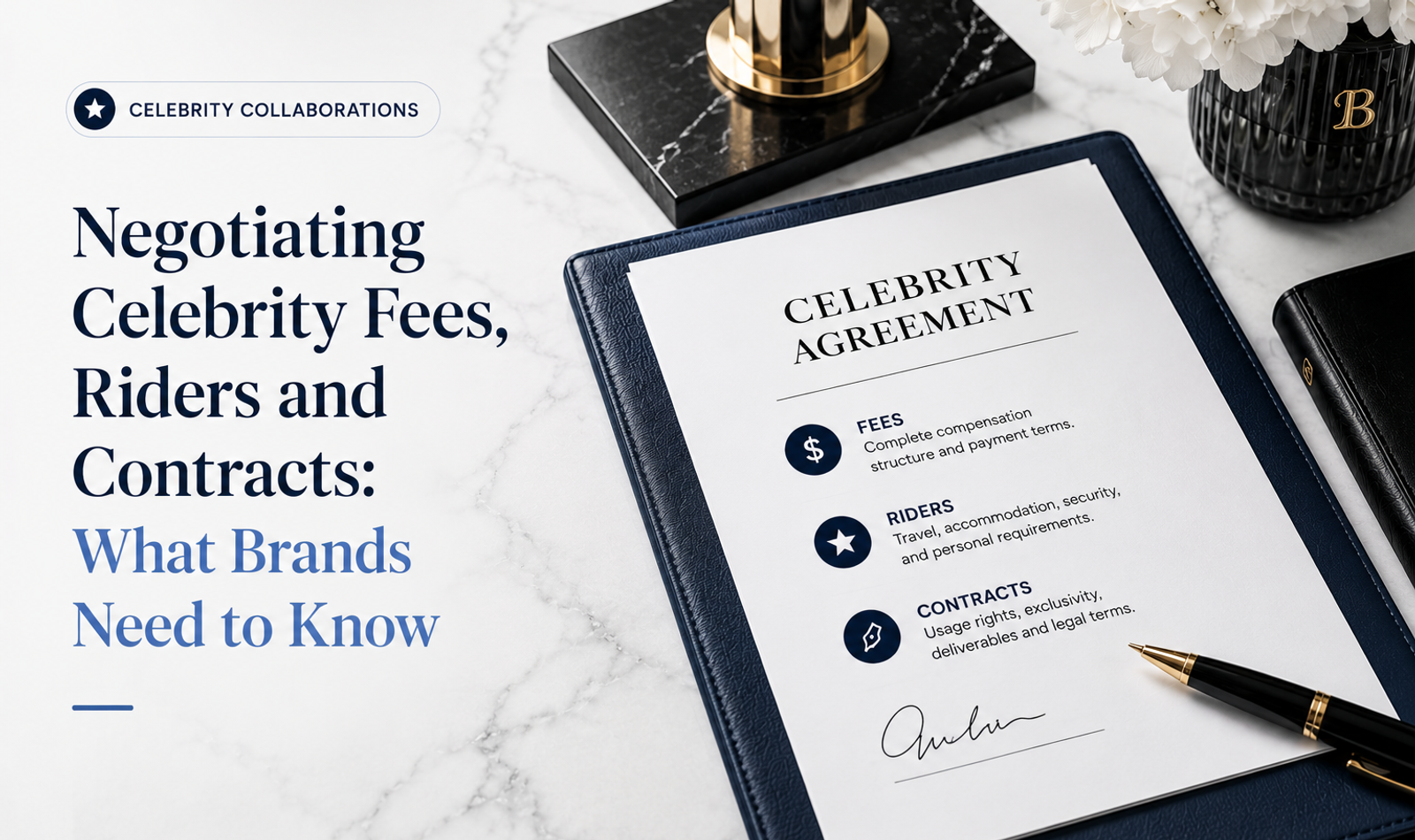
Negotiating Celebrity Fees, Riders and Contracts: What Brands Need to Know
Booking a celebrity for a brand campaign, corporate event, wedding, product launch, public initiative or live performance involves much more than agreeing on a headline fee.
The final commercial arrangement may include professional fees, agency commissions, taxes, travel, accommodation, local transportation, security, styling, production requirements, content approvals, media usage and exclusivity. A celebrity who appears affordable during the first discussion may become significantly more expensive once the complete scope is defined.
This is why brands should never negotiate only around one number.
The fee is connected to what the celebrity is expected to do, how much time the engagement requires, where their identity will be used and what commercial opportunities they may be prevented from accepting during the agreement.
An appearance at a private event is not priced in the same way as a national advertising campaign. One social media post is not equivalent to a year-long brand ambassadorship. A live performance does not automatically give the organiser permission to record and advertise the performance indefinitely.
The contract must reflect these differences clearly.
Celebrity negotiations also involve reputation and operational risk. A delayed event day, unclear script, unsuitable production environment or unauthorised use of the celebrity’s image can create conflict even when the professional fee has been paid correctly.
The celebrity’s representatives want to protect the talent’s time, image and commercial value. The brand wants certainty that the agreed appearance, content or campaign will be delivered as expected.
A well-negotiated agreement balances these interests.
It defines the scope precisely, allocates responsibilities fairly and explains what happens when circumstances change.
Begin With a Complete Brief
Negotiation should begin only after the brand has prepared a clear brief.
A representative cannot provide a meaningful commercial proposal when the request is described only as a collaboration or appearance.
The brief should explain the identity of the brand or client, the purpose of the engagement and the exact role being proposed.
For an event, the brand should identify the date, city, venue, audience, appearance duration and expected activity. The celebrity may be required to attend, perform, speak, present an award, interact with guests, participate in photographs or create social content.
Each requirement affects the fee and logistics.
For an advertising campaign, the brief should identify the product, campaign concept, production dates, expected deliverables and intended media use. It should explain whether the celebrity is required for a film shoot, photography, voice recording, social media content, interviews or promotional appearances.
The brand should also provide the proposed campaign duration and territory.
A campaign limited to organic social media in India is commercially different from a worldwide campaign using television, outdoor advertising, paid digital media and packaging.
When the scope remains unclear, the representative may quote a higher amount to protect against unknown usage or may refuse to provide a figure until more information is available.
Clarity improves the negotiation for both sides.
Understand What the Celebrity Fee Covers
A celebrity fee should never be assumed to cover every possible activity.
The agreement should state exactly what is included.
An appearance fee may cover the celebrity’s presence at a venue for a defined period. It may not include a performance, speech, media interview, social post or extended meet-and-greet.
A performance fee may cover one live set of a specified duration. It may not include rehearsals beyond the agreed schedule, complete performance recording or promotional content.
An endorsement fee may cover the celebrity’s association with the brand and a defined set of campaign assets. It does not automatically grant unlimited use of their identity.
The brand should ask for a written commercial proposal that separates the talent fee from additional costs where possible.
This makes it easier to compare options and understand the total budget.
The proposal may include the celebrity’s professional fee, representative commission, applicable taxes, travel requirements and additional production obligations.
The brand should confirm whether the quoted amount is gross or net of taxes and whether agency commission is included.
Ambiguity around these points can create significant differences between the expected and final payment.
Why Celebrity Fees Vary
Celebrity fees are influenced by several factors.
Public profile is one factor, but it is not the only one. Current demand, recent projects, audience relevance, category fit, availability and the nature of the engagement all affect pricing.
A celebrity experiencing a major film, music or sporting success may receive increased demand and higher offers.
The timing of the event or campaign can also matter. A request made during a major production schedule, festival period or awards season may be difficult to accommodate.
The amount of work required influences the fee.
A short event appearance may still require travel, styling and a full day blocked from other commitments. A one-day advertisement shoot may also require script approval, fittings, rehearsal and promotional obligations.
Usage rights can have an even greater effect than production time.
A celebrity may spend one day filming an advertisement, but the resulting content can create value for the brand over many months and across several markets. The fee therefore reflects both labour and commercial association.
Exclusivity also increases cost because it may prevent the celebrity from accepting competing endorsements.
The brand should evaluate the complete commercial value rather than comparing celebrity pricing only by hours on site.
Set a Realistic Budget Before Negotiation
A brand should define its total available budget before contacting talent.
This budget should include more than the professional fee.
The total project cost may include agency commission, taxes, travel, accommodation, local transport, security, styling, hair and makeup, production, rehearsal, technical rider requirements and hospitality.
For campaigns, the budget must also account for creative development, filming, post-production, media buying and renewals.
Brands sometimes allocate nearly the entire budget to the celebrity and then attempt to reduce production quality or usage requirements. This can weaken the final campaign.
A celebrity association is only valuable when the brand can execute and distribute it effectively.
The budget should therefore be divided strategically.
The team should establish its preferred talent fee, maximum commercial limit and the areas where scope can be adjusted.
If the quoted fee exceeds the budget, the brand may reduce deliverables, duration, media rights, territory or exclusivity instead of asking for the same full package at a much lower price.
Scope-based negotiation is generally more credible than requesting a large discount without changing the agreement.
Do Not Negotiate Only Through a Percentage Discount
Celebrity negotiation is not the same as bargaining over a standard retail product.
The brand should understand what is creating the quoted value.
If a celebrity’s commercial proposal is too high, the team can ask whether a shorter appearance, narrower usage period or reduced number of deliverables would make the association possible.
For example, a twelve-month endorsement covering television, outdoor, paid digital and packaging may be outside the budget. A three-month digital-only campaign may be more realistic.
A full performance may be expensive, while an appearance or moderated conversation may fit the event objective.
The brand can also explore fewer social deliverables or a more limited territory.
This approach protects the celebrity’s commercial positioning while allowing the parties to identify a workable structure.
A representative is more likely to engage seriously when the brand demonstrates that it understands the relationship between fee and scope.
Negotiate Through an Authorised Representative
Commercial negotiation should take place through a verified agent, manager, authorised company or legal representative.
A personal introduction may begin the conversation, but final terms should be documented through the party authorised to negotiate and sign.
The brand should confirm the representative’s company, role and authority before transferring funds.
The contracting entity may be the celebrity personally, a loan-out company, management company or another authorised business.
The bank account and invoice should correspond with the approved payment structure.
Any request to change payment instructions should be verified independently.
Brands should be cautious when an intermediary refuses to identify the authorised contracting party or insists on immediate payment without documentation.
A genuine representative should understand the need for business verification.
Define Deliverables Precisely
The deliverables section is one of the most important parts of a celebrity agreement.
General language such as “celebrity will support the campaign” is not enough.
The agreement should describe every required asset and activity.
For an event, this may include arrival time, stage appearance, performance duration, speech, award presentation, press interaction, photography and social content.
For a campaign, it may include film duration, number of photographs, short-form videos, voiceovers, social posts, stories, interviews and promotional appearances.
The agreement should also state whether content will be published on the celebrity’s channels, the brand’s channels or both.
Social media deliverables need detailed definitions.
A feed post, Reel, Story, repost and collaboration post are different deliverables. The agreement should clarify the platform, format, number of uploads and minimum period for which the content must remain visible.
The parties should also agree on caption approval, tagging, disclosure language and publication timing.
When the deliverables are not precise, each side may have a different understanding of what the fee includes.
Define the Celebrity’s Time Commitment
The agreement should specify how the celebrity’s time will be calculated.
An event appearance may be described as sixty minutes, but the parties need to understand when that time begins.
It may begin when the celebrity enters the venue, reaches the holding area or appears on stage.
Travel time, sound check, rehearsal, styling and waiting time may be treated separately.
For production, the contract should define the shoot day, expected call time, working hours, meal breaks and overtime conditions.
The brand should account for setup and approval delays without assuming that the celebrity will remain indefinitely.
If the production exceeds the agreed hours, additional charges may apply.
The schedule should be realistic and include contingency without creating excessive waiting.
Premium talent management depends heavily on time discipline.
Separate Appearance, Performance and Endorsement Rights
An appearance, performance and endorsement are not interchangeable.
An appearance means that the celebrity is physically present and completes the agreed event activities.
A performance involves artistic or professional output, such as singing, acting, speaking or participating in a demonstration.
An endorsement means that the celebrity is presented as supporting, recommending or associating with the brand or product.
A celebrity attending a brand event does not automatically become a brand endorser.
The organiser should not later publish advertisements implying a continuing endorsement unless this was agreed.
Similarly, a celebrity performing at a wedding does not automatically give the organiser or sponsors the right to use the footage in commercial advertising.
The contract should define the nature of the association and restrict use beyond that scope.
This protects the brand from accidental infringement and protects the celebrity from misleading public association.
Negotiate Usage Rights Carefully
Usage rights determine how the brand can use the celebrity’s name, image, voice, likeness, performance and approved content.
These rights should be defined by media, territory, duration and purpose.
Media may include television, cinema, radio, print, outdoor advertising, websites, ecommerce, mobile applications, email, organic social media, paid digital media, retail displays and packaging.
Territory identifies where the content can be used. This may be one country, a region or worldwide.
Duration identifies the permitted campaign period.
The contract should also explain whether the brand may keep historical content visible after the active campaign ends.
For example, an old social post may remain on the brand’s feed while paid promotion and homepage placement stop after the usage period.
The parties should distinguish between active advertising and passive archival use.
The brand should request only the rights it genuinely expects to use.
Asking for worldwide, perpetual, all-media rights may increase the fee substantially and delay negotiation.
Narrow, practical rights can create a more efficient agreement.
Organic and Paid Media Are Different
Brands often assume that permission to post content on social media includes permission to advertise that content.
Organic publication and paid media should be negotiated separately.
Organic use generally means that content appears naturally on the celebrity’s or brand’s profile without paid distribution.
Paid use includes boosting, whitelisting, dark posts, platform advertising and other sponsored distribution.
Paid media gives the brand greater control over audience targeting and campaign scale, which can increase the commercial value of the celebrity’s identity.
The agreement should define whether the brand may promote content from its own account, through the celebrity’s account or both.
It should also define the access, approval and duration of any account-level advertising permission.
The brand should not assume that a social collaboration automatically includes unlimited paid amplification.
Website, Ecommerce and Marketplace Use
The contract should specify whether the celebrity’s image can appear on the brand’s website, ecommerce pages and third-party marketplaces.
A campaign image used on the homepage is different from a permanent image attached to a product listing.
Marketplace use may expose the content across several territories and seller environments.
The brand should identify whether approved retailers, distributors or franchisees can use the assets.
If third parties are included, the contract should explain how the brand will control their usage.
The brand may remain responsible when a distributor continues using celebrity assets after the licence expires.
A clear asset-distribution process can reduce this risk.
Packaging and Product Use
Using a celebrity’s image or signature on packaging is a major commercial right.
Packaging can remain in the market long after a campaign ends. Existing inventory may still be held by retailers and distributors.
The contract should define the production period, sell-off period and treatment of remaining stock.
A sell-off period gives the brand limited time to distribute or sell products produced during the authorised term.
Without this provision, the brand may be required to destroy or withdraw packaging immediately after expiry.
The parties should also define whether the celebrity’s name can become part of the product name or collection.
A co-branded product usually requires broader negotiation than a standard campaign.
Define Content Ownership and Licensing
The brand may pay for the production of campaign content, but this does not automatically create unlimited ownership of the celebrity’s identity.
The contract should distinguish between ownership of the physical or digital production assets and the licence to use the celebrity’s rights within those assets.
The brand may own the final film or photographs while being permitted to use them only for a defined period and purpose.
The celebrity may also retain approval over edits that affect their image or message.
The contract should define whether unused footage, behind-the-scenes material and alternate edits can be published.
A brand should not assume that every moment captured during a shoot is approved campaign material.
Address Artificial Intelligence and Digital Replicas
Celebrity agreements in 2026 should address artificial intelligence explicitly.
The contract should state whether the brand may use AI to edit, translate, dub, recreate or generate the celebrity’s voice, face, body or performance.
General permission to film or photograph should not be treated as permission to create synthetic content.
AI-assisted editing may include background replacement, language localisation, voice cloning, facial alteration, generative expansion and creation of new scenes.
The parties should define which uses are permitted and which require separate written approval.
The contract should also address model training and data retention.
The brand should not upload celebrity footage, voice recordings or photographs into uncontrolled systems when the provider may retain or reuse the data.
Digital-replica rights can create commercial value beyond the original campaign and should be negotiated accordingly.
Negotiate Exclusivity With Precision
Exclusivity prevents the celebrity from working with specified competitors during an agreed period.
The category should be defined narrowly enough to be commercially fair and broad enough to protect the brand.
A food company may not need exclusivity across every type of food and beverage. It may need exclusivity only within a specific product category.
An automobile exclusivity clause may distinguish passenger vehicles from commercial vehicles, tyres, fuel and mobility applications.
The territory and duration should also be stated.
Exclusivity may begin on the signing date, production date or campaign launch date. These dates can create different commercial effects.
A cooling-off period may continue after the active campaign ends.
The brand should review the celebrity’s current associations before signing.
The representative should disclose known conflicts, but the brand should conduct independent research as well.
Broad exclusivity can increase the fee because the celebrity may lose other opportunities.
The brand should pay only for the protection it genuinely needs.
Understand the Celebrity Rider
A rider is an additional document describing operational, hospitality or technical requirements associated with the engagement.
The main contract establishes the legal and commercial terms. The rider explains how the celebrity or performer must be supported.
There may be a hospitality rider, technical rider, travel rider and security rider.
Brands should request the rider before final confirmation whenever possible.
Accepting the contract without reviewing the rider can create unexpected expenses and venue problems.
The rider should be treated as part of the agreement, not as an informal preference list.
However, rider terms can sometimes be discussed when a requirement is impossible or disproportionate.
Any agreed change should be documented.
Hospitality Rider Requirements
The hospitality rider may cover accommodation, meals, beverages, dressing rooms, guest access and backstage facilities.
The celebrity may require a private green room with controlled entry, suitable furniture, mirrors, washroom access and specific refreshments.
A touring performer may require hospitality for a larger team, including musicians, dancers, security, management and technical crew.
The brand should confirm the total number of people covered.
Hotel requirements may include property category, room type, suite requirements, early check-in, late checkout and privacy arrangements.
Dietary and medical requirements should be handled carefully and confidentially.
The organiser should not dismiss rider requirements as vanity. Some requests support privacy, health, performance preparation and operational consistency.
At the same time, the brand should clarify whether unusually expensive items are mandatory or preferred.
Travel and Local Transportation
The agreement should identify who books and pays for travel.
It should specify the permitted airline class, number of tickets, baggage allowance and travel dates.
The celebrity may travel with a manager, security professional, stylist, makeup artist or personal assistant.
The brand should not assume that only one ticket is required.
Ground transportation may include airport transfers, hotel transfers, venue movement and standby vehicles.
The vehicle standard, number of vehicles and security arrangement should be defined.
Travel plans should be approved before non-refundable bookings are made.
The agreement should address what happens when a schedule change requires ticket modification.
International engagements may involve visas, work permissions, customs, equipment movement and tax obligations.
Responsibility for each requirement should be stated clearly.
Security Rider Requirements
Security planning is essential for public events, weddings, retail appearances and crowded venues.
The rider may specify personal security, local guards, barricades, private entry routes, stage access and crowd-control arrangements.
The organiser should conduct a venue risk assessment.
The celebrity’s security team and local event team should coordinate before the event rather than meeting for the first time at arrival.
Guest photography and access should be controlled according to the contract.
An appearance does not automatically include unrestricted selfies, physical interaction or backstage access.
Security should protect the celebrity without creating an unnecessarily hostile guest experience.
The plan should be proportionate to the venue, audience and public profile.
Technical Riders for Performances
A performance rider may specify the stage, sound system, microphones, monitors, lighting, instruments, playback systems, power supply and technical crew.
The rider may also include setup, rehearsal and sound-check requirements.
The organiser should share the rider with the production team and venue before confirming feasibility.
Substituting equipment without approval can affect performance quality and create contractual disputes.
When the exact requested brand or model is unavailable, the organiser should propose a professional equivalent and obtain written approval.
The contract should identify whether the performer travels with their own technical team and equipment.
Recording, livestreaming and broadcast require separate permission.
Payment for a live performance does not automatically include content rights.
Review the Rider Before Agreeing to the Fee
The rider can materially change the total cost.
A professional fee may appear to fit the budget, but the required travel party, technical equipment, hotel rooms and security can create substantial additional expense.
The brand should calculate the all-inclusive cost before issuing final confirmation.
This calculation should include contingency for schedule changes and local operational requirements.
When comparing two celebrity options, the brand should compare complete landed costs rather than only headline fees.
A performer with a lower professional fee may require a much larger travelling team and technical production.
A higher-fee personality with a simpler appearance requirement may create a lower total cost.
Structure the Payment Schedule
Celebrity agreements commonly require an advance payment to confirm the booking.
The remaining amount may be due before the event, on completion of the shoot or according to agreed milestones.
The payment schedule should be linked to clearly defined obligations.
For a campaign, payments may be connected to contract signing, production completion, asset approval and campaign launch.
For an event, the agreement may require a booking advance and final payment before the appearance.
The brand should avoid paying the complete amount without a signed contract and verified invoice.
The celebrity’s representative may also refuse to hold the date without a non-refundable advance.
Both concerns are understandable.
A balanced payment structure provides commitment while preserving accountability.
The agreement should explain whether the advance is refundable under cancellation, non-performance or force-majeure circumstances.
Clarify Taxes, Withholding and Invoicing
The contract should identify the gross professional fee, applicable taxes, withholding and invoicing responsibilities.
Tax treatment depends on the country, residency, type of service and contracting entity.
International appearances can create additional withholding and reporting obligations.
The parties should consult qualified tax professionals before payment.
The brand should not promise a net amount without understanding the gross-up implications.
If the celebrity must receive a fixed net amount after withholding, the payer may need to increase the gross payment.
The invoice should identify the authorised entity and payment account.
The brand should retain required documentation and certificates according to applicable rules.
Tax language should be specific enough to prevent disagreement but should not attempt to replace professional advice.
Agency Commission and Intermediary Fees
The brand should understand whether agency or intermediary commission is included in the quote.
Some arrangements treat the representative’s commission as part of the celebrity’s fee. Others add it separately.
A celebrity-management company working for the brand may also charge a sourcing, negotiation or coordination fee.
The role of each intermediary should be transparent.
The brand should know who represents the celebrity, who represents the client and who is merely making an introduction.
Multiple undisclosed commissions can distort the budget and create conflicts.
The agreement or commercial proposal should clearly state the payment structure.
Cancellation by the Brand
The contract should explain what happens when the brand cancels the engagement.
Cancellation terms often become stricter as the event or production date approaches because the celebrity may have declined other work.
The advance may be non-refundable after confirmation.
Additional percentages may become payable at defined intervals.
The brand should review these terms before signing rather than assuming that the booking can be cancelled with limited cost.
The agreement should distinguish cancellation from postponement.
A postponed event may be rescheduled within an agreed period, subject to the celebrity’s availability.
The brand should not assume that the same date, fee or terms will automatically carry forward.
Cancellation by the Celebrity
The agreement should also address cancellation or non-performance by the celebrity.
The brand may be entitled to return of fees for obligations not performed, subject to the reason and contract terms.
The parties may agree to reschedule, provide substitute deliverables or terminate the arrangement.
A brand should be cautious about automatic substitution with another celebrity unless the replacement is approved.
Celebrity selection is based on strategic fit, and one personality may not be commercially equivalent to another.
The contract should address the costs already incurred by the brand, although recovery may be limited depending on the negotiated terms.
Insurance may be considered for major events and productions.
Force Majeure and Unavoidable Events
Force majeure provisions address circumstances beyond reasonable control.
These may include natural disasters, government restrictions, severe transport disruption, public emergencies and other defined events.
The clause should explain whether obligations are suspended, rescheduled or terminated.
It should also address payments and non-recoverable costs.
The definition should not be so broad that ordinary scheduling inconvenience becomes force majeure.
Illness and professional production commitments may be treated through separate provisions.
The parties should discuss rescheduling procedures in advance.
A well-drafted clause reduces conflict when neither party caused the disruption.
Morality and Reputation Clauses
Brands may request a morality or reputation clause allowing action when the celebrity engages in conduct that causes serious reputational harm.
Celebrities may request reciprocal protection if the brand becomes involved in misconduct, regulatory action or public controversy.
These clauses should be drafted carefully.
Vague terms based on any negative publicity can create excessive uncertainty.
The agreement should define the relevant conduct, decision process and available remedies.
A temporary allegation should not automatically be treated the same as verified serious misconduct.
The parties may consider suspension, investigation, removal of active content or termination depending on the circumstances.
Qualified legal advice is especially important because reputation clauses can have significant financial consequences.
Approval Rights
Celebrities generally require approval over scripts, concepts, products, wardrobe, captions and final edits involving their identity.
The brand needs an approval process that allows production to continue efficiently.
The contract should identify who can approve materials, how submissions will be made and how long the representative has to respond.
It should define the number of included revision rounds.
Silence should not automatically be treated as approval unless the parties have expressly agreed to such a process and it is legally appropriate.
The celebrity should not be portrayed making claims they did not authorise.
The brand should also retain reasonable protection against approvals being withdrawn after production based on unchanged materials.
Clear timelines and documented submissions are essential.
Advertising Claims and Endorsement Disclosures
Celebrity statements about a product must be accurate and supportable.
The brand should provide substantiation for objective claims and should not ask the celebrity to describe an experience they did not have.
If the campaign presents personal use or results, the statement should reflect the celebrity’s genuine experience.
Material connections between the brand and celebrity should be disclosed according to applicable rules and platform requirements.
The contract should allocate responsibility for preparing, approving and publishing the disclosure.
The brand should monitor approved content and correct missing or inadequate disclosures where necessary.
A platform’s built-in paid-partnership tool may be helpful, but the campaign team should not assume that every tool automatically satisfies every applicable requirement.
Compliance should be part of creative planning rather than added after publication.
Confidentiality and Announcements
Celebrity negotiations and campaign plans may be commercially sensitive.
The contract should address confidentiality before and after the engagement.
The brand should not announce the celebrity until the agreement is signed and the announcement has been approved.
Similarly, the celebrity team should not disclose confidential campaign details without permission.
The agreement can define who makes the first announcement, when it will be made and which assets may be used.
For private events, confidentiality may extend to the client identity, location, guest list and event details.
Social posting by crew, vendors and guests may also need to be controlled operationally.
The celebrity contract alone may not bind every third party, so the organiser should use suitable vendor agreements and event policies.
Insurance and Indemnity
Major productions and events may require insurance covering public liability, equipment, cancellation, workers and other risks.
The contract may require the organiser to maintain specified coverage and provide evidence.
Indemnity provisions allocate responsibility for certain claims and losses.
These provisions should be reviewed carefully because broad language can create significant exposure.
The brand may be responsible for claims arising from the product, campaign claims, venue or production.
The celebrity may be responsible for unauthorised personal conduct or breach of approved obligations.
The allocation should reflect control and fault rather than placing every possible risk on one party automatically.
Legal review is essential.
Product Approval and Category Suitability
A celebrity should understand the product or service being endorsed.
The brand should provide accurate information and allow reasonable review.
The agreement may restrict changes to the product, claims or campaign concept after approval.
A celebrity who agrees to promote one formulation or service should not automatically be required to endorse a materially changed product.
The brand should also disclose category sensitivities, regulatory issues and potential conflicts.
Health, financial, gambling, alcohol and other regulated categories may require additional legal and platform review depending on the market.
Suitability should be assessed before negotiation reaches an advanced stage.
Renewals and Extensions
The agreement should explain how the parties may renew the campaign or extend usage.
A renewal is not automatic unless the contract expressly provides an option.
An option may define the additional fee, permitted term and deadline for exercise.
The celebrity may negotiate an increase for later periods.
The brand should monitor expiration dates carefully.
Campaign assets should not continue in active use after the licence ends merely because the marketing team forgot to remove them.
Renewal discussions should begin early enough to avoid a gap.
The brand should identify every place where the content has been distributed, including retailer sites, advertising accounts and physical displays.
Archival Use After Expiry
Brands often want completed campaigns to remain visible in portfolio pages, press archives or historical social feeds.
The contract should distinguish archival use from active advertising.
A historical post may remain visible without being boosted, republished or used to imply a current endorsement.
A case-study page may be permitted for corporate history but not for ongoing product sales.
The parties should define where archival material may remain and whether it requires a disclaimer or date reference.
Clear archival rights prevent unnecessary deletion while protecting the celebrity from indefinite active association.
Breach and Cure Periods
The agreement should explain what constitutes a material breach and whether the party responsible has time to correct it.
A cure period can allow certain problems to be resolved before termination.
For example, an incorrect post may be corrected, or an overdue approval may be completed.
Some breaches may require immediate action, particularly unauthorised media usage, confidentiality violations or non-payment.
The remedies should be proportionate and clearly stated.
Vague breach provisions can create uncertainty when problems occur.
Dispute Resolution and Governing Law
The contract should identify the law governing the agreement and the forum for resolving disputes.
The parties may choose courts, arbitration or another agreed process.
International engagements require particular care because the brand, celebrity, event and payment may be connected to different jurisdictions.
The agreement should also identify the official notice method.
Informal messages through social media should not become the only method for important contractual communication.
The dispute clause should be reviewed with the complete commercial structure in mind.
Create One Central Communication Channel
Celebrity engagements involve several teams.
The brand, agency, celebrity manager, legal advisers, production team, event team, publicist and security staff may all participate.
Without a central communication structure, different people may give conflicting instructions.
The brand should appoint one authorised commercial lead and one operational lead.
The celebrity team should also identify authorised contacts.
Key approvals, schedule changes and financial instructions should be documented through agreed channels.
Informal phone discussions can be confirmed in writing.
This process reduces misunderstandings and protects both parties.
Prepare a Deal Memo Before the Full Contract
A deal memo can record the main agreed commercial terms before the complete long-form contract is finalised.
It may include the parties, fee, deliverables, dates, usage, territory, term, exclusivity and payment schedule.
The deal memo should state whether it is binding or subject to execution of the full agreement.
Brands should not assume that a short email automatically provides all necessary protection.
The complete contract still needs to address riders, cancellations, approvals, intellectual property and other detailed terms.
However, a clear deal memo can help ensure that the parties agree on the commercial foundation before legal drafting continues.
Keep Records of Every Approved Asset
The brand should maintain an organised record of scripts, captions, edits and final assets approved by the celebrity team.
Each asset should have a clear version and approval date.
The brand should also record the permitted platforms and expiration date.
This is especially important when several agencies, distributors or regional teams use the campaign.
A central asset library can prevent old or unapproved versions from being published.
The brand should communicate restrictions to every internal and external user.
A contract provides limited practical protection when the marketing team does not know what it permits.
Common Celebrity Negotiation Mistakes
One common mistake is negotiating only the headline fee and ignoring additional costs.
Another is using broad language such as all media, worldwide and perpetual without understanding its effect on price.
Brands may also assume that event attendance includes social posting, press interaction and unlimited photography.
Some agreements fail to define working hours or overtime.
Others accept a technical or hospitality rider without calculating the complete cost.
Another serious mistake is transferring deposits before verifying the representative and contracting entity.
Brands may also announce the celebrity before the agreement is signed.
Unclear cancellation clauses, missing disclosure requirements and absent AI provisions create further risk.
Finally, some businesses treat contract negotiation as an obstacle instead of a process that protects the campaign.
The strongest agreements create clarity before money, production and reputation are placed at risk.
A Practical Negotiation Process
The process should begin with a detailed internal brief and realistic total budget.
The brand then approaches the authorised representative and requests availability and an initial commercial proposal.
The parties discuss the main fee together with deliverables, dates, territory, duration, usage and exclusivity.
The brand requests and reviews the complete rider.
An all-inclusive cost estimate is prepared before final approval.
A deal memo records the agreed commercial foundation.
Legal teams then prepare or review the complete contract, including payment, cancellation, approvals, intellectual property, disclosure, confidentiality and AI rights.
The contracting entity and bank details are verified before payment.
Production and event teams receive the final scope and rider requirements.
Every asset is submitted through the agreed approval process.
The engagement is executed according to the schedule, with changes documented.
After completion, the brand confirms payment, retains approval records and monitors the usage period.
Assets are renewed, archived or removed when the agreed term ends.
This disciplined process reduces last-minute disputes and protects the commercial value of the association.
Conclusion
Negotiating celebrity fees, riders and contracts requires a complete understanding of scope.
The headline fee is only one part of the commercial arrangement.
Brands must evaluate deliverables, time commitment, usage rights, exclusivity, travel, hospitality, security, production and taxes before deciding whether an engagement fits the budget.
A professional brief creates the foundation for meaningful negotiation.
It explains what the celebrity is expected to do, where the activity will take place and how the resulting content will be used.
When the proposal is too expensive, the brand should negotiate scope rather than demanding the same rights and deliverables for a significantly lower fee.
Usage rights require particular attention.
The contract should define media, territory, duration, paid promotion, ecommerce, packaging and archival use.
A celebrity appearance or performance does not automatically provide endorsement or advertising rights.
Artificial intelligence and digital-replica uses should be addressed expressly. A brand should not create synthetic voice, image or performance content without clear written authorisation.
Exclusivity should be limited to the category, territory and period genuinely required.
Riders must be reviewed before confirmation because travel, rooms, technical production and security can materially increase the total cost.
Payment schedules should be linked to clear obligations, while taxes, commissions and invoicing responsibilities should be documented.
Cancellation, postponement, force majeure and reputation provisions protect the parties when circumstances change.
Approval procedures help the brand produce content efficiently while protecting the celebrity’s image.
Advertising claims and disclosures should be planned from the beginning.
The agreement should also support practical execution. Central communication, verified representatives, organised approval records and clear asset-expiry dates are essential.
A carefully negotiated celebrity agreement does not make the relationship unnecessarily complicated.
It makes the relationship predictable.
When both sides understand the fee, responsibilities, rights and limitations, the brand can focus on creating a credible campaign or memorable event.
The result is a celebrity association that protects the brand’s investment, respects the talent’s commercial value and reduces avoidable legal, operational and reputational risk.
At Double Trouble Studio, we support brands with celebrity negotiations, celebrity management, brand campaigns, event management, media coordination and complete on-ground execution for premium appearances and campaigns.
Need this for your brand?
Let DTS build your next campaign.
From PR, celebrity management and events to websites, social media, SEO and AI video production — Double Trouble Studio helps brands grow with strategy and execution.
Discuss Your Requirement →