Luxury events are remembered for how effortlessly they make people feel. Guests may notice the décor, cuisine, performances and celebrity presence, but they judge the experience through smaller operational moments: whether their invitation was recognised, whether entry was smooth, whether seating felt intentional and whether the team knew what to do when plans changed.
This is why guest management mistakes can damage a premium event even when the production looks impressive. A long queue, an unverified plus-one, a misplaced investor, an uninformed hostess or an unapproved celebrity photograph can change the emotional tone of the experience within minutes.
For luxury weddings, hospitality launches, corporate summits, private previews, fashion events and celebrity-attended experiences, guest management is not a back-office task. It is a brand system that connects invitations, RSVPs, arrival, access, seating, hospitality, communication, privacy and post-event relationship building.
Quick answer: The most common guest management mistakes are using disconnected guest lists, failing to segment attendees, over-inviting, underplanning entry and seating, briefing teams poorly, reacting without escalation protocols and ending communication when the event ends. Luxury brands avoid these errors by creating one verified guest database, mapping the complete guest journey, assigning clear relationship owners and rehearsing every critical touchpoint.
What Is Guest Management in Luxury Events?
Guest management is the structured planning and delivery of every interaction between an invited person and an event. It begins before the invitation is sent and continues after the guest leaves.
A complete luxury event guest management system normally includes:
- Guest-list strategy and invitation curation
- RSVP collection, confirmation and reminder workflows
- Guest segmentation by relationship, access and hospitality needs
- VIP, celebrity, media, sponsor and family protocols
- Travel, accommodation and special-assistance coordination
- Credentialing, security verification and event check-in
- Seating, zoning and access-control planning
- Arrival, movement, hospitality and departure mapping
- Guest-facing team briefing and escalation procedures
- Photography, privacy and content-approval coordination
- Post-event thank-you messages, feedback and relationship follow-up
The objective is not merely to admit people into a venue. It is to ensure that every guest receives the right experience without making the operational complexity visible.
Why Guest Management Mistakes Damage Luxury Brand Perception
In a mass event, guests may tolerate some friction. In a premium environment, they interpret friction as a signal. A disorganised welcome desk can suggest weak preparation. An overcrowded lounge can reduce perceived exclusivity. A confused team member can make an important guest feel unrecognised.
These failures are especially damaging because guest experience is social. People discuss how they were received, where they were seated, how long they waited and whether the host followed up. In influential networks, a small operational mistake can travel further than the visual success of the event.
The strongest luxury brands therefore treat guest experience as reputation management in real time.
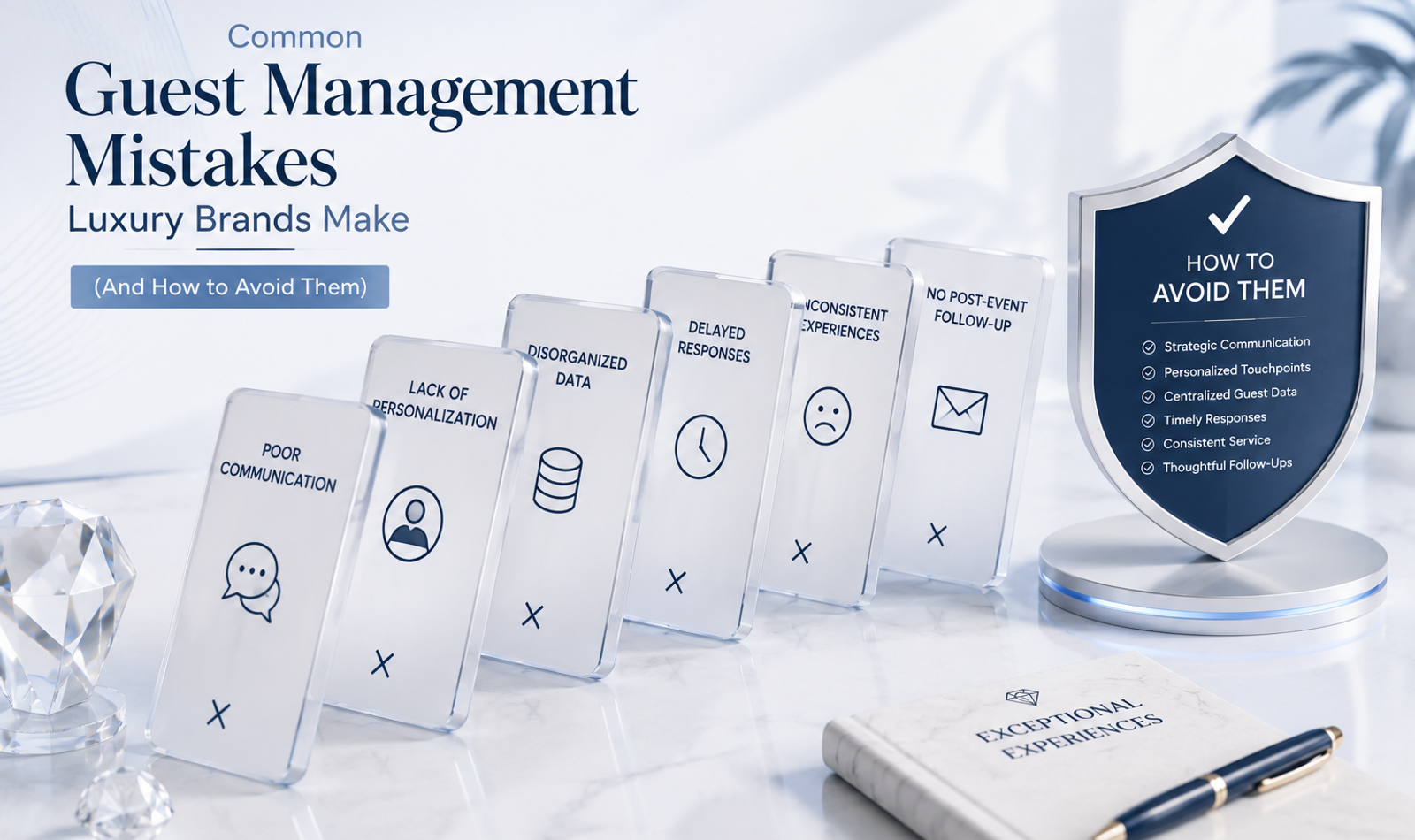
The 12 Most Common Guest Management Mistakes—and Their Solutions
Mistake 1: Treating Guest Management as a Logistics Task
The first mistake is reducing guest management to invitations, attendance and a registration desk. This approach may produce a list, but it does not create a guest strategy.
Why it damages the experience: Different attendees have different reasons for being present. A founder, celebrity, journalist, investor, wedding elder, influencer and production partner should not move through the same journey or receive identical communication.
How to avoid it: Define the purpose of every guest category before building the list. Decide who owns the relationship, what experience the guest requires and what outcome the host expects from the invitation.
A strategic guest brief should answer:
- Why is this person being invited?
- Who invited them and who will recognise them on arrival?
- What access level, seating zone or hospitality support do they require?
- Is a representative, assistant, security officer or family member accompanying them?
- Does the relationship require post-event follow-up?
When these answers are clear, guest management becomes part of brand positioning rather than a last-minute administrative function.
Mistake 2: Building the Guest List Before Defining Capacity and Experience
Many events begin with names instead of operational reality. The list grows through internal requests, client additions, family pressure, partner commitments and last-minute approvals. Capacity is considered only after the experience has already been compromised.
Why it damages the experience: A venue may technically accommodate a certain number of people while still being unable to deliver premium movement, seating, service and hospitality at that number. Legal or physical capacity is not the same as luxury capacity.
How to avoid it: Set the desired experience density before opening invitations. Calculate how many guests can be seated, welcomed, served and moved comfortably across each zone.
Review capacity for:
- Arrival and security screening
- Registration and credential collection
- Main-stage or ceremony seating
- VIP lounges and holding rooms
- Food and beverage service
- Washrooms, lifts and corridors
- Valet, parking and departure
Create a controlled reserve for approved last-minute additions rather than filling every available place at the beginning.
Mistake 3: Maintaining Multiple, Unsynchronised Guest Lists
Disconnected spreadsheets, WhatsApp messages, handwritten additions and department-specific versions create one of the most common guest management failures: nobody knows which list is final.
Why it damages the experience: Duplicate invitations, missed names, incorrect spellings, unrecorded plus-ones and conflicting access instructions appear at the entrance, where there is little time to investigate.
How to avoid it: Maintain one source of truth. Every invitation, RSVP, cancellation, plus-one, seating change and access update should be recorded in the same controlled system.
The master guest record should include only information that is genuinely required, such as:
- Full name and preferred title
- Organisation, relationship or family group
- Invited by and relationship owner
- RSVP status and confirmation date
- Approved plus-one or accompanying person
- Guest category and access level
- Travel, dietary or accessibility notes
- Table, row, room or zone assignment
- Arrival contact and special protocol
- Communication consent and relevant privacy notes
Restrict editing rights, track changes and define who has authority to approve additions. A guest database is only useful when governance is clear.
Mistake 4: Using a Weak RSVP and Confirmation Process
Informal confirmations may work for a small dinner, but they become unreliable at scale. A message saying “I should be there” is not the same as a confirmed RSVP.
Why it damages the experience: Unclear attendance affects catering, seating, credentials, transport, hotel rooms, gifts and security planning. It also creates pressure at the entrance when unconfirmed guests arrive expecting access.
How to avoid it: Create a defined RSVP journey with a deadline, reminder sequence and escalation path.
A professional RSVP process should include:
- A personalised invitation with clear event details
- A simple confirmation method
- A stated RSVP deadline
- A reminder for guests who have not responded
- A final confirmation with arrival instructions
- A controlled process for changes, cancellations and plus-ones
Use QR codes or digital credentials when appropriate, but do not assume technology alone creates a good experience. The guest-facing team still needs an exception process for name variations, network failures, misplaced phones and approved last-minute changes.
Mistake 5: Failing to Segment VIPs, Celebrities, Media and Strategic Guests
A single label such as “VIP” is often too broad. One guest may need discreet arrival, another may require media access, and another may need to be introduced to the founder. Treating them as one category creates confusion.
Why it damages the experience: High-profile guests can be delayed, exposed unnecessarily, directed to the wrong zone or approached by people who should not have access. The result is discomfort for the guest and reputational risk for the host.
How to avoid it: Build functional segments based on the experience and protocol required, not simply perceived status.
Useful segments may include:
- Celebrity or talent guest
- Celebrity representative, manager or security detail
- Founder, promoter or board guest
- Investor or strategic partner
- Government or diplomatic guest
- Media, photographer or broadcast crew
- Influencer or content collaborator
- Wedding family, close family or elder
- Sponsor or commercial partner
- General invited attendee
Each segment should have a named owner, arrival route, access rule, seating plan and communication method. Segmentation should feel discreet in execution, never theatrical.
Mistake 6: Over-Inviting and Losing Control of Plus-Ones
Luxury brands sometimes over-invite to protect attendance numbers or create a crowded visual atmosphere. The same risk appears when plus-one rules are vague or inconsistently enforced.
Why it damages the experience: Overcrowding affects movement, service speed, seating, security and comfort. It also weakens the feeling of curation that makes a premium event distinct.
How to avoid it: Set invitation tiers, approval limits and plus-one rules before invitations are issued.
Clarify:
- Which invitations include a plus-one
- Whether the accompanying person must be named in advance
- Whether children, assistants or security personnel are included
- Who can approve additional guests
- How walk-ins and unregistered companions will be handled
Do not ask entrance staff to negotiate policy in front of a guest. Escalate exceptions to a senior decision-maker away from the main queue.
Mistake 7: Designing Entry for Data Collection Instead of Guest Flow
Registration desks are often arranged around the organiser’s spreadsheet rather than the guest’s physical journey. Too many questions, poorly placed counters and unclear queue lines slow the first interaction.
Why it damages the experience: The entrance sets the emotional tone of the event. A guest who waits, repeats information or is passed between team members begins the experience with frustration.
How to avoid it: Map the arrival from vehicle drop-off to final entry. Collect essential information before the event wherever possible and keep on-site verification concise.
A strong entry design may include:
- Clear vehicle and pedestrian arrival routes
- Visible but elegant wayfinding
- Separate lanes where different verification processes are required
- Pre-issued digital or physical credentials
- A discreet exception desk away from the main queue
- A senior escalation contact with authority to decide
- A manual backup list and offline process
Conduct a timed rehearsal using realistic arrival volumes. A registration plan that works with five staff members standing still may fail when cars arrive together and guests approach from several directions.
Mistake 8: Treating Seating and Access as Static Layouts
A seating chart is not simply a collection of names placed on tables. It is a relationship map involving hierarchy, visibility, comfort, movement, security and social dynamics.
Why it damages the experience: Incorrect placement can separate hosts from important guests, create family tension, obstruct accessibility, expose celebrities or leave media teams without the access they need.
How to avoid it: Build seating and zoning around guest purpose, relationship and operational need.
Review:
- Sightlines and stage visibility
- Proximity to hosts and relationship owners
- Accessibility and movement requirements
- Security and privacy
- Age, family dynamics and cultural considerations
- Media capture and restricted areas
- Food service routes
- Late-arrival and early-departure needs
Freeze the primary seating plan by a defined deadline, maintain controlled reserves and issue the guest-facing team only the latest approved version.
Mistake 9: Under-Briefing Guest-Facing Teams
Even a strong plan fails when the people interacting with guests do not understand it. Teams are often given names and positions but not context, decision rules or communication standards.
Why it damages the experience: Uncertain staff members point, guess, contradict one another or discuss sensitive details in public. Guests feel the lack of confidence immediately.
How to avoid it: Brief teams by role and scenario, not only by task.
Every guest-facing team member should know:
- The event narrative and service tone
- Their physical zone and reporting manager
- The guest categories they are authorised to handle
- How to verify names and credentials
- How to respond when a guest is not on the list
- Where VIPs, media, sponsors and family members should be directed
- What information must remain confidential
- Who can approve an exception
- How to report an incident without creating visible panic
Run role-play exercises for realistic situations. Confidence is built before the event, not during the queue.
Mistake 10: Operating Without a Clear Escalation and Contingency Plan
Late VIP confirmations, vehicle delays, weather changes, power issues, security concerns, seating disputes and unexpected walk-ins are normal event risks. The mistake is not that something changes; it is that nobody knows who should decide.
Why it damages the experience: Teams delay action, provide inconsistent answers or escalate everything to one overwhelmed person. Small issues become visible because authority is unclear.
How to avoid it: Create a simple escalation matrix that identifies the incident type, first responder, decision-maker and communication method.
Prepare contingencies for:
- Guest names missing from the list
- Unapproved plus-ones
- VIPs arriving earlier or later than expected
- Credential or QR-code failure
- Seating conflicts
- Overcapacity in a room or lounge
- Medical, accessibility or safety concerns
- Weather disruption
- Transport and parking congestion
- Media or photography disputes
The best crisis handling is calm, private and fast. Resolve the guest’s immediate need first, then document the issue for review.
Mistake 11: Misaligning Guest Management with PR, Content and Privacy
Guest operations, PR, social media, photography and security are frequently planned by separate teams. Without coordination, one team may create exposure that another team is trying to prevent.
Why it damages the experience: A private guest may be photographed without appropriate approval, a media attendee may miss the correct access window, or an influencer may receive no guidance about what can be shared.
How to avoid it: Create one guest-content protocol before the event.
The protocol should clarify:
- Which zones may be photographed or filmed
- Which guests require approval before publication or tagging
- Who can issue media credentials
- Where interviews and content capture may take place
- Which announcements are embargoed or confidential
- Who approves names, titles, captions and photographs
- How guests can raise a privacy concern
Good amplification begins with consent, accuracy and coordination. Visibility should never be created at the cost of trust.
Mistake 12: Ending Guest Management at the Exit
Many teams close the guest list when the event ends. They do not reconcile attendance, record conversations, resolve pending hospitality matters or continue high-value relationships.
Why it damages the experience: The emotional momentum disappears, promises are forgotten and potential referrals, media opportunities or commercial conversations are lost.
How to avoid it: Build post-event guest follow-up into the original event plan.
A complete closure process should include:
- Attendance reconciliation
- Lost-and-found and travel support
- Personal thank-you messages for priority guests
- Approved photographs, videos or media assets
- Sponsor and partner fulfilment
- Feedback collection
- Business or relationship next steps
- Review of complaints and service recovery
- Secure retention or deletion of unnecessary guest data
Guest management does not end when the guest leaves. It ends when the experience, commitments and relationship have been closed properly.
The LUXE Guest Management Control Framework
Luxury brands need a system that teams can remember under pressure. The LUXE framework turns guest management into four connected controls.
L — List and Segment
Create one controlled guest database. Define guest categories, access levels, relationship owners, plus-one rules, seating needs and communication permissions.
U — Understand the Guest Journey
Map the complete experience from invitation and arrival to seating, hospitality, departure and follow-up. Identify where the guest may wait, ask a question, require assistance or encounter a decision point.
X — eXecute with Ownership
Assign clear owners for every zone, guest category and escalation. Rehearse entry, seating, VIP movement, security coordination and exception handling.
E — Extend and Evaluate
Thank guests, close commitments, review feedback and measure performance. Use what the team learns to improve the next event.
The LUXE principle: one list, one journey, clear ownership and disciplined follow-through.
A 72-Hour Pre-Event Guest Management Checklist
The final 72 hours should be used to verify systems, not invent them.
72 Hours Before
- Freeze the main invitation list and identify controlled exceptions
- Confirm priority guests, plus-ones, representatives and security details
- Verify names, titles, phone numbers and arrival contacts
- Review seating, zone access and hospitality requirements
- Confirm transportation, hotel and special-assistance details
- Share approved arrival information with guests
48 Hours Before
- Issue the final working list to authorised teams
- Complete guest-facing staff briefing
- Test digital credentials, scanners, devices and connectivity
- Prepare printed and offline backups
- Confirm signage, counters, barriers and exception areas
- Review content, media and privacy protocols
24 Hours Before
- Conduct a full venue walk-through
- Simulate peak arrival and departure
- Confirm radio groups and escalation contacts
- Verify reserved seats, lounges and holding rooms
- Check final weather, transport and security contingencies
- Remove outdated lists from circulation
How to Measure Guest Management Performance
Attendance alone does not show whether guest management succeeded. Measure the quality and control of the experience.
Before the Event
- Invitation delivery and RSVP completion
- Number of unresolved confirmations
- Accuracy of guest data
- Late additions and unapproved plus-one requests
During the Event
- Average and peak check-in time
- Queue length and congestion points
- Guest-list exceptions
- Seating or access disputes
- VIP response and escort time
- Hospitality and accessibility issues
- Incidents resolved without escalation to the host
After the Event
- Priority thank-you completion
- Outstanding commitments
- Guest feedback themes
- Sponsor, media and partner follow-up
- Repeat attendance, referrals or qualified enquiries
- Issues carried forward into the next event
Set internal benchmarks based on your event format and improve them over time. A smaller, well-managed event can create more value than a crowded event with weak guest experience.
How Technology Should Support Luxury Guest Management
Technology can centralise information, reduce repetitive work and improve visibility. It should not replace judgement or hospitality.
Useful capabilities may include:
- Centralised guest records
- Personalised invitations and RSVP forms
- Automated but segmented reminders
- QR or credential-based check-in
- Live attendance visibility
- Digital seating and zoning plans
- Role-based access for internal teams
- Incident and follow-up tracking
Choose tools according to event scale, security, privacy and team capability. A complicated platform used poorly can create more friction than a simpler system managed well.
Always maintain a backup process. Guest experience should not stop because a device, network or platform fails.
Internal Linking Opportunities for This Blog
To strengthen topical relevance on the Double Trouble Studio website, link naturally from this article to related pages and blogs using descriptive anchor text.
- Guest Management Services
- Event Management and Luxury Wedding Planning
- Celebrity Management and Appearance Coordination
- On-Site Guest Flow: Registration, Entry, Seating and Experience Mapping
- Post-Event Guest Follow-Up: Thank-You Strategies That Build Loyalty
- Managing Celebrity Appearances: Logistics, Security and On-Site Coordination
- PR and Media Management for Premium Events
- Digital Marketing and Event Amplification
Avoid placing all links in one paragraph. Add each link where it genuinely helps the reader understand the next topic.
Frequently Asked Questions
What are the most common guest management mistakes?
The most common mistakes include disconnected guest lists, weak RSVP tracking, poor segmentation, over-inviting, unclear plus-one policies, slow check-in, seating conflicts, undertrained teams, missing contingency plans and no post-event follow-up.
What is luxury event guest management?
Luxury event guest management is the end-to-end planning of invitations, confirmations, access, arrival, seating, hospitality, privacy, departure and relationship follow-up for premium events.
Why is guest segmentation important?
Segmentation helps the team provide the correct access, communication, seating and hospitality to different guest categories without making the treatment feel public or uncomfortable.
How can brands improve event RSVP management?
Use one controlled database, a clear RSVP deadline, segmented reminders, verified plus-one rules and a final confirmation message containing arrival and access information.
How should VIP guests be managed?
Assign a relationship owner, confirm arrival details, provide discreet access, reserve appropriate seating or hospitality and prepare a private escalation route for changes.
How should celebrity guests be handled at events?
Coordinate through the authorised representative, confirm arrival and security protocols, control photography and access, prepare an escort route and document agreed appearance or media requirements.
How do you avoid long event check-in queues?
Collect information before the event, issue credentials in advance where appropriate, create clear lanes, train staff, test peak arrival and establish a separate exception desk.
How can luxury brands prevent overcrowding?
Set experience-led capacity, control invitation tiers, define plus-one rules, monitor confirmations and maintain a limited reserve instead of over-inviting.
What should be included in a guest management brief?
Include the master guest list, segment definitions, arrival routes, seating and access plans, staff roles, escalation contacts, privacy rules, contingency procedures and post-event responsibilities.
What is guest flow planning?
Guest flow planning maps how people arrive, verify access, enter, move between zones, find seating, receive hospitality and depart without unnecessary congestion or confusion.
How should guest-facing teams be trained?
Train them on service tone, guest categories, verification, seating, privacy, exception handling and escalation. Use scenario-based rehearsals instead of relying only on written instructions.
How should unregistered guests be handled?
Move the conversation away from the main queue, verify the relationship discreetly and escalate to an authorised decision-maker. Frontline staff should not negotiate policy publicly.
How should event seating be managed?
Plan seating around relationships, visibility, security, accessibility, cultural considerations and movement. Freeze the plan by a deadline and distribute only the latest approved version.
What should happen after the event?
Reconcile attendance, resolve pending issues, thank priority guests, deliver approved assets, record feedback, complete sponsor or partner commitments and assign owners to every next step.
How is guest management success measured?
Measure RSVP accuracy, check-in time, queues, exceptions, seating issues, VIP response, issue resolution, feedback, repeat attendance, referrals and completion of post-event commitments.
Does Double Trouble Studio provide guest management services?
Double Trouble Studio supports premium weddings, corporate events, brand launches and celebrity-attended experiences with guest-list strategy, RSVP management, VIP coordination, entry and seating planning, on-ground execution and post-event follow-up.
How Double Trouble Studio Prevents Guest Management Mistakes
Double Trouble Studio designs guest management as part of the complete brand and event experience. The process can include guest-list architecture, invitation and RSVP workflows, VIP and celebrity coordination, travel and hospitality support, registration planning, seating and access control, media alignment, on-ground guest relations and post-event communication.
The objective is not simply to prevent queues or seating errors. It is to create a guest journey that protects the host’s reputation, supports the event’s purpose and makes every important attendee feel recognised.
Planning a luxury wedding, corporate summit, hospitality launch, private preview or celebrity-attended event? Connect with Double Trouble Studio to build a guest management system around your venue, audience and brand positioning.
Conclusion
Guest management mistakes are rarely isolated operational problems. They affect perception, comfort, security, relationships and long-term brand authority.
Luxury brands avoid these mistakes by treating guest management as a strategic system. They define capacity before invitations, maintain one verified guest list, segment attendees, control plus-ones, map entry and seating, train teams, prepare contingencies, coordinate privacy and complete post-event follow-up.
The best guest management is almost invisible. Guests do not see the database, rehearsal, seating logic or escalation plan. They experience recognition, confidence and ease.
That is what makes an event feel premium.
📩 info@dtsworld.in 📞 +91 80000 06021 📍 Andheri West, Mumbai
Need this for your brand?
Let DTS build your next campaign.
From PR, celebrity management and events to websites, social media, SEO and AI video production — Double Trouble Studio helps brands grow with strategy and execution.
Discuss Your Requirement →