Guest Data and Privacy in Luxury Events: Compliance, Security and Ethical Use
Luxury events depend increasingly on guest data. Invitations, RSVP systems, seating plans, hotel bookings, transport schedules, dietary preferences, VIP profiles and digital check-in tools all require information about the people attending.
This information allows an organiser to create a more personalised and seamless experience. It can help teams recognise guests, prepare appropriate hospitality and coordinate security. However, the same information can create serious privacy and reputation risks when it is collected unnecessarily, shared casually or stored without protection.
In a luxury environment, privacy is not only a legal responsibility. It is part of the service experience. Guests expect their personal details, travel information, photographs and preferences to be handled with the same discretion applied to every other premium touchpoint.
A secure and ethical guest-data strategy should therefore begin before invitations are sent. It must continue through registration, attendance, content sharing, post-event communication and final data deletion.
This article provides general event-planning guidance and should not be treated as legal advice. Organisers should obtain professional advice based on the event location, technology, guest profile and laws applicable on the event date.
Quick Answer
Luxury event guest data privacy requires organisers to collect only necessary information, explain how it will be used, restrict internal access and protect the systems used to store it. Guests should also have clear ways to correct information, withdraw relevant permissions and raise privacy concerns.
A strong strategy combines legal compliance, secure technology, responsible vendor management and ethical judgement. The objective is not simply to avoid a breach. It is to create an environment in which every guest feels respected and protected.
What Is Guest Data in a Luxury Event?
Guest data includes any information that identifies a person or can be connected to them. It may be collected directly through invitations and RSVP forms or indirectly through check-in systems, photography, access-control tools and event applications.
Basic guest data may include a name, phone number, email address, organisation and invitation status. More detailed records may contain seating assignments, travel schedules, room numbers, dietary requirements, access permissions and relationship notes.
Luxury events may also involve information about public figures, investors, family members, children, security teams and government guests. These records can reveal more than attendance. They may expose routines, relationships, preferences and physical locations.
The organiser should therefore treat every guest record as information entrusted for a particular event purpose. Access should be based on genuine operational need rather than general curiosity or convenience.
Common data categories include:
• Contact information
• RSVP status
• Travel details
• Hospitality needs
• Access permissions
• Media preferences
These categories should not automatically be combined into one unrestricted document. Different teams usually require different parts of the information.
Why Privacy Is Part of the Luxury Experience
Luxury service is built on trust, recognition and discretion. A guest may willingly share preferences with a host because they expect the information to improve their experience, not to circulate among unrelated vendors or appear in an unprotected spreadsheet.
A privacy failure can therefore feel deeply personal. An exposed room number, forwarded guest list or unapproved photograph may damage the relationship even when no financial harm occurs. In high-value social and professional networks, that loss of confidence can spread quickly.
Privacy also influences how comfortable guests feel during the event. Celebrities, senior executives and private families may limit their participation when they believe their location, images or conversations are not properly controlled.
Responsible data management should therefore be positioned as part of hospitality. The strongest organisers protect information quietly while still delivering personalised service.
Understanding the Compliance Landscape
Event organisers should identify which privacy, cybersecurity, contractual and sector-specific obligations apply before collecting guest data. The relevant rules may depend on where the organiser operates, where guests are located, which technology is used and where information is stored.
India’s Digital Personal Data Protection framework has been introduced through phased commencement. Organisers should confirm which provisions are legally in force on the date of their event rather than relying on outdated summaries or assuming the entire framework applies in the same way immediately.
An event involving guests, vendors or systems connected to other countries may also require review of foreign privacy requirements. International corporate events, destination weddings and global brand launches can involve several legal and contractual obligations at once.
Compliance should not be treated as a short disclaimer placed at the end of an RSVP form. It should influence how data is requested, stored, shared, secured and deleted throughout the event lifecycle.
Identifying the Data Controller
The first governance question is who decides why guest data is collected and how it will be used. Depending on the structure, this may be the brand, host family, event organiser, venue or a combination of parties.
The organisation making these decisions generally carries primary responsibility for the data-processing purpose. Technology providers, RSVP agencies, hotels, photographers and security vendors may process information on its behalf.
Responsibilities should be written clearly into contracts. The organiser should know who maintains the database, who answers guest requests and who manages a security incident.
Unclear ownership creates delayed responses and conflicting decisions. A luxury event may involve many partners, but the guest should not be required to understand that complexity to receive privacy support.
Defining a Lawful and Clear Purpose
Guest data should be collected for a clear and legitimate event purpose. The organiser should be able to explain why each category of information is needed and how it supports the guest experience or event operation.
A phone number may be needed for arrival assistance. Dietary information may be needed for hospitality planning. Identification details may be required for a controlled-access venue or travel booking.
The purpose should not expand silently after collection. Information provided for event entry should not automatically become a permanent marketing database. A separate use may require a separate communication or permission process.
Purpose clarity improves both compliance and trust. When organisers understand why information is being collected, they are less likely to request unnecessary details.
Using Consent Responsibly
Consent should be specific, informed and connected to a clear action where it is being relied upon. Guests should understand what they are agreeing to rather than being presented with a broad statement covering every possible future use.
Attendance confirmation, marketing communication, photography and biometric verification may involve different decisions. Combining everything into one mandatory checkbox reduces meaningful choice.
The organiser should also consider what happens if a guest does not agree to an optional activity. A person who does not want facial recognition should generally have access to a practical alternative check-in process.
Withdrawing consent should not be intentionally difficult. Guests should be able to contact an identified person or use a clear process to update their preference.
Consent is strongest when the organiser can demonstrate what information was shown, what action the guest took and when the choice was recorded.
Writing a Clear Privacy Notice
A privacy notice should explain the data being collected, why it is required and who may receive it. It should use direct language instead of hiding important information inside complex legal wording.
The notice should also explain how guests can ask questions, update information or raise a concern. Where retention periods or international transfers are relevant, these should be described appropriately.
The notice does not need to dominate the visual invitation. A concise explanation can appear beside the form, supported by a clearly accessible detailed policy.
Design and clarity matter. A luxury event should not use elegant communication for hospitality while presenting privacy information in unreadable text.
A useful notice answers four basic questions:
• What is collected?
• Why is it needed?
• Who receives it?
• How to object?
These answers should reflect the actual event process rather than a generic template copied from another organisation.
Practising Data Minimisation
Data minimisation means collecting only what the event genuinely needs. Every additional field increases the responsibility to protect, update and eventually delete that information.
An RSVP form does not need a complete personal history. If a phone number, dietary preference and arrival time are sufficient, the organiser should not request unrelated identity or family details.
Teams should challenge every field before publishing the form. The question should be whether the information supports a defined action. Curiosity or future possibility is not a strong reason for collection.
Data minimisation also improves the guest experience. Shorter forms are easier to complete, while simpler databases reduce errors and unauthorised exposure.
Separating Required and Optional Information
Not all event information has the same importance. Some details may be necessary to confirm attendance, while others may improve personalisation but remain optional.
The RSVP form should make this difference clear. A guest should not believe that a preference question is mandatory when the event can operate without it.
Optional information should have an understandable benefit. Asking about preferred cuisine may support hospitality, while requesting an unrelated social-media profile may provide little value.
Separating required and optional fields creates more honest communication. It also gives guests greater control over how much information they share.
Protecting RSVP Data
RSVP systems often contain the central guest database and should be treated as a high-value information asset. Access should not be shared through common passwords or unrestricted links.
The platform should support secure authentication, controlled user roles and reliable backups. Staff access should be removed when their event responsibility ends.
Guest lists should not be downloaded to multiple personal devices unless necessary. Each duplicate creates another place where information can be lost, forwarded or left unprotected.
Before selecting an RSVP provider, organisers should review security, data location, subcontractors, deletion support and incident-response procedures. A visually attractive platform is not sufficient if its data practices are unclear.
Avoiding Uncontrolled Spreadsheets
Spreadsheets are widely used because they are flexible and familiar. They can still create serious risk when copies are circulated through personal email, messaging groups and unprotected devices.
A guest list should have one approved source, defined editors and controlled viewing permissions. Sensitive details should not appear in columns visible to every team member.
Where spreadsheets are necessary, they should be stored within an approved organisational system rather than personal accounts. Downloading and forwarding should be restricted wherever practical.
Older versions should be removed from circulation. A forgotten copy may expose information long after the event has ended.
Using Role-Based Access
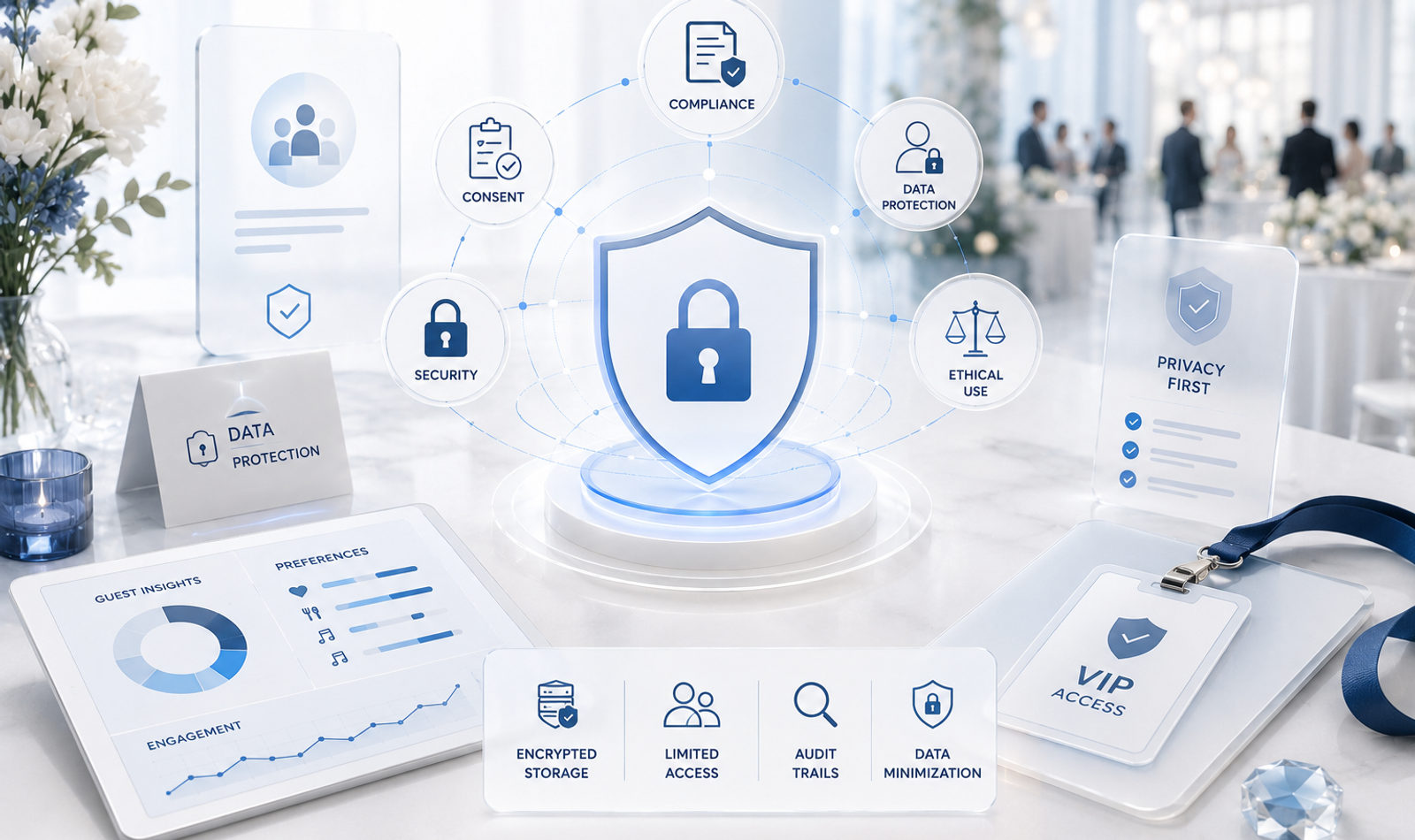
Role-based access means that each team sees only the information needed for its responsibility. Registration staff may need names and credentials, while the catering team may need meal requirements without phone numbers.
Transport coordinators may require flight and vehicle details. Photographers may need content permissions but should not receive hotel room numbers or private notes.
Senior guest managers may require a broader view, but their access should still be monitored. VIP status does not justify unrestricted sharing across the team.
Role-based access reduces accidental disclosure and improves clarity. It also prevents staff from becoming distracted by information unrelated to their task.
Securing Devices and Accounts
Guest information is often accessed through laptops, tablets and phones during the event. These devices should be protected by strong authentication, current software and automatic locking.
Shared accounts make it difficult to identify who viewed or changed information. Named accounts and activity logs provide better control and accountability.
Devices used at registration should be positioned so that guests cannot see another person’s record. Notifications and unrelated applications should be disabled where they may expose information.
Lost-device procedures should be established before the event. The team should know whom to contact and how to revoke access immediately.
Encrypting Sensitive Information
Encryption can protect information while it is stored and while it moves between systems. It should form part of the security evaluation for RSVP platforms, cloud storage and event applications.
Highly sensitive records may also be protected through masking, tokenisation or separation. For example, a check-in code can point to a guest record without displaying personal information directly.
The organiser should not assume that every vendor applies the same security standard. Contract discussions should confirm how information is protected, backed up and restored.
Encryption is only one control. Strong security also requires access management, monitoring, staff training and responsible deletion.
Managing Dietary and Accessibility Information
Dietary and accessibility information allows organisers to provide appropriate hospitality and support. It may also reveal health-related or personal circumstances that deserve careful handling.
The information should be shared only with teams responsible for the relevant service. A catering team may need the dietary requirement but not the guest’s complete profile or professional status.
Labels and printed documents should avoid exposing private details publicly. Service staff can use coded or discreet systems where appropriate.
The information should not become informal conversation among team members. Personalisation should make the guest feel supported, not observed.
Protecting VIP and Celebrity Data
VIP records may include private phone numbers, assistant details, security arrangements, vehicle information, schedules and access routes. Unauthorised disclosure can create both privacy and physical-safety risks.
These details should be stored separately or protected through higher access controls. Only the relationship owner and relevant operational leads should receive the information.
VIP lists should not be circulated to increase internal excitement or social visibility. Celebrity attendance should remain confidential until the authorised communication plan allows disclosure.
Printed movement schedules and rooming details require particular care. They should be collected after use and destroyed securely rather than left inside vehicles, control rooms or hospitality desks.
Handling Children’s Information
Luxury weddings and family events may collect names, ages, meal preferences, photographs and childcare details relating to children. This information should receive additional caution.
Parents or lawful guardians should be informed about the data being requested and how it will be used. Photography and activity permissions should be managed clearly rather than assumed.
Child-related lists should not expose unnecessary family contact details or room information. Access should remain limited to the teams providing the relevant service.
When the information is no longer needed, it should be deleted securely. The presence of children makes privacy planning more important, not less.
Managing Guest Photographs and Videos
Photography is central to luxury events, but attendance should not automatically be treated as unlimited permission for every form of publication. Private events and public brand activations may require different approaches.
Guests should receive appropriate information about photography and recording. The event should also provide a way to raise concerns or request restricted treatment where feasible.
Celebrity photographs, private family moments and confidential corporate content may require specific approval. The photography, PR and social-media teams should follow one coordinated content protocol.
Image files should also be secured. Raw folders often contain unapproved moments, identity documents visible in the background or confidential screens that should never be published.
Using Facial Recognition Ethically
Facial recognition and biometric check-in require stronger governance because they connect access decisions to a person’s physical characteristics. The organiser should first decide whether the technology provides a genuine benefit.
Guests should understand how enrolment works, what information is created, who operates the system and how long it will be retained. Participation should not be presented as harmless novelty.
A practical alternative should be available for guests who do not wish to use biometric verification. That alternative should not be intentionally slower or embarrassing.
The system must also include manual review when a match fails. No guest should be publicly rejected or treated as suspicious solely because an automated comparison did not succeed.
Securing QR and RFID Credentials
QR codes and RFID credentials may reduce manual data exposure, but they still require security planning. Codes can be forwarded, while physical cards or wristbands can be transferred or lost.
Each credential should connect to a controlled guest record. Duplicate use, replacement and deactivation processes should be prepared before the event.
Sensitive information should not be displayed directly inside the credential unless necessary. A token-based design can retrieve the appropriate record from the authorised system.
The team should also avoid photographing or publicly sharing credentials. A visible code may allow another person to copy or misuse access.
Controlling Vendor Access
Luxury events often involve several vendors that process guest information. These may include event agencies, RSVP providers, hotels, transport companies, security teams, caterers, photographers and technology suppliers.
Each vendor should receive only the information required for its service. Sharing the complete database with every partner increases exposure without improving execution.
Contracts should define confidentiality, security controls, subcontracting, retention and deletion. They should also explain how the vendor must respond if information is lost or accessed without permission.
Vendor access should end when the service is complete. Organisers should request confirmation that temporary files and unnecessary copies have been deleted.
Reviewing Cloud and International Transfers
Guest information may be stored in a cloud service located outside the organiser’s country. This can introduce additional compliance, security and contractual questions.
The organiser should know where information is stored and which entities can access it. A vendor’s brand name alone does not answer these questions.
Destination weddings and international events may involve hotels, airlines and service providers in several jurisdictions. Data-sharing plans should account for these relationships before collection begins.
Where legal restrictions or additional safeguards apply, organisers should obtain appropriate advice. Cross-border processing should be intentional rather than discovered after the platform has already been selected.
Creating a Retention Schedule
Guest data should not remain in active systems indefinitely simply because storage is inexpensive. The organiser should define how long different categories are needed.
Entry credentials may be required only for the event and a short reconciliation period. Invoice and contractual records may need longer retention where required by law.
Marketing contact details should not be retained automatically when the guest provided them only for attendance. Future communication should follow the appropriate permission and relationship process.
A retention schedule gives the team a clear deletion date. It also prevents event databases from becoming permanent archives of outdated personal information.
Deleting Data Securely
Deletion should cover more than the main RSVP platform. Copies may exist in spreadsheets, messaging applications, email attachments, printed lists and vendor systems.
The event-closure process should identify where data was shared and confirm that unnecessary copies have been removed. Printed documents should be shredded or otherwise destroyed securely.
Deleting a file from a local folder may not remove it from backups or shared drives. The technology provider should explain how deletion works across its systems.
Secure deletion demonstrates that privacy responsibility continues after the guests have left.
Preparing for a Data Breach
A data breach can involve unauthorised access, accidental sharing, lost devices, compromised accounts or disclosure to the wrong recipient. The organiser should prepare a response plan before an incident occurs.
The plan should identify the incident lead, technology contact, legal adviser and communication decision-maker. Staff should know how to report a suspected issue immediately.
The first response should focus on containment and preservation of relevant evidence. Access may need to be revoked, links disabled or affected systems isolated.
The organiser should then assess the information involved, people affected and likely consequences. Legal and contractual notification duties should be reviewed without delay.
Coordinating Cyber-Incident Reporting
Some organisations operating in India may have cyber-incident reporting and logging obligations under CERT-In directions. Applicability should be reviewed according to the entity, incident and systems involved.
Event teams should not wait until a breach occurs to determine who controls the logs or vendor information. The incident plan should identify which provider can supply technical evidence and within what timeframe.
System clocks, activity logs and named points of contact can become important during an investigation. These operational requirements should be addressed during technology procurement.
Fast reporting is only possible when responsibility and information are already organised.
Communicating with Affected Guests
When guest information is exposed, communication should be clear, factual and respectful. The organiser should avoid both unnecessary alarm and misleading reassurance.
The message should explain what happened, what information may be affected and what steps have been taken. Guests should also receive practical guidance where action may reduce risk.
A named contact should be available for questions. High-priority relationships may require direct communication from a senior representative in addition to general notices.
How an organiser responds can influence trust as strongly as the original incident. Transparency and accountability are essential to service recovery.
Ethical Use Beyond Legal Compliance
A practice can appear technically permitted while still feeling intrusive or inappropriate. Ethical guest-data use asks whether the activity is fair, proportionate and consistent with the relationship.
For example, tracking every movement through RFID may create detailed behavioural information. The organiser should decide whether that level of monitoring is necessary for access or simply attractive because the technology allows it.
Similarly, inferred preferences should not be treated as verified facts. A guest’s past behaviour may not represent their current needs or wishes.
Luxury brands should use data to reduce friction, not to maximise observation. Ethical judgement protects the emotional quality of the experience.
Avoiding Invisible Profiling
Guest segmentation supports hospitality when it is based on transparent and relevant information. It becomes problematic when people are secretly ranked or labelled through assumptions.
Internal notes should remain respectful, factual and operational. Terms that judge personality, wealth or social value can create bias and reputational risk.
Automated scoring should not determine sensitive access or hospitality decisions without human review. Systems can support teams, but they should not replace relationship judgement.
A guest should never receive poorer treatment because incomplete data has created the wrong profile.
Designing Privacy into the Event
Privacy by design means addressing data protection during event planning rather than adding controls after systems have been selected.
The organiser should map each point where guest information enters, moves and leaves the event operation. This includes invitations, forms, databases, hotel lists, check-in devices and post-event galleries.
At every stage, the team should ask what data is necessary, who needs it and when it should be removed. These questions reduce both compliance risk and operational clutter.
Privacy by design also supports better hospitality. Clear information flows help teams deliver service without repeatedly requesting the same details.
The TRUST Guest Data Framework
The TRUST framework can help luxury event teams structure responsible data management from invitation to deletion.
T — Target the Purpose
Define why each category of information is being collected. Remove fields that do not support a clear operational, safety or relationship need.
R — Restrict the Access
Give each team only the information required for its responsibility. Protect VIP, biometric and travel records with stronger controls.
U — Use Data Fairly
Apply guest information only for the communicated purpose. Avoid hidden profiling, unnecessary tracking and unrelated marketing use.
S — Secure the Lifecycle
Protect information during collection, storage, sharing, check-in and deletion. Include vendors, devices, paper lists and backup systems.
T — Terminate Retention
Delete information when the event purpose and applicable retention requirements are complete. Confirm that vendors remove their unnecessary copies.
The TRUST framework turns privacy from a legal document into an operational discipline.
Guest Data Checklist Before the Event
A short privacy review should be completed before invitations and RSVP forms go live. The team should confirm that data collection matches the event’s actual requirements.
Review these areas:
• Collection purpose
• Guest notice
• Access roles
• Vendor contracts
• Security controls
• Retention dates
The organiser should also identify the person responsible for guest privacy questions. A concern should not move through several departments before someone can answer it.
Guest Data Checklist During the Event
The on-ground team should verify that registration devices, printed lists and control-room screens are protected. Guest information should not be visible to unrelated staff or attendees.
Changes should be entered into the approved system rather than circulated through informal screenshots. Any lost document or device should be reported immediately.
Photography and media permissions should be followed consistently. High-pressure event conditions should not become an excuse for ignoring privacy controls.
Supervisors should monitor whether vendors are using information only for the agreed service.
Guest Data Checklist After the Event
After the event, the organiser should reconcile attendance, complete necessary follow-up and review where information was shared. Temporary files should not remain active by default.
Vendors should return or delete information according to the agreement. Access accounts and shared links should be disabled when no longer required.
Marketing lists should include only people whose information can appropriately be used for that purpose. Event attendance alone should not be treated as permanent permission.
The final review should document incidents, guest requests and improvements for future events.
Common Guest Data Mistakes
A common mistake is collecting too much information simply because a form can contain additional fields. Every unnecessary detail creates new security and privacy responsibility.
Another failure is sending the complete guest database to every vendor. This exposes contact, travel and VIP information to people who do not need it.
Teams also create risk by using personal messaging accounts, shared passwords and uncontrolled spreadsheets. Convenience during planning can result in permanent copies across several devices.
Finally, many organisers forget deletion. A database created for one evening may remain accessible for years without a defined reason.
Measuring Privacy Performance
Privacy performance should be evaluated through more than the absence of a major breach. Smaller operational failures can reveal weaknesses before serious harm occurs.
The team may track unauthorised access attempts, incorrect messages, lost documents and unapproved image publication. Guest correction and deletion requests should also be reviewed.
Vendor deletion completion, staff training and account closure provide useful internal measures. Repeated issues indicate that privacy controls are not fully integrated into operations.
A successful privacy system supports both security and guest confidence. It should improve over time through documented learning.
Frequently Asked Questions
What Is Guest Data at an Event?
Guest data includes information that identifies an attendee or relates to their participation. It may include contact details, RSVP status, seating, travel, dietary needs, photographs and access records.
The definition should be understood broadly because combining separate details can reveal more than one field alone. Organisers should protect information according to its context and potential impact.
Why Is Guest Privacy Important in Luxury Events?
Luxury events often involve high-profile people, private relationships and detailed hospitality planning. Exposure of this information can affect personal safety, reputation and trust.
Privacy is therefore both a compliance responsibility and a service standard. Guests should feel confident that information shared for their comfort will remain controlled.
What Data Should an RSVP Form Collect?
An RSVP form should collect only information required for attendance, communication and relevant hospitality. This may include contact details, accompanying guests, dietary needs and accessibility requirements.
Optional questions should be clearly separated from required fields. The organiser should be able to explain how every answer will be used.
Can Event Data Be Used for Marketing?
Information provided for event attendance should not automatically be treated as permission for unrelated marketing. The organiser should review the appropriate legal basis and communication expectations.
A separate, clear choice may be needed for future promotional contact. Guests should not be surprised by how their details are used.
How Should VIP Data Be Protected?
VIP data should have restricted access and stronger operational controls. Vehicle details, schedules, private contacts and security routes should be shared only with relevant senior teams.
Printed and digital copies should be monitored carefully. The information should be removed when it is no longer required.
Is Dietary Information Sensitive?
Dietary information may reveal health, religious or personal preferences depending on the context. Even where a law does not classify every dietary detail identically, organisers should handle it discreetly.
Only catering and hospitality teams that need the information should receive it. Public labels should be avoided where they may expose private details.
Can Guest Lists Be Shared with Sponsors?
Guest lists should not be shared with sponsors automatically. Any sharing should have a clear purpose, appropriate communication and contractual control.
Sponsors can often receive aggregated attendance information instead of personal contact details. Individual data should be shared only where the organiser has a valid and transparent basis.
How Should Facial Recognition Data Be Managed?
Facial recognition should be used only when it provides a clear and proportionate benefit. Guests should receive understandable information and a practical alternative where appropriate.
Access, security, retention and deletion require stronger controls. Automated failures must always have respectful human review.
How Long Should Event Data Be Stored?
Retention depends on the purpose, contractual requirements and applicable law. Not every category needs the same period.
The organiser should create a schedule before collection. Information should be deleted when it is no longer required for the event or another lawful obligation.
What Should Happen After a Data Breach?
The organiser should contain the incident, preserve evidence and assess what information and guests are affected. Legal, regulatory and contractual notification requirements should be reviewed immediately.
Communication should be factual and helpful. Affected guests should receive clear guidance and an appropriate contact person.
How Can Vendors Protect Guest Data?
Vendors should receive only the information needed for their service and use secure systems. Contracts should cover confidentiality, access, subcontractors, incidents and deletion.
The organiser should verify completion rather than assuming files disappear automatically after the event.
How Can Luxury Weddings Protect Guest Privacy?
Luxury weddings can limit access to guest lists, hotel records and private photographs. Family, vendor and social-media teams should follow one clear privacy plan.
Destination travel and room details require particular protection. Post-event galleries should also use controlled access where appropriate.
How Can Corporate Events Protect Data?
Corporate events should separate delegate, investor, media and speaker information according to role. Confidential conversations, screens and attendance records require controlled access.
The organiser should also review how lead collection and sponsor data sharing are communicated. Business value does not remove privacy responsibility.
Does the DPDP Act Apply to Events in India?
The answer depends on the type of processing, event structure and provisions in force at the relevant time. India’s DPDP framework has a phased commencement schedule.
Organisers should review current official notifications and obtain appropriate advice before relying on a general online summary.
Does Double Trouble Studio Support Secure Guest Management?
Double Trouble Studio supports premium events with guest-list planning, RSVP workflows, role-based data access, VIP mapping and secure communication processes.
The scope can also include vendor coordination, check-in planning, privacy-led content management and structured post-event data closure.
How Double Trouble Studio Supports Responsible Guest Data Management
Double Trouble Studio approaches guest data as part of the complete luxury event experience. Information should improve service, security and personalisation without reducing guest trust.
Our work can include guest-list architecture, RSVP planning, VIP mapping, access roles and vendor coordination. We can also help structure check-in data, photography permissions and post-event follow-up workflows.
Every event has a different data profile. A destination wedding, corporate summit and celebrity appearance require different levels of access, confidentiality and retention.
The objective is to make guest operations feel seamless while keeping information controlled throughout the event lifecycle.
Conclusion
Guest data allows luxury events to become more organised, personalised and responsive. It supports invitations, transport, seating, hospitality, security and relationship follow-up.
However, the value of personalisation must never be separated from privacy responsibility. Information should be collected for clear purposes, protected through appropriate security and shared only with people who genuinely need it.
Ethical use goes beyond minimum compliance. It asks whether the guest would find the activity fair, respectful and consistent with the relationship.
When compliance, security and judgement work together, privacy becomes part of the luxury experience. Guests do not see the access controls, contracts or deletion schedules. They simply feel that their information and presence have been treated with discretion.
Plan Secure Guest Management with Double Trouble Studio
Luxury guest management should combine personalisation with privacy, security and responsible data use. Double Trouble Studio designs guest systems for premium weddings, corporate events, hospitality launches, private previews and celebrity-attended experiences.
Our approach can cover guest-list strategy, RSVP management, VIP mapping, secure access, vendor coordination, check-in planning and post-event follow-up. Every workflow is designed around the event’s audience, venue and operational requirements.
Connect with Double Trouble Studio to create a guest experience that feels personalised, protected and premium.
📩 info@dtsworld.in | 📞 +91 80000 06021 | 📍 Andheri West, Mumbai
Need this for your brand?
Let DTS build your next campaign.
From PR, celebrity management and events to websites, social media, SEO and AI video production — Double Trouble Studio helps brands grow with strategy and execution.
Discuss Your Requirement →