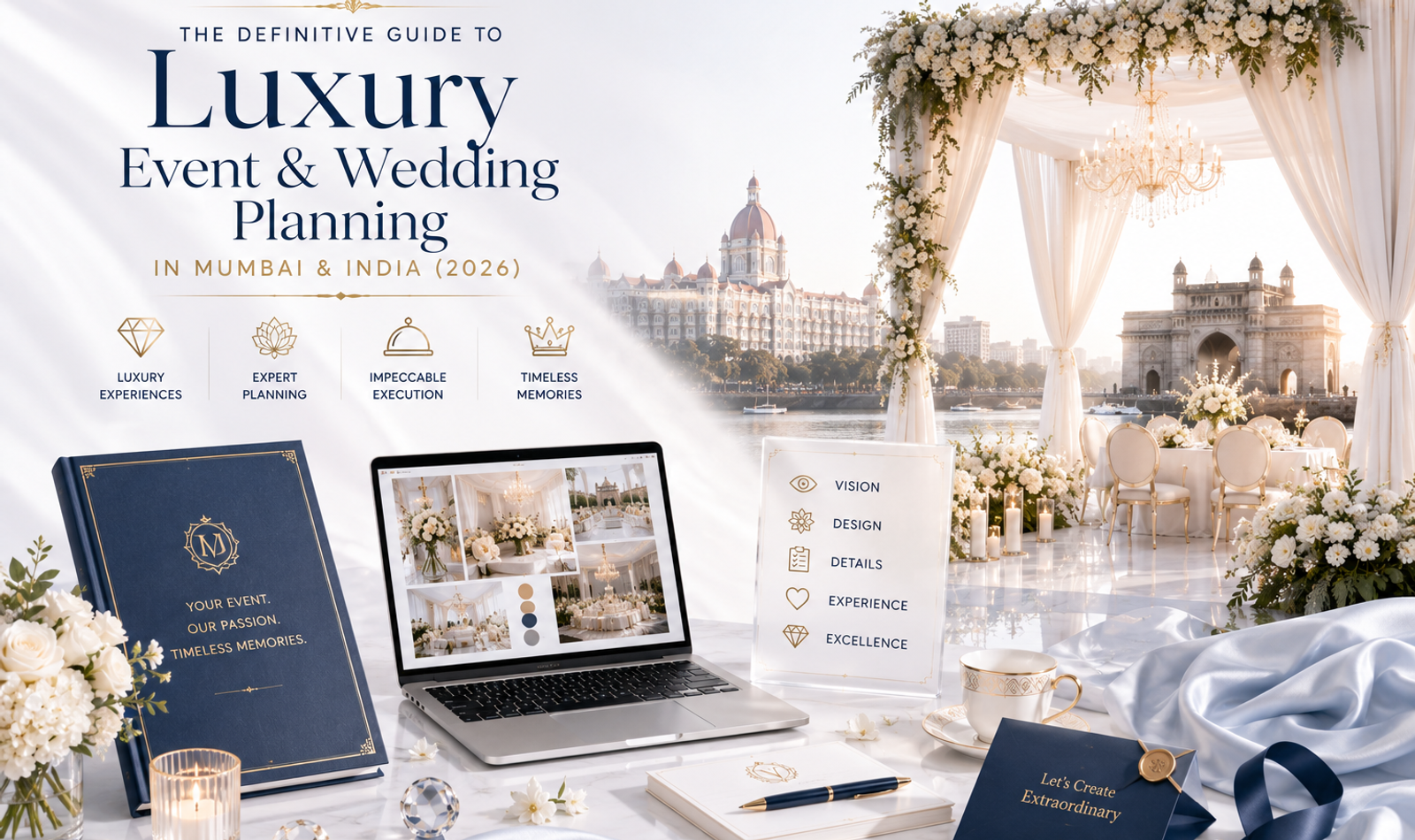
The Definitive Guide to Luxury Event & Wedding Planning in Mumbai & India (2026)
Luxury event and wedding planning in India has evolved far beyond decoration, hospitality and vendor coordination. In 2026, a luxury wedding or premium event is not judged only by how grand it looks. It is judged by how seamlessly it feels.
Guests remember how they were received, how comfortably they travelled, how clearly they were guided, how thoughtfully the ceremonies were planned and how emotionally connected the experience felt. Families remember whether the process was smooth, whether problems were solved before they became visible and whether every detail reflected their taste, values and status.
This is especially true in Mumbai and across India, where luxury weddings and premium events operate at the intersection of tradition, hospitality, design, entertainment, logistics, celebrity management, digital communication and family emotion.
India’s wedding economy continues to be one of the largest in the world. Recent industry coverage has estimated India’s wedding market at around ₹10 lakh crore annually, supported by nearly 1 crore weddings every year. This ecosystem includes venues, designers, jewellers, caterers, decorators, photographers, travel partners, artisans, performers and event professionals.
Destination weddings are also becoming a major part of this growth. Industry research has valued India’s destination wedding market at around USD 2.66 billion in 2025, with projections of USD 8.29 billion by 2032. This shows that Indian families are increasingly looking for curated experiences, not just traditional functions.
Mumbai plays a very important role in this shift. As India’s entertainment, luxury, corporate and celebrity capital, Mumbai offers access to premium hotels, sea-facing venues, private clubs, designer talent, media networks, production teams, artists, celebrity managers and luxury vendors. It is also one of the strongest cities for high-profile corporate events, brand launches, private celebrations, destination wedding planning, influencer-led experiences and luxury hospitality.
At the same time, luxury event planning in India is becoming more complex. Families and brands now expect personalisation, privacy, guest comfort, premium design, cultural sensitivity, social media readiness and flawless execution. A wedding may include multiple cities, hundreds of guests, celebrity performances, international designers, private charter movements, customised gifting, content teams, digital invites, hospitality desks and strict security coordination.
This is why luxury event and wedding planning requires more than creativity. It requires strategy, systems and experience.
A luxury event planner must understand design, operations, guest psychology, vendor quality, budgeting, crisis handling, hospitality and brand perception. The planner must know how to convert a client’s vision into an experience that feels elegant, organised and emotionally meaningful.
What Is Luxury Event Planning?
Luxury event planning is the process of designing, managing and executing high-end events where every detail reflects quality, personalisation, exclusivity and seamless guest experience.
It is not limited to expensive décor or premium venues. True luxury lies in precision.
A luxury event may include a private birthday, celebrity appearance, corporate gala, product launch, destination celebration, fashion preview, award night, luxury brand activation, investor dinner, private concert or wedding celebration.
The objective is to create an experience that feels effortless to the guest while being carefully planned behind the scenes.
In luxury event planning, every detail matters. The invitation design, arrival experience, lighting temperature, seating flow, floral styling, food service, artist timing, guest movement, security, photography, restroom access, valet flow and post-event communication all contribute to the final perception.
A guest may not consciously notice every operational detail, but they will feel the difference when everything works smoothly.
Luxury planning is therefore not only about what is seen. It is also about what is prevented.
Delays, confusion, crowding, poor communication, weak hospitality, late transportation, untrained staff and visible chaos can reduce the perceived value of even the most beautiful event.
What Is Luxury Wedding Planning?
Luxury wedding planning is a specialised form of event planning focused on creating premium, personalised and emotionally meaningful wedding experiences.
Indian luxury weddings are deeply layered. They are not usually one-day events. They often include roka, engagement, mehendi, haldi, sangeet, cocktail, wedding ceremony, reception, after-party, family dinners, welcome lunches, religious rituals and post-wedding brunches.
Each function has a different emotional purpose.
The mehendi may feel intimate and colourful. The sangeet may be high-energy and entertainment-led. The wedding ceremony may be spiritual, traditional and family-focused. The reception may be elegant, formal and social. The after-party may be private, youthful and relaxed.
A luxury wedding planner must understand how to create a different identity for each function while keeping the entire wedding connected through one larger story.
This requires planning across design, hospitality, rituals, entertainment, guest management, vendor coordination, food, logistics, photography, communication, budget and family expectations.
In India, weddings are not only events. They are cultural and emotional milestones. A good luxury wedding planner respects this while still bringing structure, refinement and modern execution.
Why Luxury Events in India Need Professional Planning
Luxury events in India involve many moving parts. A single wedding or premium celebration may include multiple venues, decorators, caterers, artists, priests, stylists, photographers, makeup teams, logistics partners, security teams, hospitality desks, travel coordinators, designers, gift vendors and production crews.
If these teams are not managed properly, even a high-budget event can feel disorganised.
Professional planning ensures that every function is prepared in advance, every vendor understands their responsibility, every guest receives support and every timeline is controlled.
A planner also acts as the central point of coordination between the client, family, venue and vendors. This reduces confusion and protects the client from constant operational pressure.
For luxury clients, time and peace of mind are extremely valuable. They do not want to spend the wedding week chasing confirmations, solving vendor problems or managing guest complaints.
They want to enjoy the occasion.
That is where a professional luxury event planner becomes essential.
Mumbai as a Luxury Event and Wedding Destination
Mumbai is one of India’s most important cities for luxury events and weddings.
The city offers iconic hotels, premium banquet spaces, private clubs, sea-facing venues, heritage locations, luxury restaurants, celebrity networks, production teams and access to high-end service providers. Venue platforms continue to list major luxury wedding hotels in Mumbai, including iconic properties such as The Taj Mahal Palace and The Oberoi Mumbai, showing the city’s continued importance as a premium wedding market.
Mumbai is also ideal for clients who want a mix of luxury, convenience and access. Families can host elegant city weddings without moving guests to a remote destination. Corporate brands can create premium experiences close to business districts, airports and media hubs. Luxury launches can access influencers, celebrities, photographers, stylists and PR teams quickly.
However, Mumbai also requires strong planning because the city has traffic, venue restrictions, space limitations, parking challenges, sound permissions, guest movement issues and high vendor demand during peak seasons.
A luxury wedding in Mumbai must be planned with realistic logistics.
Guest transportation, hotel room blocking, airport transfers, valet management, vendor entry timings and local permissions must be handled carefully. A beautiful event can suffer if guests are stuck in traffic, confused at entry gates or delayed between functions.
In Mumbai, luxury planning is not only about design. It is also about movement, timing and coordination.
Luxury Weddings Across India
India offers a wide range of luxury wedding destinations beyond Mumbai.
Rajasthan is known for palace weddings, heritage properties, royal architecture and grand destination celebrations. Goa is popular for beach weddings, sundowner events and relaxed luxury. Udaipur, Jaipur, Jodhpur and Jaisalmer continue to attract families who want royal backdrops. Delhi NCR offers luxury hotels, farmhouses and large-scale production capacity. Kerala offers nature, wellness and intimate destination weddings. Hyderabad, Bangalore, Chennai, Pune, Ahmedabad and Kolkata each bring their own hospitality, culture and venue strengths.
Destination weddings in India are no longer limited to only royal palaces or beach resorts. Families are now exploring vineyards, forest retreats, private villas, wellness resorts, boutique hotels, hill destinations and culturally rich locations.
The modern Indian luxury wedding is becoming more personal.
Some families want grandeur. Some want privacy. Some want a spiritual experience. Some want a festival-style celebration. Some want a destination weekend where every guest feels taken care of.
The planner’s role is to match the destination with the family’s personality, guest profile, budget, rituals and desired experience.
The Difference Between Luxury and Regular Event Planning
The difference between luxury and regular event planning is not only budget.
A regular event may focus on completing basic requirements such as venue, food, décor and entertainment. A luxury event focuses on experience, detail, personalisation and emotional impact.
Luxury planning considers how the guest feels from the moment they receive the invitation to the moment they return home.
It includes personalised communication, curated hospitality, thoughtful gifting, refined design, service quality, privacy, smooth transitions and memorable storytelling.
In a luxury wedding, the décor cannot look disconnected from the family’s taste. The food cannot feel generic. The hospitality cannot feel mechanical. The entertainment cannot feel randomly selected. The schedule cannot exhaust the guests. The content team cannot interrupt rituals. The entire experience must feel intentional.
Luxury also requires discretion.
High-profile families, celebrities, business leaders and premium brands often require privacy. Guest lists, travel details, family information, artist contracts and personal moments must be handled carefully.
A luxury planner must understand confidentiality as much as creativity.
Starting With the Client Vision
Every luxury event should begin with a deep understanding of the client’s vision.
The planner must understand what the client wants the event to feel like. Is it grand, intimate, spiritual, modern, traditional, glamorous, minimal, royal, artistic, youthful, corporate or cultural?
For weddings, the planner must understand the couple, families, rituals, guest expectations, religious requirements and emotional priorities.
For corporate luxury events, the planner must understand the brand, business objective, audience, message and desired outcome.
A luxury event should not feel copied from another event. It should reflect the client’s identity.
The planning process usually begins with detailed discussions about mood, scale, budget, guest count, destination, preferred dates, rituals, entertainment expectations, food preferences and family requirements.
This information becomes the foundation for the event concept.
Building the Event Concept
A luxury event concept is the creative direction that connects design, hospitality, entertainment and guest experience.
For a wedding, the concept may be inspired by heritage, love story, family culture, destination, art, nature, royalty, modern minimalism or spiritual symbolism.
For a brand event, the concept may be inspired by product positioning, customer aspiration, innovation, craftsmanship or brand identity.
The concept should not be limited to decoration.
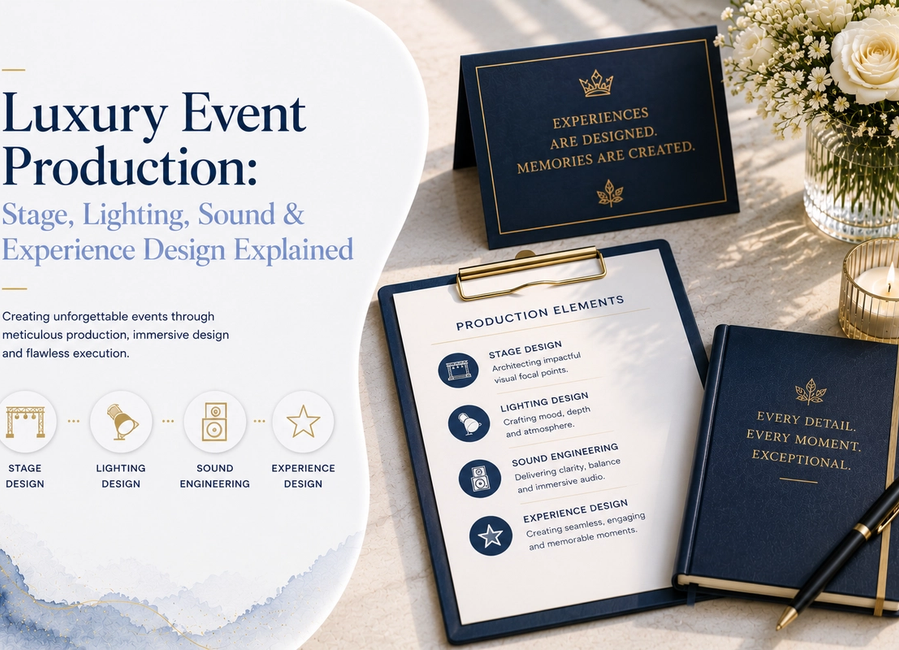
It should influence the invitation, venue styling, guest welcome, entertainment, food presentation, stage design, lighting, music, photography style and communication.
A strong concept gives the event a clear identity.
Without a concept, functions may look expensive but disconnected. With a concept, every detail feels part of one larger experience.
Choosing the Right Venue
Venue selection is one of the most important decisions in luxury event and wedding planning.
The venue determines the scale, movement, design possibilities, guest comfort, food options, permissions, logistics and overall atmosphere.
A luxury venue should match the event objective. A royal wedding may need a palace property. A modern cocktail may need a premium hotel ballroom or private club. A luxury brand launch may require a space that reflects sophistication and exclusivity. A destination wedding may need enough rooms, function spaces, guest facilities and privacy.
The planner should evaluate the venue beyond visual appeal.
Important factors include guest capacity, accessibility, parking, room inventory, vendor policies, power supply, sound restrictions, food quality, service standards, weather backup, production access, security, restroom quality and guest flow.
For destination weddings, room blocking and guest movement become especially important. A beautiful location can become stressful if accommodation is scattered, travel time is too long or function spaces are difficult for elderly guests.
The right venue should support both beauty and practicality.
Budget Planning for Luxury Events
Luxury does not mean unlimited spending. Even high-budget events require financial structure.
A clear budget helps clients understand where money is being invested and how each category supports the final experience.
Typical cost categories include venue, accommodation, décor, food and beverage, entertainment, photography, video, hospitality, logistics, gifting, invitations, production, security, permissions, styling, makeup, technology, PR, artist management and planning fees.
In luxury events, costs can rise quickly because of premium materials, custom production, celebrity appearances, destination logistics, guest experiences and multiple functions.
A good planner helps the client prioritise.
Some families may value food and hospitality most. Some may want grand décor. Some may want celebrity entertainment. Some may want intimate but extremely refined experiences. Some may want high-quality content and social media presentation.
The budget should reflect what matters most to the client.
Guest Experience as the Heart of Luxury Planning
Guest experience is one of the biggest markers of luxury.
A guest should feel informed, welcomed, guided and cared for throughout the event.
This begins before arrival. Guests may receive digital invites, travel details, RSVP forms, itinerary cards, dress codes, location maps, hotel information and contact numbers.
At arrival, they should experience smooth airport pickup, hotel check-in, welcome hampers, hospitality desks and clear communication.
During the event, they should know where to go, when functions begin, how to move between venues and who to contact for assistance.
For elderly guests, accessibility matters. For outstation guests, transport matters. For international guests, cultural explanation may matter. For VIP guests, privacy and security matter.
Luxury hospitality is not only about offering expensive gifts. It is about removing discomfort.
When guests feel taken care of, the event feels premium.
Wedding Hospitality Management
Hospitality management is one of the most critical parts of Indian luxury weddings.
Indian weddings involve family groups, relatives, friends, VIPs, elderly guests, children and sometimes international attendees. Each group may have different needs.
A wedding hospitality team manages arrivals, departures, room allocations, welcome notes, luggage coordination, transport, guest queries, event reminders, emergency requests and personal assistance.
A strong hospitality desk can prevent confusion.
Guests should not have to call the bride, groom or family members for every small question. They should have one clear point of contact.
Luxury hospitality also requires warmth. Guests should not feel like they are dealing with a mechanical helpdesk. The communication should feel polite, personal and respectful.
This is where trained teams make a difference.
Logistics and Transportation
Transportation is often underestimated in event planning, but it can make or break a luxury experience.
For weddings and large events, transportation includes airport transfers, hotel-to-venue movement, VIP cars, vendor transport, artist movement, valet services, shuttle coordination and emergency vehicles.
In cities like Mumbai, traffic planning is especially important. Travel buffers must be realistic. Routes must be checked. Drivers must be briefed. Guest pickup points must be clear. VIP movement must be discreet.
For destination weddings, transport planning becomes even more important because guests may arrive at different times from different cities.
A luxury event should not make guests feel lost, delayed or unmanaged.
Smooth transportation creates a sense of control and care.
Décor and Design Direction
Décor is one of the most visible parts of luxury event planning, but it should not be treated as decoration alone.
Design should create atmosphere.
For weddings, each function should have its own visual identity. The mehendi may use fresh colours, floral details and relaxed seating. The sangeet may use dramatic lighting, stage design and performance-focused production. The wedding ceremony may use sacred, elegant and emotional design. The reception may be formal, refined and grand.
Luxury décor should feel detailed but not overloaded.
In 2026, many premium clients are moving towards more personalised and experience-led design. Instead of simply filling venues with flowers and structures, they want meaningful design stories, refined palettes, customised installations, sustainable materials and photo-ready but tasteful spaces.
The design should also respect the venue.
A palace, beach, ballroom, farmhouse or heritage property each needs a different design approach.
Food and Beverage Planning
Food is one of the most remembered parts of Indian weddings and events.
Luxury catering is not only about variety. It is about quality, presentation, service, timing and guest understanding.
A premium event may include regional cuisine, live counters, international menus, health-conscious options, Jain food, vegan selections, kids’ menus, late-night snacks, customised desserts and curated beverages.
For weddings, food should match the function mood. A mehendi lunch may be playful and regional. A cocktail night may include plated starters and global cuisine. A wedding dinner may require traditional favourites. A post-party may need comfort food.
Service timing is equally important.
Food should be ready when guests need it. Counters should not be overcrowded. Service staff should be trained. VIP guests may require special attention. Dietary requirements should be noted in advance.
In Indian luxury events, food is hospitality.
Entertainment and Artist Management
Entertainment is a major part of luxury events and weddings in India.
This may include DJs, live bands, celebrity performers, folk artists, dancers, stand-up comedians, anchors, international acts, spiritual performers, instrumentalists or curated experiences.
Artist management requires contracts, technical riders, travel, accommodation, green rooms, security, sound checks, stage timing and payment coordination.
A celebrity performance requires even more planning. The artist’s movement, entry, exit, privacy, stage access and interaction with guests must be controlled.
Entertainment should match the event, not overpower it.
For a luxury wedding, every performance should feel connected to the function. For a corporate event, entertainment should support the brand experience. For a private celebration, it should reflect the host’s taste.
The best entertainment feels exciting but well integrated.
Ritual Planning for Indian Weddings
Indian weddings are deeply rooted in rituals.
A luxury wedding planner must respect religious, cultural and family traditions while ensuring that the ceremony remains organised and comfortable.
Different communities have different rituals, timings, requirements and symbolism. A planner must coordinate with priests, family elders, décor teams, photographers, musicians and hospitality teams.
The mandap should be beautiful but functional. The priest should have the required items. The couple and family should know the sequence. Guests should be guided respectfully.
Rituals should not feel rushed or chaotic.
A luxury wedding preserves the emotion of tradition while managing the flow with care.
Destination Wedding Planning in India
Destination weddings require a different level of planning because the event is not only about functions. It is about the complete guest stay.
The planner must manage travel, accommodation, venue buyouts, room allocation, airport coordination, local transport, guest itineraries, vendor movement, weather backup, permissions, local regulations, medical support and emergency planning.
Destination weddings also require strong communication. Guests should know what to pack, when to arrive, what to wear and what the schedule looks like.
A good destination wedding feels like a curated journey.
From welcome hampers to departure gifts, every touchpoint should feel intentional.
India offers many luxury destination options, from royal palaces to beach resorts, hill retreats, wellness properties and private estates. The right destination should match the family’s style, guest profile and logistical comfort.
Luxury Corporate Event Planning
Luxury event planning is not limited to weddings.
Premium corporate events require the same level of detail, but with a different objective.
A corporate event may include a product launch, investor dinner, leadership summit, brand activation, awards night, fashion showcase, hospitality experience or private networking evening.
The goal is not only to impress guests. It is to communicate the brand’s positioning.
Every element should support the business message.
Venue, lighting, stage design, guest seating, brand visuals, speaker flow, media presence, photography and post-event communication all contribute to how the brand is perceived.
For luxury corporate events, the experience must feel polished, purposeful and premium.
Celebrity and VIP Guest Management
Mumbai and India’s luxury event market often involves celebrities, influencers, business leaders, politicians, artists and high-profile guests.
VIP management requires discretion, timing and security.
The guest’s arrival, seating, interaction, media exposure, hospitality and exit must be planned carefully.
If a celebrity is performing, hosting or attending, the contract terms, appearance duration, photography permissions and brand usage rights must be clear.
For high-profile private weddings, privacy becomes especially important. Guest lists, hotel details, family moments and travel information should not be casually shared.
A luxury planner must understand how to manage visibility without losing control.
Media, PR and Content Planning
Modern luxury events often need strong content and media planning.
A wedding may require cinematic films, social media reels, editorial photography, drone shots, teaser videos, family films and same-day edits.
A corporate luxury event may require media coverage, press releases, influencer attendance, post-event reports, LinkedIn content and brand films.
Content teams should be integrated into planning from the beginning.
They need access, timing, shot lists, lighting support and clarity on important moments.
However, content creation should not disturb the guest experience.
Photographers and videographers must capture emotion without blocking rituals or making the event feel like a production set.
For premium events, content should look elegant, not chaotic.
Technology in Luxury Events
Technology is playing a larger role in luxury events and weddings in 2026.
Digital invitations, RSVP systems, guest apps, QR-based check-ins, event websites, WhatsApp updates, AI-generated mood boards, projection mapping, LED stage design, live streaming, drone coverage, digital seating plans and guest communication systems are becoming common.
Technology should improve convenience, not complicate the experience.
A digital RSVP system can help manage guest data. A wedding website can share schedules and travel details. WhatsApp automation can send reminders. LED screens can improve stage storytelling. Live streaming can help guests who cannot attend.
The key is balance.
Luxury events should feel human and emotional, even when technology supports the backend.
Sustainability in Luxury Weddings and Events
Sustainability is becoming more important in premium event planning.
Luxury clients are increasingly aware of waste, excessive plastic, food wastage, disposable décor and unnecessary gifting.
Sustainable luxury does not mean reducing beauty. It means planning more responsibly.
This may include local flowers, reusable structures, digital invites, curated gifting, food donation systems, waste management, eco-conscious materials, local artisans and efficient logistics.
Sustainability also connects with cultural responsibility.
Indian weddings support many artisans, performers and local vendors. Thoughtful planning can create beautiful events while supporting traditional crafts and responsible production.
Personalisation as the New Luxury
In 2026, personalisation is one of the strongest signs of luxury.
Guests are no longer impressed only by scale. They are moved by details that feel specific to the couple, family or brand.
For weddings, this may include personalised welcome notes, family-inspired menus, custom music, storytelling installations, memory walls, meaningful rituals, curated gifting and unique guest experiences.
For corporate events, personalisation may include tailored seating, customised brand journeys, audience-specific content and curated networking moments.
The more personal the event feels, the more memorable it becomes.
Luxury is no longer only about how much is spent.
It is about how thoughtfully the experience is designed.
Privacy and Security
Luxury events often require careful privacy and security planning.
This may include guest-list control, restricted access, security teams, paparazzi management, media permissions, private entrances, data protection, content approvals and non-disclosure agreements.
High-profile weddings and events must protect family privacy, celebrity movement and sensitive information.
Even digital communication should be controlled. Guest itineraries, hotel details and private schedules should not be shared publicly.
Security should be strong but not uncomfortable.
The best security systems are discreet, professional and respectful.
Crisis Management in Events
Even the best-planned events can face unexpected problems.
Weather changes, artist delays, technical issues, traffic disruptions, guest illness, vendor failure, power problems or last-minute permission issues can affect the experience.
Luxury planning requires backup systems.
There should be contingency plans for outdoor events, alternate power arrangements, medical support, emergency transport, backup vendors, rain plans, extra staff and crisis communication.
The client may never see these systems, but they are essential.
Luxury is created when problems are handled before they reach the guest.
Choosing the Right Luxury Event Planner
Selecting the right planner is one of the most important decisions for any luxury wedding or event.
A good planner should understand the client’s vision, have strong vendor networks, manage budgets transparently, communicate clearly and handle pressure calmly.
The planner should have experience with similar event scale and complexity.
For luxury weddings, the planner should understand rituals, family dynamics, hospitality, design and guest management. For corporate events, the planner should understand branding, audience experience, production and business objectives.
The best planner is not only creative.
They are organised, discreet, resourceful and reliable.
Common Mistakes in Luxury Event Planning
One common mistake is focusing too much on décor and not enough on guest experience.
Another mistake is choosing a venue based only on beauty without considering logistics.
Some clients delay decisions, which increases costs and reduces vendor availability.
Others hire too many teams without one central coordinator.
Weak communication also creates problems. If guests do not know timings, locations or dress codes, confusion begins.
Another mistake is copying trends without considering whether they suit the family, brand or venue.
Luxury events should feel curated, not forced.
Planning Timeline for Luxury Weddings
A luxury wedding should ideally be planned several months in advance.
Venue selection, date finalisation, room blocking, décor concepts, photography, entertainment and major vendor bookings should happen early.
Destination weddings require even more time because travel, accommodation and logistics are more complex.
As the wedding gets closer, the focus shifts to detailed planning. This includes guest lists, hospitality, RSVP tracking, transport, menus, performances, rituals, content plans, styling and final production schedules.
The final weeks should focus on execution, not major decision-making.
A strong timeline reduces stress and improves quality.
Why Integrated Planning Matters
Luxury events require integrated planning because every detail affects another.
Décor affects photography. Venue affects logistics. Guest count affects food. Artist timing affects production. Ritual timing affects content. Transport affects guest comfort. Weather affects backup planning.
If teams work separately, problems increase.
An integrated planner connects all departments into one execution system.
This is especially important for Indian weddings, where several functions happen over multiple days and involve many stakeholders.
Integration creates flow.
And flow is what makes an event feel effortless.
Frequently Asked Questions
Q1. What is luxury event planning?
Luxury event planning is the process of designing and managing high-end events with a focus on premium experience, personalisation, smooth execution, guest comfort, privacy and attention to detail. It includes everything from venue selection and design to hospitality, logistics, entertainment and event communication.
Q2. What makes a luxury wedding different from a regular wedding?
A luxury wedding focuses on more than basic arrangements. It includes personalised design, premium hospitality, curated guest experiences, high-quality vendors, seamless logistics, privacy, detailed rituals and emotionally meaningful storytelling across every function.
Q3. Why is Mumbai a popular city for luxury weddings and events?
Mumbai is popular because it offers premium hotels, sea-facing venues, private clubs, strong vendor networks, celebrity access, media support, production teams and luxury hospitality. It is also convenient for high-profile families, corporate brands and destination wedding planning.
Q4. How early should a luxury wedding be planned?
A luxury wedding should ideally be planned several months in advance. Destination weddings and large multi-day celebrations need more time because venues, rooms, artists, decorators, photographers and logistics partners must be booked early.
Q5. What are the most important elements of luxury wedding planning?
The most important elements include venue selection, guest hospitality, décor, food, logistics, entertainment, rituals, photography, privacy, budget planning and overall event flow. A luxury wedding succeeds when all these elements work together smoothly.
Q6. How much does a luxury wedding planner cost in India?
The cost of a luxury wedding planner depends on the scale, location, number of functions, guest count, planning duration, services required and level of involvement. Some planners charge a fixed fee, while others work on a percentage or customised project basis.
Q7. What are the best destinations for luxury weddings in India?
Popular luxury wedding destinations in India include Mumbai, Udaipur, Jaipur, Jodhpur, Goa, Delhi NCR, Kerala, Hyderabad, Pune and other premium resort or heritage locations. The best destination depends on the family’s style, budget, guest profile and preferred experience.
Q8. Why is guest management important in luxury weddings?
Guest management is important because it directly affects the experience. Smooth arrivals, hotel check-ins, transport, itinerary updates, hospitality desks and personal assistance help guests feel cared for and reduce stress for the family.
Q9. Can luxury weddings be planned sustainably?
Yes. Luxury weddings can be planned sustainably by using local materials, reusable décor, digital invitations, thoughtful gifting, food waste control, eco-conscious logistics and responsible vendor choices without compromising beauty or experience.
Q10. Why should brands or families hire a professional luxury event planner?
A professional luxury event planner brings structure, vendor knowledge, creative direction, budget control, crisis handling and execution expertise. This allows clients to enjoy the event while the planner manages details, timelines and coordination.
Conclusion
Luxury event and wedding planning in Mumbai and India is no longer only about grand venues, expensive décor and celebrity entertainment.
It is about creating meaningful, seamless and highly personalised experiences that reflect the client’s identity and make every guest feel valued.
In 2026, luxury is defined by thoughtfulness. It is seen in how guests are welcomed, how smoothly they move between functions, how rituals are respected, how food is served, how privacy is protected and how every detail connects with the larger story.
Mumbai continues to be one of India’s strongest luxury event markets because of its premium venues, hospitality ecosystem, entertainment access and professional vendor network. At the same time, destination weddings across India are creating new opportunities for families who want immersive and memorable celebrations.
The most successful luxury events are built through planning, not pressure. They require clear vision, strong vendor coordination, realistic budgets, guest-focused hospitality, creative design and calm execution.
A beautiful event may impress guests for a moment, but a well-planned experience stays with them for years.
That is the real power of luxury event and wedding planning.
Create a Luxury Celebration That Feels Effortless, Personal and Unforgettable
If you are planning a luxury wedding, private celebration, corporate event or destination experience, the right planning partner can transform your vision into a seamless reality.
At Double Trouble Studio, we design and execute premium events and weddings across Mumbai and India with a focus on guest experience, creative direction, hospitality, logistics, celebrity management, media presence and flawless on-ground execution.
📩 info@dtsworld.in 📞 +91 80000 06021 📍 Andheri (West), Mumbai
Related reading: Luxury wedding planner in Mumbai · Venue selection for weddings and events · Wedding planning timeline checklist.
Need this for your brand?
Let DTS build your next campaign.
From PR, celebrity management and events to websites, social media, SEO and AI video production — Double Trouble Studio helps brands grow with strategy and execution.
Discuss Your Requirement →