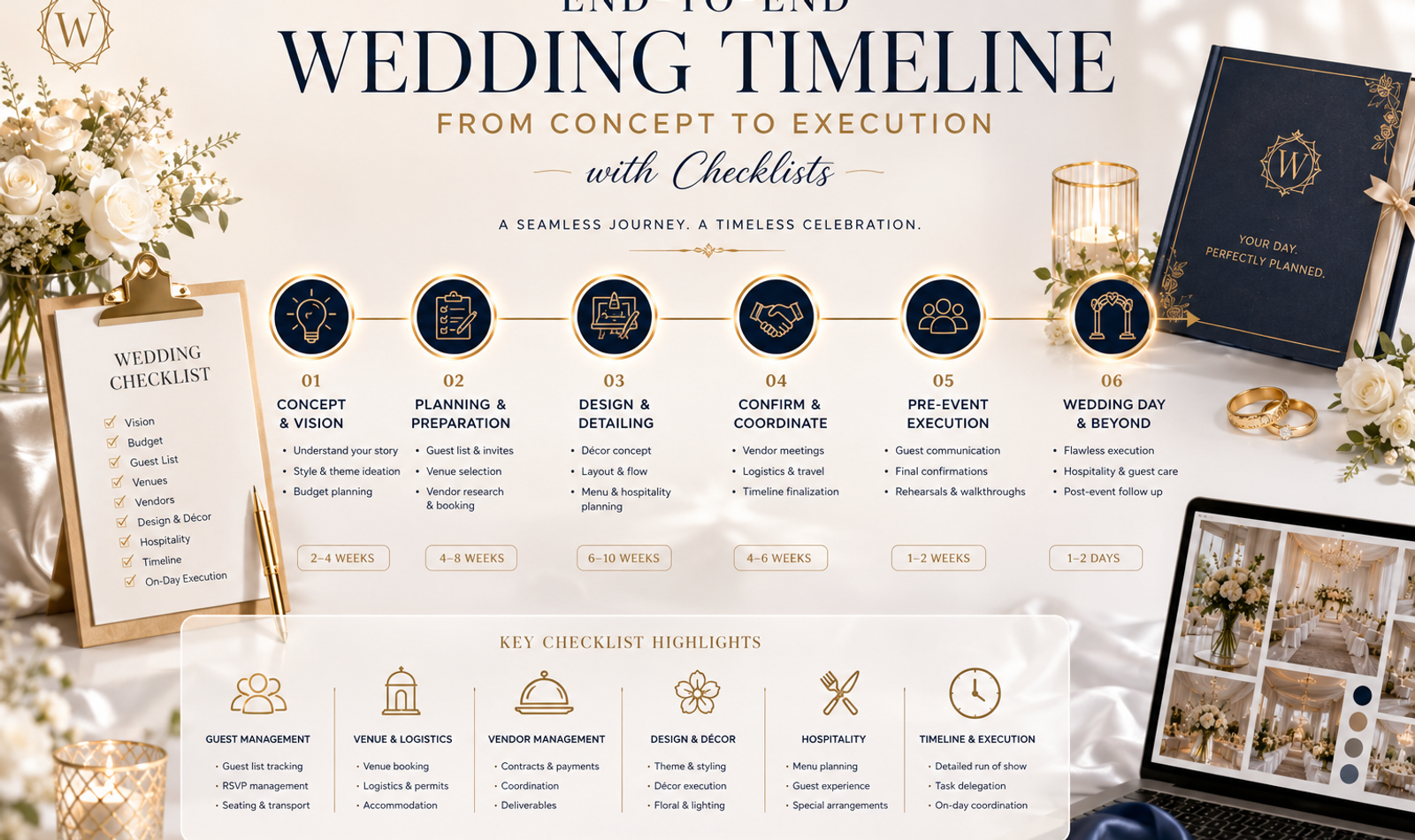
End-to-End Wedding Timeline: From Concept to Execution with Complete Checklists
Planning a wedding requires much more than selecting a venue, choosing décor and booking entertainment. A wedding is a complex live experience involving families, guests, vendors, hospitality, production, transport, ceremonies, food and several emotional decisions.
The larger and more premium the celebration becomes, the more important the planning timeline becomes. Every delayed approval can affect another department, while every unrecorded change can create confusion during execution.
An end-to-end wedding planning timeline helps couples and families understand what should happen, when it should happen and who should be responsible. It connects the original wedding concept with budgets, guest management, venue selection, vendor coordination, rehearsals and event-day delivery.
The purpose of a wedding timeline is not to make the celebration feel rigid. It creates enough structure behind the scenes so that the couple, families and guests can enjoy the experience without being surrounded by operational pressure.
Quick Answer
A complete wedding planning timeline usually begins with the wedding vision, approximate guest count, budget and preferred dates. Venue selection, vendor appointments, guest communication, hospitality and production are then developed in phases.
As the wedding approaches, the focus moves from creative decisions to confirmation, rehearsals and execution. Guest lists, seating, transport, rooming, vendor schedules and ceremony timings should be progressively locked before the wedding week.
The strongest timeline also includes contingency plans, decision deadlines and responsible owners. Tasks should not only have dates; they should have clear approval authority.
Why a Wedding Timeline Is Essential
Wedding planning involves several interconnected decisions. The venue affects décor, production, accommodation and transport, while the guest count affects catering, seating, invitations and room requirements.
Without a timeline, families may begin with visually exciting decisions before confirming the event’s basic structure. They may book entertainment before reviewing venue sound restrictions or select décor without understanding setup limitations.
A structured timeline protects the budget and reduces rushed decisions. It allows the planning team to compare options, negotiate contracts and coordinate vendors before premium dates become unavailable.
It also protects the couple emotionally. When responsibilities and deadlines are clear, the wedding does not become a continuous stream of last-minute questions.
How Early Should Wedding Planning Begin?
The ideal planning period depends on the scale, location, number of functions and guest complexity. A local single-day celebration may require less preparation than a multi-day destination wedding with several hundred guests.
Large luxury weddings should generally begin as early as practical because premium venues, hotels, artists and production teams may have limited availability. Popular wedding dates can become difficult to secure long before the event.
A shorter timeline is possible when the family can make fast decisions and remain flexible about venues and vendors. However, compressed planning requires stronger communication because several departments must progress at the same time.
The planning period should reflect the complexity of the event rather than following one universal rule. The number of guest movements, ceremonies, venues and creative installations often matters more than the number of calendar months.
The Complete Wedding Planning Lifecycle
An end-to-end wedding timeline can be divided into several planning phases. Each phase has a different purpose and should produce clear decisions before the next stage becomes too advanced.
The early phase establishes the wedding vision, budget, dates and venue. The development phase appoints vendors and creates the guest, hospitality, design and production systems.
The confirmation phase locks major decisions and begins detailed operational planning. The execution phase focuses on rehearsals, team briefings, event control and real-time coordination.
After the wedding, the closure phase manages payments, content delivery, guest follow-up and vendor reconciliation. Wedding planning does not end immediately after the last guest leaves.
Phase One: Defining the Wedding Vision
The first step is understanding what kind of wedding the couple and families want to create. This conversation should take place before detailed venue or décor decisions begin.
The wedding may be intimate, formal, contemporary, heritage-led, destination-based or highly celebratory. The emotional atmosphere matters because it should guide the venue, programme, design and hospitality.
The family should also discuss cultural and religious traditions that must be included. Ceremonies, family responsibilities and regional expectations can affect the number of functions and their timing.
A clear wedding vision prevents the planning process from becoming a collection of unrelated social-media references. It creates one direction against which every new idea can be evaluated.
Initial Concept Checklist
• Wedding atmosphere
• Cultural priorities
• Guest experience
• Event scale
• Preferred destination
• Number of functions
• Essential traditions
• Creative preferences
The checklist should lead to a short creative brief. The brief does not need to define every flower or colour, but it should explain how the wedding should feel.
Identifying Decision-Makers
Several family members may contribute ideas, but the project needs clear decision authority. Vendors should not receive conflicting approvals from the couple, parents and extended family.
The planning team should identify who approves budgets, design, guest lists, hospitality and programme decisions. Some responsibilities may be divided according to family structure.
A clear approval system does not exclude family participation. It ensures that input is collected before one final decision is communicated.
The planner should document every major approval. Verbal conversations become difficult to track when several changes occur over many months.
Decision-Making Checklist
• Budget approver
• Creative approver
• Guest-list owners
• Ceremony leads
• Hospitality leads
• Final escalation
• Vendor communication
• Payment authority
Clear decision-making becomes especially important during the final weeks. Vendors should know exactly whose instruction can change scope, cost or timing.
Phase Two: Establishing the Wedding Budget
A wedding budget should be created before major commitments are made. The total should include venue, food, rooms, design, production, entertainment, hospitality, transport, photography, attire and professional fees.
Each category should include taxes, labour, travel, setup and overtime where relevant. A quotation can appear attractive while excluding several operational expenses.
The family should also maintain a contingency reserve. Guest changes, additional production requirements, weather planning and late transportation can create unexpected costs.
A budget is not intended to reduce creativity. It helps the planning team invest in the elements that matter most without losing control of the complete event.
Wedding Budget Categories
• Venue and rooms
• Food and beverages
• Décor and florals
• Sound and lighting
• Stage and screens
• Artists and entertainment
• Guest hospitality
• Travel and transport
• Photography and films
• Invitations and gifting
• Security and permissions
• Planning and management
Every vendor commitment should be entered into a central budget tracker. Payments, due dates, taxes and approved additions should be visible in the same system.
Setting Budget Priorities
The couple and families should identify which elements are most important to them. One wedding may prioritise food and music, while another may invest more heavily in design and guest hospitality.
These priorities help when quotations exceed the original estimate. The planner can protect high-value areas and reduce expenditure in categories that contribute less to the intended experience.
Not every element needs to be extravagant. Luxury is often created by consistency, comfort and thoughtful execution rather than maximum expenditure in every direction.
Budget priorities also make vendor discussions more productive. Teams understand where quality cannot be compromised and where practical alternatives are acceptable.
Budget Control Checklist
• Confirm total budget
• Set category limits
• Add contingency reserve
• Record payment dates
• Approve written changes
• Track tax exposure
• Review weekly totals
• Close vendor balances
No additional work should be treated as approved without a written record. Informal additions are one of the most common causes of wedding budget disputes.
Phase Three: Creating the Initial Guest Estimate
The first guest estimate is needed before venue and accommodation selection. It does not need to contain every confirmed name, but it should be realistic enough to guide capacity.
The list should include family, friends, professional relationships, VIP guests and destination travellers. Children, assistants, drivers and security personnel may also affect operational planning.
The family should consider how many guests will attend each function. A welcome dinner may have a different attendance level from the wedding ceremony or reception.
A broad invitation plan should also consider the likelihood of acceptance. Destination weddings may have different attendance patterns from local city weddings.
Initial Guest Checklist
• Family allocations
• Friend allocations
• Professional guests
• VIP attendees
• Destination travellers
• Children and elders
• Plus-one rules
• Function attendance
The initial estimate should include a controlled reserve. Filling every available place before invitations are sent leaves no room for genuine late requirements.
For large celebrations, managing complex guest lists for luxury events requires clear allocations, approval authority and controlled plus-one rules.
Phase Four: Selecting Dates and Locations
Wedding dates may be influenced by family availability, religious calendars, venue availability and weather. These factors should be considered together rather than separately.
For destination weddings, the team should review travel connectivity, local weather, room inventory and vendor access. A beautiful property can become difficult when guests face complicated transfers.
Mumbai and other major cities require careful traffic planning. Event timings and venue locations should reflect where guests are staying and how they will travel.
The date should not be finalised until the family understands the main operational implications. Popular dates may also involve higher pricing and limited vendor availability.
Date and Location Checklist
• Family availability
• Ceremony requirements
• Venue availability
• Weather conditions
• Travel connectivity
• Hotel inventory
• Local restrictions
• Vendor availability
Where possible, alternative dates should remain open during the initial venue search. Flexibility can improve both choice and commercial terms.
Phase Five: Choosing the Wedding Venue
Venue selection affects almost every later decision. Capacity, architecture, guest movement, kitchen access, loading areas, accommodation and sound restrictions should all be evaluated.
A ballroom offers weather protection and technical control, while an outdoor venue may create a stronger natural atmosphere. Each option introduces different costs and contingency requirements.
The venue should comfortably support the planned guest count rather than merely fitting the maximum number. Guests need enough room to move, dine and participate without congestion.
The team should also understand mandatory venue vendors, setup hours, overtime charges and cancellation terms. These conditions can significantly affect the final budget.
Venue Inspection Checklist
• Guest capacity
• Ceiling height
• Stage visibility
• Parking access
• Valet capacity
• Loading entry
• Kitchen facilities
• Washroom quality
• Power availability
• Sound restrictions
• Setup timings
• Weather backup
The venue inspection should include the planner, production lead and décor team. Their combined review will reveal limitations that may not appear during a general sales tour.
Professional venue selection and negotiation for premium weddings and events helps families compare capacity, restrictions, commercial terms and total operational cost.
Reviewing the Venue Contract
The venue agreement should specify dates, timings, spaces, inclusions and payment terms. Taxes, overtime, corkage, cleaning and damage policies should also be clear.
The contract should state whether the venue requires specific caterers, production teams or decorators. Mandatory vendors can affect both creative flexibility and cost.
Weather-related policies are important for outdoor celebrations. The organiser should know when a decision must be made to shift the event and what alternative space is available.
Every verbal promise should be written into the agreement or an approved attachment. Contract clarity protects both the family and the venue.
Venue Contract Checklist
• Confirm booked spaces
• Record setup hours
• Check overtime rates
• Review vendor rules
• Confirm backup venue
• Verify cancellation terms
• Record room blocks
• Approve payment schedule
The final contract should be stored with the wedding’s central planning documents. Relevant restrictions must also be shared with every affected vendor.
Phase Six: Appointing the Wedding Planner
A wedding planner connects the creative, operational and hospitality sides of the celebration. The scope should be defined before work begins.
Some planners provide complete concept-to-execution management, while others focus on coordination or décor. The family should understand exactly which vendors, budgets and guest services are included.
The planner should establish a reporting structure, meeting schedule and approval process. Communication becomes inefficient when every vendor contacts several family members independently.
A strong planner protects the couple from operational pressure while ensuring that families remain involved in meaningful decisions.
Planner Selection Checklist
• Relevant wedding experience
• Destination capabilities
• Vendor relationships
• Budget transparency
• Guest-management scope
• Production understanding
• Communication system
• Crisis preparedness
References from previous clients can provide insight into reliability and behaviour under pressure. A beautiful portfolio alone does not prove operational strength.
Phase Seven: Building the Vendor Team
The vendor team may include décor, catering, production, entertainment, photography, makeup, invitations, transport and hospitality specialists. Each appointment should follow a structured evaluation.
The team should review experience, service capacity, staffing and communication quality. The cheapest quotation may become expensive when essential requirements are excluded.
Every vendor should receive the wedding brief, venue information and expected scope. Their work must support the same creative and operational direction.
Vendor appointments should be staggered according to importance. Venue-dependent teams should usually be finalised before smaller styling elements.
Vendor Appointment Checklist
• Wedding planner
• Venue partner
• Catering team
• Décor designer
• Production agency
• Entertainment manager
• Photography team
• Makeup artists
• Invitation designer
• Hospitality agency
• Transport provider
• Security partner
Every vendor should have a written contract. Payment terms, cancellation, delivery dates, travel, setup and overtime should be clearly recorded.
A structured approach to vendor management and coordinating event suppliers helps multiple specialist teams operate through one schedule and reporting system.
Creating Vendor Scopes
A vendor scope should describe exactly what is being provided. General terms such as “complete décor” or “full production” can create major misunderstandings.
The décor scope should identify structures, florals, furniture, signage and dismantling. The production scope should list sound, lighting, screens, stage and technical staffing.
The hospitality scope should explain airport assistance, hotel desks, transport and guest communication. Each team should understand where its responsibility begins and ends.
Overlapping duties should be resolved before execution. Wedding-day teams should not discover that everyone assumed another vendor was responsible.
Vendor Scope Checklist
• Exact deliverables
• Quantity details
• Setup schedule
• Team strength
• Travel requirements
• Approval deadlines
• Change procedure
• Final handover
Approved references should be attached to the scope wherever visual interpretation matters. Written detail and visual direction should support each other.
Phase Eight: Developing the Wedding Identity
The wedding identity connects invitations, décor, stationery, gifting and digital communication. It may include a monogram, colour system, typography and visual motifs.
The design should reflect the couple rather than reproduce a popular trend without meaning. Personal stories, cultural influences and venue architecture can provide stronger inspiration.
The identity should remain flexible enough to work across several functions. Each event may have a different mood while still feeling part of the same celebration.
Design decisions should also consider readability. A visually elaborate invitation or sign fails when guests cannot understand the essential information.
Wedding Identity Checklist
• Couple story
• Visual direction
• Colour palette
• Typography system
• Monogram design
• Function variations
• Signage language
• Digital templates
The final identity guide should be shared with all creative vendors. This prevents invitations, décor and content from appearing like unrelated projects.
Current theming and design trends for luxury events can provide inspiration when they are adapted to the couple, venue and cultural context.
Phase Nine: Planning Invitations and Save-the-Dates
Save-the-date communication should be shared early enough for destination guests to plan travel. The formal invitation can follow once event details are confirmed.
Physical invitations may be selected for family and priority guests, while digital formats can support faster communication and updates. Many weddings use both according to guest category.
The invitation should clearly mention the host, dates, venue, dress guidance and RSVP process. Excessive decorative language should not hide essential instructions.
Guest names and designations should be verified carefully. A spelling error creates a negative first impression and can affect later registration.
Invitation Checklist
• Save-the-date release
• Guest-name verification
• Function information
• Venue details
• Dress guidance
• RSVP contact
• Plus-one clarity
• Travel information
Invitation distribution should be tracked. The team should know which guests received the communication and which require personal follow-up.
Phase Ten: Creating the RSVP System
The RSVP process should be simple enough for guests to complete quickly. It may use a form, website, WhatsApp workflow or dedicated guest-management team.
The system should collect attendance by function, plus-one information, dietary requirements and travel needs. It should avoid requesting information that does not support a clear planning purpose.
Every response must enter one central database. Confirmations received through calls or personal messages should be recorded immediately.
The guest list should display invited, confirmed, declined, pending and cancelled statuses. This makes capacity and hospitality planning more accurate.
RSVP Checklist
• Central guest database
• Function-wise attendance
• Plus-one confirmation
• Dietary requirements
• Accessibility support
• Travel details
• Reminder schedule
• Final deadline
Priority guests may require personal confirmation through a relationship owner. Automated communication should not replace important relationship management.
A central event RSVP management system helps coordinate attendance, plus-ones, dietary needs, travel information and function-wise confirmations.
Phase Eleven: Planning Destination Hospitality
Destination weddings require a complete guest hospitality system. The experience begins before arrival and continues until every guest has departed.
The team should track flight or train information, airport transfers, room allocation, luggage and special requirements. Guests should receive one reliable point of assistance.
Hotel desks should be briefed on check-in, wedding schedules and transport. Welcome communication should explain what guests need without overwhelming them.
The hospitality team should also prepare for delayed travel, lost luggage and medical requirements. Contingency support protects the guest experience when plans change.
Destination Hospitality Checklist
• Travel data
• Airport representatives
• Vehicle assignments
• Rooming lists
• Welcome desks
• Luggage handling
• Guest itineraries
• Emergency contacts
Hospitality information should be shared securely. Room numbers, phone numbers and travel schedules should not circulate beyond the teams that need them.
Professional guest management services can connect travel, hotel desks, rooming, invitations, access and on-ground guest support.
Phase Twelve: Managing Hotel Room Blocks
Room blocks should be negotiated early, particularly during popular wedding dates. The agreement should explain room categories, release dates, taxes and cancellation terms.
The rooming list should identify guest names, family groups, arrival dates and accessibility requirements. Frequent informal changes can lead to check-in errors.
One team should own the final rooming list. The hotel and planner must work from the same approved version.
Welcome gifts, room drops and itinerary distribution should also be planned according to room allocation. Timing matters because not every guest arrives together.
Rooming Checklist
• Confirm room inventory
• Assign room categories
• Record arrival dates
• Note accessibility needs
• Plan welcome drops
• Track room changes
• Confirm final list
• Review hotel bills
The family should understand which rooms are complimentary, contracted or individually payable. Clear financial responsibility prevents confusion during checkout.
Phase Thirteen: Planning Transport and Movement
Transport should be planned according to guest numbers, family groups, luggage and programme timings. Vehicle capacity alone is not enough.
Airport pickups, hotel transfers, venue movement and departure must connect through one schedule. Drivers should receive clear identification, routes and contact instructions.
Traffic buffers are particularly important in cities such as Mumbai, Delhi and Bengaluru. Wedding timings should reflect realistic travel conditions.
Guest communication should remain simple. Guests need pickup information and assistance contacts, not the entire internal transport chart.
Transport Checklist
• Airport pickups
• Hotel transfers
• Function shuttles
• VIP vehicles
• Elderly assistance
• Driver briefings
• Traffic buffers
• Departure planning
A central transport control desk should monitor delays and vehicle changes. Guests should not be asked to coordinate different operators personally.
Phase Fourteen: Designing the Wedding Décor
Wedding décor should respond to the venue, programme and guest journey. It should not be planned only through individual reference images.
The design team should create concepts for entrance, stage, seating, dining, florals, lighting and signage. Every area should support the central creative direction.
Guest movement must remain protected. Large installations should not block pathways, stage visibility or service routes.
Materials should be reviewed under event lighting and weather conditions. Outdoor florals, fabrics and technical elements require additional durability planning.
Décor Planning Checklist
• Venue measurements
• Entrance concept
• Stage design
• Floral direction
• Table styling
• Furniture selection
• Signage system
• Lighting integration
• Weather durability
• Dismantling schedule
The final décor proposal should include realistic visualisations and detailed quantities. Approval should cover both appearance and scope.
Phase Fifteen: Planning Technical Production
Technical production includes sound, lighting, stages, screens, power and communication systems. It supports ceremonies, performances and guest comfort.
The production team should review the venue with the planner and décor designer. Stage size, screen visibility and speaker placement affect the complete layout.
Power requirements and backups must be documented. A premium event cannot depend on one unsupported technical system.
Rehearsals should test microphones, music cues, videos, lighting and artist requirements. Technical reliability is part of the guest experience.
Production Checklist
• Stage dimensions
• Sound coverage
• Lighting design
• Screen visibility
• Power backup
• Artist requirements
• Communication radios
• Technical rehearsals
Decorative and technical lighting should be planned together. Separate planning can create conflicting colour, brightness and visual results.
Phase Sixteen: Curating Entertainment
Entertainment should reflect the couple, guest profile and function. Every event does not require the same type of performance.
A welcome evening may need relaxed live music, while a sangeet may require choreographed performances and a strong production plan. The wedding ceremony may require more controlled and emotional sound.
Artist contracts should specify duration, technical riders, travel, hospitality and content permissions. Celebrity appearances and performances are different arrangements and should be documented accordingly.
The entertainment schedule must include sound checks and rehearsal access. These requirements should be balanced against venue setup and guest timings.
Entertainment Checklist
• Event-wise programming
• Artist availability
• Contracted duration
• Technical rider
• Travel arrangements
• Holding rooms
• Sound checks
• Performance permissions
Backup entertainment should be considered where the programme depends heavily on travel or weather. The planner should understand how the schedule will adapt if an artist is delayed.
Phase Seventeen: Planning Food and Beverage
Food planning should consider guest preferences, event timing, weather and cultural traditions. Menu length should not become more important than quality and service.
The catering team should understand attendance by function and likely service peaks. Live counters, bars and buffets require enough space to avoid congestion.
Dietary and allergy information should be communicated discreetly. Guests should not need to repeat confirmed requirements to several servers.
Tastings should evaluate presentation, temperature and service as well as flavour. A dish that performs well for a small tasting must also work for the full guest count.
Catering Checklist
• Function-wise menus
• Guest-count estimates
• Dietary requirements
• Service format
• Counter placement
• Staff strength
• Water service
• Vendor meals
• Bar permissions
• Final tasting
Food service timing should be connected to ceremonies and performances. Guests should not be forced to choose between an important moment and a meal.
Phase Eighteen: Selecting Photography and Film Teams
Wedding photography should be planned around the couple’s preferred style and the number of functions. The scope may include candid photography, traditional coverage, films, social edits and albums.
The team should receive ceremony schedules, family priorities and important moments. They should also understand where photography is restricted.
Movement should be coordinated with production and guest management. Excessive equipment or large teams can block views and reduce guest comfort.
Content delivery timelines and usage rights should be written into the agreement. The couple should know when teasers, films, galleries and albums will be provided.
Photography Checklist
• Coverage style
• Function schedule
• Family portraits
• Couple portraits
• Ceremony priorities
• Drone permissions
• Social edits
• Delivery deadlines
A family representative can help identify important guests during portraits. Photographers should not be expected to recognise every relationship independently.
Phase Nineteen: Planning Attire and Styling
Wedding attire should be coordinated with function schedules, weather, venue and photography requirements. Trial and alteration deadlines should be built into the timeline.
The couple should also consider movement and comfort. An outfit may look impressive but become difficult during long ceremonies or performances.
Makeup and styling teams need realistic schedules for the couple and family members. Travel time between hotel rooms and venues must be included.
Emergency styling kits should be available during events. Minor repairs, makeup touch-ups and footwear support can prevent unnecessary stress.
Styling Checklist
• Outfit selection
• Alteration deadlines
• Jewellery planning
• Makeup trials
• Hairstyle trials
• Family schedules
• Emergency kits
• Outfit transport
Every item should be labelled by function. Destination weddings require additional control because replacement options may not be nearby.
Phase Twenty: Preparing Ceremony Details
Ceremony planning should involve priests, family representatives and the planner. The sequence, materials and responsibilities must be understood clearly.
Production and décor teams need to know how long each ritual will take and where family members will be positioned. Sound and lighting should support the ceremony without overwhelming it.
Required ceremonial materials should be prepared and checked before the function. Missing items should not be discovered after guests are seated.
The ceremony should have enough time to feel meaningful. It should not be rushed because entertainment or dining was scheduled without understanding the ritual.
Ceremony Checklist
• Ceremony sequence
• Priest confirmation
• Required materials
• Family responsibilities
• Music cues
• Seating plan
• Photography access
• Ritual timing
A family coordinator should remain available during the ceremony. The couple should not be asked operational questions while participating in rituals.
Phase Twenty-One: Creating the Wedding Programme
The programme should connect guest arrival, ceremonies, entertainment, meals and transitions. It should be realistic rather than overly ambitious.
Each function requires an internal run of show and a simpler guest-facing itinerary. Technical teams need detailed cues, while guests need only essential timing.
Buffer time should be included for travel, outfit changes and family movement. A schedule without buffers becomes unreliable after the first delay.
The programme should also reflect guest comfort. Long gaps and late-night extensions may affect elderly guests, children and destination travellers.
Programme Checklist
• Guest arrival
• Couple entry
• Ceremony timing
• Performance sequence
• Speech timings
• Meal service
• Family photographs
• Event closure
Every programme item should have an owner. A timing without responsibility is only an intention.
Phase Twenty-Two: Planning Seating
Seating should consider relationships, comfort, visibility, accessibility and protocol. It should not be treated as a final decorative task.
The guest database should connect directly to the seating plan. Confirmed attendees should be placed before pending guests.
Elderly guests may need shorter routes, while close family may require quick access to ceremony areas. Speakers or performers may need operationally convenient positions.
A limited reserve can support genuine last-minute changes. However, it should remain controlled by one senior person.
Seating Checklist
• Confirmed guests
• Family groupings
• VIP placements
• Elderly access
• Stage visibility
• Child seating
• Table capacities
• Seating reserve
The latest plan should be shared with ushers and hospitality teams. Outdated versions should be removed before the function begins.
Detailed on-site guest flow, registration, entry and seating experience mapping can help align arrival, access, movement and seating.
Phase Twenty-Three: Planning Guest Gifts
Wedding gifts should support the identity and hospitality of the celebration. They should not become difficult for guests to transport or understand.
Welcome gifts may include practical items, local products, personalised notes or event information. Destination weddings can use gifting to introduce the location and itinerary.
Distribution should be planned carefully. Room drops, welcome desks and departure gifts require different tracking systems.
Gift quantity should include a controlled reserve for additions and replacements. Packaging should be tested for transport and storage.
Gifting Checklist
• Gift concept
• Personalised notes
• Guest quantities
• Room distribution
• Transport packaging
• Storage planning
• Reserve quantity
• Departure gifts
Guest names and room numbers should be handled discreetly. Distribution lists should not remain visible in public areas.
Phase Twenty-Four: Managing Permissions and Security
Permissions depend on the venue, city and event activities. Loudspeakers, temporary structures, drones, processions and alcohol service may require specific approvals.
The planner should maintain a permission tracker showing responsibility, deadline and status. Applications should not be left until the final week.
Security planning should reflect the guest profile and venue. Celebrity, government and high-profile attendees may require private routes and authorised coordination.
Security personnel should be trained in hospitality. The entrance should feel controlled without becoming aggressive.
Compliance Checklist
• Venue permissions
• Sound approvals
• Alcohol licensing
• Drone approval
• Temporary structures
• Fire compliance
• Security deployment
• Medical support
Copies of approvals should remain available at the venue. Vendor assumptions should never replace confirmed permission.
Phase Twenty-Five: Preparing Weather Contingencies
Outdoor weddings require a complete weather alternative. A backup plan should support the guest count, production, décor and catering.
The decision deadline should be agreed before the wedding day. Waiting too long can leave both the outdoor and indoor plans incomplete.
Rain, heat, humidity and wind can affect guests, florals, makeup, sound and technical equipment. Covered walkways, cooling and umbrellas may be necessary.
Weather communication should be coordinated. Guests should receive clear information without being exposed to internal uncertainty.
Weather Checklist
• Forecast monitoring
• Backup venue
• Covered pathways
• Equipment protection
• Guest umbrellas
• Cooling systems
• Decision deadline
• Communication plan
The backup should be visually considered, not treated as an emergency storage space. Guests should still experience a complete wedding.
Phase Twenty-Six: The Three-Month Countdown
Approximately three months before the wedding, major creative and vendor decisions should be approaching completion. Guest communication and hospitality planning should become more detailed.
The design, production, entertainment and photography teams should have approved scopes. The guest list should show meaningful RSVP progress.
Rooming, transport and ceremony details should also be developed. Delayed decisions at this stage can begin affecting final execution.
Regular review meetings should focus on dependencies. Each department should explain what information it still requires from others.
Three-Month Checklist
• Finalise major vendors
• Approve décor direction
• Lock entertainment
• Review guest responses
• Develop rooming lists
• Confirm transport plan
• Approve ceremony flow
• Begin seating groups
The budget should also be reviewed against actual commitments. Any significant variance should be addressed before the final month.
Phase Twenty-Seven: The One-Month Countdown
One month before the wedding, the planning focus should shift from exploration to confirmation. New ideas should be evaluated carefully because they can affect several vendors.
The guest database, rooming list and travel schedule should be close to final. Pending VIPs may still require personal follow-up.
The programme, production and ceremony plans should be documented in detail. Team leaders should begin preparing operational briefings.
Final payments and contractual deadlines should also be reviewed. Missing documentation should not remain unresolved until the wedding week.
One-Month Checklist
• Close guest confirmations
• Lock rooming list
• Approve seating draft
• Finalise production
• Confirm entertainment
• Review vendor payments
• Approve guest itinerary
• Schedule rehearsals
The couple and families should receive a simplified summary. They do not need every operational detail, but they should understand the confirmed decisions.
Phase Twenty-Eight: The Two-Week Countdown
Two weeks before the wedding, the team should begin final reconciliation. Guest, vendor and programme changes should move through one controlled process.
Vendor contact sheets and reporting lines should be finalised. Every team leader should understand arrival, setup and handover timings.
Guest communications should confirm travel, venue and assistance details. Repeated or conflicting messages should be avoided.
Emergency contacts, backup equipment and medical support should be reviewed. The objective is to remove uncertainty before setup begins.
Two-Week Checklist
• Confirm final guests
• Issue vendor schedules
• Share transport details
• Verify hotel arrivals
• Check permissions
• Confirm emergency support
• Freeze major changes
• Review contingency plans
Any remaining open decision should have a clear deadline and owner. Unassigned issues become wedding-day problems.
Phase Twenty-Nine: The Wedding Week
The wedding week should focus on delivery, not concept development. Final documents, materials and teams should be checked against approved plans.
The planner should operate one central control system for guests, vendors, transport and programme updates. Informal instructions should be verified before implementation.
Hotel desks and arrival teams should begin according to the guest travel schedule. Welcome gifts, room drops and itinerary communication should be tested.
The couple and families should be protected from unnecessary operational conversations. Only decisions that genuinely require them should be escalated.
Wedding-Week Checklist
• Open control desk
• Verify guest arrivals
• Inspect venue setup
• Test technical systems
• Distribute welcome gifts
• Brief hospitality teams
• Review ceremony items
• Confirm family schedules
Printed and digital documents should display the latest version. Old schedules should be removed from circulation.
Phase Thirty: Conducting Final Rehearsals
Rehearsals should include ceremony movements, couple entries, performances, speeches and technical cues. The goal is to test transitions, not only individual acts.
Sound, lighting, videos and stage movement should be checked under realistic conditions. Family members with ceremonial roles should understand where and when they are required.
The rehearsal should identify timing conflicts and physical obstacles. Corrections should be recorded and shared with relevant teams immediately.
Not every guest-facing moment needs to feel rehearsed. Behind-the-scenes precision allows the final experience to feel natural.
Rehearsal Checklist
• Couple entries
• Ceremony movement
• Performance cues
• Speech order
• Sound testing
• Lighting testing
• Video playback
• Emergency alternatives
The final run of show should be updated after rehearsal. Production teams should not continue using an earlier draft.
Phase Thirty-One: Wedding-Day Execution
Wedding-day execution requires one clear command structure. Department leaders should communicate through defined channels rather than calling the couple or family directly.
The control room should monitor guest arrivals, transport, seating, production and programme timing. Problems should be resolved away from guest areas whenever possible.
The run of show should guide the event, but the team should remain flexible. Ceremonies and family moments may require small timing adjustments.
The planner’s role is to protect the experience while coordinating continuous changes. Guests should not see the operational effort taking place behind the celebration.
Wedding-Day Checklist
• Team roll call
• Venue inspection
• Guest-list check
• Transport monitoring
• Couple readiness
• Ceremony materials
• Production cues
• Food service
• Security coverage
• Departure support
Every important moment should have one responsible person. Shared responsibility often becomes no responsibility during a live event.
Managing Guest Arrival
Guest arrival should be mapped from vehicle drop-off to the main function. Valet, registration, welcome and seating teams must work as one sequence.
Signage should be visible and easy to understand. Guests should not need to contact family members for basic directions.
VIP, celebrity and elderly arrivals may require separate assistance. These routes should remain discreet and operationally justified.
Arrival teams should be prepared for missing names, unapproved plus-ones and digital credential problems. Exceptions should be handled away from the main queue.
Arrival Checklist
• Valet readiness
• Welcome signage
• Guest database
• VIP alerts
• Elderly assistance
• Exception desk
• Cloakroom support
• Seating guidance
The welcome tone should remain warm even when access is being verified. Technology and control should support hospitality rather than replace it.
For premium events, contactless check-in systems can support discreet guest verification and faster entry.
Managing the Couple and Families
The couple should have a dedicated coordinator who manages timing, outfits, movement and communication. They should not be approached by several vendors simultaneously.
Family members with programme responsibilities should also have named coordinators. This prevents the planner from searching for important people minutes before a ceremony.
Meals, water and rest should be planned for the couple. Weddings can involve long hours, and physical comfort affects the experience.
Private rooms should remain prepared and secure. Personal belongings, jewellery and gifts require controlled handling.
Couple Support Checklist
• Dedicated coordinator
• Private holding room
• Outfit management
• Meal and hydration
• Family communication
• Jewellery security
• Movement timing
• Emergency styling
The couple should experience the wedding emotionally, not as project managers. Good planning protects their attention.
Managing Wedding-Day Changes
Last-minute changes are inevitable, but they should move through a controlled approval process. Vendors should not act on conflicting instructions from different family members.
Every change should be reviewed for timing, cost, safety and impact on other departments. A small stage modification may affect lighting, sound and seating.
The control team should decide whether the change is necessary or whether the original plan should continue. Not every request should be accepted during execution.
Flexibility is valuable only when it remains informed. Uncontrolled flexibility creates visible confusion.
Managing Guest Departure
The wedding experience continues until guests leave comfortably. Vehicle collection, hotel transfers and departure gifts should be planned with the same care as arrival.
Large numbers of guests may leave immediately after an important ceremony or performance. Valet and transport teams should prepare for these peaks.
Waiting areas, seating and water can improve unavoidable delays. Guests should receive clear updates rather than standing without information.
Destination weddings may require early-morning airport transfers after late functions. Driver and luggage coordination should be confirmed before guests go to sleep.
Departure Checklist
• Valet coordination
• Vehicle queues
• Hotel shuttles
• VIP departures
• Elderly assistance
• Luggage support
• Departure gifts
• Airport transfers
The final interaction shapes the closing memory of the wedding. A smooth departure reinforces the care experienced throughout the celebration.
Phase Thirty-Two: Post-Wedding Closure
The wedding planning process continues after the final event. Vendor equipment, hotel accounts, guest belongings and remaining payments must be reconciled.
The team should confirm that important guests reached their destinations safely. Lost items and unresolved hospitality issues should be handled promptly.
Photography and film delivery schedules should be reviewed. The couple should understand when previews, galleries and final albums will arrive.
Temporary guest data, digital access and shared documents should also be closed responsibly. The end of the wedding should include operational and privacy closure.
Post-Wedding Checklist
• Vendor reconciliation
• Final payments
• Hotel settlement
• Lost-property review
• Guest follow-up
• Content delivery
• Data closure
• Performance review
The planning team should conduct a final internal review. Documenting lessons helps improve future family events and vendor partnerships.
A structured post-event guest follow-up process can help close hospitality issues, collect feedback and maintain important relationships.
Creating a Master Wedding Checklist
A master checklist should connect every department to one timeline. It should show the task, deadline, owner, status and dependencies.
The checklist should not become a document that only the planner understands. Relevant sections should be accessible to the people responsible for them.
Colour coding can help identify completed, pending and delayed tasks. However, a visually attractive tracker is useful only when it is updated consistently.
The planner should review the master checklist during regular meetings. Delayed tasks should receive new deadlines and clear action owners.
Master Checklist Categories
• Strategy and budget
• Venue and contracts
• Guests and RSVPs
• Travel and rooms
• Design and décor
• Production and entertainment
• Food and beverages
• Ceremonies and programme
• Photography and content
• Security and permissions
• Rehearsals and execution
• Closure and reporting
Every category should include contingency planning. The checklist should reflect how the wedding will continue when the original plan changes.
Common Wedding Timeline Mistakes
One common mistake is beginning with décor and clothing before confirming the venue, budget and guest count. This creates emotional commitments that may not fit the final structure.
Another mistake is leaving guest confirmation and rooming lists open for too long. Hotels, catering, transport and seating cannot remain accurate without deadlines.
Families may also appoint vendors without defining one management system. Strong individual vendors can still produce a weak event when no team owns integration.
Finally, many timelines end with the wedding ceremony. Departure, payments, content and data closure also require planned responsibility.
The VOWS Wedding Planning Framework
The VOWS framework can help couples and families organise the complete journey from concept to execution.
V — Vision and Value
Define the wedding atmosphere, family priorities, guest experience and budget. Every major decision should support this foundation.
O — Operations and Ownership
Assign decision-makers, appoint vendors and create one planning system. Every task should have a responsible owner.
W — Wedding Experience
Design invitations, hospitality, ceremonies, décor, entertainment and guest movement as one connected journey.
S — Schedule and Safeguards
Build timelines, rehearse transitions and prepare backups for weather, technology, transport and programme changes.
The framework keeps the wedding emotionally meaningful while protecting operational discipline.
Frequently Asked Questions
How Far in Advance Should Wedding Planning Begin?
Planning should begin as early as practical for large, premium or destination weddings. Early planning provides greater venue, hotel and vendor choice.
Shorter timelines are possible when the family can approve decisions quickly. The required period depends on the number of functions, guests and locations.
What Should Be Planned First?
The wedding vision, budget, approximate guest count, preferred dates and location should be established first. These decisions create the foundation for venue and vendor selection.
Detailed décor should not be finalised before the venue and operational requirements are understood.
When Should the Venue Be Booked?
The venue should be booked after the family confirms the approximate guest count, dates and budget. Premium venues can become unavailable quickly during popular wedding periods.
The contract should be reviewed carefully before payment. Capacity, timings and restrictions must be confirmed in writing.
When Should Save-the-Dates Be Sent?
Save-the-dates should be sent early enough for destination and international guests to plan travel. The exact timing depends on location and guest profile.
The main dates and destination should be sufficiently confirmed before communication is released.
When Should Vendors Be Finalised?
Major vendors should be appointed after the venue and wedding direction are confirmed. Planning, catering, production, décor and photography often require early booking.
Smaller styling details can be completed later. Vendor order should reflect how strongly each decision affects other departments.
How Should a Wedding Budget Be Managed?
The budget should be divided into categories and updated after every approved commitment. Taxes, travel, labour and contingency should be visible.
No additional vendor work should be treated as approved without written confirmation. Regular budget reviews prevent late surprises.
When Should the Guest List Be Finalised?
An initial estimate is required before venue selection. The detailed list should then progress through invitation, RSVP and final confirmation stages.
A guest-list freeze should be established before seating, catering and transport are locked. Genuine exceptions should require senior approval.
When Should Seating Be Finalised?
The first seating structure can begin once confirmations become reliable. The final plan should be locked close enough to the wedding to reflect attendance without leaving ushers unprepared.
A small controlled reserve can support genuine late changes. Multiple versions should not remain in circulation.
What Should Be Included in a Destination Wedding Timeline?
A destination timeline should include travel collection, airport assistance, rooms, luggage, itineraries and departure. Guest hospitality begins before the first function.
Local permissions, weather, vendor travel and backup plans should also be included.
How Are Last-Minute Changes Controlled?
All changes should pass through one authorised planning team. The impact on cost, timing and other vendors should be reviewed before approval.
Vendors should not accept conflicting instructions from several family members during setup or execution.
What Is a Wedding Run of Show?
A run of show is the detailed event-day programme used by production and coordination teams. It includes timing, cues, movement and responsibility.
Guests may receive a simpler itinerary. The technical run of show remains an internal execution document.
Why Are Rehearsals Important?
Rehearsals test sound, lighting, entries, performances and ceremony movement. They reveal timing and spatial problems before guests arrive.
The run of show should be updated according to rehearsal findings. A rehearsal without documented corrections has limited value.
What Should Happen After the Wedding?
The team should close vendor payments, hotel bills, lost property and pending guest support. Content delivery and data closure should also be reviewed.
A final performance meeting can identify lessons for future events. Operational closure protects relationships and finances.
Does Double Trouble Studio Provide End-to-End Wedding Planning?
Double Trouble Studio supports luxury weddings, destination celebrations and multi-day experiences with concept development, venue planning, vendors, guest management, hospitality, production and on-ground execution.
The scope can also include RSVP management, travel, VIP coordination, décor, entertainment, rehearsals and complete wedding-day control.
How Double Trouble Studio Manages Complete Wedding Timelines
Double Trouble Studio approaches wedding planning as one connected journey from the original concept to post-event closure. We combine creative direction, guest experience and operational control through a structured planning system.
Our work can include budgeting, venue selection, vendor management, invitations, RSVP coordination, destination hospitality, transport, production, décor and entertainment. Every department is connected through timelines, approvals and clear ownership.
During the wedding week, our teams can support guest arrivals, hotel desks, family coordination, ceremonies, technical production and event-day execution. The objective is to protect the couple and families from unnecessary operational pressure.
Every wedding timeline is adapted to the scale, venue, destination, cultural requirements and guest profile. A premium wedding should feel personal and effortless, even when the planning behind it is highly complex.
For celebrations in the city, professional event and wedding planning in Mumbai can help coordinate venues, traffic, hospitality, vendors and production conditions.
Conclusion
An end-to-end wedding timeline turns a large collection of emotional and operational decisions into one coordinated experience. It establishes what must happen, when it must happen and who is responsible.
The early stages create the vision, budget and venue foundation. The development stages connect guests, hospitality, vendors, design and production.
The final stages protect execution through confirmed documents, rehearsals and contingency plans. Post-wedding closure ensures that relationships, payments, content and data are managed responsibly.
When the wedding timeline is planned carefully, families do not experience the celebration as a series of urgent tasks. They experience a meaningful occasion in which every major detail has been prepared around them.
Plan Your Wedding with Double Trouble Studio
A luxury wedding should feel personal, emotional and effortless from the first concept meeting to the final guest departure. Double Trouble Studio plans complete wedding journeys for celebrations in Mumbai and across India.
Our approach can include concept development, budgeting, venue selection, vendor management, invitations, RSVP coordination, guest hospitality, décor, production, entertainment, transport and wedding-day execution.
Connect with Double Trouble Studio to create a wedding timeline that remains organised behind the scenes and unforgettable for every guest.
📩 info@dtsworld.in | 📞 +91 80000 06021 | 📍 Andheri West, Mumbai
Need this for your brand?
Let DTS build your next campaign.
From PR, celebrity management and events to websites, social media, SEO and AI video production — Double Trouble Studio helps brands grow with strategy and execution.
Discuss Your Requirement →