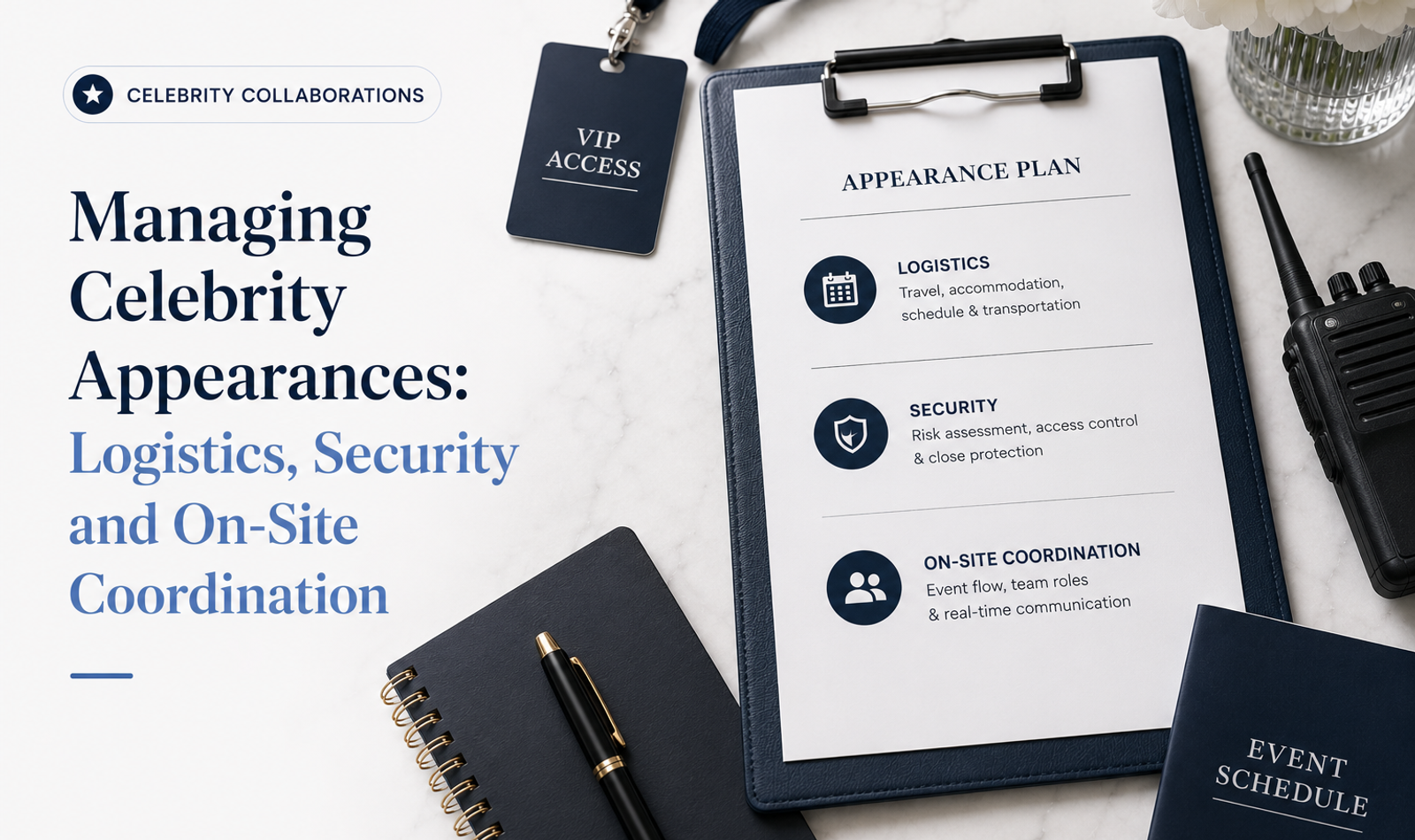
Managing Celebrity Appearances: Logistics, Security and On-Site Coordination
A successful celebrity appearance depends on much more than confirming the celebrity’s availability and signing a commercial agreement. Once the booking is complete, the organiser must convert the contract, rider and event brief into a detailed operational plan.
The celebrity must arrive safely, move through the venue privately, receive the agreed hospitality and complete every scheduled activity without unnecessary waiting or confusion. At the same time, organisers must manage guests, media, photographers, production teams, venue staff and security personnel.
A small failure in one area can affect the entire appearance.
A delayed vehicle can cause the celebrity to miss the planned stage time. An uncontrolled backstage area can lead to unauthorised photographs and crowding. A missing microphone can delay an important speech. Poor communication between security and production teams can result in the celebrity being taken through the wrong entrance.
These problems are rarely caused by one major mistake. They usually result from several small details that were not assigned, confirmed or communicated properly.
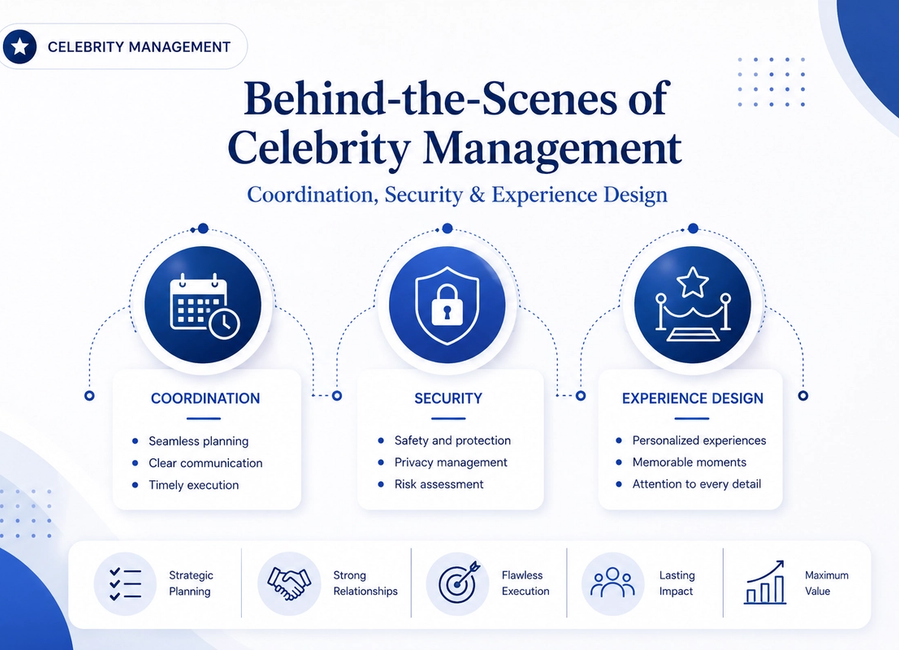
Celebrity appearance management is therefore an exercise in preparation, coordination and risk control.
The organiser must understand the celebrity’s contractual obligations, personal requirements, security needs and movement schedule. The venue must be examined from arrival to departure. Every person involved should know their responsibilities and who has the authority to make decisions.
The celebrity’s experience should feel calm, private and professionally managed even when the event itself is busy and highly public.
The best coordination is often invisible. Guests see a smooth entrance, confident stage appearance and organised departure. They do not see the transport checks, route planning, access lists, communication systems and contingency decisions that made the moment possible.
Understand the Exact Appearance Scope
Operational planning should begin with the contract and final confirmed scope.
The team must understand precisely what the celebrity has agreed to do.
An appearance may include attending the event for a fixed period, walking a red carpet, delivering a speech, presenting an award, interacting with selected guests, participating in photographs or posting content on social media.
These activities should not be treated as flexible assumptions.
If the celebrity has agreed to one stage appearance and a brief meet-and-greet, the organiser should not add unapproved interviews, extended photography or extra stage activities on the event day.
The confirmed duration also needs to be understood carefully.
A sixty-minute appearance may begin when the celebrity enters the venue, reaches the green room or appears in front of the audience. This definition should be agreed before operational planning.
The team should review the rider, travel arrangements, security requirements, photography permissions and media obligations together.
Every operational department should work from the same approved scope.
When sales, production, hospitality and security teams rely on different versions of the agreement, the risk of conflict increases.
Appoint One Celebrity Coordination Lead
One experienced person should have overall responsibility for the celebrity appearance.
This person becomes the main point of contact between the celebrity representative and the organiser’s internal teams.
The coordination lead should understand the contract, schedule, rider, venue layout and decision-making structure.
They should not be responsible for several unrelated event activities at the same time.
Celebrity management requires constant attention during the arrival and appearance period. The lead may need to respond to travel delays, schedule adjustments, security concerns or requests from the celebrity team.
When several organisers communicate directly with the celebrity manager, information can become inconsistent.
One person may promise an additional interview while another has already confirmed that no media interaction will take place. Different team members may provide conflicting arrival instructions.
A central coordinator prevents these problems.
Other department leads can communicate through this person, who then confirms changes with the celebrity representative.
Build a Detailed Movement Plan
The celebrity movement plan should cover the complete journey from arrival in the city to final departure.
It should identify the airport, railway station or local pickup point, hotel, venue, entry gate, green room, stage, photography area, media area and exit route.
The organiser should avoid planning only the public stage moment.
Movement between locations often creates the greatest operational risk.
The route should be reviewed in advance. The team should understand traffic conditions, parking restrictions, venue loading areas, alternative entrances and any construction or public activity nearby.
The celebrity should not arrive at the main public entrance unless this has been planned intentionally.
A private vehicle drop-off point is usually preferable. It should allow the car to stop safely without attracting unnecessary attention or blocking emergency access.
The route from the vehicle to the green room should be short, secure and free from uncontrolled crowds.
Alternative routes should also be identified.
If the planned entrance becomes blocked or publicly visible, the security and coordination teams should know which route to use instead.
Prepare a Minute-by-Minute Run Sheet
The celebrity appearance should be supported by a detailed run sheet.
The schedule may include airport arrival, hotel check-in, departure from the hotel, venue arrival, green room time, briefing, stage movement, photography, interaction, media activity and departure.
The run sheet should be realistic.
It should account for travel time, security checks, styling, waiting, rehearsals and possible delays.
A common mistake is creating a schedule with no transition time.
The celebrity may be expected to arrive, walk directly to the stage and begin immediately. This leaves no opportunity for briefing, refreshments or last-minute preparation.
Buffer time should be included without creating excessive waiting.
Celebrities and their teams generally prefer an accurate call time rather than arriving far earlier than required.
The final schedule should be shared only with authorised personnel.
Public circulation of detailed movement timings can create privacy and security concerns.
Coordinate Directly With the Celebrity Representative
The representative should receive one clear operational document before the event.
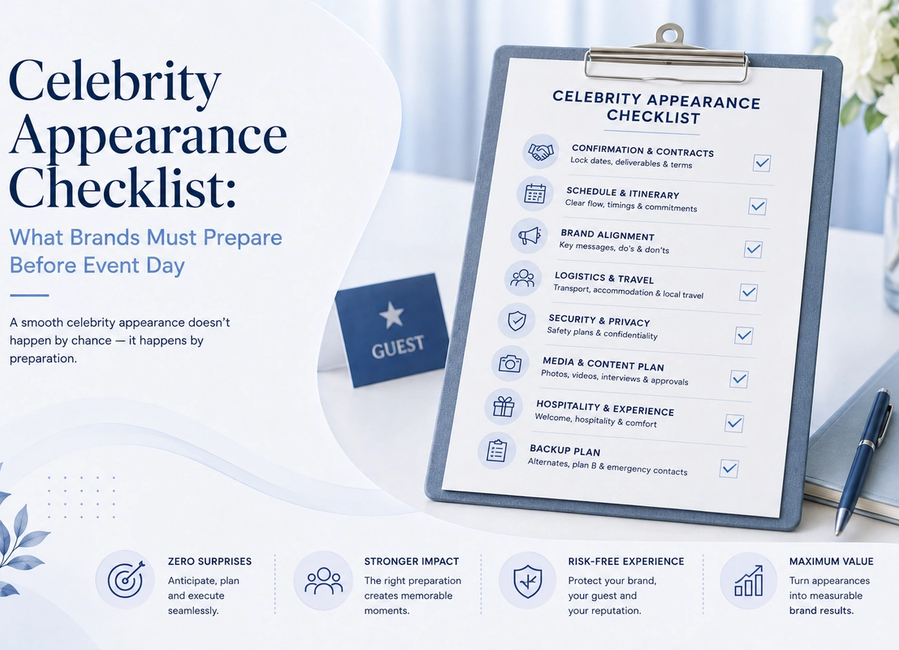
This may include confirmed travel, hotel, vehicle, coordination contacts, venue address, arrival gate, schedule, hospitality arrangements and emergency numbers.
The organiser should confirm the number and roles of people travelling with the celebrity.
The party may include a manager, personal security officer, stylist, hair and makeup artist, assistant, publicist or family member.
Each person may require transport, hotel accommodation, credentials and venue access.
The organiser should not assume that the celebrity will travel alone.
The representative should also be informed about the event format, expected audience, media presence and stage activity.
Any changes should be documented.
Important operational instructions should not depend only on informal phone calls.
Plan Travel Carefully
Travel arrangements should match the terms agreed in the contract and rider.
The organiser must confirm who is responsible for booking flights, trains or private aviation.
Names should be copied exactly from official travel documents.
Travel dates, baggage requirements, preferred timings and accompanying passengers should be confirmed before non-refundable bookings are made.
The celebrity team may require flexibility because production schedules and professional commitments can change.
The organiser should understand the change and cancellation rules attached to each booking.
Travel information should be treated confidentially.
Flight details, hotel names and arrival timings should be shared only with people who need them for operations.
Posting real-time travel information in large staff groups increases risk.
A travel coordinator should monitor the journey and remain in contact with the representative.
If the flight is delayed, the venue and production teams should receive a controlled update without creating panic.
The event schedule may need to be adjusted while preserving the celebrity’s confirmed appearance duration.
Arrange Appropriate Airport or Station Reception
The pickup team should arrive early and confirm the arrival terminal, gate and vehicle position.
A named representative should be responsible for greeting the celebrity team.
The greeter should be professional, easily identifiable and familiar with the final transport plan.
The celebrity should not be approached by several organisers at the arrival point.
A crowded welcome may attract public attention and delay movement.
The luggage plan should also be considered.
A separate luggage vehicle may be necessary when the travel party is large or carries performance equipment, costumes or styling cases.
The pickup team should have the driver’s details, vehicle number and live contact.
If access to the arrival area requires special permission, this should be arranged in advance.
The objective is to move the celebrity from arrival to the vehicle quickly and calmly.
Select the Right Vehicles
Vehicle selection should reflect the rider, travel party, location and security requirement.
The main vehicle should be clean, reliable and appropriately presented.
It should have enough space for the celebrity, representative and personal security officer where applicable.
Additional vehicles may be needed for staff, luggage, security or equipment.
The organiser should not attempt to fit the complete team into one vehicle when this creates discomfort or delays.
Drivers should be experienced, professionally dressed and briefed about confidentiality.
They should know the route, hotel entry, venue gate and alternative route before pickup.
Navigation should not begin only after the celebrity enters the vehicle.
The vehicle should have sufficient fuel and should be checked for mechanical issues in advance.
A backup vehicle may be necessary for high-profile or time-sensitive appearances.
The driver should not request photographs, autographs or personal conversation.
They are part of the professional service environment.
Manage Hotel Arrangements
The hotel should meet the category and room requirements stated in the agreement.
The organiser should confirm the number of rooms, room types, check-in arrangements, accompanying guests and payment responsibility.
Where possible, check-in should be completed before arrival.
The celebrity should not be required to wait at a public reception desk while documents or payment details are discussed.
The hotel should understand the privacy requirements.
Only authorised staff should know the guest’s room number. Calls and visitors should be controlled according to the celebrity team’s instructions.
The room should be checked before arrival for cleanliness, functionality and rider items.
A hotel coordination contact should remain available for the duration of the stay.
Early check-in or late checkout should be arranged when travel timings require them.
The organiser should also confirm whether meals will be provided in the room, restaurant or private dining space.
Conduct a Venue Recce
A venue recce should take place before the event with representatives from production, security, hospitality and celebrity coordination.
The team should physically walk the intended movement route.
Plans that appear practical on a map may not work in reality.
The recce should examine vehicle access, gate width, parking, lighting, stairs, lifts, narrow corridors, public areas and emergency exits.
The team should identify locations where guests or media may gather.
The distance between the green room and stage should be measured realistically.
If the celebrity must cross a public area, barriers, screens or temporary access control may be required.
The condition of the route matters.
Loose cables, wet floors, temporary equipment and poor lighting can create safety risks.
The recce should also confirm mobile communication coverage and radio performance in important areas.
Separate Safety and Security Planning
Safety and security support each other, but they address different types of risk.
Safety planning deals with hazards such as slips, crowd pressure, blocked exits, electrical equipment and structural issues.
Security planning deals with intentional threats such as unauthorised access, aggressive behaviour, stalking, theft or deliberate disruption.
The celebrity movement plan should consider both.
A route may be private but unsafe because it passes through a technical loading area with cables and equipment. Another route may be physically clear but publicly accessible.
The organiser should involve qualified venue and security professionals.
The celebrity coordinator should not make specialist security decisions alone.
The event should have a written risk assessment appropriate to its size, location, audience and celebrity profile.
Build a Proportionate Security Plan
Security should be based on the actual risk rather than the celebrity’s fame alone.
The plan should consider the event type, venue, audience size, public access, alcohol service, media presence, local conditions and any known threats.
A private corporate dinner requires a different structure from an open public concert.
The security team should identify the protected areas, access points and movement routes.
There should be a clear chain of command.
The celebrity may travel with personal protection personnel. Their role should be coordinated with the organiser’s event security team.
The personal security officer focuses on the celebrity, while the venue security team manages the wider environment.
These responsibilities should not be left unclear.
The teams should meet or speak before the appearance and agree on communication, vehicle movement, stage access and emergency procedures.
Control Access to Restricted Areas
The backstage area, green room, private corridor and vehicle zone should be treated as restricted spaces.
Access should be based on operational need rather than seniority or personal interest.
A large number of organisers, sponsors and guests may request backstage access. Allowing all of them into the celebrity area can create crowding and privacy problems.
Credentials should be easy for security staff to recognise.
Colour-coded or zone-based access can be useful when the event has several restricted levels.
An access list should identify authorised names and roles.
Security personnel should receive the list before the event.
Last-minute access requests should be approved only through the designated authority.
A person should not be admitted simply because they claim to be connected to the organiser.
The celebrity representative may also provide a list of approved visitors.
Prepare a Secure Green Room
The green room should be private, clean and ready before the celebrity arrives.
It should not be used as a storage room, staff meeting area or general hospitality space.
The room should have controlled access and, where required, a dedicated security officer at the entrance.
The rider may specify furniture, mirrors, lighting, refreshments, towels, temperature, washroom access and other requirements.
These items should be checked before the arrival time.
A working charging point, reliable internet connection and basic supplies can prevent unnecessary requests later.
The green room should be close enough to the stage for efficient movement but far enough from public areas to preserve privacy.
Noise should also be considered.
A room next to heavy production equipment or loud speakers may not provide a suitable preparation environment.
Only approved people should enter.
Organisers should not continuously bring guests into the room for photographs unless this is part of the agreement.
Protect Personal Information and Privacy
The celebrity’s phone number, hotel details, travel schedule and private requests should not be circulated widely.
Operational groups should contain only the information each team needs.
A driver needs pickup details but may not need the complete contract. A stage manager needs the appearance cue but may not need hotel information.
Staff should be instructed not to post photographs, locations or behind-the-scenes information without approval.
Real-time social media posts can reveal movement and private areas.
Confidentiality expectations should be included in staff and vendor briefings.
For private events, the client identity, guest list and venue details may also require protection.
Privacy is not only a celebrity preference. It is part of professional risk management.
Coordinate Hair, Makeup and Styling
Styling arrangements should be clarified before the event.
The celebrity may travel with a personal stylist, hair professional or makeup artist. Alternatively, the organiser may be responsible for providing approved professionals.
The team should confirm the required preparation time, room setup, lighting, mirrors, electrical access and wardrobe storage.
If the event has a dress theme, the celebrity team should receive it early.
The organiser should not attempt to impose last-minute wardrobe changes unless the contract provides for brand or event approval.
Any branded accessories, products or stage items should be approved before the appearance.
The styling schedule should be included in the run sheet.
Unexpected photography or media activity should not be added before the celebrity is ready.
Brief the Celebrity Before Stage Movement
Before the celebrity moves to the stage, the representative should receive a concise operational briefing.
This should explain the route, expected audience reaction, stage position, microphone, host, activity and exit.
The celebrity should know whether they are expected to speak, present, perform, answer questions or pose for photographs.
Names and pronunciations should be confirmed when the celebrity is presenting an award or acknowledging specific people.
The stage manager should provide a clear cue.
The celebrity should not be left standing in a public corridor while waiting for the programme to catch up.
If the event is delayed, the representative should receive an honest update.
A controlled holding plan is better than repeatedly saying that the stage movement will happen in two minutes.
Coordinate With the Stage Manager
The stage manager and celebrity coordinator should remain in direct communication.
The stage manager controls the programme, technical cues and stage readiness. The celebrity coordinator controls the talent movement.
Neither should act independently.
The celebrity should not leave the green room until the stage manager confirms that the stage, microphone, host and audience conditions are ready.
The stage manager should understand the agreed appearance duration and activities.
Programme delays should be adjusted around the contracted window wherever possible.
Any additional request from the host or client should be cleared through the celebrity representative before it is introduced on stage.
Live events can create pressure to improvise, but unapproved improvisation may create reputational or contractual problems.
Test Technical Requirements
The microphone, playback, presentation, lighting and stage access should be tested before the celebrity arrives.
If the celebrity is speaking, the appropriate microphone type should be confirmed.
A handheld microphone may be suitable for a short interaction, while a headset or lapel may be required for another format.
For performances, the complete technical rider should be tested through a sound check.
Backup microphones and playback systems should be available.
Teleprompters, confidence monitors and presentation screens should display the correct final content.
Technical files should be available in more than one format and stored on backup devices.
The celebrity should not become the person discovering that the equipment does not work in front of the audience.
Manage Red Carpet and Photography
A red-carpet appearance should have a defined beginning, duration and exit.
Photographers should be positioned within a controlled area.
The celebrity should not be surrounded from all directions.
The organiser should decide whether the red carpet includes solo photographs, photographs with hosts, sponsor photographs or media interaction.
This sequence should be agreed in advance.
The photographer list may need approval for high-profile appearances.
A designated photo coordinator can call the required combinations and prevent multiple people from giving conflicting directions.
The celebrity should not be asked to repeat the same photograph with numerous unapproved groups.
If sponsor branding is required in the background, the placement and design should be confirmed before the event.
Control Meet-and-Greet Activity
Meet-and-greet sessions should be structured carefully.
The agreement should define the number of guests, time available and type of interaction.
The organiser should prepare the guest list in advance.
Guests should be informed about the process before entering the area.
Personal belongings, extended conversations and multiple photographs can slow the session significantly.
A photography system can be created in which guests enter, greet the celebrity, pose once and exit through a separate route.
This protects time and prevents crowding.
Physical contact should never be assumed.
Children, elderly guests and people requiring accessibility support may need additional coordination.
The organiser should avoid promising meet-and-greet access to guests unless it has been confirmed contractually.
Manage Media Requests
Media access should be approved before the event.
The organiser should distinguish between red-carpet questions, formal interviews, press conferences and casual backstage requests.
A celebrity appearance does not automatically include media interaction.
The representative or publicist should receive the publication names, interview format, topics and expected duration.
Sensitive or unrelated topics may be excluded.
The media area should be controlled, and a moderator or public relations representative should manage the sequence.
Reporters should not be permitted to follow the celebrity into restricted areas.
If the event is live-streamed, recorded or broadcast, the required permissions should already be covered by the contract.
Control Social Media and Content Capture
The organiser should understand what content is permitted.
Guests may be allowed to film the public stage appearance, while professional commercial recording may require separate rights.
The brand should not assume that footage can be edited into advertisements simply because it was captured at the event.
Approved social media deliverables should be managed according to the agreement.
The celebrity team may require caption, tag, timing and disclosure approval.
If content is being posted in real time, one authorised team should manage final clearance.
The organiser should also control behind-the-scenes capture.
Green-room footage, private conversations and vehicle movement should not be recorded casually.
Coordinate Sponsors and Brand Partners
Sponsors may expect photographs, acknowledgements or product interaction because they supported the event.
These expectations must be included in the celebrity agreement.
The organiser should not promise sponsor activity after the booking has been completed without checking approval.
A celebrity associated with one product category may be unable to pose with a competing sponsor’s product or branding.
Sponsor logos on the stage, photo wall and digital content should be reviewed for conflicts.
If a branded gift is to be presented, the representative should approve it.
The celebrity should not be surprised on stage by an unapproved product endorsement.
Prepare Crowd Management Around the Celebrity
Celebrity movement can change crowd behaviour quickly.
Guests may leave their seats, block aisles or gather near the stage and exits.
The security and event teams should anticipate these movements.
Barriers, ushers and clear circulation routes may be required.
The celebrity should not be moved through dense crowds without a controlled pathway.
The organiser should also protect emergency exits from crowd buildup.
Announcements can be used to reduce uncertainty and keep guests in designated areas.
The event should avoid creating a public rush by announcing private departure routes or promising unrestricted access.
Crowd management should protect the celebrity and the audience together.
Establish Communication Protocols
The event should have a reliable communication system.
Radios are often more effective than phone calls in loud or crowded venues.
Key personnel should receive defined radio channels and call signs where appropriate.
The celebrity coordinator, stage manager, security lead, transport lead and venue manager should be able to reach each other immediately.
Communication should remain concise.
Long discussions over the radio can block urgent information.
Sensitive personal details should not be announced publicly over shared channels.
The team should also identify what happens when radios or mobile networks fail.
A physical command point and designated runners may provide backup.
Create a Clear Chain of Command
Every team member should know who can approve schedule changes, additional guest access or emergency actions.
Without a chain of command, several senior people may issue conflicting instructions.
The celebrity coordination lead manages talent-related operations. The security lead manages security decisions. The stage manager controls the live programme, while the event director holds overall authority.
These roles should cooperate without replacing one another.
The celebrity representative should know whom to contact for each issue.
A written contact sheet can include names, roles and numbers.
During the event, operational problems should be escalated through the correct channel rather than discussed in large groups.
Prepare for Delays
Travel, weather, traffic and programme changes can affect the schedule.
The event should have a delay strategy.
If the celebrity is late, the production team should know which programme elements can be extended, moved or removed.
The host should receive suitable holding content.
The organiser should avoid publicly announcing a precise arrival time before the celebrity is actually close to the venue.
If the event programme is delayed, the celebrity team should be informed promptly.
The organiser may need to protect the contracted departure time even when earlier parts of the event ran late.
This possibility should be discussed before the event.
Prepare for Cancellation or Non-Appearance
The team should understand the contract’s cancellation, postponement and force-majeure provisions.
A celebrity may become unavailable because of illness, travel disruption or another defined circumstance.
The organiser should decide in advance who communicates the situation to the client, guests, media and sponsors.
A replacement should not be announced without approval.
Marketing materials and social posts may need to be changed quickly.
Refund or compensation decisions should follow the event terms and contract.
The team should avoid making public accusations before the facts and contractual position are clear.
A calm response protects the event’s reputation.
Prepare Medical and Emergency Procedures
The event should have suitable medical support and an emergency response plan.
The celebrity coordinator should know the location of first aid, emergency exits and the designated assembly point.
Medical information should be handled privately.
If the celebrity has communicated a specific medical or dietary requirement, only the relevant people should receive it.
The security and venue teams should understand how the celebrity would be evacuated during an emergency.
Emergency movement may require a different route from the standard departure plan.
The organiser should never block emergency access with celebrity vehicles or production equipment.
Manage Departure With the Same Care as Arrival
Operational attention often decreases after the stage appearance is complete.
This is a mistake.
Departure can create significant crowd and security pressure because guests know the celebrity is about to leave.
The vehicle should be positioned and ready before the celebrity begins moving.
The route should be checked again for crowds, media and obstacles.
The departure time should not be announced publicly.
Approved final photographs or guest interactions should be completed before movement begins.
The celebrity should not be delayed near the exit while organisers search for the driver or luggage.
A backup route should remain available.
The transport team should confirm arrival at the hotel, airport or next destination.
Complete Post-Event Responsibilities
After the appearance, the organiser should confirm that all contractual activities were completed.
Approved photographs, content and media usage should be organised carefully.
The brand should not publish unapproved footage simply because the event has ended.
Outstanding payments, reimbursements and invoices should be processed according to the contract.
The organiser can also request feedback from the celebrity representative.
This helps identify operational strengths and areas for improvement.
Any lost property or personal item should be handled securely.
Internal teams should complete a short debrief while the details are still fresh.
The debrief should review travel, security, timing, hospitality, stage activity and communication.
The objective is to improve future execution rather than assign blame.
Maintain Records and Confidentiality
The organiser should retain the final contract, rider, approvals, invoices, travel records and operational notes securely.
Access should be limited to authorised team members.
Personal documents and identification information should not remain in shared event folders longer than necessary.
Photographs and videos should be categorised according to approved usage rights.
The brand should know when the permitted usage period ends.
Confidentiality obligations may continue after the event.
Private travel details, backstage conversations and personal requests should not be discussed publicly.
Professional discretion is one of the strongest indicators of reliable celebrity management.
Common Celebrity Appearance Management Mistakes
One of the most common mistakes is assuming that the booking agency will manage every on-site detail.
The representative may support the celebrity, but the organiser remains responsible for the venue, transport, hospitality and event environment.
Another mistake is allowing too many people direct access to the celebrity manager.
This creates conflicting communication and unapproved promises.
Poor access control often leads to crowded green rooms and repeated guest requests.
Organisers may also fail to review the rider until shortly before the event, creating last-minute procurement and production problems.
Unrealistic schedules, untested equipment and missing backup vehicles create additional risk.
Some teams focus heavily on arrival but fail to plan departure.
Others allow unapproved media and sponsors to approach the celebrity.
The most serious problems usually develop when responsibilities are assumed rather than assigned.
A Practical Celebrity Appearance Management Process
The process begins after the agreement is signed and the final scope is confirmed.
One celebrity coordination lead is appointed.
The team reviews the contract, rider, travel party, deliverables and restrictions.
Travel, hotel and vehicles are booked according to approved requirements.
A venue recce identifies routes, green rooms, stage access, restricted zones and emergency options.
Security conducts a risk assessment and creates an access and movement plan.
A detailed run sheet and contact sheet are prepared.
The celebrity representative receives the final operational note and confirms the schedule.
The green room, credentials, transport and technical systems are checked before arrival.
The airport and hotel teams monitor travel and update the central coordinator.
On the event day, the celebrity moves through controlled routes and receives a clear briefing before every public activity.
Stage, media, sponsor and guest interactions remain within the approved scope.
Departure is managed through a ready vehicle and secure route.
After the appearance, payments, content approvals and internal debriefing are completed.
This structure turns a complex appearance into a controlled operational process.
Frequently Asked Questions
Q1. What is celebrity appearance management?
Celebrity appearance management is the process of planning and coordinating every detail related to a celebrity’s presence at an event. It includes travel, hotel arrangements, security, green room setup, stage movement, media interaction, photography, hospitality and departure planning.
Q2. Why is logistics important in celebrity appearances?
Logistics are important because even a small delay or confusion can affect the entire event schedule. Proper transport, route planning, hotel coordination, arrival timing and backstage movement ensure that the celebrity reaches the right place at the right time without unnecessary stress or disruption.
Q3. What should be included in a celebrity movement plan?
A celebrity movement plan should include airport or hotel pickup, vehicle details, venue entry route, green room access, stage route, photography area, media zone, exit route and backup movement options. It should also include responsible contacts for transport, security, stage and hospitality teams.
Q4. Why is security important for celebrity appearances?
Security protects the celebrity, guests and event environment. It helps control access to restricted areas, manage crowd behaviour, prevent unauthorised photographs, protect privacy and ensure that arrival, stage movement and departure happen safely.
Q5. What is the role of a celebrity coordination lead?
The celebrity coordination lead is the main point of contact between the celebrity representative and the event team. This person manages communication, schedule updates, rider requirements, movement planning and coordination between security, production, hospitality and venue teams.
Q6. What is a celebrity rider?
A celebrity rider is a document that lists the celebrity’s requirements for the appearance. It may include travel, hotel, vehicle, green room, food, makeup, security, technical, hospitality and privacy requirements. The organiser must review and fulfil the rider properly before the event.
Q7. How should a green room be prepared for a celebrity?
A celebrity green room should be private, clean, secure and ready before arrival. It should include the agreed rider items, comfortable seating, refreshments, mirrors, lighting, charging points, washroom access and controlled entry so that only authorised people can enter.
Q8. How should media and photography be managed during a celebrity appearance?
Media and photography should be planned in advance. The organiser should confirm whether interviews, red carpet photos, sponsor photos or guest pictures are approved. Photographers and media teams should be placed in controlled areas to avoid crowding or unauthorised access.
Conclusion
Managing a celebrity appearance is not only about confirming the celebrity’s presence at an event. It is about creating a controlled, private and professionally managed experience from arrival to departure.
Every detail matters. The vehicle must arrive on time, the route must be clear, the green room must be ready, the security team must understand access control and the stage manager must know the exact appearance cue. When these elements are not coordinated properly, even a high-profile appearance can become stressful and disorganised.
The strongest celebrity appearances are built through planning, not last-minute adjustment. The organiser must understand the contract, rider, schedule, media permissions, security needs and hospitality expectations before the event day.
A single celebrity coordination lead helps prevent confusion by keeping all communication centralised. Security, production, hospitality, transport, venue and media teams should work through one clear structure.
Privacy and professionalism are equally important. Restricted areas should remain controlled, staff should not share private information and guests should not be allowed backstage unless approved. The celebrity’s time, comfort and safety must be protected throughout the event.
When logistics, security and on-site coordination work together, the appearance feels effortless to the audience. The celebrity arrives calmly, completes the scheduled activities smoothly and exits without unnecessary delay or disruption.
That is the real goal of celebrity appearance management — to make a complex operational process feel seamless, premium and professionally handled.
Manage Celebrity Appearances With Precision, Privacy and Control
If you are planning a celebrity appearance for a wedding, corporate event, brand launch, award night or private celebration, the right coordination can make the difference between a stressful appearance and a seamless one.
At Double Trouble Studio, we manage celebrity appearances with complete attention to logistics, security, hospitality, media coordination, stage movement and on-site execution — ensuring every appearance is handled with professionalism, discretion and control.
📩 info@dtsworld.in. 📞 +91 80000 06021 📍 Andheri (West), Mumbai
Related reading: Managing celebrity appearances at events.
Need this for your brand?
Let DTS build your next campaign.
From PR, celebrity management and events to websites, social media, SEO and AI video production — Double Trouble Studio helps brands grow with strategy and execution.
Discuss Your Requirement →