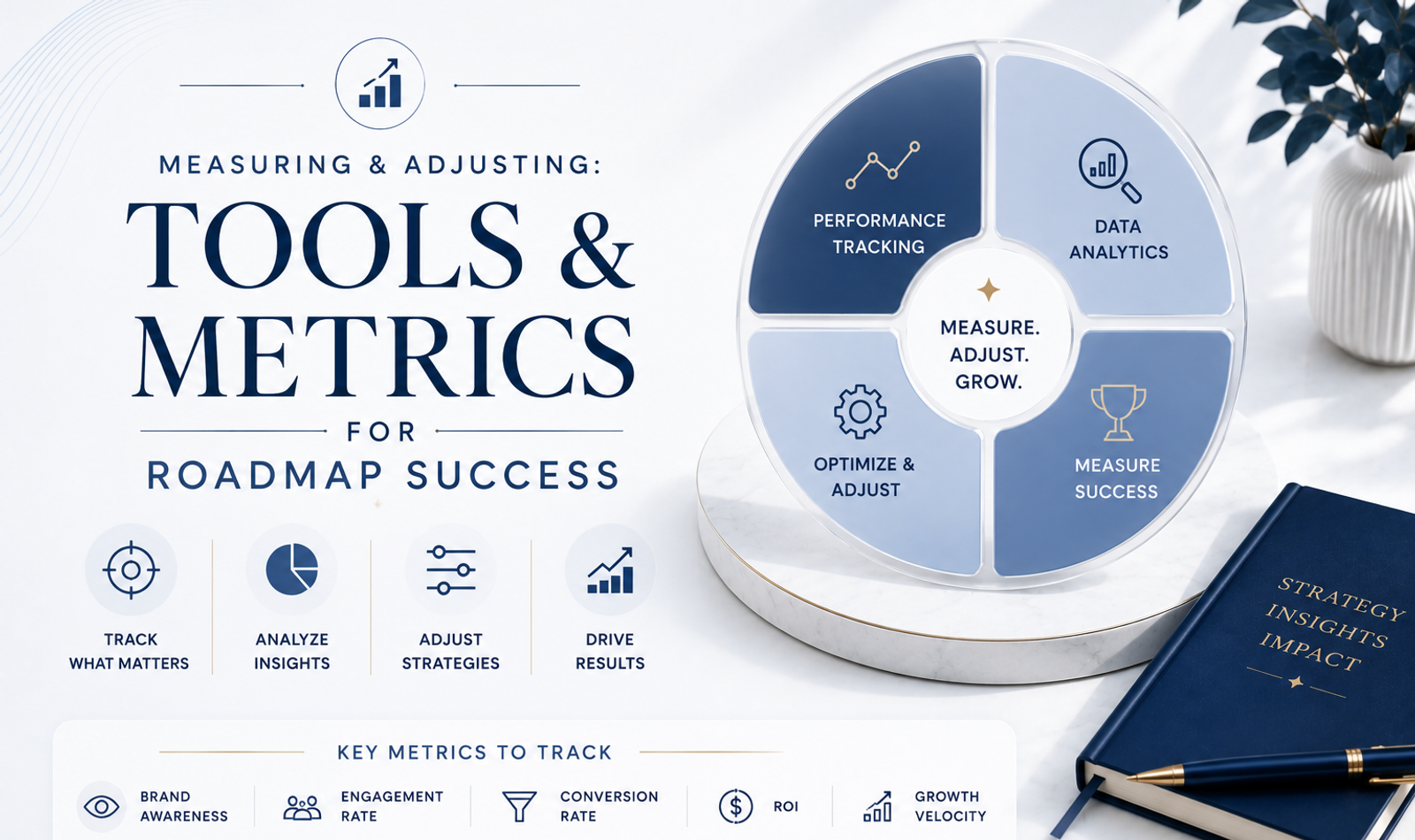
Measuring & Adjusting: Tools & Metrics for Roadmap Success
A brand roadmap is only useful when it can be measured, reviewed and adjusted. Many businesses create detailed strategies at the beginning of the year, but they do not track whether those strategies are actually working. As a result, the roadmap becomes a document instead of a decision-making system.
Successful brands do not simply execute campaigns and hope for growth. They measure performance, study customer behaviour, review channel results, identify weak points and adjust their roadmap based on evidence. This is what turns a brand strategy from a plan into a practical growth tool.
For premium, luxury, hospitality, lifestyle, event, real estate, fashion, digital and service-led brands, measurement is especially important. Customers interact with the brand across many touchpoints before making a decision. They may see a reel, visit the website, read a blog, attend an event, check a media feature, receive a WhatsApp message, view a proposal and speak to the sales team before converting.
If these touchpoints are not measured properly, the brand may not understand what is creating awareness, what is building trust and what is producing qualified enquiries.
A connected approach across Double Trouble Studio services can help brands align strategy, digital presence, PR, content and customer experience with measurable business objectives.
This guide explains how to measure and adjust your brand roadmap using the right tools, KPIs, dashboards, audits and review systems. It also explains how brands can use data without losing creativity, emotion and premium brand value.
Why Measurement Matters in a Brand Roadmap
A brand roadmap defines where the brand wants to go. Measurement shows whether the brand is actually moving in that direction.
Without measurement, teams often depend on assumptions. A campaign may look successful because it received likes, but it may not generate qualified leads. A PR feature may look impressive, but it may not reach the right audience. A website may look beautiful, but it may not convert visitors into enquiries. A social media page may grow followers, but those followers may not match the brand’s target customer.
Measurement separates activity from progress.
It helps the brand understand which actions are working, which channels deserve more investment and which activities should be changed or stopped.
A strong measurement system also creates internal clarity. Founders, marketing teams, sales teams, agencies and customer service teams can review the same data and make better decisions together.
For premium brands, measurement should not only focus on immediate sales. It should also track awareness, perception, engagement, trust, enquiry quality, customer experience and long-term brand equity.
Measurement Is Not Only About Numbers
One common mistake brands make is treating measurement as only a numbers game.
Metrics are important, but they must be interpreted correctly. A high number of impressions does not always mean brand growth. A large follower count does not always mean customer trust. A low cost per lead does not always mean business success. A viral reel does not always mean premium positioning.
Measurement must connect numbers with meaning.
For example, if a campaign generates 1,000 leads but most of them are low-budget or irrelevant, the campaign may not be successful for a premium brand. If a blog brings fewer visitors but those visitors spend more time and submit high-quality enquiries, that content may be highly valuable.
The goal is not to collect every possible metric.
The goal is to measure what matters for the brand roadmap.
Start With the Roadmap Objective
Before choosing tools and KPIs, the brand must define the main objective of the roadmap.
Different objectives require different metrics.
If the roadmap objective is to build awareness, the brand should measure reach, branded search, website traffic, PR visibility and audience growth.
If the objective is to improve premium positioning, the brand should measure lead quality, average order value, customer feedback, media quality, enquiry relevance and reduced discount dependence.
If the objective is to increase conversions, the brand should measure landing page performance, enquiry rate, sales conversion, cost per qualified lead and follow-up efficiency.
If the objective is retention, the brand should measure repeat purchases, referrals, customer lifetime value, satisfaction and loyalty engagement.
A roadmap without a clear objective creates confused measurement.
The brand must first decide what success means.
Brands that need a broader integrated strategy can explore the services offered by Double Trouble Studio across media, marketing and brand communication.
Define the Right KPIs
KPIs, or key performance indicators, are the most important metrics used to track progress.
A good KPI should be specific, measurable, relevant and connected to business or brand growth.
Not every metric should become a KPI.
For example, likes and impressions may be useful supporting numbers, but they may not be the main KPI if the brand’s real goal is qualified enquiries or customer retention.
The best KPIs help the team make decisions.
If a metric does not influence action, it may not deserve space in the main dashboard.
A premium brand should usually track KPIs across awareness, engagement, authority, conversion, customer experience and retention.
This gives a more complete view of roadmap success.
Awareness Metrics
Awareness metrics show whether more of the right people are discovering the brand.
Useful awareness metrics include branded search volume, website traffic, direct traffic, social reach, profile visits, PR mentions, video views, referral traffic and event attendance.
Branded search is especially important because it shows that people are looking specifically for the brand. This may happen after seeing social media content, PR coverage, events, influencer collaborations or word-of-mouth recommendations.
Direct website traffic also matters because it indicates that customers remember the brand enough to visit it directly.
However, awareness should be measured with quality in mind.
A premium brand does not only need more reach. It needs reach among the right customer segment.
For businesses expanding across multiple markets, location-specific performance can also be evaluated through a structured location strategy rather than treating all traffic as one audience.
Engagement Metrics
Engagement metrics show whether people are interacting with the brand meaningfully.
For social media, useful engagement metrics include saves, shares, comments, profile actions, direct messages, watch time and link clicks.
For websites, engagement metrics include time on page, scroll depth, page views per session, return visitors, blog engagement and downloads.
For email marketing, engagement includes open rate, click rate, replies and unsubscribe rate.
For events, engagement may include attendee participation, content interaction, conversations, follow-up interest and post-event enquiries.
Engagement should be evaluated carefully.
A funny or controversial post may receive high engagement but may not support the brand’s desired positioning. A detailed educational post may receive fewer likes but create stronger trust with serious customers.
This is why engagement quality matters more than engagement volume.
Authority Metrics
Authority metrics show whether the brand is becoming more credible.
For premium and service-led brands, authority is a major part of roadmap success.
Authority can be measured through media coverage, expert features, founder interviews, backlinks, guest articles, awards, industry collaborations, podcast appearances, case studies, testimonials and speaking opportunities.
The quality of the platform matters.
A feature in a relevant lifestyle, business or industry publication may be more valuable than multiple low-quality mentions.
Backlinks from credible websites also support search visibility and digital trust.
Authority metrics should also include internal proof assets such as case studies, client results, customer stories and detailed testimonials.
A strong PR and media strategy can help brands build this third-party credibility while connecting media visibility with broader marketing objectives.
A brand becomes stronger when it can prove its value.
Conversion Metrics
Conversion metrics show whether brand attention is turning into business action.
These metrics may include enquiry form submissions, consultation bookings, WhatsApp clicks, phone calls, purchases, demo requests, proposal requests, store visits, waitlist sign-ups and event registrations.
For digital campaigns, the brand should measure cost per qualified lead, conversion rate, landing page performance, lead-to-sale rate and return on ad spend.
However, premium brands should avoid focusing only on cheap conversions.
A low-cost lead may not be valuable if the customer does not match the ideal profile.
Conversion quality is essential.
The brand should track how many leads are serious, relevant, budget-aligned and likely to convert.
This helps the business optimise for quality rather than volume.
Customer Experience Metrics
Customer experience metrics show whether the brand is delivering its promise.
These metrics may include response time, enquiry handling quality, customer satisfaction, complaint resolution time, onboarding completion, delivery experience, review rating, support quality and feedback scores.
For premium brands, customer experience has a direct impact on trust and referrals.
A brand may spend heavily on campaigns, but if customers experience delays, confusion or poor service, the roadmap will fail.
Response time is especially important for service-led businesses. If a high-value customer sends an enquiry and receives a delayed or generic reply, the brand loses momentum.
For high-touch businesses such as events and weddings, experience measurement can also extend to arrivals, hospitality and guest management, where execution quality directly influences overall brand perception.
Customer experience should be reviewed monthly, not only when complaints appear.
Retention Metrics
Retention metrics show whether customers continue to value the brand after the first purchase or interaction.
Useful retention metrics include repeat purchase rate, renewal rate, customer lifetime value, referral rate, loyalty engagement, repeat enquiry volume and customer inactivity.
Retention is often more profitable than constant new acquisition.
For premium brands, strong retention also builds reputation. Satisfied customers become advocates, referral sources and long-term supporters.
A brand roadmap should not only bring new customers into the funnel. It should also strengthen relationships with existing customers.
Retention metrics show whether the brand is building long-term value.
Brand Equity Metrics
Brand equity is harder to measure than clicks or conversions, but it is extremely important.
Brand equity refers to the value created by recognition, trust, preference, reputation and willingness to pay.
Useful indicators include branded search growth, reduced discount dependence, higher average order value, stronger referral quality, increased organic enquiries, improved media interest, better partnership opportunities and customer willingness to pay premium prices.
A brand with strong equity does not need to fight only on price.
Customers choose it because they understand and trust its value.
Measuring brand equity requires both data and qualitative feedback.
The brand should listen to how customers describe it, what they remember, what they compare it with and why they choose it.
Digital Tools for Roadmap Measurement
The right tools make roadmap tracking easier.
A brand does not need to use every tool available. It needs a focused system that captures the right data.
Google Analytics can help track website traffic, user behaviour, top pages, traffic sources and conversion actions.
Google Search Console can help track search visibility, ranking queries, page performance, clicks, impressions and technical search issues.
Social media analytics can help track reach, engagement, followers, content performance, profile actions and audience behaviour.
Meta Ads Manager, Google Ads and LinkedIn Campaign Manager can help track paid media performance, cost, conversions and audience response.
CRM tools can help manage leads, follow-ups, customer status, sales stages and conversion quality.
Email marketing platforms can track open rates, click rates, audience segments and campaign performance.
Project management tools can help track roadmap tasks, ownership, deadlines and progress.
Dashboard tools can combine data from multiple sources into one review system.
The best tool is the one the team actually uses consistently.
Website Analytics for Roadmap Success
The website is often the central point of the brand roadmap.
It connects awareness, trust and conversion.
Website analytics should answer important questions.
Where are visitors coming from? Which pages are they viewing? How long are they staying? Which pages are creating enquiries? Where are visitors dropping off? Which blogs are attracting search traffic? Which campaigns are driving qualified visitors?
A brand should track homepage performance, service page performance, blog traffic, landing page conversions, contact form submissions, WhatsApp clicks and mobile behaviour.
If traffic is high but enquiries are low, the website may have a messaging or conversion problem.
If visitors leave quickly, the content may not match their expectations.
If mobile users do not convert, the mobile experience may need improvement.
A structured website development and marketing strategy can connect these analytics with UX, SEO, content architecture and conversion improvements.
Website analytics should guide regular improvements.
SEO Metrics for Long-Term Growth
SEO is a long-term roadmap channel.
It helps the brand become discoverable when customers search for relevant topics, services, locations and problems.
Important SEO metrics include organic traffic, keyword rankings, impressions, clicks, click-through rate, indexed pages, backlinks, internal linking, page speed and content performance.
The brand should also track which search queries bring relevant visitors.
Some keywords may bring traffic but not qualified leads. Other keywords may bring fewer visitors but stronger commercial intent.
For example, a broad keyword may create awareness, while a specific service or location keyword may generate enquiries.
A consistent blog and content strategy can support this process by building topical authority around customer questions, services and high-intent searches.
SEO content should also support AI-search visibility by providing clear answers, useful structure, expert insights and original examples.
The goal is to become a helpful and credible source for the right audience.
Social Media Metrics That Actually Matter
Social media performance should not be judged only by follower count.
A brand can have thousands of followers and still generate poor business results.
Useful social media metrics include reach among the right audience, saves, shares, comments, profile visits, website clicks, direct messages, story replies, video completion rate and enquiry quality.
Saves often indicate that the content is useful. Shares show that people find the content relevant enough to send to others. Profile visits show that content is creating interest. Direct messages show potential intent.
For premium brands, content should also be reviewed for brand fit.
A post may perform well but still weaken the brand if it feels off-position, too casual, too loud or irrelevant to the desired audience.
Social media should build both visibility and perception.
PR Measurement Tools and Metrics
PR measurement should go beyond counting media mentions.
A strong PR measurement system reviews the quality, relevance and impact of coverage.
Important PR metrics include publication authority, audience relevance, message accuracy, founder visibility, backlinks, referral traffic, social shares, sentiment and lead influence.
The brand should ask whether the coverage strengthened the desired positioning.
Did the article communicate the right message? Did it reach the right audience? Did it create website traffic? Did it support credibility? Can it be reused in sales decks, landing pages and social proof?
A single high-quality media feature can be more valuable than many weak mentions.
PR should be measured as a trust-building channel, not only a visibility channel.
Event Metrics for Brand Roadmaps
Events create real-world engagement, but they must also be measured.
Useful event metrics include registrations, attendance quality, guest profile, media attendance, creator participation, customer conversations, enquiries generated, content captured, post-event leads, follow-up conversion and partnership outcomes.
For premium events, guest quality is more important than crowd size.
A smaller event with high-value prospects, strong media presence and meaningful conversations may create more business value than a large event with poor audience fit.
The brand should also review event experience.
Was the guest journey smooth? Did the event reflect the brand positioning? Was the content captured properly? Did the team follow up on time? Did the event create long-term assets?
For brands using experiential marketing as part of their roadmap, events and weddings should therefore be evaluated not only on execution but also on content, PR, lead generation and long-term brand value.
Every event should contribute to the roadmap beyond the event day.
Content Marketing Metrics
Content should be measured based on purpose.
Some content is designed for awareness. Some is designed for education. Some is designed for authority. Some is designed for conversion.
Useful content metrics include page views, time on page, organic traffic, scroll depth, saves, shares, backlinks, enquiries generated, email sign-ups and lead quality.
Blogs should be reviewed based on both traffic and relevance.
A blog that ranks for a high-intent keyword and brings qualified enquiries may be more valuable than a viral article that does not support business goals.
Video content should be measured through watch time, completion rate, shares, saves, comments and action taken after viewing.
For brands investing in new visual formats, AI video and VFX can also be measured against campaign objectives such as completion rate, engagement, brand recall, leads or conversions rather than novelty alone.
Content measurement should help the brand understand which topics build trust and which formats drive action.
CRM Metrics for Lead Quality
A CRM system helps the brand track what happens after someone becomes a lead.
This is essential because marketing data alone does not show lead quality.
CRM metrics may include lead source, enquiry type, customer budget, sales stage, follow-up status, response time, proposal sent, conversion status, lost reason and revenue generated.
This helps the brand understand which channels attract the best customers.
For example, Instagram may generate many enquiries, but SEO may generate fewer and more serious leads. PR may generate high-trust conversations. Events may produce fewer but higher-value prospects.
Without CRM tracking, the brand may invest in channels that look active but do not generate quality business.
Build a Brand Performance Dashboard
A brand performance dashboard brings important metrics into one place.
The dashboard should be simple, focused and reviewed regularly.
It may include awareness metrics, website metrics, SEO metrics, social media metrics, PR results, paid media performance, lead quality, sales conversion, customer experience and retention.
The dashboard should not become overloaded.
Too much data creates confusion.
The dashboard should help the team answer a simple question: Is the roadmap working?
If the answer is unclear, the dashboard needs better structure.
A useful dashboard shows progress, problems and priorities.
Monthly Reviews
Monthly reviews help teams stay on track.
A monthly review should examine what was planned, what was completed, what performed well, what underperformed and what needs adjustment.
The review should include campaign results, website performance, content performance, lead quality, social media insights, PR updates, customer feedback and upcoming priorities.
The goal is not to change the strategy every month.
The goal is to improve execution.
Monthly reviews are useful for identifying small problems before they become major issues.
For example, if website traffic is increasing but enquiries are not, the brand can improve landing pages. If paid leads are low quality, targeting or messaging can be adjusted. If social content has reach but no action, CTAs and content direction can be improved.
Quarterly Reviews
Quarterly reviews are deeper than monthly reviews.
They should evaluate whether the brand is moving towards its larger roadmap milestones.
A quarterly review should assess awareness growth, positioning strength, channel performance, campaign results, customer acquisition, customer experience, sales conversion and retention.
This is also the right time to make strategic adjustments.
If a channel is working well, the brand may increase investment. If a campaign theme is not connecting, the message may need refinement. If the target audience is not responding, the brand may need better customer research.
Quarterly reviews help the roadmap remain flexible without becoming unstable.
A good brand strategy needs consistency, but it also needs intelligent adjustment.
Annual Review
The annual review evaluates the complete roadmap.
It should compare original goals with actual results.
The brand should review what changed in awareness, perception, traffic, leads, sales, retention, authority and brand equity.
The annual review should answer important questions.
Did the brand become more recognisable? Did it attract better customers? Did it improve trust? Did it reduce dependence on discounts? Did content build authority? Did PR improve credibility? Did events generate real value? Did digital campaigns produce qualified leads? Did customer experience improve?
Reviewing previous brand work and case studies can also help teams compare strategic intentions with actual execution and outcomes.
This review should guide the next year’s roadmap.
The strongest annual strategies are built from real learning, not assumptions.
When to Adjust the Roadmap
A roadmap should not be changed every time one campaign underperforms.
However, it should be adjusted when data shows a clear pattern.
Adjust the roadmap if the target audience is not responding, if lead quality is poor, if conversion rates remain low, if the website is not supporting customer decisions, if paid media costs are rising without quality improvement or if customer feedback reveals a mismatch between promise and experience.
The roadmap may also need adjustment when the market changes, competitors shift, customer expectations evolve or new opportunities appear.
Adjustment does not always mean changing the entire strategy.
Sometimes the brand only needs sharper messaging, better landing pages, stronger content, improved follow-up, better audience targeting or clearer proof points.
The core brand direction should remain stable unless there is strong evidence that it is wrong.
How to Adjust Without Losing Consistency
Consistency is important for brand building.
If a brand changes its message, visual direction or audience focus too often, customers become confused.
Adjustments should improve the roadmap without breaking the brand identity.
For example, if educational content performs better than promotional content, the brand can create more educational content while keeping the same positioning. If one customer segment responds better than another, the brand can refine targeting without changing the core identity. If a landing page converts poorly, the brand can improve the copy and layout without changing the entire campaign idea.
Good adjustment is strategic refinement, not random change.
The brand should remain recognisable while becoming more effective.
Common Measurement Mistakes
One common mistake is tracking too many metrics.
When everything is measured, the team may not know what matters most.
Another mistake is focusing only on vanity metrics such as likes, followers and impressions.
These numbers may show visibility, but they do not always show trust or business impact.
Brands also make the mistake of ignoring lead quality.
A campaign that generates many irrelevant enquiries can waste sales time and damage premium positioning.
Another mistake is separating marketing data from sales data.
Marketing may celebrate leads, while sales may know those leads are not serious. Both teams must review performance together.
Some brands also fail to track customer experience.
They measure campaigns but ignore response time, service quality and complaint resolution.
Finally, many brands collect data but do not act on it.
Measurement is only useful when it leads to better decisions.
Best Practices for Roadmap Measurement
A strong measurement system should be simple, consistent and connected to strategy.
Start with one main roadmap objective. Select a focused set of KPIs. Build a dashboard. Review data monthly. Analyse deeper every quarter. Use customer feedback alongside analytics. Connect marketing data with sales outcomes. Measure quality, not only quantity. Adjust based on patterns, not panic.
The brand should also document learnings.
Each campaign, event, PR activity, content series and digital experiment should teach the team something.
Over time, these learnings create a stronger brand playbook.
The brand becomes better at choosing messages, channels, formats, audiences and investments.
How Premium Brands Should Measure Differently
Premium brands must measure differently from mass-market brands.
They should not chase only volume.
A premium brand may prefer fewer but higher-quality leads. It may value stronger PR credibility over random reach. It may prioritise customer experience over aggressive conversion. It may focus on average order value, referral quality and long-term relationships instead of only short-term sales.
Premium measurement should include perception, trust and quality.
The brand should ask whether its roadmap is attracting the right kind of customers and strengthening the desired reputation.
If marketing is generating leads but those leads are price-sensitive and misaligned, the roadmap needs adjustment.
The goal is not to become visible to everyone.
The goal is to become valuable to the right audience.
Tools Every Brand Should Consider
A practical measurement system can include website analytics, search tracking, social media insights, advertising dashboards, CRM software, email analytics, PR tracking, customer feedback tools and project management platforms.
Google Analytics and Google Search Console can support website and SEO measurement.
Social platform insights can support content and audience analysis.
Advertising dashboards can measure paid campaign performance.
A CRM can track leads, sales stages and customer quality.
Email tools can measure communication performance.
Feedback forms and surveys can capture customer experience insights.
Project management tools can track roadmap execution.
The exact tool stack depends on the brand size and complexity.
The priority is consistency.
A simple system used weekly is better than an advanced system ignored by the team.
Businesses looking to connect these systems across brand strategy, PR, content, digital growth and customer experience can contact Double Trouble Studio to discuss a structured roadmap.
Frequently Asked Questions
What is roadmap success measurement?
Roadmap success measurement is the process of tracking KPIs, tools, customer feedback and performance data to understand whether a brand strategy is working.
Why is measurement important in brand strategy?
Measurement helps brands understand what is working, what needs improvement and where resources should be invested for better growth.
What are the most important brand roadmap KPIs?
Important KPIs include branded search, website traffic, qualified leads, conversion rate, customer satisfaction, repeat purchase, PR visibility and content engagement.
How often should a brand roadmap be reviewed?
A brand roadmap should be reviewed monthly for execution, quarterly for strategy performance and annually for major planning and future direction.
What tools help measure roadmap success?
Useful tools include website analytics, search console tools, social media insights, ad dashboards, CRM systems, email analytics, PR tracking tools and customer feedback forms.
How do you measure brand awareness?
Brand awareness can be measured through reach, impressions, branded search volume, direct traffic, profile visits, PR mentions, social shares and referral traffic.
How do you measure lead quality?
Lead quality can be measured through budget fit, customer profile, enquiry seriousness, conversion rate, sales feedback, proposal response and revenue generated.
How do you measure PR success?
PR success can be measured through publication quality, message accuracy, backlinks, referral traffic, media relevance, founder visibility and credibility impact.
How do you measure content performance?
Content performance can be measured through views, time on page, saves, shares, comments, search rankings, backlinks, enquiries and customer engagement.
When should a brand adjust its roadmap?
A brand should adjust its roadmap when data shows poor lead quality, weak conversion, audience mismatch, low engagement, customer feedback issues or market changes.
Conclusion
A brand roadmap becomes powerful only when it is measured and adjusted.
Without measurement, the brand may remain busy but not necessarily effective. It may publish content, run ads, host events, secure PR and improve visibility without understanding which activities are actually building trust, conversions and long-term value.
The right measurement system gives clarity.
It shows whether the roadmap is attracting the right audience, strengthening the desired positioning, generating qualified enquiries, improving customer experience and building brand equity.
The most useful metrics are not always the biggest numbers. For premium brands, quality often matters more than volume. A smaller number of serious enquiries, strong media placements, loyal customers and high-value referrals can be more important than large but irrelevant reach.
Brands should review performance monthly, evaluate strategy quarterly and conduct a full annual review before creating the next roadmap.
They should use tools such as website analytics, search data, social insights, CRM systems, PR tracking, email analytics, customer feedback and performance dashboards to make better decisions.
Most importantly, brands should adjust with purpose.
Roadmap adjustment should not mean changing direction every week. It should mean using data, feedback and customer insight to improve execution while protecting brand consistency.
Double Trouble Studio helps premium, luxury, hospitality, lifestyle, event, real estate, fashion, digital and service-led brands measure and improve their brand roadmaps through strategy, content, PR, digital marketing, SEO, customer experience and performance tracking.
With the right tools, KPIs and review system, a brand roadmap can become more than a plan. It can become a measurable growth engine for long-term brand success.
📩 info@dtsworld.in 📞 +91 80000 06021 📍 Andheri (West), Mumbai
Need this for your brand?
Let DTS build your next campaign.
From PR, celebrity management and events to websites, social media, SEO and AI video production — Double Trouble Studio helps brands grow with strategy and execution.
Discuss Your Requirement →