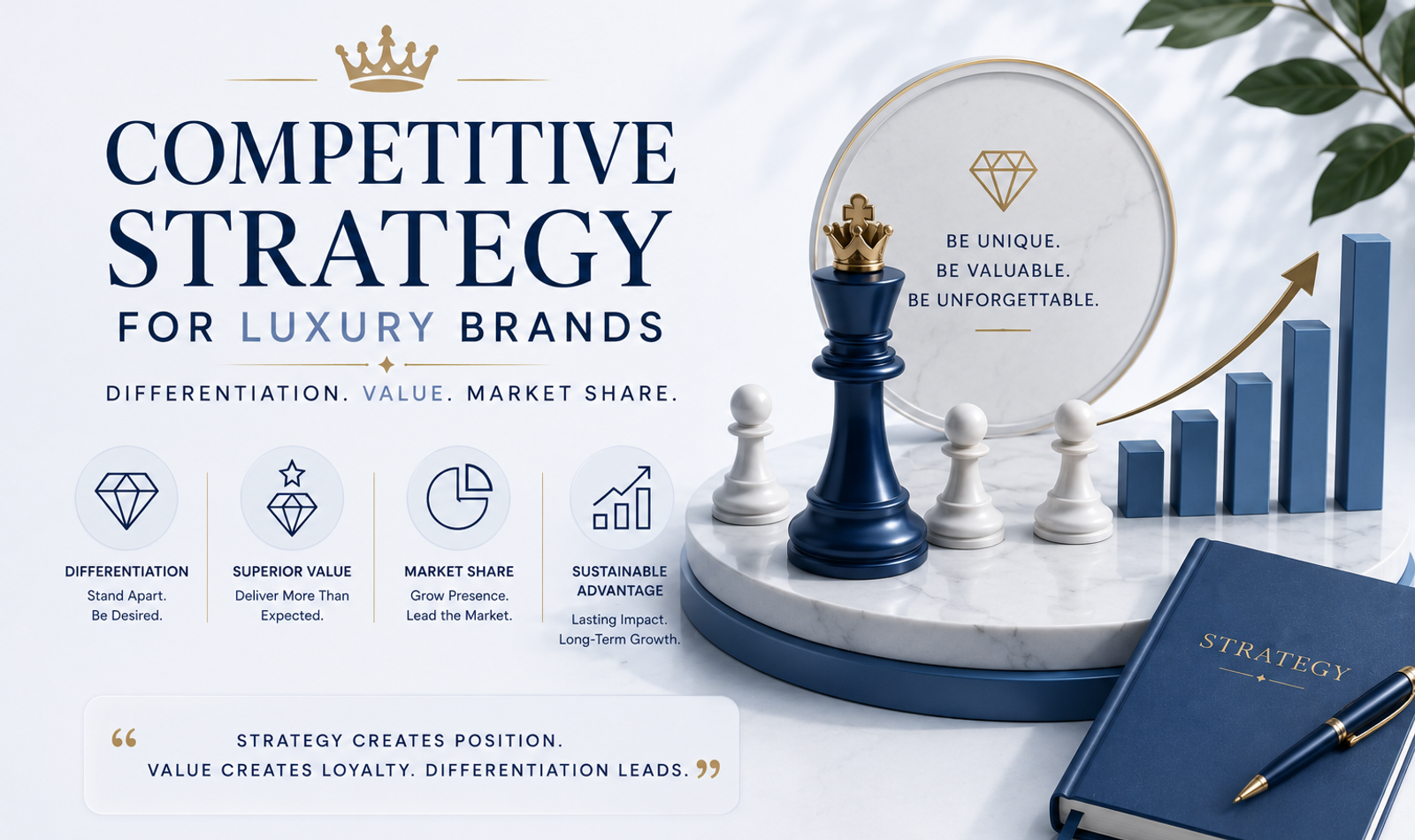
Competitive Strategy for Luxury Brands: Differentiation, Value & Market Share
Luxury brands do not win by being available to everyone. They win by becoming more desirable, more trusted and more valuable to the right audience. In a competitive market, luxury growth depends on more than beauty, price and visibility. It depends on clear differentiation, strong customer value and disciplined market positioning.
Many premium brands enter the luxury space with elegant visuals, polished campaigns and high pricing. However, this alone does not create competitive advantage. Customers are exposed to more brands, more choices and more information than ever before. They compare quality, experience, storytelling, service, social proof, founder credibility, website presence, reviews, media visibility and emotional value before making a decision.
This means luxury brands must compete strategically.
A strong competitive strategy helps the brand define what it should own in the market, why customers should prefer it and how it can grow market share without weakening its premium perception.
Luxury competition is not about shouting louder. It is about becoming harder to replace.
This guide explains how luxury brands can build competitive strategy through differentiation, customer value, pricing discipline, market share planning, customer experience and long-term brand equity.
What Is Competitive Strategy for Luxury Brands?
Competitive strategy for luxury brands is the process of defining how a luxury or premium brand will compete, differentiate and grow in a crowded market.
It helps the brand answer important questions.
Who are our real competitors? What do customers value most? What makes us meaningfully different? How do we justify premium pricing? Which customer segment should we focus on? How do we increase market share without diluting luxury perception? What experience must we deliver better than others?
For luxury brands, competitive strategy is different from mass-market competition.
Mass brands often compete on price, convenience, distribution and volume. Luxury brands compete on perception, trust, exclusivity, craftsmanship, service, storytelling, emotional meaning and customer experience.
A luxury brand should not try to be the cheapest or most available option. It should try to become the most relevant and desirable option for its chosen audience.
A clear luxury brand positioning strategy helps define how the brand should be perceived, what it should stand for and why customers should prefer it over alternatives.
Why Luxury Brands Need Competitive Strategy
Luxury markets are becoming more crowded.
Customers now see premium brands across Instagram, Google, YouTube, influencer content, digital ads, luxury events, PR features and online marketplaces. This makes it harder for any brand to stand out with visuals alone.
A beautiful campaign may attract attention, but attention is not enough.
The brand must clearly explain why it matters.
Without competitive strategy, luxury brands often fall into common traps. They copy global aesthetics, use generic premium language, chase influencers without alignment, increase prices without proof, enter too many channels too quickly or depend on discount-led conversion.
These actions may create short-term activity, but they weaken long-term value.
Competitive strategy creates discipline.
It helps the brand choose the right market position, customer segment, value proposition, pricing structure, communication style and growth channels.
Brands starting or repositioning themselves can also use a structured luxury brand roadmap to connect identity, market entry and long-term growth decisions.
Understand the Real Competitive Set
The first step is understanding who the brand is really competing against.
A luxury brand does not only compete with direct category competitors. It also competes with alternative ways customers can spend money, express identity or solve a problem.
A luxury hotel may compete with boutique stays, private villas, premium homestays, destination resorts and even international travel. A luxury fashion label may compete with designer labels, custom tailoring, international brands, jewellery, beauty and lifestyle spending. A luxury event company may compete with wedding planners, hotels, production houses, celebrity managers and family-led planning networks.
The competitive set should be studied from the customer’s point of view.
Who does the customer compare before buying? Which brands do they trust? Which alternatives feel safer, more aspirational or more convenient? What makes them hesitate?
This understanding helps the brand position itself more intelligently.
Map the Market Position
Luxury brands should map competitors based on perception and value.
The brand should evaluate how competitors communicate, price, present their identity, deliver experience and build credibility.
Look at their website, social media, PR presence, product or service structure, customer reviews, visual style, tone of voice, offers, partnerships and customer journey.
The objective is not to copy them.
The objective is to understand the category codes and find a space the brand can own.
For example, if every competitor is communicating loud glamour, a brand may own quiet sophistication. If competitors focus only on product features, a brand may own experience and service. If competitors look premium but lack proof, a brand may own transparency and expertise.
A strong competitive position should feel relevant, distinctive and believable.
The process can be strengthened through a broader competitive strategy framework for luxury brands, where positioning, differentiation and market share are evaluated together.
Differentiation Is the Core of Luxury Competition
Differentiation is the reason customers remember and choose the brand.
In luxury markets, differentiation must go beyond appearance.
Many brands can look premium. Many can use elegant typography, refined photography, muted colours and polished packaging. These elements help create perception, but they do not always create a defendable difference.
True differentiation comes from what the brand uniquely offers, believes, delivers or represents.
It may be craftsmanship, heritage, founder expertise, cultural depth, service model, personalisation, innovation, design language, community, access, experience quality or category authority.
A luxury brand must be able to complete this sentence clearly:
Customers choose us because we offer something they cannot easily get elsewhere.
If the answer is unclear, the competitive strategy is weak.
Build a Differentiation Platform
Differentiation should be built as a platform, not a single claim.
A differentiation platform includes the brand’s core difference, supporting proof, customer benefit and experience expression.
For example, a luxury hospitality brand may differentiate through intimate service and local cultural immersion. The proof may include curated itineraries, local sourcing, personalised guest planning and boutique design. The customer benefit is a stay that feels more personal and meaningful. The experience expression appears through service scripts, room details, website copy, photography and PR stories.
A luxury automotive service may differentiate through reliability and corporate-grade coordination. The proof may include trained chauffeurs, multi-city operations, premium fleet standards, response systems and client support. The customer benefit is stress-free mobility. The experience expression appears through punctual service, professional communication, clean vehicles and transparent processes.
Differentiation becomes powerful when it is visible across every touchpoint.
Brands can reinforce this with a consistent annual brand strategy framework that aligns positioning, goals, KPIs and execution across the year.
Value Is More Than Price
Luxury value is not the same as affordability.
In luxury branding, value means the customer believes the brand is worth the premium.
This value may be emotional, functional, social or experiential.
Emotional value makes the customer feel confident, proud, understood or inspired. Functional value solves a problem better than alternatives. Social value helps the customer express identity, taste or status. Experiential value creates memorable moments through service, atmosphere and detail.
A luxury brand becomes competitive when it creates multiple layers of value.
For example, a luxury wedding brand may provide functional value through planning and vendor coordination, emotional value through personal storytelling, social value through guest perception and experiential value through seamless hospitality.
This kind of value is harder for competitors to copy.
Communicate Value Clearly
Luxury brands often make the mistake of assuming that customers will understand value automatically.
They may show beautiful visuals but fail to explain what makes the brand better.
Customers need clarity.
They need to understand the process, quality, expertise, service standard, materials, experience design and outcomes behind the price.
This does not mean over-explaining or sounding too sales-driven.
It means presenting value with elegance and evidence.
The website should explain the brand’s approach. Social media should show proof and process. PR should reinforce credibility. Sales communication should explain benefits clearly. Customer experience should make the value feel real.
A premium price becomes easier to accept when value is visible.
Build Pricing Power Through Positioning
Pricing power is the ability to charge premium prices without depending on constant discounts.
Luxury brands build pricing power through positioning, trust, scarcity, service quality, proof and emotional value.
A brand with weak positioning will struggle to defend price.
Customers may compare it directly with cheaper alternatives. They may ask for discounts. They may see the product or service as replaceable.
A brand with strong positioning can shift the conversation from cost to value.
Customers understand why the brand is different and why the experience is worth paying for.
Pricing power should be protected carefully.
Frequent discounting, inconsistent pricing, unclear packages and overly aggressive sales tactics can weaken luxury perception.
Avoid Competing Only on Visibility
Visibility matters, but visibility alone is not competitive strategy.
A brand can run ads, post daily, collaborate with creators and appear everywhere while still failing to build preference.
Luxury brands should ask whether visibility is creating the right perception.
Are people remembering the brand for the intended reason? Are enquiries becoming more qualified? Are customers willing to pay premium prices? Are media mentions improving credibility? Is social content attracting the right audience? Is the website converting serious visitors?
If visibility does not improve trust or preference, the strategy needs refinement.
Luxury brands should not aim to be seen by everyone.
They should aim to be desired by the right audience.
A carefully planned luxury brand funnel can help turn awareness into consideration, trust and eventual conversion without making the brand feel mass-market.
Market Share in Luxury Branding
Market share for luxury brands should be understood carefully.
In mass markets, market share often means reaching the highest volume. In luxury markets, market share should mean winning a larger share of the right customer segment.
A luxury brand does not need the entire market.
It needs stronger relevance among customers who value its offer, can afford it and are likely to become loyal or influential buyers.
For example, a luxury event company may not need every wedding enquiry. It needs high-value clients who want refined planning, guest hospitality and premium execution. A luxury fashion brand may not need all fashion shoppers. It needs customers who value design, craft and identity. A premium automotive brand may not need all travellers. It needs corporate, executive and high-trust mobility customers.
Luxury market share should be measured by quality, not only quantity.
Choose the Right Customer Segment
Competitive strategy becomes stronger when the brand focuses on a specific customer segment.
The brand should identify which segment offers the best combination of value, fit, profitability and long-term potential.
This may include high-net-worth individuals, premium urban customers, founders, corporate decision-makers, luxury wedding families, global travellers, design-conscious homeowners, beauty-conscious consumers, premium hospitality guests or aspirational luxury buyers.
Each segment requires different messaging.
High-net-worth customers may value privacy and trust. Young premium buyers may value identity and cultural relevance. Corporate clients may value reliability and professionalism. Luxury wedding families may value experience, emotion and execution control.
A clear segment allows the brand to build sharper communication and stronger offers.
Build a Strong Value Proposition
A value proposition explains why customers should choose the brand.
For luxury brands, the value proposition should connect emotional desire with practical proof.
It should explain the customer benefit, brand difference and reasons to believe.
A weak value proposition may say, “We offer premium luxury experiences.”
A stronger value proposition may say, “We design high-touch luxury experiences where every guest journey, visual detail and operational moment is planned with precision.”
This is more specific and more believable.
The value proposition should be used across the website, social media, PR, sales decks, proposals and campaigns.
It should become the centre of competitive communication.
Use Customer Experience as a Competitive Advantage
Customer experience is one of the strongest ways luxury brands can compete.
Many brands can create good visuals, but fewer brands can deliver consistently excellent experiences.
Luxury customer experience includes response time, consultation quality, personalisation, packaging, delivery, service behaviour, complaint resolution, after-sales communication and relationship management.
Every touchpoint should reinforce the brand’s positioning.
If the brand promises refinement, the experience should feel polished. If it promises expertise, the team should communicate with clarity. If it promises exclusivity, the access should feel curated. If it promises comfort, the service should reduce stress.
Customer experience turns positioning into reality.
It also creates referrals, loyalty and reputation.
Luxury event and hospitality brands can strengthen this through guest personalisation strategies that make interactions feel more tailored and memorable.
Build Proof Before Scaling
Luxury brands should build proof before trying to gain large market share.
Proof makes the brand credible.
This may include testimonials, case studies, reviews, press features, customer stories, founder credentials, process documentation, behind-the-scenes content, awards, partnerships or measurable results.
A new luxury brand can still create proof through process transparency, founder expertise, early customer feedback and strong launch documentation.
An established brand can create proof through deeper case studies, media coverage, customer results and experience storytelling.
Proof should be visible across the website, sales material, social media and PR.
Without proof, differentiation remains a claim.
With proof, differentiation becomes trust.
Brands can also study luxury brand case studies to understand how successful premium businesses build credibility and defend their market position.
Use PR to Strengthen Competitive Position
Public relations can help luxury brands build authority and market credibility.
PR should not be random.
It should support the brand’s competitive position.
If the brand wants to be known for craftsmanship, PR should highlight process, materials, artisans and design philosophy. If the brand wants to be known for luxury hospitality, PR should highlight guest experience, service standards and destination stories. If the brand wants to be known for innovation, PR should highlight technology, new formats and founder vision.
Media coverage can also influence customer confidence.
When customers see the brand in credible platforms, they are more likely to trust the positioning.
PR is especially useful in competitive markets because it helps the brand stand apart from brands that depend only on paid advertising.
A focused luxury brand PR strategy can help align media outreach, story angles and positioning instead of treating coverage as an isolated activity.
Use Digital Strategy to Capture Demand
Digital strategy helps luxury brands capture interest and convert it into enquiries, bookings or sales.
A competitive digital strategy should include a strong website, SEO, social media, paid campaigns, email, retargeting, content marketing and performance tracking.
The website should explain value clearly.
SEO should help customers discover the brand through high-intent searches.
Social media should build desire, authority and proof.
Paid media should reach the right audience and support conversion.
Email and WhatsApp should nurture relationships.
Retargeting should bring interested customers back.
Digital strategy should not make the brand feel mass-market.
It should make the brand easier to discover, understand and trust.
An integrated approach to PR and digital full-funnel growth can help connect awareness, authority and conversion more effectively.
Build Search Visibility Around Differentiation
SEO is an important competitive tool.
Luxury customers often search before making decisions.
They may search for services, locations, comparisons, guides, reviews, pricing expectations, best practices and expert advice.
A luxury brand should create content around its differentiation.
For example, a luxury event brand can publish content on guest hospitality, destination planning, celebrity management, wedding budgeting and premium event execution. A luxury automotive brand can publish content on chauffeur-driven mobility, corporate travel planning and premium car rental standards. A luxury hospitality brand can publish content on boutique stays, curated experiences and destination guides.
This content helps the brand become discoverable and authoritative.
It also supports AI-search visibility by answering customer questions clearly.
Brands operating at the premium end can use a dedicated SEO strategy for luxury brands to align search visibility with positioning, keywords and authority.
Use Content to Build Category Authority
Content should do more than fill the calendar.
It should help the brand compete.
A luxury brand can use content to educate customers, show process, explain value, build trust, share expert perspective and demonstrate taste.
Useful content themes may include craftsmanship, customer experience, buying guides, mistakes to avoid, founder insights, case studies, behind-the-scenes process, trend commentary and service education.
Authority content makes the brand feel more knowledgeable.
This is especially important for high-consideration purchases.
Customers are more likely to trust brands that help them make informed decisions.
A structured content strategy for brand websites and blogs can help connect educational content with galleries, lead generation and long-term brand authority.
Improve Market Share Through Retention
Luxury market share should not come only from new customer acquisition.
Retention is a powerful growth strategy.
Existing customers already know the brand. If they had a strong experience, they are more likely to buy again, refer others and become advocates.
Retention can increase customer lifetime value and reduce dependence on paid acquisition.
Luxury retention can be built through private previews, personalised communication, loyalty experiences, anniversary messages, service follow-ups, exclusive events, priority access and relationship management.
A loyal luxury customer can influence other high-value customers.
This makes retention a competitive advantage.
Create Strategic Partnerships
Partnerships can help luxury brands access the right audience and build credibility.
Potential partners may include premium hotels, designers, architects, automobile brands, wellness companies, private clubs, cultural platforms, fashion stylists, media houses, event planners and real estate developers.
The partnership should support positioning.
It should not feel forced.
A luxury fashion brand may collaborate with a boutique hotel for a private showcase. A luxury mobility brand may partner with event companies for VIP transportation. A premium interior brand may partner with architects and real estate developers. A luxury hospitality brand may partner with chefs, wellness experts or cultural curators.
Good partnerships create shared value.
They help the brand grow without relying only on advertising.
Localise Without Losing Luxury Identity
Luxury brands expanding in India must understand local markets.
Customer behaviour in Mumbai, Delhi, Chandigarh, Jaipur, Bengaluru, Hyderabad, Pune, Ahmedabad, Goa and Lucknow can differ significantly.
The brand may need to adapt media strategy, partnerships, event formats, creator selection, language tone and customer journey for each city.
However, localisation should not dilute identity.
The core positioning should remain stable.
A luxury brand should feel consistent everywhere, even when expression changes slightly.
Localisation means understanding the market. It does not mean changing the brand every time.
Protect Brand Consistency
Consistency is essential in luxury competition.
Customers should experience the same level of quality across website, social media, PR, packaging, sales communication, events and service delivery.
Inconsistent branding weakens trust.
If Instagram looks premium but the proposal looks basic, perception breaks. If PR says the brand is exclusive but digital ads feel mass-market, perception breaks. If pricing is premium but customer response is careless, perception breaks.
Luxury brands should create brand guidelines, tone guidelines, visual systems, content rules, service standards and approval processes.
Consistency makes the brand easier to recognise and harder to replace.
Measure Competitive Performance
Luxury brands should measure competitive performance through both brand and business metrics.
Important metrics include branded search growth, website traffic, enquiry quality, conversion rate, average order value, repeat purchase, referrals, PR quality, social engagement, customer feedback, market perception and reduced discount dependence.
Competitor monitoring is also important.
The brand should review competitor campaigns, content direction, pricing signals, new launches, PR activity, partnerships and customer reviews.
However, the brand should not become reactive.
Competitor analysis should inform strategy, not control it.
The goal is to stay aware while protecting the brand’s own direction.
Common Competitive Strategy Mistakes
One common mistake is copying competitors.
This may feel safe, but it makes the brand less memorable.
Another mistake is competing through discounts.
Discounts may create short-term sales but weaken premium positioning.
A third mistake is focusing only on visibility.
Reach without trust does not create luxury market share.
Brands also make the mistake of using generic luxury language.
Words such as premium, exclusive and world-class are weak without proof.
Another mistake is ignoring customer experience.
In luxury markets, poor service can damage perception faster than weak advertising.
Finally, many brands fail to define their customer clearly.
Without customer focus, differentiation becomes vague and marketing becomes broad.
How to Build a Competitive Strategy Roadmap
A competitive strategy roadmap should begin with market research and competitor mapping.
The brand should identify its ideal customer, current perception, competitor positions, category gaps and strongest opportunity.
Next, it should define positioning, differentiation, value proposition and proof points.
Then it should align visual identity, messaging, website, content, PR, digital marketing and customer experience around the competitive position.
After that, the brand should build campaigns, partnerships and retention systems to grow share within the right market segment.
Finally, the roadmap should include measurement and adjustment.
Competitive strategy is not a one-time exercise.
It must evolve as the market changes, but the core brand identity should remain consistent.
A structured strategic brand roadmap for premium brands can help connect these decisions into a practical long-term plan.
Frequently Asked Questions
What is competitive strategy for luxury brands?
Competitive strategy for luxury brands defines how a brand will differentiate, create value, defend premium pricing and grow market share among the right customers.
Why is differentiation important for luxury brands?
Differentiation helps luxury brands stand apart from competitors and gives customers a clear reason to remember, trust and choose the brand.
How do luxury brands create customer value?
Luxury brands create value through quality, craftsmanship, service, experience, emotional meaning, personalisation, trust, status and long-term desirability.
How can luxury brands increase market share?
Luxury brands can increase market share by focusing on the right customer segment, building strong positioning, improving digital visibility, using PR and strengthening retention.
Should luxury brands compete on price?
Luxury brands should avoid competing mainly on price. They should compete on value, experience, differentiation, trust and desirability.
How does PR support luxury competitive strategy?
PR supports competitive strategy by building credibility, founder authority, media visibility and third-party recognition around the brand’s positioning.
How does SEO help luxury brands compete?
SEO helps luxury brands become discoverable when high-intent customers search for services, products, locations, comparisons and expert guidance.
What metrics show competitive success?
Useful metrics include branded search, enquiry quality, conversion rate, average order value, PR quality, referrals, retention and reduced discount dependence.
How can luxury brands protect pricing power?
Luxury brands protect pricing power through strong positioning, clear proof, consistent experience, controlled discounting, premium service and customer trust.
What is the biggest mistake in luxury competition?
The biggest mistake is copying competitors and competing on surface-level luxury instead of building a meaningful, defendable difference.
Conclusion
Competitive strategy for luxury brands is about creating a clear reason to be chosen.
Luxury brands cannot depend only on attractive visuals, high prices or frequent campaigns. They need meaningful differentiation, strong customer value, trusted proof, disciplined pricing and consistent customer experience.
Differentiation helps the brand become memorable.
Value helps customers understand why the brand deserves a premium.
Market share grows when the brand wins a larger share of the right customer segment, not when it tries to attract everyone.
For luxury brands in India, competition is becoming more complex as premium customers become more informed, digital discovery increases and expectations around value rise. Brands must therefore compete with clarity, discipline and consistency.
A strong competitive strategy connects positioning, identity, messaging, PR, website, SEO, content, digital marketing, partnerships, customer experience and retention.
Double Trouble Studio helps luxury, premium, hospitality, lifestyle, event, fashion, beauty, automotive, real estate and service-led brands build competitive strategy through differentiation, value creation, brand positioning, content, PR, digital marketing, website strategy and customer experience.
With the right competitive roadmap, a luxury brand can move beyond visibility and build lasting preference, stronger pricing power and sustainable market share.
Need this for your brand?
Let DTS build your next campaign.
From PR, celebrity management and events to websites, social media, SEO and AI video production — Double Trouble Studio helps brands grow with strategy and execution.
Discuss Your Requirement →