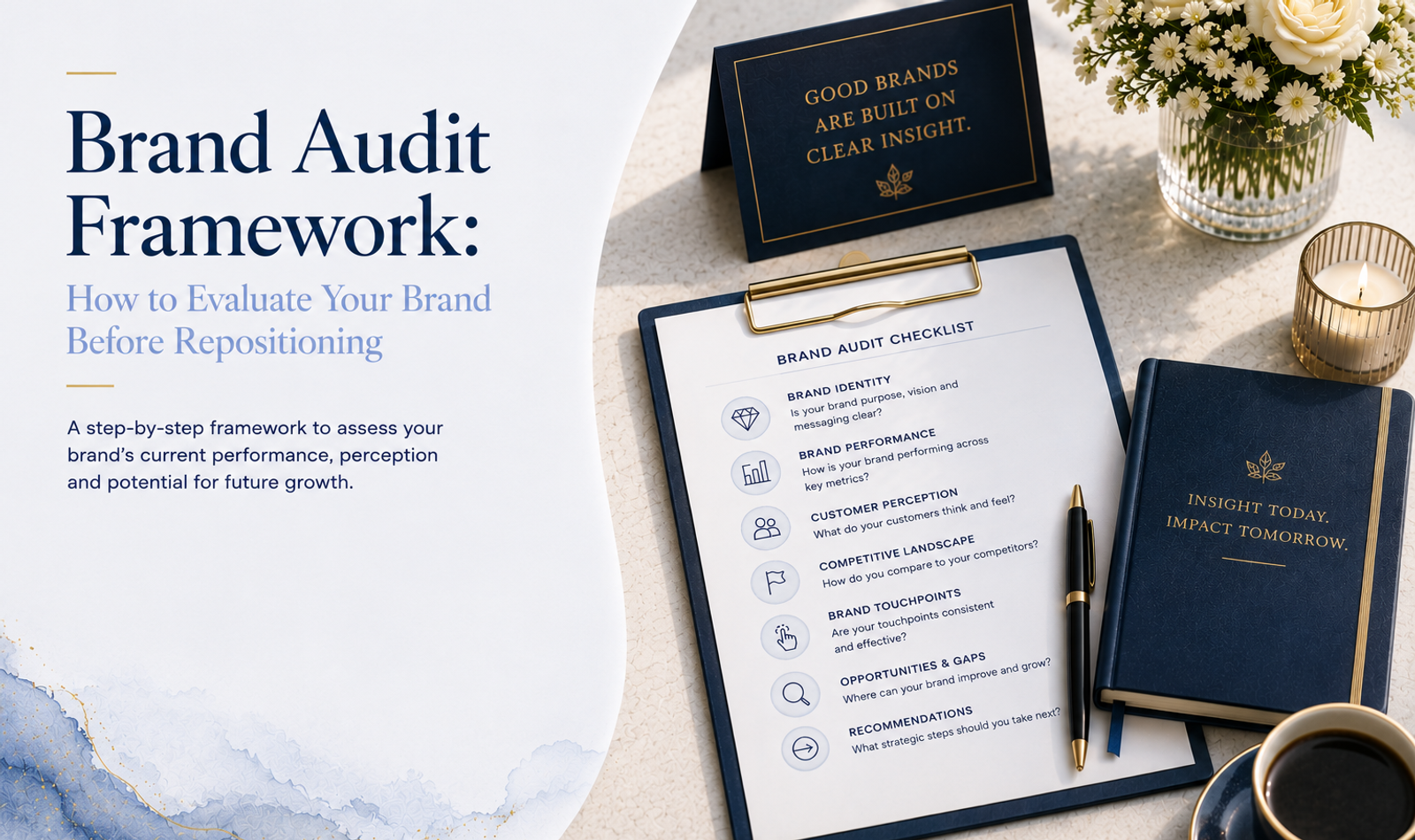
Brand Audit Framework: How to Evaluate Your Brand Before Repositioning
Brands rarely lose relevance overnight.
The change usually happens gradually.
Customer expectations evolve. New competitors enter the market. Products expand. The business enters new cities or categories. Marketing channels change. The company begins serving a different type of customer from the one it originally targeted.
Over time, a gap can develop between what the business has become and what the brand communicates.
The logo may still look familiar. The website may still generate traffic. Social media may remain active. Customers may continue buying.
Yet the brand may no longer explain clearly why the company matters, who it is for or why someone should choose it over alternatives.
This is often when businesses begin discussing repositioning.
However, repositioning should not begin with a new logo, colour palette, tagline or website.
It should begin with a brand audit.
A brand audit is a structured evaluation of how a brand currently performs across strategy, identity, communication, customer perception, digital presence and competitive positioning.
The purpose is to determine what should be retained, strengthened, changed or removed before significant repositioning decisions are made.
A professional audit helps separate genuine strategic problems from cosmetic ones.
A company may believe it needs a complete rebrand when the real issue is inconsistent communication.
Another may have strong visual recognition but weak differentiation.
A third may have excellent services but a website and digital presence that no longer reflects the quality of the business.
Understanding the actual problem prevents unnecessary changes and gives repositioning a stronger strategic foundation.
What Is a Brand Audit?
A brand audit is a comprehensive review of how a brand is defined internally, expressed externally and perceived by customers and other stakeholders.
It examines the relationship between what the company intends to communicate and what audiences actually understand.
The audit may evaluate brand purpose, positioning, audience, messaging, visual identity, customer experience, content, digital channels, reputation and competitive environment.
It should also examine business performance where relevant.
Branding does not exist separately from the commercial organisation.
If customers repeatedly misunderstand a service, choose competitors for a particular reason or fail to recognise the company's strongest advantage, those issues may indicate a positioning problem.
A useful audit therefore combines strategic analysis with evidence from customers, employees, marketing performance and the market.
Why Conduct a Brand Audit Before Repositioning?
Repositioning changes the place a brand wants to occupy in the customer's mind.
That change can affect messaging, audience targeting, pricing perception, product presentation, marketing strategy and visual communication.
Making those decisions without understanding the existing brand creates unnecessary risk.
A business may remove elements customers strongly recognise.
It may abandon valuable associations built over many years.
It may redesign the visual identity while leaving the actual positioning problem unresolved.
It may also adopt a fashionable new direction that looks attractive but has little connection with the company's competitive advantage.
A brand audit provides the evidence required to decide how extensive the repositioning should be.
Sometimes the conclusion will support a major transformation.
In other situations, the company may only need clearer messaging, better digital marketing, stronger visual consistency or an improved customer experience.
Understand Why the Brand Is Considering Repositioning
Before evaluating individual brand elements, document why repositioning is being discussed.
There should be a business reason.
The company may have entered a new market, introduced premium services, expanded its product portfolio or changed its customer base.
Growth may have made the original positioning too narrow.
A merger or acquisition may have created overlapping identities.
A younger competitor may have changed category expectations.
The brand may be perceived as outdated.
Customers may understand what the company sells but not why it is different.
The business may also be preparing for geographic expansion, investment, franchising or a new stage of growth.
Write down the reasons without immediately deciding the solution.
"Customers think we are expensive" is an observation.
"We need a cheaper-looking brand" is already a proposed solution.
The audit should investigate the observation before deciding what needs to change.
Review the Business Strategy
Brand strategy should support business strategy.
Begin by understanding how the company makes money today and where it expects future growth to come from.
Review its major products or services, customer segments, revenue sources, geographic markets and strategic priorities.
Ask whether the brand accurately represents the current business.
A company that began with one service may now operate across several categories.
A regional company may have become national.
A mass-market business may be developing a premium offering.
A traditional service provider may have evolved into a technology-enabled organisation.
If the brand continues describing the company as it existed five years ago, repositioning may be necessary.
The audit should also identify future ambitions.
A brand designed only around the current business can quickly become restrictive if expansion is already planned.
Review the Existing Brand Strategy
Collect the documents that currently define the brand.
These may include the brand strategy, mission, vision, values, positioning statement, audience profiles, tone-of-voice guidelines and brand manual.
Determine whether these materials are still actively used.
Many companies have brand documents that exist only in presentation files while daily communication follows completely different rules.
Evaluate whether the strategy remains relevant to the business.
Can employees explain the brand's positioning consistently?
Do the stated values influence decisions?
Is the target audience clearly defined?
Does the positioning identify a meaningful difference?
A strategy that cannot guide practical decisions has limited value.
Audit the Brand Purpose
Brand purpose explains why the organisation exists beyond individual transactions.
It should be relevant to the business rather than an abstract statement created only for marketing.
Review whether the existing purpose still reflects the organisation.
Has the company evolved?
Does the purpose influence products, services, customer experience or company behaviour?
Would employees recognise it without seeing the official wording?
A purpose does not need to sound dramatic.
A clear and credible reason for existing is more useful than a grand statement the company cannot demonstrate.
Repositioning should strengthen the relationship between purpose and customer value rather than inventing a purpose disconnected from operations.
Evaluate the Current Positioning
Positioning answers a fundamental question:
Why should the intended customer choose this brand instead of the available alternatives?
Review how the company currently answers that question.
The positioning may depend on expertise, design, convenience, innovation, service, heritage, accessibility, exclusivity, performance or another meaningful advantage.
Determine whether that advantage remains relevant and defensible.
If every competitor makes the same claim, it provides limited differentiation.
Words such as quality, innovation, customer-centric and premium appear across many industries.
The audit should identify what the brand can credibly claim that matters to the audience and is difficult for competitors to reproduce.
Identify the Brand's Real Competitive Advantage
The strongest positioning often comes from capabilities already present within the business.
Interview leadership, sales teams, customer-service teams and long-term employees.
Ask why customers choose the company.
Ask why customers remain.
Ask what the company does particularly well.
Ask what competitors struggle to replicate.
The answers may reveal advantages that marketing communication currently overlooks.
A hospitality company may believe its advantage is luxury design while customers repeatedly praise personalised service.
A B2B company may promote technology while customers value implementation expertise.
An event business may focus on creative concepts while clients value its ability to coordinate complex events and weddings reliably.
Repositioning should build around genuine strengths rather than manufactured claims.
Audit the Target Audience
Brands often continue targeting customer profiles created years earlier.
Review whether those profiles still represent actual buyers.
Analyse customer demographics, geography, profession, income or company size where relevant.
More importantly, examine customer motivations.
What problem are they trying to solve?
What outcome are they buying?
What concerns delay their decision?
Who influences their choice?
What alternatives do they consider?
A customer buying premium event management may evaluate the brand very differently from someone purchasing a standard event package.
A company targeting luxury customers must understand that premium positioning involves more than expensive visuals. It can influence service design, communication, access, hospitality and customer expectations.
Audience understanding should therefore be behavioural as well as demographic.
Identify the Most Valuable Customer Segments
Not every customer segment contributes equal strategic value.
The audit should identify which audiences generate revenue, repeat business, referrals, profitability or future growth.
Some customers may be highly visible but commercially limited.
Others may generate fewer transactions but significantly higher lifetime value.
A company considering repositioning toward premium customers should examine whether those customers already exist within its portfolio.
If they do, what attracted them?
If they do not, what evidence suggests the company can serve them successfully?
Repositioning toward a desirable audience without the operational ability to satisfy that audience creates a credibility problem.
Interview Existing Customers
Internal teams know the brand from inside the organisation.
Customers experience it from outside.
That difference makes customer research essential.
Interviews can explore how customers discovered the company, what they expected, why they selected it and what almost prevented the purchase.
Ask customers how they would describe the company to someone else.
The language they use can reveal valuable positioning insights.
Avoid asking only whether customers like the logo or website.
Explore perceptions of quality, trust, expertise, value, service, personality and differentiation.
Also speak with customers who have worked with the brand for different lengths of time.
Long-term customers may understand the company's evolution differently from recent buyers.
Talk to Lost Prospects
Customers who did not choose the brand can provide equally useful information.
Review lost sales where possible.
Why did the prospect choose another company?
Was the issue price, trust, service scope, portfolio, reputation, location, speed or perceived expertise?
Did they understand the offer correctly?
Sales teams often hold valuable information about recurring objections.
If the same misunderstanding appears repeatedly, communication may be contributing to the problem.
Not every lost prospect represents a branding failure.
Some customers are simply not the right fit.
The objective is to identify patterns rather than react to individual opinions.
Audit Customer Perception
Compare intended positioning with actual perception.
Management may describe the brand as innovative while customers describe it as dependable.
The company may want to appear premium while the website and promotional offers communicate value pricing.
It may believe it is approachable while customers perceive communication as formal and difficult.
Neither management nor customers automatically provide the complete truth.
The important issue is the gap between intention, experience and perception.
Create a list of attributes the company wants to own and compare them with the attributes customers actually associate with it.
Large gaps become priorities for investigation.
Audit Brand Awareness
Determine how customers recognise and remember the brand.
This may involve surveys, search data, social listening, direct customer questions or sales-team feedback.
Measure unaided awareness where practical: can people name the brand without being shown options?
Measure aided awareness: do they recognise it when prompted?
For digital businesses, branded search volume can provide another signal.
Awareness should not be confused with preference.
Customers may know a brand well without considering it suitable for their needs.
The audit should therefore examine recognition, understanding and consideration separately.
Audit the Brand Name and Architecture
Review whether the company name and portfolio structure remain clear.
As organisations expand, they may accumulate product names, sub-brands, divisions and service categories.
Customers can become confused about how these offerings relate.
The audit should map the complete brand architecture.
Identify the master brand, sub-brands, product lines, programmes and endorsed brands.
Determine whether each name has a clear role.
Repositioning may provide an opportunity to simplify architecture, but changes to established names should be approached carefully because they may hold recognition, search value and customer trust.
Audit the Logo
A logo audit should evaluate function rather than personal taste.
Does the logo remain legible at small sizes?
Does it work across digital and physical environments?
Can it be reproduced consistently?
Does it remain recognisable without unnecessary complexity?
Does it fit the intended positioning?
A logo does not need to follow every current design trend.
Recognition can be more valuable than novelty.
If the existing logo has strong equity, refinement may be more appropriate than complete replacement.
The decision should come from the broader brand strategy rather than a desire to make the company look newer.
Audit the Colour System
Colours contribute to recognition and emotional association.
Review whether the current palette is distinctive, usable and consistent.
Examine how colours appear across websites, social media, presentations, packaging, signage and advertising.
Some brands have an official palette but use dozens of unrelated shades in daily communication.
The audit should identify primary, secondary and functional colours.
Accessibility should also be considered.
Text and background combinations need sufficient contrast for readability.
A repositioning project can refine the palette without necessarily abandoning established brand recognition.
Audit Typography
Typography influences clarity and personality.
Review the fonts used across digital and offline communication.
Are the same typefaces used consistently?
Are they suitable for headings, body copy and mobile screens?
Do licensing arrangements permit the required usage?
Can teams access the fonts easily?
A highly distinctive typeface may look impressive in campaign material but become impractical for everyday documents.
The typography system should balance character with usability.
Audit Photography and Visual Direction
Images communicate positioning quickly.
Review photography, illustrations, icons, graphics, video and other visual assets.
Does the brand have a recognisable visual language?
Or does every campaign look as if it belongs to a different company?
Examine subject matter, composition, lighting, colour treatment, casting, locations and styling.
For premium brands, visual consistency can strongly influence perceived quality.
However, expensive production alone does not create premium positioning.
The imagery should express the brand idea and customer world.
A clear visual system also improves the consistency of graphic and video communication.
Audit Brand Messaging
Collect major examples of brand communication.
Review the homepage, service pages, advertisements, social profiles, proposals, brochures, email campaigns, presentations and sales material.
Identify the recurring messages.
Can a customer quickly understand what the company does?
Is the benefit clear?
Is the brand difference visible?
Does communication focus entirely on the company, or does it explain customer outcomes?
Messaging should create consistency without forcing every channel to use identical sentences.
The audit should identify a clear hierarchy between the central brand promise, supporting messages, proof points and calls to action.
Audit the Tone of Voice
A brand may appear sophisticated on its website, casual on Instagram, highly technical on LinkedIn and generic in email communication.
Some variation by channel is appropriate.
A complete personality change is not.
Review vocabulary, sentence structure, humour, formality, confidence and emotional tone.
Determine whether the voice reflects the intended positioning.
A luxury brand does not automatically need complicated language.
Clear, restrained communication may feel more premium than excessive adjectives.
The goal is to create a recognisable voice that remains flexible enough for different contexts.
Audit Claims and Proof
Brand positioning becomes stronger when claims are supported by evidence.
Review statements such as "industry-leading," "trusted," "award-winning," "premium" or "innovative."
What proves them?
Evidence may include customer results, years of experience, proprietary technology, certifications, awards, case studies, testimonials, partnerships or specialist expertise.
Unsupported claims create weak differentiation.
Strong proof makes communication more credible and can support PR and media marketing by giving journalists and audiences substantive reasons to pay attention.
Audit the Website
The website is often one of the clearest expressions of the brand.
Review it from both brand and performance perspectives.
Does the homepage communicate the company's value quickly?
Is the navigation logical?
Are services explained clearly?
Does the visual design support the desired positioning?
Are calls to action appropriate?
Is the mobile experience strong?
Does the site contain outdated information?
Review page speed, technical performance, conversion paths and search visibility as well.
A beautiful redesign that damages organic visibility can create a commercial problem.
Any repositioning involving a website should therefore coordinate brand design with web development and marketing.
Audit Search Visibility
Search behaviour provides insight into how people discover and understand the brand.
Review branded and non-branded search terms.
Which services generate organic visibility?
Which pages attract qualified visitors?
What questions lead users to the website?
Search data may reveal language customers use that differs from internal terminology.
It can also identify valuable pages that should be protected during repositioning.
URL changes, deleted pages and major content restructuring can affect rankings.
SEO considerations should therefore be incorporated into repositioning from the beginning rather than added after the new website launches.
Audit Social Media
Review each social channel individually.
Determine its strategic role.
Is Instagram primarily building brand perception?
Is LinkedIn supporting authority and B2B relationships?
Is YouTube providing education?
Are channels simply reposting the same material without considering audience behaviour?
Evaluate profile presentation, visual consistency, content categories, engagement quality and audience growth.
Examine which posts create meaningful interaction rather than only high reach.
A repositioning project should clarify how social media expresses the brand rather than treating it as a separate identity.
Audit Content Strategy
Review blogs, videos, guides, newsletters, social posts and campaign content.
What topics does the brand consistently own?
Does the content demonstrate expertise?
Does it answer questions relevant to the target audience?
Is the company producing content because it supports a strategic objective or simply because channels require regular activity?
Strong content can reinforce positioning over time.
For example, a creative agency seeking authority across branding, digital communication, AI video and VFX should demonstrate knowledge in those areas rather than relying only on promotional posts.
Content should make the desired positioning visible through repeated evidence.
Audit PR and Public Reputation
Review how the brand appears outside its owned channels.
Search for media coverage, interviews, reviews, industry discussions, awards and public commentary.
Which topics are associated with the company?
Who speaks publicly for the organisation?
Does external coverage support the desired positioning?
A company may communicate one identity through advertising while media coverage reinforces another.
This matters particularly when repositioning depends on building authority or entering a new category.
A coordinated PR, media and marketing strategy can help establish new associations beyond the company's own channels.
Audit Influencer and Creator Associations
Review creators, influencers, experts, ambassadors and celebrities previously associated with the brand.
These partnerships influence perception.
Do the collaborators reflect the intended audience and positioning?
Have partnerships become too broad or inconsistent?
Does the brand repeatedly work with people who genuinely have category credibility?
For businesses using public personalities extensively, repositioning should consider how future celebrity management and collaborations support the new identity.
The people associated with a brand can communicate its position as strongly as its advertisements.
Audit the Customer Journey
Brand perception is created through experience, not communication alone.
Map the customer journey from first discovery to enquiry, purchase, delivery, service and repeat engagement.
Identify every important touchpoint.
A premium advertisement followed by a slow enquiry response creates inconsistency.
A sophisticated website followed by an unclear proposal can weaken confidence.
A luxury event company promising personalised service must deliver that standard through planning, communication and guest management.
The brand promise should remain visible throughout the customer experience.
Audit Sales Materials
Review proposals, pitch decks, quotations, presentations and sales scripts.
These materials often receive less brand attention than public marketing, even though they appear close to the purchasing decision.
Do they communicate the same positioning as the website?
Do they clearly explain value?
Are proof points and case studies used effectively?
Does pricing presentation support the desired market position?
Sales and marketing should not describe the company differently.
A repositioning strategy should provide both teams with a shared messaging structure.
Audit the Physical Brand Experience
For businesses operating physical environments, review signage, packaging, uniforms, offices, retail spaces, events, hospitality and printed material.
Customers do not separate these touchpoints from the brand.
A company positioned as premium cannot rely exclusively on premium digital design while delivering an ordinary physical experience.
For event-led brands, the experience may include venue selection, production, hospitality, entertainment, celebrity appearances and guest coordination.
The audit should determine whether physical execution reinforces or contradicts the intended identity.
Audit Internal Brand Understanding
Employees are one of the most overlooked parts of a brand audit.
Ask people across departments how they describe the company.
What does the brand stand for?
Who is the ideal customer?
Why should customers choose it?
What should never change?
If answers vary dramatically, the organisation may have an internal clarity problem.
Repositioning will be difficult to implement if employees only receive a new logo and presentation.
Teams need to understand the strategic reasoning behind the change and how it affects their work.
Conduct a Competitor Audit
A brand cannot evaluate its positioning in isolation.
Identify direct competitors, indirect competitors and emerging alternatives.
Review their positioning, visual identity, messaging, pricing perception, customer experience, content, search visibility and social communication.
Look for repeated category conventions.
If every competitor uses the same language and visual style, there may be an opportunity to differentiate.
However, difference should remain strategically meaningful.
Being visually unusual without communicating a valuable distinction does not create strong positioning.
Create a Competitive Positioning Map
A positioning map can help visualise how brands occupy the market.
Choose dimensions that matter to customers.
These might include premium versus accessible, traditional versus contemporary, specialist versus broad-service or high-touch versus self-service.
Plot major competitors based on available evidence.
Then plot the current brand.
The exercise can reveal crowded positions and potential opportunities.
It should not be used mechanically.
An empty part of the map does not automatically represent a valuable market opportunity.
Customer demand and company capability still need to support the position.
Analyse Category Conventions
Every industry develops familiar visual and verbal patterns.
Financial brands may rely on trust and security.
Luxury brands may use restrained typography and high-quality imagery.
Technology companies may emphasise speed, simplicity and innovation.
Identify which conventions customers require for category recognition and which have become generic.
The goal is not to reject every convention.
A brand needs enough familiarity to be understood and enough distinction to be remembered.
Repositioning should decide deliberately where to conform and where to differentiate.
Conduct a SWOT Analysis
A SWOT framework can organise audit findings into strengths, weaknesses, opportunities and threats.
Strengths may include reputation, customer loyalty, specialist expertise, distribution or strong visual recognition.
Weaknesses may include inconsistent communication, unclear differentiation or outdated digital experience.
Opportunities may include new audiences, geographic expansion, changing customer behaviour or underdeveloped categories.
Threats may include new competitors, commoditisation, declining relevance or reputational risk.
The value of SWOT depends on specificity.
"Strong brand" is too broad.
"High unaided awareness among premium wedding planners in Mumbai" provides a more useful strategic insight.
Separate Brand Problems From Business Problems
Not every problem can be solved through branding.
If customers complain about delivery delays, changing the tagline will not fix the experience.
If pricing is uncompetitive because of operational costs, a visual redesign alone cannot solve the issue.
If the product lacks meaningful differentiation, communication can clarify the offer but cannot manufacture lasting advantage.
The audit should classify findings into brand, marketing, product, operational and customer-experience issues.
Repositioning works best when these areas are addressed together where necessary.
Identify Brand Equity That Should Be Protected
Before changing anything, identify what already has value.
This may include the brand name, logo recognition, colours, tagline, heritage, founder reputation, customer relationships, search rankings, domain authority, social communities or established associations.
Not everything old is outdated.
A successful repositioning often preserves recognisable assets while changing their meaning or presentation.
Removing valuable brand equity unnecessarily increases the amount of recognition the company must rebuild.
Identify What Needs to Change
After the audit, classify brand elements into four groups:
Retain — assets and associations that remain strategically valuable.
Strengthen — elements that are correct but inconsistently communicated.
Evolve — elements that need meaningful modification.
Remove — elements that actively conflict with the future positioning.
This framework prevents repositioning from becoming an automatic total redesign.
A company may retain its name and logo while evolving its messaging, visual system and digital experience.
Another may require a more fundamental transformation.
The evidence should determine the scale.
Define the Repositioning Opportunity
The audit should eventually lead to a clear strategic opportunity.
The company should be able to explain:
Who is the priority audience?
What does that audience need?
What should the brand become known for?
Why can the company credibly own that position?
How is the position different from competitors?
What evidence supports the promise?
This becomes the foundation for the repositioning strategy.
Without these answers, creative development begins too early.
Develop the New Positioning Statement
A positioning statement is primarily an internal strategic tool.
It should define the target audience, category or context, primary value and reason to believe.
It does not need to become public-facing copy.
Its purpose is to align decisions.
A strong positioning statement should be specific enough to exclude inappropriate directions.
If almost any competitor could use the same statement, it needs refinement.
Once approved, it can guide messaging, identity, campaigns, customer experience and content.
Build the Messaging Framework
Translate positioning into a communication system.
Define the central brand promise.
Develop supporting messages around major customer needs.
Add proof points.
Create language for different audiences and services where necessary.
Establish the tone of voice.
The framework should help teams communicate consistently without forcing every message into one script.
Website copy, proposals, advertising, social content and PR can then express the same strategic idea in channel-appropriate ways.
Decide Whether the Visual Identity Needs to Change
Only after strategic work should the company decide how much visual change is necessary.
Possible outcomes range from no change to complete redesign.
A light refresh may refine typography, colour usage, photography and layouts.
A broader evolution may update the logo and visual system while preserving recognisable elements.
A full identity redesign may be appropriate when the existing system fundamentally conflicts with the new positioning.
The visual solution should communicate strategic change rather than substitute for it.
Plan the Digital Repositioning
A repositioned brand needs to function across modern digital channels.
Plan changes to the website, search strategy, social profiles, digital advertising, email templates, content and analytics.
Protect valuable URLs and search rankings during website migration.
Update metadata and structured content where appropriate.
Ensure old brand language does not remain across forgotten pages.
Digital implementation should also include conversion measurement.
The company should know whether the new positioning improves qualified traffic, enquiries and customer behaviour rather than simply making the website look different.
Plan the Internal Launch
Employees should understand the repositioning before customers encounter it.
Explain why the brand is changing, what remains constant and what the new position means.
Provide updated messaging, templates, visual guidelines and practical examples.
Sales, customer service, marketing, HR and leadership may require different training.
Employees should know how to answer customer questions about the change.
Internal adoption is particularly important when the repositioning affects service standards or customer experience.
Plan the External Launch
Not every repositioning requires a dramatic public announcement.
The launch approach should reflect the scale of change.
A major transformation may justify a campaign, PR outreach, launch event and stakeholder communication.
A smaller evolution may be introduced gradually through updated digital channels and marketing material.
Existing customers should not be made to feel that the company they trusted has disappeared.
Communication can explain what is changing while reinforcing important elements that remain.
Measure the Repositioning
Repositioning should have measurable objectives.
Brand metrics may include awareness, consideration, perception and message association.
Digital metrics may include branded search, organic visibility, engagement and qualified website traffic.
Commercial metrics may include lead quality, conversion rate, average order value, customer retention or sales within priority segments.
Measurement should compare performance against a baseline established before the change.
Brand transformation takes time.
The company should avoid judging success solely from immediate social engagement around the new identity.
Create a Brand Audit Scorecard
A practical scorecard can help organise the audit.
Each area can be scored according to clarity, consistency, differentiation and performance.
Areas may include:
- Business alignment
- Positioning
- Audience clarity
- Customer perception
- Competitive differentiation
- Brand architecture
- Messaging
- Visual identity
- Website
- Search visibility
- Social media
- Content
- PR and reputation
- Customer experience
- Internal alignment
Scores should be supported by evidence.
The purpose is not to produce one perfect numerical brand score.
The scorecard helps identify where problems are concentrated and which areas require priority attention.
A Practical Brand Audit Framework
A complete audit can be organised into five stages.
Stage 1: Business and Strategy
Review business objectives, growth priorities, existing positioning, customer segments and competitive advantage.
Stage 2: Audience and Perception
Research customers, prospects, employees and market perception. Identify the gap between intended and actual brand meaning.
Stage 3: Brand Expression
Audit the name, identity, messaging, tone, website, social media, content, sales material and physical touchpoints.
Stage 4: Market and Competition
Review competitors, category conventions, emerging alternatives and positioning opportunities.
Stage 5: Strategic Recommendation
Classify what should be retained, strengthened, evolved or removed. Define the future positioning and create an implementation roadmap.
This process transforms a collection of observations into a practical repositioning strategy.
Common Brand Audit Mistakes
One common mistake is treating a brand audit as a visual-design review.
The logo and colours matter, but they represent only part of the brand.
Another mistake is relying entirely on leadership opinions without speaking with customers.
Companies may also copy competitors during repositioning instead of identifying their own advantage.
Some teams collect large amounts of data without converting findings into priorities.
Others assume every inconsistency requires change.
A brand can contain useful flexibility without becoming fragmented.
Another major mistake is redesigning the website without considering SEO, customer journeys and conversion.
Businesses may also ignore employees until the final launch.
Finally, companies sometimes pursue repositioning because the leadership team has become bored with the existing identity.
Internal familiarity is not the same as customer fatigue.
Change should be supported by strategic evidence.
When Does a Brand Need Repositioning?
Repositioning may be appropriate when the business has changed significantly, customer perception no longer reflects the desired position or competitors have reduced the brand's differentiation.
It may also be necessary when entering a new market, moving into a premium segment, expanding the portfolio or recovering from persistent relevance problems.
However, repositioning is not always the answer.
A strong position may simply need better execution.
The audit should determine whether the problem is strategy, communication, identity, customer experience or marketing performance.
Frequently Asked Questions
Q1. What is a brand audit?
A brand audit is a structured evaluation of a company's strategy, positioning, identity, messaging, customer perception, digital presence and competitive environment. It helps identify what is working and what should change.
Q2. Why should a brand audit happen before repositioning?
An audit provides evidence for repositioning decisions. It helps the company protect valuable brand equity, identify the real problem and avoid making unnecessary cosmetic changes.
Q3. What should be included in a brand audit?
A comprehensive audit should examine business strategy, audience, customer perception, positioning, competitors, messaging, visual identity, website, search visibility, social media, content, reputation and customer experience.
Q4. Does repositioning always require a new logo?
No. A company may reposition through changes to audience strategy, messaging, customer experience or communication while retaining its existing logo. Visual changes should reflect the strategic requirement.
Q5. How do you know whether a brand needs repositioning?
Common indicators include changing customer segments, unclear differentiation, outdated market perception, business expansion, inconsistent communication and a significant gap between how the company wants to be perceived and how customers actually see it.
Conclusion
Repositioning is one of the most significant decisions a brand can make.
It can change how customers understand the company, which audiences it attracts and how it competes within the market.
That is why the process should begin with evidence rather than design.
A comprehensive brand audit examines the business, audience, competition, positioning, identity, communication, digital presence and customer experience.
It identifies valuable equity that should be protected and weaknesses that require attention.
Most importantly, it distinguishes between what needs to change and what simply needs to be communicated more effectively.
When the audit is completed properly, repositioning becomes more than a visual refresh.
It becomes a strategic decision about what the brand should represent, who it should serve and why customers should choose it.
Build a Stronger Brand Before You Reposition
If your business has evolved but your brand no longer communicates its value clearly, the first step is understanding where the gap exists.
At Double Trouble Studio, we help brands evaluate their positioning, digital presence, communication and customer experience before developing the next stage of their identity.
A structured audit can help determine what your brand should retain, what it should change and how repositioning can support measurable business growth.
📩 info@dtsworld.in 📞 +91 80000 06021 📍 Andheri (West), Mumbai
Need this for your brand?
Let DTS build your next campaign.
From PR, celebrity management and events to websites, social media, SEO and AI video production — Double Trouble Studio helps brands grow with strategy and execution.
Discuss Your Requirement →