Performance digital advertising is often described as a system for generating clicks, leads and sales through measurable paid campaigns.
That description is correct, but it becomes incomplete when the business sells high-value products, premium experiences or complex professional services.
A luxury property cannot be marketed in the same way as an inexpensive consumer product. A corporate event-management company cannot evaluate performance only through the number of lead forms submitted. A high-end hospitality brand should not optimise its advertising towards low-cost bookings if those bookings do not match the property’s desired guest profile.
For high-value businesses, performance marketing must balance volume with quality.
The objective is not simply to acquire the largest possible number of enquiries. It is to reach people with the right financial capacity, need, authority, location, timing and level of intent.
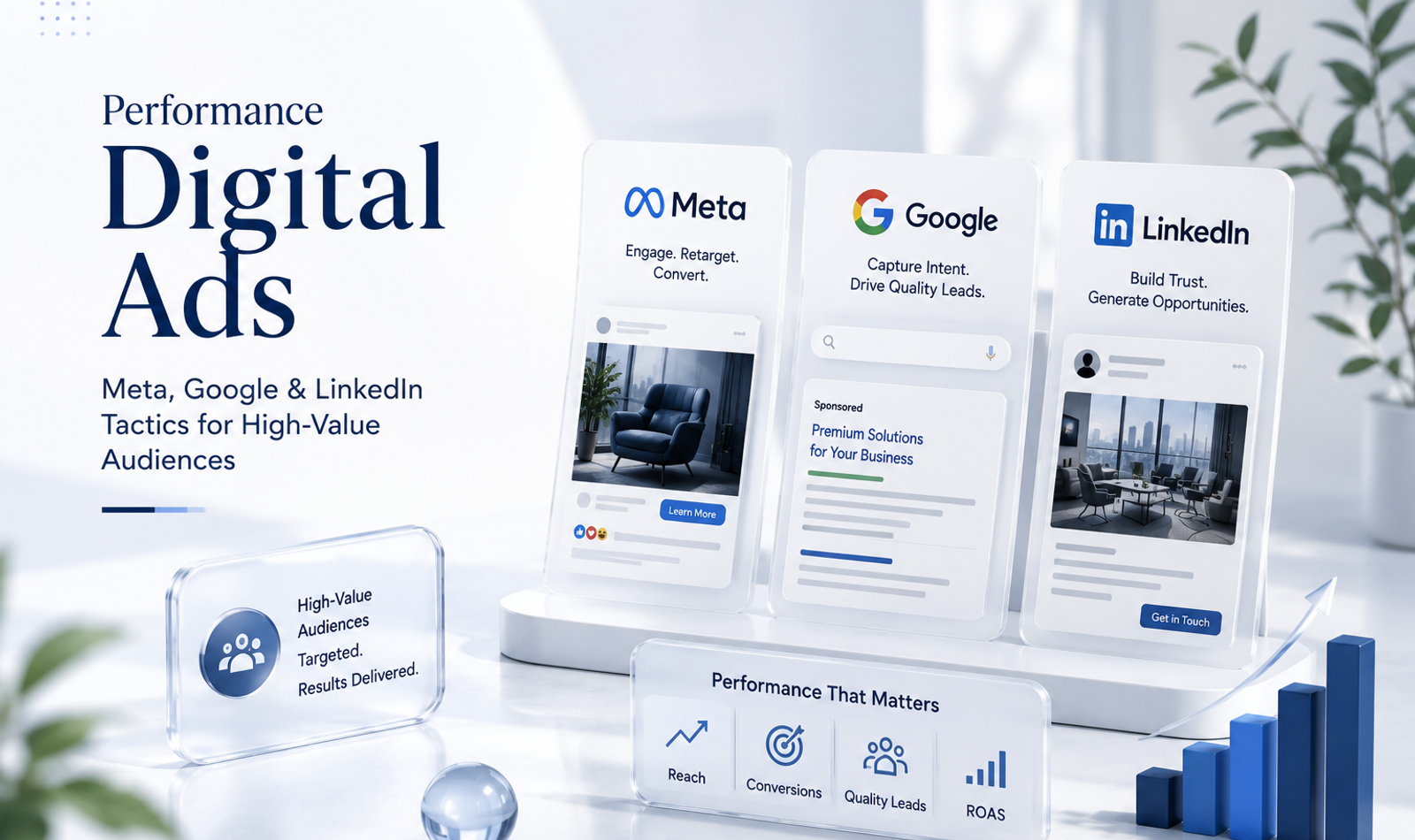
Meta, Google and LinkedIn can all contribute to this process, but they perform different roles.
Meta is particularly effective for creating demand, presenting visual stories, building familiarity and retargeting people across Instagram and Facebook.
Google captures active intent. It reaches people who are searching for a solution, comparing options, researching a destination or looking for a particular service.
LinkedIn offers professional and organisational context. It can help brands reach decision-makers by company, role, industry, seniority, experience and professional interest.
The strongest campaigns do not force one platform to perform the complete customer journey.
They use each platform according to its strengths.
A potential luxury customer may first discover a brand through an Instagram campaign, search for it later on Google, read case studies on the website and finally submit an enquiry after seeing a LinkedIn thought-leadership advertisement.
The final conversion may appear to come from one platform, but the decision was shaped across several touchpoints.
A high-value paid-media strategy must therefore consider audience quality, campaign role, creative communication, landing-page experience, sales follow-up and revenue attribution together.
What Are Performance Digital Ads?
Performance digital ads are paid campaigns planned and optimised around measurable customer actions.
These actions may include purchases, hotel reservations, consultation requests, event registrations, brochure downloads, property-viewing appointments, qualified calls or completed lead forms.
The word performance does not mean that every campaign must produce an immediate sale.
A campaign can support awareness, consideration, demand generation or conversion as long as its role is defined and measured clearly.
For a high-ticket business, an advertisement may introduce the brand to a relevant audience before the customer is ready to enquire.
Another campaign may retarget people who explored a service page but did not take action.
A final campaign may promote a private consultation, site visit, proposal request or booking.
Together, these campaigns form a performance system.
The system should be evaluated according to how effectively it moves suitable prospects towards commercially valuable outcomes.
High-Value Audiences Require a Different Strategy
High-value audiences are not defined only by personal wealth.
The term may describe individuals or organisations capable of producing significant commercial value for the business.
For a luxury hospitality company, this may include premium leisure travellers, destination-wedding families, corporate travel planners and event decision-makers.
For a real estate company, the audience may include qualified homebuyers, investors, channel partners and non-resident Indians.
For a creative agency, the most valuable prospects may be founders, marketing heads and senior decision-makers at companies with realistic budgets and recurring requirements.
For a B2B technology company, a valuable audience may consist of organisations with the right team size, systems, purchasing authority and operational problem.
These audiences usually require more trust, information and consideration before converting.
They may involve several decision-makers.
The service may need a customised proposal rather than a fixed online purchase.
The advertising strategy must therefore prioritise relevance, authority and qualification rather than low-cost reach alone.
Stop Treating Every Lead as Equal
One of the most common performance-marketing mistakes is evaluating campaigns only through cost per lead.
A campaign may generate one hundred low-cost leads, but most may be students, vendors, job seekers, customers outside the service location or people with unrealistic budgets.
Another campaign may generate ten more expensive leads, of which three become serious sales opportunities.
The second campaign may provide far greater business value.
Lead quality should be examined through the sales process.
The brand should track whether leads are contactable, relevant, qualified, proposal-ready and eventually converted.
Cost per lead remains useful, but it should be considered with cost per qualified lead, cost per opportunity, customer acquisition cost and revenue.
The advertising platform should receive meaningful conversion information wherever technically and legally appropriate.
When platforms are optimised only towards easy form submissions, they may learn to find more people who submit forms rather than people who become customers.
Define the Commercial Goal First
The campaign should begin with a business objective rather than a platform or advertisement format.
The company may want to generate private consultations, increase direct hotel bookings, attract corporate event enquiries, sell premium memberships or create a qualified B2B pipeline.
The objective determines the campaign structure.
A business seeking immediate demand from active prospects may prioritise Google Search.
A brand entering a new market may need Meta campaigns to create recognition before enough people begin searching for it.
A B2B company targeting selected enterprises may prioritise LinkedIn account-based campaigns supported by Google and retargeting.
The brand should define what a valuable conversion means.
A completed contact form is not always the final objective.
The more meaningful conversion may be an approved sales lead, a scheduled meeting, a site visit, a proposal or a confirmed booking.
Understand the Customer Journey
High-value customers rarely move directly from one advertisement to a final purchase.
They may discover the brand through a visual campaign, visit the website, review previous work, compare competitors, speak with family or colleagues and return several days later.
The customer may switch devices and channels during this process.
A marketing director may see a LinkedIn advertisement on a work laptop, search the agency name on a phone and later submit a form through a direct website visit.
A traveller may discover a hotel through Instagram, view room videos, read reviews on another platform and eventually book through Google.
The brand should design advertising around this journey.
Different campaigns can address discovery, trust, consideration, qualification and conversion.
Expecting one advertisement to complete the entire journey can produce unrealistic performance expectations.
Build a Platform Role Map
A platform role map defines what each advertising channel is expected to accomplish.
Meta may be responsible for visual discovery, brand familiarity, social proof, lead generation and retargeting.
Google Search may capture customers expressing immediate or developing intent through keywords.
YouTube and other Google inventory may support awareness, product education and repeated exposure.
LinkedIn may reach professional decision-makers, target key accounts and generate B2B leads.
The roles can overlap, but they should not be identical.
When each platform has a clear purpose, the brand can select suitable creative, offers, landing pages and metrics.
Build the Measurement Foundation Before Spending
Advertising performance depends on measurement quality.
The brand should define and configure the actions it wants to track before campaigns begin.
These may include form submissions, booked appointments, calls, WhatsApp interactions, brochure downloads, booking-engine completions and purchases.
Tracking should also include useful steps that indicate intent, such as viewing key service pages, checking room availability or beginning an application.
However, the reporting system should distinguish primary conversions from supporting actions.
A page view should not have the same value as a completed booking.
A form start should not be reported as a qualified enquiry.
Clear conversion definitions prevent inflated performance reporting.
Connect Advertising With Sales Data
Website analytics show what happens before and during lead submission.
The customer relationship management system shows what happens afterwards.
Both views are necessary.
The original campaign source should remain attached to the lead as sales teams contact, qualify and progress it.
The brand should record whether the enquiry was relevant, whether a meeting occurred, whether a proposal was issued and whether revenue was generated.
This information reveals which platforms, campaigns and audiences produce actual commercial value.
Without sales integration, marketing teams may continue increasing budgets for campaigns that generate forms but little business.
Use First-Party Data Strategically
First-party data includes information customers have shared directly with the business.
It may include previous buyers, qualified leads, newsletter subscribers, website visitors, app users and loyalty members.
This data can improve campaign relevance when collected and used lawfully.
The brand can separate past customers according to value, category, location or behaviour.
A hotel may create segments for premium leisure guests, wedding enquiries and corporate clients.
An agency may separate retained customers, completed projects and high-value opportunities.
Platforms can then use these audiences for re-engagement, exclusion, modelling or campaign learning.
High-quality first-party data is more useful than one unorganised list containing customers, vendors, employees and irrelevant contacts.
Protect Data Quality
Uploading poor-quality data can lead to poor campaign decisions.
Contact information should be accurate, current and connected with meaningful customer records.
The business should avoid assigning high value to customers simply because they made one large transaction if that transaction produced low margin or high servicing cost.
Customer value can include revenue, profit, repeat business, retention and referral potential.
The organisation should also respect consent, platform policies and applicable privacy requirements.
First-party data is a competitive advantage only when it is governed responsibly.
Meta Ads Strategy for High-Value Audiences
Understand Meta’s Role
Meta is particularly useful for reaching people before they express a direct search need.
Instagram and Facebook allow brands to communicate through strong visuals, video, social proof, founder stories, case studies and customer experiences.
This makes Meta valuable for categories where aspiration and perception influence the decision.
Luxury travel, weddings, interiors, premium automobiles, real estate, beauty, fashion and creative services can all benefit from visual demand generation.
Meta can also retarget website visitors and people who have interacted with the brand’s content.
However, the platform should not be evaluated only through cheap traffic or lead volume.
The campaign must attract the correct audience and prepare them for a high-value decision.
Use Broad Targeting With Strong Signals
Detailed interest targeting can be useful, but it should not become an attempt to describe the perfect customer through dozens of narrow selections.
Platform automation increasingly uses campaign data, conversion history, creative response and audience signals to find likely customers.
A business with reliable conversion tracking and sufficient data may benefit from broader audience structures.
The creative, offer and conversion event become important filters.
An advertisement promoting a private luxury wedding consultation with clear qualification language naturally appeals to a different audience from a generic post offering event services.
Broad targeting does not mean giving the platform no strategic direction.
Geography, age where relevant, exclusions, customer data and creative positioning should still reflect the business.
Use Customer-Value Audiences
Not every previous customer provides the same value.
Meta campaigns can use customer lists that include value information, allowing the business to build audiences based on stronger customer signals.
A value-based audience should use meaningful commercial data rather than arbitrary numbers.
The best seed audience may include profitable customers, retained clients, high-value bookings or qualified opportunities.
The brand should exclude poor-fit leads and internal records.
A larger but mixed list may provide weaker learning than a smaller, carefully prepared high-value list.
Build Lookalike Audiences From Quality Sources
Lookalike audiences help brands reach people who share characteristics with an existing source audience.
The source quality matters greatly.
A lookalike based on all website visitors may include people who arrived accidentally or left immediately.
A lookalike based on qualified customers or high-value purchasers provides a stronger commercial signal.
Brands can test different sources, including previous customers, qualified leads, completed bookings and high-intent website visitors.
Audience expansion should be evaluated through qualified outcomes rather than early click costs alone.
Use Retargeting According to Intent
Not every website visitor should receive the same retargeting advertisement.
A person who viewed one blog article is different from someone who visited pricing, booking or consultation pages several times.
Retargeting audiences can be segmented according to behaviour and recency.
Recent high-intent visitors may receive a direct consultation or booking advertisement.
Earlier-stage visitors may receive a case study, customer story or service explainer.
Existing customers may receive loyalty, upgrade or cross-service communication.
The campaign should also exclude people who have already completed the intended action unless a separate retention strategy applies.
Use Video to Build Familiarity
Video is valuable for high-consideration products because it can communicate experience, process, environment and personality.
A hotel can show arrival, room details, dining and destination experiences.
An event agency can show behind-the-scenes planning, guest flow, production and final execution.
A professional service company can use founder or expert videos to explain the customer problem and approach.
The opening seconds should establish relevance quickly.
The brand should not depend on a long cinematic introduction before explaining what the advertisement is about.
Shorter edits can generate attention, while longer content can support education and trust.
Test Different Creative Angles
Performance creative should test meaning, not only colours and button text.
A campaign can test different customer motivations.
One advertisement may focus on exclusivity. Another may focus on ease, reliability, return on investment or emotional experience.
A luxury wedding campaign may compare visual beauty with complete guest management.
An agency campaign may contrast random posting with integrated digital growth.
A hotel campaign may focus on design, privacy, food or destination access.
These angles can reveal which value proposition creates the strongest qualified response.
Use Case Studies as Ads
Case studies reduce uncertainty by showing how the business has delivered value previously.
A strong case-study advertisement includes the client situation, relevant solution and credible outcome.
It should not expose confidential details without permission.
High-value customers often need proof that the company can handle complexity.
An event company may show how it coordinated guest travel and hospitality across several cities.
An agency may show how a website, content and advertising system improved qualified enquiries.
Case-study content can be used at the consideration and retargeting stages.
Use Lead Forms Carefully
Meta lead forms can reduce friction by allowing users to submit information without leaving the platform.
This can increase volume, but lower friction may also increase low-intent submissions.
High-value campaigns should include suitable qualification questions.
These may cover location, service requirement, event date, estimated budget, company size or expected timeline.
The form should not become unnecessarily long.
The objective is to remove clearly unsuitable enquiries while preserving a smooth experience for serious prospects.
Leads should be contacted quickly.
A lead generated through an instant form may lose interest when the brand responds several days later.
Test Website Conversion Campaigns
Website campaigns give the brand greater control over qualification, content and user experience.
The landing page can explain the offering in detail and include case studies, testimonials, FAQs and pricing guidance.
Website campaigns may produce fewer leads than instant forms but stronger quality.
The business should compare the complete commercial journey rather than assuming one format is superior.
The test should include contact rate, qualification rate, meeting rate and revenue.
Use Messaging Campaigns With a Process
Messaging campaigns can be effective in markets where customers prefer WhatsApp, Messenger or Instagram conversations.
However, the business needs a response system.
The advertisement should set clear expectations and begin the conversation with useful questions.
Automated greetings can collect basic information, but high-value enquiries should move to a trained person quickly.
The sales team should avoid sending generic brochures without understanding the requirement.
Messaging success should be measured through qualified conversations and conversions rather than chat starts alone.
Control Frequency and Creative Fatigue
High-value audiences may be relatively limited.
The same people can see advertisements repeatedly, leading to creative fatigue.
The brand should monitor frequency, declining response and negative feedback.
New creative should introduce a fresh angle rather than simply changing colours.
A sequence can move from problem awareness to proof, explanation and offer.
This creates a more useful customer journey than repeating one promotional advertisement continuously.
Google Ads Strategy for High-Value Audiences
Understand Search Intent
Google Search reaches people who are actively expressing interest through keywords.
This makes it valuable for capturing demand.
However, not every relevant-looking keyword represents strong commercial intent.
Someone searching for luxury wedding ideas may be researching inspiration, while someone searching for a luxury wedding planner in Mumbai may be closer to selecting a service.
A person searching for event-management jobs has a completely different intention from a company searching for an event-management agency.
Keyword strategy should therefore examine the meaning behind the search.
Separate Brand and Non-Brand Campaigns
Brand campaigns target searches containing the company or product name.
Non-brand campaigns target category, service, problem and competitor-related searches where appropriate.
These should usually be reported separately.
Brand searches often convert efficiently because the customer already knows the business.
Combining them with non-brand traffic can make overall performance appear stronger while hiding the cost of acquiring new demand.
Brand campaigns remain important because competitors, directories and other results may appear around the search.
The business should also monitor whether broader advertising activity increases brand-search volume over time.
Build High-Intent Keyword Groups
Keywords should be organised around tightly connected customer intentions.
A luxury event company might separate corporate events, destination weddings, celebrity management and guest logistics.
A hospitality company might separate brand searches, destination searches, room intent, wedding venue searches and corporate-event searches.
Each group should use advertisements and landing pages relevant to the exact requirement.
Sending every keyword to the homepage increases customer effort and reduces message relevance.
Use Negative Keywords
Negative keywords prevent advertisements from appearing for unsuitable searches.
They may exclude jobs, courses, free templates, definitions, low-budget services, unrelated locations and do-it-yourself information.
Search-term reviews should continue after launch.
Unexpected searches often reveal wasted spending or new customer language.
Negative keywords should be applied carefully.
An overly aggressive list may block valuable searches that contain an apparently low-intent word in a relevant context.
Write Advertisements for Qualification
Search advertisements should do more than attract clicks.
They should help the correct customer recognise the fit.
The copy can mention geography, premium positioning, specialisation, minimum requirements or the type of customer served.
This may reduce click-through rate but improve lead quality.
A high-value business should not hide every indicator of pricing or service level merely to increase traffic.
The advertisement should communicate enough value and qualification to reduce unsuitable clicks.
Match Landing Pages to Search Intent
A customer searching for celebrity-management services should land on a relevant celebrity-management page.
A person searching for a luxury wedding planner should not be required to navigate through unrelated digital marketing and website services.
The page should confirm that the customer has reached the correct place immediately.
It should explain the service, process, evidence, location, relevant experience and next step.
Trust elements may include case studies, client examples, media features, testimonials and professional credentials.
Use Call Tracking and Form Tracking
Many high-value customers prefer to call or message rather than submit a long form.
The brand should track suitable telephone and messaging actions where possible.
Call quality matters.
A short accidental call should not be valued in the same way as a qualified conversation.
Sales teams should record the source and outcome.
The business should also test forms thoroughly across mobile devices.
A broken form can cause campaigns to appear weak when the real problem is the customer experience.
Use Conversion Value, Not Only Conversion Count
A hotel booking, corporate enquiry and newsletter signup should not have the same value.
Google campaigns can be guided towards conversion value when the business assigns meaningful values to actions.
Values should reflect commercial importance.
A confirmed booking may receive actual revenue.
A qualified lead may receive an estimated value based on historical conversion probability and average profit.
A general download may receive a much lower value.
These values should be reviewed as the business learns more.
Poorly designed values can direct the platform towards the wrong outcomes.
Use Customer Match
Customer Match allows brands to use eligible first-party customer data across Google’s advertising surfaces.
The business may use it to re-engage customers, exclude existing customers, support audience signals or reach similar relevant users.
Lists should be segmented according to commercial purpose.
A premium hotel may separate previous high-value guests, wedding customers and corporate organisers.
A B2B business may separate current customers, open opportunities and inactive leads.
The data should be refreshed and governed responsibly.
Use Performance Max With Clear Inputs
Performance Max can distribute campaigns across Google inventory and optimise towards selected conversion goals.
It should not be treated as a replacement for strategy.
The brand needs reliable conversion tracking, useful creative assets, relevant audience signals and clear business goals.
Audience signals can include customer lists, website visitors, search-related custom segments and other relevant indicators.
These inputs help the system understand the type of customer the business wants to reach.
Campaign performance should be evaluated through conversion quality, value and incrementality rather than total conversion volume alone.
Avoid Feeding Poor Conversions Into Automation
Automation learns from the signals it receives.
If every contact-form submission is marked as an equally valuable conversion, the campaign may find more people likely to submit forms.
It does not know automatically which leads were serious.
The business should improve offline conversion tracking and import qualified stages where possible.
For example, the system may receive separate signals for submitted lead, qualified lead and converted customer.
This helps campaign optimisation move closer to business value.
Use YouTube for Consideration
YouTube can support high-value customer education.
A longer buying cycle often requires explanation, demonstration and trust.
The brand can use customer stories, founder insight, destination films, walkthroughs and detailed service videos.
Audiences can be built from website visitors, customer data, search behaviour and content engagement.
The creative should be designed for the format.
Simply converting a static advertisement into a long slideshow may not hold attention.
YouTube should be measured through view quality, brand search, website behaviour and assisted conversions rather than direct last-click sales alone.
Use Demand Creation and Demand Capture Together
Google Search captures existing demand.
Other campaign types can help create or strengthen demand.
A brand with low category awareness may not generate enough search volume through Search alone.
Visual and video campaigns can introduce the solution before customers know which terms to search.
The strongest strategy combines demand generation with demand capture.
Meta, YouTube, PR and content may create interest, while Google Search captures the later expression of that interest.
LinkedIn Ads Strategy for High-Value Audiences
Understand LinkedIn’s Professional Advantage
LinkedIn allows advertisers to reach people according to professional and organisational context.
This is particularly useful for B2B services, corporate events, consulting, technology, recruitment, education and premium professional offerings.
The platform can target industries, companies, roles, functions, seniority and other professional characteristics.
However, detailed targeting should still reflect realistic audience size.
Combining too many narrow conditions can produce a very small audience, high frequency and limited delivery.
The brand should prioritise the professional attributes most strongly connected with purchasing authority and need.
Target the Buying Committee
High-value B2B purchases often involve several people.
A chief executive may approve the investment. A marketing head may lead the evaluation. Procurement may examine commercial terms. Finance may review the budget.
The advertising strategy should not focus only on one job title.
The brand can create audience groups for economic buyers, operational decision-makers, influencers and users.
The creative can address the concerns of each group.
A senior leader may respond to growth, risk and business outcomes.
An operational manager may need process, implementation and proof.
Use Account-Based Targeting
Account-based marketing focuses advertising on selected organisations rather than the entire market.
LinkedIn can help reach employees and decision-makers within target companies.
The brand should begin with a high-quality account list based on fit.
Criteria may include industry, company size, geography, growth stage and known need.
The campaign should not simply upload every large company.
The selected accounts should represent a realistic commercial opportunity.
Account-based advertising works best when coordinated with sales outreach, email, events and personalised content.
Use Website Retargeting
Website retargeting can reach LinkedIn members who previously visited relevant pages.
A general blog visitor may receive educational content.
A visitor to a pricing or consultation page may receive a case study or meeting invitation.
The audience should be segmented where volume allows.
Retargeting messages should acknowledge the customer’s likely stage without creating an uncomfortable sense of surveillance.
The content should provide the next useful piece of information.
Use Contact Targeting
Contact targeting can help reach known leads, customers or prospects through eligible uploaded data.
The business can nurture open opportunities, re-engage inactive leads and support account-based campaigns.
Lists should be organised according to sales stage.
A current customer should not receive the same acquisition advertisement as a new prospect.
Existing customers may receive expansion, loyalty or event communication.
The platform campaign should complement direct sales activity rather than duplicate generic outreach.
Use Lead Gen Forms for Reduced Friction
LinkedIn Lead Gen Forms can prefill professional information and reduce the effort required to respond.
This can be useful for reports, webinar registrations, consultation requests and high-value content.
The form should request only information necessary for qualification and follow-up.
A B2B campaign may ask about company, role, requirement, timeline or team size.
The thank-you experience should explain what happens next.
Leads should move into the sales or marketing system quickly.
A form submission becomes less valuable when no one responds or the promised resource is delayed.
Test Website Forms Against LinkedIn Forms
Native lead forms often produce higher response volume because they reduce friction.
Website forms can provide greater brand context and deeper qualification.
The business should test both according to the offer.
A thought-leadership report may work well with a LinkedIn form.
A complex service consultation may benefit from a dedicated landing page that explains the service and filters unsuitable enquiries.
Performance should be compared through qualified pipeline, not only form cost.
Promote Thought Leadership
High-value B2B customers often need confidence in the people behind the company.
LinkedIn campaigns can promote expert articles, founder insight, research, case studies and practical frameworks.
The content should provide value before asking for a meeting.
A senior decision-maker may be more willing to engage after seeing evidence that the company understands the problem.
Thought leadership should avoid becoming generic motivation or obvious sales content.
It should offer a clear perspective supported by experience, data or practical examples.
Use Document and Educational Content
Documents, reports, checklists and frameworks can generate strong engagement when they address a real professional challenge.
The content should be useful enough to justify the audience’s attention.
A corporate-event company might share a guide to managing multi-city guest logistics.
An agency might share a framework for evaluating digital campaign ROI.
A technology provider might explain implementation risks and decision criteria.
Educational content can build remarketing audiences and create lead-nurturing opportunities.
Use Conversation-Led Creative
B2B advertising often becomes overly formal and abstract.
Effective LinkedIn creative can communicate in direct professional language.
The advertisement should identify a recognisable business problem, explain the consequence and introduce a credible solution.
It should avoid exaggerated statements about transforming every organisation.
Decision-makers generally respond better to specificity, evidence and relevance.
Control Audience Overlap
Several LinkedIn campaigns may target similar job functions, seniority levels and industries.
This can create overlap and internal competition.
The business should define exclusions and audience roles.
Current customers, employees, open opportunities and unrelated functions may need to be excluded from acquisition campaigns.
Campaigns should be monitored for frequency and audience saturation.
Small professional audiences can become fatigued quickly.
Creating a Cross-Platform Funnel
Top-of-Funnel Demand Generation
The top of the funnel introduces the brand and customer problem.
Meta video, Instagram creative, YouTube and LinkedIn thought leadership can all support this stage.
The objective is relevant awareness rather than immediate sales.
Metrics may include qualified reach, video completion, engagement, brand search and website visits.
The content should establish the brand’s point of view and provide a reason to learn more.
Mid-Funnel Consideration
The middle of the funnel provides evidence and reduces uncertainty.
Case studies, customer stories, service explainers, webinars, reports and detailed landing pages are useful.
Retargeting campaigns can reach people who viewed relevant content or visited important pages.
Metrics may include returning visitors, content engagement, report downloads, booking-page views and qualified conversations.
Bottom-of-Funnel Conversion
The bottom of the funnel asks for a commercially meaningful action.
Google Search can capture high-intent searches.
Meta and LinkedIn retargeting can promote consultations, proposals, private previews, site visits and bookings.
The offer should match the customer’s decision stage.
A customer who has only viewed one general video may not be ready for a detailed sales call.
A person who has visited pricing, case-study and contact pages several times may require a direct invitation.
Create Consistent Messaging
The customer should recognise the same brand across platforms.
The visual format can change, but the positioning, proof and offer should remain aligned.
A premium advertisement should not lead to a generic or poorly designed landing page.
A thought-leadership campaign should not lead immediately into aggressive sales messaging.
Consistency increases trust and reduces cognitive effort.
Landing Pages for High-Value Campaigns
Match the Advertisement Promise
The landing page should continue the exact conversation started by the advertisement.
When an advertisement promises corporate event-management expertise, the page should not open with a broad list of unrelated services.
The headline should confirm relevance immediately.
The page should explain the problem, approach, proof and next step.
Use Qualification Without Creating Friction
Qualification can occur through messaging, forms, service descriptions and pricing guidance.
The page may state the cities served, type of customer, typical engagement or minimum requirements.
This information can reduce unsuitable enquiries.
However, the brand should avoid creating an intimidating experience for qualified customers.
The form should request enough information to support a useful first conversation.
Include Trust Signals
High-value audiences evaluate risk carefully.
Trust signals may include case studies, testimonials, recognised clients, press coverage, certifications, awards, team expertise and transparent process information.
The page should use proof relevant to the service.
A large logo wall cannot replace a clear explanation of what the company delivered.
Optimise for Mobile Experience
Many users discover advertisements through mobile devices even when the final purchase occurs elsewhere.
The page should load quickly, remain readable and provide easy contact options.
Forms should be tested on different screen sizes.
Large videos and decorative effects should not prevent the customer from understanding the offering or taking action.
Creative Strategy for Premium Audiences
Avoid Cheap-Looking Urgency
Urgency can support performance, but constant countdowns, excessive capital letters and aggressive discounting can weaken premium perception.
High-value offers often benefit from genuine scarcity, availability windows, private access or consultation capacity.
The communication should remain accurate.
False urgency damages trust and may attract customers interested only in discounts.
Communicate Value Before Price
Premium customers need to understand what creates the value.
Advertisements can highlight expertise, service depth, privacy, craftsmanship, results or experience.
The brand should not assume that a high price automatically communicates quality.
Proof, visual presentation and customer outcomes must support the position.
Use Strong Calls to Action
Premium does not mean vague.
The advertisement should tell the audience what to do next.
Suitable calls to action may include request a private consultation, schedule a strategy session, explore the experience, check availability or download the executive guide.
The action should match the buying stage.
Test Offers, Not Just Advertisements
Campaign performance may improve through a stronger offer rather than a different visual.
A consultation, audit, private preview, guide, webinar, site visit or custom proposal can create different levels of intent.
The offer should provide genuine value and prepare the customer for the next commercial step.
Budgeting and Bidding
Allocate Budget According to Funnel Role
The brand should avoid allocating budget equally across platforms without considering their roles.
Google Search may require sufficient investment to capture high-intent demand.
Meta may require ongoing creative and audience testing.
LinkedIn may have higher media costs but reach more relevant professional decision-makers.
Budget decisions should reflect qualified commercial outcomes.
Give Campaigns Enough Data
Frequent changes can prevent campaigns from learning.
Budgets, bids, targeting and conversion goals should not be changed impulsively after every short-term fluctuation.
The brand should allow enough time and conversion volume for meaningful evaluation while still responding to obvious tracking or quality problems.
High-value campaigns may have lower conversion volume, so evaluation periods should match the buying cycle.
Avoid Optimising Only for the Cheapest Result
The cheapest click, lead or conversion is not necessarily the most valuable.
The brand should consider downstream qualification and revenue.
A more expensive channel may generate customers with larger contracts and higher retention.
Performance reporting should connect media cost with business value.
Reporting and Attribution
Build a Unified Dashboard
A useful dashboard should include spend, reach, traffic, leads, qualified leads, opportunities, customers and revenue.
Platform metrics should remain visible, but business outcomes should receive greater importance.
The dashboard can separate awareness, consideration and conversion activity.
It should also explain data limitations and attribution assumptions.
Track Cost Per Qualified Lead
Cost per qualified lead measures the investment required to generate an enquiry meeting the company’s criteria.
This metric is often more useful than general cost per lead.
The criteria should be agreed by marketing and sales.
They may include location, budget, need, authority and timeline.
Track Pipeline and Revenue
B2B and high-ticket campaigns should be evaluated through opportunity value and closed revenue.
The brand can examine which campaigns influenced the pipeline even when they did not receive final-click credit.
Sales-cycle length should be considered.
A campaign launched this month may generate revenue several months later.
Review Assisted Conversions
A customer may engage with Meta, Google and LinkedIn before converting.
The brand should review customer journeys, campaign-assisted conversions and branded-search changes.
Last-click reporting may undervalue discovery and nurturing channels.
Attribution will never capture every human influence perfectly, but a multi-source view is more credible than giving all credit to the final touchpoint.
Measure Incremental Impact
The business should ask what additional value the campaign created.
Performance may be compared with previous periods, excluded locations, control audiences or different budget levels.
Sales, pricing, seasonality and organic demand should also be considered.
Incrementality helps distinguish captured existing demand from genuinely increased business.
Common Performance Advertising Mistakes
A common mistake is launching campaigns without reliable conversion tracking.
Another is treating all leads as equally valuable.
Brands may use broad automated campaigns while feeding the platforms poor-quality conversion data.
Some businesses create highly specific audience targeting but use generic creative.
Others produce premium advertisements that lead to slow, confusing or low-trust landing pages.
Google campaigns may waste budget on irrelevant searches because negative keywords and search terms are not reviewed.
Meta campaigns may optimise towards low-friction forms that generate weak lead quality.
LinkedIn campaigns may target audiences so narrowly that frequency becomes excessive.
Another mistake is evaluating each platform independently when the customer journey crosses several channels.
Brands may also change campaigns too frequently, preventing meaningful learning.
Finally, performance teams may focus on dashboards while ignoring slow sales response, poor qualification and weak customer experience.
Advertising cannot repair an unsuitable offer or an unprepared sales process.
A Practical Performance Digital Advertising Process
The process begins with defining the business objective and valuable customer action.
The brand maps the customer journey and assigns a role to Meta, Google and LinkedIn.
Tracking, analytics, call measurement and customer relationship management integration are prepared before launch.
First-party customer data is cleaned, segmented and governed responsibly.
Meta campaigns are structured for visual demand generation, value-based audiences, retargeting and qualified lead capture.
Google Search campaigns are built around high-intent keyword groups, negative keywords and relevant landing pages.
Performance Max and other automated campaigns receive appropriate conversion goals, creative assets and audience signals.
LinkedIn campaigns target suitable professional groups, target accounts, website visitors and known contacts.
Creative assets are developed around different customer motivations, objections and decision stages.
Landing pages maintain message consistency, explain value and include sufficient qualification.
Sales teams receive campaign context and response expectations.
Leads are classified by quality and tracked through meetings, proposals, opportunities and revenue.
Campaign optimisation uses both platform performance and downstream sales information.
Budgets are adjusted according to qualified value rather than cheap top-level metrics.
The final reporting system connects advertising exposure, customer action, sales pipeline and financial return.
Frequently Asked Questions
Q1. What are performance digital ads?
Performance digital ads are paid campaigns designed to generate measurable business outcomes such as leads, bookings, enquiries, consultations or sales. They are optimised based on performance data rather than only visibility or reach.
Q2. Why is performance marketing different for high-value businesses?
High-value businesses require quality over quantity. The focus is not just on generating leads but on attracting the right customers with proper budget, intent, authority and long-term value potential.
Q3. How do Meta, Google and LinkedIn work differently in performance marketing?
Meta is used for awareness, storytelling and retargeting. Google captures active search intent. LinkedIn reaches professional decision-makers based on role, industry and company structure.
Q4. Why is lead quality more important than lead quantity?
Because high-value businesses often lose money on low-intent leads. A smaller number of qualified leads that convert into real customers is more valuable than a large volume of irrelevant enquiries.
Q5. What is the role of landing pages in performance advertising?
Landing pages ensure message consistency, explain the offer clearly, build trust and guide the user toward a qualified conversion such as enquiry, booking or consultation.
Conclusion
Performance digital advertising for high-value businesses is not about generating maximum clicks or lowest-cost leads.
It is about building a structured system that attracts the right audience, qualifies intent and converts attention into real business outcomes.
Meta, Google and LinkedIn each play a different but connected role in this system.
Meta builds awareness and demand through visual storytelling. Google captures intent when customers are actively searching. LinkedIn connects with professional decision-makers in a structured B2B environment.
When used together, these platforms support a complete customer journey rather than isolated campaigns.
However, platform strategy alone is not enough.
Success depends on first-party data quality, creative relevance, landing-page experience, sales response speed and proper qualification of leads.
A “form submission” is not performance. A qualified opportunity and actual revenue define performance.
When strategy, targeting, creative, tracking and sales alignment work together, performance advertising becomes a predictable system for generating high-value customers at scale.
Build a Performance System That Attracts the Right Customers
If you want to move beyond low-quality leads and build a structured performance marketing system that brings in qualified, high-value customers, your entire funnel needs to work together — from ads to landing pages to sales conversion.
At Double Trouble Studio, we design performance-driven digital advertising systems across Meta, Google and LinkedIn that focus on real business outcomes, not just clicks and impressions.
📩 info@dtsworld.in 📞 +91 80000 06021 📍 Andheri (West), Mumbai
Need this for your brand?
Let DTS build your next campaign.
From PR, celebrity management and events to websites, social media, SEO and AI video production — Double Trouble Studio helps brands grow with strategy and execution.
Discuss Your Requirement →