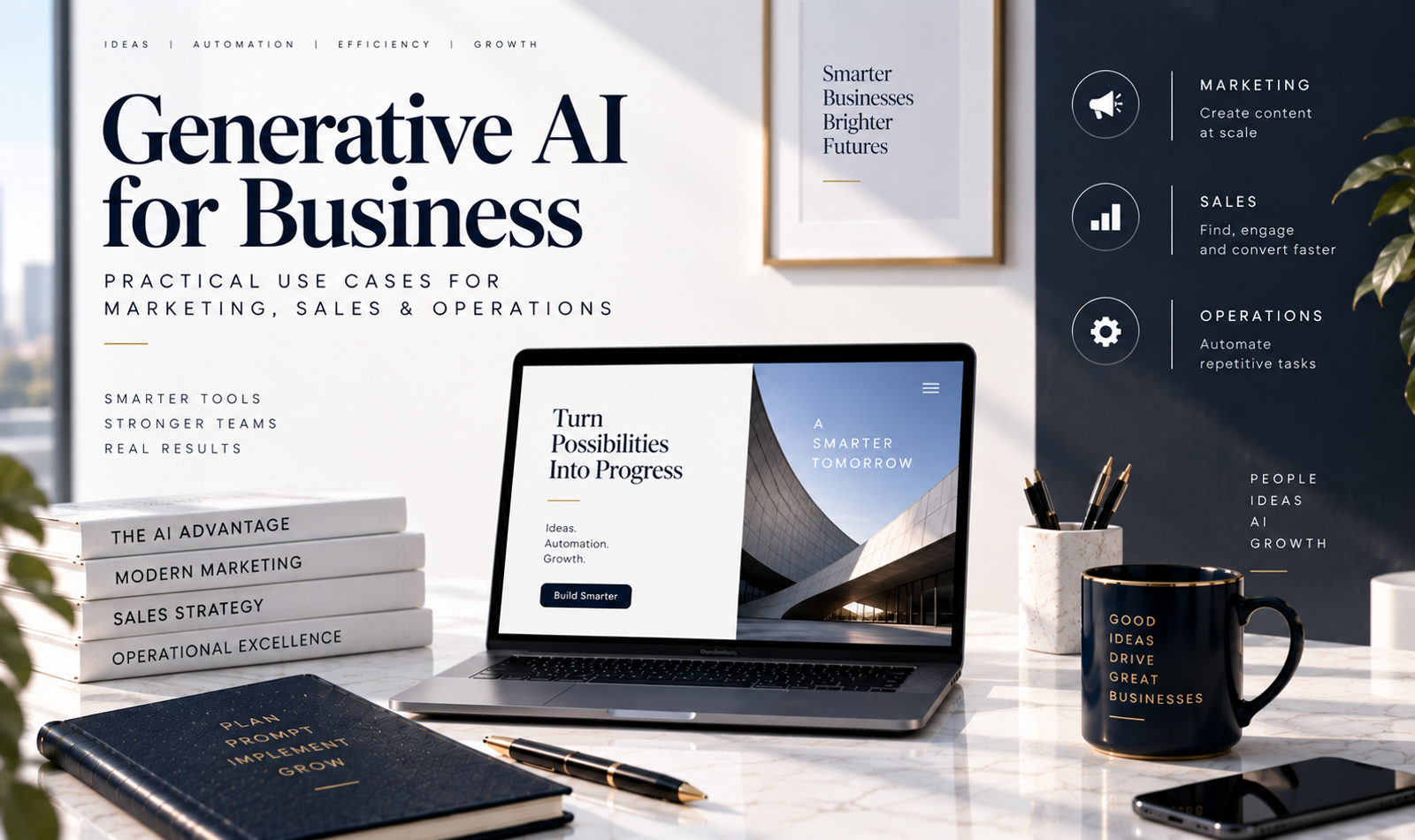
Generative AI for Business: Practical Use Cases for Marketing, Sales & Operations
Generative AI is moving from experimentation into everyday business operations.
Companies are increasingly exploring artificial intelligence to create marketing content, research audiences, prepare sales communication, analyse customer information, summarise documents, support customer service, generate videos, automate repetitive processes and improve employee productivity.
However, simply having access to AI does not create a competitive advantage.
The real question is:
Where can generative AI create practical and measurable value inside a business?
For some organisations, the strongest opportunity may be content creation. For others, it could be sales qualification, customer support, reporting, internal knowledge management or workflow automation.
The most effective approach is not to introduce AI everywhere at once.
It is to identify specific processes where AI can reduce repetitive work, accelerate execution, improve access to information or help employees make better-informed decisions.
A practical model is:
Business Strategy → Human Expertise → Generative AI → Automation → Human Review → Measurement
This guide explains generative AI for business, including practical use cases across marketing, sales and operations, implementation strategies, risks, ROI measurement and ways businesses can build responsible AI-enabled workflows.
What Is Generative AI for Business?
Generative AI for business refers to using artificial intelligence systems capable of creating, transforming, summarising, analysing or interpreting information to support business activities.
Depending on the technology involved, generative AI can work with:
- Text
- Images
- Video
- Audio
- Documents
- Data
- Presentations
- Customer conversations
- Business knowledge
For example, a company could use generative AI to:
draft a marketing campaign,
summarise a sales meeting,
create social media concepts,
prepare a proposal outline,
analyse customer feedback,
generate product descriptions,
extract information from documents,
or prepare a customer-service response.
Generative AI becomes particularly useful when combined with automation and existing business systems.
Instead of using AI as an isolated chatbot, businesses can integrate it into actual workflows.
Generative AI vs Traditional Automation
Traditional business automation usually follows predefined rules.
For example:
Form Submitted → Send Confirmation Email
Payment Received → Update Invoice Status
New Lead → Create CRM Record
These workflows are predictable.
Generative AI adds the ability to interpret or generate information.
For example:
Customer Enquiry → AI Reads Message → Identifies Requirement → Summarises Enquiry → Workflow Routes Lead → Sales Team Responds
The complete workflow becomes:
Trigger → Information → AI Interpretation → Business Logic → Action → Human Review
This combination can be especially useful for smaller organisations looking to increase efficiency. DTS's guide to AI automation for small and medium businesses explores how automation can reduce repetitive operational work without requiring businesses to automate everything.
Why Are Businesses Using Generative AI?
Most organisations contain significant amounts of repetitive knowledge work.
Employees spend time:
searching for information,
writing similar emails,
summarising meetings,
creating reports,
preparing presentations,
developing content,
researching customers,
organising documents,
updating systems,
and transferring information between applications.
Individually, these tasks may seem small.
Repeated every day across an organisation, they consume substantial time.
Generative AI can potentially reduce part of this workload.
The business benefits may include:
Faster Execution — Employees can begin with AI-assisted drafts instead of starting from zero.
Higher Productivity — Repetitive knowledge work can be reduced.
Greater Creative Capacity — Marketing teams can explore more ideas and variations.
Faster Information Access — AI can help organise large amounts of information.
More Consistent Processes — AI can operate within defined workflows.
Better Scalability — Businesses may handle larger workloads without increasing manual administration at the same rate.
The goal is not simply to use more AI.
The goal is to create more efficient business systems.
Generative AI Use Cases for Marketing
Marketing is currently one of the most practical areas for generative AI.
Modern marketing teams need to produce:
website content,
blogs,
social posts,
videos,
advertisements,
emails,
landing pages,
campaign concepts,
sales materials,
and reports.
Generative AI can accelerate many parts of this workflow.
1. AI for Marketing Research
Marketing starts with understanding the customer.
Generative AI can help teams organise information from:
customer reviews,
surveys,
sales conversations,
support tickets,
competitor messaging,
market research,
and internal documents.
For example, hundreds of customer comments could be analysed to identify recurring:
problems,
questions,
objections,
preferences,
and purchase motivations.
Marketers can then turn these insights into:
campaign ideas,
content topics,
sales messaging,
FAQs,
and product communication.
AI should support research rather than automatically replace reliable primary research.
2. AI for Audience Research
Businesses frequently serve more than one type of customer.
Generative AI can help organise existing customer information into useful groups based on legitimate business characteristics such as:
industry,
company size,
customer requirement,
location,
purchase stage,
or service interest.
Marketing teams can then develop more relevant communication for each segment.
The purpose is not invasive profiling.
It is understanding different customer needs.
3. AI for Content Strategy
Generative AI can help marketing teams develop structured content ideas.
Instead of randomly generating topics, businesses should begin with content pillars.
For example:
Education
Teach the audience something useful.
Authority
Demonstrate expertise.
Problem Solving
Address customer pain points.
Brand
Communicate positioning and perspective.
Proof
Show results, projects or case studies.
Conversion
Explain products and services.
AI can then generate potential topics within each pillar.
Businesses developing larger content ecosystems can use AI content creation tools and best practices to understand where artificial intelligence can improve content production without sacrificing quality.
4. AI for Blog Content
Generative AI can assist with:
topic ideation,
content outlines,
research organisation,
FAQ development,
first drafts,
metadata,
and content repurposing.
However, publishing large amounts of unreviewed AI content is not a strong content strategy.
A better workflow is:
Keyword & Audience Research → Content Brief → AI-Assisted Draft → Human Expertise → SEO Review → Publish → Update
The human layer should add:
experience,
examples,
original insights,
accuracy,
brand voice,
and useful context.
5. Generative AI for SEO
AI can support several SEO activities.
These include:
search-intent analysis,
keyword clustering,
content briefs,
metadata,
FAQ generation,
content updates,
internal-link planning,
and content gap analysis.
AI should not replace technical SEO fundamentals.
Websites still need:
strong architecture,
crawlability,
mobile usability,
fast loading,
clear internal linking,
and useful content.
Businesses building their organic search foundation can use DTS's on-page SEO checklist for higher rankings alongside AI-assisted content creation.
For the wider technical foundation, the complete technical SEO website optimization guide covers the infrastructure required to support sustainable organic visibility.
6. Generative AI for Social Media
Social media teams continuously need new:
Reel ideas,
captions,
carousels,
Stories,
hooks,
scripts,
and campaign concepts.
AI can help create first drafts and variations.
For example, one blog article could become:
three Reels,
one Instagram carousel,
one LinkedIn post,
five Stories,
and an email.
This allows businesses to extract more value from every core content asset.
The final content should still reflect the brand's real:
voice,
visual identity,
positioning,
and creative direction.
7. AI for Social Media Ads
Paid social campaigns require continuous creative testing.
Generative AI can help create variations of:
hooks,
headlines,
scripts,
CTAs,
creative concepts,
and advertising angles.
For example, one product could be promoted through:
Convenience
Quality
Price
Speed
Problem Solving
Social Proof
Lifestyle
The advertising team can then test which message resonates most strongly.
For businesses targeting high-value audiences, DTS's guide to performance digital ads across Meta, Google and LinkedIn explains how paid media can connect with wider customer acquisition strategies.
8. Generative AI for UGC Ads
UGC-style advertising has become an important format for performance campaigns.
Generative AI can help marketers develop:
hooks,
scripts,
product demonstrations,
testimonial structures,
objection-handling angles,
and CTA variations.
AI can therefore accelerate pre-production.
However, successful UGC still requires:
believable communication,
clear storytelling,
strong pacing,
product relevance,
and appropriate creative direction.
DTS's guide to AI UGC ads and high-converting social media ad creatives explores how AI-assisted UGC can fit into modern advertising campaigns.
9. Generative AI for Advertising Creative
One major advantage of generative AI is creative variation.
Traditional advertising teams may develop a small number of campaign assets because every variation requires additional production.
AI can help teams explore more:
visual directions,
backgrounds,
layouts,
scripts,
hooks,
headlines,
and campaign concepts.
However, greater creative volume does not automatically mean better advertising.
The process should remain:
Generate → Filter → Refine → Test → Measure → Learn
not:
Generate → Publish Everything
10. Generative AI for Video Marketing
Video is one of the fastest-growing applications of generative AI.
AI can support:
concept development,
scriptwriting,
storyboarding,
visual generation,
voiceovers,
motion concepts,
and content variations.
Professional editing can then bring these elements together through:
storytelling,
pacing,
sound,
colour,
typography,
subtitles,
and platform-specific exports.
Businesses exploring AI-powered video advertising can read AI video ads: benefits, cost and use cases.
DTS also provides dedicated AI Video & VFX services for brands looking to integrate AI into professional visual production.
11. AI Product Videos Without Traditional Shoots
Some brands can use AI to create product environments and advertising concepts without producing every visual through a traditional physical shoot.
Potential applications include:
product demonstrations,
concept commercials,
social advertisements,
campaign variations,
and visual storytelling.
This can reduce certain production barriers and accelerate creative testing.
However, the appropriate approach depends on:
product complexity,
required realism,
brand standards,
budget,
and campaign objective.
For a deeper explanation, explore AI product videos and commercials without traditional shoots.
12. Generative AI for Email Marketing
Generative AI can assist email marketing with:
subject-line variations,
campaign drafts,
newsletter structures,
follow-ups,
product messaging,
and audience-specific copy.
AI can also help analyse campaign performance.
For example, marketers can compare:
open rates,
click behaviour,
conversions,
and content performance.
The objective should not be sending more emails.
It should be creating more relevant communication.
13. AI for Content Repurposing
Content repurposing is one of the most practical generative AI applications.
Consider a 30-minute founder interview.
It could potentially become:
one long-form article,
five short videos,
one carousel,
several LinkedIn posts,
multiple quotes,
an email newsletter,
and FAQ content.
AI can help identify and restructure the strongest ideas.
This creates a more efficient content engine:
Create Once → Adapt → Distribute → Measure → Reuse What Works
Generative AI Use Cases for Sales
Marketing creates awareness and demand.
Sales converts that demand into customers.
Generative AI can support sales teams by reducing administrative work and helping employees prepare faster.
14. AI for Lead Generation
AI can support lead-generation systems through:
audience research,
campaign development,
landing-page copy,
content,
advertising,
lead classification,
and follow-up preparation.
But AI does not automatically create qualified leads.
The complete system still needs:
Audience → Offer → Message → Traffic → Landing Page → Lead Capture → Qualification → Sales Follow-Up
Businesses should therefore connect AI with a strong conversion journey. DTS's guide to building conversion-focused marketing funnels explains how website journeys can move visitors toward meaningful actions.
15. AI for Lead Qualification
Not every incoming enquiry deserves the same response.
A website may receive:
sales enquiries,
support requests,
vendor messages,
partnership proposals,
job applications,
and spam.
Generative AI can help classify these enquiries.
For example:
Message Received → AI Identifies Intent → Requirement Categorised → Appropriate Team Assigned
This can reduce the amount of time employees spend manually sorting enquiries.
16. AI for Lead Scoring
Lead scoring helps sales teams prioritise opportunities.
A scoring system may consider:
customer fit,
business requirement,
engagement,
timeline,
and previous activity.
AI can help organise this information and identify patterns.
However, lead scores should support sales decisions rather than automatically reject customers.
17. AI for Prospect Research
Salespeople frequently spend time researching companies before meetings.
Generative AI can help organise available information into a concise account briefing.
For example:
Company
Industry
Products or Services
Potential Requirement
Previous Interaction
Important Questions
This can reduce preparation time.
Important information should still be verified before being used in high-value sales conversations.
18. AI for Personalised Sales Outreach
Generic mass outreach is easy to ignore.
Generative AI can help salespeople prepare more relevant first drafts using legitimate business information.
For example, outreach could be adapted according to:
industry,
service requirement,
business challenge,
or customer stage.
Human review remains essential.
Personalisation should make communication more relevant, not create artificial familiarity.
19. AI for Sales Emails
Sales teams repeatedly write similar communication:
introduction emails,
meeting confirmations,
information requests,
proposal follow-ups,
and post-meeting summaries.
AI can help generate first drafts.
The salesperson can provide:
context,
objective,
customer information,
tone,
and desired next action.
AI then helps structure the communication.
The salesperson remains responsible for what is actually sent.
20. AI for Sales Meeting Preparation
Before an important meeting, AI can help organise:
customer information,
previous communication,
requirements,
open questions,
and relevant documents.
Instead of manually reviewing multiple systems, a salesperson can begin with a structured briefing.
This allows more time for understanding the customer.
21. AI Meeting Summaries
After a meeting, employees often need to:
write notes,
identify decisions,
create action items,
update CRM records,
and prepare follow-ups.
AI can help generate a first summary.
For example:
Meeting Transcript → Summary → Customer Requirements → Action Items → CRM Draft → Human Review
This can reduce repetitive administration.
22. AI for Proposal Creation
Sales proposals often contain repeatable components.
These may include:
company overview,
customer problem,
proposed solution,
scope,
deliverables,
timeline,
and next steps.
Generative AI can help structure these sections based on customer information.
Human review should remain mandatory for:
pricing,
legal terms,
commercial commitments,
and final scope.
23. AI for CRM Management
CRM systems lose value when information is incomplete.
AI and automation can support workflows such as:
New Lead → Create Record
Meeting Completed → Prepare Summary
Proposal Sent → Create Follow-Up
Deal Won → Start Onboarding
Deal Inactive → Create Reminder
The goal is to reduce manual CRM administration while maintaining useful customer records.
24. AI for Sales Follow-Ups
Sales opportunities are frequently lost because follow-ups happen too late.
AI and automation can create a more structured system.
For example:
Proposal Sent → Follow-Up Date Reached → Context Retrieved → Draft Prepared → Salesperson Reviews → Communication Sent
This keeps the human salesperson involved while reducing repetitive preparation.
25. AI for Objection Analysis
Sales conversations contain valuable marketing information.
Prospects may repeatedly raise objections around:
pricing,
timing,
trust,
features,
scope,
or ROI.
AI can help organise these objections across sales notes.
Marketing teams can then turn them into:
FAQ pages,
Reels,
articles,
case studies,
landing-page sections,
and sales materials.
This creates a feedback loop:
Sales Conversations → Customer Insight → Marketing Content → Better-Educated Leads → Sales
Generative AI Use Cases for Business Operations
The largest long-term opportunity for generative AI may exist behind the scenes.
Operations teams manage enormous amounts of:
documents,
emails,
reports,
tasks,
customer information,
and internal communication.
Many of these activities are repetitive.
26. AI Workflow Automation
Consider a typical manual process:
Enquiry Arrives → Employee Reads → Categorises → Copies Data → Updates CRM → Sends Email → Creates Follow-Up
A connected AI system could potentially become:
Enquiry Arrives → AI Categorises → CRM Updated → Team Notified → Confirmation Sent → Follow-Up Created
The employee becomes involved when judgment or relationship management is required.
For businesses beginning their automation journey, AI automation for small and medium businesses provides a useful foundation for identifying repetitive processes worth automating.
27. AI for Customer Service
Customer support teams frequently receive similar questions.
These may involve:
pricing,
availability,
services,
bookings,
returns,
appointments,
or process information.
AI can support:
FAQ responses,
ticket classification,
knowledge retrieval,
message summaries,
and request routing.
A workflow could be:
Customer Message → AI Identifies Intent → Simple Request Resolved OR Complex Request Escalated
Automation should make support easier.
It should not prevent customers from reaching people when necessary.
28. AI for Document Summarisation
Businesses process large numbers of:
reports,
proposals,
research documents,
meeting transcripts,
briefs,
and internal communications.
AI can help summarise these documents into:
key points,
decisions,
risks,
questions,
and action items.
This can reduce reading time.
Important source material should still be reviewed where accuracy is critical.
29. AI for Document Processing
Businesses regularly receive:
forms,
applications,
invoices,
briefs,
purchase orders,
and other structured or semi-structured documents.
AI can assist with:
information extraction,
classification,
summarisation,
and routing.
For example:
Document Uploaded → AI Extracts Required Information → System Updated → Relevant Team Notified
Human verification may still be appropriate for sensitive or high-impact information.
30. AI for Internal Knowledge Management
Business knowledge is often scattered across:
documents,
emails,
presentations,
shared folders,
project systems,
and employee knowledge.
Employees may repeatedly ask:
Where is the latest proposal template?
What is our onboarding process?
What did this customer request?
Which document contains our brand guidelines?
AI-powered internal knowledge systems can help employees locate relevant information faster when the systems are properly structured and secured.
31. AI for Reporting
Reporting can consume significant employee time.
Teams often manually:
open platforms,
copy numbers,
update spreadsheets,
calculate changes,
and write summaries.
A more automated process could be:
Data Collected → Dashboard Updated → AI Identifies Changes → Summary Prepared → Manager Reviews
The manager still provides business interpretation.
AI simply reduces repetitive reporting work.
32. AI for Business Data Analysis
Generative AI can make business data easier to explore.
Instead of manually reviewing every report, managers may be able to ask:
Which campaigns generated the most qualified leads?
Which service category grew fastest?
Which sales stage has the largest drop-off?
Which customer segment generates the strongest repeat business?
AI can help organise and explain patterns where reliable underlying data is available.
Important decisions should still be checked against original data.
33. AI for Project Management
Project teams repeatedly create:
task lists,
meeting summaries,
project updates,
status reports,
and reminders.
AI can help turn information into structured project actions.
For example:
Client Brief → AI Summary → Suggested Tasks → Project Manager Reviews → Tasks Assigned
This can reduce administrative work while keeping project ownership human.
34. AI for Client Onboarding
New customers often trigger the same process.
For example:
contract,
invoice,
welcome email,
onboarding form,
shared folder,
project board,
internal briefing,
and kickoff meeting.
Automation can connect these steps.
A workflow could become:
Deal Won → Onboarding Starts → Documents Prepared → Information Requested → Project Created → Team Notified
A well-designed website can also serve as the starting point for these customer workflows. DTS's web development and marketing services focus on building websites that support broader digital marketing and conversion goals rather than operating only as static brochures.
35. AI for Employee Onboarding
New employee onboarding can include:
documents,
training,
account setup,
meetings,
policies,
and role information.
Generative AI can help prepare:
role-specific summaries,
training materials,
FAQs,
and onboarding checklists.
Automation can coordinate reminders and standard tasks.
Managers remain responsible for expectations, culture and employee development.
36. AI for Recruitment Administration
AI can support administrative parts of recruitment.
Examples include:
organising candidate information,
summarising submitted materials,
scheduling,
drafting communication,
and managing documents.
Businesses should be careful about using AI for actual employment decisions.
AI systems can introduce bias or miss important context.
The final decision should involve appropriate human judgment.
37. AI for Finance Administration
AI and automation may assist with:
invoice processing,
expense organisation,
payment reminders,
report summaries,
and document categorisation.
However, major financial decisions and transactions require appropriate controls and verification.
Automation should support financial operations rather than remove accountability.
38. AI for Standard Operating Procedures
Many companies depend heavily on undocumented employee knowledge.
Generative AI can help convert rough notes into structured:
SOPs,
checklists,
training documents,
process guides,
and FAQs.
For example:
Employee Explains Process → AI Structures Information → Manager Reviews → SOP Published
This can make business knowledge easier to transfer as teams grow.
39. AI for Presentations
Generative AI can help employees prepare:
presentation outlines,
executive summaries,
slide structures,
talking points,
and first-draft copy.
The human presenter should remain responsible for:
data accuracy,
argument,
storytelling,
and final communication.
40. AI for Business Research
AI can assist research workflows by:
organising information,
summarising documents,
comparing material,
developing questions,
and structuring findings.
However, generative AI can produce inaccurate information.
Important claims should therefore be verified against reliable sources.
Generative AI for Small Businesses
Generative AI is not only relevant to large corporations.
Small businesses may benefit significantly because employees often perform several roles.
A founder may manage:
marketing,
sales,
operations,
customer communication,
and administration.
AI can reduce selected repetitive tasks across these areas.
A small business might begin with:
content drafts,
meeting summaries,
lead classification,
customer FAQ support,
proposal preparation,
and reporting.
The objective is not to build a complicated AI infrastructure.
Start with one measurable problem.
Solve it.
Then expand.
Generative AI for Marketing Agencies
Agencies manage large volumes of:
campaigns,
content,
client communication,
creative assets,
reports,
and approvals.
Generative AI can support:
campaign research,
content ideation,
script development,
creative variations,
meeting summaries,
reporting,
and internal documentation.
Businesses interested in broader AI-led marketing can explore DTS's guide to AI marketing services for business growth.
Generative AI for E-Commerce
E-commerce businesses can use AI across:
product descriptions,
advertising,
social media,
email,
customer support,
review analysis,
and campaign variations.
A single product could be communicated through:
features,
benefits,
comparisons,
demonstrations,
UGC,
reviews,
and lifestyle content.
AI helps accelerate these variations.
The business should still protect:
product accuracy,
pricing accuracy,
brand consistency,
and customer trust.
Generative AI for B2B Businesses
B2B companies often sell through expertise.
AI can help convert internal knowledge into:
articles,
LinkedIn posts,
white-paper outlines,
sales materials,
case studies,
email campaigns,
and presentations.
It can also help sales teams prepare for complex customer conversations.
The strongest B2B content should still originate from genuine:
expertise,
experience,
customer insight,
and original business knowledge.
Generative AI for Professional Services
Professional-service businesses can use generative AI for:
research,
document summaries,
proposal drafts,
meeting preparation,
marketing,
and administrative workflows.
However, businesses operating in regulated or high-risk sectors need stronger review processes.
AI can assist expertise.
It should not pretend to possess professional accountability.
How to Identify the Best Generative AI Use Cases
Do not start with:
“Which AI software should we buy?”
Start with:
“Where does our business repeatedly lose time?”
Evaluate potential AI opportunities across five factors.
Frequency
How often does the task happen?
Time
How much employee time does it consume?
Predictability
Does it follow a similar pattern?
Data Availability
Does the business have reliable information?
Risk
What happens if AI gets it wrong?
The strongest starting opportunities are usually:
High Frequency + High Time Consumption + Predictable + Lower Risk
The Generative AI Opportunity Matrix
Businesses can classify tasks into four categories.
High Frequency + Low Risk
Strong AI/automation candidate.
Examples:
routine summaries,
classification,
internal drafts,
report preparation.
High Frequency + High Risk
AI-assisted with human review.
Examples:
important customer communication,
financial processing,
sensitive documents.
Low Frequency + Low Risk
AI may help, but automation may produce limited ROI.
Low Frequency + High Risk
Keep primarily human-led.
This prevents businesses from automating processes simply because automation is technically possible.
How to Implement Generative AI in a Business
Successful implementation should be gradual.
Step 1: Identify the Business Problem
Ask:
What repetitive work consumes the most time?
Where do customers wait unnecessarily?
Which tasks create frequent errors?
What information is difficult to locate?
Which processes are repeated across departments?
Step 2: Map the Existing Process
Document what happens today.
For example:
Lead Arrives → Admin Reads → Spreadsheet Updated → Salesperson Assigned → Follow-Up Created
This exposes inefficiencies.
Step 3: Simplify the Process
Remove unnecessary steps first.
Do not automate an inefficient process without questioning why the process exists.
Step 4: Choose the Role of AI
Determine whether AI should:
generate,
summarise,
classify,
extract,
analyse,
or assist.
If a simple automation rule solves the problem, use the simpler solution.
Step 5: Define Human Review Points
Decide which actions require human approval.
These might include:
external communication,
pricing,
financial decisions,
legal information,
important proposals,
and sensitive customer situations.
Step 6: Integrate AI With Existing Systems
AI becomes more valuable when connected to:
websites,
CRM,
email,
project management,
analytics,
and other business systems.
For example:
Website → Lead Capture → AI Classification → CRM → Sales
or:
Campaign → Lead → CRM → Sales → Conversion
The website therefore remains an important part of the infrastructure. Businesses can strengthen this foundation through DTS's web development and marketing services.
Step 7: Test With Real Scenarios
Test:
normal inputs,
incorrect inputs,
missing information,
duplicates,
unusual requests,
and system failures.
Automation should include fallback processes.
Step 8: Train Employees
Employees need to understand:
what AI can do,
where it can fail,
what information can be shared,
what requires verification,
and when humans must intervene.
Step 9: Measure Results
Track:
time saved,
response time,
error rate,
customer satisfaction,
conversion,
and operational efficiency.
Step 10: Scale Gradually
Once one use case creates measurable value, expand into adjacent workflows.
This creates a controlled AI adoption strategy.
How to Measure Generative AI ROI
Businesses should eventually connect AI investment to measurable outcomes.
A simple model is:
Time Saved + Cost Efficiency + Revenue Opportunity + Error Reduction − AI Implementation & Operating Cost = Estimated AI Value
Imagine a team spends 40 hours each month creating repetitive reports.
If AI and automation reduce that work to 15 hours, approximately 25 hours become available for higher-value work.
Across multiple processes, departments and months, this can create meaningful operational capacity.
But time savings are only one metric.
AI may also improve:
customer response,
lead follow-up,
creative testing,
documentation,
content production,
and data accessibility.
Generative AI KPIs Businesses Should Track
Useful metrics include:
Time Saved — How much repetitive work was reduced?
Processing Time — How quickly is work completed?
Error Rate — Did mistakes decrease?
Output Quality — Are AI-assisted outputs actually useful?
Employee Adoption — Are employees using the system?
Lead Conversion — Are sales outcomes improving?
Customer Response Time — Are customers receiving faster support?
Content Performance — Is AI-assisted marketing producing stronger results?
Cost per Output — Has production become more efficient?
Revenue Impact — Is AI contributing to measurable commercial outcomes?
The right metrics depend on the original business problem.
Human-in-the-Loop Generative AI
One of the strongest models for business AI is human-in-the-loop automation.
AI performs part of the process.
A person remains responsible for the important decision.
For example:
AI Drafts Proposal → Salesperson Reviews → Proposal Sent
AI Creates Content → Editor Reviews → Publish
AI Summarises Complaint → Support Manager Reviews → Response
AI Analyses Report → Manager Validates → Decision
This combines AI efficiency with human accountability.
What Should Businesses Not Fully Automate?
Businesses should be cautious about fully automating:
legal commitments,
large financial transactions,
employment decisions,
crisis communication,
sensitive personal information,
important negotiations,
major customer complaints,
and strategic decisions.
AI may assist these processes.
It should not automatically become the final authority.
Generative AI and Data Security
Generative AI systems may process sensitive business information.
Before using AI, organisations should understand:
What information is being processed?
Does it contain customer data?
Where is it stored?
Who can access it?
How long is it retained?
What permissions exist?
Can the provider use the information for training?
Security becomes even more important when AI connects with websites, CRMs and other customer-facing systems.
DTS's guide to building secure websites for premium clients explains why data protection and digital trust should be part of the broader technology strategy.
Generative AI and Accuracy
Generative AI can produce information that sounds convincing but is incorrect.
Businesses should therefore verify outputs when accuracy matters.
This is especially important for:
statistics,
financial information,
legal claims,
technical information,
customer commitments,
and public-facing factual content.
Fluent writing is not proof of factual accuracy.
Generative AI and Brand Trust
Businesses should also establish rules around synthetic content.
AI should not be used to create:
fake testimonials,
fabricated case studies,
false business results,
or misleading representations of people.
This becomes particularly important with AI-generated video and synthetic media.
DTS's guide to ethical AI video production and professional editing explores authenticity, transparency and brand trust in greater depth.
Common Generative AI Mistakes Businesses Make
Using AI Without a Business Problem
AI adoption should begin with a measurable need.
Automating Everything
Not every process should be automated.
Publishing Raw AI Content
Review before publishing.
Ignoring Security
Protect business and customer data.
Automating Bad Processes
Simplify first.
Using AI Where Simple Rules Work Better
Complex technology is not always better technology.
Measuring AI by Volume
More content or automation does not necessarily create more value.
Ignoring Employee Training
Employees need clear AI guidelines.
Creating Disconnected AI Tools
AI should eventually connect with broader business processes.
Never Reviewing AI Systems
AI workflows require ongoing evaluation.
A Practical Generative AI Framework for Business
A company can use the following framework:
BUSINESS PROBLEM
What needs improvement?
↓
CURRENT PROCESS
How does the work happen today?
↓
AI OPPORTUNITY
Can AI generate, summarise, classify, extract or analyse?
↓
AUTOMATION
Which repetitive actions can happen automatically?
↓
HUMAN REVIEW
Where is judgment required?
↓
INTEGRATION
Which business systems need to communicate?
↓
SECURITY
What data needs protection?
↓
MEASUREMENT
Which KPI proves that the system works?
↓
OPTIMISATION
How can performance improve over time?
The goal is not:
Maximum AI
The goal is:
Maximum Useful AI
Building an AI-Enabled Business
The long-term opportunity is not a collection of disconnected AI tools.
It is a connected business system.
Imagine:
Marketing
AI helps research audiences and create campaigns.
↓
Advertising
Creative variations generate demand.
↓
Website
Prospects arrive at relevant landing pages.
↓
Lead Capture
Customer information enters the system.
↓
Qualification
AI helps organise and classify enquiries.
↓
Sales
Salespeople receive better information.
↓
Conversion
Qualified prospects become customers.
↓
Onboarding
Standard processes begin automatically.
↓
Operations
AI assists reporting, documentation and repetitive workflows.
↓
Customer Experience
Teams respond faster with better information.
↓
Analytics
Performance information feeds back into marketing and sales.
This creates a connected loop:
Marketing → Sales → Operations → Customer Data → Insights → Better Marketing
The website and conversion journey play an important role in connecting these stages. DTS's guide to building conversion-focused marketing funnels provides a useful framework for turning digital attention into measurable customer actions.
Frequently Asked Questions About Generative AI for Business
What is generative AI for business?
Generative AI for business is the use of artificial intelligence systems that can generate, transform, summarise, classify or interpret information to support marketing, sales, operations and other business processes.
What are practical generative AI business use cases?
Common use cases include content creation, marketing research, social media, advertising, video production, sales communication, lead qualification, meeting summaries, customer support, reporting, document processing and workflow automation.
How can generative AI help marketing?
Generative AI can support audience research, content creation, SEO, social media, advertising, email marketing, video production, campaign variations and analytics.
How can generative AI help sales?
AI can support prospect research, lead qualification, sales emails, meeting preparation, proposal drafts, CRM administration and follow-up workflows.
How can generative AI improve operations?
AI can help summarise documents, classify information, prepare reports, support customer service, organise internal knowledge and reduce repetitive administrative work.
Can small businesses use generative AI?
Yes. Small businesses can start with focused use cases such as content drafting, lead organisation, customer communication, meeting summaries, proposal preparation and reporting.
Can generative AI automate business tasks?
Yes. Generative AI can be combined with automation to interpret information and support workflow actions. High-impact decisions should retain appropriate human oversight.
Does generative AI replace employees?
Generative AI can automate or accelerate selected tasks, but businesses still require people for strategy, judgment, creativity, relationships, context and accountability.
What is the difference between generative AI and automation?
Automation executes predefined actions. Generative AI creates or interprets information. Combining both can create more intelligent workflows.
What is human-in-the-loop AI?
Human-in-the-loop AI means artificial intelligence completes part of a workflow while a person reviews, approves or controls important actions.
Is generative AI useful for marketing agencies?
Yes. Agencies can use generative AI for research, content, scripts, creative concepts, reporting, meeting summaries and selected workflow automation.
Is generative AI useful for sales teams?
Yes. It can reduce administrative work, improve meeting preparation, organise prospect information and help prepare personalised communication.
Is generative AI useful for operations?
Yes. Operational applications include reporting, document processing, customer support, knowledge management, onboarding and workflow automation.
Is generative AI safe for businesses?
It can be used responsibly when organisations establish appropriate security, access controls, human review, data governance and verification procedures.
What are the risks of generative AI?
Risks include inaccurate outputs, privacy concerns, intellectual-property issues, bias, security problems, misleading content and excessive reliance on automated systems.
How should a business start using generative AI?
Begin with one clear business problem. Identify a repetitive, time-consuming and relatively low-risk process, test AI on a controlled scale, measure results and expand gradually.
How can businesses measure generative AI ROI?
Businesses can measure time saved, processing speed, error reduction, employee productivity, customer response time, lead conversion, marketing performance and relevant revenue outcomes against implementation and operating costs.
Which departments benefit most from generative AI?
Marketing, sales, customer support, operations, administration, HR, finance and management can all benefit depending on their processes and data.
Can generative AI help Indian businesses?
Yes. Indian businesses across agencies, e-commerce, hospitality, professional services, retail, B2B and other sectors can use generative AI for marketing, sales and operational efficiency when appropriate controls are implemented.
Final Thoughts
Generative AI is changing how businesses approach marketing, sales and operations.
But successful AI adoption is not about using artificial intelligence for every task.
It is about identifying where technology creates measurable value.
Marketing teams can use AI to:
research,
create,
repurpose,
test,
and analyse.
Sales teams can use AI to:
research prospects,
organise leads,
prepare communication,
summarise meetings,
and improve follow-ups.
Operations teams can use AI to:
process information,
support customers,
prepare reports,
organise knowledge,
and reduce repetitive work.
The businesses that benefit most from generative AI are unlikely to be those using the greatest number of AI tools.
They will be the businesses that build the strongest systems around those tools.
A practical model is:
Business Strategy + Reliable Data + Generative AI + Automation + Human Oversight + Measurement
AI provides speed, scale and information-processing capacity.
People provide:
strategy,
creativity,
judgment,
relationships,
context,
and accountability.
That is the practical opportunity behind generative AI for business.
Not replacing the organisation.
Building a more capable, efficient and scalable one.
Build Practical AI Solutions With Double Trouble Studio
Double Trouble Studio helps businesses connect AI with digital marketing, content, websites, video production and customer acquisition systems.
Explore AI marketing services for business growth, discover DTS's AI Video & VFX services, strengthen your digital infrastructure with web development and marketing services, review our selected work, or contact Double Trouble Studio to discuss practical AI applications for your business.
📩 info@dtsworld.in 📞 +91 80000 06021 📍 Andheri (West), Mumbai.
Need this for your brand?
Let DTS build your next campaign.
From PR, celebrity management and events to websites, social media, SEO and AI video production — Double Trouble Studio helps brands grow with strategy and execution.
Discuss Your Requirement →