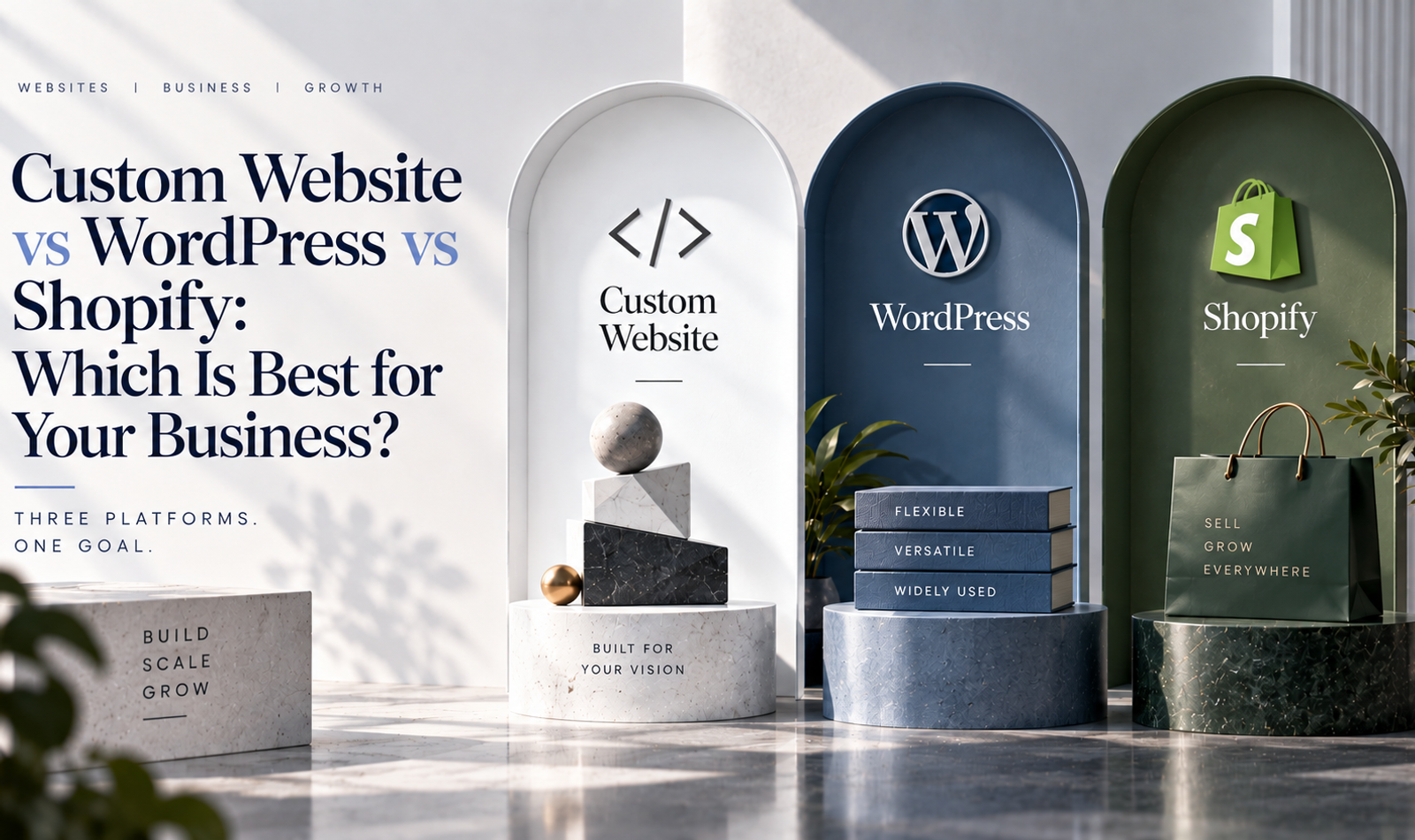
Custom Website vs WordPress vs Shopify: Which Is Best for Your Business?
Choosing the right platform is one of the most important decisions when building a business website.
A company may need a professional corporate website to generate enquiries. An e-commerce brand may need an online store capable of managing hundreds or thousands of products. A startup may need a custom platform with user accounts, dashboards or unique business functionality.
Although all of these businesses need a website, they do not necessarily need the same technology.
Three options commonly appear during the decision-making process:
Custom Website Development, WordPress and Shopify.
Each has its own advantages, limitations, cost structure and ideal use case.
WordPress is widely used for business, corporate and content-driven websites because it offers flexible content management and a large plugin ecosystem.
Shopify is primarily designed for e-commerce and provides businesses with a managed platform for products, orders, payments and online store operations.
Custom website development provides the greatest level of control because the website can be designed and developed specifically around the business requirements rather than being built within the limitations of a pre-existing platform.
The question is therefore not:
“Which platform is the best?”
The more useful question is:
“Which platform is best for my specific business, customers, functionality, budget and future growth plans?”
This guide compares custom websites vs WordPress vs Shopify across design flexibility, cost, SEO, performance, e-commerce, scalability, security, maintenance, content management and long-term business requirements.
Custom Website vs WordPress vs Shopify: Quick Comparison
Before examining each option in detail, it is useful to understand their fundamental differences.
Factor
Custom Website
WordPress
Shopify
Best For
Custom business requirements, premium websites, platforms and applications
Business, corporate, service and content-heavy websites
E-commerce and product-based businesses
Design Flexibility
Very High
High
Moderate to High
Development Flexibility
Very High
High
More controlled by Shopify ecosystem
Content Management
Customisable
Excellent
Good
E-Commerce
Can be custom-built
Available through WooCommerce/plugins
Core strength
SEO Control
Excellent when properly developed
Excellent when properly configured
Good, with some platform limitations
Initial Cost
Usually Higher
Low to High
Low to High
Maintenance
Depends on architecture
Requires regular management
Much of infrastructure is managed
Scalability
Potentially Very High
High with correct architecture
Strong for e-commerce
Technical Control
Maximum
High
More Limited
Launch Speed
Usually Slower
Usually Faster
Usually Faster
This comparison does not mean one platform automatically performs better than another.
A professionally configured WordPress website can outperform a poorly developed custom website.
A Shopify store can be much more effective for a product business than an unnecessarily complex custom e-commerce system.
The right decision depends on the problem being solved.
What Is a Custom Website?
A custom website is designed and developed specifically around the requirements of a particular business.
Instead of starting with a pre-built theme or being restricted by a hosted platform's architecture, developers can create the website using technologies appropriate for the project.
A custom website may use technologies such as React, Next.js or other front-end and backend frameworks, together with databases, APIs and content management systems selected according to the business requirement.
The key advantage is control.
The company can determine how the website:
looks,
behaves,
stores information,
connects with other systems,
and scales in the future.
For example, a custom website may be appropriate for a business requiring a unique quotation engine, customer portal, marketplace, interactive product experience, advanced booking system or specialised workflow that cannot be implemented efficiently through standard plugins.
Custom development can also be valuable for premium brands where the website itself is an important part of the customer experience.
DTS's guide to designing high-end luxury websites explains how visual identity, UX and digital brand experience can work together when the website is treated as more than a basic information platform.
What Is WordPress?
WordPress is a content management system that allows businesses to create and manage websites without developing every part of the content-management infrastructure from scratch.
It is commonly used for:
business websites,
corporate websites,
blogs,
news platforms,
portfolio websites,
service websites,
and content-heavy digital platforms.
WordPress can also support e-commerce through WooCommerce and other extensions.
One of the reasons WordPress became widely adopted is its flexibility.
Businesses can choose from thousands of themes and plugins or build completely custom WordPress themes.
This means two WordPress websites can be very different.
One may be a low-cost website assembled from a ready-made theme.
Another may involve custom UI/UX, custom theme development, advanced integrations, structured content, technical SEO and high-performance infrastructure.
Therefore, describing a website as “WordPress” does not tell you its quality.
The quality depends on how WordPress is designed, developed, configured and maintained.
What Is Shopify?
Shopify is a hosted e-commerce platform designed primarily for businesses that want to sell products online.
Unlike WordPress, where e-commerce functionality is generally added through WooCommerce or another system, commerce is at the centre of Shopify.
The platform provides infrastructure for:
product management,
collections,
shopping carts,
checkout,
payments,
orders,
discounts,
customer accounts,
and other online retail requirements.
This makes Shopify particularly attractive to brands that want to launch an e-commerce store without developing the complete commerce infrastructure themselves.
Shopify also provides hosting and manages much of the underlying technical environment.
Businesses can customise the storefront using themes, applications and custom development.
However, because Shopify is a managed ecosystem, businesses do not have the same level of technical control they would have with a completely custom platform.
For many e-commerce businesses, this trade-off is worthwhile because the company can focus on products, marketing and operations instead of maintaining the underlying commerce infrastructure.
The Most Important Difference: Platform vs Business Requirement
Businesses often choose website technology in the wrong order.
They first decide:
“We want WordPress.”
or:
“We want Shopify.”
and only afterwards consider what the website actually needs to do.
A better process begins with the business requirement.
First determine:
Who will use the website?
What should visitors be able to do?
Will the website generate leads or transactions?
Does it need e-commerce?
How frequently will content change?
Will multiple team members manage content?
Does it need customer accounts?
Does it need third-party integrations?
Does it need custom workflows?
How important is SEO?
How quickly does the business expect to scale?
What functionality may be required two or three years from now?
Once these questions are answered, the technology decision becomes much easier.
Custom Website vs WordPress: What Is the Difference?
The main difference between a custom website and WordPress is the level at which the underlying system is pre-built.
WordPress already provides a mature CMS, administration system, user management, content structure and extensive plugin ecosystem.
Custom development gives the development team more freedom to determine exactly how these systems should work.
For a typical business website, rebuilding a complete CMS from scratch may be unnecessary.
WordPress may already provide everything the company needs.
However, when the website requires specialised functionality, highly customised interactions or a particular technology architecture, custom development may become more appropriate.
The decision therefore comes down to whether the business benefits more from existing infrastructure or complete technical flexibility.
WordPress vs Shopify: What Is the Difference?
WordPress is primarily a flexible content management system.
Shopify is primarily a commerce platform.
WordPress can become an online store through WooCommerce.
Shopify can also manage pages, blogs and content.
However, their starting points are different.
A service company publishing:
service pages,
case studies,
location pages,
articles,
and lead-generation content
may find WordPress more naturally suited to its requirements.
A fashion, beauty, lifestyle or consumer product company primarily focused on:
products,
inventory,
checkout,
orders,
payments,
and online sales
may find Shopify more convenient.
Neither distinction is absolute.
The correct choice depends on which capability sits at the centre of the business.
Custom Website vs Shopify: What Is the Difference?
A custom e-commerce website gives a company much greater control over how its commerce system works.
Developers can create custom:
product structures,
checkout logic,
pricing rules,
subscriptions,
marketplace systems,
customer dashboards,
recommendation engines,
and operational workflows.
Shopify already provides much of the standard commerce infrastructure.
This can dramatically reduce development complexity.
The trade-off is that the business operates within Shopify's ecosystem.
For most standard e-commerce brands, this can be a practical advantage.
For businesses with highly unusual commerce requirements, a custom platform may eventually provide greater flexibility.
The decision should therefore be based on whether the business's commerce model is relatively standard or genuinely requires specialised technology.
Which Option Gives the Best Design Flexibility?
Design flexibility is important because a website influences how customers perceive a business.
Custom Website Design
Custom development offers the greatest freedom.
Designers and developers can create interfaces specifically around:
the brand,
customer journey,
content,
and required interactions.
There is no need to force the brand into a standard theme structure.
This makes custom development particularly useful for premium brands, creative companies and businesses where digital experience is part of differentiation.
WordPress Design
WordPress can also offer substantial design freedom.
A low-budget WordPress website may use a standard theme, but a professionally developed WordPress website can use a completely custom design.
The CMS does not necessarily determine how the front end looks.
Therefore, WordPress can support highly distinctive websites when developed properly.
Shopify Design
Shopify offers strong storefront customisation, particularly through custom themes and Shopify's templating system.
However, some parts of the platform are more controlled than a completely custom architecture.
For most e-commerce brands, Shopify provides enough design flexibility to create a professional online store.
Businesses requiring highly experimental digital experiences may eventually encounter limitations.
Why UI/UX Matters More Than the Platform Name
A common mistake is assuming that choosing the correct platform automatically creates a good website.
It does not.
A website can be built on excellent technology and still have:
confusing navigation,
poor mobile usability,
weak information hierarchy,
unclear CTAs,
or an ineffective customer journey.
UI/UX determines how visitors experience the platform.
Professional UX planning considers questions such as:
What does the visitor want?
What information do they need first?
What should they see next?
What could create uncertainty?
Where should the CTA appear?
How can unnecessary friction be removed?
The technology supports the experience.
It does not replace experience design.
Businesses building premium websites can review DTS's guide to UI/UX design principles for high-end brand websites for a deeper understanding of how interface design influences usability and perception.
Custom Website vs WordPress vs Shopify for SEO
SEO is one of the most important comparison points because businesses often want their website to generate long-term organic traffic.
The good news is that all three options can support SEO when implemented correctly.
The differences lie mainly in control, configuration and technical limitations.
Is a Custom Website Good for SEO?
A properly developed custom website can provide excellent SEO control.
Developers can determine:
URL structure,
metadata,
schema,
internal linking,
sitemaps,
redirects,
page rendering,
image optimisation,
performance,
and other technical elements.
Frameworks such as Next.js can support strong performance and search-friendly architecture when implemented correctly.
However, custom does not automatically mean SEO-friendly.
If developers ignore SEO requirements, a custom website can still have serious problems.
For example, poor rendering, missing metadata, incorrect canonicals, broken internal links or inefficient JavaScript can negatively affect search visibility.
SEO therefore needs to be considered during architecture and development.
Is WordPress Good for SEO?
WordPress can be extremely effective for SEO.
It provides strong content-management capabilities and can be extended with SEO tools that help teams manage:
titles,
meta descriptions,
sitemaps,
canonicals,
schema,
and other page-level elements.
WordPress is particularly useful for businesses that plan to publish substantial amounts of:
blogs,
guides,
service pages,
case studies,
and location content.
However, WordPress can develop performance problems when websites use too many unnecessary plugins, heavy themes or poorly configured page builders.
The platform itself is not necessarily the problem.
Implementation quality matters.
DTS's on-page SEO checklist explains several elements businesses should optimise regardless of the platform they use.
Is Shopify Good for SEO?
Shopify can perform well for e-commerce SEO.
Businesses can optimise:
product titles,
descriptions,
collections,
content,
metadata,
internal links,
and images.
Shopify also provides a relatively structured technical environment.
However, businesses have less control over certain technical elements compared with completely custom development.
For most e-commerce brands, these limitations do not automatically prevent strong organic performance.
A good Shopify SEO strategy still depends heavily on:
keyword targeting,
product content,
collection architecture,
internal linking,
technical health,
site speed,
and authority.
The most important lesson is that SEO performance depends on the complete strategy, not simply the CMS name.
Technical SEO Matters on Every Platform
Regardless of whether the website uses WordPress, Shopify or custom development, businesses should pay attention to:
crawlability,
indexability,
mobile usability,
page speed,
Core Web Vitals,
structured URLs,
canonicals,
redirects,
XML sitemaps,
and internal linking.
Technical issues can prevent strong content from performing properly.
DTS's guide to technical SEO foundations explains how speed, mobile performance and Core Web Vitals contribute to a stronger website foundation.
Which Platform Is Best for Content Marketing?
For businesses publishing large amounts of editorial content, WordPress is often one of the strongest options because content management is central to the platform.
Marketing teams can generally create and manage:
blogs,
authors,
categories,
service pages,
case studies,
and other structured content
without requiring developers for every update.
Custom websites can also provide excellent content-management capabilities when connected to a suitable CMS.
A headless CMS can allow businesses to separate content management from front-end development.
This can provide both editorial flexibility and custom technical architecture.
Shopify includes blogging and content functionality, but its strongest capability remains commerce.
For a product brand where content supports the store rather than being the entire business model, this may be sufficient.
The right choice depends on how central content is to the company's growth strategy.
DTS's guide to content strategy for brand websites explains how blogs, galleries and other content assets can support discovery and conversion.
Which Is Best for E-Commerce?
For most businesses asking this question, Shopify becomes particularly attractive when e-commerce is the primary objective.
Shopify already provides much of the infrastructure required to operate an online store.
This reduces the amount of custom development needed for standard e-commerce functionality.
A product business can therefore focus on:
catalogue,
merchandising,
content,
marketing,
and customer experience.
WordPress combined with WooCommerce can also be a strong e-commerce solution.
It may be particularly useful when the business wants greater control over content and already operates within WordPress.
However, WooCommerce requires more active technical management because the store depends on WordPress, themes, plugins, hosting and various updates.
Custom e-commerce development becomes most relevant when the business model requires functionality that standard commerce platforms cannot efficiently support.
For example, a custom solution may be justified for:
specialised marketplaces,
complex B2B pricing,
unusual product configuration,
advanced customer portals,
or deeply integrated operational systems.
The important principle is:
Do not build custom technology simply because custom sounds more premium.
Custom development should solve a real requirement.
Which Platform Is Best for a Service Business?
For many service businesses, WordPress or a custom website is usually more relevant than Shopify.
A service company's website typically needs to:
explain services,
demonstrate expertise,
show case studies,
rank on Google,
generate enquiries,
and build trust.
It usually does not require complex shopping-cart infrastructure.
WordPress can be effective when the company wants a manageable CMS and plans to publish content regularly.
A custom website can be more appropriate when the company requires:
a highly differentiated design,
specialised lead-generation tools,
advanced integrations,
or a premium digital experience.
DTS's Web Development & Marketing services combine website development with SEO, content structure and digital customer acquisition.
Which Platform Is Best for a Corporate Website?
Corporate websites generally require strong:
content organisation,
brand consistency,
security,
performance,
and content management.
WordPress can work very well for corporate websites when properly developed and maintained.
A custom CMS or headless architecture may become more appropriate for organisations requiring:
complex integrations,
advanced security,
multiple digital properties,
large-scale content systems,
or unusual technical requirements.
Shopify would normally not be the first choice for a corporate website unless commerce is a central part of the company's digital requirement.
The platform should follow the organisation's needs rather than industry trends.
Which Platform Is Best for a Startup?
Startups should be particularly careful when choosing website technology.
An early-stage company often does not yet know exactly how customers will use its product.
Spending heavily on complex custom development before validating the business model can create unnecessary cost.
If the startup primarily needs:
a marketing website,
content,
lead capture,
and basic company information,
WordPress may be sufficient.
If it is launching an e-commerce brand, Shopify may allow it to enter the market faster.
If the website itself is the product, such as a marketplace, SaaS platform or specialised digital service, custom development may be necessary.
The decision should be based on the Minimum Viable Product.
The first version should validate the business rather than attempt to include every future feature.
Which Platform Is Best for a Luxury Brand?
Luxury brands need to evaluate the website as part of the brand experience.
Customers may judge the company based on:
visual design,
typography,
photography,
video,
motion,
speed,
and attention to detail.
Custom development offers maximum creative control.
However, a custom-designed WordPress website can also deliver a highly premium experience.
Shopify can work extremely well for luxury product brands where e-commerce is central.
The important distinction is between platform and execution quality.
A badly designed custom website will not feel more luxurious simply because it is custom.
Similarly, a carefully designed Shopify store can feel significantly more premium than a poorly executed bespoke platform.
DTS's guide to luxury website UX principles explains why premium digital experiences need to balance aesthetics with speed and usability.
Custom Website vs WordPress vs Shopify: Cost Comparison
Cost varies widely within all three categories.
A simple WordPress website can be inexpensive.
A fully custom WordPress project can cost several lakhs.
A Shopify store can begin with a standard theme and relatively small development budget, while a heavily customised Shopify Plus project can require a much larger investment.
Custom websites generally have the highest potential initial development cost because more components may need to be designed and developed specifically for the project.
However, businesses should not evaluate cost only at launch.
The better comparison is total cost of ownership.
That includes:
initial development,
hosting,
subscriptions,
plugins,
applications,
maintenance,
security,
development support,
and future upgrades.
A cheaper initial website can become expensive if it requires constant fixes or redevelopment.
A more expensive architecture can also be wasteful if the business never uses the capabilities it paid to build.
The goal is to choose the most appropriate investment for the business requirement.
WordPress Costs to Consider
WordPress itself can be used without a traditional platform subscription, but operating a professional WordPress website can involve several costs.
These may include:
hosting,
premium themes,
plugins,
security,
backups,
developer maintenance,
and ongoing updates.
The cost therefore depends heavily on how the website is built.
A small WordPress site using a standard theme will have a very different cost structure from a large custom WordPress platform.
Shopify Costs to Consider
Shopify operates through a subscription model.
Businesses should consider:
platform subscription,
theme costs,
applications,
payment-related charges,
custom development,
and ongoing optimisation.
Some functionality that would be developed directly into a custom platform may require paid Shopify applications.
One app may be inexpensive.
However, multiple recurring applications can gradually increase the monthly operating cost of the store.
This should be considered when calculating long-term ownership.
Custom Website Costs to Consider
Custom websites generally involve greater development expenditure at the beginning.
Costs may include:
strategy,
UI/UX,
front-end development,
backend development,
CMS,
database architecture,
APIs,
testing,
deployment,
and infrastructure.
The website may also require ongoing developer support.
However, custom development can reduce dependence on third-party plugins or platform restrictions when the architecture is designed properly.
The financial question should therefore be considered over several years rather than only at launch.
Which Option Is Fastest to Launch?
Shopify is often one of the fastest ways to launch a standard e-commerce business because much of the required commerce infrastructure already exists.
WordPress can also be launched relatively quickly, particularly when the project uses established themes and standard functionality.
Custom development generally takes longer because more decisions need to be made around:
architecture,
design,
development,
testing,
and deployment.
However, launch speed should not be the only factor.
A business should avoid launching quickly on a platform that cannot support its requirements six months later.
The correct balance is:
Speed to Market + Current Requirements + Future Flexibility
Which Platform Offers Better Performance?
All three platforms can provide good performance when implemented correctly.
Custom development offers the greatest technical control over how the website loads and behaves.
Developers can optimise:
code,
images,
scripts,
caching,
rendering,
and infrastructure
according to the specific project.
WordPress can also be fast, but poorly configured themes and excessive plugins can create performance problems.
Shopify manages much of the infrastructure itself, which can simplify performance management, although third-party applications and heavy themes can still affect storefront speed.
Businesses should therefore avoid claims such as:
“Custom websites are always faster.”
or:
“Shopify is always faster than WordPress.”
Performance depends heavily on implementation.
Which Platform Is More Scalable?
Scalability means more than handling traffic.
It also includes the ability to support:
more content,
more products,
more customers,
more locations,
new integrations,
and new business functionality.
Custom websites can offer extremely high scalability when their architecture is designed correctly.
WordPress can scale effectively for many content and business use cases, but the hosting, database, plugins and architecture need to be managed carefully.
Shopify is designed to support growing e-commerce businesses and can handle significant commerce operations without the merchant managing the underlying server infrastructure.
The correct question is therefore:
“What type of scale are we expecting?”
A publisher scaling to thousands of articles has different needs from an e-commerce company scaling to thousands of daily orders.
Which Is Better for Website Security?
Security is not simply a platform checkbox.
It depends on:
architecture,
configuration,
access control,
software updates,
hosting,
monitoring,
and team behaviour.
Shopify has an advantage in that much of the underlying commerce infrastructure is managed by the platform.
WordPress requires more active maintenance because the website owner or development partner is responsible for managing:
WordPress updates,
themes,
plugins,
hosting,
and security configuration.
Custom websites can provide strong security, but security must be deliberately designed and maintained.
A custom system is not automatically secure simply because it uses custom code.
Businesses processing customer or sensitive information should make security a core development requirement.
DTS's guide to building secure websites for premium clients explains how security, data protection and trust contribute to a professional website environment.
Which Is Easier to Maintain?
Shopify generally reduces infrastructure maintenance because Shopify manages the hosted platform.
Businesses still need to manage:
content,
products,
themes,
applications,
and custom functionality,
but they are not responsible for maintaining the entire commerce server environment.
WordPress requires more ongoing technical maintenance.
Themes, plugins, WordPress itself and hosting environments need regular attention.
Custom website maintenance depends entirely on the technology architecture.
Some custom websites are extremely stable and require limited intervention.
Others require continuous development.
Businesses should therefore ask about maintenance before development begins.
The cost of maintaining the website should be part of the platform decision.
DTS's guide to website security and maintenance for e-commerce and booking sites provides additional guidance on long-term website management.
Custom Website vs WordPress vs Shopify for Conversion
Conversion depends far more on strategy and user experience than the platform itself.
A website converts when it successfully moves a visitor from interest to action.
That action may be:
making a purchase,
submitting an enquiry,
booking an appointment,
requesting a quotation,
or contacting the sales team.
A WordPress website with strong messaging, proof and CTAs can outperform an expensive custom website with confusing navigation.
Similarly, a Shopify store with clear product information, strong trust signals and a smooth checkout can outperform a more technically sophisticated e-commerce platform.
Conversion optimisation therefore involves:
customer understanding,
page structure,
copy,
design,
trust,
speed,
and friction reduction.
DTS's guide to building conversion-focused marketing funnels explains how websites can be designed around customer movement rather than simply traffic.
When Should You Choose a Custom Website?
A custom website is generally worth considering when your business has requirements that standard platforms cannot efficiently support.
This may include a specialised marketplace, advanced booking system, complex customer dashboard, unusual business logic or highly customised digital experience.
Custom development can also be appropriate when technology itself creates competitive differentiation.
For example, if the way customers interact with the website is central to the product, technical flexibility may justify the additional development investment.
Custom development is usually less necessary when the business only requires standard pages, a blog, basic lead-generation forms or conventional e-commerce functionality.
In those situations, an established platform may deliver the required outcome more efficiently.
When Should You Choose WordPress?
WordPress is often a strong choice when the website is primarily focused on:
content,
services,
corporate information,
SEO,
lead generation,
or publishing.
It can be particularly useful when non-technical marketing teams need to update the website frequently.
WordPress also offers a large ecosystem of tools and integrations, which can reduce the need for custom development.
It is commonly suitable for:
professional service businesses,
agencies,
consultants,
corporate websites,
educational organisations,
publishers,
and content-driven brands.
The main requirement is that WordPress should be developed and maintained professionally rather than overloaded with unnecessary themes and plugins.
When Should You Choose Shopify?
Shopify is usually worth considering when the primary objective of the website is selling products online.
It is especially useful for:
fashion brands,
beauty brands,
lifestyle businesses,
D2C companies,
consumer product brands,
and retailers.
The platform can allow these businesses to launch and manage commerce without building the complete infrastructure themselves.
Shopify may become less suitable when the business requires highly unusual workflows that fall far outside standard commerce functionality.
However, businesses should not assume they need custom development until they have properly evaluated whether Shopify's existing ecosystem can solve the requirement.
When Should You Avoid Custom Development?
Custom development should not be chosen simply because it sounds more advanced.
Building common functionality from scratch can create unnecessary:
cost,
development time,
maintenance,
and technical risk.
If a mature platform already solves the business problem effectively, using it may be the more intelligent decision.
Custom technology is most valuable when customisation creates meaningful business value.
When Can WordPress Become the Wrong Choice?
WordPress can become problematic when businesses rely on too many plugins to create functionality the platform was not originally selected to handle.
A website with dozens of overlapping plugins may become difficult to:
maintain,
secure,
optimise,
and troubleshoot.
WordPress may also be unsuitable for certain highly specialised applications requiring complex real-time functionality or unusual backend systems.
The issue is not that WordPress is weak.
The issue is using WordPress for a problem better solved through another architecture.
When Can Shopify Become the Wrong Choice?
Shopify may become limiting when the business requires highly customised commerce logic or functionality that cannot be implemented cleanly within the platform.
Another consideration is recurring cost.
A business relying on many paid applications may gradually create a substantial monthly technology bill.
Businesses should therefore evaluate:
platform fees,
application costs,
customisation requirements,
and long-term operating needs
before committing.
However, for standard e-commerce, Shopify's managed infrastructure can often be more efficient than developing and maintaining a complete custom commerce platform.
A Practical Decision Framework
Businesses can simplify the decision by evaluating five areas.
1. Primary Business Objective
If the main goal is publishing content and generating enquiries, WordPress may be highly suitable.
If the primary goal is selling products, Shopify deserves serious consideration.
If the website requires specialised functionality, custom development may be necessary.
2. Required Functionality
Write down what users must actually be able to do.
Do not begin with technology.
Begin with behaviour.
3. Internal Team
Consider who will manage the website after launch.
A marketing team may need a simple CMS.
An e-commerce team may need easy product and order management.
A technology company may have developers capable of managing custom infrastructure.
4. Budget
Consider both initial and ongoing costs.
A low initial price does not always mean a lower three-year cost.
5. Future Growth
Think about realistic future requirements without trying to predict every possible feature.
The architecture should support growth without overengineering the first version.
Custom Website vs WordPress vs Shopify: Which Is Best?
There is no universal winner.
The best choice depends on the business model.
Choose a Custom Website when:
Your business requires unique functionality, specialised integrations, maximum technical control or a highly customised digital experience.
Choose WordPress when:
Your business requires a flexible corporate, service, content or SEO-driven website that marketing teams can manage efficiently.
Choose Shopify when:
Your primary business objective is selling products online and you want a mature managed commerce ecosystem.
For many businesses, the decision can be summarised as:
Content & Services → WordPress
E-Commerce → Shopify
Unique Digital Functionality → Custom Development
However, these are guidelines rather than absolute rules.
A professional development partner should evaluate the actual project before recommending a platform.
Frequently Asked Questions About Custom Websites, WordPress and Shopify
Is WordPress better than a custom website?
WordPress may be better when a business needs a content-driven, corporate or service website without highly specialised functionality. Custom development may be better when the business requires unique systems, integrations or greater technical control.
Is Shopify better than WordPress?
Shopify is generally more focused on e-commerce, while WordPress is more flexible as a general content management system. The better option depends on whether commerce or content is the primary requirement.
Is Shopify better than a custom website?
Shopify can be better for standard e-commerce because it provides mature commerce infrastructure without requiring businesses to build everything from scratch. Custom development becomes more valuable when specialised functionality is required.
Which is better for SEO: WordPress or Shopify?
Both can rank successfully. WordPress generally provides substantial content and SEO flexibility, while Shopify provides a structured e-commerce environment. SEO performance depends more on implementation, content, technical health and authority than the platform name alone.
Is a custom website better for SEO?
Custom development can provide excellent SEO control, but only if SEO requirements are included during development. Custom code alone does not guarantee better rankings.
Which platform is best for a small business?
Many service-based small businesses can use WordPress effectively. Product-based businesses may benefit from Shopify. Businesses with unique technology requirements may require custom development.
Which platform is best for e-commerce?
Shopify is a strong option for many standard e-commerce businesses. WooCommerce can be suitable for WordPress-based businesses, while custom development may be required for specialised commerce models.
Which platform is best for a startup?
It depends on the startup. A content or lead-generation startup may use WordPress, a D2C startup may use Shopify, and a technology startup whose website is the product may require custom development.
Is WordPress suitable for large businesses?
Yes. WordPress can support large websites when it is professionally architected, hosted, secured and maintained. The suitability depends on the organisation's specific technical requirements.
Is Shopify only for small businesses?
No. Shopify can support businesses of different sizes, including high-volume commerce operations. The correct setup depends on the brand's requirements.
Are custom websites more expensive?
Custom websites generally have higher initial development costs because more functionality may need to be designed and developed specifically for the project. However, total long-term cost depends on architecture and maintenance.
Is WordPress cheaper than Shopify?
Not necessarily. WordPress costs depend on development, hosting, plugins and maintenance, while Shopify involves platform subscriptions, applications and development. Either can become more expensive depending on requirements.
Can I move from WordPress to Shopify later?
Yes, migration is possible, but content, products, URLs, SEO, redirects and integrations need to be planned carefully.
Can I move from Shopify to a custom website later?
Yes. Businesses sometimes move to custom platforms when their requirements outgrow the capabilities or economics of their existing commerce system. Migration should be planned carefully to protect data, customer experience and SEO.
Which platform is easiest to manage?
Shopify is generally straightforward for e-commerce operations because much of the infrastructure is managed. WordPress provides strong content management but requires more technical maintenance. Custom website management depends on how the CMS and backend are designed.
Which platform gives the most control?
Custom development generally provides the greatest level of technical control.
Which platform is best for blogging?
WordPress is particularly strong for content-heavy websites and blogging. Custom CMS solutions can also be excellent, while Shopify's blogging capabilities are generally secondary to its commerce functionality.
Which is best for a luxury brand?
It depends on the business model. A luxury service brand may benefit from custom development or a custom-designed WordPress website, while a luxury product brand focused on e-commerce may find Shopify highly suitable.
Should I choose the platform before hiring a developer?
Ideally, the business requirements should be defined first. A development partner can then recommend the most appropriate technology instead of forcing the project into a predetermined platform.
Final Thoughts
The debate between custom website vs WordPress vs Shopify does not have one universal answer.
Each option solves a different type of problem.
WordPress provides a powerful and flexible content management environment that can work extremely well for service businesses, corporate websites, content platforms and SEO-driven websites.
Shopify provides a mature e-commerce ecosystem that can help product businesses launch, operate and scale online stores without developing the complete commerce infrastructure themselves.
Custom development provides maximum flexibility and control when a business requires unique functionality, specialised integrations or a digital experience that standard platforms cannot efficiently provide.
The wrong way to make the decision is:
“Which platform is most popular?”
The right way is:
Business Model → Customer Requirements → Functionality → Content → E-Commerce → SEO → Integrations → Budget → Maintenance → Scalability
Technology should support the business strategy.
The business strategy should not be forced to fit the technology.
A simple WordPress website can be the correct solution for one company.
A sophisticated Shopify store can be the correct solution for another.
A completely custom platform may be essential for a third.
What matters is not whether the website is called custom, WordPress or Shopify.
What matters is whether it is:
fast,
secure,
easy to use,
easy to manage,
search-friendly,
scalable,
aligned with the brand,
and capable of helping the business achieve its commercial goals.
The best website platform is therefore not the platform with the longest feature list.
It is the platform that solves your current business requirements efficiently while giving you enough flexibility to support realistic future growth.
Build the Right Website for Your Business With Double Trouble Studio
Choosing between custom development, WordPress and Shopify should begin with your business requirements rather than a predetermined technology.
Double Trouble Studio helps businesses plan and develop digital experiences around brand positioning, customer journeys, SEO, performance and conversion.
Explore DTS's Web Development & Marketing services, review our selected work, or contact Double Trouble Studio to discuss the right website architecture for your business.
📩 info@dtsworld.in 📞 +91 80000 06021 📍 Andheri (West), Mumbai.
Need this for your brand?
Let DTS build your next campaign.
From PR, celebrity management and events to websites, social media, SEO and AI video production — Double Trouble Studio helps brands grow with strategy and execution.
Discuss Your Requirement →