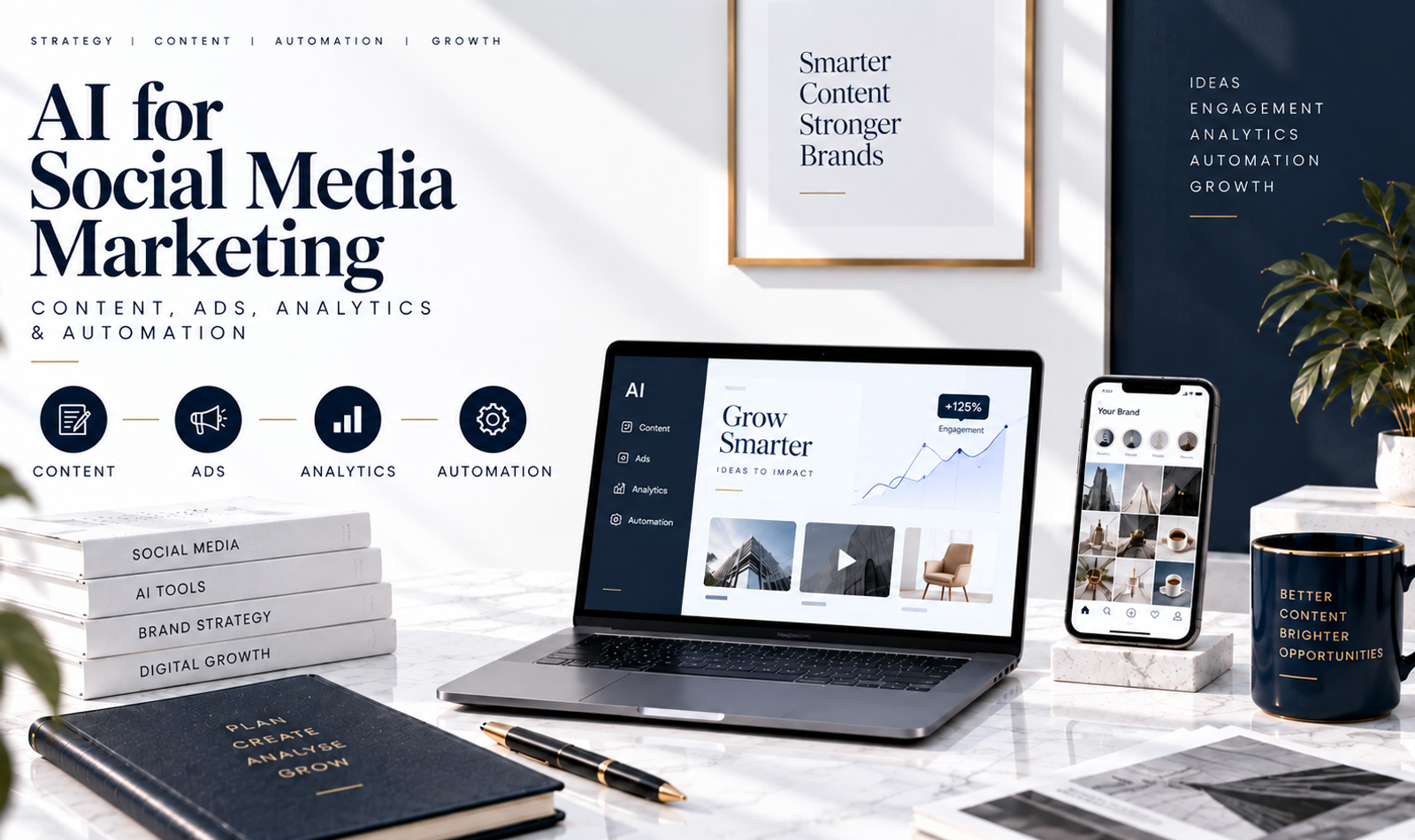
AI for Social Media Marketing: Content, Ads, Analytics & Automation
Social media marketing has become increasingly complex.
A few years ago, a business could maintain visibility by posting consistently, running occasional advertisements and responding to comments.
Today, brands may need to manage Instagram Reels, Stories, carousels, LinkedIn posts, YouTube Shorts, paid campaigns, creator collaborations, customer messages, content calendars, analytics and multiple creative formats at the same time.
The amount of content has increased.
The amount of data has increased.
Competition for attention has increased.
And audiences expect brands to communicate faster while still producing relevant, original and high-quality content.
This is where AI for social media marketing can become valuable.
Artificial intelligence can help businesses research audiences, generate content ideas, create first drafts, produce creative variations, analyse campaign data, organise customer interactions and automate repetitive marketing workflows.
But successful AI social media marketing is not about generating hundreds of posts automatically.
It is about combining:
Human Strategy + Creative Direction + AI Assistance + Automation + Performance Data
When used correctly, AI can help marketing teams become faster and more informed without sacrificing brand identity.
This guide explains how businesses can use AI across four major areas of social media marketing:
Content → Ads → Analytics → Automation
It also explains what should remain human-led and how brands can build an AI-supported social media system that contributes to measurable business growth.
What Is AI for Social Media Marketing?
AI for social media marketing is the use of artificial intelligence to support the planning, creation, distribution, optimisation and analysis of social media activity.
Depending on the workflow and tools involved, AI can assist with:
content research,
content ideas,
caption drafting,
video concepts,
scripts,
creative variations,
audience analysis,
advertising,
performance analysis,
social listening,
comment categorisation,
lead management,
and workflow automation.
AI does not need to control the entire social media process.
In many cases, its greatest value comes from assisting marketers with repetitive or data-heavy work while people remain responsible for strategy, creative judgment and brand communication.
Why Is AI Becoming Important in Social Media Marketing?
The scale of modern social media creates an operational challenge.
A single campaign may require:
one campaign concept,
multiple Reel scripts,
several static creatives,
carousel posts,
Stories,
LinkedIn adaptations,
YouTube Shorts,
paid advertising variations,
captions,
CTAs,
and performance reports.
Producing all of this manually can consume significant time.
AI can accelerate selected stages.
For example, one campaign idea can potentially be transformed into:
a Reel concept,
a carousel outline,
a LinkedIn post draft,
an advertisement variation,
a short video script,
and several headline options.
The marketing team can then refine the strongest ideas instead of beginning every asset from zero.
What Can AI Do for Social Media Marketing?
AI can support social media marketing across the entire workflow:
Research → Strategy → Ideation → Creation → Publishing → Advertising → Engagement → Analytics → Optimisation
The value of AI differs at every stage.
During research, it can organise information.
During creation, it can accelerate drafts and variations.
During advertising, machine learning can support optimisation.
During analytics, AI can help identify patterns.
During operations, automation can reduce repetitive work.
The important principle is that AI should solve a specific marketing problem rather than being used simply because it is available.
1. AI for Social Media Strategy
Before creating content, brands need a strategy.
A social media strategy should define:
the business objective,
target audience,
brand positioning,
platform priorities,
content pillars,
formats,
publishing approach,
paid media role,
and measurement framework.
AI can help organise research and explore strategic possibilities.
For example, marketers can use AI to analyse existing information about:
customer pain points,
common questions,
content themes,
competitor positioning,
reviews,
sales conversations,
and audience interests.
The output should inform human strategy rather than automatically become the strategy.
Define the Business Objective First
Every social media programme should answer:
What business result are we trying to influence?
Possible objectives include:
brand awareness,
community growth,
website traffic,
lead generation,
sales,
event registrations,
product discovery,
customer retention,
or brand authority.
Different objectives require different content.
A luxury brand seeking stronger positioning should not necessarily follow the same strategy as a local business trying to generate immediate enquiries.
AI becomes more useful when the objective is clear.
2. AI for Audience Research
Effective social media content begins with understanding the audience.
Businesses can use AI to help organise customer information from sources such as:
reviews,
survey responses,
comments,
customer service conversations,
sales notes,
search queries,
and previous campaign performance.
AI can help identify recurring themes such as:
frequent questions,
common objections,
purchase motivations,
customer vocabulary,
and areas of confusion.
These insights can then become content opportunities.
For example, if customers repeatedly ask about pricing, a business may create educational pricing content.
If customers struggle to understand how a service works, the brand may create an explainer Reel.
If customers frequently compare two solutions, that comparison may become a carousel.
AI therefore helps convert customer information into potential communication ideas.
3. AI for Content Pillar Development
Random posting creates inconsistent communication.
A better approach is to create strategic content pillars.
Depending on the business, these could include:
Education
Teach the audience something useful.
Authority
Demonstrate expertise and industry knowledge.
Brand Storytelling
Communicate the company's values, people and perspective.
Product or Service
Explain what the business offers.
Social Proof
Show testimonials, results or customer experiences.
Behind the Scenes
Show processes, teams and production.
Community
Encourage conversations and participation.
Conversion
Give audiences a reason to take the next step.
AI can help marketers generate ideas within each pillar while maintaining a more balanced content calendar.
4. AI for Social Media Content Ideas
One of the simplest uses of AI is ideation.
Instead of asking AI:
“Give me 30 Instagram ideas.”
provide strategic context.
For example:
Audience: Premium hospitality brands
Objective: Generate qualified leads
Service: Website development
Platform: Instagram
Positioning: Premium digital agency
Content Pillar: Education
AI can then produce ideas that are more relevant to the actual campaign.
The quality of AI output often depends on the quality of the strategic input.
5. AI for Caption Writing
AI can accelerate first drafts of social media captions.
It can help create:
short captions,
long-form LinkedIn posts,
hooks,
CTA variations,
launch announcements,
educational copy,
and campaign messaging.
However, generic AI writing is easy to recognise.
Common problems include:
unnecessary adjectives,
repetitive sentence structures,
generic motivational language,
too many emojis,
and phrases that do not reflect how the brand actually communicates.
The solution is to develop clear brand voice guidelines.
Provide AI with information about:
tone,
sentence style,
preferred vocabulary,
words to avoid,
CTA style,
and audience.
Then edit the output.
AI should create a starting point.
Brand judgment creates the final communication.
6. AI for Hooks
The first seconds of a video or first line of a caption can determine whether someone continues consuming the content.
AI can help create multiple hook variations.
For example, instead of producing one opening, a marketer might generate:
a question-led hook,
a problem-led hook,
a surprising insight,
a comparison,
a contrarian angle,
and a direct benefit.
The team can then choose the strongest option.
This makes AI particularly useful for creative testing.
7. AI for Carousel Content
Carousels can work well for:
education,
frameworks,
checklists,
comparisons,
case studies,
and step-by-step explanations.
AI can help convert a larger topic into a slide structure.
For example:
Slide 1: Hook
Slide 2: Problem
Slide 3: Why it matters
Slides 4–7: Key insights
Slide 8: Practical action
Slide 9: Conclusion
Slide 10: CTA
Designers and marketers should then refine the information hierarchy and visual storytelling.
8. AI for Social Media Video Scripts
Short-form video requires constant script development.
AI can help prepare first drafts for:
Reels,
Shorts,
UGC advertisements,
founder videos,
product explainers,
and educational clips.
A useful short-form structure might be:
Hook → Problem → Insight → Solution → Proof → CTA
The script should still sound natural when spoken.
Written AI copy often needs editing before it becomes good spoken dialogue.
9. AI for UGC Advertising
UGC-style advertising has become an important performance creative format because it can feel more direct and platform-native than highly polished traditional advertising.
AI can support UGC production by helping develop:
hooks,
scripts,
product angles,
testimonial structures,
objection-handling variations,
and CTA options.
AI can also help create multiple creative directions quickly.
But successful UGC requires more than an AI-generated script.
The creative needs:
believable delivery,
clear product relevance,
strong pacing,
appropriate visuals,
and a persuasive offer.
For a deeper framework, explore DTS's guide to AI UGC ads and high-converting social media ad creatives.
10. AI for Social Media Images
AI-generated visuals can help brands experiment with concepts that may otherwise require significant production resources.
Potential applications include:
campaign concepts,
product environments,
editorial visuals,
moodboards,
backgrounds,
storytelling imagery,
and early creative exploration.
However, AI images should be reviewed carefully.
Brands need to watch for:
visual inconsistencies,
incorrect product details,
unrealistic anatomy,
distorted logos,
unwanted text,
and brand-safety issues.
For premium brands, creative direction becomes even more important because small visual errors can reduce perceived quality.
11. AI Video for Social Media Marketing
AI video production is expanding the range of creative possibilities available to marketing teams.
Brands can use AI-supported workflows for:
concept films,
product videos,
visual storytelling,
social ads,
motion content,
campaign teasers,
and short-form content.
The strongest results usually combine AI generation with professional editing.
Editing adds:
pacing,
sound design,
colour,
typography,
transitions,
subtitles,
and narrative structure.
DTS's guide to AI video production for luxury brands explains how AI tools can fit within a professional creative workflow.
12. AI Product Videos Without Traditional Shoots
Traditional product shoots can require:
location,
crew,
camera equipment,
lighting,
models,
production design,
and post-production.
AI can support alternative workflows for selected campaigns by generating or enhancing environments and creative concepts digitally.
This can be useful when brands need:
rapid creative testing,
multiple campaign variations,
concept-driven visuals,
or content for different platforms.
However, AI production should not automatically replace traditional production.
The right approach depends on:
the product,
campaign objective,
required realism,
budget,
and brand positioning.
Businesses exploring this area can read AI product videos and commercials without traditional shoots.
13. AI for Content Repurposing
One strong content asset can become multiple social assets.
For example, a 1,500-word article can potentially become:
a LinkedIn post,
a carousel,
three Reels,
several Stories,
an email,
and short educational posts.
AI can help identify the strongest ideas and restructure them into platform-specific formats.
This reduces the need to constantly invent completely new topics.
The important word is repurpose, not duplicate.
A LinkedIn post should not simply be copied into an Instagram caption.
Each platform requires its own format and audience consideration.
For businesses building broader content systems, AI content creation tools and best practices provides a useful foundation.
14. AI for Social Media Advertising
Paid social media advertising is one of the areas where machine learning already plays a significant role.
Advertising platforms can use automated systems to help optimise:
delivery,
bidding,
placements,
audience discovery,
and campaign performance.
For marketers, AI can additionally assist with:
creative ideation,
copy variations,
audience research,
campaign analysis,
and reporting.
The objective should not be to hand over every advertising decision to automation.
Brands still need to control:
strategy,
offer,
budget,
creative direction,
landing-page experience,
and business-level measurement.
15. AI for Ad Creative Testing
One advertisement is rarely enough.
Performance campaigns often require multiple creative variations.
AI can help produce variations around:
hooks,
headlines,
scripts,
visual concepts,
CTAs,
and audience pain points.
For example, one service could be advertised through several angles:
Cost
Save unnecessary expense.
Speed
Get results faster.
Convenience
Reduce operational effort.
Quality
Improve the outcome.
Risk
Avoid common mistakes.
Proof
Demonstrate previous results.
The campaign can then test which angle resonates most effectively.
Creative Volume vs Creative Quality
AI makes it easier to produce more creative variations.
That does not mean every variation should be published.
A common mistake is confusing creative volume with creative quality.
Generating 100 weak advertisements is not necessarily better than producing 10 strong variations.
Human review should filter AI outputs according to:
brand relevance,
clarity,
visual quality,
accuracy,
and conversion potential.
16. AI for Meta Advertising
Meta's advertising ecosystem uses machine learning across many parts of campaign delivery.
Businesses can complement platform automation by using AI to help analyse:
creative performance,
lead quality,
campaign patterns,
and customer feedback.
The important step is connecting advertising performance with actual business outcomes.
An advertisement may generate:
high engagement,
low CPC,
and cheap leads,
while producing very few customers.
That campaign should not automatically be considered successful.
For businesses targeting high-value audiences, DTS's guide to performance digital ads across Meta, Google and LinkedIn explains how paid media can connect with wider customer acquisition objectives.
17. AI for Instagram Marketing
Instagram is highly visual and format-driven.
AI can support Instagram marketing through:
Reel concepts,
scripts,
carousel structures,
caption drafts,
Story ideas,
creative variations,
and content repurposing.
Brands should still maintain a recognisable identity.
If every post uses a different AI style, the feed may become visually inconsistent.
Develop clear rules around:
colour,
typography,
photography,
editing,
visual composition,
and tone.
AI should operate inside the brand system rather than replace it.
18. AI for LinkedIn Marketing
LinkedIn requires a different approach.
Strong LinkedIn communication often relies on:
expertise,
industry insight,
founder perspectives,
case studies,
business lessons,
and professional storytelling.
AI can help founders and teams organise rough ideas into clearer drafts.
For example:
a meeting insight,
client question,
industry observation,
or project lesson
can become a structured LinkedIn post.
The final post should retain the individual's real perspective.
AI should help articulate expertise—not manufacture expertise that does not exist.
19. AI for YouTube and Short-Form Video
AI can assist YouTube workflows with:
topic research,
script outlines,
titles,
descriptions,
chapters,
short-form cutdown ideas,
and content repurposing.
A long-form video can potentially become multiple Shorts.
A podcast can become clips.
A webinar can become educational social content.
This allows brands to create more value from existing production.
20. AI for Audience Targeting
AI can help marketers analyse patterns within customer and campaign data.
Potential insights may include:
which audience segments engage,
which segments convert,
which creative works for specific audiences,
and where low-quality leads originate.
Marketers can use these insights to improve targeting.
However, targeting should not depend on assumptions about sensitive personal characteristics or inappropriate profiling.
Businesses should use audience data responsibly and comply with applicable privacy requirements and platform policies.
21. AI for Social Media Analytics
Analytics is one of the most valuable AI use cases.
Social platforms generate large amounts of information:
reach,
impressions,
views,
watch time,
engagement,
clicks,
leads,
conversions,
and audience data.
The problem is that teams often report these metrics without extracting meaningful insight.
AI can help summarise performance and identify patterns.
Instead of:
“Reach increased 23%.”
analysis should ask:
Why?
Was it:
one viral Reel?
better hooks?
higher posting frequency?
paid distribution?
a collaboration?
seasonality?
The goal is to turn data into decisions.
22. Metrics That Actually Matter
The right social media metrics depend on the objective.
Awareness
Reach,
impressions,
video views,
audience growth,
and branded search.
Engagement
Comments,
shares,
saves,
replies,
and meaningful interactions.
Traffic
Link clicks,
website sessions,
landing-page engagement.
Lead Generation
Leads,
qualified leads,
cost per lead,
cost per qualified lead.
Sales
Purchases,
conversion rate,
customer acquisition cost,
revenue.
Brand
Sentiment,
message recall,
share of voice,
and audience perception.
A business should not judge every post by the same metric.
23. AI for Content Performance Analysis
AI can help teams compare content patterns.
For example:
Do educational Reels outperform promotional videos?
Do founder-led posts generate more comments?
Do carousels create more saves?
Which hooks increase watch time?
Which CTA generates more website visits?
Which topics attract qualified enquiries?
These questions create actionable insight.
The objective is to develop a feedback loop:
Publish → Measure → Learn → Improve → Publish Again
24. AI for Social Listening
Social media contains valuable customer intelligence.
People discuss:
brands,
products,
competitors,
problems,
trends,
and experiences.
AI-assisted social listening can help organise large amounts of conversation and identify:
recurring themes,
sentiment patterns,
frequent complaints,
customer questions,
and emerging topics.
This information can support:
content strategy,
customer service,
product development,
and PR.
Human interpretation remains important, particularly because online sentiment can be sarcastic, contextual or unrepresentative.
25. AI for Comment and Message Management
Brands may receive hundreds or thousands of comments and messages.
AI can help categorise them into groups such as:
customer enquiry,
support request,
complaint,
sales opportunity,
spam,
or general engagement.
This can help teams prioritise responses.
A workflow might look like:
Message received → Intent classified → Correct team notified → Response prepared → Human reviews if needed
Important complaints and sensitive conversations should be escalated rather than automatically answered without oversight.
26. AI for Lead Generation Through Social Media
Social media becomes more valuable when attention connects to customer acquisition.
A prospect may:
see a Reel,
visit the profile,
click the website,
read a service page,
submit an enquiry,
and enter the sales pipeline.
AI and automation can help connect these steps.
For example:
Social Ad → Landing Page → Form → CRM → Qualification → Sales Assignment → Follow-Up
This turns social media from a content channel into part of a measurable acquisition system.
For a deeper framework, see AI for lead generation: how businesses can find, qualify and convert leads.
27. AI for Social Media Automation
Social media teams perform many repetitive operational tasks.
These can include:
content scheduling,
approval reminders,
campaign reporting,
lead routing,
comment categorisation,
and performance summaries.
Automation can reduce this workload.
A workflow might look like:
Content Drafted → Review → Approved → Scheduled → Published → Performance Collected → Report Updated
AI can support selected stages.
The broader principles are covered in DTS's guide to AI workflow automation for repetitive business tasks.
What Should You Automate?
Good automation candidates usually have three characteristics:
Repetitive
The task happens frequently.
Predictable
The process follows similar steps.
Low Risk
An automation error would not create serious consequences.
Examples may include:
report collection,
scheduling,
routine notifications,
data organisation,
and standard workflow updates.
What Should Remain Human-Led?
Social media is fundamentally communication between people.
Important activities should remain human-led or human-reviewed.
These include:
brand strategy,
creative direction,
sensitive customer conversations,
crisis communication,
important partnerships,
high-value sales conversations,
and major brand decisions.
A useful principle is:
Automate operations. Assist creativity. Keep strategy human-led.
28. AI and Influencer Marketing
AI can support influencer campaigns by helping teams organise:
creator research,
audience information,
campaign briefs,
content tracking,
and performance data.
However, creator selection should not be based only on numbers.
Brands need to consider:
audience fit,
brand alignment,
credibility,
content quality,
reputation,
and commercial terms.
DTS's guide to influencer marketing for luxury brands explores creator selection, campaign planning and ROI measurement in greater depth.
29. AI and Brand Communication
Social media should not exist in isolation.
A customer may discover a brand through Instagram and then:
Google it,
visit its website,
read an article,
watch a founder interview,
or attend an event.
The communication should feel connected.
This means social media strategy should align with:
PR,
website messaging,
content,
advertising,
events,
and wider brand positioning.
Consistency creates recognition.
30. Connect Social Media With PR
PR creates third-party credibility.
Social media can amplify that credibility.
A strong media feature can become:
a LinkedIn post,
an Instagram Story,
a Reel,
a quote card,
a founder commentary post,
or a website trust signal.
Likewise, strong social content can reveal ideas that later become PR stories.
For brands building broader visibility, DTS's PR and media marketing services connect media relations with digital communication and brand positioning.
31. Connect Social Media With Your Website
Social media platforms are rented distribution channels.
Your website is an owned digital asset.
Social activity should therefore have clear pathways toward:
service pages,
product pages,
articles,
case studies,
landing pages,
booking pages,
or contact forms.
A high-performing Reel can create attention.
The website often needs to convert that attention into deeper consideration or action.
DTS's web development and marketing services focus on building digital experiences that support visibility, communication and conversion.
32. Connect Social Media With SEO
Social media and SEO work differently, but they can support the same content ecosystem.
A search-optimised article can become:
social posts,
Reels,
carousels,
and founder content.
Social conversations can reveal questions worth answering through search content.
This creates a connected model:
Search Demand → Long-Form Content → Social Repurposing → Engagement → Audience Insight → New Content
Businesses strengthening their organic foundation can use the on-page SEO checklist for higher rankings to improve website content alongside social distribution.
33. Connect Social Media With Events
Events create significant social content opportunities.
Before an event:
teasers,
announcements,
speaker reveals,
guest highlights,
and countdowns.
During the event:
live Stories,
guest arrivals,
interviews,
behind-the-scenes footage,
and real-time moments.
After the event:
recap films,
photo carousels,
testimonials,
highlights,
and PR amplification.
Content planning should therefore begin during event planning—not when the event starts.
34. AI Social Media Marketing for Small Businesses
Small businesses can benefit from AI because they often have limited marketing teams.
AI can help with:
content planning,
caption drafts,
basic creative concepts,
video scripts,
analytics summaries,
and repetitive workflows.
A practical small-business system could be:
Monthly Strategy → Weekly Content Planning → AI-Assisted Drafts → Human Review → Scheduling → Analytics → Monthly Optimisation
The objective should be consistency and quality rather than producing excessive content.
35. AI Social Media Marketing for B2B Brands
B2B social media often requires authority rather than entertainment alone.
Useful formats include:
industry insights,
founder opinions,
case studies,
educational posts,
client problems,
research,
and process explanations.
AI can help organise complex expertise into accessible content.
LinkedIn can be particularly useful for this model.
The strongest content should still originate from real:
experience,
expertise,
data,
or perspective.
36. AI Social Media Marketing for Luxury Brands
Luxury brands require additional creative discipline.
AI should not make luxury communication feel mass-produced.
Premium positioning depends on:
visual quality,
restraint,
storytelling,
consistency,
and experience.
AI can support:
editorial concept development,
high-end visual experimentation,
creative variations,
and cinematic video production.
But every output should pass through strong art direction.
Luxury brands may also benefit from understanding luxury brand positioning strategy before scaling AI-generated communication.
37. AI Social Media Marketing for E-Commerce
E-commerce brands can use AI across:
product content,
ad creative,
customer segmentation,
retargeting,
performance analysis,
and customer communication.
A single product can be presented through multiple angles:
features,
benefits,
demonstrations,
reviews,
comparisons,
UGC,
and lifestyle storytelling.
AI can accelerate the creation and testing of these variations.
The key is connecting creative performance with purchases rather than engagement alone.
38. AI Social Media Marketing for Service Businesses
Service companies need to sell expertise and trust.
Useful social content may include:
educational Reels,
case studies,
FAQs,
process explanations,
before-and-after examples,
founder insights,
and customer results.
AI can help transform internal expertise into content.
For example, common sales questions can become:
Reels,
carousels,
blogs,
and FAQ posts.
This creates a direct relationship between customer conversations and content strategy.
39. Build an AI-Powered Social Media Workflow
A practical workflow can look like this:
Stage 1: Strategy
Define objective, audience, positioning and content pillars.
Stage 2: Research
Analyse customer questions, trends, competitors and previous performance.
Stage 3: Ideation
Generate content ideas around strategic pillars.
Stage 4: Production
Create scripts, visuals, videos, captions and variations.
Stage 5: Human Review
Check accuracy, brand voice, visual quality and relevance.
Stage 6: Publishing
Schedule and distribute approved content.
Stage 7: Paid Amplification
Promote appropriate content and test advertising variations.
Stage 8: Community Management
Monitor comments, DMs and customer questions.
Stage 9: Analytics
Measure content and campaign performance.
Stage 10: Optimisation
Use insights to improve the next cycle.
The complete system becomes:
Strategy → Research → Create → Review → Publish → Advertise → Engage → Measure → Learn → Improve
40. Create an AI-Assisted Monthly Content System
A business could structure a month around:
Week 1: Educational authority
Week 2: Customer problems and solutions
Week 3: Proof, case studies and behind-the-scenes
Week 4: Product/service communication and conversion
Within each week, content can be adapted into:
Reels,
carousels,
Stories,
static posts,
and professional platform-specific content.
AI can help create variations while the marketing team protects the central brand narrative.
41. Use AI to Create More From Your Best Content
Do not assume every content idea has equal value.
If one topic performs strongly, explore it further.
A high-performing Reel can become:
a carousel,
long-form article,
LinkedIn post,
FAQ,
paid ad,
and follow-up video.
AI makes this repurposing easier.
This creates a more efficient content model:
Find What Works → Expand It → Adapt It → Distribute It → Measure Again
42. How to Measure AI Social Media Marketing ROI
The purpose of AI is not simply to reduce content production time.
Businesses should measure whether it improves outcomes.
Potential AI-related performance indicators include:
time saved,
creative output,
content engagement,
cost per creative variation,
lead quality,
cost per qualified lead,
conversion rate,
and campaign ROI.
For example:
If AI allows a marketing team to test 10 strong creative concepts instead of three without reducing quality, it may improve learning speed.
If it simply produces 50 generic posts that create no business impact, the additional volume has little value.
43. Common AI Social Media Marketing Mistakes
Publishing Raw AI Output
Always review content before publication.
Losing Brand Voice
AI-generated content should follow defined brand guidelines.
Creating Too Much Content
Volume does not automatically create relevance.
Copying Trends Without Strategy
A trend should serve the brand, not distract from it.
Automating Every Customer Interaction
Important conversations require people.
Focusing Only on Engagement
Likes do not automatically become business outcomes.
Ignoring Creative Quality
AI-generated visuals still require professional judgment.
Using the Same Content Everywhere
Adapt content for each platform.
Depending Entirely on AI Ideas
Real customer insights and brand experience should remain major content sources.
Ignoring Data Privacy
Customer and audience data should be handled responsibly.
Measuring AI by Speed Alone
Faster production is useful only when the output contributes to marketing objectives.
44. Ethical Use of AI in Social Media Marketing
Brands should consider:
authenticity,
copyright,
privacy,
misrepresentation,
and disclosure.
AI should not be used to create misleading customer testimonials or falsely represent real events.
Synthetic media involving identifiable people requires particular care.
Brands should establish internal guidelines covering:
what AI can generate,
what requires review,
what data can be used,
and when disclosure may be appropriate.
DTS's guide to ethical AI video production and professional editing explores authenticity and brand trust in greater detail.
45. Human Creativity Still Matters
AI can generate options quickly.
But it does not automatically understand:
brand history,
cultural nuance,
business politics,
customer relationships,
creative taste,
or strategic priorities
in the same way an experienced team can.
The strongest model is collaborative.
AI handles:
speed,
variation,
organisation,
and selected analysis.
Humans handle:
strategy,
taste,
judgment,
relationships,
and accountability.
A Practical AI Social Media Marketing Framework
Businesses can use this framework:
OBJECTIVE
What business result should social media support?
↓
AUDIENCE
Who are we trying to reach?
↓
POSITIONING
What should they think about the brand?
↓
CONTENT PILLARS
What topics should the brand consistently communicate?
↓
AI RESEARCH
What questions, patterns and opportunities exist?
↓
AI-ASSISTED CREATION
Develop concepts, scripts, copy and creative variations.
↓
HUMAN REVIEW
Protect accuracy, originality and brand quality.
↓
DISTRIBUTION
Publish across relevant channels.
↓
PAID MEDIA
Scale appropriate messages.
↓
AUTOMATION
Reduce repetitive operational work.
↓
ANALYTICS
Measure content and business performance.
↓
OPTIMISATION
Use results to improve the next campaign.
This is more effective than simply asking:
“How can we use AI to post more?”
The better question is:
“How can AI help our social media strategy create better business outcomes?”
Frequently Asked Questions About AI for Social Media Marketing
What is AI for social media marketing?
AI for social media marketing is the use of artificial intelligence to support content research, creation, advertising, audience analysis, analytics and workflow automation across social platforms.
How is AI used in social media marketing?
Businesses can use AI for content ideas, caption drafts, video scripts, creative variations, ad analysis, social listening, lead qualification, reporting and repetitive workflow automation.
Can AI create social media content?
Yes. AI can assist with captions, scripts, images, video concepts, carousels and other content formats. Human review is important for accuracy, quality and brand consistency.
Can AI automate social media marketing?
AI and automation can handle selected repetitive tasks such as scheduling workflows, reporting, categorisation and notifications. Strategy, creative direction and sensitive customer communication should remain human-led.
How can AI help with Instagram marketing?
AI can support Reel ideas, scripts, captions, carousel structures, Story concepts, visual creation, content repurposing and performance analysis.
How can AI help with LinkedIn marketing?
AI can help organise professional insights, founder perspectives, case studies and educational ideas into clearer LinkedIn content drafts.
How can AI improve social media ads?
AI can support creative variation, audience analysis, campaign reporting and performance optimisation. Advertising platforms also use machine learning within their delivery systems.
Can AI help generate leads from social media?
Yes. AI can support the process from advertising and content through lead capture, qualification, CRM routing, nurturing and sales follow-up.
What is AI social media analytics?
AI social media analytics uses artificial intelligence to help organise and interpret performance data, identify patterns and produce insights from social activity.
What is social media automation?
Social media automation uses software to handle repetitive tasks such as scheduling, notifications, reporting, workflow updates and selected customer interactions.
Should brands automate social media comments and DMs?
Simple requests may be categorised or supported through automation, but complaints, high-value sales enquiries and sensitive conversations should generally receive human attention.
Is AI social media marketing useful for small businesses?
Yes. AI can help smaller teams with research, planning, content drafts, creative variations, reporting and repetitive marketing workflows.
Is AI useful for luxury social media marketing?
Yes, but luxury brands need strong human art direction to maintain visual quality, exclusivity, tone and brand consistency.
Can AI replace a social media manager?
AI can automate or accelerate selected tasks, but social media management also requires strategy, cultural understanding, creativity, community management and business judgment.
What are the risks of AI in social media marketing?
Risks include inaccurate content, generic messaging, copyright concerns, privacy issues, misleading synthetic media, brand inconsistency and excessive automation.
How should businesses start using AI for social media?
Begin with a clear strategy, identify repetitive or time-consuming tasks, introduce AI into selected parts of the workflow and measure whether it improves quality, efficiency or business results.
Final Thoughts
AI is changing social media marketing.
But the biggest opportunity is not simply producing more posts.
The real opportunity is building a smarter marketing system.
AI can help businesses:
understand audiences,
develop ideas faster,
create more useful variations,
produce content efficiently,
analyse advertising,
organise customer interactions,
automate repetitive workflows,
and identify performance patterns.
But AI cannot compensate for weak positioning, unclear messaging or poor creative direction.
A strong social media strategy still needs:
Clear Objectives + Audience Understanding + Brand Positioning + Creative Ideas + Consistent Execution + Measurement
AI then strengthens that foundation.
The most effective model is therefore not:
AI → Content → Post
It is:
Strategy → Customer Insight → AI-Assisted Creation → Human Creative Direction → Distribution → Advertising → Analytics → Learning → Optimisation
That distinction matters.
Brands that use AI simply to increase content volume may contribute more noise.
Brands that combine AI with strategy, creativity and customer understanding can build faster and more intelligent social media operations without losing the human qualities that make communication effective.
Build an AI-Powered Social Media Strategy With DTS
Double Trouble Studio helps brands combine social media strategy, digital marketing, performance advertising, AI content, video production, websites and automation into an integrated growth ecosystem.
Explore DTS's AI marketing services for business growth, see our work, or contact Double Trouble Studio to discuss AI-powered social media and digital marketing for your brand.
📩 info@dtsworld.in 📞 +91 80000 06021 📍 Andheri (West), Mumbai.
Need this for your brand?
Let DTS build your next campaign.
From PR, celebrity management and events to websites, social media, SEO and AI video production — Double Trouble Studio helps brands grow with strategy and execution.
Discuss Your Requirement →