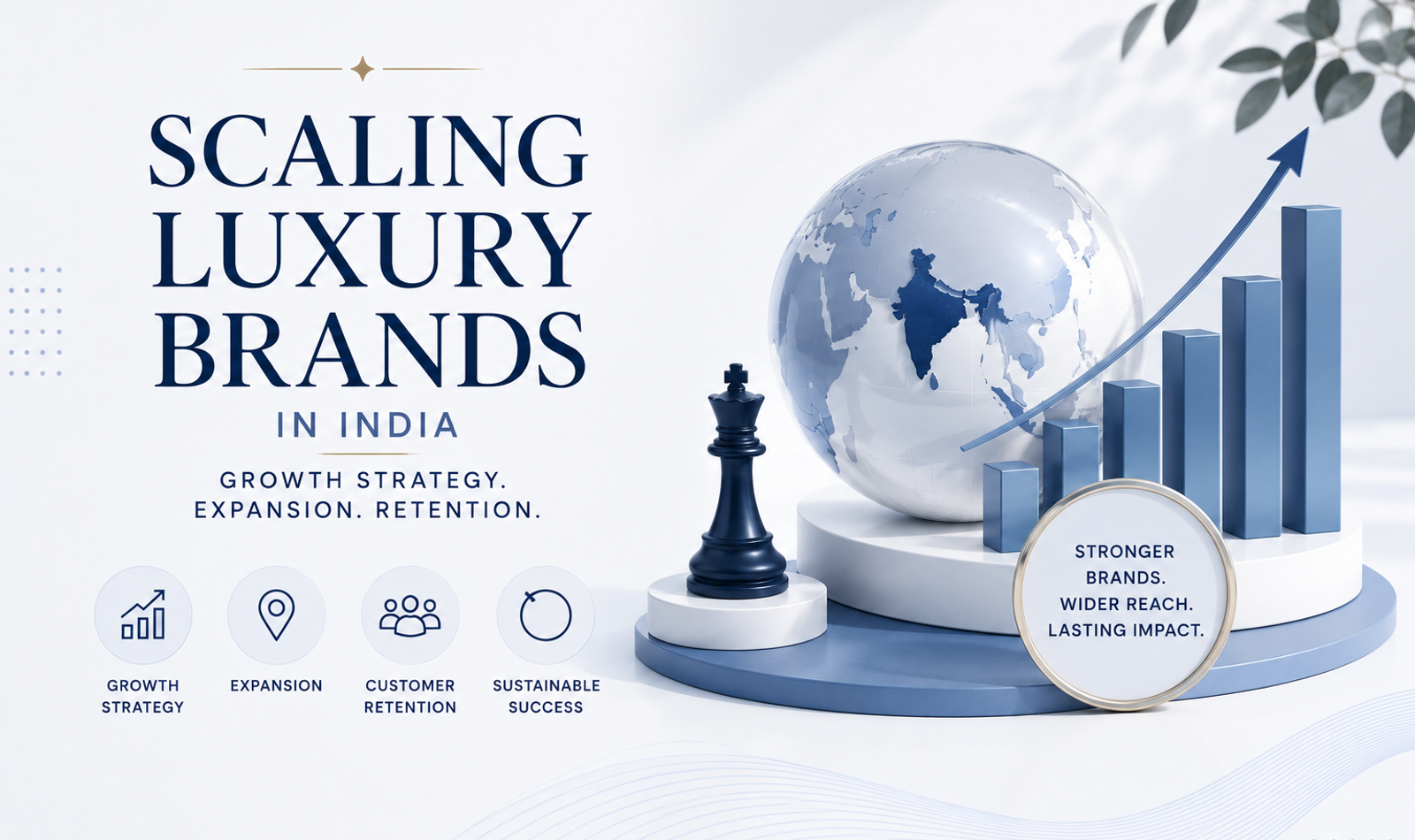
Scaling Luxury Brands in India: Growth Strategy, Expansion & Retention
Scaling a luxury brand in India requires more than increasing advertising, opening new locations or posting more content. Luxury growth must be intentional, controlled and consistent. A brand can grow quickly, but if that growth weakens perception, reduces exclusivity or damages customer experience, the brand may lose the very value that made it premium in the first place.
India offers strong opportunities for luxury and premium brands. Aspirational customers are growing across metros and emerging cities. Digital discovery has made premium brands more accessible. Customers are more willing to explore better products, refined experiences, elevated services and brands that reflect their lifestyle.
However, scaling in India also brings complexity.
The market is diverse. Customer expectations differ across cities. Premium perception is shaped by culture, service, pricing, digital credibility, PR visibility, word of mouth and experience quality. A luxury brand that works in Mumbai may need a different communication style in Chandigarh, Jaipur, Hyderabad, Ahmedabad, Pune, Ludhiana or Lucknow.
This is why luxury growth must be guided by a clear strategy.
A luxury brand should scale through strong positioning, controlled expansion, digital trust, public relations, customer experience, retention systems and long-term brand equity. It should not simply chase visibility.
This guide explains how to scale luxury brands in India with the right growth strategy, expansion roadmap and customer retention framework.
What Does Scaling a Luxury Brand Mean?
Scaling a luxury brand means increasing reach, revenue, customer base, market presence and brand value without weakening premium perception.
For mass-market brands, scaling often means reaching more people at lower cost. For luxury brands, scaling must be more selective. The brand does not need everyone. It needs the right customers, the right markets, the right partners and the right touchpoints.
Luxury scaling should protect desirability.
If a luxury brand becomes too available, too discounted, too inconsistent or too aggressive, customers may stop seeing it as premium.
A successful luxury scaling strategy balances growth and control.
It increases awareness but protects exclusivity. It expands into new markets but keeps the brand experience consistent. It uses digital channels but does not dilute the brand voice. It attracts new customers but retains existing high-value customers.
Scaling should make the brand stronger, not louder.
Why Luxury Scaling in India Needs a Different Approach
India is not one single luxury market.
It includes mature metro consumers, young aspirational buyers, high-net-worth families, global travellers, entrepreneurs, corporate decision-makers, brides and grooms, premium homeowners, luxury diners, fashion-conscious youth and emerging wealthy consumers in non-metro cities.
Each segment has different motivations.
Some customers value status. Some value privacy. Some value craftsmanship. Some want international quality. Some want Indian cultural relevance. Some want convenience. Some want personalisation. Some want proof before paying a premium.
This makes luxury scaling more complex.
A brand cannot use one generic message everywhere.
It must define its priority audience and adapt communication without changing its core identity.
For example, a luxury wedding brand may speak differently to a Mumbai family, a Delhi family, an NRI client and a destination wedding couple. A premium automotive brand may need separate communication for corporate clients, event planners, executives and luxury travellers. A luxury hospitality brand may need different messaging for weekend travellers, wedding guests, corporate retreats and destination seekers.
The brand identity should remain consistent, but market expression should be localised.
Start With a Clear Luxury Positioning
Before scaling, the brand must have strong positioning.
If the positioning is unclear, scaling only spreads confusion.
Luxury positioning defines what the brand stands for, who it serves, why it is different and why customers should pay a premium.
The brand should answer a few important questions.
What do we want to be known for? Which customer do we want to attract? What emotional and functional value do we offer? What makes us different from other premium brands? What proof do we have? How should customers describe us after experiencing the brand?
A luxury brand may position itself around craftsmanship, personalisation, heritage, innovation, service excellence, design, cultural relevance, privacy, convenience or experience quality.
The positioning should be specific.
Saying “we are a premium brand” is not enough. The customer must understand what kind of premium value the brand offers.
Scaling should only begin after this positioning is clear.
Build a Growth Strategy Around Brand Equity
Luxury brands should not measure growth only through sales.
Sales matter, but brand equity matters too.
Brand equity is the value created by recognition, trust, preference, reputation and willingness to pay. A luxury brand with strong equity can attract better customers, defend premium pricing, generate referrals and build long-term demand.
A growth strategy should therefore include both commercial and brand-building goals.
Commercial goals may include revenue, enquiries, bookings, orders, store visits, consultations, market expansion and repeat purchases.
Brand goals may include awareness, premium perception, PR visibility, customer trust, social proof, content authority, search visibility and customer loyalty.
The brand should avoid growth tactics that damage long-term equity.
For example, heavy discounting may increase short-term sales but weaken pricing power. Excessive influencer collaborations may increase reach but reduce exclusivity. Rapid expansion may increase availability but create inconsistent customer experience.
Luxury growth should be profitable, desirable and sustainable.
Choose the Right Expansion Model
Luxury brands can scale through different expansion models.
Some brands expand geographically by entering new cities or regions. Some expand digitally by improving e-commerce, website enquiries, SEO and paid media. Some expand through retail presence, pop-ups, events or experience centres. Some expand through partnerships, collaborations, franchise models or distribution networks. Some expand by launching new product lines or service categories.
The right model depends on the brand’s category, customer behaviour and operational capacity.
A luxury fashion brand may scale through selective retail, online drops, stylists, PR and private previews. A luxury hospitality brand may scale through destination experiences, partnerships, event packages and direct booking systems. A premium automotive brand may scale through city coverage, corporate partnerships and digital lead generation. A luxury event brand may scale through destination expertise, PR, celebrity access, content and high-value referrals.
The brand should not choose expansion only because competitors are doing it.
Expansion should follow demand, capability and positioning.
Expand City by City, Not Randomly
In India, city expansion should be planned carefully.
Every city has a different luxury mindset, media environment, customer network and purchase behaviour.
A brand may perform well in Delhi NCR but need a different local strategy for Jaipur, Chandigarh, Hyderabad, Pune, Ahmedabad or Goa. The core promise may remain the same, but the entry strategy should adapt.
Before entering a new city, the brand should study demand, competitors, local influencers, media platforms, customer segments, pricing tolerance, logistics and service capability.
The brand should also identify local trust builders.
These may include premium communities, business associations, event networks, luxury hotels, real estate circles, creators, stylists, media houses, private clubs, wedding planners, architects or corporate groups.
A city launch should not depend only on ads.
It should include local partnerships, PR, curated events, digital campaigns, search visibility and strong follow-up systems.
The goal is to enter with credibility, not just visibility.
Use Digital to Scale Without Losing Premium Perception
Digital marketing is essential for scaling luxury brands in India.
Customers discover, research and compare premium brands online before making decisions. They check websites, Instagram pages, Google results, reviews, creator content, PR features and founder profiles.
However, luxury digital marketing must be controlled.
The brand should not sound desperate, overly promotional or generic.
The website should communicate trust, value and experience. Social media should build desire and authority. SEO should help serious customers discover the brand. Paid campaigns should target quality, not just volume. Email and WhatsApp communication should feel polished and personal.
Digital should make the brand more accessible without making it feel ordinary.
This balance is important.
Luxury brands should use digital platforms to educate, inspire, reassure and guide customers, not only to push sales.
Build a High-Trust Website
A luxury brand website is not just a digital brochure.
It is a trust platform.
Before scaling campaigns, the website should be ready to convert interest into action.
The website should clearly explain the brand’s positioning, products or services, process, proof, customer experience, FAQs and next steps.
It should use refined design, strong photography, fast loading speed, mobile-friendly layouts and clear enquiry or purchase paths.
For luxury services, the website should include case studies, client stories, service process, consultation options and trust signals.
For luxury products, it should include product details, material information, craftsmanship, usage guidance, care instructions, reviews and secure checkout.
For hospitality and event brands, it should show ambience, guest experience, location value, service quality and booking support.
A weak website can waste strong visibility.
If the brand wants to scale, the website must support premium trust.
Build SEO for Long-Term Luxury Discovery
Search visibility is important for luxury brands because serious customers often research before enquiring.
SEO helps the brand appear when customers search for services, products, locations, comparisons and expert guidance.
A luxury brand should create helpful content around customer questions.
This may include service pages, product guides, location pages, blogs, FAQs, case studies, trend articles, comparison content and founder insights.
For example, a luxury event brand can publish content about destination wedding planning, guest management, luxury event budgeting and celebrity management. A luxury automotive brand can publish content about chauffeur-driven mobility, corporate car rental and executive travel. A luxury hospitality brand can publish content about weekend escapes, boutique stays, destination experiences and private events.
SEO should not be treated as keyword stuffing.
It should be used to build authority and trust.
When customers find useful content, they are more likely to believe the brand understands their needs.
Use PR to Build Authority During Expansion
Public relations is powerful for luxury scaling.
As the brand enters new markets, launches new services or grows its presence, PR can create credibility.
PR helps the brand move from self-promotion to third-party recognition.
Media coverage, founder interviews, event features, expert commentary, collaboration stories and business milestones can strengthen the brand’s reputation.
For luxury brands, PR quality matters more than quantity.
A relevant feature in a respected lifestyle, business, travel, fashion, hospitality or industry platform can be more valuable than many low-quality mentions.
PR should be aligned with the brand’s expansion goals.
If the brand is entering a new city, regional media and local lifestyle platforms may matter. If the brand is targeting premium customers, luxury and business platforms may matter. If the brand wants founder authority, interviews and expert comments can help.
PR should support the brand story, not just announce activity.
Use Events as Growth Accelerators
Events can help luxury brands scale by creating direct experience.
A private preview, launch event, founder dinner, customer evening, pop-up, showcase, workshop, press meet or brand collaboration can make the brand feel more real and desirable.
Events are especially useful when entering new markets.
They allow the brand to meet customers, media, creators, partners and community leaders.
However, events must be strategic.
The guest list should match the brand’s target audience. The venue should reflect positioning. Hospitality should feel premium. Content capture should be planned. PR should be integrated. Digital follow-up should be ready.
An event should create more than memories.
It should create content, media interest, qualified leads, customer relationships, partnership opportunities and future campaign material.
Luxury events should be designed as brand-building assets.
Build Strategic Partnerships
Partnerships can help luxury brands enter new audiences with credibility.
A luxury brand can partner with hotels, restaurants, architects, designers, stylists, real estate developers, wellness brands, automobile companies, private clubs, event planners, fashion platforms, media houses or cultural institutions.
The partnership should feel natural.
It should not look like two unrelated logos placed together.
The best partnerships are built around a shared audience, shared values or shared experience.
For example, a luxury fashion brand may collaborate with a premium hotel for a private showcase. A luxury mobility brand may partner with event companies for VIP transportation. A luxury wellness brand may partner with boutique hospitality brands. A premium interior brand may collaborate with architects and real estate developers.
Partnerships should support positioning and lead quality.
They should never dilute the brand.
Scale Content Without Losing Quality
As luxury brands grow, content demand increases.
The brand may need more reels, blogs, campaign visuals, founder content, PR assets, case studies, email campaigns, landing pages and sales material.
However, content quality must remain high.
Luxury content should not become rushed, repetitive or trend-chasing.
The brand should build clear content pillars.
These may include brand story, craftsmanship, customer experience, education, proof, lifestyle, founder perspective, behind-the-scenes process, PR visibility and customer testimonials.
Each content pillar should support the brand’s positioning.
A luxury brand should not post only because the calendar needs content. Every post should strengthen perception, trust or desire.
Scaling content requires systems.
The brand should create guidelines for visual style, tone of voice, captions, video direction, approvals, storytelling and platform usage.
Build a Retention Strategy Early
Luxury brands often focus heavily on acquisition.
However, retention is one of the strongest growth levers.
A retained customer is more likely to buy again, refer others, attend events, share feedback, leave reviews and become part of the brand community.
Retention should begin immediately after the first purchase or service experience.
The brand should create a thoughtful post-purchase journey.
This may include personalised follow-up, care guidance, loyalty communication, early access, private invitations, anniversary messages, service check-ins, special previews or exclusive recommendations.
For luxury service brands, retention may include relationship management, seasonal check-ins, curated updates and priority support.
For luxury product brands, retention may include styling guidance, product care, new collection previews and customer appreciation experiences.
Retention builds long-term brand value.
Build Loyalty Without Discounting
Luxury loyalty should not depend only on points and discounts.
Discount-based loyalty can weaken premium perception.
Instead, luxury brands can build loyalty through access, recognition, personalisation, service and community.
Loyal customers may receive private previews, priority booking, exclusive consultations, limited edition access, invitation-only events, personalised recommendations or special relationship manager support.
The customer should feel valued, not targeted.
Luxury loyalty is emotional.
Customers stay when they feel understood, respected and remembered.
A strong retention strategy helps the brand grow without constantly spending on new acquisition.
Improve Customer Experience Before Scaling
Customer experience must be stable before expansion.
If the brand cannot deliver consistently in one market, it will struggle in multiple markets.
Before scaling, the brand should review enquiry response, consultation process, sales communication, payment experience, product delivery, packaging, service standards, customer support, complaint resolution and feedback collection.
Luxury customers expect smoothness.
They may not always complain publicly, but they will quietly avoid returning if the experience does not match the promise.
The brand should create customer experience standards.
These standards should define response time, tone of communication, service process, packaging rules, follow-up steps, escalation systems and experience details.
Scaling should not reduce quality.
It should make quality more systematic.
Use CRM to Manage Luxury Relationships
A CRM system is essential for scaling luxury brands.
As the customer base grows, the brand cannot depend only on memory, WhatsApp chats or manual follow-ups.
A CRM helps track leads, enquiries, customer preferences, purchase history, follow-up dates, sales stage, event attendance, feedback and retention opportunities.
For luxury brands, personalisation matters.
A CRM allows the brand to remember important details, such as customer interests, preferred city, budget range, occasion type, past purchases, family events or service preferences.
This helps the brand communicate more thoughtfully.
CRM systems also help measure lead quality and source performance.
The brand can identify whether enquiries are coming from Instagram, SEO, PR, events, referrals, partnerships or ads.
This makes scaling more intelligent.
Train Teams for Brand Consistency
As a luxury brand grows, more people represent it.
Sales teams, customer service teams, store staff, event teams, digital teams, agencies, franchise partners and vendors all influence perception.
If they do not understand the brand, consistency will break.
Team training is therefore essential.
Everyone should understand the brand promise, ideal customer, tone of voice, service standards, pricing logic and customer experience expectations.
Luxury brands should create internal guidelines.
These may include brand books, communication templates, customer scripts, visual guidelines, service standards and escalation processes.
Training protects quality during expansion.
A luxury brand is only as strong as the people delivering it.
Control Distribution and Availability
Distribution is a major part of luxury scaling.
The brand must decide where and how customers can access it.
Too much availability can reduce desirability. Too little availability can limit growth.
The right balance depends on the brand model.
A luxury product brand may use selective retail, own website, private appointments, limited drops or premium marketplaces. A luxury service brand may use consultation-based access, curated packages or appointment-led sales. A hospitality brand may balance direct booking with selected travel platforms. An automotive brand may expand city coverage while maintaining service standards.
The brand should avoid channels that damage perception.
If a distribution partner does not match the brand’s service quality, the partnership may create more harm than growth.
Luxury scaling requires controlled access.
Expand the Product or Service Portfolio Carefully
New products and services can help luxury brands grow, but expansion should be selective.
Every new offering should strengthen the brand’s position.
If a luxury brand launches too many unrelated products or services, customers may become confused.
A portfolio expansion should be based on customer demand, brand fit, operational capability and margin potential.
For example, a luxury event brand may expand into destination wedding planning, celebrity management or guest hospitality if these services support the core positioning. A luxury fashion brand may expand from occasion wear to accessories if the design language remains consistent. A luxury hospitality brand may add private dining or curated experiences if they strengthen guest value.
Expansion should feel natural.
The customer should understand why the new offering belongs to the brand.
Build Community Around the Brand
Community can help luxury brands grow through belonging and advocacy.
A luxury community does not need to be large. It needs to be valuable.
Community may include loyal customers, founders, creators, media, partners, industry experts, collectors, members, guests or repeat buyers.
The brand can nurture community through private events, newsletters, WhatsApp updates, exclusive previews, knowledge sessions, loyalty clubs, founder notes or curated experiences.
Community builds emotional connection.
It also creates word-of-mouth growth.
In luxury, personal recommendation can be more powerful than advertising.
A customer who feels part of the brand world is more likely to return and refer.
Measure Scaling Success
Luxury scaling should be measured carefully.
The brand should track both growth and quality.
Important metrics include qualified enquiries, conversion rate, average order value, repeat purchase, customer lifetime value, direct traffic, branded search, PR quality, referral volume, customer satisfaction, retention rate, premium lead quality, event attendance quality and reduced discount dependence.
The brand should also track customer perception.
How are customers describing the brand? What do they remember? Why do they choose it? What objections do they raise? Which competitors do they compare?
If the brand is attracting more customers but weaker customer quality, the scaling strategy may need adjustment.
If revenue is growing but customer experience is declining, scaling may be too fast.
If visibility is increasing but trust is not improving, the brand may need stronger proof and PR.
Scaling must be monitored, not assumed.
Common Mistakes While Scaling Luxury Brands
One major mistake is scaling too fast before operations are ready.
Luxury customers expect consistency. If growth creates delays, poor service or quality issues, reputation can suffer.
Another mistake is over-discounting to attract new customers.
Discounting may produce short-term sales but weaken luxury perception.
A third mistake is using mass-market communication.
Luxury brands should avoid sounding desperate, loud or generic.
Another mistake is entering too many markets without localisation.
India requires city-specific understanding.
Brands also make the mistake of choosing influencers only by follower count.
For luxury brands, audience quality, tone, credibility and fit matter more than reach.
Another common mistake is ignoring retention.
Acquiring new customers is important, but luxury growth becomes stronger when existing customers return and refer.
Finally, many brands measure only visibility.
Luxury success must include lead quality, customer experience, retention and brand equity.
How to Build a 12-Month Luxury Scaling Roadmap
A luxury scaling roadmap should be built in stages.
The first stage should focus on audit, positioning, customer journey and website readiness.
The second stage should focus on content systems, SEO, PR, social media and trust-building assets.
The third stage should focus on controlled expansion through paid campaigns, partnerships, events and new market testing.
The fourth stage should focus on retention, loyalty, referral systems, customer experience and annual review.
Each stage should have clear goals and KPIs.
The roadmap should also define what the brand will not do.
This is important because luxury brands must protect focus.
Not every collaboration, trend, city, channel or customer is right for the brand.
Strategic restraint is part of luxury growth.
Frequently Asked Questions
What does scaling a luxury brand mean?
Scaling a luxury brand means growing revenue, reach and market presence while protecting premium perception, customer experience, pricing power and brand equity.
How can luxury brands grow in India?
Luxury brands in India can grow through clear positioning, digital visibility, PR, premium experiences, city-wise expansion, strategic partnerships and retention systems.
Why is retention important for luxury brands?
Retention is important because loyal luxury customers create repeat business, referrals, advocacy, reviews, stronger relationships and long-term brand value.
Should luxury brands use discounts to scale?
Luxury brands should avoid frequent discounting. They can use private access, added value, exclusive previews and personalised benefits instead.
How can luxury brands expand into new cities?
They should study local demand, customer behaviour, competitors, media platforms, partnerships, logistics and service capability before entering a new city.
What digital channels help luxury brand growth?
Useful channels include a premium website, SEO, Instagram, LinkedIn, email, WhatsApp, PR amplification, paid media, content marketing and retargeting.
How does PR help luxury brand expansion?
PR builds credibility through media coverage, founder visibility, expert commentary, event stories, collaborations and third-party recognition.
How can luxury brands improve customer loyalty?
They can improve loyalty through personalisation, private access, premium service, thoughtful follow-up, early previews, exclusive events and relationship management.
What metrics should luxury brands track?
Luxury brands should track qualified enquiries, conversion rate, average order value, branded search, PR quality, retention, referrals and customer satisfaction.
What is the biggest mistake in scaling luxury brands?
The biggest mistake is growing too fast without protecting positioning, service quality, customer experience and premium perception.
Conclusion
Scaling luxury brands in India requires a careful balance between growth and control.
The opportunity is strong, but luxury brands cannot scale like mass-market brands. They must grow in a way that protects perception, pricing power, customer experience and long-term brand equity.
A strong luxury scaling strategy begins with clear positioning. It then moves into digital trust, PR visibility, website readiness, content systems, controlled expansion, strategic partnerships and customer retention.
Expansion should be city-specific, data-led and experience-focused.
Retention should be treated as a growth engine, not an afterthought.
Luxury brands that scale successfully are not the ones that become visible everywhere. They are the ones that become desirable, trusted and valuable to the right audience.
In India, where premium consumption is growing across metros and emerging cities, brands must combine cultural understanding with global execution standards.
Double Trouble Studio helps luxury, premium, hospitality, lifestyle, event, fashion, beauty, automotive, real estate and service-led brands scale through positioning, brand roadmaps, PR, content, digital marketing, website strategy, SEO, customer experience and retention systems.
With the right strategy, luxury brands can expand without losing exclusivity, grow without weakening perception and build long-term value in one of the world’s most exciting premium markets.
Need this for your brand?
Let DTS build your next campaign.
From PR, celebrity management and events to websites, social media, SEO and AI video production — Double Trouble Studio helps brands grow with strategy and execution.
Discuss Your Requirement →