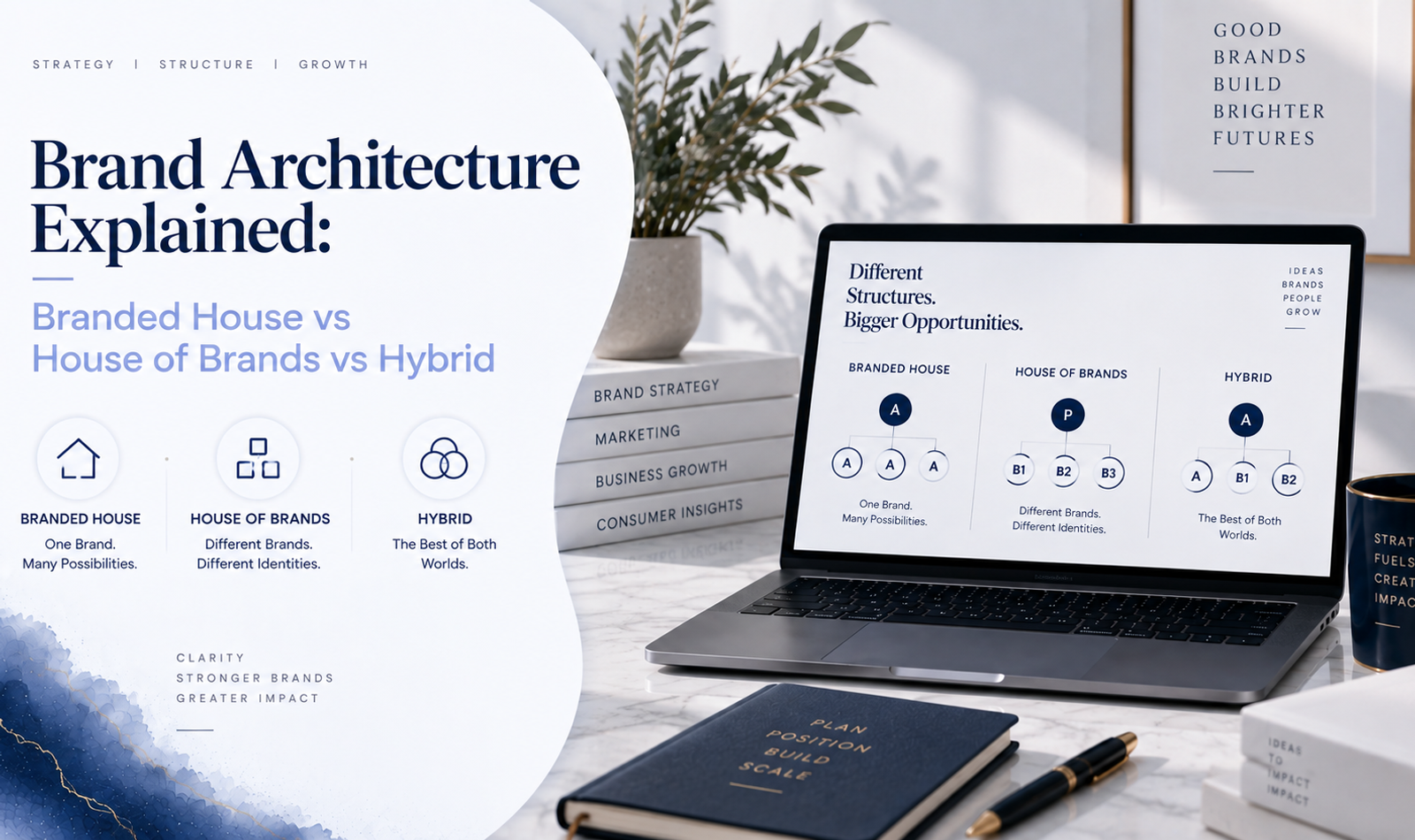
Brand Architecture Explained: Branded House vs House of Brands vs Hybrid
As businesses grow, their brand structure often becomes more complicated.
A company may begin with one product under one name. Over time, it may introduce new services, enter different categories, acquire another business, launch a premium range or create products for completely different customer segments.
Eventually, an important strategic question appears:
Should everything continue under one brand, or should different products and businesses have their own identities?
This is where brand architecture becomes important.
Brand architecture defines how a parent company, master brand, sub-brands, products and services relate to one another. It determines what customers see, which name carries the reputation, how new offerings are introduced and how brand equity moves across the portfolio.
The three most common models are:
Branded House → House of Brands → Hybrid Brand Architecture
None of these structures is automatically better than the others.
The right choice depends on the company's customers, categories, positioning, existing brand equity, growth plans, reputation risks and resources.
For businesses building multiple products or planning long-term expansion, brand architecture should therefore be treated as a strategic business decision rather than simply a naming exercise.
This guide explains how each model works, their advantages and disadvantages, and how to choose the right structure for a growing brand portfolio.
What Is Brand Architecture?
Brand architecture is the strategic system that defines the relationship between a company's corporate brand, master brand, sub-brands, products and services.
In simple terms, it answers:
Which brand name should customers see?
How closely should different products or businesses be connected?
Should one master brand carry the reputation of the entire company?
Should individual brands build their own identities?
How should customers understand the relationship between them?
Brand architecture can influence:
brand positioning,
naming,
visual identity,
marketing,
customer perception,
websites,
SEO,
PR,
sales,
and future expansion.
It is therefore much broader than deciding what to call a new product.
Why Brand Architecture Matters
When a company has only one product, brand architecture may feel unnecessary.
As the portfolio expands, however, the relationship between different offerings becomes increasingly important.
Imagine a company launching:
a premium product,
a mass-market product,
a professional service,
and a technology platform.
Should all four carry exactly the same name?
Possibly.
But they may serve different audiences, compete in different categories and require different positioning.
Without a clear architecture, businesses can gradually develop:
overlapping brands,
confusing names,
duplicate websites,
competing marketing campaigns,
unclear customer journeys,
and inconsistent positioning.
A structured architecture prevents growth from turning into brand confusion.
Businesses evaluating an existing portfolio can begin with a brand audit framework to understand current equity, positioning, customer perception and strategic gaps before changing the structure.
The Three Main Brand Architecture Models
Most brand portfolios can be understood through three broad structures:
Branded House
One powerful master brand is used across most products and services.
House of Brands
A parent organisation owns multiple independent customer-facing brands.
Hybrid Brand Architecture
The organisation combines elements of both approaches.
The difference is primarily about how much identity and equity should be shared.
What Is a Branded House?
A branded house is a brand architecture model in which one dominant master brand appears across most products, services or business divisions.
The basic structure looks like:
Master Brand
→ Product A
→ Product B
→ Service C
→ Business Division D
The individual offerings may have descriptive names, but the master brand remains the primary source of recognition.
Customers are therefore building a relationship with the master brand rather than completely separate product identities.
How a Branded House Works
Suppose a company called Nova offers:
Nova Pay
Nova Business
Nova Travel
Nova Premium
Each offering serves a different purpose, but the name Nova remains central.
Marketing investment in one part of the portfolio can strengthen recognition for the others.
The organisation is effectively saying:
“These are different solutions from the same brand.”
This can create a powerful cumulative effect.
Instead of building several identities independently, the business continually strengthens one master brand.
Advantages of a Branded House
Shared Brand Equity
New products can benefit from recognition and trust already established by the parent brand.
This can make launches easier.
Marketing Efficiency
Advertising, PR, content and sponsorship investment can contribute to one central identity.
A company does not need to build every brand from zero.
Easier Cross-Selling
Customers who already trust one service may be more willing to explore another offering from the same brand.
Clearer Corporate Identity
Employees, investors, partners and customers can understand the organisation more easily.
Stronger Digital Consolidation
Content, authority and traffic can often be concentrated within one primary digital ecosystem instead of being divided across several unrelated properties.
Disadvantages of a Branded House
The greatest advantage of a branded house can also become its greatest weakness.
Everything is connected.
If one major product experiences a reputation problem, other products carrying the same master brand may also be affected.
A branded house can also become restrictive when offerings target very different customers.
Imagine one master brand trying to simultaneously represent:
affordable consumer products,
ultra-premium services,
children's products,
and enterprise technology.
The positioning may become difficult to explain.
A strong master brand needs enough strategic flexibility to stretch across its portfolio without losing meaning.
When Should a Business Use a Branded House?
A branded house can work particularly well when:
products serve related audiences,
offerings share similar values,
the master brand already has strong equity,
cross-selling matters,
the company wants marketing efficiency,
and future offerings naturally fit the same positioning.
The decision should be connected to the company's wider growth plan.
A strategic brand roadmap for premium brands can help businesses evaluate whether new products should strengthen an existing identity or require greater separation.
What Is a House of Brands?
A house of brands uses a different structure.
The parent company owns several customer-facing brands, but those brands can operate with largely independent identities.
The structure may look like:
Parent Company
→ Brand A
→ Brand B
→ Brand C
→ Brand D
Customers may know the individual brands very well while knowing relatively little about the corporate parent.
Each brand can have its own:
name,
identity,
positioning,
audience,
pricing,
website,
social presence,
and communication strategy.
How a House of Brands Works
Imagine a consumer company operating three brands:
one affordable skincare brand,
one premium beauty brand,
and one professional salon brand.
If all three use the corporate name prominently, customers may struggle to understand why their prices, personalities and target audiences are so different.
A house-of-brands structure allows each business to develop independently.
One can be youthful and accessible.
Another can be exclusive and luxurious.
The third can focus on professional authority.
All can still belong to the same parent organisation.
Advantages of a House of Brands
Greater Positioning Flexibility
Each brand can target a different audience without being restricted by the identity of the parent company.
Different Price Positions
The same organisation can participate in:
value,
mid-market,
premium,
and luxury categories
without forcing every offering into one price perception.
Risk Separation
A reputation issue affecting one brand may be less likely to directly affect every other portfolio brand.
Easier Category Expansion
The parent organisation can enter categories where the existing master brand may not naturally fit.
Acquisition Flexibility
When companies acquire established brands, they may preserve their existing equity rather than immediately renaming them.
Disadvantages of a House of Brands
The major challenge is cost.
Each brand may require its own:
strategy,
identity,
website,
content,
advertising,
PR,
social media,
SEO,
and customer acquisition.
Instead of building one brand, the organisation may be building several.
This can significantly increase complexity.
Another challenge is fragmented equity.
A successful campaign for Brand A may do very little for Brand B if customers do not know they are related.
This is the strategic trade-off:
independence provides flexibility, but flexibility requires resources.
When Should a Business Use a House of Brands?
A house of brands can make sense when:
audiences are very different,
categories are unrelated,
pricing positions conflict,
individual brands already have strong equity,
the company regularly acquires brands,
or independent identities provide strategic value.
The architecture should reflect genuine market differences rather than a desire to create more logos.
Before building several independent brands, companies should understand how each one will create meaningful differentiation. DTS's guide to competitive strategy for luxury brands explores how positioning and value need to remain distinct within competitive markets.
What Is Hybrid Brand Architecture?
Hybrid brand architecture combines elements of a branded house and a house of brands.
Some products may carry the master brand prominently.
Others may operate as sub-brands.
Some may use an endorsed relationship.
Others may remain relatively independent.
The structure might look like:
Parent Brand
→ Parent Brand Product A
→ Parent Brand Product B
→ Sub-Brand C
→ Independent Brand D
→ Brand E, endorsed by Parent Brand
This approach provides flexibility.
It can also become complicated if the relationships are not clearly defined.
Why Companies Use Hybrid Brand Architecture
Businesses rarely grow in perfectly planned sequences.
They:
launch new products,
acquire companies,
enter new markets,
create premium ranges,
build digital products,
and discontinue older offerings.
Over time, a pure architecture may no longer fit.
A hybrid model allows the organisation to decide how much connection each brand needs.
For example, a new product may benefit strongly from the reputation of the master brand.
An acquired company may already possess valuable independent equity.
A premium offering may need more distinction while still benefiting from parent endorsement.
Hybrid architecture can accommodate all three situations.
Advantages of Hybrid Brand Architecture
Flexibility
Different portfolio brands can have different relationships with the parent company.
Existing Equity Can Be Preserved
Acquired or established brands do not necessarily need to be renamed.
Strategic Endorsement
A smaller brand can benefit from the credibility of a larger parent without losing its own identity.
Different Audiences Can Be Served
Brands can maintain distinct positioning while remaining part of a broader ecosystem.
Disadvantages of Hybrid Brand Architecture
Flexibility can create complexity.
Customers may struggle to understand:
which brand owns what,
why some products use the parent name,
why others do not,
and how the businesses relate.
Internal teams may also apply the architecture inconsistently.
A hybrid system therefore requires strong governance.
Rules need to define:
naming,
logos,
endorsement,
website relationships,
visual identity,
messaging,
and future product launches.
Branded House vs House of Brands vs Hybrid
The easiest way to understand the three models is through the question of shared equity.
In a branded house, most equity flows toward one master brand.
In a house of brands, equity is distributed across individual brands.
In a hybrid system, equity is shared selectively.
The choice affects far more than the logo.
It influences:
marketing investment,
reputation,
customer understanding,
digital strategy,
sales,
and long-term business value.
Master Brand vs Sub-Brand vs Endorsed Brand
These terms are often confused.
Master Brand
The master brand is the dominant identity across a portfolio.
It provides the central reputation and meaning.
Sub-Brand
A sub-brand has its own identity but remains visibly connected to the master brand.
The parent name may still play a prominent role.
Endorsed Brand
An endorsed brand has greater independence but receives visible support from another brand.
The message is essentially:
“This is its own brand, but it is backed by this established organisation.”
Independent Brand
An independent portfolio brand may have little visible customer-facing connection with the corporate parent.
Understanding these levels of connection makes it easier to design a hybrid architecture.
How Brand Naming Fits Into Architecture
Naming is one of the most visible expressions of architecture.
In a branded house, naming may follow a consistent system.
For example:
Master + Product
Master + Service
Master + Category
This makes relationships obvious.
A house of brands may deliberately use completely different names.
A hybrid architecture may combine:
master-brand names,
sub-brand names,
endorsed brands,
and independent identities.
Naming decisions should therefore come after architecture, not before it.
Otherwise, businesses may create attractive names without understanding how those names fit into the portfolio.
How Brand Architecture Affects Positioning
Architecture and positioning are closely connected.
Suppose a parent company is known for affordable products.
It wants to launch an ultra-premium offering.
Using the same name may provide recognition, but it may also carry the existing price perception into the premium category.
Creating a separate brand provides more positioning freedom but sacrifices some existing recognition.
This is the type of trade-off architecture needs to resolve.
Companies should therefore understand what each brand needs to represent before deciding how closely it should be connected to the parent.
A structured brand positioning workshop can help clarify audience, identity and differentiation before portfolio decisions are finalised.
How Brand Architecture Affects Customer Perception
Customers do not study corporate organisation charts.
They interpret what they see.
If two products use the same brand name, customers naturally assume there is a relationship.
They may expect similar:
quality,
service,
values,
pricing,
or experience.
If two brands look completely unrelated, customers may assume they are independent even when they have the same owner.
Brand architecture therefore manages customer expectations.
The question is not only:
“How is our company organised internally?”
The more useful question is:
“What relationship should the customer understand?”
How Brand Architecture Affects Marketing Costs
Architecture has direct financial implications.
A branded house can create efficiencies because:
one reputation,
one audience ecosystem,
one PR engine,
one website,
and one content system
may support multiple offerings.
A house of brands may require separate investment for each identity.
That does not make a house of brands a bad strategy.
It means the business needs enough resources to support it properly.
Creating five independent brands with the budget to market only one can produce a portfolio full of underdeveloped identities.
Architecture should therefore reflect financial reality.
Brand Architecture and Brand Equity
Brand equity represents the recognition, associations, trust and perceived value attached to a brand.
Architecture determines where that equity accumulates.
Under a branded house, successful products strengthen the master brand.
Under a house of brands, success may remain concentrated within the individual brand.
Under a hybrid structure, some equity may transfer through endorsement.
This becomes particularly important when launching new products.
Ask:
Where do we want today's marketing investment to create value five years from now?
That question can significantly influence architecture.
Brand Architecture and Reputation Risk
Shared equity creates shared exposure.
In a branded house, customers may connect a problem in one business directly with the master brand.
This can make reputation management especially important.
A house of brands can provide greater separation, although ownership relationships can still become publicly visible.
Hybrid architectures sit somewhere between these extremes.
Companies should therefore consider:
operational risk,
regulatory risk,
category risk,
customer expectations,
and crisis scenarios
when designing the portfolio.
Brand reputation is an ongoing strategic asset, and businesses operating premium portfolios can benefit from understanding crisis PR and reputation recovery before issues arise.
Brand Architecture and PR
PR becomes easier when journalists, customers and stakeholders can understand the relationship between brands.
A branded house usually concentrates media visibility around the master identity.
A house of brands may require separate media narratives for individual businesses.
A hybrid portfolio may need both corporate and consumer-facing communication.
The architecture should therefore define:
who speaks,
which brand receives coverage,
how the parent company is mentioned,
and when portfolio relationships matter.
For businesses developing a structured reputation strategy, PR & Media Marketing can connect brand positioning with external communication.
Brand Architecture and SEO
Brand architecture can also affect organic search strategy.
Imagine a company with five closely related services.
If it creates five unrelated websites, each domain may need to develop:
authority,
content,
links,
technical strength,
and search visibility
independently.
A branded-house approach may allow related content to sit within one stronger domain architecture.
However, separate websites can make sense when individual brands genuinely serve different markets and search intents.
The decision should not be made solely for SEO.
But SEO implications should be evaluated before domains and websites are separated.
DTS's guide to SEO for luxury brands explains how positioning, content and authority work together to build organic visibility.
Brand Architecture for Websites and Digital Ecosystems
A website is one of the clearest expressions of brand architecture.
A branded house may use:
one domain,
one navigation system,
and dedicated sections for products or services.
A house of brands may use completely separate domains and digital experiences.
A hybrid model may combine corporate and individual brand websites.
The digital architecture should make relationships clear.
Questions to consider include:
Should users move easily between brands?
Should the parent company appear in the footer?
Should all services share one navigation?
Should each brand have separate social accounts?
Should customer data remain connected?
Should the brands share a content platform?
These decisions should follow the strategic architecture.
Businesses planning complex digital portfolios can explore DTS's web development and marketing services for website structure, user experience and digital growth planning.
Content Strategy Across Multiple Brands
A multi-brand portfolio can easily create duplicate content.
Different brands may begin publishing similar:
blogs,
guides,
social posts,
FAQs,
and campaigns.
This can waste resources and blur positioning.
The architecture should define which brand has authority over which topics.
For example, a parent company may publish:
corporate insights,
research,
investor information,
and group announcements.
Individual brands may focus on:
customer problems,
products,
services,
and category-specific content.
A clear content strategy for brand websites can help organise these roles and reduce unnecessary duplication.
Brand Architecture for New Product Launches
Every new product creates an architecture decision.
Should it become:
a product under the existing brand?
a named sub-brand?
an endorsed brand?
or an independent brand?
Do not automatically create a new brand because the product feels important.
Ask:
Does it serve the same audience?
Does it share the same promise?
Does it fit the existing price position?
Can the current brand credibly stretch into this category?
Would a new identity create meaningful strategic value?
Would customers benefit from knowing the connection?
If the answers favour shared equity, the existing brand may be stronger.
If the product requires substantially different positioning, greater separation may be justified.
Brand Architecture During Mergers and Acquisitions
Acquisitions create some of the most difficult architecture decisions.
Suppose Company A acquires Brand B.
There are several possibilities.
Brand B could be:
renamed under Company A,
kept completely independent,
endorsed by Company A,
or gradually integrated.
The correct decision depends partly on existing equity.
If Brand B has strong customer loyalty, immediately replacing its identity could destroy value.
If the acquired brand has weak recognition, integration may be more efficient.
Architecture should therefore consider what customers already know and trust.
Brand Architecture During Repositioning
Sometimes the portfolio itself is not the problem.
The way customers understand it is.
A business may discover that:
brands overlap,
one identity has become outdated,
a premium offer lacks distinction,
or several services compete with one another.
Architecture may need to change alongside positioning.
DTS's guide to brand repositioning strategy explains when and how businesses can change market perception without discarding useful existing equity.
Brand Architecture for D2C and Consumer Brands
D2C companies often begin with one hero product.
As they grow, they may expand into:
new categories,
product lines,
audience segments,
and price tiers.
The temptation is to create a new brand for every opportunity.
That can fragment marketing investment.
If the new categories share the same audience and promise, a branded-house or sub-brand model may create stronger cumulative equity.
Separate brands become more useful when the new proposition requires a fundamentally different identity.
Brand Architecture for Luxury and Premium Businesses
Luxury architecture requires particular care because perception is central to value.
A premium group may own brands across:
fashion,
hospitality,
beauty,
automotive,
jewellery,
or experiences.
The parent brand may provide credibility.
But individual businesses may need distinctive worlds.
Over-standardisation can remove the character that makes a luxury brand desirable.
Too little connection, however, can waste valuable parent equity.
The architecture should therefore balance:
heritage,
exclusivity,
independence,
and endorsement.
Businesses working in premium markets can study luxury brand case studies and what successful brands do differently when evaluating how portfolio decisions affect long-term perception.
Brand Architecture for Service Businesses
Service companies can also outgrow their original structure.
An agency might expand into:
consulting,
technology,
events,
production,
education,
and software.
Should all services remain under the agency brand?
The answer depends on whether customers see them as related.
If the same customer may purchase several services, a branded house can support cross-selling.
If one division serves a completely different market with a different business model, greater independence may make sense.
The architecture should make buying easier rather than creating organisational complexity for customers.
Brand Architecture for International Expansion
Geographic expansion can create another question:
Should the company use one global brand or create local identities?
A strong global master brand can provide:
recognition,
consistency,
and efficiency.
However, local market conditions may require adaptations in:
language,
product,
pricing,
distribution,
or communication.
The important distinction is between localisation and fragmentation.
A company can adapt execution to different markets without necessarily creating a new brand for each geography.
How to Audit Your Existing Brand Portfolio
Before changing architecture, map everything.
Create an inventory of:
corporate brands,
consumer brands,
sub-brands,
product lines,
services,
websites,
domains,
social accounts,
visual identities,
and naming systems.
Then evaluate each one.
Ask:
Who is the audience?
What is the positioning?
How much awareness exists?
What equity does it have?
Does it overlap with another brand?
Does it require separate marketing?
Does it support the business strategy?
Could it be consolidated?
Should the parent relationship become stronger or weaker?
This portfolio map often reveals unnecessary complexity.
How to Choose the Right Brand Architecture
There is no universal answer.
A useful decision process should examine several dimensions.
1. Audience Overlap
If customers are similar, shared branding may be more efficient.
If audiences are fundamentally different, greater independence may help.
2. Category Relationship
Related categories are easier to organise under one master brand.
Unrelated categories may need more separation.
3. Positioning
Can all offerings credibly share the same promise?
4. Price
Can premium and value offerings coexist without creating confusion?
5. Existing Equity
Which names already carry meaningful recognition and trust?
6. Reputation Risk
How much risk should brands share?
7. Marketing Resources
Can the company realistically support several independent brands?
8. Future Expansion
Will the architecture still make sense as the portfolio grows?
These questions move architecture away from personal preference and toward strategic decision-making.
A Step-by-Step Brand Architecture Framework
A practical architecture process can follow this sequence:
Step 1: Define Business Strategy
Understand where the organisation intends to grow.
Step 2: Map the Portfolio
Document every brand, product and service.
Step 3: Analyse Customers
Identify audience overlap and differences.
Step 4: Evaluate Existing Equity
Determine which names have real value.
Step 5: Clarify Positioning
Define what each offering needs to represent.
Step 6: Identify Relationships
Decide which offerings should be closely connected.
Step 7: Select the Architecture
Choose branded house, house of brands or hybrid.
Step 8: Build the Naming System
Define how future products will be named.
Step 9: Establish Visual Relationships
Determine logo, typography, colour and endorsement rules.
Step 10: Design the Digital Architecture
Plan websites, domains, SEO and social ecosystems.
Step 11: Define Governance
Create rules for future launches.
Step 12: Measure and Review
Reassess the architecture as the business evolves.
The complete process can be summarised as:
Business Strategy → Portfolio → Customer → Positioning → Equity → Architecture → Naming → Identity → Digital Structure → Governance → Growth
Brand Architecture and Long-Term Strategy
Architecture should not be designed only around today's portfolio.
It should support where the company is going.
A business expecting to launch one closely related product each year may benefit from one master brand.
A company planning acquisitions across unrelated categories may need a more flexible portfolio structure.
Architecture therefore belongs inside long-term strategy.
DTS's annual brand strategy framework provides a useful structure for connecting brand decisions with goals, milestones and measurement.
Common Brand Architecture Mistakes
Creating Too Many Brands
Every new identity requires investment.
Do not create a new brand without a strategic reason.
Forcing Everything Under One Name
A master brand should not stretch so far that it loses meaning.
Letting Internal Structure Define Customer Structure
Customers do not need to understand every internal division.
Ignoring Existing Brand Equity
Renaming an established brand can destroy recognition.
Inconsistent Naming
Random naming makes relationships harder to understand.
No Rules for New Products
Architecture should guide future launches.
Ignoring Digital Consequences
Domains, SEO, websites and social media are part of the architecture.
Ignoring Reputation Risk
Shared branding means shared perception.
Choosing Architecture Based Only on Design
Architecture is a business strategy decision before it is a visual identity decision.
When Should You Change Your Brand Architecture?
Architecture should be reviewed when:
the company has grown significantly,
new categories have been added,
customers are confused,
brands overlap,
marketing costs are duplicated,
the company completes acquisitions,
positioning changes,
international expansion begins,
or the existing structure prevents future growth.
Changing architecture does not always require changing every brand name.
Sometimes the solution may involve:
clearer endorsement,
simplified naming,
website consolidation,
portfolio restructuring,
or better communication.
The objective is clarity, not change for its own sake.
How Brand Architecture Supports Growth
Good architecture makes expansion easier.
When the rules are clear, leadership teams can evaluate new opportunities more quickly.
A new product can be assessed against an existing framework.
Instead of asking:
“What should we call this?”
the company can ask:
“What role does this offering play in our portfolio?”
That is a much stronger strategic question.
Once the role is clear, naming, design and communication become easier.
Frequently Asked Questions About Brand Architecture
What is brand architecture?
Brand architecture is the system that defines how a parent company, master brand, sub-brands, products and services relate to one another.
Why is brand architecture important?
It helps customers understand a company's offerings while guiding naming, positioning, marketing, digital strategy and future expansion.
What are the main types of brand architecture?
The three commonly used models are branded house, house of brands and hybrid brand architecture.
What is a branded house?
A branded house uses one dominant master brand across most products and services, allowing the portfolio to share recognition and reputation.
What is a house of brands?
A house of brands is a structure in which a parent organisation owns several customer-facing brands that operate with relatively independent identities.
What is hybrid brand architecture?
Hybrid brand architecture combines multiple relationships. Some products may use the master brand, while others operate as sub-brands, endorsed brands or independent brands.
What is the difference between a branded house and a house of brands?
A branded house concentrates brand equity around one master identity. A house of brands builds equity separately across multiple customer-facing brands.
What is a master brand?
A master brand is the dominant identity that provides recognition and reputation across several products or services.
What is a sub-brand?
A sub-brand has a distinct proposition or identity but remains visibly connected to the master brand.
What is an endorsed brand?
An endorsed brand maintains its own identity while visibly receiving credibility from a parent or master brand.
Which brand architecture is best?
There is no universally best architecture. The right choice depends on audience overlap, categories, positioning, pricing, existing equity, resources and growth strategy.
When should a company use a branded house?
It is often appropriate when offerings serve related audiences, share positioning and can benefit from common brand equity.
When should a company use a house of brands?
It can be useful when products target different audiences, categories or price positions and require independent identities.
What are the disadvantages of a branded house?
A branded house can create reputation spillover and may make it difficult to position highly different offerings independently.
What are the disadvantages of a house of brands?
It generally requires greater marketing resources because individual brands need to build awareness and equity separately.
How does brand architecture affect SEO?
Architecture can determine whether organic authority and content are concentrated within one website or divided across multiple domains.
Should different brands have separate websites?
Only when the strategic relationship, audience and customer journey justify separation. Separate domains also need their own content, authority and ongoing optimisation.
How does brand architecture affect naming?
Architecture determines whether products use the master-brand name, a sub-brand structure, endorsement or completely independent naming.
How do you develop a brand architecture strategy?
Start with business strategy, map the portfolio, analyse customers and existing equity, clarify positioning, select the appropriate model and then establish naming, visual, digital and governance rules.
When should a business restructure its brand portfolio?
A review may be necessary after major growth, acquisitions, category expansion, repositioning or when customers and internal teams struggle to understand the relationship between offerings.
Final Thoughts
Brand architecture is ultimately about making growth understandable.
A company may own ten products, five services and several businesses.
Customers should not need an organisational chart to understand them.
The architecture should make relationships intuitive.
A branded house can concentrate reputation and marketing investment around one powerful master brand.
A house of brands can give individual businesses the freedom to serve different markets and build independent identities.
A hybrid architecture can provide the flexibility to use both approaches where appropriate.
The important question is not:
Which model sounds more sophisticated?
It is:
Which structure best supports our customers, positioning, business strategy and future growth?
Architecture should therefore be decided before naming systems, logos and websites are allowed to multiply.
Start with the business.
Understand the portfolio.
Understand the customer.
Evaluate existing equity.
Clarify positioning.
Then decide how much each brand should share.
A well-designed architecture can make marketing more efficient, customer understanding clearer and future expansion significantly easier.
Build a Brand Architecture That Can Scale With Your Business
As businesses expand into new products, services and markets, their brand structure needs to evolve without losing clarity.
Double Trouble Studio helps brands connect strategy, positioning, digital experience, PR, content and market growth into a more coherent brand ecosystem.
Explore Double Trouble Studio's work or contact DTS to discuss your brand strategy, portfolio structure and future growth.
📩 info@dtsworld.in 📞 +91 80000 06021 📍 Andheri (West), Mumbai.
Need this for your brand?
Let DTS build your next campaign.
From PR, celebrity management and events to websites, social media, SEO and AI video production — Double Trouble Studio helps brands grow with strategy and execution.
Discuss Your Requirement →