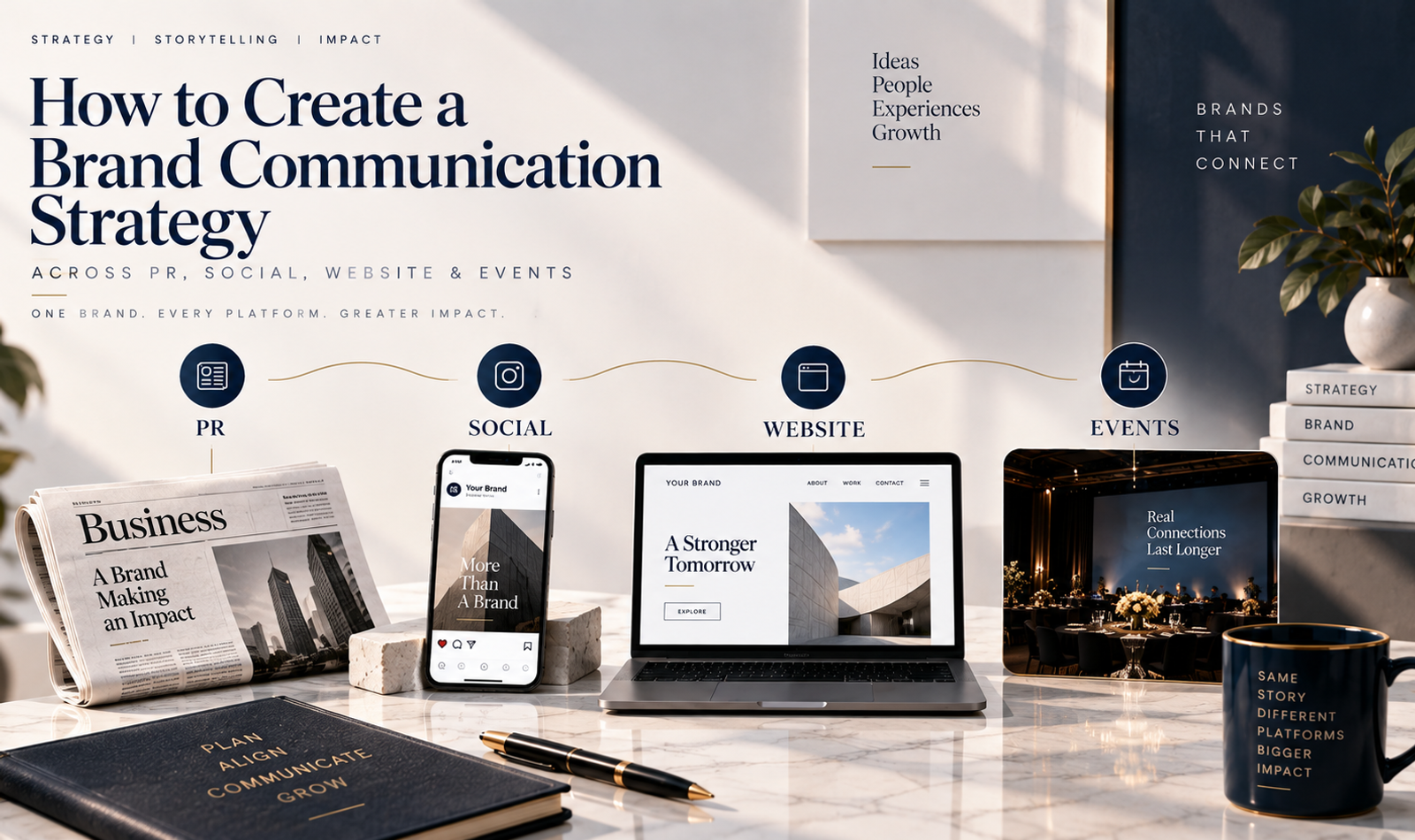
How to Create a Brand Communication Strategy Across PR, Social, Website & Events
A customer rarely experiences a brand through only one channel.
They may first discover a company through an Instagram Reel, search for it on Google, visit its website, read a media article, watch an interview with the founder, attend a launch event and finally contact the sales team.
Every one of these interactions communicates something about the brand.
The problem begins when each channel communicates something different.
The website may position the company as premium while social media feels casual. PR coverage may focus on innovation while advertising focuses entirely on discounts. An event may create a sophisticated experience, but the follow-up communication may feel generic.
Individually, each activity may be well executed. Collectively, however, the brand can still feel inconsistent.
This is why businesses need a brand communication strategy.
A strong brand communication strategy creates a common system for what the brand says, how it says it, where it communicates and how the message adapts across PR, social media, websites, events and other customer touchpoints.
The objective is not to publish exactly the same content everywhere.
It is to create one brand with many expressions rather than many disconnected versions of the same brand.
This guide explains how to create an integrated brand communication plan across PR, social media, websites and events while maintaining clear positioning, consistent messaging and measurable business objectives.
What Is a Brand Communication Strategy?
A brand communication strategy is a structured plan that defines how a brand communicates its positioning, value, personality and key messages to different audiences across different channels.
It answers several fundamental questions:
Who are we communicating with?
What do we want them to understand about us?
What should they remember?
Why should they believe us?
Which channels should deliver each message?
How should the message change according to the platform without changing the brand itself?
A communication strategy therefore goes beyond content creation.
Social media posts, press releases, blogs, advertisements and events are communication outputs.
The strategy determines how all of those outputs work together.
Why Brand Communication Strategy Matters
Modern brands operate across an expanding number of touchpoints.
A company may communicate through:
PR and media,
Instagram,
LinkedIn,
YouTube,
its website,
blogs,
email,
WhatsApp,
paid advertising,
influencers,
events,
founder interviews,
sales presentations,
and offline experiences.
Without a central strategy, individual teams can easily begin communicating independently.
The PR team develops one narrative.
The social team creates another.
The website uses different terminology.
The event agency interprets the brand differently again.
Over time, inconsistency weakens recognition.
Customers may see plenty of content but still struggle to answer a simple question:
What does this brand actually stand for?
Communication strategy solves this by creating a shared strategic foundation.
Brand Communication Starts With Positioning
Before deciding what to post on Instagram or what story to pitch to journalists, the brand needs to know what position it wants to occupy.
Positioning defines how the business wants to be perceived relative to alternatives.
It includes:
the audience,
the category,
the value proposition,
the point of difference,
the emotional benefit,
and the reasons to believe.
Communication then translates that position into messages.
For example, if a company wants to be perceived as a premium hospitality brand, its website, PR stories, social content, events and partnerships should collectively reinforce that perception.
If one channel repeatedly communicates luxury while another competes primarily on price, the positioning becomes less clear.
For a deeper strategic foundation, the DTS guide to luxury brand positioning strategy explains how perception, pricing and differentiation work together.
Start With a Brand Audit
Before building a new communication strategy, understand what the brand is already communicating.
Review the existing ecosystem.
Look at:
website copy,
social media,
press coverage,
advertisements,
blogs,
email communication,
event collateral,
sales presentations,
founder interviews,
influencer partnerships,
and customer-facing materials.
Ask whether they feel like expressions of the same brand.
Identify inconsistencies in:
messaging,
tone,
visual identity,
claims,
audience targeting,
and calls to action.
A structured brand audit framework can help businesses evaluate their current positioning before introducing a new communication system.
Define Clear Communication Objectives
Communication should have a purpose.
A brand may want to:
build awareness,
establish authority,
change perception,
enter a new market,
launch a product,
generate leads,
increase consideration,
build trust,
support sales,
attract investors,
strengthen employer branding,
or manage reputation.
Different objectives require different communication priorities.
A new brand may need awareness and education.
An established premium brand may need authority and reputation.
A technology company entering a new category may need to explain why the category matters before promoting its product.
A communication plan becomes much stronger when every major activity connects to a defined objective.
Understand Your Audience
Brands rarely communicate with only one audience.
Depending on the business, audiences may include:
customers,
prospects,
journalists,
creators,
employees,
investors,
partners,
vendors,
industry professionals,
and communities.
Each group may require a different emphasis.
Customers may care about value and experience.
Journalists may care about relevance and newsworthiness.
Investors may care about growth and market opportunity.
Employees may care about culture and purpose.
The core brand should remain consistent, but the message can be adapted according to what matters to each audience.
Build an Audience Communication Map
For every important audience, define four things:
What do they currently think?
What do we want them to think?
What proof will change or reinforce that perception?
Which channels are most effective for reaching them?
This creates a useful bridge between strategy and execution.
For example:
A premium consumer may need to understand quality, exclusivity and service.
A journalist may need a compelling story supported by evidence.
A prospective employee may need to understand culture and ambition.
The communication strategy should coordinate these messages rather than treating them as unrelated campaigns.
Create a Core Brand Message
A brand should be able to communicate its central idea clearly.
This does not mean reducing the entire business to one slogan.
It means defining the primary idea that should remain recognisable across communication.
A strong core message should answer:
Who are we?
Who do we serve?
What value do we create?
What makes us different?
Why should people believe us?
This becomes the anchor for all other communication.
Build a Brand Messaging Framework
One message is not enough for every situation.
A messaging framework creates a hierarchy.
A useful structure can include:
Core Brand Message
The central idea the brand wants to own.
Value Proposition
Why the brand is valuable to its audience.
Supporting Messages
Three to five strategic themes that reinforce the core message.
Proof Points
Evidence supporting the claims.
Audience-Specific Messages
Variations for customers, media, partners, employees or investors.
Campaign Messages
Temporary communication related to launches, events or promotions.
This hierarchy prevents campaigns from becoming disconnected from the larger brand.
Create Message Pillars
Message pillars are recurring themes that a brand wants to become known for.
A premium mobility company, for example, might build communication around:
service,
reliability,
comfort,
safety,
and experience.
A creative agency might focus on:
strategy,
creativity,
technology,
execution,
and measurable growth.
These pillars should appear repeatedly across channels in different forms.
PR may communicate them through media stories.
Social media may demonstrate them through short-form content.
The website may explain them in detail.
Events may allow people to experience them physically.
Repetition creates memory.
Build a Strong Brand Narrative
Facts communicate information.
Narratives create meaning.
A brand narrative connects:
where the company came from,
what it believes,
what problem it wants to solve,
how it is different,
and where it is going.
This narrative becomes particularly useful in:
PR,
founder communication,
website About pages,
campaigns,
events,
and brand films.
DTS's guide to building a brand narrative through story-led PR explores how brands can turn positioning into stories that audiences and media can understand.
Define Brand Voice and Tone
Messaging determines what a brand communicates.
Voice determines how it communicates.
A brand may be:
authoritative,
warm,
sophisticated,
bold,
minimal,
technical,
playful,
or conversational.
The voice should remain recognisable across channels.
Tone can change according to context.
A crisis statement should not sound like an Instagram caption.
A luxury event invitation should not read like a technical blog.
A LinkedIn announcement may require more professional language than a Reel caption.
Consistency does not mean identical language.
It means maintaining the same personality while adapting to context.
Create a Communication Channel Strategy
Every channel has a different role.
The mistake is treating every platform as another place to distribute the same content.
A stronger system gives each channel a specific job.
For example:
PR builds credibility.
Social media builds frequency and community.
The website builds depth and conversion.
Events build experience and relationships.
When these channels work together, communication becomes more powerful.
PR: Build Credibility and External Validation
PR provides something owned communication cannot create by itself:
third-party credibility.
A brand can say that it is innovative.
A respected publication independently discussing its innovation can make the claim more credible.
PR can support:
brand launches,
founder positioning,
thought leadership,
product announcements,
industry commentary,
corporate milestones,
event visibility,
partnerships,
and reputation management.
A strong PR and media marketing strategy should therefore connect directly with the wider brand narrative.
Develop PR Story Pillars
PR should not depend only on occasional press releases.
Create repeatable story territories.
These may include:
founder expertise,
industry insights,
innovation,
business growth,
consumer trends,
new launches,
partnerships,
research,
events,
or social impact.
Each territory should support the brand's overall positioning.
This helps the PR team identify opportunities without inventing a completely new narrative every month.
Connect PR With the Brand Launch Cycle
Communication is especially important when launching a new brand, service or product.
PR should begin before the announcement itself.
The communication cycle can include:
pre-launch positioning,
founder visibility,
media relationship building,
launch announcement,
event coverage,
interviews,
post-launch commentary,
and ongoing authority building.
For brands planning market entry, the 90-day PR strategy for a new brand launch in India provides a useful framework for building visibility around a launch.
Social Media: Build Frequency, Personality and Community
PR may create moments of authority.
Social media maintains the relationship between those moments.
It allows a brand to communicate frequently and directly.
Social media can demonstrate:
personality,
culture,
expertise,
products,
customer experiences,
behind-the-scenes activity,
campaigns,
and real-time relevance.
The key is to avoid turning social media into an isolated content factory.
Every post should contribute to the larger communication strategy.
Build Social Content Around Strategic Pillars
Instead of asking:
“What should we post today?”
ask:
“Which communication pillar should we strengthen today?”
Content can then be organised into categories such as:
education,
authority,
brand storytelling,
product,
customer proof,
culture,
entertainment,
community,
and conversion.
This creates consistency without making the feed repetitive.
Use Social Media to Amplify PR
PR and social media should not operate separately.
When the brand receives meaningful media coverage, social channels can amplify it.
A media feature can become:
a LinkedIn post,
an Instagram Story,
a founder Reel,
a quote card,
a newsletter mention,
or a website trust signal.
One strong PR result can therefore create several communication assets.
Similarly, strong social content can sometimes reveal story angles that later become useful for media outreach.
The relationship should work in both directions.
Website: Build the Brand's Source of Truth
Social platforms change.
Media coverage is controlled by publishers.
Events are temporary.
The website is the brand's owned communication environment.
It should provide the clearest and most complete version of:
positioning,
services,
expertise,
proof,
content,
and conversion pathways.
A visitor who discovers the company through PR or social media will often visit the website before making a serious decision.
If the website tells a different story, confidence can fall.
Align Website Messaging With the Communication Strategy
The homepage should immediately communicate:
who the brand is,
what it does,
who it serves,
and why it is different.
Service pages should expand on that promise.
Case studies should provide evidence.
The About page should communicate the larger narrative.
Blogs should build expertise.
Contact pages should make the next step easy.
A strong content strategy for brand websites helps organise these different content roles around one coherent digital identity.
Website UX Is Part of Communication
Communication is not limited to written copy.
Website design also sends signals.
Typography can communicate sophistication.
Speed can communicate competence.
Navigation can communicate clarity.
Photography can communicate positioning.
Poor mobile performance can undermine a premium message.
A brand that claims simplicity but presents users with a confusing website creates a contradiction.
For premium businesses, luxury website UX principles demonstrate how minimalism, speed and emotional impact contribute to brand perception.
SEO Should Support Brand Communication
SEO is sometimes treated purely as a traffic channel.
It can also support communication strategy.
Search content allows brands to build authority around subjects connected to their positioning.
For example, a company that wants to become known for luxury hospitality should not publish random high-volume topics simply because they generate searches.
Its content strategy should build topical authority around the market it wants to own.
SEO therefore connects:
search demand,
brand expertise,
customer questions,
and business objectives.
This makes organic visibility part of the communication system rather than a separate marketing activity.
Events: Turn Brand Communication Into Experience
PR communicates the brand through media.
Social communicates through content.
The website communicates through digital experience.
Events allow people to experience the brand physically.
This makes events one of the most powerful communication channels available.
A brand event can communicate through:
venue,
design,
hospitality,
guest list,
music,
lighting,
food,
technology,
entertainment,
speakers,
product presentation,
and service.
Every detail sends a signal.
Design Events Around the Brand Message
An event should not simply look attractive.
It should express the positioning.
If the brand stands for innovation, the experience should demonstrate innovation.
If it stands for exclusivity, the guest journey should feel considered and selective.
If it stands for creativity, the environment should give guests something genuinely unexpected.
DTS's approach to luxury event production and experience design shows how production elements can contribute to the larger brand experience.
Connect Events With PR
Events can generate powerful media opportunities.
A launch may create:
media previews,
interviews,
celebrity appearances,
founder conversations,
industry commentary,
and visual assets.
But event PR should not begin after the event is over.
Media planning should happen during the communication planning stage.
The guide to event PR strategy before, during and after an event explains how events can become longer-term visibility platforms rather than one-night activities.
Connect Events With Social Media
Events are also content engines.
A well-planned event can generate:
teasers,
behind-the-scenes videos,
guest arrivals,
interviews,
live content,
product moments,
creator collaborations,
recap films,
photography,
and post-event stories.
The social team should therefore participate in event planning early.
Waiting until the event day to decide what content to capture usually leads to missed opportunities.
Connect Events With the Website
Event communication can also extend to the website.
Depending on the campaign, the site may host:
registration,
event information,
speaker profiles,
launch details,
press assets,
event galleries,
recap videos,
or follow-up content.
This allows temporary experiences to create permanent digital value.
Businesses integrating physical and digital touchpoints can also explore hybrid luxury events, where online and offline audiences are deliberately designed into one experience.
Influencers and Creators as Communication Partners
Creators should not operate outside the communication strategy.
A creator partnership introduces another public voice representing the brand.
The creator should therefore understand:
the core message,
campaign objective,
non-negotiable brand points,
audience,
and desired perception.
At the same time, the content should preserve enough creative freedom to feel authentic.
A useful approach is to define the message clearly while allowing the creator to translate it into their own communication style.
For businesses using creators strategically, the DTS guide to influencer and KOL collaborations covers selection, contracts and measurement.
Founder Communication Should Support the Brand
Founders are increasingly important communication channels.
Their:
LinkedIn posts,
interviews,
podcasts,
speeches,
media commentary,
and event appearances
can influence how the company is perceived.
Founder communication should have its own personality but remain strategically connected to the business.
A founder can discuss:
industry change,
leadership,
innovation,
customer behaviour,
business lessons,
and future vision.
This creates human authority around the corporate brand.
The DTS guide to founder PR and personal branding explains how leadership visibility can contribute to broader brand authority.
Create an Integrated Campaign System
Once each channel has a role, campaigns can be planned as connected ecosystems.
Imagine a new product launch.
Instead of creating separate activities for every channel, begin with one campaign idea.
PR
Pitch the market story, founder perspective and product relevance.
Social
Build anticipation, explain the product and show behind-the-scenes content.
Website
Create the primary destination for information and conversion.
Events
Create a physical experience around the product.
Influencers
Provide third-party demonstration and social proof.
Paid Media
Scale the strongest messages to targeted audiences.
Content
Answer deeper questions and build long-term search visibility.
Everything originates from the same strategic message.
This is the principle behind integrating events, PR and digital into a brand roadmap.
Create a Brand Communication Calendar
A content calendar shows what will be published.
A communication calendar should show the larger story.
It can map:
campaigns,
PR moments,
events,
product launches,
content themes,
founder communication,
seasonal opportunities,
partnerships,
and important business milestones.
This allows teams to coordinate.
For example, if a major event is planned for October, September communication can build anticipation.
PR can begin media outreach.
Social can introduce the theme.
The website can publish relevant content.
Influencers can prepare collaborations.
The event then becomes the peak of a communication sequence rather than an isolated activity.
Create Communication Governance
A strategy only works when teams know how to use it.
Create a central communication guide containing:
brand positioning,
core message,
message pillars,
audiences,
tone of voice,
approved terminology,
proof points,
visual principles,
channel roles,
and approval processes.
This does not need to become a rigid document that prevents creativity.
Its purpose is to provide a common reference point.
PR agencies, social teams, designers, event partners and internal stakeholders should all be able to understand the same brand foundation.
Maintain Consistency Without Becoming Repetitive
Consistency is often misunderstood.
It does not mean posting the same message everywhere.
Suppose the core idea is:
“We make premium travel effortless.”
PR might communicate this through a story about service standards.
Social media might show the experience visually.
The website might explain the service model.
An event might demonstrate the hospitality physically.
The expression changes.
The underlying meaning remains consistent.
That is integrated brand communication.
Brand Communication for Luxury Brands
Luxury communication requires restraint.
More communication does not automatically create more value.
Premium brands often need to balance:
visibility,
scarcity,
authority,
desire,
and exclusivity.
Every communication should reinforce perception.
Constant promotional messaging can reduce premium positioning.
Luxury brands therefore benefit from combining:
editorial storytelling,
high-quality visual content,
selective PR,
carefully chosen creators,
premium digital experiences,
and high-touch events.
Communication should create desire rather than simply demand attention.
Brand Communication for New Brands
New brands face a different challenge.
They need to establish meaning quickly.
Early communication should repeatedly answer:
Who are you?
What do you do?
Why do you exist?
Who is it for?
Why should customers care?
What makes you credible?
Trying to communicate too many messages at launch can slow recognition.
A new brand usually benefits from a smaller number of strong ideas repeated consistently.
A structured PR strategy for a new brand launch in India can help align early visibility with the larger market-entry narrative.
Brand Communication During Repositioning
Repositioning creates a communication challenge because the audience already holds an existing perception.
The brand needs to move from:
current perception → desired perception
without creating unnecessary confusion.
This requires coordinated communication.
If only the website changes but PR and social continue using the old narrative, repositioning will struggle.
The new position should gradually appear across:
website copy,
visual identity,
social content,
PR stories,
leadership communication,
events,
partnerships,
and campaigns.
The DTS guide to brand repositioning strategy provides a broader framework for managing this transition.
Communication During a Crisis
Consistency becomes especially important during difficult situations.
Brands should establish:
who speaks publicly,
which channels carry official updates,
how quickly information is approved,
what tone is appropriate,
and how misinformation is addressed.
The objective is not to make every crisis response sound identical.
It is to prevent contradictory information.
Social media, PR, leadership communication and website updates should work from the same verified facts.
Measure Brand Communication Performance
Communication should be measured according to its objectives.
Different channels require different indicators.
PR Metrics
Relevant media coverage,
quality of publications,
share of voice,
message inclusion,
sentiment,
referral traffic,
and business enquiries.
Social Metrics
Reach,
engagement,
shares,
saves,
video completion,
audience growth,
website visits,
and conversions.
Website Metrics
Organic visibility,
qualified traffic,
engagement,
conversion rate,
lead quality,
and enquiry volume.
Event Metrics
Attendance,
guest quality,
engagement,
media coverage,
content generated,
leads,
and post-event response.
The goal is not to force every channel into the same metric.
It is to understand how each contributes to the communication objective.
For PR specifically, measuring PR ROI can help connect media activity with visibility and business outcomes.
Measure Message Consistency
Performance metrics tell you whether communication is reaching people.
They do not always tell you what people remember.
Brands should also measure:
message recall,
brand associations,
customer perception,
sentiment,
search behaviour,
and qualitative feedback.
Ask customers:
What comes to mind when you think about our brand?
Their answers reveal whether the communication strategy is creating the intended perception.
Common Brand Communication Mistakes
Treating Every Channel Separately
PR, social, websites and events should not operate as unrelated departments.
Communicating Too Many Messages
Trying to become known for ten things usually makes it harder to become known for one.
Changing Tone Randomly
Adapt tone to the platform without changing the underlying personality.
Focusing Only on Promotion
Communication should also educate, build authority and create trust.
Using Social Media as the Entire Strategy
Social media is one communication channel, not the complete brand strategy.
Ignoring the Website
A strong campaign can lose impact if users arrive on a weak or inconsistent website.
Planning Event Content Too Late
Content and PR opportunities should be designed before the event.
Measuring Only Reach
Visibility matters, but perception and business outcomes matter too.
Copying Competitors
A communication strategy should reinforce differentiation rather than imitate category conventions.
Inconsistent Proof
Claims should be supported by credible evidence across channels.
A Step-by-Step Brand Communication Strategy Framework
A practical framework can follow this sequence:
Step 1: Audit Current Communication
Review every important brand touchpoint.
Step 2: Clarify Positioning
Define what the brand should represent.
Step 3: Set Objectives
Determine what communication needs to achieve.
Step 4: Map Audiences
Identify who needs to receive the message.
Step 5: Define the Core Message
Create the central communication idea.
Step 6: Build Message Pillars
Choose recurring themes the brand wants to own.
Step 7: Create Proof Points
Support claims with evidence.
Step 8: Define Voice and Tone
Establish how the brand should sound.
Step 9: Assign Channel Roles
Decide what PR, social, website and events should each accomplish.
Step 10: Build Integrated Campaigns
Connect multiple channels around shared ideas.
Step 11: Create a Communication Calendar
Coordinate stories, campaigns, launches and events.
Step 12: Establish Governance
Create rules that keep teams aligned.
Step 13: Measure Performance and Perception
Track both channel results and brand understanding.
Step 14: Refine the Strategy
Use insights to improve future communication.
The complete framework can be summarised as:
Positioning → Audience → Objectives → Core Message → Message Pillars → Proof → Channel Roles → PR + Social + Website + Events → Campaigns → Measurement → Optimisation
A Practical Brand Communication Plan
A useful brand communication plan should answer five questions.
What are we trying to achieve?
This defines the objective.
Who needs to hear from us?
This defines the audience.
What should they understand and remember?
This defines the message.
Where should we communicate it?
This defines the channel strategy.
How will we know whether it worked?
This defines measurement.
When these five elements are clear, content production becomes significantly easier.
Teams stop creating communication simply because a calendar needs to be filled.
Every activity has a strategic role.
Frequently Asked Questions
What is a brand communication strategy?
A brand communication strategy is a structured plan for how a company communicates its positioning, values, messages and proof across different audiences and channels.
What is a brand communication plan?
A brand communication plan translates strategy into execution by defining audiences, messages, channels, campaigns, timing, responsibilities and measurement.
Why is brand communication important?
Consistent communication helps audiences understand what a brand represents, improves recognition and supports trust across multiple customer touchpoints.
What are the main brand communication channels?
Common channels include PR, social media, websites, blogs, email, events, advertising, influencers, leadership communication and offline customer experiences.
What is integrated brand communication?
Integrated brand communication means coordinating different channels around a shared positioning and message while adapting the execution to each platform.
How do you create a brand communication strategy?
Start with a brand audit and positioning, define audiences and objectives, create a messaging framework, assign roles to each channel and then coordinate campaigns and measurement.
How should PR and social media work together?
PR can build third-party credibility while social media amplifies media coverage, communicates directly with audiences and maintains engagement between major PR moments.
What role does a website play in brand communication?
The website acts as an owned source of truth where customers can understand the brand's positioning, services, expertise, proof and next steps.
How do events support brand communication?
Events allow audiences to experience brand values through physical environments, hospitality, content, entertainment, products and personal interactions.
Should brands use the same message on every platform?
The core meaning should remain consistent, but the format, tone and depth should adapt to the audience and platform.
How often should a communication strategy be reviewed?
It should be reviewed regularly and whenever there is a major change in positioning, audience, business strategy, product portfolio or market environment.
How do you measure brand communication?
Measure channel-specific results such as media coverage, engagement, traffic, leads and event participation alongside broader indicators such as message recall, sentiment and customer perception.
What is the difference between brand strategy and communication strategy?
Brand strategy defines what the brand represents and how it competes. Communication strategy determines how that positioning is expressed and reinforced across audiences and channels.
Can a small business create an integrated communication strategy?
Yes. Integration is not dependent on having a large budget. A smaller company can coordinate its website, social media, PR and customer communication around a few clear messages.
What causes inconsistent brand communication?
Common causes include unclear positioning, separate teams working without shared guidelines, too many messages, inconsistent tone and a lack of communication governance.
Final Thoughts
A strong brand is not built through one advertisement, one viral Reel, one media article or one impressive event.
It is built through consistent meaning across repeated experiences.
PR may introduce credibility.
Social media may create familiarity.
The website may provide depth.
Events may create emotional connection.
Creators may extend reach.
Founders may create authority.
Advertising may accelerate visibility.
But the customer should still recognise the same brand throughout the journey.
That is the purpose of a brand communication strategy.
The objective is not to make every channel look or sound identical.
It is to make every channel contribute to the same perception.
When positioning, messaging, PR, social media, website content and events are planned as one system, communication becomes more efficient and the brand becomes easier to understand, remember and trust.
Build One Brand Across Every Communication Channel
Double Trouble Studio helps businesses connect brand strategy with PR, digital communication, content, websites and real-world experiences so every major touchpoint contributes to a more consistent brand.
Explore Double Trouble Studio's work or contact DTS to discuss an integrated communication strategy for your brand.
📩 info@dtsworld.in 📞 +91 80000 06021 📍 Andheri (West), Mumbai.
Add a concise executive summaryInclude a practical channel matrix
Need this for your brand?
Let DTS build your next campaign.
From PR, celebrity management and events to websites, social media, SEO and AI video production — Double Trouble Studio helps brands grow with strategy and execution.
Discuss Your Requirement →