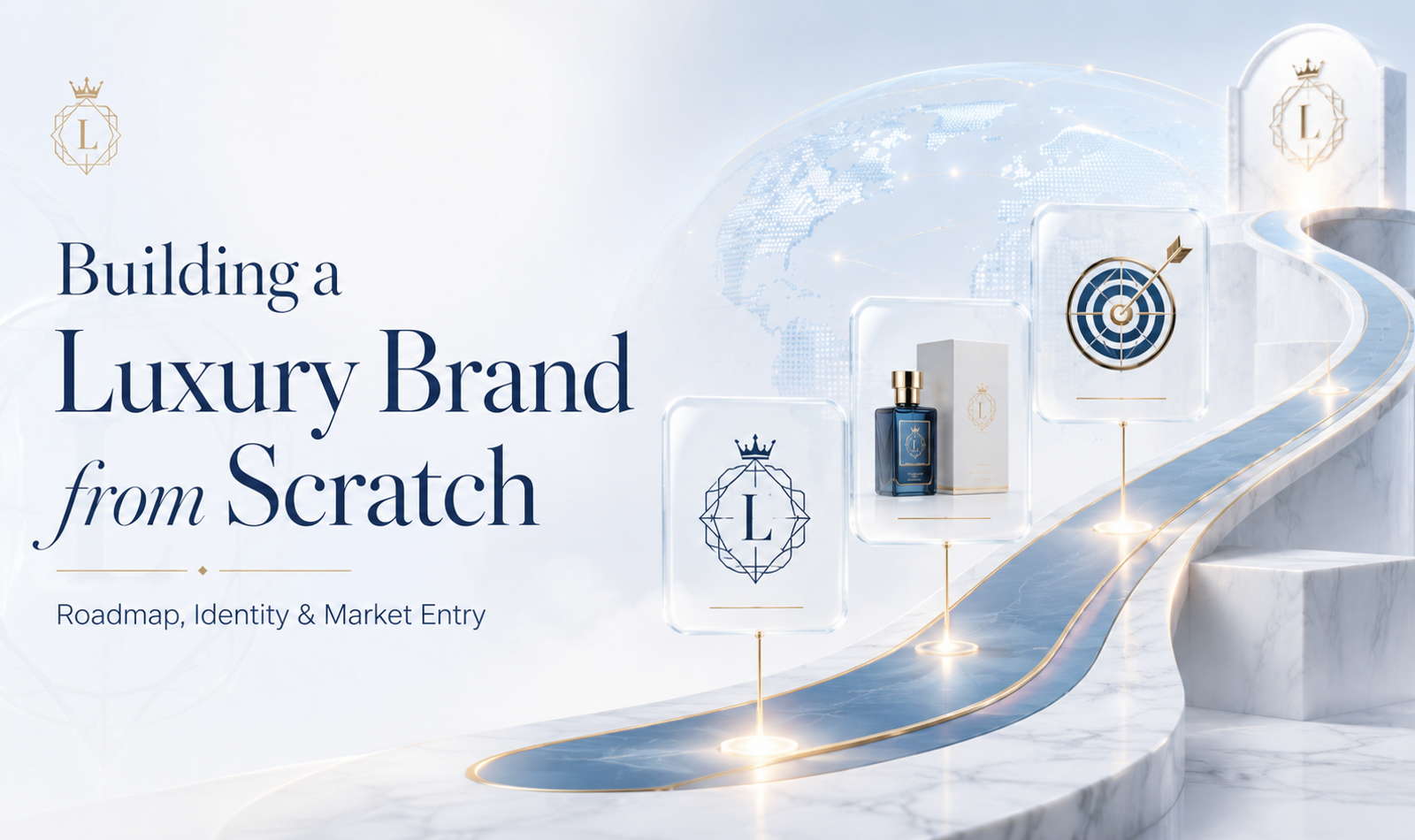
Building a Luxury Brand from Scratch: Roadmap, Identity & Market Entry
Building a luxury brand from scratch is not only about creating a premium logo, elegant packaging or attractive social media page. A true luxury brand is built through strategy, clarity, differentiation, customer experience, pricing discipline and consistent market perception.
Many new brands want to enter the luxury space because the category appears glamorous and profitable. However, luxury branding is more demanding than regular brand building. Customers expect more than a product or service. They expect meaning, quality, trust, refinement, exclusivity, emotional value and a memorable experience.
A luxury brand must earn its position.
It must define who it is for, why it exists, what makes it different, how it justifies premium pricing and how it will enter the market with credibility.
This is why a structured roadmap is essential.
Without a roadmap, a new luxury brand may spend heavily on design, photography, influencers and ads, but still fail to create trust. The brand may look expensive, but if the positioning is unclear, the customer journey is weak or the market entry strategy is rushed, the launch may not convert into long-term growth.
This guide explains how to build a luxury brand from scratch using a practical roadmap covering identity, positioning, market entry, launch strategy, digital presence, customer experience and long-term brand equity.
What Does It Mean to Build a Luxury Brand from Scratch?
Building a luxury brand from scratch means creating a complete brand system from the beginning.
This includes the brand idea, audience, positioning, identity, messaging, pricing, product or service experience, website, content, public relations, launch plan, market entry and customer journey.
A luxury brand cannot be built only through appearance.
The brand must have a strong strategic foundation. It must know what kind of customer it wants to attract and what value it offers beyond basic utility.
For example, a luxury hospitality brand is not only selling rooms. It is selling atmosphere, service, comfort, privacy and emotional escape. A luxury fashion brand is not only selling clothing. It is selling identity, taste, craftsmanship and self-expression. A luxury event and wedding brand is not only selling décor. It is selling trust, experience, guest hospitality and flawless execution.
Luxury begins when the customer sees meaning beyond the product.
Start With the Luxury Brand Vision
Every luxury brand should begin with a clear vision.
The vision defines what the brand wants to become in the long term. It should explain the role the brand wants to play in the market and in the customer’s life.
A strong vision is not a slogan. It is a strategic direction.
For example, a luxury interior brand may want to become known for quiet, material-led Indian sophistication. A premium skincare brand may want to become trusted for science-backed rituals designed for modern Indian skin. A luxury event company may want to become the preferred planning partner for refined celebrations and high-value guest experiences.
The vision helps the founder and team make better decisions.
If an activity does not support the vision, it should be questioned.
This is especially important in the early stage because new brands often get distracted by trends, competitor activity and short-term attention.
Define the Ideal Luxury Customer
A luxury brand cannot be designed for everyone.
The first major strategic decision is defining the ideal customer.
This includes more than age, income, city and lifestyle. The brand must understand the customer’s mindset, values, aspirations, fears and decision-making behaviour.
Luxury customers may value status, privacy, craftsmanship, convenience, personalisation, cultural identity, design, service, emotional meaning or expert guidance. Different luxury customers buy for different reasons.
A customer buying luxury jewellery may care about heritage, design, investment value and emotional significance. A customer booking a luxury event planner may care about trust, discretion, execution quality and guest management. A customer choosing a premium automotive service may care about punctuality, safety, comfort and professionalism.
The brand must know which motivation it wants to serve.
Without customer clarity, the brand will create broad and generic communication.
A luxury brand becomes stronger when it is clear about who it is for and who it is not for.
Study the Market Before Entering It
Market entry should never be based only on intuition.
Before launching, the brand should study the category, competitors, customer expectations, pricing patterns, media environment, distribution channels and digital search behaviour.
The goal is not to copy competitors. The goal is to understand where the opportunity exists.
A new luxury brand should identify what existing brands are doing well, where they are weak and what customers still need.
For example, a luxury hospitality brand may notice that competitors show beautiful rooms but fail to communicate personalised service. A premium fashion brand may notice that many labels look refined but lack strong storytelling around craft. A luxury service brand may notice that competitors appear expensive but do not explain process, proof or customer outcomes.
The market study helps the brand find a credible space.
A luxury brand should not enter the market looking like everyone else.
It must enter with a point of view.
Build a Clear Positioning Strategy
Brand positioning defines how the brand should be perceived in the customer’s mind.
This is one of the most important parts of building a luxury brand from scratch.
A strong positioning strategy should define the target audience, category, customer desire, brand promise, core difference and reasons to believe.
The brand should avoid generic claims such as premium quality, exclusive experience or world-class service unless those claims are supported by clear meaning.
A better positioning statement is specific.
For example, a luxury event brand may position itself as a high-touch planning partner for families and brands that want culturally rich, emotionally personal and flawlessly managed celebrations.
A luxury automotive service may position itself as a dependable chauffeur-driven mobility partner for corporate leaders, premium travellers and event logistics across key Indian cities.
A luxury skincare brand may position itself around clinically informed routines, refined textures and intelligent self-care for modern premium consumers.
Positioning gives the brand direction.
It shapes pricing, identity, messaging, customer experience and market entry.
Define the Brand Promise
A luxury brand promise explains what customers can consistently expect.
It should be clear, specific and deliverable.
A weak promise sounds decorative. A strong promise guides operations.
For example, if a brand promises personalisation, the customer journey must feel personally guided. If it promises discretion, communication and service must feel private and controlled. If it promises craftsmanship, customers should be able to see the details and process behind the work.
The promise must be realistic.
A new luxury brand should not promise what it cannot deliver consistently.
Luxury customers may forgive a brand for being new, but they will not forgive a mismatch between promise and experience.
The brand promise becomes the standard for every touchpoint.
Create Reasons to Believe
Luxury customers need proof.
A beautiful identity may attract attention, but proof builds trust.
Reasons to believe are the evidence behind the brand promise.
These may include founder expertise, team experience, product quality, craftsmanship, materials, processes, quality checks, service standards, testimonials, certifications, limited production, partnerships, case studies, awards, media coverage or customer results.
A new brand may not have years of history, but it can still create proof.
It can show its process, founder vision, expert involvement, material selection, product testing, design approach, customer care standards and launch preparation.
Transparency builds credibility.
Instead of saying “we are premium,” the brand should show why the experience is premium.
Proof is especially important during market entry because customers are still learning to trust the brand.
Build the Luxury Brand Identity
Brand identity is the visual and verbal expression of the strategy.
It includes the name, logo, typography, colour palette, photography style, packaging, website design, social media style, tone of voice and overall brand world.
Luxury identity should not be created only by choosing elegant fonts and muted colours.
It should express the brand’s specific positioning.
A quiet luxury brand may need minimal layouts, soft tones, refined textures and calm language. A bold luxury fashion brand may need stronger visual contrast, editorial photography and expressive storytelling. A luxury wellness brand may need calm design, sensory details and reassuring communication. A luxury automotive brand may need sharp lines, clarity, trust signals and professional presentation.
The identity should feel consistent across every platform.
Customers should recognise the brand whether they see a website page, Instagram post, brochure, event invite, packaging or proposal.
Consistency creates memory.
Name, Logo and Visual System
A luxury brand name should be memorable, pronounceable and aligned with the desired perception.
It may be founder-led, concept-led, heritage-inspired, abstract, modern or category-specific. The name should support the long-term brand vision and be practical for digital use.
The logo should be refined and scalable.
It should work on websites, packaging, signage, social media, business cards, event invites and product applications.
The visual system should go beyond the logo.
A complete system includes typography rules, colour combinations, spacing, icon style, layout principles, photography treatment, video mood and usage guidelines.
Luxury brands should avoid clutter.
However, minimalism should not become generic.
The best luxury identities are simple but distinctive.
Build a Luxury Tone of Voice
Luxury brands must sound as refined as they look.
Tone of voice controls how the brand communicates across websites, captions, emails, brochures, proposals, advertisements and customer messages.
The tone may be elegant, warm, poetic, intelligent, discreet, bold, editorial, professional or personal depending on the positioning.
A luxury brand should avoid excessive shouting, repetitive sales language and unsupported superlatives.
Words such as premium, exclusive, best and world-class become weak when used too often.
Strong luxury communication is precise.
It explains value with detail, proof and confidence.
For example, instead of saying “we create unforgettable luxury experiences,” a brand can say “we design intimate, high-touch celebrations shaped around personal stories, refined hospitality and seamless guest journeys.”
Specific language creates stronger perception.
Design the Customer Experience Before Launch
Customer experience is the real test of luxury branding.
A brand may look beautiful online, but if the enquiry process is slow, the packaging feels ordinary or the service is inconsistent, the luxury positioning will fail.
Before entering the market, the brand should map the complete customer journey.
This includes discovery, website visit, enquiry, consultation, proposal, purchase, delivery, usage, support, feedback and repeat engagement.
Every stage should support the brand promise.
If the brand promises high-touch service, the enquiry response should feel polished. If it promises convenience, the booking or purchase process should be simple. If it promises refinement, packaging and communication should feel thoughtful. If it promises expertise, the team should explain recommendations clearly.
Luxury is experienced through details.
Small touchpoints can create strong impressions.
Build the Product or Service Architecture
A new luxury brand must clearly define what it sells.
The product or service architecture should be easy to understand.
Customers should not feel confused by too many options, unclear packages or inconsistent pricing.
For product brands, define hero products, entry products, premium products, limited editions and future collections.
For service brands, define core services, premium services, add-ons, consultation formats, retainers or bespoke solutions.
The structure should support positioning.
A luxury brand should not appear disorganised.
The offer should feel curated, intentional and easy to explore.
This does not mean every price must be public, especially for bespoke services. However, the value structure should be clear enough for serious customers to understand the next step.
Create a Pricing Strategy
Pricing is one of the strongest positioning signals.
A luxury brand should not price itself casually.
The pricing strategy should consider product cost, service effort, customer value, competitor context, desired perception, distribution model and long-term profitability.
A premium price must be supported by premium proof.
If the brand charges more, customers should understand what creates the added value.
This may include better materials, deeper expertise, design originality, limited availability, personalisation, service quality, convenience, after-sales support or emotional significance.
New luxury brands often fear pricing too high.
However, underpricing can also damage perception. If a brand looks luxury but prices itself too low, customers may question its quality or seriousness.
The goal is not to be expensive for the sake of it.
The goal is to price in a way that reflects real value and protects brand positioning.
Plan Market Entry Carefully
Market entry is the way a brand introduces itself to the public.
This stage must be planned with precision.
A weak launch can create confusion. A strong launch can create curiosity, credibility and early demand.
The market entry strategy should define the launch audience, channels, message, timing, offer, PR story, content plan, influencer or creator strategy, website readiness and sales process.
The brand must decide whether to launch softly, publicly or through a controlled private introduction.
A soft launch allows the brand to test operations, collect feedback and refine experience before heavy promotion.
A public launch creates wider awareness through social media, PR and media marketing, advertising and events.
A private launch works well for luxury brands that want controlled access, curated guest lists or invite-only discovery.
The right approach depends on the category, audience and business model.
Build a Launch Roadmap
A luxury brand launch should ideally be planned across 90 days.
The first stage should focus on research, positioning, identity and customer journey.
The second stage should focus on website, content, photography, packaging, PR material and sales systems.
The third stage should focus on teaser campaigns, launch event planning, creator outreach, paid media setup, PR outreach and customer acquisition.
Launch day should not be the end.
The brand should continue with post-launch content, lead follow-up, PR amplification, customer feedback, retargeting and performance review.
Luxury launches should feel intentional, not rushed.
Every touchpoint should communicate confidence.
Build a Digital Presence Before Visibility
A new luxury brand should not attract attention before its digital presence is ready.
Customers who discover the brand will usually search for it online.
They may visit the website, check Instagram, read reviews, explore founder profiles, compare competitors and look for proof.
The website should clearly explain the brand’s positioning, products or services, process, proof, FAQs and next steps. A strong web development and marketing foundation helps connect brand presentation with search visibility, user experience and conversion.
Social media should express the brand world through strong visuals, storytelling, process, founder perspective, customer education and launch content.
SEO foundations should be set from the beginning.
This includes page titles, meta descriptions, service pages, blogs, internal links, alt text, location relevance and helpful content.
Digital presence should make the brand easier to trust.
Use PR to Build Early Credibility
Public relations can help a new luxury brand build credibility faster.
A new brand may not yet have years of customer proof, so media visibility, founder storytelling and expert positioning can support trust.
The PR story should be meaningful.
It may focus on the founder’s vision, market gap, design philosophy, craftsmanship, cultural relevance, innovation, launch concept or customer trend.
A structured PR, media and marketing strategy should be supported by strong images, a clear brand profile, founder bio, launch note and media-ready information.
The brand should focus on relevant platforms rather than chasing every publication.
For luxury brands, quality of media matters more than quantity.
A few strong features in the right places can create better perception than many random mentions.
Use Events for Luxury Market Entry
Events can be powerful for luxury brand launches.
A launch event, private preview, founder dinner, press meet, influencer experience, product showcase or curated salon can help people experience the brand directly.
However, the event should not be planned only for decoration.
It should support the brand strategy.
The guest list, venue, invitation, hospitality, lighting, music, styling, photography, speeches, content capture and follow-up should all reflect the brand identity. Professional celebrity management can also become relevant when the launch strategy includes celebrity appearances, performances or carefully aligned public figures.
For luxury brands, the event experience becomes proof.
It shows whether the brand truly understands detail, taste and service.
A well-planned luxury launch event can also generate PR, creator content, customer conversations, social media assets and future brand storytelling.
Build Content Pillars from the Beginning
Content should not be random after launch.
A luxury brand should build content pillars before going live.
Useful content pillars may include brand story, craftsmanship, product or service education, founder perspective, customer experience, behind-the-scenes process, proof, lifestyle, culture, design and FAQs.
Each pillar should support positioning.
For example, a luxury skincare brand can create content around ingredients, rituals, results, skin education and product texture. A luxury event brand can create content around guest hospitality, design planning, vendor coordination and celebration storytelling. A luxury automotive service can create content around comfort, safety, corporate mobility and chauffeur standards.
Brands can also use AI video and VFX as part of their visual content system when the execution supports, rather than dilutes, the luxury identity.
Content helps the audience understand the brand’s value.
It also supports SEO, AI-search visibility and long-term trust.
Build a Sales and Enquiry System
Luxury brands often lose customers because the enquiry experience is weak.
Before market entry, the brand should prepare response scripts, enquiry forms, consultation processes, proposal templates, pricing communication and follow-up systems.
The response should feel premium.
It should be fast, clear, polite and aligned with the brand tone.
If the brand is service-led, the consultation should feel structured and thoughtful.
If the brand is product-led, the purchase journey should feel smooth and reassuring.
Sales should not feel aggressive.
Luxury sales is often about confidence, education, trust and timing.
A strong enquiry system converts interest into action without damaging the brand’s perception.
Build Trust Signals
New luxury brands need trust signals because customers are still forming opinions.
Trust signals may include founder credentials, process details, testimonials, early customer feedback, expert collaborations, press coverage, high-quality photography, secure website experience, clear policies, transparent communication and professional presentation.
For service brands, case studies and process explanations are especially useful. A strong portfolio of previous work can demonstrate capability more convincingly than generic claims about quality.
For product brands, material details, craftsmanship, packaging, reviews and usage guidance are important.
For hospitality or event brands, guest stories, venue visuals, service standards and experience details create confidence.
Trust signals should be visible across the website, social media, proposals and campaigns.
Luxury customers need reassurance before they commit.
Avoid Over-Scaling Too Early
New luxury brands should avoid scaling before the foundation is stable.
Heavy advertising, too many collaborations or rapid expansion can damage the brand if operations are not ready.
Luxury growth should be controlled.
The brand should first test customer response, improve the experience, collect proof and refine messaging.
After that, it can scale through paid media, PR, partnerships, events, SEO and new markets.
For businesses expanding geographically, a structured location strategy can help align local visibility with the broader brand rather than creating disconnected market communication.
A luxury brand should grow with discipline.
Rapid visibility without strong delivery can create negative perception.
In luxury, reputation is difficult to repair once trust is broken.
Measure the Launch and Market Entry
Measurement helps the brand understand whether the market entry is working.
Important metrics may include website traffic, branded search, social engagement, enquiry quality, consultation bookings, sales conversion, PR coverage, event attendance, customer feedback, average order value and repeat interest.
However, luxury brands should not measure only volume.
The quality of attention matters.
A smaller number of qualified enquiries may be more valuable than many irrelevant leads.
The brand should review which messages attracted the right customers, which channels created trust and which touchpoints need improvement.
The first 90 days after launch should be treated as a learning period.
Build Long-Term Brand Equity
After launch, the brand must continue building equity.
Brand equity is created through recognition, trust, preference, reputation and willingness to pay.
This requires consistency over time.
The brand should continue publishing high-quality content, improving customer experience, building PR authority, collecting testimonials, refining SEO, hosting curated experiences and strengthening its product or service standards.
Luxury brands should also protect their identity.
Not every trend, creator, platform or campaign idea will suit the brand.
Saying no is part of luxury strategy.
A luxury brand becomes stronger when it knows what to avoid.
Common Mistakes When Building a Luxury Brand from Scratch
One common mistake is starting with design before strategy.
A beautiful identity cannot solve unclear positioning.
Another mistake is targeting too broad an audience.
Luxury brands need focus.
A third mistake is copying established luxury brands.
Inspiration is useful, but imitation weakens differentiation.
Many new brands also underprice themselves because they fear rejection.
If the brand wants premium perception, pricing must match the value and positioning.
Another mistake is launching before the website, content, customer journey and sales process are ready.
Attention is wasted when the foundation is weak.
Finally, brands often ignore customer experience.
Luxury is not only what customers see. It is what they feel at every touchpoint.
How Double Trouble Studio Approaches Luxury Brand Building
Building a luxury brand requires strategy and execution working together.
At Double Trouble Studio, the process begins with understanding the founder’s vision, customer segment, market opportunity and desired positioning.
From there, the brand system can be developed across identity, messaging, website, content, PR, digital marketing, launch planning and customer experience.
The objective is not simply to make the brand look premium.
The objective is to make the brand feel clear, credible, desirable and commercially ready.
You can learn more about Double Trouble Studio and how the agency approaches integrated creative, digital and experiential work.
For luxury, hospitality, lifestyle, event, fashion, beauty, automotive, real estate and service-led brands, this integrated approach helps create stronger market entry and long-term brand value.
Frequently Asked Questions
What is the first step in building a luxury brand from scratch?
The first step is defining the brand vision, ideal customer, market opportunity and positioning before creating the visual identity or launch campaign.
How do you create a luxury brand identity?
A luxury brand identity is created through strategy-led design, including logo, typography, colours, photography, packaging, tone of voice, website and customer experience.
What makes a brand feel luxury?
A brand feels luxury when it combines high perceived value, refined identity, strong differentiation, premium pricing, excellent service, trust signals and consistent experience.
How important is pricing in luxury branding?
Pricing is very important because it signals value. However, premium pricing must be supported by quality, proof, experience, positioning and customer trust.
Should a luxury brand launch publicly or privately?
It depends on the strategy. Some luxury brands benefit from a private preview or soft launch, while others need a public launch supported by PR, content and digital marketing.
How can a new luxury brand build trust?
A new luxury brand can build trust through founder credibility, process transparency, strong visuals, customer feedback, PR, testimonials, expert collaborations and clear communication.
What should a luxury brand website include?
A luxury brand website should include positioning, product or service details, proof, process, visuals, FAQs, contact options, trust signals and a smooth enquiry or purchase journey.
How does PR help a new luxury brand?
PR helps a new luxury brand build credibility through media coverage, founder stories, launch features, expert commentary and relevant industry visibility.
What mistakes should new luxury brands avoid?
New luxury brands should avoid unclear positioning, generic identity, over-discounting, weak customer experience, copying competitors and launching before the foundation is ready.
How long does it take to build a luxury brand?
A luxury brand can launch within a few months, but meaningful recognition and brand equity require consistent execution, customer trust and market presence over time.
Conclusion
Building a luxury brand from scratch requires more than a premium appearance.
It requires a clear roadmap, strong identity, market understanding, positioning, pricing strategy, digital presence, customer experience and controlled market entry.
A luxury brand must know who it serves, what it promises, why it is different and how it will prove its value.
The roadmap should begin with vision, customer clarity and market research. It should then move into positioning, identity, messaging, pricing, website development, PR, content, launch planning and customer journey design.
The launch should feel intentional, not rushed.
After launch, the brand must continue building trust, visibility, authority and long-term equity.
Luxury branding is not about looking expensive for a moment. It is about becoming valuable, memorable and trusted over time.
Double Trouble Studio helps luxury, premium, hospitality, lifestyle, event, fashion, beauty, automotive, real estate and service-led brands build from scratch through strategy, identity, website development, PR, content, digital marketing, launch planning and customer experience.
If you are preparing to launch or reposition a premium brand, you can contact Double Trouble Studio to discuss the strategy, digital presence and market-entry requirements.
With the right roadmap, a new luxury brand can enter the market with clarity, confidence and a stronger foundation for long-term growth.
📩 info@dtsworld.in 📞 +91 80000 06021 📍 Andheri (West), Mumbai
Related reading: Luxury brand positioning strategy.
Need this for your brand?
Let DTS build your next campaign.
From PR, celebrity management and events to websites, social media, SEO and AI video production — Double Trouble Studio helps brands grow with strategy and execution.
Discuss Your Requirement →