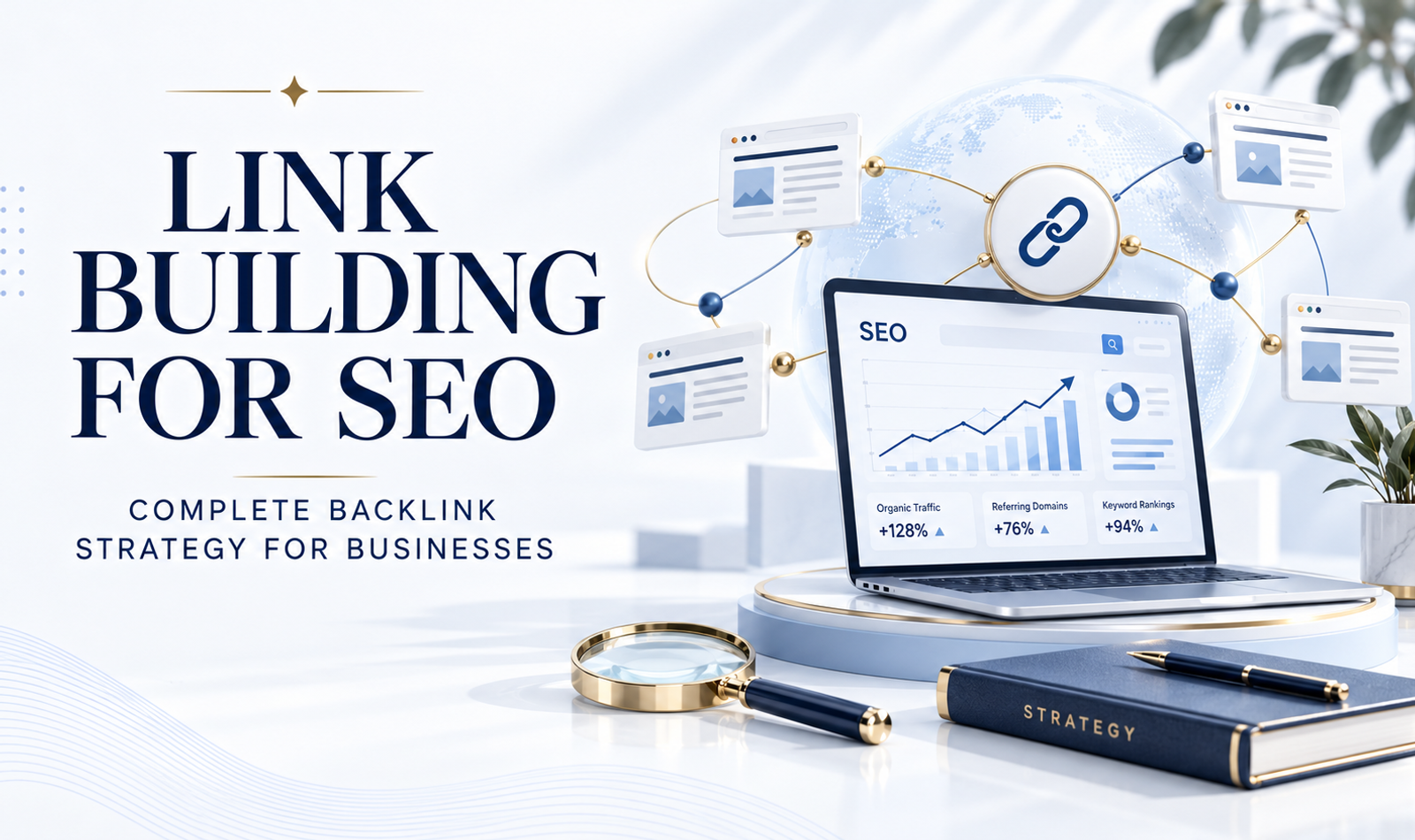
Link Building for SEO: Complete Backlink Strategy for Businesses
A strong online presence requires more than an attractive website and well-written content. Businesses also need to establish credibility, attract relevant audiences, and make their websites discoverable across the digital landscape. One important part of this process is link building for SEO.
Link building involves earning hyperlinks from other websites that direct users to your own website. These links, commonly known as backlinks, can support website discovery, referral traffic, brand visibility, and organic search performance.
However, modern link building is not simply about collecting hundreds or thousands of backlinks. Search engines have become increasingly sophisticated at identifying manipulative linking practices, making quality, relevance, and editorial value essential considerations.
For businesses, the objective should be to build a natural and relevant backlink profile that supports sustainable growth rather than pursuing artificial ranking improvements.
At Double Trouble Studio, we understand that successful SEO requires a combination of technical optimisation, valuable content, structured website architecture, and meaningful digital visibility.
This guide explains what backlinks are, how they work, the best link-building strategies for businesses, common mistakes to avoid, and how to develop a practical backlink acquisition plan that supports long-term organic growth.
What Is Link Building in SEO?
Link building is the practice of earning or acquiring hyperlinks from external websites that point to pages on your website.
A hyperlink allows users to move between online resources. When another website links to your business website, it creates an external reference that may introduce your content to a new audience.
For example, imagine a marketing agency publishes a detailed research report about website conversion rates in the hospitality industry. An established business publication may reference that report in an article about digital marketing performance.
When the publication links to the original report, the agency receives a backlink.
Such references can be useful because readers may discover the agency's expertise through a trusted source. Search engines may also use links when evaluating and discovering web content.
Nevertheless, backlinks should not be treated as guaranteed endorsements or automatic ranking improvements. Their potential value depends on factors such as the relevance of the source, the context of the link, and whether it was placed for genuine editorial reasons.
Businesses exploring a comprehensive organic marketing approach can learn more about professional search engine optimisation services.
Why Are Backlinks Important for SEO?
Backlinks have historically been an important element of how search engines understand connections between webpages.
They can also contribute to business visibility in ways that extend beyond search rankings.
Improving Website Discovery
Links create pathways between websites, helping users and search engine crawlers discover relevant resources.
When an established publication references a new research article, readers who may never have encountered the original website can find it through that link.
However, backlink acquisition should complement—not replace—technical SEO, internal linking, and proper indexing practices.
Supporting Organic Search Visibility
Google uses complex ranking systems that consider numerous signals.
Links may contribute to those systems, but their impact varies, and no individual backlink guarantees improved rankings.
Businesses should therefore avoid strategies that focus exclusively on acquiring links while ignoring website quality and content relevance.
Generating Referral Traffic
A backlink from a relevant website can send visitors directly to your business.
For example, a professional association linking to a detailed industry resource may introduce potential customers already interested in the subject.
These visitors may be more commercially relevant than traffic generated by unrelated websites.
Strengthening Brand Recognition
Online references from relevant publications, organisations, and industry communities can improve brand exposure.
Consistent visibility can help potential customers become familiar with a company and understand its areas of expertise.
This is particularly useful for professional service providers where credibility and trust influence customer decisions.
Quality Backlinks vs Low-Quality Backlinks
Not all backlinks offer the same potential benefits.
A useful backlink generally comes from a website that has a legitimate reason to reference your content and serves an audience that may find the destination valuable.
For example, an editorial citation from a recognised business publication may introduce relevant visitors to a research report.
By comparison, links appearing on unrelated websites created solely to exchange or sell links are unlikely to provide meaningful value.
When evaluating backlink opportunities, examine the source's topical relevance, content quality, readership, editorial standards, and the purpose of the link.
Many SEO professionals use third-party metrics such as Domain Authority, Domain Rating, or Authority Score to compare websites.
These can be helpful research indicators, but they are not official Google ranking scores and should never be treated as definitive measures of backlink quality.
The objective is not to obtain the greatest number of links. It is to earn links that make sense for your business, content, and audience.
Understanding Different Types of Backlinks
Backlinks can contain attributes that help search engines interpret their relationship to the linking page.
Regular Editorial Links
A regular hyperlink without special qualifying attributes is often described in the SEO industry as a dofollow link.
There is no separate HTML attribute required to make a link dofollow.
These standard links may be considered by search engines when evaluating and discovering content.
However, editorial links should arise naturally from the linking website's decision to reference your resource.
Nofollow Backlinks
A nofollow link includes the rel="nofollow" attribute.
Google treats this attribute as a hint when determining how the link should be considered.
Nofollow links can still provide referral traffic and brand exposure, so businesses should not automatically dismiss them.
Sponsored Backlinks
Sponsored links use the rel="sponsored" attribute to identify links associated with advertisements, sponsorships, or other compensated arrangements.
This distinction is important because paid advertising is legitimate, but buying links intended to manipulate rankings violates Google's link spam policies.
UGC Backlinks
The rel="ugc" attribute is commonly used for links appearing in user-generated content, such as forum posts and comments.
These attributes help identify the nature of links rather than ranking them into universal categories of good and bad.
How to Build an Effective SEO Backlink Strategy
A successful backlink strategy begins with an understanding of business goals rather than an arbitrary target for the number of links acquired.
Businesses should first identify their most valuable website pages, the audience they want to attract, and the content that could reasonably earn editorial attention.
The next step involves evaluating existing backlinks, reviewing competitor visibility, and identifying relevant publications or communities.
A practical strategy should also include content development, outreach planning, campaign measurement, and risk management.
For example, a B2B technology business may focus on original technical research and industry publications.
A local hospitality company may pursue regional media coverage, tourism associations, and relevant community references.
Different industries require different approaches, and an effective strategy should reflect those differences.
1. Create High-Quality, Link-Worthy Content
One of the most sustainable ways to earn backlinks is to publish resources that people genuinely want to reference.
Link-worthy content usually offers information that is useful, original, credible, or difficult to find elsewhere.
Examples include detailed research reports, practical guides, calculators, checklists, industry surveys, technical tutorials, and original case studies.
For instance, a website development agency could publish a detailed analysis of common technical problems affecting business websites.
If the research methodology is clear and the findings provide useful insight, industry bloggers and publications may choose to cite the study.
The most important consideration is whether the content provides genuine value.
Publishing long articles alone does not guarantee that other websites will link to them.
Businesses need information that contributes something meaningful to the subject.
A structured content strategy for brand websites and blogs can help identify suitable research and educational content opportunities.
2. Use Digital PR to Earn Editorial Backlinks
Digital public relations can support link building by creating newsworthy stories that journalists and publishers may want to cover.
A digital PR campaign might involve original industry research, expert commentary, useful datasets, or genuinely significant business developments.
For example, a hospitality marketing agency may conduct research into how consumers discover and evaluate luxury hotels.
If the findings offer meaningful insights, business or hospitality publications may decide to reference the research.
These editorial references may include links to the original source.
However, publishers control their own editorial decisions, and media coverage does not guarantee a backlink.
Digital PR should therefore be measured through a broader combination of media relevance, brand mentions, readership, referral visits, and earned links.
Businesses interested in connecting public relations with online visibility can explore PR and media marketing services.
3. Conduct Competitor Backlink Analysis
Competitor backlink analysis helps businesses understand which websites reference similar organisations and what types of content attract attention within their industry.
Tools such as Ahrefs and Semrush can help identify referring domains, linked pages, and potential content opportunities.
The objective is not to copy every competitor backlink.
Instead, review why particular resources earned references.
For example, a competitor may have published an original industry survey that several publications cited.
This may reveal an opportunity to create your own useful research addressing a related but underserved question.
Competitor analysis can also identify professional associations, reputable directories, and relevant publications that may be worth investigating.
Each opportunity should be evaluated individually based on relevance, credibility, and audience value.
4. Build Backlinks Through Guest Contributions
Guest contributions involve sharing useful knowledge with relevant third-party publications.
When approached responsibly, this can introduce a business to new audiences and establish professional credibility.
For example, an SEO specialist may contribute an article explaining website migration challenges to a recognised technology publication.
The article should primarily serve the publication's readers.
Any backlink should be editorially appropriate rather than inserted for the sole purpose of influencing search rankings.
Businesses should avoid large-scale guest posting campaigns designed around keyword-rich backlinks.
Google's spam policies specifically address manipulative article campaigns.
The goal of guest contributions should be to share genuine expertise, develop professional relationships, and reach relevant readers.
5. Explore Broken Link Building Opportunities
Broken link building involves identifying external references that no longer lead to working resources.
If your website provides a relevant replacement, you may suggest it to the website owner.
For example, an educational article may link to an outdated SEO guide that has been removed.
If your business publishes a genuinely useful guide covering the same information, the publisher may consider updating the broken reference.
The suggested resource should closely match the original link's purpose.
A commercial landing page is generally not an appropriate replacement for an unrelated educational article.
Broken link building works best when outreach is selective, respectful, and focused on improving the reader's experience.
6. Earn Links from Industry Resource Pages
Some professional organisations and educational websites maintain curated lists of useful industry resources.
These pages may include links to practical guides, research reports, tools, and specialist organisations.
If your business has developed a genuinely useful resource, it may be appropriate to suggest it for consideration.
Before contacting the publisher, review the resource page's audience and existing recommendations.
The outreach message should explain the value your content provides.
Avoid submitting your website to unrelated resource pages or directories merely to increase backlink counts.
The opportunity should make sense for both the publisher and the reader.
7. Develop Local SEO Backlinks
Local businesses can earn relevant visibility through legitimate organisations and publications connected to their geographic market.
Potential opportunities include local media, professional associations, chambers of commerce, relevant community initiatives, and credible regional directories.
For example, a Mumbai-based company participating in a recognised industry event may receive coverage from a regional business publication.
A restaurant may be featured in a local hospitality guide, while a professional services company may appear in a relevant association directory.
These references should be based on authentic business activity.
Creating artificial networks of location-based websites or purchasing irrelevant directory placements is not a sustainable local SEO strategy.
For businesses targeting customers in Maharashtra, professional SEO services in Mumbai can form part of a broader location-focused search strategy.
8. Build Links Through Professional Partnerships
Many businesses maintain relationships with suppliers, clients, technology partners, educational institutions, and professional associations.
These relationships can sometimes create legitimate opportunities for online references.
For example, a technology company may be included in a partner directory because it provides a compatible integration.
A marketing agency may contribute research to an industry organisation's report.
A business may also collaborate with another organisation on a genuinely useful educational resource.
These links should exist because they provide relevant information to users.
Businesses should avoid requiring ranking-passing backlinks as contractual obligations or organising excessive reciprocal link exchanges.
Professional partnerships should produce real commercial or educational value independently of SEO considerations.
9. Create Original Research and Industry Reports
Original research is particularly valuable for link earning because it gives publications a specific source to reference.
Businesses can produce useful studies by analysing legitimate internal datasets, conducting transparent surveys, or examining clearly documented public information.
For example, a digital agency might study website performance trends among a defined sample of Indian small businesses.
The resulting report could examine common issues, explain the methodology, and provide practical recommendations.
If the findings are sufficiently useful, journalists or industry professionals may reference the research.
Accuracy matters more than dramatic statistics.
Avoid inventing percentages, exaggerating small samples, or presenting unsupported industry claims.
Transparent, credible research helps the content remain valuable beyond the immediate backlink campaign.
10. Create Effective Backlink Outreach Campaigns
Backlink outreach involves contacting relevant publishers, journalists, or website owners about a useful resource.
The strongest outreach campaigns begin with careful research.
Identify publications that regularly cover topics related to your expertise.
Read their recent content and determine whether your resource could add meaningful value.
A personalised outreach message should briefly explain why the information is relevant.
For example, an agency that has published original research may highlight a specific finding that supports a journalist's recent article.
Avoid sending generic mass emails asking unrelated websites to provide backlinks.
A publisher should have a genuine editorial reason to consider the resource.
Follow-up communication should remain professional and limited.
The objective is to establish useful relationships rather than pressure recipients into linking.
11. Understand Anchor Text Optimisation
Anchor text is the clickable text used in a hyperlink.
It provides context about the linked destination.
For example, an article discussing technical search optimisation might link to a guide using descriptive wording such as technical SEO foundations.
Meaningful anchor text helps readers understand where the link will take them.
However, businesses should avoid trying to control every anchor used in external backlinks.
Naturally earned references may use brand names, article titles, descriptive phrases, or plain URLs.
Excessive use of identical, keyword-heavy anchors across artificially acquired links can indicate manipulative linking activity.
The best approach is to prioritise accurate, natural descriptions and allow external publishers to make appropriate editorial choices.
12. How to Audit Your Website's Backlink Profile
A backlink audit involves reviewing websites that currently link to your domain.
The objective is to understand link sources, identify useful references, and recognise potential issues.
Start with available link information from Google Search Console and reputable third-party SEO tools.
Review referring domains, commonly linked pages, anchor text patterns, and relevant referral traffic.
Pay particular attention to valuable links pointing to broken or outdated pages.
These may reveal opportunities to restore useful resources or implement appropriate redirects.
Be cautious when interpreting so-called toxic backlink scores.
Third-party tools may classify links as suspicious based on proprietary criteria, but those labels are not equivalent to an official Google penalty.
Google's systems can identify and ignore many forms of link spam.
The disavow tool should be used cautiously, particularly when there is a substantial pattern of unnatural links associated with a manual action or a credible risk of one.
Businesses should avoid disavowing large numbers of links simply because a commercial tool assigns them a low score.
13. Best Tools for Backlink Research and Monitoring
Several SEO tools can assist businesses with backlink analysis and outreach planning.
Google Search Console provides information about links discovered by Google's systems, although the available reports do not provide a complete list of every backlink.
Ahrefs and Semrush offer third-party backlink databases, competitor analysis, and research features.
Majestic provides additional link analysis metrics.
Screaming Frog can help examine internal links, redirects, broken pages, and website architecture.
Spreadsheets and outreach management systems are also useful for tracking contacts, publication opportunities, and campaign outcomes.
Each platform uses different methods and datasets.
Businesses should compare information carefully and avoid assuming that every reported metric represents Google's own evaluation.
14. Common Link Building Mistakes to Avoid
One of the biggest link building mistakes is purchasing inexpensive backlink packages that promise immediate improvements in Google rankings.
These services may rely on automated websites, unrelated directories, or manipulative link networks.
Another mistake is focusing only on the number of acquired links.
A backlink campaign should be evaluated according to relevance, editorial quality, traffic, and business outcomes rather than volume alone.
Businesses also make mistakes when they publish low-value content and expect external websites to reference it.
A resource must provide a meaningful reason for another website to link to it.
Poor outreach practices can create additional problems.
Generic emails, irrelevant requests, and excessive follow-ups can damage professional relationships.
Finally, link building should never replace technical SEO or content improvement.
Businesses should address indexing problems, website usability, content relevance, and internal navigation alongside external visibility efforts.
15. A Practical 90-Day Backlink Strategy for Businesses
A structured 90-day plan can help businesses establish a repeatable process for earning relevant backlinks.
This framework focuses on building a sustainable workflow rather than promising a fixed number of links.
Days 1–30: Research and Preparation
Begin by reviewing your website's existing backlink profile, content quality, and most valuable pages.
Identify relevant competitors and investigate the publications that reference their useful resources.
Select potential link-worthy content opportunities based on your expertise and the needs of your target audience.
Develop a shortlist of relevant websites, journalists, professional associations, and industry publications.
At the end of the first month, the business should have a clear campaign plan, a prioritised outreach list, and a defined content asset to develop.
Days 31–60: Content Development and Outreach
Use the second month to create or improve resources that may attract genuine editorial references.
This could involve an original research report, detailed industry guide, useful tool, or practical educational resource.
Check the accuracy of information and ensure that supporting sources are properly identified.
Once the resource is ready, begin contacting relevant publications.
Personalise outreach messages according to the publisher's audience and existing coverage.
Document responses and focus on developing professional relationships.
Days 61–90: Monitoring and Optimisation
During the third month, review campaign performance.
Identify whether relevant publications have referenced the content, whether referral traffic has increased, and whether new opportunities have emerged.
Monitor organic search performance without assuming that every ranking change results from link-building activity.
Update the content where additional details would improve its usefulness.
Review which outreach approaches produced meaningful conversations and which did not.
Use these findings to refine the strategy for the next quarter.
16. How to Measure Link Building Success and SEO ROI
Measuring link building performance requires more than counting backlinks.
Referring domains can provide an indication of how widely the website is referenced, but quality and relevance matter more than the raw count.
Referral traffic helps businesses understand whether external links are introducing actual visitors.
Website analytics can show whether those visitors engage with content, submit enquiries, or complete other meaningful actions.
Organic search performance should also be monitored through impressions, clicks, and relevant search queries.
However, SEO performance changes for numerous reasons.
Website updates, technical improvements, competitive activity, content changes, and search engine adjustments can all influence results.
Businesses should therefore avoid attributing every ranking improvement to individual backlinks.
For lead-generation companies, the most important outcomes may include qualified enquiries, booked consultations, and customer acquisition.
An effective link-building strategy should ultimately contribute to business visibility and meaningful commercial opportunities.
17. Link Building and AI Search Visibility
The increasing use of AI-powered search tools has created new interest in how businesses are discovered and referenced online.
Traditional backlinks and brand mentions can both contribute to broader digital visibility, but they are not interchangeable.
A backlink is a clickable reference from one webpage to another.
A brand mention is a reference to an organisation, which may or may not include a link.
AI-powered search systems use different approaches to retrieving and presenting information.
There is no universal formula guaranteeing that backlinks will cause a business to appear in an AI-generated answer.
Businesses interested in Generative Engine Optimisation should focus on accurate information, useful expertise, reputable coverage, and a clearly structured website.
Original research and credible editorial references can contribute to an organisation's broader information presence.
However, manufacturing backlinks or purchasing brand mentions should not be presented as a guaranteed AI visibility strategy.
18. How Link Building Fits into a Complete SEO Strategy
Backlink acquisition works best when the website already provides a strong foundation for visitors.
A business may earn a relevant editorial reference, but that opportunity can be weakened if the linked page is difficult to navigate, contains outdated information, or fails to answer the reader's question.
Technical performance, content relevance, website design, and internal linking are therefore closely connected with external visibility.
For example, a research article attracting backlinks should be accessible, clearly organised, and connected to related website resources.
Readers should be able to explore additional information without encountering broken links or confusing navigation.
Businesses seeking improvements to their website foundation can explore website development and management services.
A complete SEO strategy aligns valuable content, appropriate technology, organic search objectives, and meaningful user experiences.
19. How Double Trouble Studio Supports SEO and Digital Growth
Developing a sustainable search presence requires a clear understanding of business goals, audience needs, website performance, and competitive positioning.
At Double Trouble Studio, we approach SEO as part of a broader digital marketing strategy rather than an isolated ranking exercise.
Our work across digital services focuses on helping businesses strengthen their online presence through relevant content, website improvements, search-focused planning, and appropriate opportunities for brand visibility.
Depending on the agreed project scope, SEO planning may involve keyword analysis, website audits, content strategy, internal linking improvements, performance measurement, and coordination with wider digital communication activities.
Our SEO services in Mumbai provide a starting point for businesses looking to improve their organic search strategy.
For businesses seeking stronger media recognition, PR and media marketing services can form a complementary part of their brand communication efforts.
The goal is to develop a digital presence that attracts relevant audiences and supports long-term business growth.
Frequently Asked Questions About Link Building for SEO
1. What is link building in SEO?
Link building is the process of earning or acquiring hyperlinks from external websites that point to your website. These links can help users discover your content, introduce referral traffic, and contribute to broader organic search visibility. Effective link building focuses on relevant editorial references rather than artificially increasing backlink numbers.
2. Why are backlinks important for SEO?
Backlinks can help search engines discover pages and understand relationships between online resources. They may also contribute to ranking systems and provide referral traffic. However, backlinks are only one aspect of SEO, and rankings depend on numerous other factors, including content relevance and technical website quality.
3. How many backlinks does a website need to rank?
There is no fixed backlink requirement for ranking on Google. Different search queries have different levels of competition, and link quantity alone does not determine rankings. Businesses should prioritise useful content and relevant editorial references rather than setting arbitrary backlink targets.
4. What is the difference between backlinks and internal links?
Backlinks connect an external website to your website, while internal links connect pages within the same website. Backlinks can introduce visitors from external sources, whereas internal links primarily help users navigate related content and support website discovery.
5. What makes a backlink high quality?
A high-quality backlink typically comes from a relevant, credible website with a genuine reason to reference your content. The linking page's subject, audience, editorial standards, and context are important considerations. Third-party authority scores can support research but should not be treated as official Google metrics.
6. Is buying backlinks against Google's guidelines?
Buying or selling links intended to manipulate search rankings violates Google's spam policies. Legitimate paid advertising and sponsorships can include appropriately qualified links, such as those using the sponsored attribute. Businesses should avoid paid link schemes designed to transfer ranking credit.
7. What is white-hat link building?
White-hat link building generally refers to practices that seek relevant links without manipulating search engine ranking systems. Examples include producing useful resources, publishing original research, contributing legitimate expertise, and earning editorial coverage through digital PR.
8. Are nofollow backlinks valuable?
Nofollow backlinks can provide referral traffic, brand exposure, and useful audience connections. Google treats the nofollow attribute as a hint. A nofollow link from a relevant publication may therefore have meaningful business value even without a measurable ranking impact.
9. What is digital PR link building?
Digital PR link building involves developing useful research, expert insights, or newsworthy stories that publishers may choose to reference. These campaigns can support brand visibility and create opportunities for editorial backlinks. However, coverage and links depend on independent publisher decisions.
10. How can small businesses build backlinks?
Small businesses can pursue legitimate local business references, industry associations, community involvement, useful educational content, and relevant media opportunities. The best methods depend on the company's expertise, geographic market, and target audience.
11. What is competitor backlink analysis?
Competitor backlink analysis examines websites that reference competing businesses. It can help reveal relevant publications, content opportunities, and industry relationships. Businesses should use this information to inform their strategy rather than copying every competitor link.
12. How long does link building take to show SEO results?
There is no guaranteed timeline. Earning useful backlinks may require content development, outreach, and relationship building. Organic search performance also depends on other factors, so businesses should evaluate progress over time using visibility, referral traffic, and qualified lead metrics.
13. What are toxic backlinks?
Toxic backlinks are a term used by some SEO tools to describe links they consider suspicious or potentially low quality. Their scoring systems are proprietary and do not represent official Google penalties. Businesses should investigate significant unnatural linking patterns rather than automatically disavowing links based on a tool score.
14. Which tools are best for backlink analysis?
Google Search Console, Ahrefs, Semrush, and Majestic are commonly used for backlink research. These tools provide different databases and metrics. Screaming Frog can also help identify internal linking and technical website issues that affect content discovery.
15. Can backlinks improve AI search visibility?
Backlinks and editorial references can support broader online discoverability, but there is no guarantee that they will cause a website to appear in AI-generated search responses. Businesses should focus on accurate content, genuine expertise, reputable references, and clear website information.
Conclusion: Build Backlinks That Support Sustainable Business Growth
Link building remains an important component of search engine optimisation, but businesses should approach it with a long-term perspective.
The purpose of a backlink strategy is not simply to increase the number of external websites linking to a domain.
Instead, it should help a business earn meaningful references, reach relevant audiences, strengthen digital visibility, and support organic search growth.
High-quality content, original research, digital public relations, industry relationships, and thoughtful outreach can create opportunities for legitimate backlinks.
At the same time, businesses should avoid manipulative practices such as paid ranking-passing links, automated backlink networks, and excessive link exchanges.
A successful strategy also depends on a strong website foundation, including useful content, technical optimisation, internal linking, and a positive user experience.
When these elements work together, link building can contribute to a more credible and discoverable online presence.
At Double Trouble Studio, we believe SEO should connect search visibility with genuine business outcomes.
Whether your company needs a structured SEO strategy, stronger website content, improved technical performance, or wider digital visibility, sustainable growth begins with the right planning approach.
Looking to strengthen your website's SEO and organic visibility?
Connect with Double Trouble Studio to discuss your website, content opportunities, backlink strategy, and broader digital marketing objectives.
Contact Double Trouble Studio to explore an SEO approach tailored to your business.
📩 Email: info@dtsworld.in 📞 Phone: +91 80000 06021 📍 Location: Andheri (West), Mumbai.
Need this for your brand?
Let DTS build your next campaign.
From PR, celebrity management and events to websites, social media, SEO and AI video production — Double Trouble Studio helps brands grow with strategy and execution.
Discuss Your Requirement →