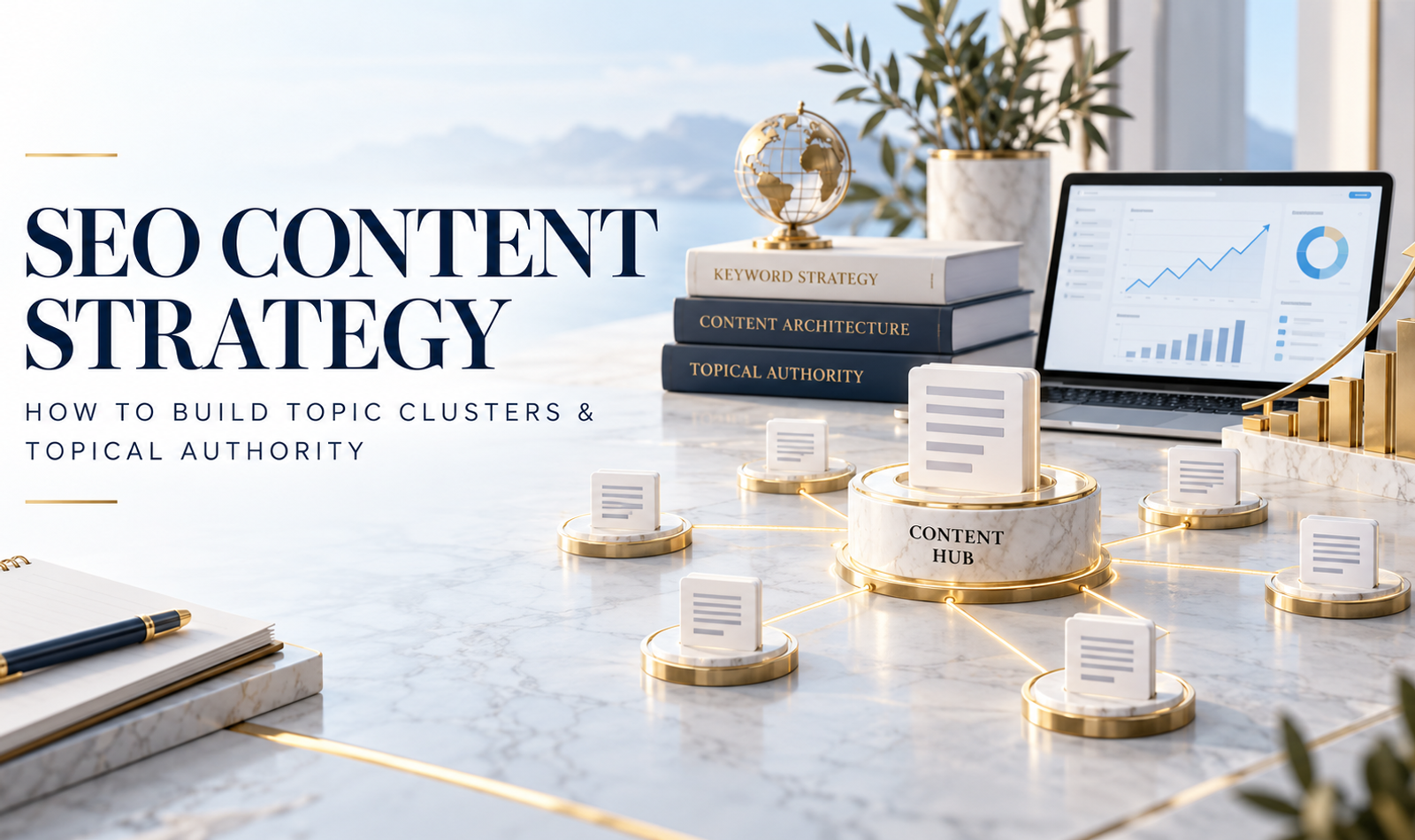
SEO Content Strategy: How to Build Topic Clusters & Topical Authority
Publishing blog posts regularly is no longer enough to build a successful organic search presence. Businesses need a structured SEO content strategy that helps search engines understand their website, answers customer questions, and connects relevant information with products or services that generate revenue.
Many companies invest in content marketing without developing a clear relationship between their articles. They publish blogs about different subjects, target unrelated keywords, and expect organic traffic to increase simply because more content is available.
The problem is that content quantity does not automatically create search visibility, credibility, or business growth.
A well-planned SEO content strategy focuses on subject relevance, search intent, content quality, website architecture, and internal linking. Instead of treating every article as an independent page, businesses organise their content into connected groups that explore important topics in meaningful depth.
This approach is commonly known as topic cluster SEO, and it is often used to develop what marketers call topical authority.
For example, a digital marketing company offering SEO services could create a comprehensive guide to search engine optimisation, supported by articles about keyword research, technical SEO, on-page optimisation, local SEO, and content strategy. These resources would connect through relevant internal links, creating a more useful learning experience while guiding potential customers toward suitable services.
At Double Trouble Studio, we approach search visibility as a combination of strategic content planning, website structure, technical optimisation, and business-focused digital marketing.
In this guide, we explain what topic clusters are, how topical authority works, how to create effective pillar pages, and how businesses can develop a scalable SEO content strategy that supports organic visibility, customer engagement, and qualified lead generation.
What Is an SEO Content Strategy?
An SEO content strategy is a structured approach to planning, creating, optimising, publishing, and improving website content to satisfy relevant search queries and support measurable business objectives.
Unlike general content marketing, which may focus broadly on engagement, brand storytelling, or audience awareness, SEO content planning considers how potential customers search for information and what kind of content best satisfies their needs.
A successful strategy begins by identifying the subjects most closely related to a company's products, services, and audience.
These subjects are then researched to understand search demand, keyword variations, user intent, competition, and opportunities for valuable content.
The next step involves organising those opportunities into a logical website structure that connects educational resources, service pages, landing pages, and conversion pathways.
For example, a website development agency might focus on website design, development platforms, performance optimisation, website maintenance, conversion rate optimisation, and technical SEO.
Each subject could support multiple articles answering specific questions while connecting to relevant commercial service pages.
A strong SEO content strategy should therefore address three fundamental questions: what does the audience need to know, how can the business provide useful answers, and how does that information connect to the company's services?
Businesses looking to develop a broader organic growth plan can explore our search engine optimisation services.
What Are Topic Clusters in SEO?
Topic clusters are groups of interconnected website pages that cover a broad subject and its related subtopics in an organised structure.
The approach typically includes one central pillar page and several supporting cluster pages.
The pillar page introduces and explains the main subject comprehensively, while cluster pages explore individual components in greater detail.
Relevant internal links connect these pages, helping readers move between general explanations and specialised information.
For example, a business targeting the broad subject of search engine optimisation might create a pillar page titled "Complete Guide to SEO for Businesses."
Supporting cluster articles could explain SEO keyword research, technical SEO, local search optimisation, content marketing, internal linking, and SEO performance measurement.
A reader interested in one area can navigate to a detailed explanation without leaving the website.
At the same time, the pillar page provides a central resource that introduces the subject and directs users toward related content.
The objective is not simply to increase the number of links. It is to create a logical information structure where each page serves a distinct purpose.
A topic cluster works best when its pages answer different but related search questions without unnecessarily duplicating one another.
What Is Topical Authority in SEO?
Topical authority is an SEO industry concept describing how comprehensively, accurately, and credibly a website covers a particular subject.
A website demonstrates subject expertise when it consistently provides useful information that addresses the needs of its intended audience.
For example, a company offering professional website development services may build a strong body of content covering design principles, development processes, website performance, maintenance, security, and related digital technologies.
Over time, this collection can become a useful resource for people researching website development.
However, topical authority should not be confused with an official Google ranking score.
Google does not provide website owners with a universal numerical topical authority metric, and publishing numerous related articles does not guarantee better rankings.
Search visibility depends on multiple factors, including content usefulness, relevance, technical accessibility, competition, and the overall search experience.
Topic clusters are valuable because they encourage systematic content coverage, purposeful internal linking, and better navigation.
Their success ultimately depends on whether the content genuinely serves users.
Why Topic Clusters Matter for SEO and Business Growth
A topic cluster strategy can improve several aspects of a website's content architecture.
First, it helps businesses organise information around subjects that matter to their customers. Rather than publishing disconnected articles, the website develops clear content categories and relationships.
Second, topic clusters can improve internal navigation. Visitors who arrive through one search query can discover relevant supporting information without conducting another search.
Third, a connected content structure helps search engines discover pages through crawlable internal links and understand the context of linked resources.
Fourth, topic clusters support different stages of the customer journey.
Some visitors may be researching a broad problem, while others are comparing solutions or preparing to contact a service provider.
A well-designed cluster can provide useful information for each stage without forcing every article to function as a sales page.
For instance, someone reading about technical SEO might later explore website performance optimisation or professional SEO services.
A relevant internal link can make that transition easier.
An effective topic cluster strategy therefore supports both search visibility and commercial relevance.
Understanding Pillar Pages, Cluster Content and Internal Linking
The success of a topic cluster depends on three interconnected components.
1. Pillar Pages: The Central Resource
A pillar page is a comprehensive resource covering the major aspects of a broad subject.
Its purpose is to introduce the topic, answer foundational questions, and guide readers toward more specialised information.
For example, a pillar page about search engine optimisation may explain how SEO works, its main categories, common strategies, and important performance indicators.
The page should provide sufficient value to stand independently while linking to supporting content where additional detail is helpful.
A pillar page does not need to include every possible detail about a subject. Its value comes from covering the topic logically and directing readers toward relevant deeper resources.
Pillar pages may be educational guides or commercially oriented category pages, depending on the subject and search intent.
2. Cluster Content: Supporting Articles
Cluster content consists of focused pages that examine specific areas within the broader subject.
For an SEO pillar page, supporting articles might explain keyword research, technical audits, title tags, search intent, content optimisation, and local SEO.
Each cluster article should target a distinct question or search need.
For example, an article explaining how to conduct keyword research should provide actionable research methods rather than repeating the same general SEO introduction found on the pillar page.
High-quality cluster content may include examples, comparisons, frameworks, explanations, and practical recommendations.
The content should be useful even when read independently.
3. Internal Links: Connecting Related Resources
Internal linking creates pathways between the pillar page, cluster articles, and other relevant pages on the website.
These links help users discover useful information while allowing search engines to follow relationships between pages.
For example, an article discussing site architecture could link to a guide on technical SEO foundations, website speed, and Core Web Vitals.
Similarly, a broader SEO article may link to a detailed resource explaining content development or conversion-focused website design.
Internal links should use meaningful anchor text that describes the linked destination.
Avoid inserting links solely to reach a predetermined number or repeatedly using identical, keyword-heavy anchor text.
The primary purpose of every link should be to help readers understand the subject or take a relevant next step.
How to Build an SEO Topic Cluster Strategy: Step by Step
Building an effective topic cluster requires research, planning, content creation, and ongoing evaluation.
The process should begin with business objectives rather than a list of random keywords.
Step 1: Identify Your Core Business Topics
Start by identifying the primary products, services, and areas of expertise that define your business.
These are the subjects for which your website should become a useful information resource.
For example, a digital marketing agency might prioritise search engine optimisation, social media marketing, website development, paid advertising, and marketing automation.
Each subject can eventually support a separate content cluster.
However, businesses should avoid creating clusters for unrelated subjects simply because those keywords appear popular.
A topic should have a clear relationship to the audience, the company's expertise, and its commercial objectives.
A service-based company may find it helpful to organise content around the questions customers ask before purchasing a service.
For example, a website development company might frequently receive questions about website costs, platform selection, development timelines, maintenance, and redesign decisions.
These questions can become the foundation of a useful content strategy.
Step 2: Conduct Keyword Research and Understand Search Intent
Once the core topics are identified, conduct keyword research to discover how people search for information within each subject.
Keyword research can reveal common questions, terminology variations, commercial queries, and gaps in existing content.
However, search volume alone should not determine which keywords receive priority.
A keyword with high traffic potential may attract visitors who have little interest in purchasing your services.
Meanwhile, a more specific query with lower search volume may attract users who are actively comparing providers or preparing to make a decision.
For example, "what is SEO" generally represents an informational need, while "SEO agency in Mumbai" can indicate commercial investigation or service-purchase intent.
Both queries may be valuable, but they require different content approaches.
Search intent is commonly divided into informational, navigational, commercial, and transactional categories.
Understanding these categories helps marketers decide whether a keyword should be targeted through a blog article, service page, comparison guide, or landing page.
The goal is to create content that answers the actual question behind the search.
Step 3: Group Related Keywords into Topic Clusters
After gathering keyword ideas, organise them into groups based on meaning and search intent.
This process is called keyword clustering.
For example, keywords such as "technical SEO audit," "website crawl errors," and "technical SEO checklist" may belong to the same broader technical optimisation topic.
However, they do not automatically need separate pages.
A business should examine whether the queries represent substantially different user needs before deciding how many articles to create.
If two keywords require nearly identical explanations, combining them into one strong article may be more useful than publishing duplicate content.
On the other hand, if one query requires a comprehensive technical guide and another requires a specific troubleshooting tutorial, separate pages may be appropriate.
Effective keyword clustering focuses on user intent rather than superficial similarities between phrases.
Step 4: Select the Right Pillar Page
Once the cluster structure is established, identify the central resource that should serve as the pillar page.
The pillar page should cover a meaningful broad subject without becoming so general that it loses relevance.
For example, "Digital Marketing" may be too broad for a focused cluster targeting a specific service.
A more useful pillar topic could be "Search Engine Optimisation for Business Websites."
The page can explain the subject comprehensively while linking to detailed supporting articles.
Before creating a new pillar page, review the website's existing content.
Sometimes a strong service page or established guide already provides an appropriate central resource.
Creating another page targeting nearly the same purpose could introduce unnecessary duplication.
For businesses offering professional development services, their website development and management page may provide a commercial destination for related educational articles.
Step 5: Create Comprehensive Supporting Content
Supporting articles should answer the specific questions identified during keyword research.
Each article needs a clear purpose, suitable depth, and useful information that goes beyond generic definitions.
For example, a supporting article on technical SEO should explain important technical concepts, common problems, diagnostic methods, and practical improvements.
A cluster article about SEO content planning should describe keyword selection, editorial workflows, content structure, and performance measurement.
Avoid creating articles that repeat the same information with minor changes in wording.
The purpose of supporting content is to expand the website's usefulness, not simply increase its page count.
Good supporting articles may include step-by-step processes, original examples, useful comparisons, and references to reliable sources.
They should also be reviewed periodically when industry practices or tools change.
Step 6: Build a Logical Internal Linking Structure
Once the pillar and supporting pages are available, connect them with relevant internal links.
A supporting article should link to the central pillar page where it helps readers understand the broader subject.
The pillar page should also link to important supporting resources.
Related cluster pages can link to one another when the relationship is helpful.
For example, a content strategy article may reference content planning for brand websites, blogs, galleries, and lead magnets when discussing how different content formats contribute to a website.
Internal linking should not become a rigid exercise where every page must link to every other page.
The best structure follows genuine relationships between topics and gives readers a clear reason to move from one resource to another.
Step 7: Optimise On-Page SEO Elements
Even well-researched content can underperform when its page structure is confusing or technically inaccessible.
Each page should have a descriptive title, clear main heading, appropriate subheadings, relevant URL, and useful meta description.
The primary keyword should appear naturally where it helps communicate the subject.
Images should include descriptive alternative text when appropriate, and important information should be available in accessible page content.
Where applicable, structured data can help search engines interpret supported content types.
However, adding structured data does not guarantee special search appearances.
A strong content strategy should also consider mobile usability, page performance, crawlability, indexing, and canonical URLs.
These foundations allow useful content to be discovered and presented effectively.
Step 8: Publish Content According to a Strategic Calendar
A content calendar helps teams organise publishing priorities and maintain a consistent workflow.
However, publishing frequency should be based on available resources and content quality rather than arbitrary output targets.
A practical approach is to publish the central pillar resource and then prioritise supporting articles according to business relevance, search demand, and content gaps.
Businesses should also update existing resources instead of continuously producing new articles.
For example, an older article may contain useful information but require updated examples, better organisation, or improved internal links.
Refreshing that article may provide more value than publishing another page on the same subject.
The publishing schedule should therefore balance new content creation with maintenance and optimisation.
Practical Example: Building an SEO Topic Cluster for a Digital Marketing Agency
Consider a digital marketing agency that wants to increase qualified enquiries for SEO services.
Instead of publishing unrelated articles about online marketing, the agency could develop one central SEO topic cluster.
Pillar Page: Complete Guide to SEO for Business Growth
This central resource would explain the fundamentals of SEO, major optimisation categories, search intent, and the relationship between organic visibility and business outcomes.
The supporting articles could cover the following topics.
Cluster Article 1: SEO Keyword Research
This article would explain how to find relevant keywords, evaluate search intent, assess competition, and prioritise search queries that align with business goals.
Cluster Article 2: Technical SEO
This article would discuss website crawlability, indexing, page performance, technical audits, mobile usability, and common technical problems.
Cluster Article 3: On-Page SEO
This guide would explain title tags, headings, content structure, image optimisation, internal links, and other page-level improvements.
Cluster Article 4: Local SEO
This article would focus on location-based search visibility, Google Business Profile optimisation, local landing pages, and customer discovery.
Cluster Article 5: SEO Content Strategy
This resource would explain how to create pillar pages, supporting articles, keyword clusters, and useful content architecture.
Cluster Article 6: SEO Performance Measurement
This article would discuss organic traffic, search impressions, leads, conversions, attribution, and the connection between SEO activity and business results.
Each supporting page would link to relevant resources within the cluster, while the central page would provide navigation to the major topics.
The agency's commercial SEO services page could be linked where visitors are likely to need professional assistance.
This structure allows the website to address educational questions while creating natural pathways toward service enquiries.
How to Create SEO Pillar Pages That Provide Real Value
A successful pillar page should be designed as a useful resource rather than a collection of keyword-heavy paragraphs.
Begin by identifying the primary search intent and the major questions readers expect the page to answer.
Develop a logical structure that introduces the subject before exploring its important components.
The introduction should explain the topic clearly and establish what readers will learn.
Subsequent sections should provide meaningful explanations without forcing users to navigate elsewhere for every basic answer.
Supporting articles can then cover more specialised aspects in greater depth.
For example, a pillar page about website development might explain planning, design, development platforms, testing, launch procedures, and maintenance.
Separate articles could provide detailed comparisons of website platforms, development cost considerations, accessibility, and performance optimisation.
The pillar page should include useful links to those resources where they naturally support the discussion.
A well-designed pillar page can also include diagrams, comparisons, practical examples, and decision-making frameworks.
Its purpose is to make a broad subject easier to understand.
Internal Linking Strategies for Stronger Topic Clusters
Internal links play an important role in helping users navigate content and allowing search engines to discover related pages.
However, not all internal linking strategies provide the same value.
A useful internal link should connect two pages with a genuine contextual relationship.
For example, a blog discussing content strategy may naturally reference website development, search engine optimisation, or conversion-focused landing pages.
A page about improving lead generation may connect to a guide on building conversion-focused marketing funnels.
Descriptive anchor text provides readers with useful context about the destination.
Instead of repeatedly using phrases such as "click here," the link should identify what the reader will learn.
Internal links should also be distributed naturally throughout the article.
Avoid inserting a large collection of unrelated links at the end of a page merely to increase link volume.
Another important practice is ensuring that key pages are not isolated.
An orphan page is a page with no discoverable internal links pointing to it. Important website content should be accessible through a logical navigation or linking structure.
Businesses should periodically audit internal links to identify broken destinations, unnecessary redirects, outdated references, and important pages that need better connections.
How to Perform Content Gap Analysis for Topic Clusters
Content gap analysis helps identify useful subjects that a website has not adequately covered.
The process typically begins with a review of existing website content and competitor resources.
Analyse which topics are already addressed, which customer questions remain unanswered, and where existing articles lack meaningful detail.
Competitor research can reveal potential opportunities, but copying another website's content structure without considering your audience can result in irrelevant publishing priorities.
For example, a competitor may rank for a keyword that receives considerable traffic but has little connection to your business model.
Targeting that keyword may not contribute to qualified enquiries.
Instead, evaluate each opportunity according to audience relevance, search intent, competitive difficulty, business value, and the expertise your organisation can contribute.
A content gap may also involve missing stages of the customer journey.
A website could have numerous introductory guides but very little content helping users compare service options or understand pricing.
Addressing these gaps can make the website more useful to potential customers.
How to Avoid Keyword Cannibalisation in Topic Clusters
Keyword cannibalisation can occur when multiple pages target substantially overlapping search intent without offering sufficiently distinct value.
For example, imagine a website publishing separate articles titled "What Is SEO Content Strategy?", "SEO Content Strategy Explained", and "Complete Guide to SEO Content Strategy."
If all three articles answer the same questions and target the same audience, they may compete for similar search queries and create an unnecessarily fragmented content experience.
However, ranking overlap alone does not prove that cannibalisation is occurring.
Different pages can legitimately appear for similar keywords when they serve different needs.
The correct approach is to evaluate search intent, page purpose, and content overlap.
Where duplication is substantial, businesses may consider consolidating content into one stronger resource and redirecting obsolete URLs appropriately.
Where pages address different needs, clear headings, distinct content, and purposeful internal links can help preserve their individual value.
A content inventory and keyword mapping document can make these decisions easier to manage.
Topic Clusters for Local SEO and Service-Based Businesses
Topic clusters can be particularly useful for businesses serving specific geographic markets.
Local SEO often involves combinations of services, locations, and customer requirements.
For example, a company offering SEO services in multiple cities may need content that explains both its core expertise and the relevance of its services to particular markets.
A broad educational SEO cluster can support service-focused local landing pages.
However, creating dozens of nearly identical city pages with only the location name changed is not an effective content strategy.
Location-specific content should provide meaningful local information, relevant service details, and useful context for the intended audience.
Businesses operating in cities such as Mumbai, Delhi, Pune, and Bengaluru should also consider actual service availability, local competition, and customer needs.
For instance, companies seeking SEO services in Delhi may have market-specific requirements that should be addressed clearly.
Local topic clusters work best when they combine genuine geographic relevance with strong core expertise.
SEO Content Strategy for AI Search and Generative Engine Optimisation
Search behaviour is evolving as users increasingly interact with AI-powered search experiences and conversational answer systems.
This has encouraged greater interest in Generative Engine Optimisation, commonly called GEO.
GEO generally refers to practices intended to make information clear, useful, discoverable, and suitable for interpretation by AI-powered search and answer systems.
There is no universal method that guarantees a website will be quoted or recommended by an AI assistant.
However, several sound content practices remain valuable across traditional and AI-assisted discovery.
Articles should explain important concepts clearly, answer questions directly, use accurate terminology, and provide meaningful supporting context.
Content that includes original insights, relevant examples, transparent authorship, and credible references can provide users with more confidence in its usefulness.
Topic clusters may help by organising subject matter logically across related pages.
For example, a website that clearly explains SEO concepts and provides detailed supporting guides gives readers multiple ways to understand a subject.
However, simply creating a large number of AI-generated articles does not establish expertise.
Businesses should prioritise accuracy, original value, editorial review, and content that reflects genuine knowledge of their services and customers.
How SEO Content Strategy Supports Lead Generation
Organic traffic becomes commercially valuable when it attracts people who are relevant to the business.
A successful SEO content strategy should therefore connect informational content with appropriate commercial opportunities.
Consider a business owner researching website conversion problems.
The person may initially search for educational information about landing page design, website usability, or conversion optimisation.
After reading relevant explanations, the visitor may become interested in professional assistance.
An article about website usability could naturally link to a resource covering UI/UX design principles for high-end brand websites.
From there, a relevant service page can provide further information about professional solutions.
This does not mean every blog post should contain aggressive sales messages.
Instead, the content should guide readers toward the next logical step in their decision-making process.
Educational articles build understanding, comparison content supports evaluation, and commercial pages explain available services.
When these stages are connected thoughtfully, the website becomes more useful while creating opportunities for qualified lead generation.
How to Measure Topic Cluster Performance and SEO ROI
Measuring the performance of an SEO content strategy requires more than monitoring keyword rankings.
Rankings can provide useful information about visibility, but they do not directly show whether website content is generating valuable business outcomes.
Begin by monitoring organic search impressions, clicks, and page-level performance through Google Search Console.
These metrics help identify which pages are appearing for relevant queries and where search visibility may be improving or declining.
Website analytics can provide additional information about visitor behaviour, engagement, and conversions.
For lead-generation businesses, important conversions may include contact form submissions, qualified enquiries, consultation requests, phone calls, or bookings.
Review performance at both the individual page level and the broader topic-cluster level.
A cluster may produce several informational visits before a user converts through a service page.
Because attribution is not always straightforward, businesses should avoid assuming that every conversion can be assigned to one article.
Commercial outcomes should also be evaluated alongside lead quality.
Ten qualified enquiries may be more valuable than thousands of visits from people who have no interest in the company's services.
A mature SEO content strategy measures visibility, relevance, engagement, conversions, and business impact together.
Common SEO Topic Cluster Mistakes to Avoid
Even a well-intentioned topic cluster strategy can underperform when it is executed without sufficient planning.
One common mistake is choosing broad topics with little relationship to the company's actual products or services.
Another is producing a large number of similar articles that provide minimal additional value.
Businesses may also create pillar pages that contain only brief introductions and links, leaving readers without meaningful information.
Poor internal linking can create additional problems. Links inserted without context may confuse visitors rather than help them navigate.
Another mistake is ignoring commercial search intent.
A website may attract substantial informational traffic but fail to provide useful service pages, comparison resources, or conversion pathways.
Technical issues can also limit performance. Important pages may be difficult to crawl, excluded from indexing, or affected by incorrect canonical configurations.
Finally, some organisations treat SEO content as a one-time publishing project.
Content needs periodic evaluation, especially when search behaviour, services, technology, or customer needs change.
The objective should be to maintain a useful and coherent content ecosystem rather than continuously expand page count.
How Long Does It Take to Build Topical Authority?
There is no fixed timeline for building topical authority or improving search visibility through topic clusters.
Results depend on factors such as website history, existing content quality, competition, technical condition, brand visibility, and the relevance of published information.
A newer website operating in a highly competitive market may require substantial work before receiving meaningful organic traffic.
An established website with relevant content and strong technical foundations may be able to improve its structure more quickly.
Businesses should avoid expecting immediate ranking improvements simply because they publish several connected articles.
Instead, content performance should be reviewed over time using search impressions, relevant clicks, indexing status, engagement, and conversions.
The most effective strategy focuses on long-term usefulness and continuous improvement rather than arbitrary promises about ranking timelines.
Creating a Practical 90-Day SEO Content Strategy
A 90-day content plan can provide a useful starting framework for businesses implementing topic clusters.
Days 1–30: Research and Strategy
The first month should focus on understanding business objectives, auditing existing website content, and identifying the most important topic opportunities.
Conduct keyword research, analyse search intent, review competing resources, and select a manageable set of priority subjects.
Map relevant keywords to existing or planned pages.
During this stage, determine whether new pillar pages are required or whether existing resources can be improved.
The main deliverable should be a documented content architecture with clear page purposes and publishing priorities.
Days 31–60: Content Development and Optimisation
The second month should focus on creating or improving the central pillar resource and developing high-priority supporting content.
Writers, editors, designers, and SEO professionals should work together to ensure that every page provides accurate explanations and meets its intended search purpose.
Review headings, page titles, internal links, visual resources, and conversion pathways.
Where technical issues are identified, address them alongside content development.
Publishing should be based on content readiness rather than a fixed volume target.
Days 61–90: Publishing, Linking and Measurement
During the third month, complete relevant supporting articles, refine internal links, and monitor indexing and early search performance.
Review whether important pages are accessible through crawlable links and whether visitors can navigate between related resources easily.
Analyse initial search data, identify underperforming sections, and create a prioritised improvement plan.
At the end of the 90-day period, assess what has been delivered and establish the next content priorities.
This framework represents an implementation schedule, not a promise that rankings or lead generation will reach a particular level within 90 days.
How Double Trouble Studio Helps Businesses Build SEO Content Strategies
Developing a successful content strategy requires alignment between the website, its target audience, business services, and long-term marketing objectives.
At Double Trouble Studio, we understand that organic visibility should contribute to meaningful business outcomes rather than exist as an isolated marketing metric.
Our approach to SEO-focused content planning considers keyword relevance, search intent, website architecture, content quality, internal linking, and opportunities to guide potential customers toward relevant services.
A business may need a complete topic-cluster framework, improvements to existing articles, better service-page connections, or a more structured content publishing plan.
The right priorities depend on the website's current condition, competitive environment, and commercial goals.
Our SEO and search engine optimisation services provide a starting point for businesses seeking to improve their organic presence.
For organisations that also need better website structure, the relationship between content architecture and development can be particularly important.
You can explore more about our work, creative capabilities, and digital services on the Double Trouble Studio About page.
An effective SEO content strategy should be built around the questions your customers genuinely ask and the expertise your business is equipped to provide.
Frequently Asked Questions About SEO Content Strategy, Topic Clusters and Topical Authority
1. What is an SEO content strategy?
An SEO content strategy is a structured plan for researching, creating, organising, optimising, and maintaining website content to address relevant search queries and support business objectives. It involves keyword research, search intent analysis, content planning, website architecture, internal linking, and performance measurement. Its purpose is to produce useful content that attracts relevant audiences rather than simply increasing the number of published articles.
2. What are topic clusters in SEO?
Topic clusters are groups of related pages organised around a central subject. A typical structure includes a pillar page that explains the broad topic and supporting articles that explore individual subtopics. Relevant internal links connect the pages and help readers navigate related information. Topic clusters are a content architecture method, not a guaranteed ranking technique.
3. What is topical authority?
Topical authority is an SEO industry concept referring to the depth, relevance, accuracy, and credibility of a website's coverage of a particular subject. Businesses can work toward stronger subject coverage by publishing useful information, addressing related questions, and demonstrating genuine expertise. However, Google does not publish a universal topical authority score that directly determines website rankings.
4. How do topic clusters improve SEO?
Topic clusters can improve content organisation, internal navigation, and connections between relevant pages. They help website owners cover subjects systematically and provide readers with pathways to detailed information. Search engines can also use crawlable internal links to discover content and understand page relationships. The effectiveness of a cluster depends on content quality, relevance, technical accessibility, and other ranking considerations.
5. What is the difference between a pillar page and a cluster page?
A pillar page covers a broad subject comprehensively and introduces its major components. A cluster page focuses on a narrower question or subtopic within that subject. For example, a general guide to SEO could serve as a pillar page, while articles about keyword research, local SEO, and technical audits could serve as supporting cluster pages.
6. How many articles should a topic cluster contain?
There is no ideal number of articles that applies to every topic cluster. The required content depends on the breadth of the subject, the audience's needs, and the depth of existing resources. Some topics may be covered effectively through a central guide and a small number of supporting pages, while others require more extensive content. Every article should serve a distinct purpose.
7. How do I choose topics for an SEO content cluster?
Begin with your primary products, services, customer questions, and areas of expertise. Conduct keyword research to identify relevant searches and analyse the intent behind them. Group related questions logically and prioritise topics according to audience needs, commercial relevance, competition, and your ability to provide valuable information.
8. What is keyword clustering in SEO?
Keyword clustering is the process of grouping search queries based on their meaning, context, and user intent. The objective is to determine which keywords can be addressed by the same page and which require separate resources. Proper clustering can improve content planning and reduce unnecessary duplication across website pages.
9. How important is internal linking for topical authority?
Internal linking is important for content discovery, navigation, and the organisation of related information. Relevant links help users find supporting resources and allow search engines to discover connected pages. However, adding large numbers of links does not automatically establish topical authority. Links should be contextual, descriptive, and useful to readers.
10. How can I avoid keyword cannibalisation in topic clusters?
Start by mapping each important search intent to an appropriate page. Review whether multiple pages provide substantially similar information or compete to satisfy the same query. Where duplication exists, consider consolidation or clearer differentiation. Avoid creating separate articles solely to target minor keyword variations when one comprehensive resource would better serve users.
11. Can topic clusters help local SEO?
Yes. Topic clusters can connect broad educational content with relevant location-based service pages. For example, a company offering SEO services across several Indian cities might publish detailed resources about SEO practices while maintaining genuinely useful local service pages. Location pages should provide meaningful, specific information rather than duplicated text with different city names.
12. Do topic clusters help with AI search and GEO?
Topic clusters can make website information easier to navigate and organise, which may also support content clarity across AI-assisted search experiences. However, there is no guarantee that creating clusters will cause a website to be cited by AI systems. Accurate explanations, useful examples, credible information, and clearly structured content remain important.
13. How long does it take to see results from an SEO content strategy?
Results vary according to competition, website authority signals, technical condition, existing content, and implementation quality. Some improvements may become visible earlier, while meaningful organic growth can require sustained effort. Businesses should monitor indexing, impressions, relevant clicks, qualified enquiries, and conversions instead of relying on fixed ranking deadlines.
14. What are the best tools for planning SEO topic clusters?
Commonly used tools include Google Search Console, Google Analytics, Google Keyword Planner, Ahrefs, Semrush, and Screaming Frog. These tools serve different purposes, including search performance analysis, keyword discovery, competitive research, technical audits, and website evaluation. Businesses should select tools based on their budget, objectives, and the type of information required.
15. How can businesses measure the ROI of SEO content clusters?
Start by identifying the business outcomes the content is intended to support, such as qualified enquiries, booked consultations, or online purchases. Monitor organic visibility, relevant traffic, conversion activity, and lead quality. Where possible, connect website analytics with customer relationship management data to evaluate how content contributes to revenue. Because customers may interact with several pages before converting, results should be considered across the broader journey.
Conclusion: Build an SEO Content Strategy That Creates Long-Term Business Value
A successful SEO content strategy is not measured by how many blog posts a website publishes. Its value comes from how effectively those pages answer customer questions, organise useful information, support organic visibility, and connect interested visitors with relevant business solutions.
Topic clusters provide a practical framework for organising this content.
By developing comprehensive pillar pages, publishing focused supporting articles, and connecting related resources through meaningful internal links, businesses can create a clearer and more useful website experience.
However, building topical authority requires more than creating clusters or targeting additional keywords.
It depends on subject expertise, content accuracy, original value, consistent maintenance, technical accessibility, and a genuine understanding of audience needs.
Businesses should therefore begin with their core services, conduct thoughtful keyword research, map search intent, and prioritise content that serves both readers and commercial objectives.
Over time, a well-maintained content ecosystem can support stronger search visibility, better user journeys, and more opportunities for qualified lead generation.
At Double Trouble Studio, we believe effective SEO should connect content strategy with meaningful business growth.
Whether your company needs keyword research, topic-cluster development, website optimisation, or a more structured organic marketing approach, the first step is understanding what your customers are searching for and why.
Ready to build an SEO content strategy that supports real business growth?
Connect with Double Trouble Studio to discuss your website, content gaps, keyword opportunities, and organic growth objectives.
Contact Double Trouble Studio to discuss your SEO and content strategy requirements.
📩 Email: info@dtsworld.in 📞 Phone: +91 80000 06021 📍 Location: Andheri (West), Mumbai.
Need this for your brand?
Let DTS build your next campaign.
From PR, celebrity management and events to websites, social media, SEO and AI video production — Double Trouble Studio helps brands grow with strategy and execution.
Discuss Your Requirement →