Content Strategy for Brand Websites: Blogs, Galleries and Lead Magnets
A successful brand website requires more than attractive design and basic information about the business. It needs a clear content strategy that helps the right audience discover the brand, understand its value and move towards a meaningful action.
Many websites are created with a strong visual layout but very little thought about how the content will perform after launch. The homepage contains a headline, the service pages provide short descriptions and the contact page includes a form. Once these pages are published, the website may remain unchanged for months.
This approach limits the website’s potential.
A brand website should function as a growing communication platform. It should answer customer questions, demonstrate expertise, present visual proof and create opportunities for visitors to develop a relationship with the business.
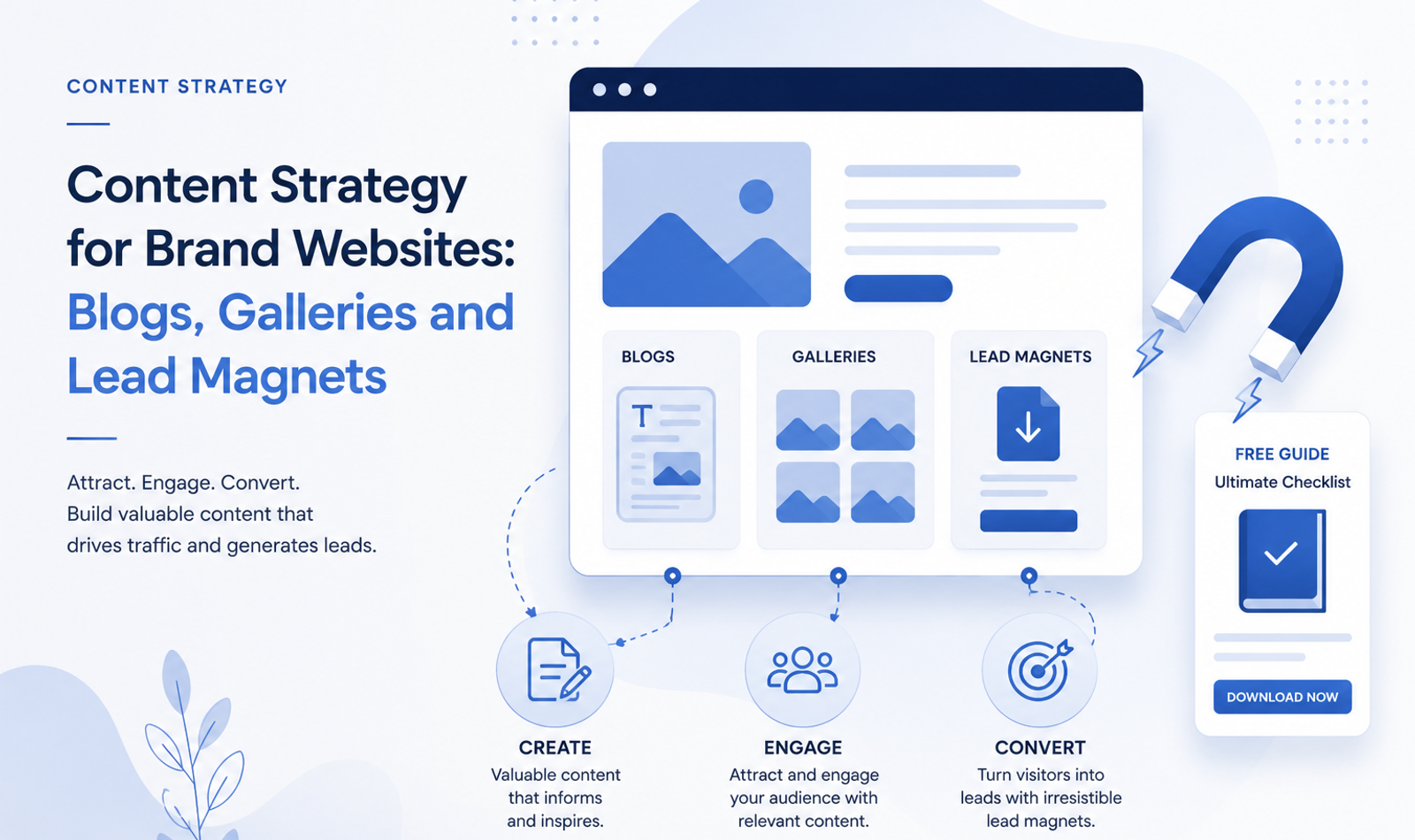
Blogs, galleries and lead magnets are three of the most valuable content assets for achieving these objectives. Each serves a different purpose within the customer journey.
Blogs help the brand address relevant topics, improve organic visibility and educate potential customers. Galleries communicate quality through projects, products, campaigns or experiences. Lead magnets provide additional value in exchange for contact information, helping the business continue communicating with visitors who are not yet ready to purchase.
Professional website development and digital marketing services can help connect these assets through strategy, UX, SEO, technical development and lead-generation systems.
When these elements are planned separately, they may generate limited results. A blog may attract traffic without directing readers towards a service. A gallery may look impressive without explaining the business value behind the work. A lead magnet may collect email addresses from people who have little interest in becoming customers.
A strong content strategy connects all three.
The blog introduces ideas and attracts relevant audiences. The gallery provides evidence that the brand can deliver. The lead magnet allows interested visitors to continue the journey. Service pages, case studies and calls to action then bring these content assets together.
The result is a website that does more than display a brand. It supports awareness, trust, lead generation and long-term business growth.
What Is a Website Content Strategy?
A website content strategy is a structured plan for deciding what information a brand should publish, who the content is intended for, where it should appear and what business purpose it should support.
It covers more than writing blog posts. It includes homepage messaging, service descriptions, portfolio pages, product information, case studies, videos, images, downloadable resources, frequently asked questions and calls to action.
The strategy should define how these elements work together.
Every page should have a clear role. The homepage may introduce the brand and direct users towards major offerings. Service pages explain specific solutions. Blog articles answer questions and attract search traffic. Galleries provide visual evidence. Lead magnets convert interest into a continuing relationship.
Without a strategy, content often becomes inconsistent. Different pages repeat the same claims, important customer questions remain unanswered and calls to action appear without enough context.
A content strategy creates structure. It helps the brand decide which subjects deserve attention and which content formats are most appropriate.
The process begins with the audience. The business must understand who it wants to reach, what those people care about and what information they need before making a decision.
It must also understand its own commercial priorities. A brand seeking premium consulting enquiries will require a different strategy from an ecommerce company launching new products. A wedding management company may rely heavily on visual storytelling, while a technical service business may require more educational content.
The website content strategy should connect audience needs with business goals.
Content Should Reflect the Brand Positioning
Content is one of the clearest expressions of a brand’s positioning.
The design may create an initial impression, but the words, images and stories explain what the brand actually represents.
A premium brand should not rely on generic phrases such as high quality, excellent service or innovative solutions. These claims are used by almost every business and provide little reason for visitors to remember one company over another.
The content should communicate a distinctive point of view.
A luxury interior design studio may focus on personalisation, materials and spatial experience. A technology company may focus on efficiency, reliability and product innovation. A creative agency may communicate strategic thinking, cultural relevance and visual execution.
These ideas should appear consistently across the website.
A detailed luxury brand strategy roadmap can help premium businesses define positioning, audience, emotional territory, competitive difference and brand voice before planning content.
The blog topics should support the brand’s expertise. The gallery should highlight the type of work the business wants to attract. The lead magnet should solve a problem that is relevant to the ideal customer.
When the content strategy is disconnected from the positioning, the brand may attract the wrong audience. For example, a premium service provider that publishes only beginner-level cost-saving content may attract people looking for the cheapest option.
The purpose of content is not simply to generate more traffic. It is to attract attention from people who are likely to value the brand’s offering.
Understand the Audience Before Planning Content
Content becomes effective when it responds to real audience needs.
The business should understand the questions potential customers ask before, during and after their decision. It should identify their concerns, priorities and level of knowledge.
A first-time customer may need an explanation of how a service works. An experienced buyer may want to compare approaches, review previous results and understand what makes the company different.
The audience may also use different language from the business. Internal terminology that feels normal to the team may confuse visitors.
Customer conversations, sales enquiries, search data, social media comments and support questions can provide useful content ideas. Repeated questions often indicate that the website is missing important information.
For example, an event management company may repeatedly receive questions about timelines, venue coordination and guest handling. These topics can become articles, service-page sections, case studies or downloadable planning guides.
An ecommerce brand may notice that customers frequently ask how to choose between products. It can create comparison articles, product guides and interactive recommendations.
Audience research prevents the brand from creating content based only on what the internal team wants to say.
The most valuable content often begins with what the customer needs to understand.
Define the Purpose of Each Content Type
Different content formats perform different roles.
Blogs are generally effective for education, search visibility and thought leadership. Galleries are effective for visual proof, inspiration and quality perception. Lead magnets are effective for capturing interest and beginning a direct communication journey.
These roles can overlap, but each format should have a primary objective.
A blog article should not attempt to function as a complete company brochure. Its first responsibility is to answer the question or topic that attracted the reader.
A gallery should not be treated as a random collection of images. It should help visitors understand the brand’s quality, style or experience.
A lead magnet should not exist only to collect email addresses. It should offer enough value to justify the exchange and should connect naturally to a relevant service or product.
Understanding these differences helps the brand create stronger content.
The strategy should also define how the formats connect. An article about website design trends may link to a gallery of completed websites. The gallery can direct visitors to a case study. The case study can offer a website-planning checklist or consultation.
A structured conversion-focused marketing funnel can help connect awareness content, proof, lead magnets and conversion actions into one continuous journey.
This creates continuity across the website.
Build a Strong Business Blog
A business blog should support both audience needs and commercial positioning.
Publishing articles without a clear theme can create a large collection of disconnected content. The website may cover industry news, internal updates, basic tutorials and promotional announcements without building authority around any particular subject.
A stronger blog is organised around a defined set of topics connected to the brand’s expertise.
A digital agency may publish content across website development, SEO, social media, branding, public relations and AI video. A premium hospitality brand may focus on destinations, experiences, food, local culture and travel planning.
These main subjects can be organised into content categories or topic clusters.
Within each category, the brand can create broad foundational guides and more specific supporting articles. A foundational guide may explain website conversion strategy, while supporting articles address landing pages, calls to action, forms and website analytics.
This structure helps visitors explore related information and makes it easier for the website to develop depth around important subjects.
The blog should not exist only for search engines. Search visibility is valuable, but content must also be useful enough to strengthen the reader’s perception of the brand.
A well-written article can demonstrate expertise before the visitor speaks with the business. It can answer objections, explain a process and show that the company understands the customer’s situation.
Choose Blog Topics Strategically
Blog topics should be selected according to relevance, audience value and business connection.
Search demand can provide useful direction, but a topic should not be chosen only because it has a high search volume. A broad keyword may attract many visitors who have no commercial relevance to the business.
The strategy should include a balance of educational, problem-focused, solution-focused and decision-support content.
Educational articles help readers understand a subject. Problem-focused content helps them recognise why an issue matters. Solution-focused content introduces possible approaches. Decision-support content helps visitors compare options or prepare to choose a provider.
For example, a website development company may create an educational article explaining Core Web Vitals. It may publish a problem-focused article about why slow websites lose enquiries. A solution-focused article can explain how technical optimisation improves performance. A decision-support article may describe how to choose a website development agency.
Together, these topics support different stages of the customer journey.
A complete technical SEO website optimization guide is an example of foundational content that can connect to narrower articles about speed, indexing, redirects, schema and mobile performance.
The business should also publish subjects that reflect real experience. Original insights, project lessons and industry-specific observations are more valuable than simply repeating information already available on many websites.
Content becomes more credible when it includes practical knowledge.
Write People-First Blog Content
A successful blog article should satisfy the reason the reader opened the page.
The introduction should confirm that the article addresses the relevant problem or question. The main content should provide useful explanation, and the conclusion should help the reader understand the next step.
The writing should be clear and structured. Long paragraphs can be used, but the article should still contain meaningful headings that allow visitors to understand its direction.
Headings should describe the subject of each section rather than being added only for keyword use.
The article should avoid unnecessary repetition. Repeating the focus keyword in every paragraph can make the content sound unnatural and reduce readability.
Search optimisation should support the content rather than control it. Important terms can appear in the title, introduction, headings, metadata and body where they fit naturally.
A practical on-page SEO checklist for higher rankings can help teams optimise titles, headings, URLs, internal links, images and content structure without weakening readability.
The brand should also avoid creating long articles simply to reach a word count. Length is useful when the subject requires depth, but unnecessary sections do not create more value.
A strong article provides original explanation, practical context and a clear perspective.
The tone should match the brand. A professional service company may use an authoritative but accessible style. A lifestyle brand may use more emotional and descriptive language.
Consistency helps readers recognise the brand even when they enter through different articles.
Connect Blogs to Relevant Services
A blog should not become an isolated section of the website.
When an article attracts a relevant visitor, it should provide a natural path towards deeper information.
An article about social media strategy may link to a social media management service. A guide to choosing a wedding venue may link to an event-planning service or gallery. A technical SEO article may connect to a website audit or SEO consultation.
The relationship must be genuine.
Adding an enquiry button after every paragraph can make the article feel like a disguised advertisement. Instead, the service should be introduced where it helps the reader continue solving the problem.
Internal links can also connect related blog articles. A broad guide may link to more detailed explanations of specific topics.
This improves the user journey and helps search engines discover and understand the relationships between pages.
The anchor text should describe the destination clearly. A phrase such as “explore our website development services” provides more information than “click here.”
The objective is to help visitors move through the website without forcing them into an immediate conversion.
Keep Blog Content Updated
A content strategy should include maintenance, not only publication.
Some articles remain useful for years, while others become outdated as tools, regulations, platforms and industry practices change.
Outdated information can reduce trust. It may also cause customers to make decisions based on advice that is no longer accurate.
The business should review important articles periodically. Updates may involve correcting facts, adding recent examples, improving screenshots, replacing broken links or expanding sections that no longer meet the reader’s needs.
The publication date and update date should be used honestly. Changing the date without meaningfully updating the article can mislead visitors.
Older articles may also need to be consolidated. Two weak pages addressing almost the same topic can compete with each other and create a fragmented experience.
In such cases, the strongest information can be combined into one complete resource, with the weaker URL redirected appropriately.
Content maintenance protects the value of the website’s existing library.
Use Galleries as Strategic Content
Visual galleries are often treated as design features rather than content assets.
A brand may upload attractive images and allow visitors to scroll through them without explanation. While the visuals may create interest, the gallery misses an opportunity to communicate context, expertise and business value.
A strategic gallery should have a clear purpose.
A creative agency may use galleries to present branding campaigns, websites, events and video projects. An architecture studio may organise galleries by residential, commercial and hospitality projects. An ecommerce brand may use galleries to show products in real settings, customer styling or campaign stories.
The gallery should help visitors answer an important question: can this brand deliver the quality or style I am looking for?
The selection of images therefore matters as much as the layout.
The website should display the work that supports the brand’s future positioning. Including every completed project may weaken the overall impression when the quality and relevance vary.
Curation communicates confidence.
Turn Galleries Into Project Stories
A gallery becomes more valuable when it explains what the visitor is viewing.
Instead of displaying only an image and project name, the website can provide context about the client, objective, concept, process or result.
This does not require a long case study for every item. A short project description can explain why the work matters.
For example, an event gallery may explain that the team managed venue design, guest coordination, entertainment and production for a multi-day celebration.
A website gallery may identify the industry, project scope and major design objective.
This information transforms the gallery from visual decoration into evidence of capability.
Brands can use their completed work and client projects as proof of execution, creative range and relevant experience.
Selected projects can then link to complete case studies. The case study may explain the challenge, strategy, execution and outcome in greater detail.
Detailed automotive and hospitality website transformation case studies demonstrate how visual work can be supported by strategic context, process and measurable outcomes.
The gallery attracts attention, while the case study supports evaluation.
Organise Galleries for Easy Exploration
A large gallery requires clear organisation.
Visitors should be able to explore work that is relevant to their interests without opening every project.
Categories, filters and descriptive labels can improve the experience. A digital agency may allow visitors to view website projects, social media campaigns, events and branding separately.
An interior-design studio may organise projects by property type, style or location.
The number of filters should remain manageable. Excessive options can make the interface feel complicated.
Each gallery page should also have a meaningful URL and title. Important collections should not exist only inside a JavaScript interaction that search engines or users cannot access directly.
Navigation should work well on mobile devices. Small filter buttons, hover-only descriptions and heavy image grids can become difficult to use on touchscreens.
The mobile gallery may require fewer columns, simplified animation and carefully cropped images.
Strong UI/UX design principles for high-end brand websites can help galleries remain visually premium while supporting navigation, readability and mobile usability.
The premium visual experience should remain accessible without creating unnecessary loading time.
Optimise Gallery Images
High-resolution images are essential for visual brands, but they can also make gallery pages slow.
Images should be prepared at dimensions appropriate for their display size. The website should not force visitors to download extremely large files for small thumbnails.
Responsive image delivery allows the browser to select an appropriate file according to the device and screen size.
Compression can reduce file weight while preserving sufficient visual quality. Modern image formats may improve efficiency, although suitable fallbacks may still be required depending on the website’s technical setup.
Images below the initial visible area can be loaded later, while the most important opening visual should receive higher priority.
The website should reserve space for images before they load. This prevents text and buttons from moving unexpectedly.
A detailed guide to technical SEO foundations, speed and Core Web Vitals can help visual brands protect loading performance, responsiveness and layout stability.
File names and alternative text should also be meaningful. Alternative text should describe the useful content of an image for visitors who cannot see it. It should not be filled with unrelated keywords.
When an image is purely decorative, it may not require descriptive alternative text.
Captions can provide context when they help visitors understand the work.
Image optimisation protects both performance and accessibility.
Use Video and Interactive Galleries Carefully
Video can strengthen visual storytelling by showing movement, atmosphere and process.
A hospitality brand may use short destination films. An event company may show venue transformations. A product brand may demonstrate materials or features.
However, video should be added with a clear purpose.
Autoplaying multiple videos within one gallery can create performance and usability problems. The website may become slow, noisy and difficult to navigate.
A strong thumbnail and short preview may be more effective than loading every full video immediately.
Videos should include useful titles and descriptions. Captions or transcripts may be required when spoken information is important.
Interactive galleries can also create engagement, but the interaction should not hide essential information. Visitors should not need to discover unusual gestures simply to view a project.
Creativity should support the content rather than compete with it.
Brands planning video-led content can review the benefits and use cases of AI video advertising while keeping website performance and user control in mind.
Understand the Role of Lead Magnets
A lead magnet is a useful resource offered in exchange for a visitor’s contact information.
It provides a lower-commitment conversion for people who are interested in the subject but not ready to speak with the business.
Common lead magnets include guides, checklists, templates, reports, calculators, quizzes, webinars, email courses and assessments.
The format should reflect the audience’s needs.
A premium website agency may offer a website-planning checklist. An event company may create a wedding-timeline template. A property consultant may provide an investment guide. A skincare company may offer a product-selection quiz.
A lead magnet should solve a specific problem. General resources such as “Our Complete Business Guide” may sound impressive but often lack a clear reason to download.
Specificity increases perceived value.
The visitor should understand what the resource includes, how it will help and who it is designed for.
Connect Lead Magnets to the Business Offering
A lead magnet is most valuable when it attracts potential customers for the business’s actual service or product.
A resource can generate a large number of downloads while producing very few qualified leads if the subject is too broad.
For example, a premium branding agency offering a free social media caption calendar may attract students, freelancers and small creators who are unlikely to purchase a complete branding service.
A brand-strategy questionnaire or premium website-planning guide may attract a smaller but more relevant audience.
The lead magnet should address a problem that naturally leads towards the paid solution.
It should provide useful guidance without pretending to replace the entire service. The purpose is to help the visitor make progress and understand where professional support may become valuable.
The next communication should continue the same subject.
If someone downloads an ecommerce-security checklist, the follow-up should provide additional information about website maintenance, security audits or ecommerce development.
Immediate unrelated promotion can weaken trust.
Design Effective Lead-Magnet Landing Pages
A lead magnet should have a focused landing page.
The page should explain the resource clearly and make the exchange feel worthwhile.
A strong headline identifies the benefit. The supporting text explains what the visitor will receive. A visual preview can make the resource feel more tangible.
The form should request only necessary information. In many cases, a name and email address are sufficient.
Asking for a telephone number, company size, full address and project budget in exchange for a short checklist can reduce completion.
The page should also communicate how the information will be used. Visitors should not be surprised by the communication that follows.
The call to action should describe the result. “Download the Website Planning Guide” is clearer than “Submit.”
After completing the form, the visitor should reach a confirmation page or receive immediate access through email.
Luxury and premium brands can apply suitable conversion optimization strategies for high-ticket funnels when designing landing pages, forms and follow-up actions.
The delivery process should be tested regularly. A high-converting landing page becomes useless when the download link is broken or the email enters spam.
Create Lead Magnets With Genuine Value
A lead magnet should reflect the quality of the brand.
A poorly designed PDF containing basic information copied from blog articles may reduce confidence rather than increase it.
The resource should be clear, useful and professionally presented.
It does not need to reveal every part of the company’s process, but it should help the visitor achieve a meaningful result.
A checklist should contain practical actions. A template should be ready to use. A report should provide useful analysis. A guide should organise information in a way that makes decision-making easier.
The design should align with the website’s visual identity. Typography, colours, imagery and tone should feel consistent with the brand.
The resource should also work well on mobile devices. Many visitors will open the file through email on a phone.
Large text blocks and wide tables may become difficult to read. A responsive webpage or simplified document may sometimes provide a better experience than a traditional PDF.
Build a Follow-Up Journey
The lead magnet begins a relationship; it should not be treated as the final conversion.
The first follow-up message should deliver the promised resource immediately and confirm what the visitor can expect next.
Additional communication can provide related advice, examples and invitations.
A short sequence may explain how to use the resource, highlight a common mistake and share a relevant case study.
The paid service can then be introduced as a logical next step.
The communication should remain useful. Sending daily promotional messages simply because someone downloaded one guide can damage the relationship.
Frequency should reflect the buying cycle. A customer considering a high-value service may need time to research and compare options.
The brand should also provide a clear method for managing communication preferences.
Lead nurturing works best when the content remains connected to the original interest.
Connect Blogs, Galleries and Lead Magnets
The strongest strategy treats blogs, galleries and lead magnets as parts of one content journey.
Consider a visitor who searches for information about planning a premium destination wedding.
They may first discover a detailed blog article explaining the planning process. Within the article, they see a link to a gallery of destination events completed by the company.
The gallery demonstrates the brand’s visual style and production quality. A featured project links to a case study that explains how the company managed guests, vendors and venue logistics.
The visitor is interested but not yet ready to contact the business. The case study offers a downloadable destination-wedding planning checklist.
After downloading the checklist, the visitor receives useful follow-up content and an invitation to arrange a consultation.
Each asset performs a different role, but the experience feels continuous.
The blog provides discovery and education. The gallery provides emotional impact and proof. The lead magnet captures interest. The follow-up supports conversion.
This connected structure is more effective than publishing content without a planned journey.
Use Content for Different Funnel Stages
Website visitors arrive with different levels of awareness.
Some people are beginning to understand a problem. Others are comparing solutions, and some are ready to choose a provider.
The content strategy should support each stage.
Early-stage content generally answers broad questions and introduces important ideas. Blog articles, educational videos and introductory guides are useful here.
Middle-stage content helps visitors evaluate options. Detailed service pages, galleries, case studies and comparison articles are particularly valuable.
Decision-stage content reduces hesitation. Testimonials, process explanations, frequently asked questions, consultations and clear enquiry pages support this stage.
Lead magnets can be used at several points depending on their purpose. A broad checklist may support early research, while a detailed assessment may attract people closer to making a decision.
A complete luxury brand funnel from awareness to conversion demonstrates how different content types can support discovery, trust, consideration and high-value action.
The website should not demand the same action from every visitor.
Someone reading an introductory article may not be ready to request a proposal. A related article, gallery or guide may be a more appropriate next step.
Maintain Consistent Brand Voice
A website often involves multiple writers, designers and departments.
Without clear guidelines, the blog may sound formal, the lead magnet may sound casual and the gallery descriptions may use a completely different style.
A consistent brand voice creates a more unified experience.
The business should define how its content should sound. It may be authoritative, warm, refined, direct, playful or educational.
The voice should remain recognisable while adapting to the context. A legal policy will naturally sound different from a social-media article, but both should still reflect the same level of clarity and professionalism.
Content guidelines can include preferred terminology, sentence style, formatting and examples of language to avoid.
Consistency also applies to naming. Services, product categories and brand terms should not change randomly across pages.
A unified voice strengthens brand memory and reduces confusion.
Create an Editorial Process
A content strategy requires a reliable production process.
Ideas should move through research, planning, writing, design, review, publication and maintenance.
The process should identify who is responsible for accuracy, brand alignment, search optimisation and final approval.
An editorial calendar can organise content according to campaigns, seasonal demand, product launches and long-term topics.
However, the calendar should not become a pressure to publish low-value content simply to meet a frequency target.
One useful and well-produced article may create more value than several rushed posts.
The process should also include media preparation. Gallery images need correct dimensions and descriptions. Lead magnets require design and testing. Blog articles may require featured visuals, metadata and internal links.
Publication is not the end of the process. Content should be promoted, measured and updated.
Measure Content Performance
Content performance should be evaluated according to its purpose.
A blog article may be measured through organic visibility, qualified traffic, engagement and assisted conversions.
A gallery may be evaluated through project views, case-study visits, enquiry clicks and time spent exploring relevant work.
A lead magnet may be evaluated through landing-page conversion rate, download completion, lead quality and eventual customer conversion.
Traffic alone does not reveal whether the strategy is working.
An article may attract thousands of visitors but generate no interest in the brand’s services. Another may receive much less traffic but produce several valuable enquiries.
The business should connect content performance to commercial outcomes where possible.
It should also examine the journey between assets. If many people read a blog article but few visit the linked service page, the transition may be weak or irrelevant.
If a lead magnet receives downloads but the follow-up sequence generates no engagement, the resource may be attracting the wrong audience.
Measurement should guide improvements rather than encourage constant changes without sufficient evidence.
Repurpose Strong Content
A well-researched content idea can be adapted into several formats.
A detailed blog article may become a short video, carousel, email series, infographic or lead magnet.
A project gallery may provide material for a case study, social-media campaign and behind-the-scenes article.
A lead magnet may generate several supporting blog topics.
Repurposing improves efficiency, but each format should be adapted rather than copied without thought.
A social post needs a concise message. A blog article requires greater context. A video may depend on demonstration and visual pacing.
The central idea remains consistent while the presentation changes.
Repurposing can also strengthen distribution. Not every member of the audience prefers to consume information in the same way.
Some people prefer detailed articles, while others respond to visual examples or short video explanations.
A multi-format strategy allows the brand to communicate the same expertise through different experiences.
Avoid Common Content Strategy Mistakes
One common mistake is creating content without a defined audience.
Broad articles may attract visitors but fail to build relevance with potential customers.
Another mistake is treating the blog as a company-news section. Internal announcements can be useful, but they rarely answer the questions new customers are searching for.
Galleries often fail because they contain attractive images without context, organisation or clear paths to enquiry.
Lead magnets fail when they are too general, low quality or disconnected from the paid offering.
Another problem is publishing content without internal links. Visitors reach the end of a page without understanding where to go next.
Brands may also focus so heavily on keywords that the writing becomes repetitive and unnatural.
Content strategies can fail through inconsistency as well. Publishing several articles in one month and then remaining inactive for a year makes it difficult to build momentum or maintain information.
Finally, businesses frequently ignore existing content while producing new material. Updating and improving valuable pages may create better results than continuously adding more URLs.
Build a Practical Content Structure
A strong brand website can organise its content around several connected layers.
The homepage introduces the brand’s positioning and primary offerings. Service or product pages explain how the business creates value.
The blog addresses audience questions and develops expertise around relevant subjects.
Gallery pages present visual proof, while selected projects become detailed case studies.
Lead magnets capture interest from visitors who need more information before making direct contact.
Frequently asked questions remove common uncertainty, and the contact or enquiry process provides a clear final action.
Each page should link naturally to the next most useful resource.
The structure should remain easy to understand on mobile devices and should not depend entirely on complicated menus.
Important pages should be reachable through crawlable links and included within the overall website architecture.
A well-planned luxury website UX system can help premium brands balance visual atmosphere, practical information, performance and conversion paths.
The content system should also be manageable by the internal team. A complicated publishing model may fail when the business does not have the resources to maintain it.
A smaller, well-managed system is more valuable than an ambitious structure that quickly becomes outdated.
Frequently Asked Questions
What Is a Content Strategy for a Brand Website?
A content strategy for a brand website is a structured plan that defines what content should be published, who it is created for, where it should appear and how it supports business goals.
It includes blogs, service pages, galleries, case studies, lead magnets, FAQs, visuals and calls to action.
A strong content strategy ensures that every page has a purpose and helps visitors move naturally from awareness to trust and enquiry.
Why Are Blogs Important for Brand Websites?
Blogs help a brand answer customer questions, build authority and improve organic search visibility.
They allow the business to educate potential customers before they make a decision.
A well-planned blog can attract relevant traffic, support SEO and guide readers towards services, galleries, case studies or lead magnets.
How Do Galleries Help a Brand Website?
Galleries provide visual proof of a brand’s work, quality and style.
They are especially useful for creative agencies, event companies, interior designers, hospitality brands, ecommerce brands and luxury businesses.
When galleries include project context, descriptions and links to case studies, they become stronger content assets rather than only image collections.
What Is a Lead Magnet?
A lead magnet is a useful resource offered to website visitors in exchange for their contact information.
It may be a checklist, guide, template, report, quiz, calculator, webinar or downloadable resource.
The goal is to provide value to interested visitors who may not be ready to enquire immediately but want to continue learning from the brand.
Why Should Blogs, Galleries and Lead Magnets Be Connected?
Blogs, galleries and lead magnets work best when they are part of one content journey.
A blog can attract and educate visitors, a gallery can build confidence through visual proof, and a lead magnet can capture interest for future communication.
When these assets are connected through internal links and clear calls to action, the website becomes more effective at generating trust and leads.
How Often Should Website Content Be Updated?
Website content should be reviewed regularly to keep it accurate, useful and relevant.
Important blog articles may need updates when tools, trends, customer behaviour or industry practices change.
Galleries should be curated to show the best and most relevant work, while lead magnets and follow-up emails should be tested to ensure they continue delivering value.
What Makes a Lead Magnet Effective?
An effective lead magnet solves a specific problem for a specific audience.
It should be useful, easy to understand, professionally designed and directly connected to the brand’s service or product offering.
A generic resource may generate downloads, but a focused lead magnet is more likely to attract qualified leads.
How Can a Business Measure Content Strategy Performance?
Content performance can be measured through organic traffic, page engagement, enquiry clicks, gallery views, lead-magnet downloads, conversion rates and lead quality.
The most important measurement is not only how many people visit the website, but whether the content attracts the right audience and supports meaningful business action.
Conclusion
A content strategy for brand websites should connect visibility, storytelling, proof and lead generation.
Blogs, galleries and lead magnets are not separate marketing additions. They are complementary parts of the customer journey.
Blogs allow the brand to answer important questions, demonstrate expertise and attract audiences through search and other channels.
Galleries communicate quality through visual evidence. When they include context and project stories, they help visitors understand not only what the brand has created but also how it approaches its work.
Lead magnets provide a valuable next step for people who are interested but not yet ready to make a direct enquiry or purchase.
The strongest strategy connects these elements. Articles guide visitors towards relevant work. Galleries link to case studies and services. Lead magnets continue the conversation beyond the website.
Content should always begin with the audience. The business must understand what potential customers need to know, what concerns prevent them from acting and what evidence will build confidence.
It must also remain aligned with the brand’s positioning. The topics, visuals and resources should attract the type of work and customers the business wants in the future.
Quality matters more than volume. Publishing large amounts of generic content does not automatically build authority. Useful, original and well-presented content creates a stronger impression.
The website should also maintain what it publishes. Articles need updates, galleries require curation and lead-magnet journeys must be tested.
Measurement then helps the business understand which content attracts qualified visitors and which assets influence meaningful action.
When blogs, galleries and lead magnets operate as one connected system, the website becomes more than a collection of information. It becomes a platform that educates audiences, communicates brand value, builds trust and supports consistent business growth.
Ready to Build a Stronger Brand Website?
Your website should do more than look good. It should educate your audience, showcase your work, build trust and generate qualified leads through a clear content strategy.
At Double Trouble Studio, we help brands create high-performing websites with strategic content, SEO-focused blogs, premium galleries, lead magnets, digital marketing and complete brand-communication support.
Businesses looking for website development and digital marketing services in Mumbai can work with our team across website strategy, content architecture, SEO, UX, galleries and lead-generation systems.
For businesses that need wider visibility and authority, our PR and media marketing services can connect editorial storytelling, earned media and digital campaigns with the website content journey.
Contact Double Trouble Studio for website content strategy, SEO, digital marketing, branding, PR, AI video and creative growth solutions.
📩 info@dtsworld.in 📞 +91 80000 06021 📍 Andheri West, Mumbai
Need this for your brand?
Let DTS build your next campaign.
From PR, celebrity management and events to websites, social media, SEO and AI video production — Double Trouble Studio helps brands grow with strategy and execution.
Discuss Your Requirement →