SEO vs Google Ads: Which One Is Better for Your Business?
SEO and Google Ads are two of the most powerful digital marketing channels for business growth, but they work in very different ways. SEO helps your website appear in organic search results over time, while Google Ads helps your business appear through paid placements when people search for specific keywords. Both can generate traffic, leads and sales, but the right choice depends on your business stage, budget, industry, competition, timeline and customer journey.
Many business owners ask whether they should invest in SEO or Google Ads first. The answer is not always the same for every business. A new business that needs enquiries immediately may benefit from Google Ads because it can create quick visibility. A business that wants long-term traffic, brand authority and reduced dependency on paid media should invest in SEO. A premium or luxury brand may need both because high-value customers often research deeply before making a decision.
The truth is that SEO and Google Ads should not be seen as enemies. They are different tools for different stages of growth. SEO builds long-term digital authority, while Google Ads captures demand quickly. SEO helps people discover and trust your brand organically, while Google Ads helps you appear in front of customers at the exact moment they are searching.
When supported by professional website development and digital marketing services, both channels can become part of a connected system that supports immediate leads and long-term business growth.
In 2026, this comparison has become even more important because search behaviour is changing. Customers are not only clicking search results; they are also reading AI Overviews, comparing brands through Google, checking reviews, visiting websites, watching social media content and asking more specific questions before they buy. This means your business needs more than traffic. It needs trust, visibility, relevance, strong landing pages and helpful content.
This complete guide explains SEO vs Google Ads in detail, including how both channels work, their benefits, limitations, cost structure, ROI, lead quality, role in local business growth and how to decide which one is better for your business.
What Is SEO?
SEO stands for Search Engine Optimization. It is the process of improving your website so that search engines can crawl it, understand it and rank it for relevant search queries. When someone searches for a product, service or question related to your business, SEO helps your website appear in the unpaid organic results.
Businesses that are new to organic search can begin with a detailed beginner’s guide to search engine optimization to understand how rankings, keywords, crawling and search intent work together.
SEO includes keyword research, on-page SEO, technical SEO, content writing, internal linking, backlinks, website speed, mobile optimization, local SEO, schema markup, image optimization and user experience.
A complete technical SEO website optimization strategy helps ensure that search engines can crawl, index and understand the website without encountering unnecessary technical barriers.
The goal is not only to rank higher but to attract the right audience with the right intent. A good SEO strategy brings people who are already searching for information, solutions, products or services connected to your business.
For example, if someone searches “best SEO agency in India,” “website development company in Mumbai,” “luxury wedding planner in Delhi,” “local SEO for restaurants” or “how to improve website ranking,” SEO helps your website appear when the searcher needs that information. This is powerful because the user already has intent. They are not being interrupted by your marketing. They are actively looking for something.
SEO usually takes time to build, but it creates long-term value. A strong service page, blog post, local landing page or guide can continue bringing traffic for months or even years if it remains relevant and updated. This makes SEO one of the most sustainable digital marketing investments for businesses that want long-term growth.
What Are Google Ads?
Google Ads is Google’s paid advertising platform. It allows businesses to show ads across Google Search, YouTube, Display Network, Gmail, Google Maps, Shopping and partner websites depending on the campaign type. When most business owners compare SEO vs Google Ads, they usually compare organic Google Search results with paid search ads.
With Google Search Ads, your business can appear when someone searches for a keyword related to your service. For example, an SEO agency can run ads for “SEO services in Mumbai,” a clinic can run ads for “dentist near me,” a restaurant can run ads for “best restaurant in Bandra,” and an event company can run ads for “corporate event planner in Mumbai.” The business pays when someone clicks the ad or interacts with the campaign depending on the bidding model.
Google Ads is powerful because it gives speed and control. You can choose keywords, locations, budgets, audience signals, ad copy, landing pages, call extensions and conversion goals. This makes it useful for businesses that need immediate traffic, quick leads, seasonal promotions, launch campaigns or market testing.
However, Google Ads depends on active spending. Once you stop the campaign or reduce the budget, the traffic usually stops. This is the biggest difference between paid ads and SEO. Google Ads can bring faster results, but SEO builds an asset that can keep growing over time.
SEO vs Google Ads: The Basic Difference
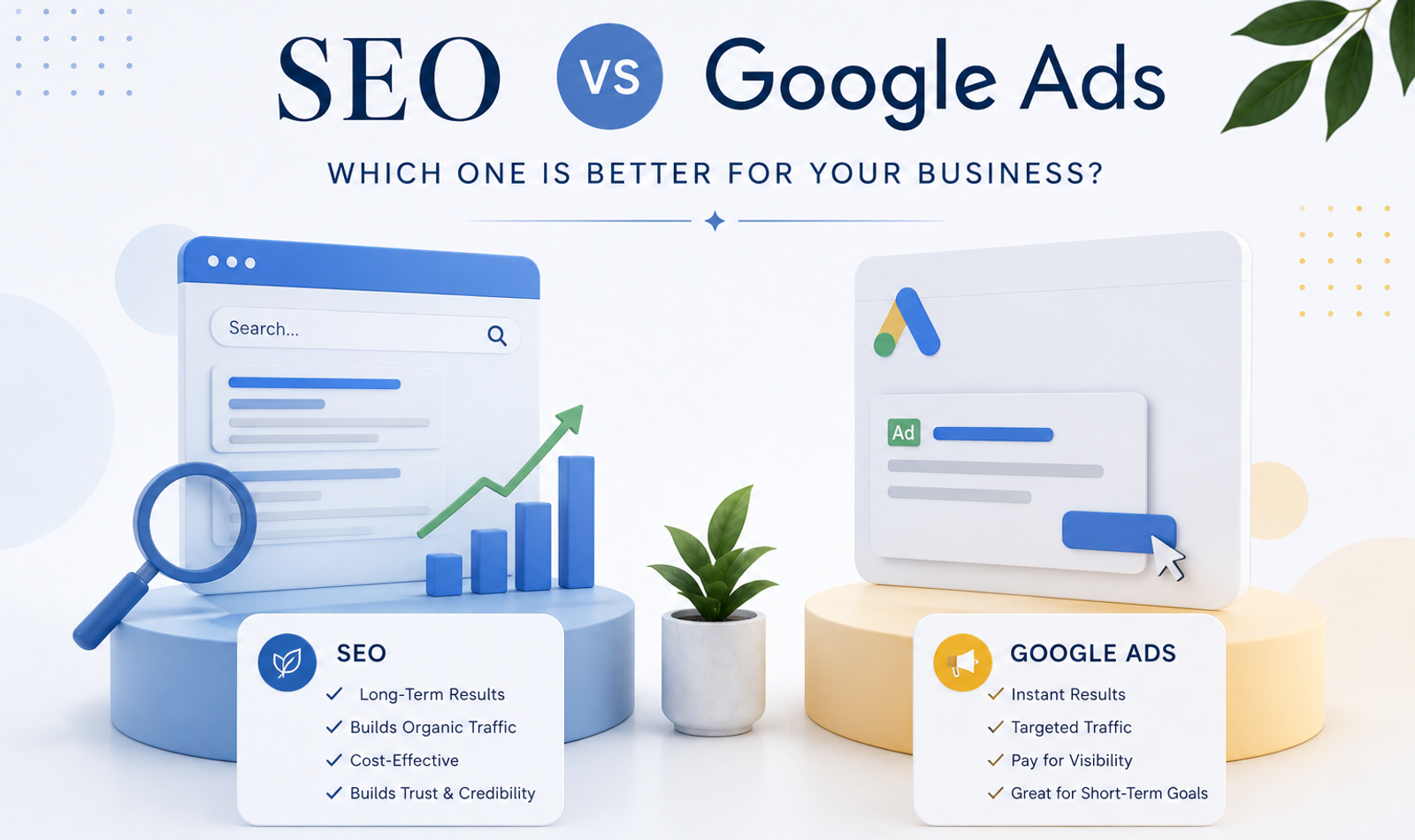
The basic difference between SEO and Google Ads is that SEO earns visibility organically, while Google Ads buys visibility through paid placements. SEO focuses on improving your website so it ranks naturally, while Google Ads focuses on showing your business through paid campaigns for selected keywords, audiences or placements.
SEO is slower but more sustainable. It requires content, technical optimization, authority building and consistency. Google Ads is faster but more budget-dependent. It can bring leads quickly, but you must keep spending to maintain visibility. SEO builds trust and authority over time, while Google Ads creates immediate exposure and measurable campaign data.
A useful way to understand the difference is this: SEO is like building a long-term digital property, while Google Ads is like renting premium space on a busy road. Both can bring customers, but one grows as an asset and the other works as long as you pay for placement.
This does not mean one is always better than the other. The better choice depends on what your business needs right now. If you need enquiries this week, Google Ads may be more useful. If you want long-term organic traffic, authority and lower dependency on paid media, SEO is essential. If you want the strongest result, both should work together.
SEO vs Google Ads for Speed
When it comes to speed, Google Ads is usually faster than SEO. A properly set up Google Ads campaign can start generating traffic soon after approval. This makes it useful for new businesses, limited-time offers, event promotions, product launches, emergency services, seasonal campaigns and businesses that need leads immediately.
SEO takes more time because organic ranking depends on many factors. Search engines need to crawl your website, index your pages, evaluate your content, understand your authority and compare your website with competitors. If the keyword is competitive, ranking can take several months. If the website is new, it may take longer because the domain needs to build trust.
However, SEO’s slower timeline should not be seen as a weakness. SEO is a long-term growth channel. Once your pages start ranking, they can bring visitors without paying for every click.
Following a practical on-page SEO checklist for higher rankings can improve titles, headings, content structure, internal links and page relevance during this process.
A well-optimized blog, service page or local landing page can keep working for your business even when you are not actively running ads.
If speed is your only goal, Google Ads wins. If long-term visibility is your goal, SEO is stronger. The smartest strategy is often to use Google Ads for quick traffic while SEO grows in the background.
SEO vs Google Ads for Cost
SEO and Google Ads both require investment, but the cost structure is different. With Google Ads, you usually pay for clicks, impressions, conversions or campaign delivery depending on the campaign setup. If your industry is competitive, the cost per click can be high. If your landing page is weak or your targeting is too broad, you may spend money without getting quality leads.
SEO does not charge you for every organic click, but it is not free. You need to invest in strategy, website optimization, technical SEO, content writing, keyword research, analytics, link building, local SEO and ongoing updates. The difference is that SEO investment can compound over time. A page you optimize today may continue producing traffic later.
Google Ads works like a direct cost-per-visibility model. SEO works like a long-term asset-building model. Google Ads can be profitable when campaigns are managed well, but the traffic usually stops when the budget stops. SEO takes longer, but it can reduce long-term acquisition cost if your rankings become strong.
For businesses with limited budgets, SEO foundations are important because they improve the website and build long-term traffic. For businesses with immediate sales targets, Google Ads can be useful if conversion tracking and landing pages are properly set up.
SEO vs Google Ads for Trust
SEO often creates stronger trust because many users naturally trust organic results. When your website appears in organic search for helpful and relevant queries, users may see your brand as more credible. This is especially true when the page provides useful content, answers important questions and shows expertise.
Google Ads can also build trust, but it depends heavily on the quality of the ad, landing page and brand experience. Some users know that ads are paid placements, so they may compare the brand more carefully. If the ad feels too aggressive or the landing page looks weak, users may not convert.
For premium and high-value businesses, trust is extremely important. Customers do not always enquire after one click. They may search your brand name, read your blogs, check your services, compare reviews, visit your Instagram, look at your work and then decide whether to contact you.
Strong UI/UX design principles for high-end brand websites help ensure that both paid and organic visitors encounter a professional, clear and trustworthy digital experience.
SEO supports this research journey because it gives your brand more helpful content and organic visibility.
Google Ads can bring the visitor to your website, but SEO and strong content often help build the trust needed for conversion. This is why a strong website, case studies, testimonials, FAQs and service pages are important for both channels.
SEO vs Google Ads for Long-Term ROI
SEO usually offers stronger long-term ROI when executed consistently. This is because organic traffic does not require payment for every click. Once your website ranks for relevant keywords, it can continue generating traffic and leads over time. The value of SEO grows as your website adds more useful pages, earns more authority and improves technical performance.
Google Ads can also produce strong ROI, especially for high-intent keywords and well-optimized campaigns. If your ad targeting is precise, your offer is strong and your landing page converts, Google Ads can generate profitable leads quickly. However, the ROI is directly connected to your ad spend, competition and campaign quality.
If your business depends only on Google Ads, your acquisition cost may increase over time as competitors bid on the same keywords. If your business invests only in SEO, you may miss immediate opportunities while waiting for rankings to grow. The best ROI often comes from using both strategically.
SEO builds long-term visibility and reduces dependency on paid media. Google Ads captures immediate demand and gives useful data. Together, they create a stronger growth system.
SEO vs Google Ads for Lead Quality
Lead quality depends on search intent, targeting, landing-page quality and brand positioning. Google Ads can generate high-quality leads when you target specific keywords with strong buying intent. For example, someone searching “hire SEO agency in Mumbai” or “book luxury wedding planner in Delhi” may be closer to taking action than someone searching a general educational query.
However, Google Ads can also generate poor leads if the targeting is too broad. A business may receive many clicks from people who are not serious, not ready to buy or not aligned with the brand’s pricing. This is why negative keywords, location targeting, ad copy and landing-page messaging are important.
SEO can also generate strong leads because users often arrive after reading useful content or exploring multiple pages. A visitor who reads your blog, visits your service page, checks your work and then submits an enquiry may be more informed and serious.
For premium brands, lead quality matters more than lead volume. A luxury event company, real estate consultant, premium car rental brand or digital agency does not need thousands of low-quality leads. It needs qualified enquiries from the right audience.
Applying suitable conversion optimization strategies for luxury brands can help high-value businesses improve lead quality without relying on aggressive sales tactics.
Both SEO and Google Ads should be optimized for quality, not just traffic.
SEO vs Google Ads for Small Businesses
Small businesses often need both visibility and cost control. Google Ads can help them get traffic quickly, but it can also become expensive if campaigns are not managed carefully. A small business should avoid running broad ads without clear targeting, conversion tracking and a strong landing page.
SEO may take longer, but it is very useful for small businesses because it builds a long-term discovery channel. A small business can improve local SEO, create service pages, optimize Google Business Profile, collect reviews and publish helpful blogs. Over time, this can bring consistent organic traffic without paying for every visitor.
For a small business, the best approach is often to build SEO foundations first and use Google Ads selectively. This means the website should have clear service pages, fast loading speed, mobile-friendly design, local keywords, trust signals and a simple enquiry process before spending heavily on ads.
When the foundation is strong, Google Ads performs better because paid traffic lands on a website that is ready to convert. Without that foundation, even a good ad campaign may waste money.
SEO vs Google Ads for Local Businesses
Local businesses can benefit strongly from both SEO and Google Ads. Local SEO helps your business appear in Google Maps, local organic results and “near me” searches. This is useful for restaurants, salons, clinics, hotels, car rental companies, event planners, real estate consultants, retail stores and service providers.
Google Ads helps local businesses appear quickly for high-intent searches in specific areas. For example, a salon can run ads in Bandra, a clinic can target Andheri, a restaurant can promote weekend reservations in Lower Parel, and an event agency can target corporate-event searches in Mumbai.
Local SEO is important because it builds long-term trust through Google Business Profile, reviews, local keywords, citations, location pages and local content.
Businesses targeting customers in Mumbai can use a focused local SEO strategy for Mumbai businesses to improve visibility across Google Maps and location-based searches.
Google Ads is useful when the business wants immediate calls, bookings, walk-ins or enquiries.
For local businesses, the strongest approach is usually combined. Use local SEO to build trust and visibility over time. Use Google Ads for urgent demand, seasonal campaigns, new service launches and high-value keywords.
SEO vs Google Ads for Premium and Luxury Brands
Premium and luxury brands need a more careful strategy than mass-market businesses. They should not chase only cheap clicks or high traffic volume. Their goal is to attract quality leads, protect brand perception and build trust with customers who value premium services or products.
SEO is powerful for luxury brands because it supports authority and research. High-value customers often search before making decisions. They may read guides, compare services, check case studies, search reviews, look at PR features and explore the website deeply before contacting the brand.
A specialised approach to SEO for luxury brands can improve search authority while preserving premium positioning and refined communication.
Google Ads can also work for luxury brands when used carefully. The campaign should target high-intent keywords, premium locations, specific services and qualified audiences. The ad copy should feel refined and confident, not desperate or discount-heavy. The landing page should feel premium and trustworthy.
For luxury brands, SEO builds credibility and Google Ads captures intent. Together, they help the brand appear at the right time while maintaining premium perception.
When SEO Is Better Than Google Ads
SEO is better when your business wants long-term organic traffic, stronger brand authority and sustainable growth. It is especially useful when your customers research before buying, compare options, ask questions and need trust before taking action.
SEO is also better when you want to reduce dependency on paid ads. Over time, ranking pages can bring traffic without paying for every click. This is valuable for businesses that want consistent visibility and lower long-term acquisition costs.
SEO is ideal for blogs, service pages, location pages, educational guides, FAQs, case studies and comparison content.
A structured content strategy for brand websites helps connect these assets with customer questions, search intent and lead-generation journeys.
SEO helps your business appear across the full customer journey, from awareness to decision.
Choose SEO when you are ready to invest consistently, improve your website, create useful content and build authority over time.
When Google Ads Is Better Than SEO
Google Ads is better when your business needs immediate traffic or leads. It is useful for new businesses that do not rank organically yet, businesses launching a new product or service, seasonal campaigns, event registrations, limited-time offers and urgent lead generation.
Google Ads is also useful for testing. You can test keywords, landing pages, offers, locations and messaging faster than SEO. If a keyword converts well in Google Ads, you can later create SEO content around that keyword.
For example, a business can test whether “SEO agency Mumbai,” “local SEO services Mumbai” or “digital marketing agency Mumbai” brings better leads through ads. After understanding which keywords convert, the business can build stronger organic pages for those keywords.
Choose Google Ads when speed, testing and controlled visibility are the priority.
Why SEO and Google Ads Work Better Together
SEO and Google Ads work best when they support each other. Google Ads provides fast traffic and keyword data. SEO builds long-term visibility and authority. Together, they help your business capture both immediate and future demand.
Google Ads can show which keywords generate leads, which locations perform best and which messages get clicks. This data can guide SEO content strategy. SEO can improve landing pages, build trust and reduce long-term dependence on paid clicks.
A user may click your ad today but not convert immediately. Later, they may search your brand name, read your blog, check your service page and then enquire.
A well-planned conversion-focused marketing funnel helps connect these different visits, channels and customer actions into one journey.
This is why digital marketing should not depend on one channel only.
When SEO and Google Ads work together, your brand becomes more visible, more trusted and more conversion-ready.
Landing Pages Matter for Both SEO and Google Ads
Whether you choose SEO or Google Ads, your landing-page quality is extremely important. A landing page should match the user’s intent, explain the offer clearly, build trust and guide visitors towards action.
For SEO, the page should be crawlable, indexable, keyword-focused, helpful and well structured. It should answer user questions, include proper headings, provide useful content and link to related pages.
For Google Ads, the landing page should match the ad message. If the ad promotes “SEO services in Mumbai,” the landing page should clearly explain SEO services for Mumbai businesses. If there is a mismatch, users may leave and the campaign may waste budget.
The landing page should also follow strong technical SEO foundations for speed, mobile usability and Core Web Vitals so visitors can access and interact with it smoothly.
A strong landing page improves both organic rankings and paid conversions. A weak landing page can make both SEO and Google Ads underperform.
SEO and Google Ads in the AI Search Era
Search is changing because AI Overviews, generative search and answer engines are changing how people discover information. Users may now receive summarized answers directly in search results, but they still need trusted brands, strong websites and helpful content when making decisions.
SEO is not dead in the AI search era. It is becoming more important because AI-powered search systems need clear, structured and reliable content to understand a topic. Businesses should create helpful pages with direct answers, strong headings, FAQs, examples and original insights.
The wider impact of AI on digital marketing in 2026 also affects content production, audience targeting, campaign automation and customer research.
Google Ads is also evolving with automation, AI-assisted bidding and smarter campaign formats. Businesses must improve conversion tracking, landing pages, creative quality and audience signals to get better results.
Companies may use AI content creation tools and best practices to support research and production, but human expertise, originality and brand accuracy should remain central.
In the AI search era, both SEO and Google Ads need strong website foundations. Poor content, weak landing pages and unclear messaging will become less effective.
Common Mistakes Businesses Make
One common mistake is choosing Google Ads because SEO feels slow, but then sending paid traffic to a weak website. If the landing page is slow, unclear or untrustworthy, ads may generate clicks but not leads.
Another mistake is choosing SEO but expecting instant results. SEO takes time and consistency. A few blogs are not enough in a competitive market. The website needs technical health, content depth, internal links, backlinks, local SEO and regular updates.
Many businesses compare SEO and Google Ads only by traffic. This is not enough. The real comparison should include lead quality, conversion rate, cost per qualified lead, customer lifetime value and long-term ROI.
Another common mistake is running Google Ads without conversion tracking. Without tracking, you cannot know which keywords, ads or landing pages are actually generating business value.
Businesses should also follow suitable secure website practices for premium clients, particularly when landing pages collect names, phone numbers, email addresses or payment information.
How to Choose the Right Strategy
To choose between SEO and Google Ads, start with your business goal. If you need leads immediately, Google Ads may be the better first step. If you want long-term organic growth and brand authority, SEO should be a priority.
Next, look at your website. If your website is slow, outdated or unclear, fix it before spending heavily on ads. Paid traffic cannot solve a weak landing page. SEO also needs a strong website foundation to perform well.
Then consider your budget. If you have a small budget, start with SEO basics and local SEO. If you have a budget for immediate acquisition, use Google Ads strategically for high-intent keywords.
Finally, consider your customer journey. If customers need time to research and trust your brand, SEO content is essential. If customers make fast decisions based on urgent need, Google Ads can work very well.
Best Strategy for Most Businesses
For most businesses, the best strategy is not SEO or Google Ads. The best strategy is SEO and Google Ads used together with proper planning.
Start by improving your website foundation. Make sure your service pages are clear, your website loads fast, your mobile experience is smooth, your tracking is set up and your calls to action are easy to find.
Then build SEO content around your main services, local keywords and customer questions. Publish helpful blogs, optimize service pages, improve internal links and strengthen your Google Business Profile if local SEO matters.
After that, use Google Ads for high-intent keywords, selected locations, retargeting and campaign launches. Use ad data to improve SEO strategy and landing pages.
Businesses can review Double Trouble Studio’s completed work to understand how website design, content and digital strategy can be presented as one connected brand experience.
This creates a balanced system where SEO builds long-term growth and Google Ads supports immediate demand.
Frequently Asked Questions
What Is the Main Difference Between SEO and Google Ads?
SEO helps your website rank organically in unpaid search results, while Google Ads helps your business appear through paid ads for selected keywords, locations and audiences.
Is SEO Better Than Google Ads?
SEO is better for long-term organic growth, trust and sustainable traffic. Google Ads is better for quick visibility, immediate leads and campaign testing.
Does Google Ads Help SEO Rankings?
Google Ads does not directly improve organic rankings. However, it can provide keyword data, traffic insights and brand visibility that support your wider SEO strategy.
Which Is Cheaper: SEO or Google Ads?
SEO does not charge per click, but it requires investment in content, optimization and strategy. Google Ads can generate quick traffic but requires ongoing ad spend.
Which Gives Better ROI?
SEO often gives stronger long-term ROI, while Google Ads can give faster ROI if campaigns are well managed and landing pages convert properly.
Should Small Businesses Use SEO or Google Ads?
Small businesses should build SEO foundations first and use Google Ads carefully for high-intent searches, local campaigns or immediate lead generation.
How Long Does SEO Take?
SEO usually takes several months to show strong results, depending on competition, website quality, content, backlinks, technical SEO and consistency.
How Fast Do Google Ads Work?
Google Ads can start bringing traffic quickly after campaign approval, but performance depends on targeting, budget, competition, ad quality and landing pages.
Can SEO and Google Ads Work Together?
Yes. SEO and Google Ads work very well together. Ads bring quick data and traffic, while SEO builds long-term visibility, authority and trust.
What Should I Choose First?
Choose Google Ads first if you need leads immediately. Choose SEO first if you want long-term growth. Ideally, improve SEO foundations and use Google Ads strategically.
Conclusion
SEO and Google Ads are both powerful digital marketing channels, but they are built for different purposes. SEO helps your business build long-term organic visibility, brand trust, authority and sustainable traffic. Google Ads helps your business appear quickly, capture immediate demand and test campaigns with more control.
If your business needs quick leads, Google Ads can be useful. If your business wants long-term growth, SEO is essential. If your business wants the strongest digital marketing system, both should work together.
The most important point is that both channels need a strong website. Without clear messaging, fast loading speed, helpful content, strong landing pages, trust signals and proper tracking, both SEO and Google Ads can underperform.
In 2026, search is becoming more competitive and AI-powered. Businesses need helpful content, technical SEO, AI Overview readiness, GEO optimization, clear landing pages and strong conversion systems. Traffic alone is not enough. The goal is to attract the right audience, build trust and convert interest into business growth.
Build a Strong SEO and Google Ads Strategy
At Double Trouble Studio, we help businesses grow through SEO, Google Ads strategy, website development, landing-page optimization, local SEO, content marketing, PR, social media and performance-focused digital marketing.
Businesses looking for website development and digital marketing services in Mumbai can work with our team across website strategy, SEO foundations, landing pages, content, local visibility and conversion optimization.
With the right strategy, SEO can build your long-term visibility, Google Ads can capture immediate demand and both can work together to create stronger leads, better trust and sustainable business growth.
Contact Double Trouble Studio to discuss SEO, Google Ads strategy, landing-page development, local SEO, content marketing and complete digital growth solutions.
📩 info@dtsworld.in 📞 +91 80000 06021 📍 Andheri East, Mumbai
Need this for your brand?
Let DTS build your next campaign.
From PR, celebrity management and events to websites, social media, SEO and AI video production — Double Trouble Studio helps brands grow with strategy and execution.
Discuss Your Requirement →