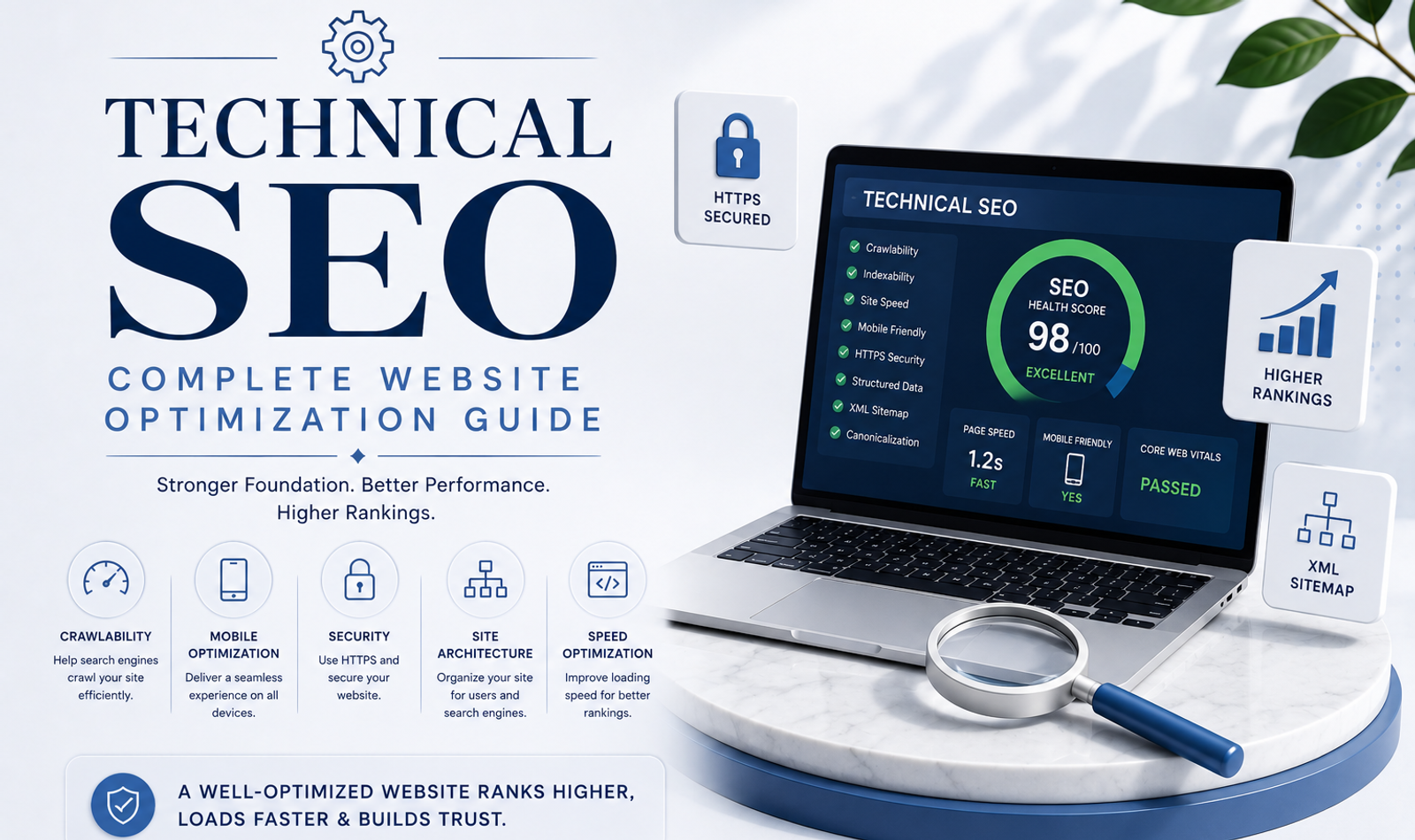
Technical SEO: Complete Website Optimization Guide
Technical SEO is the foundation that helps search engines crawl, index, understand and rank your website properly. A website can have beautiful design, strong content and premium branding, but if search engines cannot access the pages correctly, the website may struggle to perform in search results.
Many businesses think SEO is only about keywords and blogs. Keywords are important, but they are only one part of search engine optimization. Technical SEO makes sure the website structure, speed, mobile experience, indexing signals, URLs, redirects, schema markup and crawl paths are working correctly.
In simple words, technical SEO helps your website become search-engine friendly.
It also improves user experience.
A technically optimized website loads faster, works better on mobile, reduces errors, avoids duplicate content, improves crawl efficiency and helps users move through the website smoothly. For businesses, this can lead to stronger rankings, better organic traffic, more qualified leads and higher conversion potential.
Professional website development and digital marketing services can help connect technical SEO with development, content, UX, performance and long-term search growth.
In 2026, technical SEO is also important for AI Overview optimization, GEO and answer-engine visibility. AI-powered search systems still depend on accessible, structured, helpful and indexable content. If your website has technical problems, even strong content may not be understood properly.
This complete guide explains technical SEO in a beginner-friendly but practical way. It covers crawling, indexing, site architecture, Core Web Vitals, mobile SEO, schema markup, canonical tags, redirects, JavaScript SEO, XML sitemaps, robots.txt, duplicate content, security, performance and AI search readiness.
What Is Technical SEO?
Technical SEO is the process of optimizing the technical structure of a website so search engines can crawl, index and understand it correctly.
It focuses on the backend and structural elements of a website.
This includes website speed, mobile performance, crawlability, indexing, URL structure, internal links, redirects, sitemaps, robots.txt, canonical tags, structured data, HTTPS, server response codes and duplicate-content management.
Businesses that are new to organic search can begin with a detailed beginner’s guide to search engine optimization to understand how technical SEO fits into the wider search strategy.
Technical SEO does not replace content SEO.
It supports it.
If content is the message, technical SEO is the delivery system. A strong page needs both useful content and a healthy technical foundation.
For example, a blog may be perfectly written, but if it is blocked by robots.txt, marked noindex or hidden behind poor JavaScript rendering, search engines may not rank it properly. A service page may have strong keywords, but if it loads slowly or has a broken layout on mobile, users may leave before enquiring.
Technical SEO helps remove these barriers.
Why Technical SEO Matters
Technical SEO matters because search engines need access to your website before they can rank it.
If Google cannot crawl a page, it may not discover it.
If Google cannot index a page, it may not appear in search results.
If Google cannot understand the structure of your website, important pages may not receive enough value.
If users experience slow speed, broken pages or mobile issues, they may lose trust.
Technical SEO creates a clean foundation for rankings.
It also supports every other marketing activity.
When users come from Instagram, Google Ads, PR coverage, LinkedIn, WhatsApp or referrals, they often land on your website. If the website is fast, clear and technically stable, the chance of conversion increases.
For premium and luxury brands, technical SEO is even more important because website experience affects brand perception.
A slow, broken or confusing website can make even a premium brand feel weak.
The principles involved in designing high-end luxury websites show why visual quality, technical performance, UX and brand experience must work together.
Crawling: Helping Search Engines Discover Pages
Crawling is the process search engines use to discover pages on the web.
Search-engine bots visit websites and follow links to find pages. If your website structure is clean, important pages are easier to discover.
A website should have crawlable internal links.
Important pages should not be hidden too deep inside the website. If a page can only be found after too many clicks, search engines and users may not treat it as important.
Your homepage, service pages, category pages, blog categories, contact page and high-value landing pages should be easy to reach.
Internal links help crawling.
For example, a blog about technical SEO can link to SEO services, website development, Core Web Vitals guidance, an on-page SEO checklist and related content-strategy pages.
A practical on-page SEO checklist for higher rankings can help improve headings, metadata, internal links and page relevance alongside technical fixes.
These links help users and search engines move between related content.
Crawling is the first step of visibility.
If your pages are difficult to find, your SEO performance becomes limited.
Indexing: Getting Pages Into Search Results
Indexing happens when a search engine stores and understands a page so it can be considered for search results.
A page must be crawlable and indexable to appear in organic search.
Common indexing problems include noindex tags, blocked pages, duplicate content, poor canonical settings, weak content, server errors and pages with little value.
Every important page should be checked for indexing.
Google Search Console is useful for this because it shows whether pages are indexed, discovered or excluded.
Not every page needs to be indexed.
For example, admin pages, thank-you pages, internal search pages, cart pages, duplicate filters and private pages may not need indexing.
Technical SEO helps decide which pages should be indexed and which pages should remain outside search results.
This protects crawl quality and improves website clarity.
Website Architecture
Website architecture is the way pages are organized and connected.
A clean structure helps users and search engines understand your website.
For most business websites, the structure should be simple.
The homepage should connect to main service pages. Service pages should connect to related blogs, case studies and contact pages. Blog categories should organize content clearly. Important pages should not be buried too deeply.
A strong website architecture also supports topical authority.
For example, an SEO category may include blogs about on-page SEO, technical SEO, local SEO, keyword research, SEO audits, Core Web Vitals and AI Overview optimization. These pages should link to one another naturally.
A clear content strategy for brand websites can help organize blogs, service pages, galleries, case studies and lead-generation resources into connected topic clusters.
This helps search engines understand that your website has depth around SEO.
Good architecture improves crawling, rankings and user experience.
URL Structure
URLs should be clean, readable and descriptive.
A good URL gives users and search engines a clear idea of the page topic.
For example:
technical-seo-complete-website-optimization-guide
This is better than a URL with random numbers or unclear parameters.
A strong URL should be short, lowercase and separated with hyphens.
Avoid unnecessary dates, special characters and long strings.
For service pages, URLs should clearly describe the service.
For blogs, URLs should match the topic.
For location pages, URLs should include the city or region naturally.
A clean URL structure improves trust and makes content easier to share.
XML Sitemap
An XML sitemap is a file that lists important pages on your website.
It helps search engines discover pages more efficiently.
A sitemap is especially useful for larger websites, new websites, blogs, ecommerce stores and websites with many pages.
Your sitemap should include important indexable pages.
It should not include broken pages, redirected pages, noindex pages or duplicate pages.
After creating a sitemap, submit it through Google Search Console.
However, a sitemap does not replace internal linking.
Search engines still need a clear website structure and crawlable links.
Think of the sitemap as a support signal, not the entire SEO foundation.
Robots.txt
The robots.txt file tells search-engine crawlers which parts of the website they can or cannot crawl.
It is useful for blocking low-value or private sections from crawling.
However, robots.txt should be handled carefully.
If important pages are accidentally blocked, search engines may not crawl them properly.
For example, if your service pages, blogs, JavaScript files, CSS files or important assets are blocked, Google may not fully understand or render the website.
Robots.txt should not be used as the only method to hide sensitive information.
Private content should be protected properly through authentication or server controls.
A technical SEO audit should always review robots.txt settings.
Meta Robots Tags
Meta robots tags control indexing and link-following behaviour at the page level.
The most common directive is noindex.
A noindex tag tells search engines not to include that page in search results.
This is useful for pages such as thank-you pages, internal-results pages, low-value filters or private pages.
However, adding noindex to important pages by mistake can damage SEO visibility.
Technical SEO should review all important pages to make sure they are indexable.
Important service pages, blogs, category pages and landing pages should not have noindex unless there is a specific reason.
Meta robots tags are powerful, so they must be used with care.
Canonical Tags
Canonical tags tell search engines which version of a page is the preferred version.
They help manage duplicate or similar content.
For example, an ecommerce website may have the same product visible through different filter URLs. A canonical tag helps search engines understand the main version.
Canonical tags are also useful for blogs, service pages and category pages when duplicate versions exist.
The canonical URL should usually point to the main version of the page.
Incorrect canonical tags can cause ranking problems.
If an important page points its canonical tag to another URL by mistake, search engines may ignore the important page and rank the wrong version.
A technical SEO audit should always review canonical tags.
Redirects
Redirects send users and search engines from one URL to another.
They are important when pages are moved, URLs are changed or old content is replaced.
The most common SEO-friendly redirect is a 301 redirect.
A 301 redirect tells search engines that the page has moved permanently.
Redirects help preserve traffic and ranking signals when URLs change.
However, redirects should be clean.
Avoid redirect chains, where one URL redirects to another and then another. These chains can slow down crawling and user experience.
Avoid redirect loops, where pages keep redirecting back and forth.
When updating a website, migration or redesign, redirect planning is essential.
Without proper redirects, rankings and traffic may drop.
Status Codes
HTTP status codes tell browsers and search engines what happened when a page was requested.
A normal working page should return a 200 status code.
A page that has moved permanently should use a 301 redirect.
A page that no longer exists may return a 404 status code.
A server error may return a 500-level status code.
Technical SEO should check status codes regularly.
Important pages should not return errors.
Broken pages should be fixed, redirected or removed from internal links.
If many important pages return errors, search engines may have difficulty crawling the website.
Users may also lose trust when they land on broken pages.
404 Pages
A 404 page appears when the requested page cannot be found.
Some 404 pages are normal.
However, too many broken pages can harm user experience and waste crawl resources.
A good 404 page should be helpful.
It should explain that the page is unavailable and guide users towards important pages such as the homepage, services, blog or contact page.
Broken internal links should be fixed.
If a removed page had traffic, backlinks or value, redirect it to the most relevant active page.
Do not redirect every broken URL to the homepage without reason.
Redirects should be relevant.
Page Speed Optimization
Page speed is an important part of technical SEO because users expect websites to load quickly.
Slow pages can reduce engagement, increase exits and lower conversion rates.
Page speed can be improved by compressing images, reducing unused code, optimizing fonts, enabling caching, improving server response time, using modern image formats, reducing unnecessary scripts and selecting efficient hosting.
For business websites, speed affects trust.
If a user clicks from Google and the page takes too long to load, they may leave and choose a competitor.
For premium brands, speed also affects perception.
A luxury website should feel smooth and polished.
The relationship between luxury website UX, minimalism and speed demonstrates why technical performance is part of the brand experience rather than only a development concern.
Technical SEO and website development should work together to improve performance.
Core Web Vitals
Core Web Vitals are metrics that measure real-world user experience.
They focus on loading performance, interactivity and visual stability.
The major Core Web Vitals include Largest Contentful Paint, Interaction to Next Paint and Cumulative Layout Shift.
Largest Contentful Paint measures loading performance.
Interaction to Next Paint measures responsiveness.
Cumulative Layout Shift measures visual stability.
A website should aim to provide a fast, stable and responsive experience.
Core Web Vitals are not the only ranking factor, but they are important for user experience.
A detailed guide to technical SEO foundations, speed and Core Web Vitals can help businesses understand how performance issues affect both visitors and organic visibility.
Improving Core Web Vitals can make the website feel smoother and more trustworthy.
For SEO, better page experience supports stronger performance over time.
Mobile SEO
Mobile SEO is essential because many users search and browse from phones.
A website should be fully responsive.
Text should be readable without zooming. Buttons should be easy to tap. Images should fit the screen. Forms should be simple. Navigation should be smooth. Content should not be hidden or broken on mobile.
Mobile experience directly affects conversions.
Many users visit websites from Google Search, Instagram, LinkedIn, WhatsApp and paid ads on mobile devices.
If the mobile website is slow or difficult to use, users may leave.
Technical SEO should test every important page on mobile.
A page that looks good on desktop but fails on mobile is not fully optimized.
JavaScript SEO
Many modern websites use JavaScript frameworks.
JavaScript can create smooth and interactive websites, but it must be implemented carefully for SEO.
Search engines need to access and render important content.
If important text, links or metadata are loaded in a way that search engines cannot process properly, the page may struggle to rank.
For JavaScript-heavy websites, technical SEO should check whether content is visible in the rendered HTML, whether internal links are crawlable, whether metadata loads properly and whether pages can be indexed.
Frameworks such as Next.js can support SEO well when implemented correctly.
Server-side rendering, static generation, clean routing, metadata management and fast performance can help.
The key is to make important content accessible, not hidden behind broken rendering.
Structured Data and Schema Markup
Structured data helps search engines understand page content more clearly.
Schema markup can be added for articles, products, FAQs, breadcrumbs, services, local businesses, organizations, reviews, events and more.
Structured data does not guarantee rich results, but it can improve eligibility for enhanced search appearances.
For blogs, Article or BlogPosting schema is useful.
For service pages, Service schema may help.
For local brands, LocalBusiness schema can support clarity.
For websites, Organization and WebSite schema can support brand understanding.
For FAQs, FAQ schema should only be used when the questions and answers are visible on the page.
Structured data should be accurate.
Do not add misleading schema, fake reviews or hidden information.
Schema should support trust and clarity.
HTTPS and Website Security
HTTPS is a basic requirement for modern websites.
It protects data between the user and the website.
A website without HTTPS can look unsafe to users and browsers.
For SEO, HTTPS is part of a trustworthy technical foundation.
Businesses should make sure SSL certificates are active and configured properly.
All website versions should redirect to the secure HTTPS version.
Mixed-content issues should be fixed.
This happens when an HTTPS page loads insecure HTTP assets such as images or scripts.
Security is not only technical.
It affects user trust and brand perception.
Businesses collecting enquiry, booking or payment data should also follow appropriate secure website practices for premium clients.
Duplicate Content
Duplicate content happens when the same or very similar content appears on multiple URLs.
This can confuse search engines.
They may not know which page to rank.
Duplicate content can happen because of URL parameters, filter pages, copied product descriptions, printer pages, HTTP and HTTPS versions, www and non-www versions or repeated location pages.
Technical SEO helps manage duplicate content through canonical tags, redirects, clean URL structures, unique content and appropriate indexing rules.
For business websites, service pages should not be copied across multiple cities without meaningful local value.
Each important page should have a clear purpose and unique content.
Unique content improves search clarity.
Internal Linking Structure
Internal links help search engines and users move through your website.
They also help distribute authority across pages.
Important pages should receive internal links from relevant sections.
For example, an SEO guide can link to technical SEO services, an on-page SEO checklist, website development and content-strategy pages.
Internal links should use descriptive anchor text.
Avoid generic anchor text such as “click here” when a clearer phrase is possible.
Internal linking should feel natural.
Do not overload every page with unnecessary links.
The goal is to guide users and search engines logically.
A strong internal-linking structure supports crawlability, topical authority and conversions.
Breadcrumbs
Breadcrumbs help users understand where they are on the website.
For example:
Home > Blog > SEO > Technical SEO Guide
Breadcrumbs improve navigation and site structure.
They are especially useful for blogs, ecommerce websites, service websites and large websites.
Breadcrumbs can also support structured data.
They help search engines understand page hierarchy.
For users, breadcrumbs create a smoother browsing experience.
A small technical detail like this can improve both SEO and usability.
Image SEO
Images should be optimized for speed, accessibility and search understanding.
Use compressed images.
Use modern formats where possible.
Use descriptive file names.
Add meaningful alt text.
Avoid uploading huge images that slow down pages.
For example, instead of using a file name such as IMG_2390.jpg, use technical-seo-dashboard.jpg.
Alt text should describe the image naturally.
It should not be stuffed with keywords.
Image SEO is especially important for blogs, product pages, portfolios, hospitality websites, event websites, fashion websites and ecommerce stores.
Good images improve user experience, but optimized images protect speed and accessibility.
Video SEO
Videos can improve engagement, but they should be optimized properly.
Important video pages should include a clear title, description, transcript or supporting text.
If the video is embedded, make sure it does not slow the page excessively.
Use lazy loading where appropriate.
For video-rich websites, VideoObject schema may help search engines understand video content.
Videos should support the page topic.
Do not rely only on video without written content.
Search engines and users need context.
A page with video, transcript, summary and FAQs is usually stronger than a page with only an embedded video.
Brands creating video-led campaigns can also review the benefits and use cases of AI video advertising while ensuring that video assets remain optimized for website performance.
Website Navigation
Website navigation affects SEO and conversions.
Users should be able to find important pages quickly.
Main navigation should include key pages such as services, work, about, blog and contact.
For service-led brands, dropdown menus can help organize services.
For blogs, categories should be clear.
For ecommerce, categories and filters should be easy to use.
Avoid hiding important pages in confusing menus.
Navigation should work well on mobile.
A strong navigation structure helps users explore and helps search engines understand page importance.
Pagination and Large Websites
Large websites often use pagination for blog archives, product categories or listings.
Pagination should be handled carefully.
Important pages should remain crawlable.
Category pages should have useful content where relevant.
Avoid creating thousands of thin or low-value paginated pages.
For ecommerce sites, filters and sorting options can create many URL variations.
Technical SEO should manage these URLs carefully to avoid crawl waste and duplicate content.
Large websites need stronger crawl control than small websites.
This is where technical SEO becomes especially important.
Faceted Navigation
Faceted navigation allows users to filter products or listings by size, colour, price, category, location or other attributes.
It is useful for users but can create SEO problems.
Each filter may generate a new URL.
If not controlled, this can create thousands of duplicate or low-value pages.
Technical SEO should decide which filter pages should be indexable and which should not.
Important category pages may be optimized for search.
Low-value combinations may be blocked, canonicalized or noindexed depending on the situation.
Faceted navigation should improve user experience without damaging crawl efficiency.
Hreflang for Multilingual Websites
Hreflang tags help search engines understand language and regional versions of pages.
They are useful for websites targeting multiple languages or countries.
For example, a website may have English and Hindi versions or India and UAE versions.
Hreflang should be implemented carefully.
Incorrect hreflang can confuse search engines and show the wrong page to users.
Each version should point to the correct alternate versions.
Multilingual SEO also requires high-quality translation and localized content.
Do not rely only on automatic translation without reviewing meaning, tone and user intent.
International and Local Technical SEO
Technical SEO changes depending on business goals.
A local business should focus on city pages, Google Business Profile, local schema, NAP consistency, location signals and mobile usability.
An international business should focus on hreflang, regional URLs, international targeting, currency, language and server performance.
A luxury brand expanding in India may need city-specific landing pages for Delhi NCR, Mumbai, Chandigarh, Jaipur, Pune, Goa, Bengaluru, Hyderabad and Ahmedabad.
These pages should not be copied and pasted.
They should include unique local relevance, services, FAQs, proof and contact information.
Businesses targeting customers in Mumbai can use a focused local SEO strategy for Mumbai businesses to improve Google Maps visibility and location-based organic discovery.
Technical SEO should support business expansion.
AI Overview and GEO Readiness
Technical SEO supports AI Overview and GEO visibility because AI-powered search experiences depend on accessible, understandable and helpful content.
A website should be crawlable, indexable and technically clean.
Content should be structured with clear headings, definitions, FAQs and direct answers.
Schema markup can help search engines understand page types and entities.
Fast, mobile-friendly pages improve user experience.
A strong internal-linking structure helps demonstrate topical depth.
For AI-search readiness, avoid hiding important information in images or scripts.
Make the content readable, structured and accessible.
The wider impact of AI on digital marketing in 2026 also affects search behaviour, content workflows, campaign automation and customer discovery.
GEO does not replace technical SEO.
It depends on it.
SEO Logs and Crawl Analysis
Server-log analysis can help advanced SEO teams understand how search-engine bots interact with the website.
Logs can show which pages bots crawl, how often they crawl, which errors they encounter and whether crawl resources are being wasted.
This is especially useful for large websites.
For smaller websites, Google Search Console may be enough for basic crawl and indexing insights.
However, as a website grows, crawl analysis becomes more valuable.
It helps identify crawl traps, broken pages, low-value sections and missed important pages.
Technical SEO becomes more data-driven when logs are used properly.
Google Search Console for Technical SEO
Google Search Console is one of the most important tools for technical SEO.
It helps you check indexing, search performance, page experience, Core Web Vitals, sitemaps, mobile issues, structured data and manual actions.
Every website should be connected to Google Search Console.
It helps identify technical issues that may affect visibility.
You can inspect URLs, submit sitemaps, review indexing status and check which queries bring traffic.
Search Console should be reviewed regularly.
Technical SEO is not a one-time setup.
It needs ongoing monitoring.
Technical SEO Audit
A technical SEO audit reviews the health of a website.
It helps identify issues that affect crawling, indexing, rankings, speed and user experience.
A complete technical audit should review crawlability, indexability, status codes, redirects, canonical tags, robots.txt, sitemap, Core Web Vitals, mobile usability, structured data, internal links, duplicate content, page speed, HTTPS, broken links and site architecture.
The goal is not only to find errors.
The goal is to prioritize fixes based on business impact.
For example, fixing a noindex tag on an important service page is more urgent than changing a minor image file name.
A good audit separates critical issues from small improvements.
Technical SEO for Website Redesigns
Website redesigns can damage SEO if they are not handled carefully.
When changing design, structure, URLs or platform, technical SEO planning is essential.
Before redesigning, crawl the old website and collect all important URLs.
Map old URLs to new URLs.
Set proper 301 redirects.
Keep important content accessible.
Preserve metadata where relevant.
Check internal links.
Submit the updated sitemap.
Test the website before launch.
After launch, monitor indexing, traffic, errors and rankings.
Many websites lose traffic after redesigns because redirects, content and technical settings are not handled properly.
SEO should be part of the redesign process from the beginning.
Businesses planning a premium redesign can study automotive and hospitality website transformation case studies to understand how design, UX and technical performance can be improved together.
Technical SEO for Ecommerce Websites
Ecommerce websites need strong technical SEO because they often have many products, categories, filters and duplicate URLs.
Important elements include category structure, product schema, product descriptions, image optimization, canonical tags, pagination, faceted navigation, internal-search handling, out-of-stock product strategy, reviews, breadcrumbs and fast checkout experience.
Product pages should have unique content.
Category pages should be optimized for search intent.
Filters should be managed carefully.
Large images should be compressed.
Structured data should be accurate.
Secure ecommerce and booking website maintenance is also important for protecting transactions, uptime, customer information and technical reliability.
Ecommerce technical SEO improves discoverability and the purchase experience.
Technical SEO for Service Websites
Service websites need technical SEO to support lead generation.
Important pages include the homepage, service pages, location pages, case studies, blogs, contact page and conversion landing pages.
Each service page should be indexable, fast, mobile-friendly and internally linked.
Forms should work properly.
CTA buttons should be clear.
Schema markup can support service and organization understanding.
LocalBusiness schema may help businesses targeting specific cities.
Service websites should also use clean navigation and strong internal linking between blogs and service pages.
A well-planned conversion-focused marketing funnel can connect SEO traffic with service pages, case studies, forms and qualified enquiry paths.
Technical SEO helps turn website traffic into qualified enquiries.
Technical SEO for Luxury and Premium Brands
Luxury and premium brands need technical SEO without compromising design.
A premium website should look refined, but it should also load quickly, work well on mobile and communicate clearly.
Heavy videos, oversized images, custom animations and complex scripts can slow down websites if they are not optimized.
Luxury brands often rely on visual storytelling, but important content should not be hidden only in images.
Text, metadata, alt text, schema and internal links remain important.
A luxury website should feel beautiful and technically strong.
The goal is not to remove design.
The goal is to make design performance-ready.
A specialized approach to SEO for luxury brands can improve visibility and authority without weakening premium positioning.
Common Technical SEO Mistakes
One common mistake is blocking important pages in robots.txt.
Another mistake is adding noindex tags to pages that should rank.
Many websites have broken redirects after redesigns.
Some websites use duplicate content across service pages or location pages.
Large images often slow down pages.
Some websites have poor mobile usability.
Others use JavaScript in a way that hides important content.
Many businesses forget to submit sitemaps or check indexing.
Structured data is sometimes added incorrectly or for content that is not visible on the page.
Technical SEO mistakes can quietly reduce performance.
Regular audits help prevent these issues.
Technical SEO Checklist Summary
A complete technical SEO checklist should include crawlability, indexing, XML sitemap, robots.txt, canonical tags, redirects, status codes, mobile optimization, page speed, Core Web Vitals, HTTPS, internal linking, website architecture, schema markup, duplicate content, image optimization, JavaScript rendering, breadcrumbs, broken links, 404 pages, hreflang, faceted navigation and Search Console monitoring.
This checklist should be reviewed before launching a new website, after redesigning a website and during regular SEO audits.
Technical SEO is not a one-time task.
Websites change.
New pages are added.
Old pages are removed.
Plugins, scripts and design updates can create new issues.
Ongoing monitoring keeps the website healthy.
Frequently Asked Questions
What Is Technical SEO?
Technical SEO is the process of optimizing a website’s technical structure so search engines can crawl, index, understand and rank its pages properly.
Why Is Technical SEO Important?
Technical SEO is important because even strong content may not rank if search engines cannot access, index or understand the website correctly.
What Is Included in Technical SEO?
Technical SEO includes crawling, indexing, XML sitemaps, robots.txt, canonical tags, redirects, page speed, mobile SEO, schema, Core Web Vitals and HTTPS.
What Is Crawlability in SEO?
Crawlability means how easily search-engine bots can discover and access pages on your website through links, sitemaps and a clean technical structure.
What Is Indexing in SEO?
Indexing is the process through which search engines store and understand a page so it can appear in search results.
What Is an XML Sitemap?
An XML sitemap is a file that lists important website pages and helps search engines discover them more efficiently.
What Is Robots.txt?
Robots.txt is a file that tells search-engine crawlers which parts of a website they can or cannot crawl.
What Are Core Web Vitals?
Core Web Vitals are user-experience metrics that measure loading performance, interactivity and visual stability.
What Is Schema Markup?
Schema markup is structured data that helps search engines understand page content more clearly and may support enhanced search results.
How Does Technical SEO Help AI Overview Visibility?
Technical SEO helps AI Overview visibility by making content crawlable, indexable, structured, fast, mobile-friendly and easier for search systems to understand.
Conclusion
Technical SEO is the foundation of strong website performance.
It helps search engines crawl, index and understand your website. It also improves user experience, page speed, mobile usability, website structure and search visibility.
A website may have strong content and premium design, but without technical SEO, it may not reach its full ranking potential.
A complete technical SEO strategy includes crawlability, indexing, sitemaps, robots.txt, canonical tags, redirects, Core Web Vitals, mobile optimization, schema markup, HTTPS, internal linking, duplicate-content control, JavaScript rendering and regular audits.
In 2026, technical SEO is also essential for AI Overview optimization, GEO and answer-engine visibility. Search systems need accessible, structured and reliable content. Technical SEO makes that possible.
For businesses, technical SEO is not only a ranking task.
It is a website-health system.
It improves discovery, trust, performance and conversion.
Improve Your Website’s Technical SEO
At Double Trouble Studio, we help brands improve technical SEO, website performance, search visibility, content structure, Core Web Vitals, website development, digital marketing and long-term organic growth.
Businesses looking for website development and digital marketing services in Mumbai can work with our team across technical audits, site architecture, speed optimization, mobile usability, content structure and conversion-focused development.
With the right technical SEO foundation, your website can become faster, clearer, more discoverable and more powerful as a business-growth asset.
Contact Double Trouble Studio to discuss technical SEO, website audits, Core Web Vitals, website development, local SEO and long-term search growth.
📩 info@dtsworld.in. 📞 +91 80000 06021. 📍 Andheri West, Mumbai
Need this for your brand?
Let DTS build your next campaign.
From PR, celebrity management and events to websites, social media, SEO and AI video production — Double Trouble Studio helps brands grow with strategy and execution.
Discuss Your Requirement →