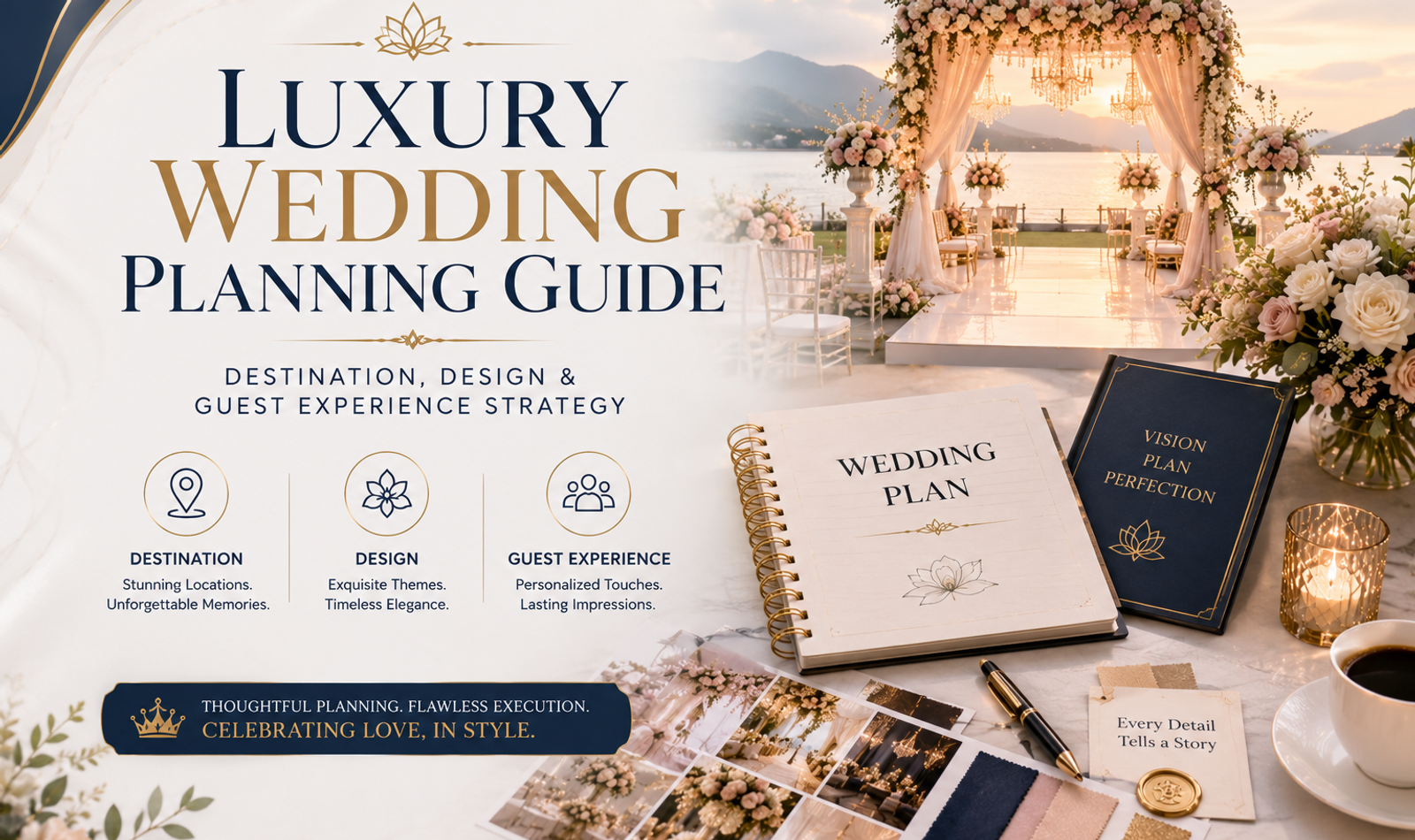
Luxury Wedding Planning Guide: Destination, Design & Guest Experience Strategy
Luxury wedding planning is no longer limited to selecting an impressive venue, creating elaborate décor and booking premium entertainment. A truly exceptional wedding requires a complete strategy connecting destination, design, hospitality, logistics, cultural traditions and guest experience.
Indian luxury weddings often involve several functions, travelling guests, family decision-makers, specialist vendors and complex production requirements. Every department must work together while allowing the celebration to feel natural, emotional and personal.
The most memorable weddings are not always the ones with the largest decorative structures or the highest number of performances. They are the celebrations in which the couple’s identity is visible, the guests feel cared for and every transition appears effortless.
A wedding may take place in a Mumbai ballroom, a Rajasthan palace, a coastal Goa resort, a private Alibaug property or an international destination. The planning principles remain similar, but the logistical, financial and creative requirements change significantly.
This luxury wedding planning guide explains how to develop a complete destination, design and guest-experience strategy. It covers concept development, venue selection, budgeting, guest management, travel, décor, entertainment, hospitality, production, privacy and wedding-day execution.
Quick Answer
A luxury wedding should be planned through three connected strategies: destination strategy, design strategy and guest-experience strategy. The destination determines travel, venues and accommodation, while the design creates the visual and emotional identity of the celebration.
The guest-experience strategy connects invitations, arrivals, rooms, transport, food, seating, entertainment and departures. Every decision should reduce inconvenience while increasing emotional connection and comfort.
Planning should begin with the couple’s story, approximate guest count, preferred dates, budget and destination options. Major venues and vendors should then be appointed before detailed décor and programme decisions are finalised.
The strongest luxury weddings use one central planning team, one guest database, one financial tracker and one master execution schedule. Multiple vendors may participate, but the wedding should feel like one carefully designed experience.
What Defines a Luxury Wedding?
A luxury wedding is defined by personalisation, quality, service and attention to detail. Expensive elements can support the experience, but expenditure alone does not create luxury.
Guests experience luxury when communication is clear, transport arrives on time, rooms are prepared and food is served smoothly. They also notice thoughtful personalisation, comfortable seating, appropriate lighting and culturally meaningful details.
The couple should feel represented throughout the celebration. The wedding should reflect their personalities, relationships, family traditions and shared memories rather than reproducing a generic online theme.
Luxury is also expressed through discretion. Operational activity, security, technical systems and vendor pressure should remain largely invisible to the guest.
The Three Pillars of Luxury Wedding Planning
Planning Pillar
Core Purpose
Key Decisions
Destination strategy
Select the right place and venue ecosystem
City, venue, rooms, travel and weather
Design strategy
Create the wedding’s emotional and visual identity
Concept, décor, lighting, florals and styling
Guest-experience strategy
Make every interaction comfortable and memorable
Invitations, travel, hospitality, food and movement
These three pillars should be developed together. A beautiful design may become impractical when the venue has limited setup access, while an attractive destination may create excessive travel pressure for the guest profile.
Begin with the Couple’s Story
The couple’s story should form the foundation of the wedding concept. This does not mean turning every detail into a literal timeline of their relationship.
The planning team should understand the couple’s personalities, cultural backgrounds, lifestyle, shared interests and emotional priorities. These elements can influence the destination, programme, music and design.
One couple may want a highly energetic multi-day celebration, while another may prefer intimate dining and meaningful ceremonies. The correct luxury strategy is different for each.
The planning process should also identify what the couple does not want. Clear exclusions can prevent the wedding from becoming overloaded with trends that do not feel personal.
Couple Discovery Checklist
• Personal style
• Shared interests
• Family traditions
• Cultural priorities
• Favourite destinations
• Guest expectations
• Essential moments
• Non-negotiable preferences
The discovery stage should produce a concise creative and operational brief. This document becomes the foundation for later vendor conversations.
Identify the Family Decision Structure
Indian weddings often involve several family members contributing ideas and approvals. This can add emotional depth, but it may also create conflicting instructions.
The planning team should identify who approves budgets, guest lists, ceremonies, décor and entertainment. Separate responsibilities can be assigned, but final authority must remain clear.
A family representative may manage one side’s guest list, while another person manages rituals or hospitality. Vendors should not receive competing instructions from several relatives.
Every important decision should be documented. Written approval becomes essential when the wedding includes several venues, functions and vendor teams.
Define the Wedding Vision
The wedding vision should describe how the celebration should look, feel and operate. It should include emotional, cultural and hospitality priorities.
A vision may describe the wedding as intimate, artistic, heritage-inspired, modern, destination-led or highly celebratory. It should remain specific enough to guide design decisions.
The vision should also explain how guests should feel. The desired experience may be warm and personal, dramatic and immersive or relaxed and elegant.
A clear wedding vision prevents individual functions from becoming unrelated. Each event may have a different mood while remaining part of one complete celebration.
Create the Initial Wedding Scope
The initial scope should identify the number of functions, approximate guest count, preferred dates and possible destinations. It should also define whether the wedding includes local, domestic destination or international travel.
The scope should consider ceremonies, welcome events, sangeet, wedding, reception, brunch and after-parties. Each additional function creates venue, hospitality and production requirements.
Guest attendance may differ by function. The planning team should not assume that every invited person will attend the complete wedding programme.
The initial scope does not need to contain every final detail. It should provide enough information to begin budgeting and venue research responsibly.
Building the Wedding Budget
Luxury wedding budgeting should begin before the destination and design are fully committed. The budget determines which venues, guest experiences and creative ideas are practical.
The total should include venue, rooms, catering, décor, production, entertainment, hospitality, transport, photography, security, invitations, gifts and planning fees.
Taxes, travel, labour, setup, dismantling and overtime should also be included. These expenses are frequently missing from early estimates.
The budget should reflect the couple’s priorities. A family may invest more heavily in guest hospitality and food, while another may prioritise design, entertainment and photography.
Typical Luxury Wedding Budget Categories
Budget Category
Main Components
Frequent Cost Risk
Venue
Rental, setup and overtime
Limited access hours
Accommodation
Rooms, suites and staff stays
Unused room guarantees
Food and beverages
Menus, bars and service
Guest-count changes
Décor and florals
Structures, flowers and furniture
Scope expansion
Production
Stage, sound, lights and screens
Late technical additions
Entertainment
Artists, DJs and performances
Travel and riders
Hospitality
Airport, hotel and guest support
Increased staffing
Transport
Cars, coaches and luggage
Unplanned movements
Photography
Films, photographs and edits
Extended coverage
Invitations and gifts
Design, printing and delivery
Quantity changes
Security
Access and VIP management
Additional deployment
Planning
Strategy and execution
Unclear scope
Contingency
Weather and emergencies
Early consumption
The budget allocation should be customised. One fixed percentage formula cannot accurately represent every luxury wedding.
Create Core and Enhancement Budgets
The core budget should contain everything required to deliver the approved wedding at the expected quality. It should protect guest comfort, ceremonies, production reliability and safety.
Optional enhancements should remain in a separate list. These may include additional artists, upgraded florals, personalised room gifts or extended content production.
The separation prevents optional ideas from reducing essential hospitality or operational expenditure. It also gives the family a controlled way to approve additions later.
Every enhancement should include a complete cost and decision deadline. Last-minute approval may create higher pricing and reduced vendor availability.
Protect the Contingency Reserve
A contingency reserve should be included from the first budget forecast. It protects the wedding from weather, guest changes, technical failure and urgent logistics.
The reserve should not be treated as an informal extension of the décor budget. Using it for optional creative upgrades can leave the wedding financially exposed.
One authorised person should approve contingency spending. Every use should be recorded with the reason and affected category.
The required amount depends on destination, season, venue and complexity. Outdoor and multi-day celebrations usually require stronger protection.
Choosing Between a Local and Destination Wedding
A local wedding may reduce travel and room requirements while allowing access to familiar vendors. It can still provide a luxury experience through strong venues, design and hospitality.
A destination wedding creates a more immersive celebration because guests spend greater time together. The destination can also become part of the emotional and visual identity.
However, destination weddings require travel, accommodation, luggage, transport and local supplier coordination. Guest comfort becomes a larger operational responsibility.
The family should evaluate whether the destination provides enough experiential value to justify the travel. A remote venue should offer more than visual beauty.
How to Select the Right Wedding Destination
The destination should be selected according to guest profile, connectivity, climate, venue options and wedding vision. Social-media popularity should not be the only criterion.
The planning team should examine airport or railway access, transfer time and hotel inventory. Elderly guests and children may find complicated journeys difficult.
Local vendor capability and permissions should also be reviewed. Bringing most suppliers from another city can increase freight, accommodation and management costs.
The destination should also suit the season. Outdoor comfort, rain, heat and wind can affect every function.
Luxury Wedding Destination Comparison
Destination
Best Wedding Style
Main Advantage
Key Planning Concern
Mumbai
Urban luxury and ballroom weddings
Connectivity and production
Traffic and venue access
Alibaug
Private coastal celebrations
Privacy near Mumbai
Transfers and weather
Goa
Resort and leisure weddings
Hospitality and atmosphere
Seasonal demand
Udaipur
Palace and heritage weddings
Architecture and romance
Rooms and transport
Jaipur
Heritage and large celebrations
Venue variety
Multi-location movement
Delhi NCR
Large luxury weddings
Capacity and vendors
Traffic and travel zones
Hyderabad
Palace and convention weddings
Hospitality infrastructure
Guest logistics
Chandigarh
Refined city weddings
Planned connectivity
Premium venue availability
Hill destinations
Intimate scenic weddings
Landscape and privacy
Weather and roads
International locations
Highly immersive weddings
Destination exclusivity
Travel documentation
The comparison should support initial research. Final decisions require venue inspections, current availability and complete commercial review.
Planning a Luxury Wedding in Mumbai
Mumbai can support hotel weddings, private celebrations, waterfront events and large receptions. The city offers experienced production, décor and entertainment vendors.
Venue location should be selected according to accommodation and guest travel. A prestigious venue may still create difficulties when most guests are staying far away.
Traffic buffers should be added to every movement schedule. The couple, families, artists and vendors may each require different transport plans.
Monsoon weddings require complete indoor alternatives and covered arrival routes. Humidity can also affect floral installations, makeup and temporary flooring.
Planning a Wedding in Alibaug
Alibaug can offer greater privacy and a relaxed coastal atmosphere while remaining connected to Mumbai. It is suitable for resort weddings, private estates and intimate celebrations.
Guest transfers may involve road, sea or combined movement. Weather conditions and luggage requirements should influence the final transport strategy.
Heavy décor and production equipment may need to travel by road even when guests use faster transfer routes. Vendor logistics should therefore be planned separately.
The wedding programme should allow enough arrival time. Guests should not move directly from a complicated transfer into a tightly scheduled ceremony.
Planning a Wedding in Goa
Goa supports resort-led weddings, welcome parties, beach-inspired events and leisure-focused hospitality. It can offer several experiences within one property.
The venue should be evaluated according to room inventory, outdoor permissions and weather backup. Travel between distant hotels and venues can create delays.
The design should respond to local architecture, tropical landscapes and coastal light. Generic beach decoration may not create a distinctive experience.
Peak-season room rates and vendor demand require early planning. The family should also understand local sound and outdoor event conditions.
Planning a Wedding in Rajasthan
Rajasthan offers palaces, forts, courtyards, havelis and resort properties suitable for heritage-led celebrations. The architecture can become the central visual identity.
Historic venues may restrict structures, sound, vehicles, food and photography. Décor should respect the property instead of hiding it.
Room inventory may be distributed across several hotels. Hospitality and transport systems must remain accurate.
Local craft, food and performance can add authenticity. Cultural elements should be used with understanding rather than as disconnected visual decoration.
Selecting the Wedding Venue
The venue should support guest comfort, programme, design and production. Its visual appeal is only one part of the decision.
The planner should review capacity after accounting for stages, bars, catering and movement. Maximum venue capacity may not equal comfortable luxury capacity.
Loading routes, service lifts, rigging, power and sound restrictions should be inspected. These details influence both cost and creative possibilities.
The venue should also provide sufficient washrooms, private rooms, parking and emergency access. Guests experience these practical elements directly.
Venue Selection Checklist
• Comfortable capacity
• Architectural quality
• Room availability
• Private entrances
• Loading access
• Power supply
• Rigging points
• Catering facilities
• Sound restrictions
• Weather backup
• Accessible routes
• Medical support
The planning, production, décor and hospitality teams should inspect the property together before final confirmation.
Negotiating the Venue Contract
The venue contract should identify every event space, setup period, function timing and room commitment. Important sales promises should appear in writing.
Minimum food, beverage or room commitments require careful review. The family should understand what becomes payable if attendance changes.
Overtime, power, valet, corkage, security and damage policies should also be included. These charges can affect the final budget significantly.
Cancellation, postponement and weather terms should be reviewed before payment. High-value agreements may require professional legal advice.
Creating the Wedding Design Strategy
The design strategy should translate the couple’s story into a complete visual and emotional environment. It should include colour, materials, lighting, florals, furniture and guest movement.
The wedding should not be designed as one stage surrounded by secondary decoration. Arrival, dining, lounges, bars and pathways all contribute to perception.
Each function may use a different creative direction while sharing one identity. Typography, materials, motifs or storytelling can connect the entire wedding.
The design should also consider photography, weather and production. Visual ambition must remain executable within the venue and schedule.
From Theme to Narrative
A theme is usually a visual label such as royal, tropical, floral or vintage. A narrative explains why the wedding looks and feels a particular way.
A narrative may be inspired by the couple’s shared journey, family heritage, destination or creative interests. It provides greater originality than a generic theme.
The invitation can introduce the story, while the venue reveals it through movement and atmosphere. Music, food and gifts can continue the narrative.
Guests should be able to feel the concept without reading a long explanation. The strongest wedding stories are emotionally clear.
Designing Multiple Wedding Functions
A multi-day wedding should provide variety without becoming visually disconnected. Every function should have a clear purpose and mood.
The welcome event may feel informal and destination-led, while the mehendi can be bright and social. The wedding ceremony may become quieter and more emotional.
The sangeet or reception can introduce stronger production, movement and theatricality. The functions remain connected through the couple’s identity.
All functions should be designed together before individual concepts are finalised. This prevents repetitive colours, structures and entertainment.
Designing the Wedding Entrance
The entrance is the guest’s first physical interaction with the wedding environment. It should establish mood while supporting security and hospitality.
A cinematic entrance may use lighting, sound, scent and gradual visual reveals. However, registration and guest verification should remain simple.
The path should be accessible and comfortable for formal clothing. Long uneven routes may create difficulty for elderly guests and high heels.
Signage should be clear without becoming visually intrusive. Guests should not need to contact family members for basic directions.
Designing the Ceremony
The ceremony design should support tradition, visibility and emotional intimacy. It should not be treated only as a decorative photograph.
The mandap or ceremony structure should allow the couple and key family members to move comfortably. The priest and ritual materials also require adequate space.
Seating should provide clear sightlines and appropriate access for elderly guests. Production equipment should not block the ceremony.
Lighting, music and florals should enhance the rituals without overpowering them. The ceremony remains the emotional centre of the wedding.
Designing the Sangeet and Reception
The sangeet requires coordination between stage design, choreography, sound, lighting and guest seating. Rehearsals should be included in the setup schedule.
The stage should support both performances and camera coverage. Screens may be required when the venue is large.
The reception may focus more strongly on dining, entertainment and social interaction. Lounge areas and conversation zones can reduce pressure on formal seating.
Both events should include realistic programme lengths. An overloaded performance schedule can delay food and reduce guest energy.
Wedding Floral Strategy
Floral design should respond to season, venue and event mood. Imported flowers are not automatically superior to local and seasonal materials.
Botanical architecture can shape entrances, ceilings, stages and dining areas. Flowers may be combined with branches, foliage, fruit, textiles or sculptural surfaces.
Large installations should protect guest sightlines and safety. Floral volume should not reduce movement or conversation.
Waste and disposal should also be considered. Repurposing flowers between functions may be possible when quality and timing allow.
Wedding Lighting Strategy
Lighting defines how the wedding feels in person and how it appears in photographs. It should be planned with décor and production.
Warm architectural lighting can create intimacy during ceremonies and dining. Richer movement and colour may support performances and after-parties.
Guests should still be able to see food, steps and one another clearly. Excessive darkness can create discomfort and safety concerns.
The photography team should review key lighting areas during rehearsal. Different camera systems may respond differently to colour and brightness.
Furniture and Seating Strategy
Furniture should match the wedding design while remaining comfortable. Visual appearance should not override practical use.
Low lounge seating may work for younger guests but become difficult for elderly attendees. Mixed seating can provide choice.
Dining tables, lounges and high tables should be positioned according to programme and service. Furniture should not block movement or emergency routes.
Rental quantities should include a controlled reserve. Last-minute guest additions should not result in visible seating shortages.
Designing the Guest Experience
Guest experience begins before the invitation is received and continues until the final departure. Every interaction contributes to the wedding’s reputation.
The planning team should map invitations, RSVPs, travel, check-in, transport, functions, meals, assistance and departures. Each stage should have a clear owner.
Luxury guest experience does not require constant attention. It requires the right support to appear at the right moment.
Guests should feel recognised without feeling monitored. Personalisation should remain discreet and relevant.
The Guest Journey Table
Guest Stage
Main Requirement
Luxury Experience Detail
Invitation
Clear and personal communication
Accurate names and elegant design
RSVP
Simple confirmation process
Dedicated assistance
Travel
Reliable information
Coordinated transfers
Arrival
Warm welcome
Personal recognition
Check-in
Fast room allocation
Prepared documents and gifts
Functions
Smooth movement
Clear transport and guidance
Dining
Comfort and choice
Dietary personalisation
Departure
Timely support
Luggage and transport coordination
Every guest stage should be tested from the perspective of someone unfamiliar with the family, venue and destination.
Creating the Guest List
The guest list should be divided by family, friends, professional relationships, VIPs and destination travellers. Each function may have a different attendance list.
Plus-one and children policies should be decided before invitations are distributed. Unclear policies create uncomfortable later conversations.
The list should include relationship owners who can confirm priority guests personally. Automated reminders may not be suitable for every invitee.
A controlled reserve should remain available for genuine additions. The venue should not be filled to maximum capacity before confirmations begin.
RSVP Management
The RSVP system should collect attendance by function, approved companions, dietary needs and travel details. All responses should enter one central database.
Confirmations received through calls or messages should be updated immediately. Separate personal lists create inaccurate information.
Priority guests may require personal follow-up. The family relationship owner should support the hospitality team where necessary.
The RSVP deadline should be connected with hotel, catering, transport and printing deadlines. It is an operational requirement, not only an invitation detail.
Invitations and Wedding Communication
Wedding invitations should combine creative design with practical clarity. Dates, venues, dress guidance and RSVP instructions should be easy to identify.
Physical invitations can create emotional value for close family and senior guests. Digital invitations support faster updates and destination information.
Guest names and titles should be verified carefully. A spelling error can weaken the first impression of personalisation.
A wedding website or controlled communication platform can centralise travel, itineraries and updates. Too many separate messages can create confusion.
Destination Guest Travel
Guest travel planning should begin with accurate flight, train and arrival information. Luggage, elderly guests and children should also be considered.
Airport representatives and drivers should work from the same current schedule. Delays must be communicated across hospitality, transport and hotel teams.
Guests should receive transfer confirmation before travel. A last-minute driver number should not be the only information provided.
International guests may require additional practical guidance. Official travel and documentation requirements should always be verified through appropriate authorities.
Rooming List Management
The rooming list should contain guest names, dates, room categories and special requirements. One team should control the approved version.
Close families, elders and VIPs may require specific floors or room locations. Accessibility should be considered during allocation.
Hotel release and cancellation dates must be tracked. Unused guaranteed rooms can create substantial costs.
Room drops and welcome gifts should use the same final rooming information. Frequent informal changes should not bypass the control system.
Wedding Welcome Experience
The welcome experience may include airport greetings, hotel desks, room gifts and itinerary support. It should feel warm rather than excessively formal.
Welcome gifts can include local products, comfort items, personal notes and practical information. They should remain easy to transport.
Hospitality staff should know the wedding schedule, rooming process and assistance contacts. Decorative desks without reliable information provide little value.
The team should also prepare for early arrivals and delayed rooms. Guests should receive a comfortable alternative while waiting.
Transport and Guest Movement
Transport should connect airports, hotels, venues and local activities. Every vehicle movement should be connected to the event programme.
Guests should be grouped logically. Large coaches, smaller shuttles and dedicated family cars can be used together.
The planner should account for luggage, road conditions and parking. Vehicle capacity should not be calculated only according to seats.
A central transport desk should monitor dispatch and delays. Guests should not need to coordinate drivers personally.
Guest Communication During the Wedding
Guests should receive concise daily information covering timings, transport and dress requirements. Repeated long messages may be ignored.
Different groups may need different communication. Family, VIPs, general guests and performers should not all receive the same operational detail.
Changes should clearly identify what is new. Sending an entire itinerary again without explanation can create confusion.
One assistance number should remain active throughout the wedding. Guest questions should not move directly to the couple or parents.
Food and Beverage Strategy
Food is one of the most remembered aspects of an Indian wedding. The menu should consider guest profile, culture, function timing and destination.
A larger number of dishes does not always improve the experience. Quality, temperature, presentation and service speed are more important.
Each function should have a distinct culinary identity. Repeating the same cuisine and service format can make a multi-day wedding feel monotonous.
Dietary requirements should be collected through the RSVP system. Guests should not need to repeat confirmed needs at every function.
Menu Planning Checklist
• Function-wise menus
• Regional preferences
• Dietary requirements
• Service format
• Counter placement
• Staff strength
• Beverage planning
• Vendor meals
Food service should remain coordinated with ceremonies and performances. Key moments should not force guests to choose between the programme and dining.
Luxury Bar Planning
The bar experience should match the event design and guest profile. It may include classic service, signature drinks and strong non-alcoholic options.
Venue policies, corkage and licensing should be understood before purchase. Stock and consumption controls may also be required.
Bars should be positioned to prevent congestion. They should remain accessible without disrupting ceremony or stage visibility.
Service speed is part of the luxury experience. Beautiful styling cannot compensate for long queues.
Entertainment Planning
Entertainment should support the couple’s personality and each function’s purpose. Every event does not require the same scale or style.
Live music may suit a welcome dinner, while the sangeet may include family performances and headline artists. The ceremony may require more restrained sound.
Artist agreements should define performance duration, technical riders, travel, hospitality and content rights. A celebrity appearance and full performance are different commitments.
Sound checks and rehearsals should be part of the master schedule. Entertainment cannot be confirmed independently from production.
Family Performances
Family performances often become the most emotional part of a wedding. They require choreography, rehearsals, music edits and stage planning.
The rehearsal schedule should respect family availability. Final practice should take place on the actual stage wherever possible.
Video playback, entry positions and lighting cues must be tested. Small technical mistakes can disrupt months of preparation.
The programme should also remain realistic. Too many performances can delay dinner and reduce attention.
Photography and Wedding Films
The photography team should be selected according to visual style, scale and the number of simultaneous functions. One team may not be sufficient for several venues.
The photographers should receive the ceremony schedule, family priorities and restricted moments. A family representative can help identify important guests.
Drone use may require venue and regulatory approval. It should not be assumed to be available at every property.
Delivery timelines, editing scope and usage rights should be included in the contract. The couple should know when previews, films and albums will be delivered.
Content Creation and Social Media
Some luxury weddings require same-day edits, social-media reels or controlled press content. These services should be defined separately from traditional photography.
The family should decide what may be published and when. Guests should not assume that every private moment is public content.
High-profile weddings may require restricted posting rules or delayed publication. Vendors should receive clear contractual guidance.
A wedding can be designed with several naturally photogenic environments without turning every space into a formal photo wall.
Wedding Production Planning
Production includes sound, lighting, stage structures, screens, power, rigging and communication. It is essential to both performance and guest comfort.
The team should inspect ceiling height, loading routes, power and sound restrictions. Technical requirements should be reviewed before final décor approval.
Backup power, microphones and playback systems should remain available. One device should not control a critical wedding moment without support.
Production rehearsals should follow the actual run of show. Testing individual equipment is not enough.
Security and Privacy
Luxury weddings may include celebrities, business leaders, public figures and private family information. Security should remain professional and discreet.
Guest verification may use invitations, lists or digital credentials. An exception desk should handle missing names away from the main queue.
Room numbers, travel schedules and private contacts should be shared only with authorised teams. Vendors should receive information according to operational need.
Photography and social posting may also require control. Some guests may not want their attendance or image shared publicly.
Celebrity and VIP Guest Management
VIP guests may require private transport, secure entrances and dedicated coordinators. Their arrival should not disrupt the general guest experience.
One team should manage communication with celebrity representatives or security personnel. Separate family and vendor requests can create confusion.
Holding rooms, stage access and departure plans should be confirmed. Information should remain restricted until operationally required.
VIP hospitality should remain discreet. Excessively visible differentiation can make other guests uncomfortable.
Ceremony Planning
The ceremony plan should be developed with priests, family representatives and the planner. Ritual sequence, materials and responsibilities should be documented.
Décor and production teams need to understand movement, music and seating. Ceremony lighting should remain respectful and practical.
All materials should be checked before guests arrive. Missing ritual items should not be discovered after the couple is seated.
The schedule should give traditions enough time. Rituals should not be rushed because entertainment or dining was planned without proper consultation.
Ceremony Checklist
• Ritual sequence
• Priest confirmation
• Required materials
• Family responsibilities
• Music cues
• Seating plan
• Photography access
• Timing buffers
One family coordinator should remain available so that the couple is not interrupted with operational questions.
The Master Wedding Timeline
The master timeline should connect planning deadlines, vendor appointments, guest communication and live execution. It should not contain only event-day timings.
Early stages focus on budget, dates, destination and venue. The middle stage covers vendors, design, entertainment and guest communication.
The final stage focuses on rooms, transport, seating, rehearsals and control documents. Post-wedding closure should also be included.
Every major task should have an owner and deadline. The timeline should remain accessible to relevant decision-makers.
Luxury Wedding Planning Timeline
Planning Stage
Primary Actions
12–18 months before
Vision, budget, dates and destination
9–12 months before
Venue, rooms and primary vendors
6–9 months before
Design, production and invitations
3–6 months before
Entertainment, travel and guest management
6–12 weeks before
RSVPs, rooming, menus and schedules
2–6 weeks before
Seating, transport and rehearsals
Wedding week
Setup, hospitality and execution
Post-wedding
Payments, content and closure
The schedule should be compressed or extended according to complexity. Large destination weddings generally benefit from earlier planning.
Creating the Wedding Run of Show
The run of show is the detailed execution schedule used by planners, production teams, performers and coordinators. It includes timing, cues and responsibilities.
Guest arrival, couple entries, ceremonies, speeches, performances, dining and departures should all be connected.
Different departments may require additional detail, but the underlying timing should remain consistent. Production and hospitality cannot work from conflicting schedules.
The run should include buffers for travel, outfit changes and family movement. A schedule without buffers becomes unreliable after the first delay.
Wedding Rehearsals
Rehearsals should cover entries, rituals, family performances, speeches and technical cues. They help identify problems before guests arrive.
Sound, video, lighting and stage movement should be tested under realistic conditions. Family members with responsibilities should understand where they need to be.
The rehearsal should also test transitions. The programme may appear correct on paper but become difficult when real movement begins.
The final run of show should be updated after rehearsal. Old versions should be removed from active use.
Weather Contingency
Outdoor weddings require a complete weather alternative. The backup should support the full guest count, catering, production and programme.
Covered movement between vehicles and venues should also be considered. A dry main space does not help when guests are exposed during arrival.
Wind, heat and humidity can affect flowers, fabric, makeup and technical equipment. Materials should be selected accordingly.
The decision deadline should be agreed in advance. Waiting until the last moment may leave both options incomplete.
Medical and Emergency Planning
A medical response plan should be appropriate to the guest count, venue and destination. Medical contacts and emergency access routes should remain available.
Elderly guests, children and long event durations may increase the need for support. Hydration and temperature control can prevent avoidable problems.
Security, hospitality and venue teams should understand how to respond without creating public alarm.
Emergency information should remain inside the control-room documents. Every department lead should know the escalation process.
Sustainable Luxury Wedding Planning
Sustainability can be integrated through reusable structures, rental furniture, local sourcing and responsible gifting. The approach should remain practical and measurable.
Local flowers and materials may reduce freight and improve destination relevance. Potted plants may be repurposed after selected events.
Digital communication can reduce unnecessary printing, although physical invitations may still remain important for priority guests.
Environmental responsibility should not appear only through decorative language. The planning team should document real sourcing, waste and reuse decisions.
Accessibility and Inclusive Hospitality
Accessible planning should begin during venue and floor-plan development. It should not be added after the design is complete.
Ramps, pathways, washrooms and seating should support guests with mobility needs. Clear signage and readable communication also improve comfort.
Elderly guests may need shorter walking routes and nearby transport. Children may require safe supervised areas during long functions.
Inclusive planning improves the experience for a much wider guest group. It is an essential part of modern luxury hospitality.
Wedding-Day Command Structure
The wedding day should operate through one event director and department leads. Vendors should not contact the couple or parents for routine decisions.
A control room should contain schedules, guest information, vendor contacts, floor plans and emergency details. Operational issues should be assigned and tracked.
Production, hospitality, guest management, logistics and security should each have clear leadership. Every lead should also have a backup.
The command system allows the visible wedding environment to remain calm. Complex coordination stays behind the scenes.
Wedding-Day Command Roles
• Event director
• Control-room lead
• Production manager
• Hospitality manager
• Guest-list manager
• Transport manager
• Security lead
• Family coordinator
The final vendor briefing should explain the complete reporting and escalation structure.
Managing Last-Minute Changes
Last-minute changes should be assessed for cost, safety, timing and vendor impact. A seemingly small request can affect several departments.
Changing the stage may affect lighting, screens, seating and photography. Adding a guest may affect food, transport, rooms and gifts.
Only authorised decision-makers should approve changes. Vendors should not act on informal requests from unrelated family members.
Every approved change should be documented. This protects execution and post-wedding financial reconciliation.
Guest Departure Strategy
The guest experience continues until departure. Valet, shuttles, luggage and airport transfers require the same planning as arrival.
Departure peaks should be predicted after ceremonies and performances. Vehicle teams should prepare before guests begin leaving.
Guests waiting for transport should receive seating, water and accurate information. Unexplained delays create a poor final impression.
Departure gifts and personal messages can create a meaningful closing moment. The final interaction should feel as considered as the welcome.
Post-Wedding Closure
The planning process continues after the final event. Vendor equipment, hotel accounts, guest belongings and payments must be closed.
The team should track lost property and unresolved guest concerns. Prompt communication protects relationships.
Photography and film delivery schedules should also be reviewed. The couple should know when each asset is expected.
Temporary guest data, access systems and vendor permissions should be closed responsibly after operational requirements end.
Post-Wedding Financial Reconciliation
Final invoices should be compared with contracts and approved additions. Overtime, room changes and consumption charges should be verified.
Hotel accounts should be matched with the final rooming list. Transport bills should be compared with authorised vehicle schedules.
Deposits and refunds must remain visible until received. The wedding budget should not be considered closed while financial liabilities remain uncertain.
A final cost report helps families understand the original budget, additions and actual expenditure.
The SIGNATURE Luxury Wedding Framework
The SIGNATURE framework connects destination, design and guest experience through one practical planning system.
S — Story and Style
Define the couple’s personality, emotional objective and wedding identity before developing themes.
I — Investment and Priorities
Create a complete budget, protect essential categories and separate core costs from enhancements.
G — Guest Intelligence
Understand guest groups, travel, dietary needs, accessibility and relationship priorities.
N — Network of Vendors
Appoint capable venues and specialist suppliers through detailed scopes, contracts and clear reporting lines.
A — Atmosphere and Architecture
Design every function around the venue, programme, culture and guest movement.
T — Travel and Hospitality
Coordinate rooms, arrivals, transport, assistance and departures through one guest-management system.
U — Uncertainty Planning
Prepare for weather, technical failure, travel disruption, security concerns and medical requirements.
R — Rehearsal and Run of Show
Test ceremonies, performances, production and guest transitions before live execution.
E — Execution and Evaluation
Operate a central command system, manage live changes and complete financial and vendor review after the wedding.
The SIGNATURE framework ensures that every creative idea is supported by budgeting, hospitality and execution discipline.
Complete Luxury Wedding Planning Checklist
Before wedding-week execution begins, the planning team should confirm the complete strategic and operational foundation.
• Approved wedding vision
• Confirmed budget
• Signed venue contract
• Vendor scopes
• Guest database
• Rooming list
• Transport plan
• Design approvals
• Catering confirmation
• Entertainment contracts
• Ceremony plan
• Security structure
• Weather backup
• Final rehearsal
• Control-room documents
• Closure plan
Each item should have one responsible owner and fixed completion deadline.
Common Luxury Wedding Planning Mistakes
One common mistake is developing décor before finalising the venue, guest count and budget. The design then becomes disconnected from operational reality.
Another mistake is selecting a destination based only on photographs. Travel, rooms, climate and vendor infrastructure must also be considered.
Families may allow several people to give direct instructions to vendors. This creates conflicting scopes and unnecessary costs.
Guest hospitality is sometimes treated as secondary to visual production. Delayed transport, uncomfortable rooms and unclear communication can damage the entire experience.
Finally, many weddings prepare extensively for arrival but neglect departure, financial closure and content delivery. The complete journey should remain planned until every responsibility is finished.
Frequently Asked Questions
What is included in luxury wedding planning?
Luxury wedding planning can include concept development, budgeting, destination selection, venue negotiation, design, hospitality, entertainment, guest management and execution.
The exact scope should be documented before appointing the planner.
How early should a luxury wedding be planned?
Large and destination weddings should begin as early as practical. Premium venues, room blocks and specialist vendors may require advance commitment.
A shorter timeline is possible when the family remains flexible about dates, venues and suppliers.
How do you choose a destination wedding location?
Evaluate connectivity, guest profile, climate, venues, accommodation and local vendor capability. The location should provide enough experiential value to justify travel.
A venue inspection should take place before final confirmation.
Which destinations are suitable for luxury weddings in India?
Mumbai, Alibaug, Goa, Udaipur, Jaipur, Delhi NCR, Hyderabad and selected hill destinations can support different wedding formats.
The best option depends on season, guest count, budget and preferred atmosphere.
How is a luxury wedding budget created?
The budget should be divided into venue, rooms, food, décor, production, entertainment, hospitality, transport and professional fees.
Taxes, vendor travel, overtime and contingency should be included from the beginning.
How can wedding costs be controlled?
Use category limits, detailed vendor scopes, written approvals and one central budget tracker. Guest-list growth should also be controlled.
Optional enhancements should remain separate from essential wedding costs.
How do you select a luxury wedding venue?
Review comfortable capacity, architecture, accommodation, setup access, power, catering and weather backup.
The venue contract should explain timings, mandatory vendors, overtime and cancellation terms.
What makes luxury wedding design different?
Luxury design is personalised around the couple and venue. It connects invitations, décor, lighting, dining and entertainment through one narrative.
Quality, proportion and guest comfort matter more than decoration volume.
How are destination wedding guests managed?
Guest management includes travel information, airport support, rooming lists, transport, itineraries and assistance contacts.
All guest information should remain inside one controlled database.
What is wedding hospitality management?
Hospitality management coordinates arrivals, hotel check-in, luggage, room gifts, information desks and departures.
Its objective is to reduce effort for guests throughout the wedding journey.
How should food be planned for a luxury wedding?
Menus should reflect the guest profile, function timing and cultural preferences. Quality and service should receive greater attention than excessive variety.
Dietary requirements should be collected in advance and communicated discreetly.
How are VIP and celebrity guests managed?
VIP guests may require dedicated transport, private entrances, security and restricted information access.
One authorised coordinator should manage communication with representatives and security teams.
Why are wedding rehearsals important?
Rehearsals test ceremonies, performances, entries, sound, lighting and transitions. They identify conflicts before guests arrive.
The final run of show should be updated after rehearsal.
What should a wedding weather plan include?
It should include a full-capacity backup venue, covered access, equipment protection and a decision deadline.
The alternative should support catering, production and the complete programme.
What happens after the wedding?
The planning team should close vendor accounts, hotel bills, lost property, content delivery and guest-data access.
A final budget and vendor-performance review should also be completed.
Does Double Trouble Studio plan luxury destination weddings?
Double Trouble Studio supports luxury and destination weddings in Mumbai and across India with complete planning, design, guest management and execution.
The scope can include destinations, venues, budgets, vendors, hospitality, entertainment, production and wedding-day coordination.
How Double Trouble Studio Plans Luxury Weddings
Double Trouble Studio approaches luxury wedding planning as a complete journey rather than a collection of individual functions. We begin by understanding the couple, families, destination and intended guest experience.
Our work can include concept development, budgeting, venue selection, vendor management, décor, production, entertainment, hospitality and transport. Every department is connected through one planning system.
For destination weddings, we coordinate travel, accommodation, local suppliers, guest communication and cultural integration. For Mumbai weddings, we plan around traffic, venue access, weather and premium guest movement.
During the wedding week, our teams can manage arrivals, hotel desks, rehearsals, ceremonies, vendors, control rooms and live changes. The couple and families remain emotionally present while operational complexity stays behind the scenes.
The objective is to create a celebration that feels personal, refined and effortless. Every design, hospitality and production decision should contribute to the couple’s story and the guest’s memory.
Conclusion
A luxury wedding requires more than beautiful décor and premium vendors. It requires one connected strategy covering destination, design and guest experience.
The destination should support travel, accommodation and the couple’s vision. The design should transform personal identity into an emotionally coherent environment.
Guest experience should guide invitations, transport, food, seating, hospitality and departures. Every detail should reduce effort while increasing comfort and connection.
Budgeting, vendor management, rehearsals and contingency planning create the foundation for flawless execution. When these systems work together, the wedding feels effortless despite its complexity.
The most successful luxury weddings are not simply admired. They are felt, remembered and recognised as uniquely belonging to the couple and families behind them.
Plan Your Luxury Wedding with Double Trouble Studio
A luxury wedding should feel deeply personal, beautifully designed and professionally managed from the first concept discussion to the final guest departure. Double Trouble Studio creates complete wedding experiences in Mumbai and across India.
Our approach can include destination selection, venue planning, budgeting, design, vendor management, invitations, guest hospitality, transport, entertainment, production and wedding-day execution.
Connect with Double Trouble Studio to create a wedding that combines meaningful storytelling, refined hospitality and seamless on-ground coordination.
📩 info@dtsworld.in 📞 +91 80000 06021 📍 Andheri (West), Mumbai
I applied 15 contextual internal links, all from the DTSWorld.in sitemap you supplied, without changing the blog’s substance.
Related reading: Luxury wedding planning guide 2026.
Need this for your brand?
Let DTS build your next campaign.
From PR, celebrity management and events to websites, social media, SEO and AI video production — Double Trouble Studio helps brands grow with strategy and execution.
Discuss Your Requirement →