Building Conversion-Focused Marketing Funnels on Your Website
A website should do more than create an attractive digital presence. It should guide visitors from their first interaction with a brand towards a meaningful business action. That action may involve submitting an enquiry, booking a consultation, requesting a quotation, downloading a resource, joining an email list or completing a purchase.
Many websites receive traffic but fail to generate consistent results because they are designed as collections of pages rather than connected customer journeys. The homepage introduces the company, the service pages describe the offering and the contact page contains a form, but there is no clear strategy connecting these elements.
A conversion-focused marketing funnel solves this problem by giving each stage of the visitor journey a specific purpose.
The funnel helps a business understand what a potential customer needs at different levels of awareness. Someone who has just discovered a brand is unlikely to respond to the same message as someone who has already compared several providers and is ready to make a decision. The website should recognise these differences and present the right information at the right moment.
Building an effective funnel does not mean pressuring every visitor into making an immediate purchase. It means reducing uncertainty, increasing relevance and creating a logical path towards action.
A strong website funnel combines marketing strategy, user experience, content, design, conversion optimisation and measurement. When these areas work together, the website becomes an active sales and lead-generation system rather than a passive online brochure.
Understanding the Website Marketing Funnel
A marketing funnel is a framework used to describe the stages a potential customer moves through before and after completing a conversion.
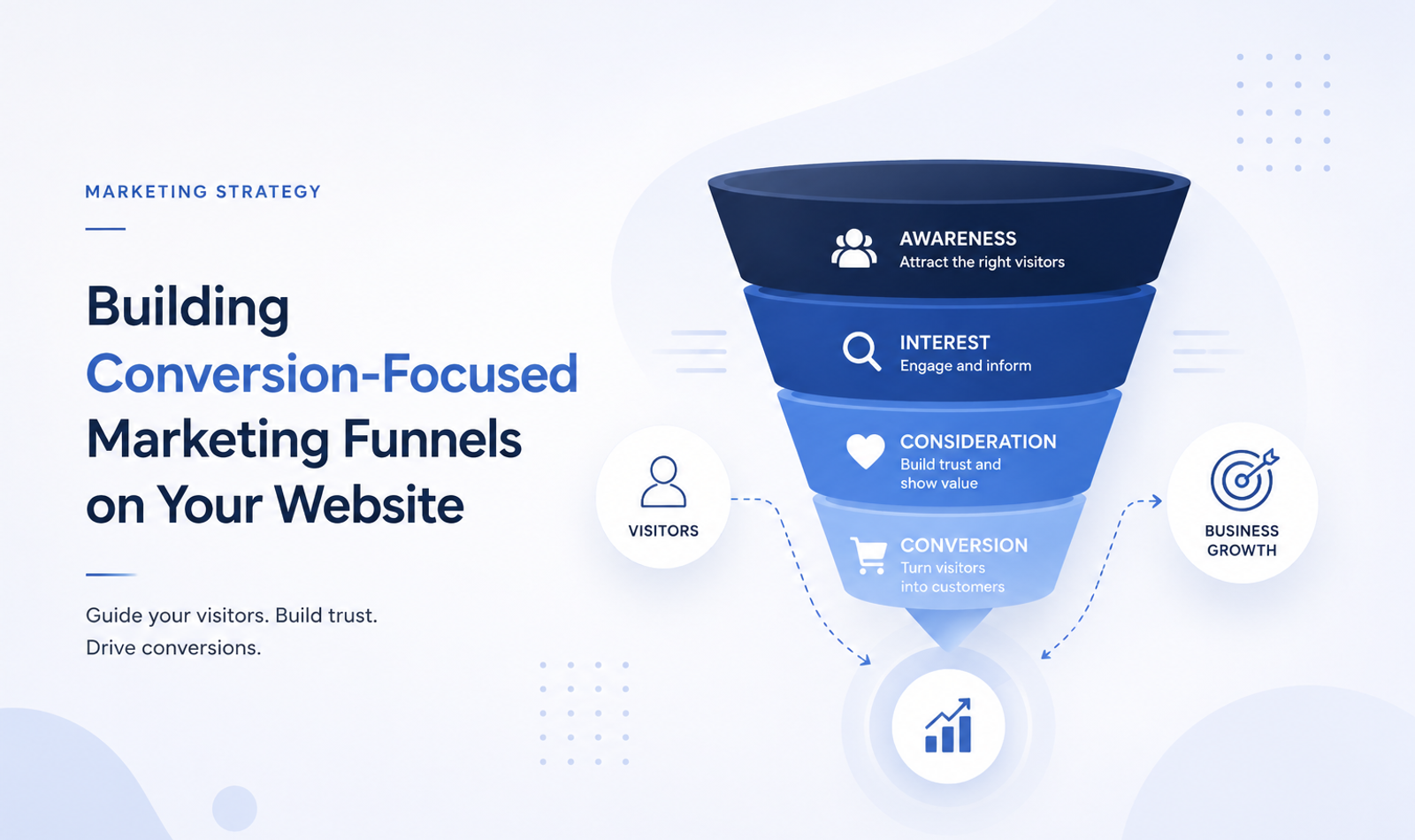
The traditional funnel is usually divided into awareness, consideration and conversion. Some models also include retention, loyalty and advocacy after the initial purchase.
At the awareness stage, people recognise a need, problem or opportunity. They may not yet know which solution is appropriate or which brand can help them. At the consideration stage, they explore options, compare providers and evaluate whether a particular solution is suitable. At the conversion stage, they are closer to taking action but may still require reassurance.
The funnel becomes narrower towards the bottom because not every person who discovers the brand will become a customer. However, the objective is not to force as many people as possible through every stage. The objective is to attract the right audience and help qualified prospects progress naturally.
Modern customer journeys are not always linear. A visitor may discover a brand through social media, leave the website, return through a Google search, view a case study, read reviews and then contact the company several days later. Another person may visit a pricing page first, return to the homepage and then read an educational article before making a decision.
The marketing funnel should therefore be used as a strategic guide rather than a strict sequence that every person must follow.
A conversion-focused website supports multiple entry points while keeping the journey connected. Regardless of whether someone enters through a blog post, service page, advertisement or social media campaign, they should be able to understand the brand and identify a relevant next step.
Begin With a Clear Conversion Goal
A funnel cannot be designed effectively until the business defines what a successful conversion means.
Some websites treat every possible action as equally important. They display buttons for calling, emailing, following social media accounts, downloading brochures, subscribing to newsletters and viewing services. When too many actions compete for attention, visitors may not understand what the business wants them to do.
A primary conversion goal should reflect the most valuable action a qualified visitor can take.
For a professional service company, the goal may be to book a consultation. For a real estate business, it may be to arrange a site visit. For an ecommerce brand, it may be to complete a purchase. For a restaurant, it may be to reserve a table or place an order.
Secondary conversions can support the main objective. A visitor who is not ready to book a consultation may download a guide or subscribe to updates. These actions allow the brand to continue the relationship.
The primary goal should influence the entire website structure. The messaging should explain why the visitor should act, the content should answer relevant questions and the calls to action should guide the visitor towards the conversion.
A website should not ask users to take an action simply because the business wants more leads. It must first provide enough value and confidence to make the action feel reasonable.
Understand the Target Audience
A conversion-focused funnel must be based on a clear understanding of the people it is designed to attract.
A website cannot speak effectively to everyone. Different audiences have different priorities, concerns, levels of knowledge and purchasing motivations.
A startup founder looking for a website may care about speed, affordability and flexibility. An established luxury brand may care more about strategic positioning, visual quality and specialised expertise. Both may require web development, but the message that motivates them will be different.
Audience research should identify the problems customers are trying to solve, the outcomes they want, the questions they ask and the objections that delay their decisions.
It is also useful to understand what they have already tried. A business owner who has previously worked with an unreliable agency may require stronger reassurance about communication, timelines and accountability. Someone purchasing a service for the first time may require more educational content.
The funnel should use the audience’s language rather than internal industry terminology. Visitors should immediately recognise that the website understands their situation.
When the message is too broad, the brand may attract traffic without attracting qualified prospects. A more focused message may reach fewer people but create stronger relevance and higher conversion potential.
Map the Customer Journey
Customer journey mapping helps a business understand the steps, questions and emotional states that may appear between initial discovery and final conversion.
The process begins by identifying the main ways people enter the website. Some may arrive through organic search, while others come from advertisements, social media, email campaigns, referrals or direct recommendations.
Each traffic source creates a different level of expectation.
A visitor clicking an advertisement for “luxury website design services” expects to reach a page specifically addressing premium website design. Sending that visitor to a general homepage creates unnecessary work because they must search for the promised information.
A visitor arriving through an educational article may not be ready to submit an enquiry. They may first need to explore a related service page, review examples and understand the company’s approach.
Journey mapping should examine the information visitors require at each stage. Early-stage visitors often need education and problem clarification. Middle-stage visitors need evidence, comparisons and solution details. Decision-stage visitors need reassurance, clarity about the process and an easy way to take action.
The purpose of mapping is not to predict every possible click. It is to ensure that the website provides a logical path between important stages.
Every major page should answer two questions: what does the visitor need here, and what should they do next?
Build Awareness With Useful Content
The top of the marketing funnel is focused on discovery and awareness.
At this stage, potential customers may recognise a problem without knowing exactly how to solve it. They may search for information, watch educational content or explore industry topics.
A conversion-focused website should provide useful content that responds to these early questions.
Blog articles, guides, videos, reports, checklists and educational landing pages can attract people who are researching relevant subjects. The content should help visitors understand the problem, evaluate its importance and identify possible solutions.
For example, a digital marketing agency may publish an article explaining why a business receives website traffic but no enquiries. A real estate company may create a guide to choosing the right commercial property. A premium skincare brand may explain how particular ingredients address different concerns.
The content should provide genuine value rather than functioning as a long advertisement. Visitors are more likely to trust a brand that helps them understand the subject before promoting its services.
However, educational content should still connect to the business. A relevant call to action can invite the reader to explore a service, view a case study or download a more detailed resource.
The transition should feel natural. A person reading about conversion problems may be directed towards a conversion optimisation service. A reader learning about wedding planning may be invited to explore the company’s wedding management process.
Top-of-funnel content creates awareness, but its long-term value depends on whether it guides visitors into a deeper relationship with the brand.
Strengthen Consideration Through Solution-Focused Pages
The middle of the funnel is where visitors evaluate whether the brand can provide the right solution.
At this stage, general awareness content is no longer enough. The website must explain the offering clearly and demonstrate why it is relevant.
Service pages, product category pages, comparison guides, case studies, process explanations and detailed FAQs are particularly important during consideration.
A strong service page should not simply list what the company does. It should explain the problem being solved, the outcome being created and the approach used to deliver that outcome.
The visitor should understand who the service is designed for and what makes the business different from other options.
For example, a web development service page may explain that the company creates fast, search-optimised and conversion-focused websites for premium brands. It can then describe the strategy, design, development, testing and launch process.
The page should also respond to practical concerns. Visitors may want to know how long the service takes, what information they need to provide, whether support is included and how the project begins.
Middle-of-funnel content should reduce uncertainty without overwhelming the reader. The purpose is to help qualified visitors decide whether the solution is suitable.
Convert Interest Through Decision-Stage Content
Visitors near the bottom of the funnel are closer to taking action, but they may still require reassurance.
They may be comparing providers, reviewing prices, checking testimonials or looking for evidence that the company can deliver.
Decision-stage content should make the value of acting clear while reducing the perceived risk.
Case studies are especially effective because they show how the business has solved similar problems. A strong case study describes the client’s situation, the strategy used, the work completed and the result achieved.
Testimonials can also support the decision, particularly when they are specific. A statement explaining how the company improved communication, increased qualified enquiries or delivered a project within a difficult timeline is more persuasive than a generic compliment.
Pricing information may be appropriate depending on the business model. Some services require a custom quotation, but the website can still explain what influences the cost or provide an initial range. Complete secrecy can discourage visitors who want to know whether the service is realistically within their budget.
The final conversion page should make the action easy. Visitors should not need to search for the contact form, phone number or booking system.
The page should clearly explain what happens after submission. If the team will respond within one business day, state it. If the first step is a short consultation, explain what will be discussed.
Clarity reduces hesitation.
Create Landing Pages That Match Visitor Intent
A landing page is the page a visitor reaches after clicking a specific advertisement, email, search result or campaign link.
Conversion-focused landing pages should match the message and intent that caused the click.
When an advertisement promotes social media management for restaurants, the landing page should focus on restaurant social media management. Sending the visitor to a general digital marketing page weakens the connection between the promise and the experience.
Message consistency creates confidence. The headline should confirm that the visitor has reached the right place. The supporting content should explain the value, and the visual direction should feel connected to the original campaign.
A landing page usually performs best when it has one primary objective. Unnecessary navigation, unrelated services and multiple competing actions can distract visitors from the intended conversion.
This does not mean that the page should be extremely short. The appropriate length depends on the complexity, price and risk of the decision.
A simple event registration may require a concise page. A high-value consulting service may require detailed information about the process, expertise, results and frequently asked questions.
The page should contain enough information to support the decision without adding sections simply to make it longer.
Develop a Clear Value Proposition
The value proposition explains why a visitor should choose the brand’s offering.
It should communicate what the business provides, who it is designed for and what meaningful benefit it creates.
Weak value propositions often rely on vague claims such as quality, innovation or excellence. These words are widely used and do not help visitors distinguish one provider from another.
A stronger value proposition is more specific.
Instead of saying, “We provide innovative digital solutions,” a company may say, “We design fast, conversion-focused websites for premium brands that need stronger visibility and more qualified enquiries.”
This statement communicates the service, audience and outcome.
The value proposition should appear prominently on important entry pages. It should also be supported by the rest of the content. If a business claims to specialise in premium brands, the design, portfolio and case studies should reinforce that positioning.
A value proposition does not need to explain every feature. Its purpose is to create immediate relevance and encourage visitors to continue.
Use Calls to Action Strategically
Calls to action guide visitors towards the next step in the funnel.
They should be clear, specific and appropriate to the visitor’s level of readiness.
A person reading an introductory article may respond to “Explore Our Website Strategy Services” or “Download the Conversion Checklist.” Asking them to “Buy Now” may be premature.
A visitor reviewing a service page may be ready for “Discuss Your Project” or “Request a Proposal.”
The language should explain what will happen after the click. Generic labels such as “Submit” or “Click Here” provide little context.
The visual treatment should also create hierarchy. The primary call to action should be easier to notice than secondary links, but it should not appear aggressive or disconnected from the page design.
Buttons should appear after the website has provided enough information to justify the action. They can also be repeated on longer pages so that interested users do not need to return to the top.
Too many calls to action can weaken the journey. A page that asks visitors to book, subscribe, download, follow, call and chat simultaneously creates decision fatigue.
The strongest action should remain clear.
Reduce Friction in the Conversion Process
Friction refers to anything that makes it harder for a visitor to complete an intended action.
Some friction is unavoidable because the business needs information to process an enquiry or purchase. The objective is to remove steps that do not create enough value.
Long forms are a common source of friction. A company may ask for detailed project information before establishing trust. Visitors who are only beginning the conversation may not be willing to provide their budget, full address, company size and extensive requirements.
The form should request only the information required for the next step.
A basic enquiry may need a name, contact method, service selection and short message. More detailed qualification can take place after the first conversation.
Form labels should be clear, and error messages should explain how to correct a problem. The layout should work well on mobile devices, where typing is less convenient.
Account creation can also create friction in ecommerce and booking funnels. Guest checkout or simplified registration may reduce abandonment.
Unexpected costs, unclear delivery terms and hidden conditions can damage trust near the end of the funnel. Important details should be communicated before the visitor reaches the final action.
A smooth conversion process feels predictable. The visitor understands what is required, why it is required and what will happen next.
Build Trust Throughout the Funnel
Trust is not created by one testimonial section. It develops through the entire website experience.
The quality of the design, accuracy of the content, clarity of the navigation and performance of the website all influence credibility.
Visitors look for evidence that the business is legitimate, experienced and capable of delivering the promised result.
Case studies, testimonials, client names, press coverage, certifications, awards and professional team profiles can strengthen trust. Their effectiveness depends on authenticity and relevance.
A testimonial should ideally identify the customer and explain the experience. Anonymous statements with no context may appear less convincing.
Client logos can demonstrate experience, but they should not replace detailed evidence. A case study that shows the work and result provides deeper confidence.
Contact information should be easy to find. Businesses that hide their location, phone number or company identity may create unnecessary concern.
The website should also communicate realistic expectations. Exaggerated guarantees and unsupported claims can reduce credibility. Premium positioning is more convincing when it is supported by specific evidence.
Trust should increase as visitors move through the funnel. Early-stage content demonstrates knowledge, middle-stage pages demonstrate capability and bottom-stage content reduces the risk of acting.
Use Social Proof Carefully
Social proof helps visitors evaluate a brand through the experiences and decisions of other people.
Testimonials, ratings, reviews, case studies, user-generated content and customer numbers are common forms of social proof.
The most persuasive social proof is connected to the visitor’s situation. A hospitality business is more likely to respond to a marketing agency case study about another hospitality brand than to a completely unrelated example.
Specificity also improves credibility.
A testimonial stating that the business received more qualified enquiries, improved its visual identity or completed a successful launch provides more value than a statement saying the team was “great to work with.”
Social proof should be placed near important decision points. A relevant testimonial on a service page may be more effective than a large collection of unrelated testimonials on a separate page.
However, the website should not become overcrowded with badges, counters and review widgets. Excessive proof can make the brand appear insecure.
The objective is to provide the right evidence at the moment visitors need reassurance.
Support the Funnel With Lead Magnets
Not every visitor is ready to contact the business or complete a purchase during the first visit.
A lead magnet provides something useful in exchange for the visitor’s contact details, allowing the relationship to continue.
Common lead magnets include guides, checklists, templates, reports, webinars, assessments and consultations.
The lead magnet should solve a specific problem connected to the business’s service. A generic resource may generate many email addresses but few qualified leads.
A website development agency may offer a website performance checklist. A wedding planning company may provide a wedding budget guide. A real estate consultant may offer a location comparison report.
The value should be clear before the visitor submits the form. The page should explain what the resource includes and who will benefit from it.
The information requested should remain proportional to the value being offered. Asking for extensive personal details in exchange for a simple checklist can reduce conversions.
Lead magnets should not function as isolated downloads. They should connect to a follow-up sequence that provides further help and introduces the relevant service.
Nurture Leads After the First Conversion
A form submission or email subscription is often the beginning of the customer relationship rather than the final result.
Lead nurturing helps maintain communication with people who have shown interest but are not yet ready to purchase.
An effective sequence may begin by delivering the promised resource, followed by additional educational content, relevant examples and an invitation to take the next step.
The communication should remain helpful and connected to the original interest.
Someone who downloads an SEO checklist should receive information related to search visibility and website performance. Sending unrelated promotions immediately can weaken trust.
The timing and frequency of messages should respect the nature of the decision. A person considering a high-value service may need time to evaluate options. A limited event registration may require a shorter sequence.
Automation can support lead nurturing, but the communication should not feel mechanical. Personalisation based on genuine behaviour or interest can make the experience more relevant.
The purpose is not to send as many messages as possible. It is to help the prospect progress with greater confidence.
Connect Content Across the Funnel
Website content becomes more effective when individual pages are connected strategically.
A blog article should link to a relevant guide, service or case study. A service page should link to examples of completed work. A case study should provide a path to enquiry.
This creates a content ecosystem rather than a collection of isolated pages.
Internal links also help visitors explore the information they need without returning to the main navigation. The anchor text should describe the destination clearly.
For example, an article about improving online visibility may link naturally to an SEO service page. A discussion of website conversion problems may link to a conversion-focused web development service.
The relationship should be relevant. Adding service links to every paragraph can make the content feel promotional and reduce trust.
Content mapping can identify gaps in the funnel. A website may have many awareness articles but no detailed case studies. Another may have strong service pages but no educational content to attract early-stage visitors.
Each major customer question should be answered somewhere within the website, and the answer should guide the visitor towards the next logical resource.
Personalise the Journey Without Creating Confusion
Personalisation can make a funnel more relevant by adapting content according to the visitor’s interests, location, industry or previous behaviour.
A returning visitor may see recently viewed products. A service website may direct different industries towards specialised case studies. An international ecommerce store may display the appropriate currency and shipping information.
However, personalisation should remain transparent and useful. Unexpected changes can confuse visitors, especially when they return to a page and find different information.
The website should also avoid making assumptions that limit discovery. A visitor who viewed one service may still be interested in another.
Personalisation works best when it reduces effort rather than controlling the journey.
Privacy and consent must remain part of the strategy. The business should collect only the data it genuinely needs and explain how it is used.
A conversion should never depend on creating an experience that feels invasive.
Optimise the Funnel for Mobile Users
Many visitors will enter and move through the funnel entirely on a mobile device.
A funnel designed primarily for desktop can lose conversions when pages become difficult to navigate, read or complete on smaller screens.
The mobile version should preserve the same value proposition, evidence and conversion opportunities. Important content should not disappear merely to make the page shorter.
Headlines should remain readable, buttons should be easy to tap and forms should use suitable input fields. The page should not require users to zoom or move horizontally.
Sticky calls to action can be useful on mobile when they remain unobtrusive. A booking, enquiry or purchase button can stay accessible without covering important content.
Images and videos should be optimised so that they do not create long delays. Heavy animation may need to be simplified.
The funnel should also consider mobile behaviour. A user may prefer calling or sending a WhatsApp message instead of completing a long form. The business can provide these options while still tracking them as meaningful actions.
Mobile optimisation is not only a design requirement. It directly affects whether interested visitors can complete the journey.
Improve Website Speed and Stability
A conversion-focused funnel depends on a technically reliable website.
Every stage becomes less effective when pages load slowly, buttons respond late or content moves unexpectedly.
Visitors arriving from advertisements or social media may leave before the landing page appears. People completing a purchase may abandon the process when the checkout feels unstable. A form that fails to provide immediate feedback can make users uncertain about whether their information was submitted.
Large images, autoplay videos, excessive scripts and third-party widgets commonly reduce performance.
The website should prioritise the content required for the current stage of the funnel. A landing page does not need several heavy animation libraries if they do not support the conversion.
Images should be compressed and delivered at appropriate sizes. Non-essential tools should be delayed or removed. Forms and interactive components should respond quickly.
Performance should be tested on real mobile devices and average networks rather than only on fast office connections.
A fast website reduces friction before the visitor has even evaluated the offer.
Use SEO to Attract Relevant Funnel Traffic
Search engine optimisation can introduce potential customers at different stages of the funnel.
Informational keywords often attract early-stage visitors. Service and solution keywords attract people who are actively considering options. Branded and high-intent terms may reach users who are closer to conversion.
The website should create content that matches these different intentions.
An article targeting “how to improve website conversions” may attract awareness-stage traffic. A page targeting “conversion rate optimisation agency” speaks to a more commercial audience.
The content should satisfy the intent behind the query. An educational search should not lead to a thin sales page, while a service-focused search should not require the visitor to read several general articles before finding the offering.
SEO content should remain helpful and people-focused. Keywords should guide the subject and structure, but they should not make the writing unnatural.
Internal linking can then help visitors move from educational content towards relevant solutions.
Organic traffic becomes valuable when the website attracts the right audience and gives them a clear journey after arrival.
Align Paid Campaigns With the Funnel
Paid advertising can bring targeted traffic into any stage of the funnel, but the campaign and landing page must remain aligned.
Awareness campaigns may introduce the brand through video, display or social media content. Consideration campaigns may promote guides, comparisons or service benefits. Conversion campaigns may target people who have already visited the website or shown strong intent.
The advertisement should set an accurate expectation. The landing page should continue the same message, offer and visual direction.
A mismatch increases the likelihood that users will leave. An advertisement promising a free consultation should not lead to a page where the offer is difficult to find.
Campaign audiences should also be considered. A first-time visitor may require more explanation than someone returning through remarketing.
The funnel allows paid media to do more than generate clicks. Each campaign can be designed around a specific stage and outcome.
Measure Meaningful Actions
A funnel cannot be improved when the business measures only total website traffic.
Traffic provides context, but it does not show whether visitors are progressing towards business goals.
The website should track meaningful actions such as form submissions, consultation bookings, phone calls, WhatsApp clicks, downloads, account registrations, checkout starts and purchases.
Smaller engagement actions can also help explain behaviour. These may include viewing a case study, reaching an important section, watching a product video or using a pricing calculator.
However, every click should not be treated as a primary conversion. The measurement system should distinguish between engagement signals and actions that create genuine business value.
Tracking must be tested carefully. Duplicate events can inflate results, while missing confirmation signals can underreport conversions.
The business should also connect website data with actual lead quality. A landing page may generate many enquiries, but they may be irrelevant or low value. Another page may generate fewer leads but produce more customers.
Conversion-focused measurement should therefore extend beyond form completion.
Analyse Funnel Drop-Off
Funnel analysis shows where visitors stop progressing.
A large drop between a landing page and a form may indicate that the offer is unclear or that the page lacks trust. A drop during form completion may suggest that too much information is being requested. Ecommerce abandonment may be caused by unexpected costs, limited payment options or account requirements.
Drop-off does not always indicate a problem. Some visitors are not qualified or ready to proceed.
The objective is to identify unusual or unnecessary friction.
Quantitative data shows where visitors leave, while qualitative research helps explain why. Session recordings, user testing, customer interviews and form feedback can reveal issues that analytics alone cannot explain.
A page should not be changed simply because it has a high exit rate. An educational article may answer the visitor’s question successfully without producing an immediate conversion.
The stage, purpose and audience of the page must be considered.
Test Funnel Improvements Carefully
Conversion rate optimisation involves testing changes intended to improve the percentage or quality of users completing an action.
Possible tests may involve headlines, calls to action, form length, page structure, social proof, pricing presentation or offer positioning.
Testing should begin with a clear hypothesis. The team should explain what it believes is causing friction and why a particular change may improve the experience.
Randomly changing button colours without understanding the user problem rarely creates a meaningful strategy.
Tests should also protect the brand. A short-term increase in clicks is not valuable if the message becomes misleading or attracts unsuitable leads.
The selected metric should reflect business quality. A test that increases form submissions but reduces qualified enquiries may not be successful.
Businesses with limited traffic may not have enough data for traditional controlled experiments. They can still use user testing, interviews and behavioural evidence to make informed improvements.
The funnel should evolve through learning rather than constant redesign.
Include Retention in the Funnel
The marketing funnel should not end after the first purchase or signed project.
Existing customers may be more likely to purchase again, upgrade a service or recommend the brand when the post-conversion experience remains strong.
The website can support retention through customer portals, educational resources, support content, reorder options, loyalty programmes and personalised recommendations.
Email communication can provide onboarding information, usage guidance, project updates or relevant offers.
The initial conversion should also create the correct expectation. A clear confirmation page can explain what happens next, provide access to useful information and reduce post-purchase uncertainty.
Satisfied customers can become advocates. Reviews, referrals and user-generated content can then strengthen the top and middle of the funnel for new visitors.
A complete funnel connects acquisition, conversion, retention and advocacy.
Common Website Funnel Mistakes
One of the most common mistakes is sending every visitor to the homepage. Different campaigns and search intentions require different entry pages.
Another mistake is asking for a major commitment too early. Visitors who have received little value or evidence may not be ready to book a call or make a purchase.
Businesses also create friction by using unclear messages. A visually attractive page may fail to explain the offer, audience or outcome.
Too many calls to action can make the journey confusing, while weak calls to action leave visitors without direction.
Some websites focus heavily on lead quantity without considering lead quality. Broad messaging and low-friction forms may produce more submissions but create significant work for the sales team.
Another problem is failing to follow up. Leads may submit a form and receive no immediate confirmation or useful communication.
Finally, many funnels are not measured correctly. Without reliable tracking, the business cannot determine which pages, campaigns or content influence conversions.
Creating a Practical Website Funnel Structure
A conversion-focused website can begin with a clear homepage that introduces the brand, audience, value proposition and major solutions.
Educational blog content and guides attract visitors who are researching relevant problems. These pages link to detailed services, products or resources.
Service pages explain the solution, process and expected outcome. Case studies and testimonials provide evidence during evaluation.
Landing pages support specific campaigns and offers. Lead magnets capture the details of visitors who are interested but not ready for a direct sales conversation.
Email nurturing continues the relationship, while clear contact, booking or checkout pages make the final action easy.
Confirmation pages explain what happens after conversion and provide a relevant next step.
This structure should not feel like a rigid sequence. Visitors should be able to enter from different sources and still understand where to go next.
Frequently Asked Questions
What is a conversion-focused marketing funnel?
A conversion-focused marketing funnel is a structured website journey that guides visitors from awareness to consideration and then towards a meaningful action. That action may be an enquiry, consultation booking, quotation request, product purchase, download, email subscription or appointment. The funnel helps every page serve a clear purpose instead of working as an isolated section.
Why does a website need a marketing funnel?
A website needs a marketing funnel because visitors arrive with different levels of awareness and intent. Some are just discovering the brand, some are comparing options and some are ready to take action. A funnel helps the website provide the right content, proof and call to action at each stage so visitors can move forward naturally.
What are the main stages of a website funnel?
The main stages of a website funnel are awareness, consideration and conversion. Awareness content educates and attracts visitors. Consideration content explains services, products, benefits and proof. Conversion content helps visitors take action through forms, bookings, purchases, consultations or direct enquiries.
What is the difference between traffic and conversions?
Traffic means people are visiting the website, while conversions mean visitors are taking meaningful actions that support business goals. A website can receive high traffic but still generate poor results if the visitors are not relevant or if the website does not guide them towards the next step clearly.
How can blogs support a marketing funnel?
Blogs support the awareness stage by answering customer questions and attracting people through search engines, social media and content marketing. A strong blog should also guide readers towards relevant services, case studies, lead magnets or landing pages so that the journey continues beyond the article.
What makes a landing page conversion-focused?
A conversion-focused landing page has one clear objective, a strong headline, relevant content, persuasive proof and a clear call to action. It should match the visitor’s intent and the message of the campaign, advertisement or search result that brought them to the page.
Why are calls to action important in a funnel?
Calls to action guide visitors towards the next step. They help users understand what action they should take after reading a page, viewing a service or exploring a case study. Strong calls to action use clear language such as “Book a Consultation,” “Request a Proposal,” “Download the Guide” or “Discuss Your Project.”
How can a website reduce friction in the conversion process?
A website can reduce friction by using shorter forms, clear labels, fast-loading pages, mobile-friendly layouts, transparent pricing details, simple checkout steps and clear confirmation messages. The easier and more predictable the process feels, the more likely visitors are to complete the action.
What role does trust play in website conversions?
Trust is essential because visitors need confidence before sharing their details, booking a consultation or making a purchase. Trust can be built through case studies, testimonials, client logos, reviews, clear contact information, professional design, transparent content and a smooth user experience.
What is a lead magnet in a website funnel?
A lead magnet is a valuable resource offered in exchange for a visitor’s contact information. It may be a checklist, guide, template, report, webinar, calculator or consultation offer. Lead magnets help capture visitors who are interested but not yet ready to make a direct enquiry or purchase.
How should website funnel performance be measured?
Website funnel performance should be measured through meaningful actions such as form submissions, consultation bookings, WhatsApp clicks, phone calls, downloads, checkout starts, purchases and lead quality. Traffic, time on page and clicks are useful, but they should be connected to actual business outcomes.
What is the biggest mistake in website funnel design?
The biggest mistake is designing a website as separate pages without a connected journey. When the homepage, service pages, blogs, case studies and contact page do not guide visitors towards the next step, the website may look good but fail to generate consistent enquiries or sales.
Conclusion
Building conversion-focused marketing funnels on a website requires more than adding forms and buttons to existing pages.
The funnel begins with a clear understanding of the audience, the business objective and the customer journey. It then uses relevant content, focused landing pages, persuasive evidence and carefully placed calls to action to help visitors progress.
The strongest funnels respect the fact that people make decisions at different speeds. Some visitors need education, while others are ready to compare providers or complete a purchase. The website should support each stage without creating unnecessary pressure.
Conversion-focused design is built on relevance and trust. The message must match the visitor’s intention. The content must answer real questions. The proof must support the promise, and the conversion process must feel simple and predictable.
Measurement is equally important. Traffic alone does not reveal whether the funnel is working. Businesses must track meaningful actions, analyse drop-off and connect website conversions to actual lead or customer quality.
A successful funnel is not a fixed collection of pages. It is an evolving system that connects marketing, content, design, technology and sales.
When these elements work together, the website becomes capable of attracting the right visitors, developing their interest and converting that interest into measurable business growth.
Ready to Build a Conversion-Focused Website Funnel?
Your website should do more than attract visitors. It should guide the right audience, build trust, answer important questions and convert interest into qualified leads, bookings and business growth.
At Double Trouble Studio, we help brands create conversion-focused websites with strategic funnel planning, SEO, landing pages, content strategy, UI/UX design, digital marketing, PR, AI video and complete creative growth solutions.
For website funnels, conversion-focused website development, SEO, landing page strategy, branding, PR, AI video, digital marketing and creative strategy, connect with us today.
📩 info@dtsworld.in 📞 +91 80000 06021 📍 Andheri West, Mumbai
Need this for your brand?
Let DTS build your next campaign.
From PR, celebrity management and events to websites, social media, SEO and AI video production — Double Trouble Studio helps brands grow with strategy and execution.
Discuss Your Requirement →