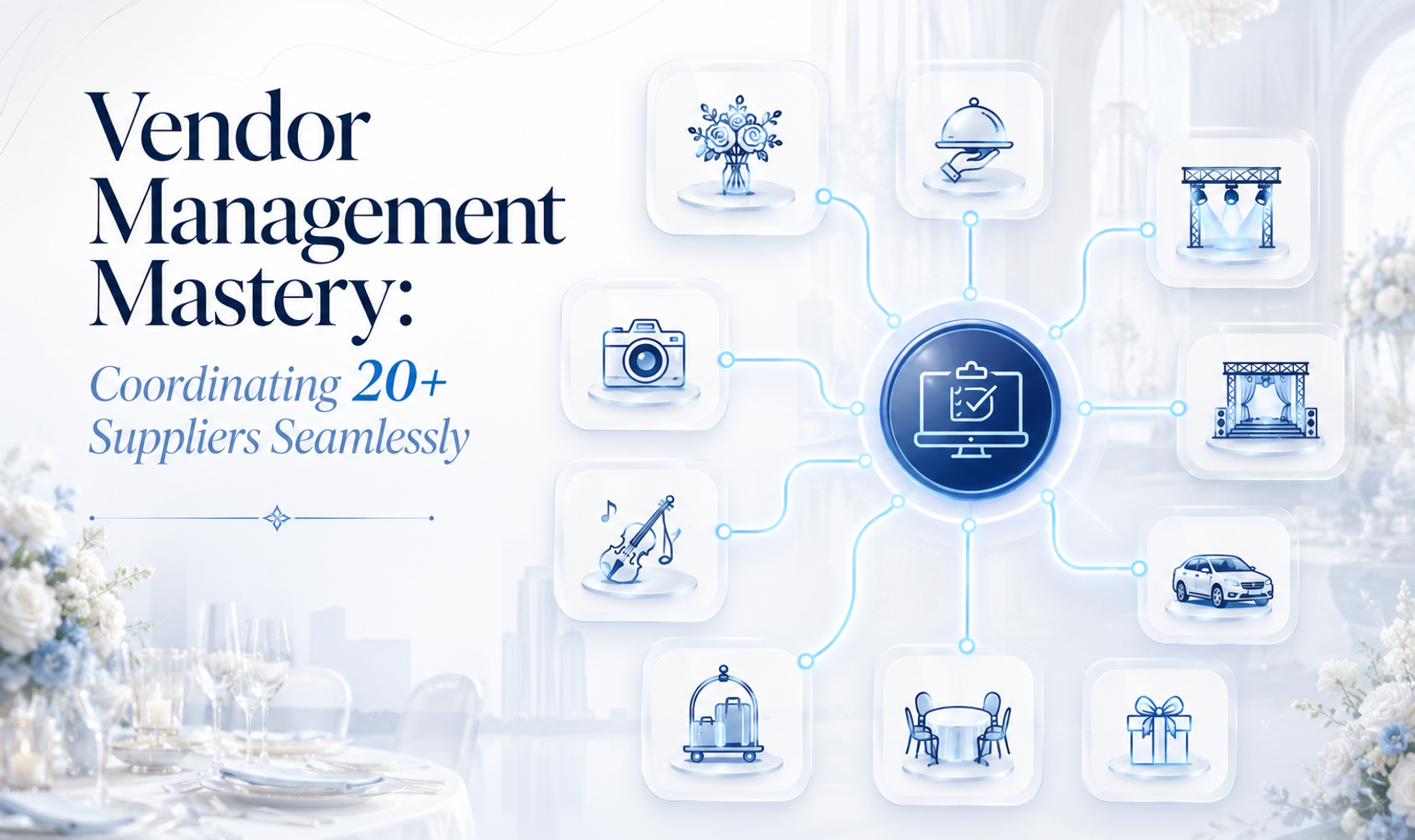
Vendor Management Mastery: Coordinating 20+ Suppliers Seamlessly
A large wedding, luxury celebration, corporate summit or brand launch can involve more than twenty specialist suppliers working within the same venue and timeline. Décor, production, catering, hospitality, transport, entertainment, security, photography, invitations, gifting and technology must all deliver their individual responsibilities without disrupting one another.
The challenge is not simply appointing talented vendors. It is creating one management system through which every supplier understands the event objective, approved scope, access schedule, dependencies, communication process and escalation authority.
Without structured event vendor management, even highly experienced suppliers can create confusion. Teams may arrive at the wrong time, work from outdated plans, block shared access routes or assume that another vendor is responsible for an essential task.
Seamless supplier coordination requires planning discipline behind the scenes. When it is done correctly, guests experience one cohesive event rather than twenty separate companies trying to deliver their own work.
This guide explains how to coordinate complex vendor ecosystems for luxury weddings, corporate events, private celebrations, destination experiences and large-scale productions. It covers vendor selection, onboarding, contracts, scopes, schedules, communication, quality control, risk management, payments and event-day execution.
Quick Answer
Coordinating more than twenty event suppliers requires one lead management team, one master schedule and clearly documented responsibilities. Every vendor should receive an approved scope, venue information, setup time, reporting line and dependency list before execution begins.
Supplier communication should be centralised through structured meetings, written approvals and controlled document versions. Important changes should never remain inside private conversations between one family member and one vendor.
The event-day team should operate through department leads and a central control room. Vendors should know who can approve changes, how problems are escalated and which decisions require financial or safety review.
The objective is not to control every creative detail personally. It is to create enough clarity for specialist suppliers to perform confidently within one coordinated event system.
What Is Event Vendor Management?
Event vendor management is the process of selecting, briefing, contracting, coordinating and evaluating all external suppliers involved in an event. It begins before appointments are made and continues until final delivery, payment and post-event closure.
The process includes far more than requesting quotations and confirming availability. It requires understanding how each supplier’s work affects the venue, other departments, guest journey, budget and event timeline.
A décor company may depend on the production team’s rigging schedule. The catering team may need access to the same loading area being used by furniture and technical trucks.
Photography may require clear stage sightlines, while security may restrict access to the same spaces. Event vendor management connects these dependencies before they become live problems.
Why Vendor Coordination Becomes Complex
The difficulty of supplier management increases when several vendors need the same space, time or information. Each team may be excellent within its own specialisation but may not understand the full event structure.
A décor supplier may focus on completing the installation, while the production team focuses on technical rehearsal. If both require the main stage at the same time, one department will be delayed.
Complexity also increases when several decision-makers communicate directly with vendors. A family member may request a décor change without informing production, while a brand executive may alter the programme without updating catering.
The issue is rarely a lack of effort. It is usually the absence of centralised information, approval authority and dependency planning.
Typical Vendor Ecosystem for a Luxury Event
Vendor Category
Primary Responsibility
Common Dependency
Venue team
Space, access and operations
All vendors
Wedding or event planner
Overall coordination
Hosts and suppliers
Décor company
Styling and installations
Venue and production
Production agency
Sound, lighting and screens
Décor and entertainment
Catering team
Food and service
Venue and guest count
Entertainment agency
Artists and programme
Production and hospitality
RSVPs, access and seating
Hosts and security
Hospitality team
Hotels and guest support
Transport and guest data
Transport provider
Airport and venue movement
Hospitality and programme
Photography team
Images and films
Production and programme
Security team
Access and safety
Venue and guest list
Technology provider
Registration and digital tools
Guest data and venue internet
Gifting partner
Welcome and departure gifts
Rooming and guest lists
Makeup and styling
Couple, hosts or speakers
Programme timings
Invitation partner
Physical and digital invitations
Guest list and design identity
Fabrication supplier
Scenic structures
Décor, venue and engineering
Furniture supplier
Guest seating and lounges
Décor and floor plans
Floral supplier
Flowers and botanical styling
Décor and setup schedule
Valet provider
Vehicle movement
Venue and security
Permission consultant
Licences and approvals
Venue and programme
Medical support
Emergency response
Venue and security
Housekeeping team
Cleaning and waste
Venue, catering and décor
The exact vendor structure varies according to the event. However, the management principles remain consistent even when different companies combine several responsibilities.
Begin with One Event Objective
Every supplier should understand what the event is trying to achieve. A vendor cannot make the correct decisions when it receives only dimensions, timings and a list of deliverables.
A luxury wedding may prioritise family comfort, cultural authenticity and smooth destination hospitality. A corporate summit may prioritise delegate engagement, brand positioning and measurable business conversations.
The event objective helps vendors make better choices when small questions arise. A décor supplier understands whether restraint or theatricality is more appropriate, while the hospitality team understands the expected service tone.
The planner should communicate one concise event brief during vendor onboarding. This creates a shared understanding before individual scopes begin.
Create a Central Vendor Management Team
Complex events should not be managed by one individual responding to every call. A central vendor-management team should divide responsibility while maintaining one leadership structure.
The event director or lead planner owns the complete project. Department managers may then oversee production, décor, hospitality, guests, logistics and content.
Vendors should know their primary contact and the senior escalation contact. They should not need to message several people to receive one confirmed answer.
The internal team should also understand decision limits. Department managers may approve operational adjustments, while budget or concept changes may require senior authorisation.
Core Management Roles
• Event director
• Vendor manager
• Production lead
• Hospitality lead
• Guest-list lead
• Logistics lead
• Finance controller
• Safety coordinator
The number of managers depends on the event scale. The important requirement is that every supplier has a clear reporting route.
Build the Master Vendor Register
The vendor register is the central record of every appointed supplier. It should include company information, scope, contract status, payment milestones, contacts and event responsibilities.
The register helps the planning team identify missing appointments and unresolved documents. It also prevents important information from remaining inside personal phones or email accounts.
Each vendor record should include the company, department, lead contact, phone number, arrival time and emergency contact. Insurance, licences or technical certificates may also be recorded where required.
The register should remain controlled and current. Outdated supplier information can create serious confusion during setup and execution.
Vendor Register Checklist
• Company name
• Department category
• Lead contact
• Backup contact
• Approved scope
• Contract status
• Payment status
• Setup timing
• Required documents
• Final approval
The event-day contact sheet can be created from this register. Sensitive financial details should remain restricted to authorised members.
Select Vendors According to Capability
Vendor selection should consider more than portfolio quality or quotation value. The supplier must have the operational capacity to deliver the proposed scale.
A décor company may produce beautiful intimate weddings but lack the team or fabrication capability for a large convention venue. A photography team may have strong imagery but limited experience coordinating several simultaneous functions.
The planner should review similar work, staffing, equipment, communication and contingency planning. References can provide useful insight into reliability under pressure.
The correct supplier should fit the event’s quality expectations, budget and management system. A talented vendor who refuses structured coordination may still create significant project risk.
Vendor Evaluation Criteria
• Relevant experience
• Team capacity
• Financial clarity
• Communication quality
• Technical capability
• Safety awareness
• Backup planning
• Reference feedback
The selection process should compare complete value rather than the lowest quotation. Missing services often create higher costs later.
Issue a Consistent Vendor Brief
Every potential supplier should receive the same essential event information before submitting a quotation. This makes proposals easier to compare and reduces hidden assumptions.
The brief should include dates, venues, guest count, event timings, design direction and expected deliverables. It should also explain setup, breakdown and venue restrictions where known.
Suppliers should be encouraged to identify exclusions and operational requirements. A complete quotation is more valuable than an attractive number that ignores important infrastructure.
The brief should be updated when the event scope changes. However, the planning team should avoid sending several conflicting versions without clear revision labels.
Define Detailed Vendor Scopes
A strong vendor scope explains what is included, excluded and dependent on another supplier. It should be specific enough to support execution and payment review.
The décor scope may include stage design, structures, furniture, flowers, signage and dismantling. The production scope may include sound, lighting, LED screens, power distribution and technical operators.
The hospitality scope may cover airport assistance, hotel desks, guest communication and luggage movement. Each responsibility should be measurable and clearly assigned.
Broad terms such as complete event décor or all guest management can lead to disagreement. Detailed scopes protect both the organiser and supplier.
Scope Documentation Checklist
• Exact deliverables
• Quantities and sizes
• Material specifications
• Staffing commitments
• Setup requirements
• Excluded services
• Approval stages
• Handover conditions
Scope documents should be attached to vendor contracts where practical. Visual references should support written information rather than replace it.
Identify Cross-Vendor Dependencies
A dependency exists when one vendor cannot complete work until another supplier provides access, equipment or information. These relationships should be identified before the schedule is created.
The floral team may require completed structures before installation. The lighting team may need rigging points installed before focusing fixtures.
The catering team may need the final floor plan before determining service stations. The guest-management team may require confirmed seating before preparing table allocations.
A dependency map prevents one delay from spreading unexpectedly across the entire event. It also helps the planner identify which activities require the strongest monitoring.
Common Vendor Dependencies
• Décor and production
• Venue and loading
• Catering and layout
• Entertainment and sound
• Hospitality and transport
• Guest lists and security
• Photography and lighting
• Gifting and rooming
Dependencies should appear inside the master schedule. Vendors should understand both what they are waiting for and who is waiting for them.
Create a Responsibility Matrix
A responsibility matrix clarifies who performs, approves, supports and receives information for each major task. It prevents several suppliers from assuming that another team is responsible.
For example, the production company may install the stage, the décor company may approve its finish and the venue may approve structural placement. The planner coordinates the sequence and final handover.
The matrix becomes particularly useful for shared activities such as registration desks, green rooms, artist hospitality and waste removal.
Every important event task should have one final owner. Several supporting teams may participate, but accountability should not be divided vaguely.
Responsibility Matrix Categories
• Task owner
• Final approver
• Supporting teams
• Information recipients
The matrix should remain practical. It does not need to document every minor activity, but it should cover all high-risk and cross-department tasks.
Develop a Master Procurement Schedule
Vendor appointments should follow the event’s planning priorities. The venue, planner, production, décor and catering usually influence several later decisions and should be addressed early.
Entertainment, photography and hospitality may also require early booking during high-demand periods. Smaller printing, gifting and styling suppliers can often be appointed later.
The procurement schedule should include brief release, quotation deadline, negotiation, contract and first payment. This prevents important appointments from remaining open indefinitely.
Delayed appointments reduce choice and increase pressure on the remaining design and execution timeline.
Negotiate Complete Commercial Terms
Vendor negotiation should focus on complete value rather than one headline price. The planner should understand labour, transport, setup, overtime, taxes and exclusions.
A lower quotation may exclude installation teams, freight or equipment that another supplier includes. Direct price comparison becomes misleading when the scopes are different.
Payment milestones should align with design approvals, procurement and delivery. A large advance without corresponding documentation can increase risk.
Commercial discussions should remain respectful and transparent. Aggressive negotiation that removes essential staffing or safety measures may weaken execution.
Prepare Strong Vendor Contracts
Every major supplier should have a written agreement covering scope, fees, payment, cancellation, postponement and responsibilities. The contract should also define how additions are approved.
The agreement may include confidentiality, intellectual property, image usage, data protection and insurance according to the service. Structural and technical vendors may require safety documentation.
The planner should confirm whether subcontracting is allowed. The supplier should not replace a critical team or service without authorisation.
High-value agreements may require legal review. Operational clarity and legal protection should support one another.
Contract Checklist
• Approved scope
• Payment milestones
• Taxes and charges
• Cancellation terms
• Postponement terms
• Overtime rates
• Change process
• Liability terms
• Confidentiality rules
• Delivery deadlines
Signed documents should be stored in one controlled folder. The event-day team does not need access to every commercial detail.
Standardise Vendor Onboarding
Vendor onboarding should take place immediately after appointment. The supplier should receive the current event brief, venue rules, contacts and reporting expectations.
The onboarding process should explain how approvals are requested and where documents are stored. Vendors should also understand meeting frequency and change-control procedures.
Technical suppliers may require venue drawings, power information and loading instructions. Guest-facing vendors may need communication and service standards.
A formal onboarding process reduces repeated questions and ensures that all suppliers begin with the same information.
Vendor Onboarding Checklist
• Event brief
• Venue information
• Scope confirmation
• Contact hierarchy
• Meeting calendar
• File-access process
• Approval workflow
• Safety requirements
Onboarding should not be delayed until the final month. Early alignment allows vendors to identify problems while solutions remain available.
Use One Document Management System
Vendor coordination becomes difficult when files are scattered across email, messaging applications and personal drives. The event should use one approved document system.
Folders may be organised by contracts, designs, guests, schedules, venue information and technical plans. Access should be based on responsibility.
File names should include dates and revision numbers. Terms such as final, final new and final latest should be avoided because they create confusion.
Superseded documents should be archived rather than left inside active folders. Vendors must know which version is currently approved.
Control Design Revisions
Luxury events often involve several rounds of design and programme changes. Every revision can affect budget, production, venue access and other suppliers.
The planner should record what changed, who approved it and which departments are affected. The update should then be issued through the central system.
A new stage design may change screen dimensions, lighting positions and seating capacity. The change cannot remain only between the host and décor designer.
Revision control protects the event from vendors working with different assumptions. It also helps identify whether additional cost is justified.
Establish a Change-Control Process
Change control does not prevent new ideas. It ensures that every requested change is evaluated before implementation.
The request should describe the change, reason, deadline, cost and operational impact. Relevant department leads should review dependencies before final approval.
Urgent event-day changes require a faster process but should still have an authorised decision-maker. Vendors should not act on informal instructions from unrelated stakeholders.
The change should be added to the latest scope, schedule or floor plan. Approval without documentation creates confusion later.
Build the Master Event Schedule
The master schedule should include vendor arrival, unloading, setup, testing, rehearsal, guest timings and breakdown. It becomes the operational backbone of the event.
The schedule should be based on dependencies rather than created separately for each supplier. One team’s completion time should connect clearly with the next team’s start.
Setup access, service lifts and loading areas may need to be allocated in time blocks. This prevents several trucks from arriving simultaneously.
The schedule should also contain buffer time. A plan without buffers assumes that every task will perform perfectly, which is rarely realistic.
Master Schedule Sections
• Venue access
• Truck arrivals
• Structural setup
• Technical installation
• Décor finishing
• Floral installation
• Catering setup
• Rehearsal windows
• Guest arrival
• Programme cues
• Breakdown timing
The schedule should identify the vendor and internal manager responsible for every major activity.
Create Department-Level Schedules
The master schedule provides an overall view, but each department may require a more detailed working schedule. Production, hospitality and transport often involve many internal tasks.
Department schedules should remain aligned with the master document. Changes to one should be reflected in the other.
The production schedule may include individual sound checks and screen tests. The hospitality schedule may include every airport arrival and room drop.
Detailed schedules should not overwhelm vendors who do not need them. Each team should receive the information required for its responsibilities.
Plan Shared Venue Access
Loading areas, service lifts, kitchens and storage spaces are frequently shared across vendors. These resources should be allocated deliberately.
Large fabrication and technical equipment may need to enter before floral, furniture and catering teams. Fragile elements should not be installed while heavy movement continues.
The venue should approve the access plan and understand truck sizes, timings and storage requirements. Security teams should receive vehicle and crew lists where required.
A shared access plan reduces delays, protects materials and prevents conflict between suppliers.
Conduct Combined Venue Walk-Throughs
Separate venue visits may not reveal cross-vendor issues. A combined walk-through allows décor, production, catering, security and hospitality teams to review the same environment together.
The team should examine guest arrival, loading, stage, dining, service routes, power, storage and emergency access. Each vendor should explain its operational requirements.
Conflicting requirements can then be resolved before final plans are approved. For example, a catering counter may be moved before it blocks an essential technical cable route.
The walk-through should produce an action list with owners and deadlines. A venue visit without documented outcomes has limited value.
Create a Floor-Plan Approval System
Several departments depend on the final floor plan. Seating, décor, catering, production, security and photography all need accurate spatial information.
One team should control the master floor plan. Vendor-specific details may be added through layers or separate documents, but the underlying layout should remain consistent.
Every revision should identify the date and version. The planner should also verify that the plan matches the actual venue measurements.
The approved floor plan should protect guest movement, emergency exits and service access. A visually attractive arrangement cannot compromise safety.
Centralise Vendor Communication
Messaging applications are useful for speed but can become difficult to manage when several groups and private conversations exist. Important information should not depend entirely on chat history.
The event team may use messaging for immediate coordination while recording approvals and major changes through email or project documentation.
Separate groups may be created for department leads, guest operations and event-day control. However, the number of groups should remain manageable.
Vendors should understand where to send questions and what requires written approval. Central communication protects accuracy and accountability.
Run Structured Vendor Meetings
Vendor meetings should focus on decisions, dependencies and unresolved issues. Long meetings in which every supplier repeats a general update can waste time.
An agenda should be shared in advance. The discussion should cover schedule, approvals, risks and information required from other teams.
Minutes should record the decision, responsible person and deadline. Suppliers who could not attend should receive the relevant outcomes.
Meeting frequency can increase as the event approaches. Early monthly or fortnightly meetings may become weekly and then daily during the final stage.
Meeting Agenda Checklist
• Pending approvals
• Schedule updates
• Vendor dependencies
• Venue restrictions
• Budget changes
• Risk concerns
• Required decisions
• Next deadlines
The planner should close each meeting with a clear action summary. Every action should have one owner.
Manage Communication with Hosts
Families and brand stakeholders should not need to coordinate every supplier directly. The planning team should collect decisions and communicate them through one structured route.
This protects the host from operational overload and prevents vendors from receiving conflicting instructions. It also allows the planner to evaluate the impact of requested changes.
Hosts should receive concise summaries covering decisions, costs and high-priority risks. They do not need to review every technical conversation.
The planner should still maintain transparency. Centralisation should simplify communication, not hide important information.
Track Vendor Approvals
Designs, menus, music, technical plans and guest communication may each require formal approval. The planner should maintain an approval tracker.
The tracker should show what was submitted, who must approve it and the deadline. Pending approvals should be highlighted before they delay procurement or production.
Approval should be specific. A general message saying looks good may not clarify which version or cost has been accepted.
Once approved, the document should be marked and distributed to the affected suppliers. Vendors should not continue working from an unapproved concept.
Control the Event Budget
Every vendor commitment should connect to the central event budget. The planner should track contracted value, approved additions, payments and final balance.
Additional work should not be accepted through informal conversations. The supplier should provide the revised scope and cost before proceeding whenever time permits.
The finance controller should compare invoices with contracts and approved changes. Discrepancies should be resolved before the final payment.
Budget visibility also helps the event team identify where contingency remains available. Financial control supports creative decision-making rather than restricting it.
Payment Tracking Checklist
• Contracted amount
• Advance payment
• Progress payment
• Approved additions
• Tax documents
• Final invoice
• Retention amount
• Payment status
Payments should follow documented milestones. Suppliers should also receive clarity about the internal approval timeline.
Manage Vendor Cash-Flow Expectations
Event vendors often need to purchase materials, book labour and reserve equipment before delivery. Payment delays can affect their ability to perform.
The organiser should honour agreed milestones and request complete documentation early. Last-minute invoice disputes can create unnecessary tension before the event.
At the same time, payment should remain connected to confirmed scope and progress. The planner should avoid releasing the full amount before essential delivery where the contract allows milestone protection.
Professional payment management strengthens vendor relationships. Reliable suppliers are more willing to support urgent requirements when the commercial relationship remains respectful.
Implement Quality-Control Reviews
Quality control should happen throughout planning rather than only during event setup. Designs, materials, menus and technical systems can be reviewed through scheduled checkpoints.
Décor mock-ups, furniture samples and floral trials help confirm the visual direction. Menu tastings and service rehearsals can identify hospitality concerns.
Production teams should test screens, sound, lighting and power. Technology providers should demonstrate registration and backup processes before guest arrival.
Early quality reviews allow correction without event-day panic. They also ensure that the approved concept and actual delivery remain aligned.
Quality-Control Stages
• Concept approval
• Material sampling
• Technical testing
• Service rehearsal
• Setup inspection
• Final handover
• Live monitoring
• Post-event review
The person approving quality should understand both the creative brief and contracted scope.
Coordinate Production and Décor
Production and décor are among the most closely connected event departments. Stage structures, screens, lighting, rigging and scenic finishes must be designed together.
The production team should review décor drawings before fabrication. The décor team should understand technical clearances, heat, load and cable requirements.
Lighting focus should happen after major structures and florals are in place. However, access must remain available for technical adjustments.
Combined planning reduces last-minute cutting, repainting and repositioning. It also creates a more integrated visual result.
Coordinate Catering and Layout
Food service influences floor plans, guest movement and programme timing. Catering should not be placed after the rest of the event design is complete.
Buffets, bars, live counters and service routes require enough space. Placement should also consider wind, temperature, fire safety and guest visibility.
Catering teams need accurate guest counts and meal timings. Delays in the programme may require service adjustments to protect food quality.
Décor and catering should collaborate on counter styling. The result should feel part of the event identity without reducing service efficiency.
Coordinate Entertainment and Technical Teams
Artists and performers depend on technical production, programme management, transport and hospitality. Their requirements should be collected early.
The entertainment manager should provide technical riders, travel details and rehearsal needs. The production team should identify any equipment or timing concerns.
Holding rooms, meals, security and stage access should also be assigned. Celebrity or headline talent may require additional confidentiality and movement planning.
The final performance schedule should reflect sound checks and venue restrictions. Entertainment should not be confirmed independently from the systems required to deliver it.
Coordinate Hospitality and Transport
Guest hospitality and transport share the same information regarding arrivals, departures, hotels and special requirements. Separate systems can create duplicate or conflicting records.
The hospitality team should own the verified travel database, while the transport supplier manages vehicle assignments according to that information.
Changes should be updated through one authorised process. A flight delay communicated privately to one driver may not reach the hotel or welcome desk.
Daily movement sheets should be reviewed before each event day. VIP, elderly and family movements may require dedicated coordination.
Coordinate Photography with Other Vendors
Photography and video teams need access, lighting and programme information. Their requirements should be considered during layout and schedule planning.
Large camera platforms may affect seating, while drones may require venue and regulatory approval. Additional lights should not conflict with production or guest comfort.
The content team should know which moments are private or restricted. Celebrity, family and corporate permissions should be communicated clearly.
A shot list can identify important people and details, but the team should retain enough flexibility to capture natural moments.
Plan Vendor Meals and Welfare
Supplier teams may work for extended hours before and after the event. Meals, water, rest and washroom access should be planned.
Vendor welfare is not simply a courtesy. Tired, hungry teams are more likely to make mistakes during critical execution periods.
Meal counts should be collected from department leads and verified. Different shifts may require meals at different times.
The event schedule should allow reasonable breaks where operations permit. Professional working conditions support better delivery.
Manage Crew Access and Accreditation
Large events may require identification for every vendor team member. Crew lists should be collected before the venue’s security deadline.
Access categories may include loading, backstage, production, hospitality and general working areas. Not every crew member needs unrestricted movement.
Badges, wristbands or digital credentials should be easy to verify. Replacement and late-addition processes should also be established.
Crew information should be handled securely. It should be collected only for legitimate access and safety purposes.
Coordinate Safety and Compliance
Safety should be integrated into vendor management. Fabrication, electrical work, rigging, food service and temporary structures all create specific responsibilities.
Vendors may need to provide certificates, load calculations, insurance or equipment documentation. The venue and safety lead should review these requirements early.
Emergency exits and fire equipment must remain accessible throughout setup and execution. Decorative or storage materials should not block safety routes.
The event team should know who can stop unsafe work. Schedule pressure should never override essential safety controls.
Create a Vendor Risk Register
The risk register identifies what could fail, how serious the impact would be and what backup is available. Each department should contribute to it.
Production risks may include power failure, equipment damage or content playback problems. Hospitality risks may include delayed flights, rooming errors and vehicle shortages.
Décor risks may involve weather, late fabrication or structural concerns. Entertainment risks may include artist delay, illness or travel disruption.
The risk register should assign prevention, response and ownership. A risk without an owner is only an observation.
Risk Register Checklist
• Identified risk
• Likelihood level
• Impact level
• Prevention action
• Backup response
• Responsible owner
• Decision deadline
• Current status
The register should be reviewed more frequently as the event approaches.
Prepare Vendor Backup Plans
Backup planning should focus on critical services whose failure would stop or significantly damage the event. Power, sound, registration and transport usually require strong alternatives.
Some suppliers may maintain backup equipment internally. Others may need support from an alternate provider or local resource.
The planning team should understand how quickly the backup can become operational. A replacement that requires several hours may not protect a live event.
Backup contacts and equipment locations should appear inside the control-room documents. Plans should be tested where possible.
Control Last-Minute Vendor Requests
Suppliers may identify additional requirements during the final stage. Some may be essential, while others may reflect incomplete early planning.
Every request should explain the reason, cost and impact if it is not approved. The department lead should verify whether it falls inside the original scope.
Urgent decisions should still be documented. The finance and event leads should understand what was authorised.
The planner should avoid rejecting a valid requirement simply because it arrived late. However, vendors should also be held accountable for timely planning.
Handle Vendor Conflicts Professionally
Conflicts may arise around space, timing, scope or responsibility. The planner should address the operational issue rather than allowing personal disagreement to dominate.
The relevant contracts, plans and previous decisions should be reviewed. The objective is to determine the most practical and fair solution.
Disputes should be resolved away from hosts and guests. Public arguments can damage confidence and distract teams from execution.
After the immediate issue is controlled, the decision should be documented. Repeated conflicts may indicate unclear scope or weak leadership.
Manage Destination Event Suppliers
Destination weddings and events often combine local vendors with suppliers travelling from another city. This creates additional accommodation, freight and communication requirements.
The planner should decide which services are best sourced locally and which require specialist external teams. Local knowledge can be valuable for permissions, labour and infrastructure.
Travel schedules, rooming and equipment freight should be coordinated centrally. Suppliers should not arrange critical logistics without connection to the event plan.
Local and external teams should meet before setup. Assumptions about working methods, materials and timings can differ between markets.
Destination Vendor Checklist
• Local supplier research
• Travel bookings
• Crew accommodation
• Equipment freight
• Local permissions
• Labour coordination
• Weather planning
• Backup resources
The event budget should include transport, meals and extended working days for travelling teams.
Manage Wedding Vendors
Wedding vendor management requires sensitivity because several family members may communicate preferences directly to suppliers. The planner should create a clear approval process without reducing family involvement.
Ceremonies, guest lists and cultural responsibilities may involve different family representatives. Their input should be collected and consolidated before vendors receive final instructions.
The couple should not be required to resolve supplier disputes during the wedding week. The planning team should protect their time and attention.
Wedding suppliers should also understand privacy. Guest details, family photographs and programme information should not be used or published without permission.
Manage Corporate Event Vendors
Corporate events require stronger alignment with brand, legal, finance and communications teams. Vendor scopes may involve confidentiality, intellectual property and data security.
The production and design teams should follow approved brand guidelines. Any sponsor visibility or co-branding must also be documented.
Corporate procurement may require purchase orders, vendor registration and specific invoicing processes. These should be completed early enough to avoid payment and access delays.
The event should also produce measurable outcomes. Vendors may need to support attendance reporting, content delivery and post-event analytics.
Manage Celebrity and VIP Suppliers
Celebrity-attended events may involve talent management, security, transport, hospitality and content teams working with sensitive information.
Only authorised suppliers should receive artist schedules, room numbers or private contacts. The information should be shared according to operational need.
Technical riders and hospitality requirements should be confirmed before the final week. Last-minute celebrity requests can affect several departments.
One talent coordinator should manage communication with the celebrity representative. Vendors and family members should not create separate requests directly.
Prepare the Event-Day Vendor Command Structure
The event-day command structure should show who leads each department and how information moves. Vendors should not contact the host whenever a problem appears.
The event director manages the complete experience, while department heads control their teams. A control-room coordinator can track schedules, issues and decisions.
Radio channels or messaging groups may be assigned according to function. Critical updates should remain concise and include required action.
The structure should be explained during the final vendor briefing. Suppliers should know how to escalate urgent safety, guest or programme issues.
Event-Day Command Roles
• Event director
• Control-room lead
• Production manager
• Décor manager
• Hospitality manager
• Guest manager
• Logistics manager
• Safety lead
Every role should have a backup. Long event days and multiple functions require continuity.
Operate a Central Control Room
The control room is the operational centre of a complex event. It should hold the latest schedules, contacts, guest updates, floor plans and emergency information.
The room should be accessible to department leads but protected from unnecessary traffic. It should also contain charging, communication and documentation facilities.
Issues should be logged with time, owner and resolution status. This prevents the same problem from being discussed repeatedly without action.
The control room allows visible guest areas to remain calm. Operational pressure stays behind the scenes.
Conduct the Final Vendor Briefing
The final briefing should take place after major plans are locked and before live execution. Every department lead should attend.
The meeting should confirm arrival times, reporting contacts, access, programme, emergency routes and escalation. Late changes should be highlighted clearly.
Suppliers should be encouraged to raise unresolved concerns before setup begins. Silence should not be assumed to mean that every detail is understood.
The briefing should end with the final contact sheet and schedule distribution. Old files should be withdrawn.
Final Vendor Briefing Checklist
• Final schedule
• Venue access
• Crew credentials
• Reporting lines
• Guest timings
• Programme changes
• Safety rules
• Emergency contacts
• Breakdown timing
• Payment process
The meeting should remain practical and focused. Detailed design discussions should already be complete.
Inspect Vendor Setup Progress
Setup should be monitored through scheduled checkpoints rather than reviewed only when installation is nearly complete.
The planner can inspect structural completion, technical installation, décor finishing and hospitality readiness at different times. Delays become easier to address when identified early.
The venue should also participate in inspections where its approval is required. Safety and damage concerns should be resolved before guest areas open.
Progress photographs and status updates can support remote stakeholders. However, on-ground inspection remains essential.
Manage Final Event Handover
Before guests arrive, every department should confirm readiness. The final handover may include décor, production, catering, registration, washrooms and security.
The event director should walk through the guest journey from arrival to departure. Small issues such as exposed cables, missing signs or blocked routes can then be corrected.
Department leads should confirm that their teams, backups and emergency contacts are active. The programme should not begin until essential guest and safety systems are ready.
The final handover marks the transition from setup to live operations. Vendor movement should then become more discreet.
Monitor Live Vendor Performance
Vendor management continues throughout the live event. Service quality, programme timing and guest movement should be monitored continuously.
The control team should identify issues early and assign them without creating public discussion. Examples may include sound imbalance, delayed food replenishment or transport congestion.
Vendors should understand which adjustments they can make independently. Larger changes should still require department approval.
The objective is not to criticise teams during execution. It is to protect the guest experience through calm and fast correction.
Coordinate Breakdown and Exit
Breakdown should be planned with the same care as setup. Venues may impose strict exit times, loading routes and damage inspections.
Fragile or rental items should be removed in a controlled sequence. Heavy production equipment should not move while guest areas remain active.
Vendor waste, leftover materials and personal equipment must be cleared. Responsibilities for disposal and recovery should be documented.
The planner should complete venue handover and record any damage or pending items. Breakdown should not become unmanaged simply because the guests have left.
Close Vendor Accounts
After the event, the finance team should compare final invoices with contracts and approved additions. Missing or incorrect documents should be resolved promptly.
Retention amounts, deposits and reimbursements may require separate tracking. The venue and rental suppliers may also need damage clearance.
Suppliers should receive clarity about payment timelines. Delayed communication can damage otherwise successful relationships.
Financial closure should include a final budget report showing committed, added and actual expenditure.
Conduct a Post-Event Vendor Review
A post-event review helps the planning team understand what worked and what should improve. Department leads should provide factual feedback.
The review may cover communication, punctuality, quality, flexibility, safety and guest impact. It should distinguish between vendor performance and problems caused by late host decisions.
Important suppliers may also be invited to share their perspective. They often identify operational issues that internal teams did not see.
The findings should be added to the vendor database. Future selection becomes stronger when it is based on documented delivery rather than memory.
Vendor Performance Measures
• Schedule compliance
• Quality consistency
• Communication speed
• Scope accuracy
• Budget discipline
• Safety performance
• Problem resolution
• Guest impact
Performance should be evaluated according to the supplier’s responsibility. Different vendor categories require different success measures.
The ORCHESTRA Vendor Management Framework
The ORCHESTRA framework helps event teams coordinate large supplier ecosystems through one structured process.
O — Outline the Objective
Define the event purpose, guest experience and main priorities. Suppliers should understand the complete vision rather than only their individual tasks.
R — Register Every Vendor
Maintain one central vendor record covering contacts, scopes, contracts, payments and required documents.
C — Clarify Responsibilities
Use detailed scopes, responsibility matrices and dependency maps. Every important task should have one final owner.
H — Harmonise Communication
Create one communication hierarchy, file system and meeting structure. Prevent private instructions from replacing central approvals.
E — Engineer the Schedule
Connect setup, testing, rehearsal, live operation and breakdown through one dependency-based master timeline.
S — Secure Quality and Safety
Review materials, technical systems, service standards and compliance before the event becomes live.
T — Track Budget and Changes
Record contracts, additions, payments and revised scope. No major change should remain undocumented.
R — Run Central Command
Use department leads, a control room and clear escalation routes during setup and live execution.
A — Assess and Archive
Complete vendor reviews, final accounts and document closure after the event.
The ORCHESTRA framework reflects how complex events should operate. Individual specialists perform different parts while one central team protects timing, quality and harmony.
Complete Event Vendor Checklist
Before execution, the planner should confirm that every appointed vendor has completed the required planning steps.
• Signed contract
• Approved scope
• Lead contact
• Final quotation
• Payment schedule
• Venue briefing
• Setup timing
• Crew list
• Dependency review
• Safety documents
• Final approval
• Backup plan
The checklist should be reviewed by department rather than only by company name. One supplier may operate several different scopes.
Common Vendor Management Mistakes
One common mistake is appointing suppliers without defining detailed responsibilities. This creates gaps and duplication between departments.
Another mistake is allowing hosts, family members and executives to communicate separate instructions directly to vendors. The event then develops several competing versions.
Planners may also create individual vendor schedules without connecting dependencies. Every supplier appears organised, but shared spaces and handovers remain unresolved.
Weak change control, late payments and poor documentation can also damage delivery. Vendor management succeeds when creative flexibility operates inside a clear professional system.
Frequently Asked Questions
What is event vendor management?
Event vendor management is the process of selecting, contracting, coordinating and reviewing all suppliers involved in an event.
It connects individual vendor responsibilities with the venue, budget, guest journey and event timeline.
How do you coordinate more than twenty event vendors?
Use one lead management team, one vendor register and one master schedule. Every supplier should have a detailed scope, primary contact and reporting line.
Dependencies and shared access should be discussed before the event. Event-day communication should move through department leads and a central control room.
What should an event vendor contract include?
The contract should include scope, fees, payments, taxes, delivery, cancellation, postponement and overtime. It should also explain how additional work is approved.
Confidentiality, insurance, safety and intellectual-property terms may be required depending on the supplier.
What is a vendor dependency map?
A dependency map identifies where one vendor’s work depends on another team. It shows the required sequence of activities.
For example, floral installation may depend on completed fabrication, while lighting focus may depend on finished décor.
How should event vendors communicate?
Communication should follow one clear hierarchy. Vendors may use messaging for urgent coordination, but important approvals and changes should be documented.
Every supplier should know its primary contact and escalation route.
How often should vendor meetings happen?
Meeting frequency depends on the event stage. Early meetings may take place monthly or fortnightly, while final-stage meetings may become weekly or daily.
Every meeting should focus on decisions, dependencies, risks and upcoming deadlines.
How should vendor quotations be compared?
Compare complete scope rather than only the final amount. Review labour, materials, transport, taxes, setup and exclusions.
The lowest quotation may create higher final costs when essential services are missing.
How are last-minute vendor changes controlled?
Every change should be reviewed for cost, timing, safety and impact on other suppliers. One authorised person should approve it.
The latest scope, floor plan or schedule should then be updated and shared with affected teams.
Why is vendor onboarding important?
Onboarding gives the supplier the event brief, venue information, contacts, schedule and approval process. It creates a shared starting point.
Early onboarding also helps vendors identify risks before execution becomes urgent.
What is a vendor responsibility matrix?
A responsibility matrix identifies who performs, approves, supports and receives information for each important task.
It prevents several suppliers from assuming that another team is responsible.
How should vendor payments be managed?
Payments should follow written milestones connected to scope and progress. Approved additions should be recorded separately.
The finance team should compare final invoices with contracts before releasing balances.
How should destination wedding vendors be managed?
Local and travelling vendors should be connected through one schedule and management structure. Travel, accommodation, freight and local labour should be planned centrally.
Combined venue inspections and final briefings are especially important for destination events.
How are wedding vendors different from corporate event vendors?
Wedding vendors may work with several family decision-makers and culturally specific ceremonies. Corporate suppliers may require stronger brand, legal and procurement processes.
Both require clear scopes, central communication and event-day command systems.
What happens in an event control room?
The control room tracks schedules, guest updates, programme changes, vendor issues and emergency communication.
Department leads use it to coordinate decisions while keeping operational pressure away from guest areas.
How should vendor performance be reviewed?
Review punctuality, quality, communication, safety, budget and problem-solving. Feedback should reflect the supplier’s agreed scope.
The results can support future vendor selection and preferred-supplier relationships.
Does Double Trouble Studio manage multiple event suppliers?
Double Trouble Studio supports luxury weddings, corporate events, brand launches, private celebrations and celebrity-attended experiences with complete vendor coordination.
The scope can include vendor sourcing, contracts, schedules, production, hospitality, guest management and event-day command.
How Double Trouble Studio Coordinates Complex Vendor Teams
Double Trouble Studio approaches vendor management as the operational foundation of a successful event. We connect every supplier through one central event brief, management hierarchy and execution schedule.
Our work can include vendor sourcing, quotation comparison, scope definition, negotiation, contract coordination and dependency planning. We also manage venue access, department meetings, approvals and quality-control checkpoints.
During execution, our teams can operate vendor control desks, manage setup schedules, coordinate rehearsals and resolve real-time issues. Every supplier receives clear communication while the host remains protected from unnecessary operational pressure.
The objective is to make twenty or more vendors perform like one integrated team. Guests experience one polished event, even though several specialist companies are working behind the scenes.
Conclusion
Coordinating more than twenty event suppliers requires far more than creating a contact list and messaging group. It requires a complete management system built around clarity, ownership and shared timelines.
Detailed scopes prevent gaps and duplication, while dependency planning ensures that one vendor’s work supports the next. Central communication protects suppliers from conflicting instructions.
Quality control, payment discipline and safety planning strengthen vendor performance throughout the project. The event-day command structure then converts months of planning into coordinated live execution.
When vendor management is handled professionally, complexity remains invisible to the guest. Every supplier contributes its specialisation while the complete event feels seamless, consistent and carefully controlled.
Coordinate Your Event Vendors with Double Trouble Studio
A complex event should never feel like twenty separate suppliers working in the same venue. Double Trouble Studio coordinates complete vendor ecosystems for luxury weddings, corporate events, private celebrations, hospitality launches and celebrity-attended experiences.
Our approach can include vendor sourcing, commercial negotiation, scope development, master scheduling, production coordination, guest management, hospitality and on-ground event control.
Connect with Double Trouble Studio to build one integrated vendor team capable of delivering your event smoothly from the first briefing to final closure.
📩 info@dtsworld.in 📞 +91 80000 06021📍 Andheri West, Mumbai
Need this for your brand?
Let DTS build your next campaign.
From PR, celebrity management and events to websites, social media, SEO and AI video production — Double Trouble Studio helps brands grow with strategy and execution.
Discuss Your Requirement →