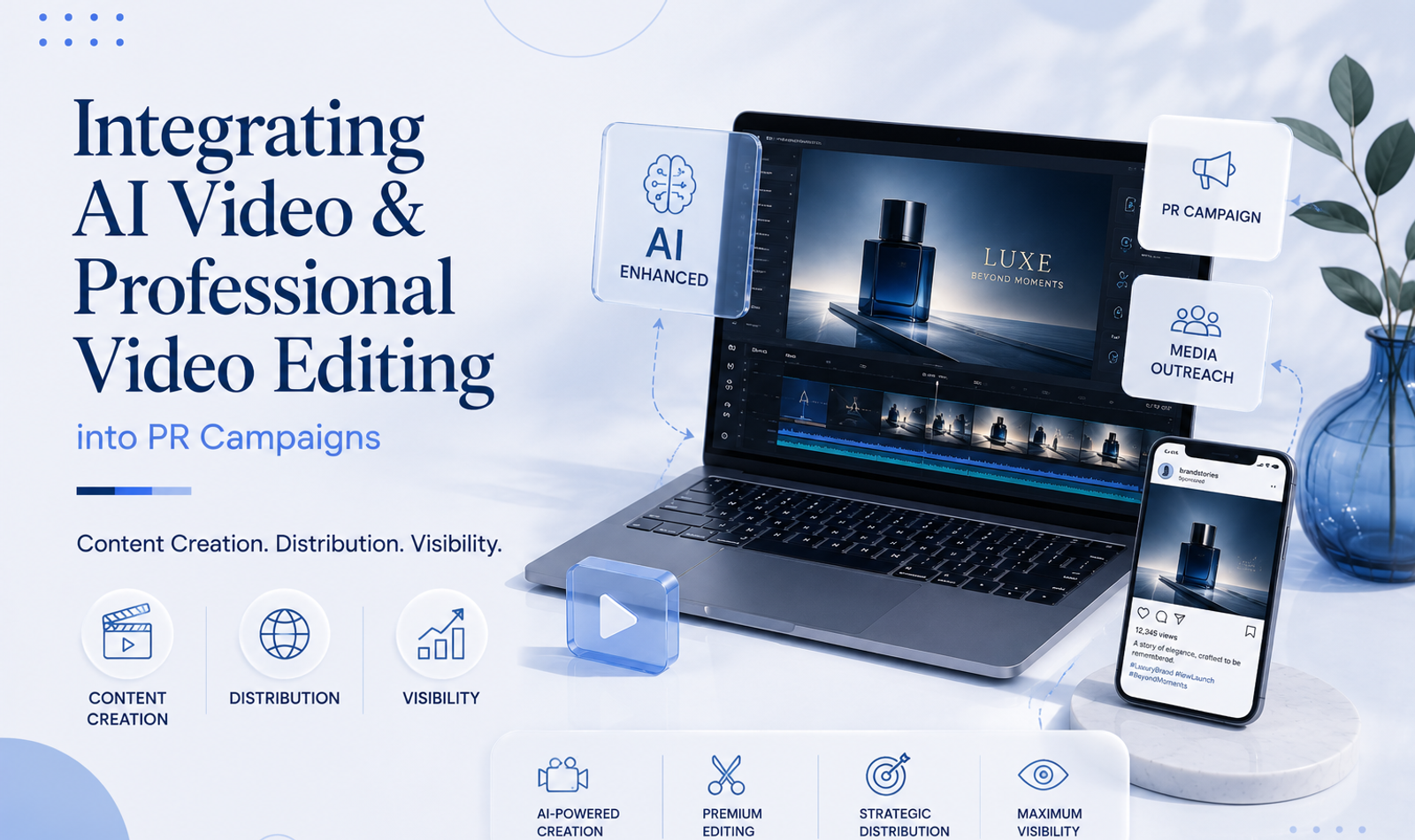
Public relations has moved far beyond press releases and media mentions.
Modern PR campaigns now need strong stories, visual proof, social amplification, founder visibility, digital assets, media-ready content and measurable brand visibility.
A brand can no longer depend only on written communication.
Audiences want to see the story.
Journalists want clear assets.
Social media needs fast-moving content.
Founders need credible visibility.
Campaigns need recall across multiple platforms.
This is where AI video production and professional video editing become powerful tools for PR.
AI video helps brands create campaign teasers, visual explainers, founder-led clips, animated press assets, concept films, social reels, launch videos and PR story visuals faster than traditional production alone.
Professional video editing then turns those assets into polished communication.
Editing controls pacing, sound, colour, subtitles, typography, message clarity, platform formatting and brand consistency.
Together, AI video and professional editing can make PR campaigns more visible, more understandable and more shareable.
But they must be used strategically.
A PR campaign is not successful because it has more content.
It is successful when the right story reaches the right audience with the right credibility.
AI video can help build attention, but PR strategy must create meaning.
Professional editing can improve presentation, but the story must still be real, relevant and trustworthy.
The strongest PR campaigns use video as a bridge between media storytelling, social visibility and audience action.
A press release can become a short explainer.
A founder quote can become a LinkedIn clip.
A launch announcement can become a cinematic teaser.
A media feature can become a social proof video.
An event recap can become proof of execution.
A campaign can become a complete content system.
This is how AI video and professional editing can transform PR from one-time publicity into ongoing brand visibility.
Why PR Campaigns Need Video Today
PR works best when people can quickly understand why a story matters.
A written press note may explain the facts, but video can show the emotion, scale, product, founder, event or customer experience behind the story.
Video makes PR more accessible.
It helps audiences understand complex services.
It makes launches feel more exciting.
It gives journalists and media partners richer context.
It gives social media teams more content to amplify.
It helps brands create visibility before, during and after the media campaign.
For premium and luxury brands, video is especially important because perception matters.
A brand story may sound impressive in words, but it becomes more memorable when supported by strong visuals.
A hospitality launch feels more desirable when audiences can see the mood.
A luxury event feels more credible when viewers can see the scale and detail.
A fashion campaign feels more powerful when fabric, styling and movement are visible.
A founder’s perspective feels more human when delivered through real video.
PR is about building reputation.
Video helps reputation feel visible.
The Role of AI Video in PR
AI video can support PR campaigns at multiple stages.
It can help develop the campaign concept.
It can turn abstract ideas into visual narratives.
It can create pre-launch teasers before the final shoot is ready.
It can support media kits with short visual explainers.
It can create social assets from a larger PR story.
It can help simplify complex services, technology, sustainability initiatives or brand positioning.
AI video is especially useful when the story needs imagination.
A brand entering a new market can visualise the opportunity.
A luxury event company can show the mood of a proposed experience.
A digital agency can visualise online visibility, search growth and brand perception.
A hospitality brand can create a destination-led teaser before the campaign film is complete.
AI allows brands to create visual assets faster.
But the AI video must support the PR story.
It should not become random visual decoration.
The audience should understand the campaign better because of the video.
Brands that want a more structured approach can use an end-to-end AI video production workflow to connect ideation, creation, editing and distribution.
The Role of Professional Video Editing in PR
Professional video editing is what makes PR video content publishable, credible and platform-ready.
A PR campaign may include interviews, B-roll, product footage, event clips, AI visuals, founder commentary, media logos, headlines, subtitles and social cutdowns.
Editing brings these pieces together.
It removes confusion.
It creates rhythm.
It makes the message clear.
It improves audio quality.
It balances colour.
It adds captions and titles.
It adapts the content for different platforms.
PR video editing must be especially careful because credibility matters.
The editor should not exaggerate claims, distort meaning or make the story feel misleading.
A founder quote should remain accurate.
A testimonial should preserve the customer’s real meaning.
An event recap should show real execution.
A media feature should not be presented as a stronger endorsement than it actually is.
Professional editing gives PR content polish without weakening trust.
AI Video and Editing Are Stronger Together
AI video and professional editing should not be treated as separate activities.
AI can generate or support content.
Editing turns that content into communication.
A campaign teaser may begin as an AI-generated concept film.
The editor can then add music, pacing, titles, brand typography and a CTA.
A founder video may use real footage.
The editor can add AI-generated visual metaphors to support key points.
A media kit may include a short AI-assisted explainer.
The editor can make it clear, concise and professionally branded.
An event campaign may use AI to create pre-event mood visuals.
The final recap can use real footage and professional editing to prove what happened.
The hybrid approach gives brands both speed and credibility.
AI expands creative possibilities.
Editing protects quality and meaning.
PR strategy keeps the content relevant.
Start With the PR Objective
Before creating any AI video or edited asset, the brand must define the PR objective.
The campaign may aim to launch a product, announce an expansion, promote an event, build founder authority, manage reputation, introduce a new service, support a cause, attract media attention or strengthen brand trust.
Each objective needs different content.
A product launch may need teaser videos, product explainers and founder clips.
An event campaign may need countdown videos, media invitation visuals and post-event recaps.
A thought-leadership campaign may need expert commentary videos.
A crisis response may need clear, human communication and simple explanatory visuals.
A luxury brand awareness campaign may need cinematic mood films and media-ready storytelling assets.
Without a clear objective, video production becomes unfocused.
The brand may create attractive assets that do not support the campaign outcome.
PR video should always serve the larger communication goal.
Define the Campaign Story
Every PR campaign needs a story.
The story is not just the announcement.
It is the reason people should care.
A brand launching a new service must explain what problem it solves.
A luxury event must explain what makes the experience different.
A hospitality brand must explain why the destination, service or concept matters now.
A fashion brand must explain the inspiration, craft or cultural relevance behind the collection.
A digital agency must explain how its service helps brands become more visible, trusted or profitable.
AI video can make this story more visual.
But first, the story must be clear.
The brand should define the main message, emotional angle, proof points and audience relevance.
Once the story is clear, video assets can be planned around it.
Map the Audience
PR campaigns usually speak to multiple audiences.
Journalists need news value and facts.
Customers need emotion, trust and clarity.
Investors or partners may need credibility and scale.
Employees may need internal alignment.
Social media audiences need short, engaging content.
Industry peers may need thought leadership.
A single video may not work for all these audiences.
The brand should plan different versions.
A media kit video may be concise and factual.
A social teaser may be emotional and visually strong.
A founder LinkedIn clip may be direct and insight-led.
A website video may be polished and brand-focused.
An event recap may be cinematic and proof-driven.
AI video and professional editing make these versions easier to produce.
Audience mapping ensures each asset has a purpose.
AI Video for PR Content Creation
AI video can speed up PR content creation by helping brands move from idea to visual asset quickly.
It can create launch teasers, campaign explainers, animated storyboards, motion posters, social reels, media-kit clips, founder-support visuals and event concept films.
It can also support scriptwriting, caption ideas, visual direction and content variations.
For brands with limited time, this is valuable.
A PR team can create several video assets around one story without planning a full shoot for every version.
However, AI-generated content should still be reviewed.
Product details, claims, locations, faces, logos and text should be checked carefully.
AI content should not misrepresent reality.
In PR, trust matters more than visual novelty.
Professional Editing for PR Content Creation
Professional editing helps turn raw material into campaign-ready assets.
A PR campaign may include many types of footage: founder interviews, product clips, event shots, media interactions, influencer content, behind-the-scenes footage and AI visuals.
Editing organises these into clear stories.
The editor can create a hero film, short reels, media-kit videos, LinkedIn clips, ad cutdowns and website banners.
This multiplies the value of one campaign.
Professional editing also ensures that the brand looks consistent across every touchpoint.
Colours, fonts, subtitles, logos, transitions and sound design should match the brand identity.
This consistency helps PR campaigns feel more premium and credible.
Example: Product Launch PR Campaign
A product launch can use AI video and professional editing from the beginning.
Before launch, AI can create a teaser that hints at the product’s mood, category or benefit without revealing everything.
A short animated announcement can build curiosity.
A founder or product-head video can explain why the launch matters.
Professional editing can then create a media-kit video with product shots, key facts, brand story and launch message.
After the launch, the team can create social cutdowns, paid ad versions and PR amplification clips.
If media coverage appears, the brand can edit snippets into social proof videos where rights and usage are appropriate.
This turns the product launch into a full visibility cycle.
The campaign does not end when the press note is sent.
It continues across social, search, website and media amplification.
Brands can strengthen this approach by planning PR as a 90-day new brand launch strategy, rather than treating launch day as the entire campaign.
Example: Event PR Campaign
An event PR campaign can use AI video before, during and after the event.
Before the event, AI can create mood films, animated invitations, stage concept visuals, countdown reels and sponsor reveal videos.
These assets help build anticipation.
They also give media and guests a clearer sense of the event’s theme.
During the event, real footage becomes essential.
The team should capture arrivals, décor, performances, guest reactions, speaker moments, media interactions and sponsor branding.
After the event, professional editing creates the official recap.
AI can support title sequences, transitions and social cutdowns.
The recap can then be used for PR follow-ups, sponsor reporting, social posts, sales decks and future pitches.
For events, AI creates anticipation.
Real footage creates proof.
Editing creates memory.
Brands planning experience-led campaigns can connect this workflow with professional events and weddings management.
Example: Founder Thought-Leadership PR
Founder-led PR works best when the founder has a clear point of view.
AI video and editing can help package that point of view across platforms.
The founder can record one strong conversation about an industry trend, brand mission or market change.
Professional editing can turn it into several short clips.
AI can support visual metaphors, captions, motion graphics and different platform versions.
A LinkedIn clip may focus on professional insight.
An Instagram reel may use a sharper hook.
A media pitch may include the founder’s expert quote and a short supporting video.
This creates consistency between PR and social communication.
The founder’s ideas become easier to distribute, remember and reuse.
This approach can also strengthen founder PR and personal branding by building authority around expertise rather than relying only on company announcements.
Example: Luxury Brand PR Campaign
Luxury PR depends on perception.
AI video can help luxury brands create mood, atmosphere and cinematic campaign storytelling.
A luxury hospitality brand can use AI-supported visuals to show privacy, destination mood and guest experience.
A jewellery brand can use AI-assisted motion to create light, reflection and emotional atmosphere around real product footage.
A fashion brand can use AI to create editorial teasers and animated campaign frames.
Professional editing ensures the final assets feel premium.
The edit should be refined, not crowded.
Typography should be minimal.
Music should feel aligned with the brand.
The story should be emotional but credible.
Luxury PR video should not feel like a generic AI experiment.
It should feel like a controlled brand world.
A clearly defined luxury brand positioning strategy helps ensure that AI-generated visuals reinforce rather than dilute premium perception.
Example: Regional PR Campaign
Regional PR campaigns need cultural and local relevance.
AI video can help create city-specific teasers, localised social assets and visual references quickly.
A brand launching in Mumbai, Delhi, Chandigarh, Goa, Jaipur or Bengaluru can create visual content that speaks to the local market.
However, the content must feel authentic.
AI should not create fake cultural symbols or inaccurate local representations.
Professional editing can combine real local footage with AI-supported visuals.
For PR, the story should explain why the launch matters to the region.
For social media, the video should connect with local audiences.
For media outreach, the assets should support the local angle.
Regional visibility works when content feels specific, not generic.
Example: Cause-Led PR Campaign
Cause-led PR campaigns require sensitivity.
A sustainability campaign, social initiative, education drive or community programme should not feel artificial or performative.
AI video can help create explainers, animated awareness videos, visual metaphors and campaign teasers.
Professional editing can combine real footage from the initiative with interviews, community voices and on-ground proof.
The brand should avoid using AI to fake impact.
If trees were planted, people supported or communities reached, the content should show real evidence.
AI can support the message, but proof should remain real.
Cause-led PR depends on trust.
The video must feel responsible, accurate and human.
Example: Crisis Communication
AI video can support crisis communication, but it must be handled carefully.
In sensitive situations, real human accountability is usually stronger than synthetic presentation.
A founder, spokesperson or senior leader speaking directly can create more trust than an AI avatar.
AI can still help with captions, language versions, simple visual explainers, timeline graphics or internal communication assets.
Professional editing should make the message clear, calm and respectful.
The edit should not overdramatise the issue.
It should not hide responsibility.
It should not create artificial emotion.
Crisis PR video should focus on clarity, action and trust.
When the situation is serious, authenticity matters more than visual style.
AI Video for Media Kits
A modern media kit can include more than a press release and images.
It can include a short campaign video, founder introduction, product explainer, event teaser or brand story film.
AI can help create some of these assets faster.
Professional editing ensures they are concise and useful.
Journalists do not need long promotional films.
They need clear context.
A media-kit video should explain the story quickly and support the written material.
It may show the founder, product, event concept, campaign purpose or visual identity.
The goal is to make the story easier to understand.
The video should not replace the press note.
It should support it.
AI Video for Press Releases
A press release can become more powerful when supported by video.
A short video can summarise the announcement, explain the product, introduce the founder or show campaign visuals.
For digital PR, this makes the announcement more shareable.
For social media, it creates an asset that can be posted with the release.
For the website, it can support a campaign landing page.
AI can help create motion graphics, visual metaphors and teaser assets.
Professional editing ensures the final video feels clear and credible.
The press release remains the factual document.
The video becomes the visual entry point.
Together, they make the campaign easier to understand.
AI Video for Social Distribution
Social distribution is one of the strongest areas for AI video.
PR stories often need repeated visibility.
One press announcement should not appear only once.
AI video and professional editing can turn one PR story into multiple social assets.
A launch announcement can become a teaser, a founder clip, a product reel, a behind-the-scenes edit, a media coverage recap and a paid ad.
A media feature can become a social proof video.
An event recap can become several reels.
A thought-leadership article can become short video insights.
This creates more touchpoints for the audience.
Social distribution extends the life of PR.
A broader strategy for integrating AI video into social and PR campaigns can help brands coordinate these assets instead of publishing them randomly.
AI Video for LinkedIn Distribution
LinkedIn is important for PR because it connects leadership visibility, professional reputation and industry conversation.
AI video and professional editing can help brands create stronger LinkedIn content.
Founder clips, expert commentary, campaign explainers, event recaps and media-coverage highlights work well on LinkedIn when edited clearly.
The tone should be credible and professional.
The video should not feel too gimmicky.
Subtitles should be clear.
The opening should state the issue or insight quickly.
For B2B brands, LinkedIn video can turn PR from external publicity into visible authority.
It helps leaders and brands stay part of the conversation.
AI Video for Instagram Distribution
Instagram is important for visual PR, especially for luxury, events, fashion, hospitality, food, lifestyle and personal brands.
AI video can create reels, motion posters, countdowns, animated launches and campaign teasers.
Professional editing makes these assets clean, polished and platform-ready.
The opening should be visually strong.
Text should be minimal and readable.
Music and pacing should match the brand.
For luxury PR, the content should feel premium, not noisy.
For event PR, the content should show energy and scale.
For founder PR, the content should feel human and direct.
Instagram helps make PR visible to the audience, not only the media.
AI Video for YouTube Distribution
YouTube is useful for longer-form PR storytelling.
A brand can publish launch films, founder interviews, campaign explainers, event recaps, case studies and documentary-style videos.
AI video can support introductions, graphics, subtitles, visual examples and motion sequences.
Professional editing is essential because YouTube viewers expect structure.
The video should have a clear opening, useful sections and a strong close.
If the video includes realistic altered or synthetic media, brands should review YouTube’s disclosure requirements.
Not every AI-assisted workflow needs disclosure, but realistic synthetic content that could be mistaken for real people, places, scenes or events may require it.
YouTube can also support search visibility because video titles, descriptions and topics can continue to be discovered over time.
AI Video for Website and SEO Visibility
PR campaigns should not depend only on third-party media.
The brand’s website should also host the campaign story.
AI video and professional editing can support landing pages, blog posts, case-study pages, service pages and media rooms.
A campaign video on the website can explain the story quickly.
A founder clip can support trust.
An event recap can show proof.
A product explainer can improve understanding.
The website also gives the brand control over the narrative.
PR visibility should connect back to owned assets.
When media, social and search all point to the same campaign page, the brand can capture more long-term value.
A strong web development and digital marketing strategy helps convert PR attention into owned traffic, enquiries and longer-term search visibility.
AI Video for Email and WhatsApp Distribution
Direct distribution channels are also important.
A short AI-assisted video can be shared through email newsletters, WhatsApp Business, client groups, media outreach and event invitations.
The video should be lightweight and easy to open.
It should not require too much time from the viewer.
For media outreach, a short visual asset can support the pitch if it is relevant.
For clients, a video recap can improve recall.
For event guests, animated invitations or thank-you videos can feel more premium.
Professional editing ensures these videos are clean, compressed and properly formatted.
Direct channels work best when the video is useful, not overwhelming.
AI Video for Paid PR Amplification
Paid amplification can extend the reach of PR content.
A media feature, founder insight, event recap or campaign announcement can be turned into paid social creatives.
AI video helps create variations.
Professional editing makes those variations clear and brand-safe.
However, paid PR amplification needs careful review.
The brand should not imply that a media outlet endorsed something beyond what was actually published.
AI-generated visuals should not distort the product or message.
Platform ad tools may also use AI to modify creative.
Brands should review all AI-enhanced ad outputs carefully because automated changes can create accuracy or brand-safety issues.
Brands can also connect PR assets with an AI-powered video advertising strategy when paid distribution is part of the campaign.
PR Visibility Through Video Repurposing
Repurposing is one of the biggest advantages of AI video and professional editing.
A single PR campaign can produce many video assets.
The hero campaign film can become short reels.
The founder interview can become quote clips.
The event recap can become sponsor cuts.
The product launch can become an explainer.
The media feature can become social proof.
The press conference can become highlights.
The website page can include a silent hero video.
This makes the campaign more efficient.
Instead of creating one announcement and moving on, the brand creates a content library.
AI helps generate variations.
Editing ensures each version remains professional.
Content Creation Before the Campaign
AI video can support pre-campaign preparation.
Before the PR campaign goes live, the team can create teasers, internal explainers, press-kit visuals, founder briefing videos, countdown reels and launch announcement assets.
This helps the campaign feel organised.
The brand does not have to rush after the announcement.
The creative assets are ready when the story goes live.
Pre-campaign video also helps internal teams understand the message.
Sales, customer service, leadership and social media teams can align around one campaign story.
This internal clarity improves external communication.
Content Creation During the Campaign
During the campaign, speed matters.
AI video and professional editing can help produce fast-response assets.
If the campaign receives media coverage, the brand can create social proof posts.
If an event is happening, the team can publish same-day highlights.
If a founder quote gains traction, it can become a short video.
If audience questions appear, the brand can create a quick explainer.
The campaign should stay alive while attention is high.
AI supports speed.
Professional editing protects quality.
This balance is important because rushed content can still damage perception if it feels careless.
Content Creation After the Campaign
After the campaign, video helps extend visibility.
The brand can create recap films, results videos, case studies, behind-the-scenes edits, media coverage compilations and learning-based content.
This is especially useful for event PR, product launches and brand campaigns.
A post-campaign video can show what happened, who engaged, what was achieved and why it mattered.
For future sales, this becomes proof.
For future PR, it becomes a reference.
For social media, it becomes ongoing content.
For the website, it becomes portfolio or case-study material.
AI and editing help turn one campaign into long-term brand assets.
Distribution Strategy for AI Video PR Content
Distribution should be planned before production.
The brand should decide where each video will go.
A hero film may go on the website and YouTube.
Short reels may go on Instagram.
Founder clips may go on LinkedIn.
Media-kit videos may go to journalists.
Event recaps may go to sponsors, clients and social platforms.
Paid cutdowns may go into Meta or YouTube campaigns.
Email versions may go to client databases.
Each platform needs a different edit.
The same video should not be posted everywhere without adaptation.
Professional editing ensures that the format, pacing and message match the channel.
Visibility Strategy for PR Campaigns
Visibility is not only about getting published once.
It is about repeated, relevant presence across the right channels.
AI video and professional editing help increase this presence.
A PR story can appear as a press release, media pitch, founder video, Instagram reel, LinkedIn post, website page, YouTube film, email update and paid ad.
This creates multiple discovery points.
A journalist may discover the brand through the media kit.
A customer may discover it through Instagram.
A corporate partner may see the founder clip on LinkedIn.
A search user may find the campaign page.
A prospect may receive the event recap in a proposal.
Visibility improves when the story is distributed in many useful forms.
Building long-term media relationships can further turn campaign visibility into recurring media opportunities instead of one-off coverage.
Integrating PR, Social and SEO
Video becomes more powerful when PR, social and SEO work together.
A PR story can generate media visibility.
Social media can amplify the story.
The website can host the full campaign content.
SEO can help the content remain discoverable.
AI video can support all these channels.
A campaign video can be embedded in a blog.
Short clips can drive traffic to the landing page.
Media coverage can be repurposed into social proof.
Founder videos can support thought leadership.
Event recaps can support service pages and case studies.
This connected approach helps the campaign last longer.
PR should not live in isolation.
This is also why integrating events, PR and digital into a brand roadmap can create more value from every campaign asset.
Brand Safety in AI Video PR Campaigns
Brand safety is essential in PR because reputation is the core objective.
AI video should be reviewed for accuracy, rights, disclosure, likeness, claims, product details, cultural sensitivity and platform suitability.
A PR campaign should not use AI to create fake testimonials, fake event attendance, synthetic media quotes, false product results or misleading founder messages.
Professional editing should also avoid changing meaning through cuts or captions.
The final video should be strong, but truthful.
In PR, trust is more valuable than short-term attention.
A video that creates confusion can harm the campaign it was meant to support.
Brands using generative production at scale should establish an ethical AI video and brand-safety workflow before publishing.
Disclosure and Transparency
Transparency matters when AI is used in realistic ways.
If a video includes synthetic people, fake scenes, AI-generated event moments, altered product demonstrations or realistic visuals that could be mistaken for real footage, disclosure should be considered.
Not every AI-assisted process requires public disclosure.
Using AI for script ideas, captions, internal planning or technical editing may not materially change audience understanding.
But if the viewer could misunderstand what is real, transparency protects trust.
Platforms are increasingly adding disclosure and AI info labels for synthetic or generative content.
For PR campaigns, disclosure is not only a platform issue.
It is a reputation issue.
Copyright and Permissions
AI video PR campaigns need rights management.
The team should review music licences, stock footage, fonts, templates, voiceovers, reference images, AI tool terms, event footage, influencer content and media-logo usage.
A brand should not copy a competitor’s campaign style or use celebrity likeness without permission.
Media coverage should be repurposed carefully.
The brand should avoid copying large parts of articles or implying endorsement beyond the published story.
If real people appear in the video, consent may be required.
If event guests, children, VIPs or employees are included, privacy should be reviewed.
Professional PR content should be rights-safe before distribution.
Measuring Content Creation
Content creation should be measured by usefulness, not only quantity.
The brand can track how many assets were created from one PR campaign, but it should also review whether each asset had a clear purpose.
Did the teaser build anticipation?
Did the founder clip explain the message?
Did the event recap prove execution?
Did the media-kit video support outreach?
Did the social cutdowns increase engagement?
Did the website video improve understanding?
AI can help create more assets, but more is not always better.
The goal is to create the right assets for the right channels.
Measuring Distribution
Distribution should be measured by reach, placement, channel performance and audience quality.
The brand can track where the video was published, how many people saw it, which channels performed best and whether the audience matched the campaign target.
For social media, metrics may include views, watch time, shares, saves, comments, profile visits and link clicks.
For LinkedIn, metrics may include impressions, engagement, profile visits, connection requests and inbound enquiries.
For YouTube, metrics may include retention, search discovery and referral traffic.
For email or WhatsApp, metrics may include opens, clicks and replies.
Distribution measurement helps the brand understand where the PR story is gaining traction.
Measuring Visibility and Outcomes
PR visibility should not be measured only by views or media mentions.
The brand should also look at outcomes.
Did branded search increase?
Did website traffic improve?
Did enquiries become more relevant?
Did the sales team receive better conversations?
Did the event attract stronger guests or sponsors?
Did media coverage include the key message?
Did social content improve recall?
Did the campaign strengthen reputation?
A strong PR campaign should show both visibility and value.
Common Mistakes in AI Video PR Campaigns
One common mistake is creating AI videos without a PR story.
The video may look impressive but fail to explain why the campaign matters.
Another mistake is publishing the same video on every platform without adapting the format.
Brands may also overuse AI effects, making the campaign feel artificial.
Some teams use AI to fake proof, such as unrealistic event scale or synthetic testimonials.
This can damage trust.
Another mistake is ignoring distribution.
A great video will not create visibility if it is not published, amplified and repurposed strategically.
PR campaigns need both content and channel planning.
A Practical Workflow for AI Video PR Campaigns
The workflow begins with PR strategy.
The brand defines the objective, audience, message, media angle and desired outcome.
The team then creates a content map.
This map identifies which videos are needed for media outreach, social media, website, paid ads, internal alignment and post-campaign reporting.
AI video is used where it adds speed, creativity or visual explanation.
Real footage is used where proof and authenticity matter.
Professional editing turns all assets into polished versions.
Disclosure, rights, brand safety and platform formats are reviewed.
The campaign is launched across media, social, website and direct channels.
Performance is measured and used to improve the next campaign.
This workflow keeps PR video content strategic, visible and credible.
How Double Trouble Studio Integrates AI Video and Editing into PR Campaigns
Double Trouble Studio integrates AI video production and professional video editing into PR campaigns for brands, events, luxury businesses and digital-first companies.
Our approach begins with the campaign story.
We identify the PR objective, media angle, audience and platforms.
Then we create video assets that support content creation, distribution and visibility.
For launches, we create teasers, explainers, founder videos and social cutdowns.
For events, we create pre-event AI visuals, invitations, countdown reels, same-day highlights and post-event recaps.
For luxury brands, we focus on emotion, visual restraint, premium editing and brand-safe storytelling.
For founder-led PR, we create thought-leadership clips, LinkedIn videos and media-support assets.
Our goal is not only to create more content.
Our goal is to make PR campaigns more visible, memorable and useful for long-term brand growth.
Frequently Asked Questions
Q1. How does AI video improve PR campaigns?
AI video helps PR campaigns by quickly creating visual assets like teasers, explainers, founder clips, motion graphics and campaign visuals. It makes complex stories easier to understand and helps brands distribute content faster across social media, press kits and digital platforms.
Q2. Is AI video enough for a PR campaign?
No. AI video alone is not enough. PR campaigns also need real storytelling, credible messaging and professional editing. AI supports speed and creativity, but strategy and authenticity are still essential for trust and impact.
Q3. What is the role of professional video editing in PR?
Professional editing ensures PR content is clear, structured and trustworthy. It controls pacing, sound, colour, subtitles, typography and message delivery while maintaining brand consistency across all platforms.
Q4. Can PR campaigns use both AI video and real footage?
Yes. The best PR campaigns use a hybrid approach. AI video is used for concepts, teasers and visual support, while real footage is used for proof, events, founder communication and testimonials.
Q5. Why are videos important in modern PR?
Videos make PR more engaging and easier to understand. They help journalists, audiences and customers quickly grasp the story, while also improving visibility across social media, websites and digital platforms.
Conclusion
PR campaigns today are no longer limited to press releases and written communication. Modern audiences expect visual storytelling, real proof, and content that can be consumed across multiple platforms.
AI video helps brands speed up content creation and visualize ideas that were previously difficult or expensive to produce. It supports campaign teasers, explainers, founder communication and social media assets.
However, AI alone cannot carry PR strategy. Professional video editing ensures clarity, accuracy, emotional flow and brand consistency. Real footage remains essential for trust, especially in events, product launches and founder-led communication.
The most effective PR strategy today is a hybrid approach. AI brings speed and creativity, while traditional editing brings authenticity and structure. PR strategy ties everything together into a meaningful narrative.
When used correctly, video transforms PR from simple communication into a powerful visibility engine that builds trust, awareness and long-term brand value.
Build PR That People Don’t Just Read — They Remember
If your brand wants to turn PR into a powerful visual storytelling engine, combining AI video production, cinematic editing, and strategic communication can completely change how your audience sees you.
At Double Trouble Studio, we craft high-impact PR video systems that don’t just announce your story — they amplify it across social media, press, events, and digital platforms with clarity, creativity, and credibility.
📩 info@dtsworld.in 📞 +91 80000 06021 📍 Andheri West, Mumbai
Need this for your brand?
Let DTS build your next campaign.
From PR, celebrity management and events to websites, social media, SEO and AI video production — Double Trouble Studio helps brands grow with strategy and execution.
Discuss Your Requirement →