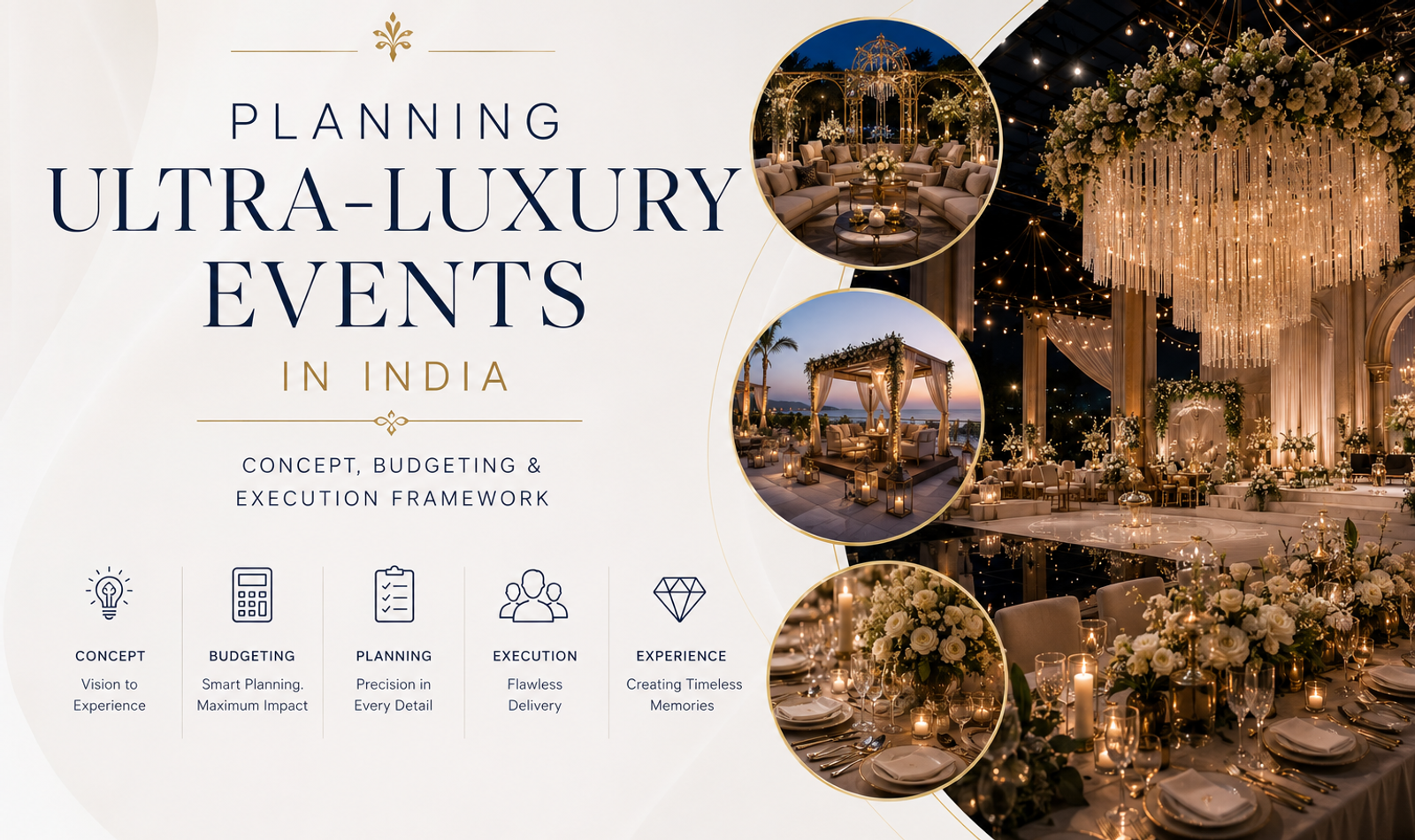
Planning Ultra-Luxury Events in India: Concept, Budgeting & Execution Framework
Ultra-luxury events in India are no longer defined only by expensive venues, celebrity performances or large floral installations. Their real distinction comes from how precisely every element is conceived, coordinated and experienced by the guest.
A premium celebration may involve a heritage property in Rajasthan, a luxury hotel in Mumbai, a private resort in Goa or a large convention-led environment in Delhi NCR. The location changes, but the expectation remains the same: every interaction should feel intentional, effortless and personally relevant.
Ultra-luxury event planning combines creativity, hospitality, logistics, production, security, guest intelligence and financial control. It requires several specialist vendors to deliver one cohesive experience while remaining almost invisible to the guest.
The challenge becomes greater when the event involves high-profile families, corporate leaders, celebrities, international guests or several days of programming. Every detail must be managed without making the experience feel overly controlled.
This guide explains how to plan ultra-luxury events in India from the first concept discussion to final financial closure. It covers creative strategy, budgeting, venue selection, supplier management, guest experience, entertainment, production, security, content and live execution.
Quick Answer
Ultra-luxury event planning in India begins with a clear understanding of the host, audience, event purpose and desired emotional impact. The concept should then guide the venue, hospitality, design, entertainment, food and programme.
The budget must be divided into detailed categories and managed through one central financial system. Every vendor appointment, creative enhancement and guest-related addition should be connected to an approved scope and payment schedule.
Execution requires a master timeline, department-level schedules, rehearsals, control rooms and clearly defined escalation authority. Guests should experience the event as seamless even when several hundred professionals are working behind the scenes.
The strongest ultra-luxury events are not necessarily those with the largest expenditure. They are the ones in which every investment contributes to meaning, comfort, exclusivity and long-term memory.
What Is an Ultra-Luxury Event?
An ultra-luxury event is a highly personalised experience designed around exceptional service, creative originality, privacy and operational precision. It may be a wedding, corporate gala, private dinner, product launch, award ceremony or destination celebration.
The difference between luxury and ultra-luxury is not simply the budget. Ultra-luxury events usually involve a higher level of personalisation, discretion, access and quality control.
The guest may experience private transport, personalised communication, dedicated hospitality, restricted venues, curated entertainment and custom-designed environments. However, these details should feel natural rather than visibly excessive.
An ultra-luxury event also requires stronger risk management. The cost of failure is higher because guest expectations, reputation and operational complexity are significantly greater.
How Ultra-Luxury Events Differ from Standard Premium Events
Planning Area
Premium Event
Ultra-Luxury Event
Concept
Refined theme
Original narrative world
Guest experience
High service quality
Personalised hospitality
Venue
Premium hotel or property
Exclusive or restricted access
Design
Elegant décor
Custom spatial transformation
Entertainment
Professional performers
Curated or headline talent
Food
Premium menus
Bespoke culinary journey
Technology
High-quality production
Integrated invisible technology
Security
Standard access control
Layered privacy management
Vendor team
Experienced suppliers
Specialist multi-agency ecosystem
Execution
Detailed coordination
Central command and live intelligence
The ultra-luxury category requires deeper integration between departments. A highly expensive stage cannot compensate for weak transport, delayed food or poor guest communication.
Luxury Is Experienced Through Ease
Guests often experience luxury through what they do not need to manage. They do not need to search for transport, wait at registration, repeat dietary requirements or ask where the next function is taking place.
A smooth arrival, comfortable seating, discreet assistance and clear communication may appear simple. Behind the scenes, each of these moments requires planning, data and trained teams.
Luxury is also expressed through timing. Guests should not remain in queues, wait unnecessarily for a programme to begin or experience long periods without food, water or information.
The planning team should therefore evaluate the event from the guest’s perspective. Every avoidable effort reduces the perception of refinement.
Begin with the Host’s Purpose
Before developing a theme, the planning team should understand why the event is being organised. The purpose influences every creative and financial decision.
A wedding may prioritise family connection, cultural meaning and guest hospitality. A corporate gala may focus on stakeholder relationships, recognition or brand repositioning.
A product launch may require media impact, demonstrations and content creation. A private celebration may value discretion and emotional intimacy more than public visibility.
The purpose should be written in one clear statement. This becomes the reference point when several attractive ideas compete for approval.
Define the Emotional Objective
The emotional objective explains what guests should feel during and after the event. The event may aim to create wonder, intimacy, pride, nostalgia, excitement or trust.
This objective should guide the pace and atmosphere. An intimate celebration should not be designed like a loud concert simply because large-scale production is available.
A corporate gala designed around trust may use warm hospitality, meaningful storytelling and carefully managed networking. A fashion launch designed around disruption may use contrast, movement and unexpected spatial experiences.
The emotional objective creates consistency. It helps vendors understand not only what they are building but why it should feel a particular way.
Understand the Guest Profile
Ultra-luxury planning begins with detailed guest understanding. Age, travel origin, cultural expectations, professional relationships and accessibility needs influence the event structure.
International guests may require travel guidance, currency information and language support. Senior leaders or public figures may require private access and controlled schedules.
Elderly guests may need shorter walking distances, appropriate seating and medical assistance. Families with children may benefit from supervised activity spaces and flexible dining.
Guest understanding should improve service without becoming intrusive. Only information required for legitimate planning should be collected.
Guest Profile Checklist
• Age groups
• Travel origin
• Cultural preferences
• Dietary requirements
• Accessibility needs
• VIP classifications
• Security concerns
• Communication preferences
The guest profile should influence the venue, programme, food, seating and transportation plans.
Developing the Ultra-Luxury Event Concept
The concept should be developed from the host’s identity, event purpose, venue and guest profile. It should not begin by copying an image from another event.
A strong concept can be expressed through a clear narrative. It explains the world being created, how guests enter it and what they experience as the programme develops.
The concept may be inspired by art, architecture, cultural heritage, nature, a brand philosophy or a personal story. The inspiration should remain coherent across design, music, food and hospitality.
A concept should also be executable. Creative ambition must be tested against engineering, venue access, weather, budget and setup time.
Concept Development Stages
Stage
Key Question
Expected Output
Discovery
Who is the event for?
Host and guest brief
Purpose
What must it achieve?
Event objective
Narrative
What story should it tell?
Creative direction
Visualisation
How should it appear?
Mood boards and layouts
Feasibility
Can it be delivered safely?
Technical review
Commercial review
What will it cost?
Approved concept budget
Integration
How do all departments connect?
Execution framework
The concept should not move into fabrication until creative, technical and financial approval are aligned.
Narrative-Led Luxury Design
Narrative-led event design creates a complete journey rather than a collection of unrelated decorative zones. Every touchpoint communicates a different part of the story.
The invitation may introduce the visual language, while the arrival creates anticipation. The main environment then reveals the strongest emotional and visual moment.
Dining, entertainment and guest gifts can continue the narrative. The event feels cohesive because every department is expressing the same central idea.
The story should remain understandable without requiring long explanations. Guests should experience the concept through atmosphere and interaction.
Balancing Indian Culture with Contemporary Design
India offers an extensive range of cultural references, materials, craftsmanship and regional traditions. Ultra-luxury events can use these influences in modern and respectful ways.
A Punjab-inspired celebration may incorporate phulkari, agricultural landscapes, folk music and regional hospitality. A Rajasthan event may respond to courtyards, stone, miniature painting and local textiles.
A South Indian celebration may use brass, jasmine, temple architecture and classical music. A Mumbai event may draw from art, cinema, architecture or the coastline.
Cultural elements should not be combined randomly. Authenticity becomes stronger when the design reflects one clear context and credits the artists involved.
Selecting the Right City or Destination
India offers several destinations suitable for ultra-luxury events. The correct selection depends on audience, programme, connectivity, climate and venue availability.
Mumbai provides luxury hotels, media access, celebrity infrastructure and strong production resources. Rajasthan offers heritage venues and architectural character.
Goa supports resort-led events, leisure programming and coastal hospitality. Delhi NCR can accommodate large galas, conferences and diplomatic gatherings.
Bengaluru and Hyderabad can support technology, business and convention-led experiences. Hill and nature destinations may be suitable for intimate celebrations but require stronger weather and transport planning.
Indian Luxury Event Destination Comparison
Destination
Best Suited For
Main Strength
Primary Challenge
Mumbai
Galas, launches and weddings
Connectivity and production
Traffic and setup access
Udaipur
Heritage weddings
Architecture and exclusivity
Room distribution
Jaipur
Weddings and incentives
Heritage and connectivity
Multi-venue transport
Goa
Resort events and retreats
Leisure and hospitality
Seasonal demand
Delhi NCR
Large corporate events
Capacity and infrastructure
Traffic and movement
Bengaluru
Technology summits
Corporate ecosystem
Travel times
Hyderabad
Conferences and weddings
Venues and convention capacity
Guest logistics
Chandigarh
Weddings and institutional events
Planned city and access
Premium-date availability
Alibaug
Private events and retreats
Privacy near Mumbai
Transfer complexity
Hill destinations
Intimate celebrations
Landscape and seclusion
Weather and road access
The destination should be selected after reviewing actual venue and accommodation availability, not only visual appeal.
Venue Selection for Ultra-Luxury Events
The venue is one of the most important decisions because it affects design, production, hospitality and budget. Its operational capability should be evaluated alongside architecture.
The planner should review capacity, rooms, loading, power, sound, kitchens, parking, washrooms and emergency access. Maximum capacity may not represent comfortable luxury capacity.
The venue should also support privacy. High-profile events may require private entrances, secure holding rooms and controlled service routes.
Outdoor venues should provide a complete weather alternative. The backup should support the same guest count and programme rather than functioning as a partial emergency space.
Ultra-Luxury Venue Checklist
• Architectural character
• Exclusive access
• Guest capacity
• Accommodation inventory
• Private entrances
• Loading access
• Rigging capability
• Power infrastructure
• Sound restrictions
• Weather backup
• Medical support
• Security controls
A combined inspection should involve planning, production, décor, hospitality and security teams.
Negotiating Venue Contracts
The venue agreement should identify every reserved space, date, setup period, room block and service. Commercial assumptions should not remain verbal.
Minimum catering commitments, room guarantees and mandatory vendor conditions require careful review. These can significantly affect the total cost.
Overtime, power, corkage, valet and damage charges should also be understood. A lower rental may be offset by several operational expenses.
The venue should confirm what happens during postponement, weather disruption or force majeure. High-value agreements may require professional legal review.
Creating the Ultra-Luxury Event Budget
Budgeting should begin before the concept becomes too detailed. The organiser should establish a preferred budget, approved maximum and protected contingency.
The total should be divided into specific categories. Venue, accommodation, catering, design, production, entertainment, hospitality, transport, content, security and professional fees should remain visible.
Taxes, travel, labour, setup and dismantling should be included. Comparing quotations without these costs creates inaccurate expectations.
The budget should support the event priorities. It should not distribute money evenly across departments without considering guest impact.
Typical Ultra-Luxury Event Budget Structure
Budget Category
Main Components
Common Cost Risk
Venue and spaces
Rental, setup and overtime
Restricted access
Accommodation
Rooms, suites and hospitality
Unused guarantees
Food and beverages
Menus, bars and service
Guest-count changes
Creative design
Concept, décor and florals
Scope expansion
Production
Sound, lighting and screens
Technical additions
Entertainment
Artists, hosts and performances
Riders and travel
Guest management
Invitations, RSVPs and seating
Late additions
Transport
Airport and venue movement
Additional vehicles
Content
Photography, films and social assets
Extended coverage
Security
Access, VIP protection and privacy
Additional deployment
Planning fees
Strategy and event management
Unclear deliverables
Contingency
Weather and emergencies
Premature use
The allocation should reflect the event rather than relying on one fixed percentage template.
Separate Core and Enhancement Budgets
The core budget should contain everything required to deliver the approved event safely and at the expected quality. Optional enhancements should remain separate.
Enhancements may include additional artists, upgraded florals, personalised gifts or extended content production. They should not reduce essential hospitality or safety expenditure.
This separation allows the host to make informed additions after the financial foundation is stable. It also prevents optional ideas from appearing as unavoidable costs.
Every enhancement should include a decision deadline. Late confirmation may increase cost or become operationally impossible.
Protecting the Contingency Reserve
Contingency should cover genuine uncertainty such as weather, transport disruption, technical replacement or unexpected guest requirements. It should be established from the beginning.
The reserve should not become available to every department. One senior financial authority should control its use.
Using contingency for early design upgrades creates risk. The event may later face an unavoidable expense without any financial protection.
The amount should reflect complexity, destination, weather and vendor certainty. A multi-day outdoor event may require greater protection than a controlled indoor gala.
Cost Control Without Reducing Luxury
Cost control is not the same as selecting cheaper vendors. It means eliminating duplication, clarifying scope and directing investment towards meaningful areas.
The planner can reduce cost by using venue architecture, reusing scenic structures and consolidating transport. Seasonal florals and local sourcing may also improve efficiency.
The guest list should be controlled carefully because additional attendees affect several departments. Each addition may increase food, rooms, vehicles, gifts and staffing.
Operational quality should remain protected. Poor sound, slow service and insufficient hospitality staff can damage the experience more than reduced decorative scale.
Vendor Selection for Ultra-Luxury Events
Ultra-luxury events require suppliers with proven capability, discretion and communication discipline. A beautiful portfolio alone is not enough.
The vendor should have experience with similar scale, venues and guest expectations. Staffing, backup systems and financial clarity should also be reviewed.
The planning team should understand whether the supplier uses subcontractors. Critical services should not be transferred without approval.
References can provide insight into reliability under pressure. Previous clients may reveal how the vendor handles changes, deadlines and live problems.
Vendor Evaluation Criteria
• Relevant experience
• Team capacity
• Technical capability
• Service consistency
• Financial clarity
• Privacy awareness
• Backup systems
• Communication quality
Vendor selection should compare complete value rather than only the final quotation.
Coordinating Multiple Specialist Vendors
An ultra-luxury event may involve more than twenty suppliers. Each vendor must understand its scope, schedule and dependency on other teams.
Décor may depend on production rigging, while floral installation depends on completed structures. Catering requires final layouts and guest counts.
A master vendor register should include contacts, contracts, payment status, setup times and required documents. Every supplier should have one primary reporting contact.
The objective is to make specialist vendors operate like one integrated team. Guests should never feel that separate companies are competing for space or attention.
Create Detailed Vendor Scopes
Vendor scopes should explain deliverables, quantities, staffing, materials, exclusions and handovers. Broad terms such as complete décor are not sufficient.
The production scope should list sound, screens, lighting, power, rigging and operators. The hospitality scope should identify airport assistance, hotel desks and guest communication.
Visual references should support written scope. They should not replace measurements, quantities or material specifications.
Detailed scopes reduce disputes and improve financial control. They also help the planner identify gaps between suppliers.
Build the Master Event Timeline
The master timeline should connect planning, procurement, setup, rehearsal, live operation and breakdown. It should be based on dependencies.
Venue access, truck arrivals, structural installation, technical testing and décor finishing should be sequenced carefully. Shared loading areas may require scheduled time slots.
The schedule should also include guest movements, programme cues and meal service. Operational and experiential timing must remain connected.
Buffers should be included. A schedule that assumes every activity will finish perfectly is not suitable for a complex event.
Master Timeline Stages
Planning Stage
Primary Focus
12–18 months before
Concept, destination and budget
9–12 months before
Venue and primary vendors
6–9 months before
Design, production and hospitality
3–6 months before
Guests, entertainment and logistics
6–12 weeks before
Confirmations and testing
2–6 weeks before
Final lists and rehearsals
Event week
Setup and execution
Post-event
Reconciliation and review
The timeline should be adapted to demand, destination and corporate procurement requirements.
Designing the Guest Journey
The guest journey begins before arrival. Invitations, travel communication and assistance establish the first impression.
Arrival should feel controlled and welcoming. Valet, registration, security and hospitality should work as one sequence.
The programme should provide clear transitions between dining, ceremonies, entertainment and networking. Guests should not need to search for information repeatedly.
Departure should receive equal attention. Vehicle collection, luggage and final gifts influence the closing memory of the event.
Invitation and Communication Strategy
Ultra-luxury invitations should combine design with clarity. Guests need accurate information about dates, venues, dress guidance and RSVP.
Physical invitations may be suitable for close family, senior stakeholders or priority guests. Digital communication supports faster updates and travel coordination.
Guest names and titles should be verified. Errors in formal communication can damage the perception of personal attention.
A controlled website or messaging system can centralise information. Important updates should identify clearly what has changed.
RSVP and Guest Data Management
The RSVP system should collect attendance by function, approved companions, dietary requirements and travel details. Every response should enter one database.
The system should show confirmed, declined, pending and cancelled guests. Different functions may have different attendance numbers.
Access to guest data should remain restricted. Transport providers, caterers and security teams should receive only the information required for their work.
Data should also be closed responsibly after the event. Temporary access and unnecessary files should not remain active indefinitely.
Luxury Hospitality Planning
Hospitality is one of the clearest indicators of an ultra-luxury event. It should feel personal without becoming intrusive.
Destination guests may require airport representatives, private transport, rooming support, luggage assistance and welcome communication. VIP guests may need dedicated coordinators.
Hospitality desks should have access to accurate information. A visually attractive desk is ineffective when staff cannot resolve real questions.
The team should prepare for delays, room changes, medical needs and lost belongings. Service quality becomes most visible when something does not go according to plan.
Hospitality Checklist
• Airport assistance
• Hotel check-in
• Luggage handling
• Guest itineraries
• Dedicated coordinators
• Medical support
• Lost-property process
• Departure assistance
Every guest-facing staff member should receive a clear briefing on service tone and escalation.
Rooming List Management
Rooming lists should be controlled by one team and shared through approved versions. They should include names, dates, room categories and special requirements.
Family groups, elderly guests and high-profile attendees may require specific allocations. Private floors or controlled access may be considered where appropriate.
Hotel release deadlines should be tracked. Unused guaranteed rooms can create significant financial loss.
Room drops, gifts and guest itineraries should be connected with the approved rooming list.
Transport and Movement Planning
Transport should connect airports, stations, hotels, venues and private activities. Every movement should align with the programme.
Vehicle assignments should consider group size, luggage and road conditions. Premium cars are not always practical for large baggage loads.
Drivers should receive routes, guest information and escalation contacts. Their communication should remain professional and discreet.
A central transport control desk should monitor dispatch, delays and changes. Individual departments should not book vehicles separately without updating the master plan.
Ultra-Luxury Event Design
Ultra-luxury design should respond to venue architecture, guest movement and programme. It should not focus only on one central stage.
Entrances, lounges, bars, dining and pathways should all reflect the creative narrative. The experience should feel complete from every viewpoint.
High-impact installations may be combined with quieter spaces. Guests require areas for conversation and rest during long programmes.
Materials, flowers and finishes should be tested under actual lighting and climate conditions. Visual quality depends on detail, proportion and execution.
Floral and Botanical Design
Flowers can shape architecture, movement and atmosphere. They should not be treated only as decorative centrepieces.
Sculptural installations, planted pathways and suspended botanical forms can create strong visual experiences. However, sightlines and safety must remain protected.
Seasonality, transport and waste should be considered. Local and seasonal materials may provide better quality and reliability.
Floral repurposing can be planned where practical. Sustainability should reflect real actions rather than communication language alone.
Lighting as a Creative Material
Lighting can transform a venue without rebuilding physical structures. It creates mood, highlights architecture and directs attention.
Ceremonies may require warm and flattering light, while entertainment may use richer colour and movement. The transition should follow the emotional programme.
Lighting should support photography and guest visibility. Excessive darkness or extreme colour can weaken comfort and captured content.
The lighting designer should work with décor and production teams from the beginning. Separate planning often creates inconsistent results.
Food and Beverage Experience
Food should be planned as part of the event narrative and hospitality system. Menu quantity alone does not define luxury.
The culinary direction may reflect regional culture, personal preferences or brand identity. Presentation and service should remain consistent with the design.
Dietary requirements should be recorded discreetly. Guests should not need to repeat confirmed needs at every meal.
Counter placement, service speed and seating influence the dining experience. Beautiful food stations that create long queues reduce perceived quality.
Catering Checklist
• Function-wise menus
• Guest guarantees
• Dietary requirements
• Service formats
• Counter placement
• Staff strength
• Beverage policy
• Vendor meals
Tastings should evaluate presentation, temperature and service as well as flavour.
Entertainment Strategy
Entertainment should support the event purpose and audience. A famous performer is not automatically the right choice.
The programme may include live music, cultural performances, immersive theatre, celebrity talent or interactive experiences. Each should contribute to the narrative.
Artist agreements should cover performance duration, technical riders, travel, hospitality and content permissions. Appearance and performance should be defined separately.
Sound checks and rehearsals must be included in the venue schedule. Entertainment cannot be planned independently from production.
High-profile attendance requires discretion, security and precise movement. Artist schedules, room information and private contacts should remain restricted.
One talent coordinator should manage communication with the representative. Vendors and guests should not create separate access requests.
Holding rooms, transport, technical riders and media permissions should be confirmed early. Celebrity arrival should not disrupt general guest movement.
VIP treatment should remain professional without making other guests feel visibly unimportant. Privacy and hospitality must be balanced carefully.
Technical Production
Technical production includes stage, sound, lighting, screens, rigging, power and communication. It is a foundation of the live experience.
The team should inspect the venue and review load, height, access and power restrictions. Temporary structures may require engineering documentation.
Backup power, sound and playback should be prepared. Critical systems should not depend on one unsupported device.
Technical rehearsals should follow the actual programme. Individual equipment testing cannot reveal every transition problem.
Invisible Technology
Technology should improve convenience and engagement without dominating the visual environment. Registration systems, credentials and digital signage can be integrated into the design.
Screens may be embedded into scenic structures rather than appearing as separate equipment. Interactive installations should remain intuitive.
AI-assisted tools may support planning, visualisation and guest communication. Professional teams must still review feasibility, privacy and cultural context.
The strongest event technology becomes almost invisible. Guests remember the experience it enabled rather than the device itself.
Security and Privacy
Security planning should reflect the guest profile, venue and event type. It may include perimeter control, entry verification, backstage access and private routes.
The team should separate hospitality from enforcement. Security staff should remain firm without creating an aggressive arrival experience.
Photography permissions may also require control. Some guests may not want their attendance or image shared publicly.
Guest lists, room details and travel schedules should remain accessible only to authorised teams. Discretion is a central element of ultra-luxury service.
Permissions and Compliance
Sound, alcohol service, drones, structures and public performances may require specific approvals depending on the venue and location.
The planner should maintain a permissions tracker showing responsibility, deadline and status. Applications should not be left until the event week.
Fire safety, medical support and emergency access must remain protected. Décor or equipment should never block required routes.
Legal and regulatory requirements may vary. Appropriate professional guidance should be obtained for the specific event and location.
Weather and Contingency Planning
Outdoor events require complete weather alternatives. The backup must support the full guest count, food, production and programme.
The decision deadline should be established before setup. Waiting until the last moment may leave both environments incomplete.
Heat, humidity, rain and wind affect flowers, makeup, flooring, sound and guest comfort. Climate-sensitive materials should be selected accordingly.
Contingency should also cover travel delays, artist disruption, technical failure and medical emergencies.
Event Risk Register
Risk Area
Example Risk
Primary Response
Weather
Rain or extreme heat
Activate backup venue
Travel
Delayed guest arrivals
Adjust transport and programme
Production
Power or equipment failure
Use backup systems
Entertainment
Artist delay
Activate alternate segment
Hospitality
Rooming error
Escalate through hotel desk
Security
Unauthorised access
Move to exception process
Catering
Service delay
Adjust programme and replenishment
Medical
Guest emergency
Activate medical response
Every major risk should have an owner, backup action and decision deadline.
Photography and Content Strategy
Ultra-luxury events are increasingly designed with content in mind. However, content creation should not interfere with the live experience.
The photography team should receive the programme, family priorities and permission rules. Camera platforms and movement should be coordinated with seating.
Editorially designed moments can create strong photographs without relying on one formal backdrop. Entrances, bars and dining areas may all support content.
Ownership, delivery and usage rights should appear in contracts. Corporate and private events may require different distribution controls.
Creating the Run of Show
The run of show connects every programme moment with technical, hospitality and guest actions. It should identify timing, cues and owners.
Entries, speeches, performances, dining and departures must be coordinated. The schedule should include realistic buffers.
Different teams may require different versions. Production needs technical cues, while hosts and guests need simplified information.
The final run should be updated after rehearsal. Old versions should be withdrawn from circulation.
Conducting Rehearsals
Rehearsals should test movement, timing, sound, lighting, content and transitions. They are essential for reducing visible mistakes.
Speakers, performers and key family members should understand their cues. Technical teams should practise backup responses.
Hospitality and security teams may also rehearse arrivals, registration and VIP movement. Operational simulations can reveal gaps before guests arrive.
The goal is not to make the event feel mechanical. Rehearsal creates the confidence required for natural live moments.
Event-Day Command Structure
The event day should operate through department heads and one event director. Vendors should not contact the host for routine problems.
A control room should hold the latest schedule, contacts, guest updates and emergency information. Issues should be logged and assigned.
Radio or messaging channels may be divided by department. Critical communication should remain brief and action-oriented.
Every lead should have a backup. Multi-day events require continuity even when teams rotate or rest.
Event-Day Command Roles
• Event director
• Control-room lead
• Production manager
• Hospitality manager
• Guest-list manager
• Logistics manager
• Security lead
• Finance controller
The command structure should be explained during the final supplier briefing.
Managing Live Changes
Last-minute changes are unavoidable, but they should follow an approval system. The team should assess cost, safety and impact on other departments.
A stage change may affect screens, lighting, seating and photography. It cannot be approved as one isolated décor request.
Event-day changes should be recorded. This supports financial reconciliation and prevents conflicting instructions.
The planner should protect the approved experience from unnecessary late additions. Flexibility should remain informed rather than reactive.
Managing Event-Day Costs
Overtime, additional vehicles and emergency equipment may create live expenses. One authorised financial controller should record these additions.
Vendors should receive approval before providing chargeable work whenever time permits. Safety actions may require immediate response.
The control room should understand the remaining contingency. Large costs should not be approved without visibility into the complete budget.
Post-event disputes become easier to resolve when live decisions are documented clearly.
Guest Departure and Closing Experience
The event journey continues until every guest has departed. Vehicle collection, hotel shuttles and luggage require coordination.
Peak departure periods should be anticipated. Valet and transport teams need enough capacity after major programme moments.
Waiting guests should receive seating, water and accurate information. Unexplained delays can weaken the final impression.
Departure gifts and personal farewells may provide a meaningful closing moment. The final interaction should reflect the same quality as the arrival.
Post-Event Financial Closure
Vendor invoices should be compared with contracts, approved changes and delivery records. Overtime, consumption and damage charges require verification.
Venue and hotel accounts should be reconciled against guest and rooming lists. Deposits and refunds should also be tracked.
The final report should compare the original budget, revised forecast and actual cost. Significant differences should be explained.
Financial closure creates transparency and provides reliable information for future events.
Post-Event Performance Review
A luxury event should be reviewed according to guest experience, operational success and financial control. Visual beauty alone is not enough.
The team may evaluate arrival time, seating accuracy, programme delays, transport changes and service issues. Corporate events may also measure business and sponsor outcomes.
Vendor performance should be documented. Strong suppliers can be retained for future projects, while recurring problems should influence later selection.
Guest feedback and internal observations should be converted into practical learning. Every major event should improve the next one.
The PALACE Ultra-Luxury Event Framework
The PALACE framework connects concept, budget and execution through six planning disciplines.
P — Purpose and People
Define the event objective, host identity, guest profile and desired emotional outcome.
A — Architecture and Atmosphere
Select the destination, venue and creative concept according to the guest journey and event narrative.
L — Luxury through Logistics
Coordinate transport, rooms, hospitality, accessibility and service so that complexity remains invisible.
A — Allocation and Accountability
Build detailed budgets, vendor scopes, approvals and payment systems. Every task and cost should have one owner.
C — Command and Contingency
Create schedules, rehearsals, control rooms and backup plans for weather, travel, production and security.
E — Experience and Evaluation
Deliver a meaningful guest journey and review performance, cost and learning after the event.
The PALACE framework ensures that ultra-luxury is supported by disciplined planning rather than decorative expenditure alone.
Complete Ultra-Luxury Event Checklist
Before execution, the planning team should review the complete strategic, creative and operational system.
• Event objective
• Guest profile
• Creative narrative
• Approved budget
• Venue contract
• Vendor scopes
• Guest database
• Rooming list
• Transport schedule
• Production plan
• Entertainment contracts
• Security plan
• Weather backup
• Final rehearsal
• Control-room documents
• Financial closure plan
Every checklist item should have a responsible owner and fixed completion deadline.
Common Ultra-Luxury Event Planning Mistakes
One common mistake is equating luxury with decorative scale. Large structures cannot compensate for weak service, poor sound or guest discomfort.
Another mistake is selecting a venue before understanding travel, accommodation and production requirements. The visual choice then creates unnecessary operational cost.
Uncontrolled guest additions and informal vendor instructions can also increase budgets quickly. Every change should pass through central approval.
Finally, some events focus heavily on arrival and performance while neglecting food, washrooms, seating and departure. Guests judge the complete journey.
Frequently Asked Questions
What is ultra-luxury event planning in India?
Ultra-luxury event planning in India involves creating highly personalised weddings, galas, launches and private events with premium hospitality, creative design and precise execution.
It combines venues, vendors, production, guest management, security and financial control within one planning system.
What makes an event ultra-luxury?
An ultra-luxury event provides originality, personalisation, exclusivity, comfort and discretion. Every element is designed around the host and guest profile.
The distinction comes from integration and service quality rather than expenditure alone.
How far in advance should an ultra-luxury event be planned?
Large weddings and destination events should begin as early as practical. Premium venues and specialist vendors may require early commitment.
Shorter timelines are possible when dates, venues and creative requirements remain flexible.
Which Indian cities are best for luxury events?
Mumbai, Udaipur, Jaipur, Goa, Delhi NCR, Bengaluru, Hyderabad and Chandigarh can support different luxury event formats.
The best destination depends on connectivity, venue availability, season, guest profile and event purpose.
How is an ultra-luxury event budget created?
The budget should be divided into venue, food, rooms, design, production, entertainment, hospitality, transport, security and professional fees.
Taxes, travel and contingency should be included from the beginning.
How can luxury event costs be controlled?
Use detailed vendor scopes, quotation comparisons, category limits, approval systems and change logs. Guest-list growth should also be monitored carefully.
Cost control should protect hospitality, safety and production reliability.
How many vendors are involved in a luxury event?
Large events may involve more than twenty specialist suppliers. The exact number depends on venue, functions and production complexity.
Every supplier should operate through one management structure and master schedule.
How are VIP and celebrity guests managed?
VIP management may include private transport, secure routes, dedicated coordinators and restricted information access.
One authorised representative should manage communication with celebrity or talent teams.
What should a luxury event contingency plan include?
It should cover weather, travel, power, technical failure, medical support and programme disruption.
Every risk should have an owner and defined response.
How is privacy protected at a luxury event?
Guest data, room information and schedules should be shared only with authorised teams. Photography and access permissions should also be controlled.
Security should protect privacy without creating an uncomfortable atmosphere.
Why are rehearsals important?
Rehearsals test entries, speeches, performances, sound, lighting and transitions. They reveal conflicts before guests arrive.
The final run of show should be updated after rehearsal.
How should luxury event vendors be selected?
Review relevant experience, team capacity, technical capability, backup planning and discretion. Quotations should be compared according to complete scope.
The lowest price should not be the only criterion.
What is the role of an ultra-luxury event planner?
The planner connects concept, budget, venue, vendors, guests and live execution. They protect the host from operational pressure.
The planner also manages schedules, approvals, risks and financial control.
How is success measured after the event?
Success can include guest satisfaction, service quality, schedule accuracy, vendor performance and budget control.
Corporate events may also evaluate business, media, sponsor and stakeholder outcomes.
Does Double Trouble Studio plan ultra-luxury events in India?
Double Trouble Studio supports luxury weddings, corporate galas, private celebrations, launches and celebrity-attended experiences in Mumbai and across India.
The scope can include concept development, budgeting, venues, vendors, guest management, production, entertainment and execution.
How Double Trouble Studio Plans Ultra-Luxury Events
Double Trouble Studio approaches ultra-luxury event planning as a complete journey from concept discovery to final closure. We begin by understanding the host, audience, destination and intended emotional impact.
Our work can include creative strategy, budgeting, venue selection, vendor management, guest hospitality, transport, décor, production, entertainment and security. Every department is connected through one central plan.
For destination events across India, we coordinate rooming, travel, local suppliers, freight and cultural integration. For Mumbai events, we plan around traffic, venue access, monsoon conditions and premium guest movement.
During execution, our teams can manage control rooms, rehearsals, vendor schedules, guest support and live changes. The host experiences the celebration while operational complexity remains behind the scenes.
The objective is to create events that feel exceptional without feeling forced. Every investment should contribute to comfort, emotion, storytelling or relationship value.
Conclusion
Planning ultra-luxury events in India requires more than an expensive venue and impressive décor. It requires a complete framework connecting concept, budget, hospitality and execution.
The concept should begin with purpose, people and place. The budget should direct investment towards the experiences that matter most.
Detailed scopes, timelines, rehearsals and control systems allow multiple vendors to work as one team. Risk planning protects the event when weather, travel or programme conditions change.
When every department is integrated, luxury becomes visible through ease, personalisation and emotional impact. The event feels effortless because the planning behind it is exceptionally disciplined.
Plan Your Ultra-Luxury Event with Double Trouble Studio
An ultra-luxury event should feel personal, seamless and impossible to reproduce for anyone else. Double Trouble Studio plans complete experiences for luxury weddings, corporate galas, private celebrations, launches and celebrity-attended events.
Our approach can include concept development, destination selection, budgeting, vendor management, guest hospitality, décor, production, entertainment, security and on-ground execution in Mumbai and across India.
Connect with Double Trouble Studio to create an event that combines creative ambition, financial control and flawless delivery through one professionally managed framework.
📩 info@dtsworld.in | 📞 +91 80000 06021 | 📍 Andheri East, Mumbai
Need this for your brand?
Let DTS build your next campaign.
From PR, celebrity management and events to websites, social media, SEO and AI video production — Double Trouble Studio helps brands grow with strategy and execution.
Discuss Your Requirement →