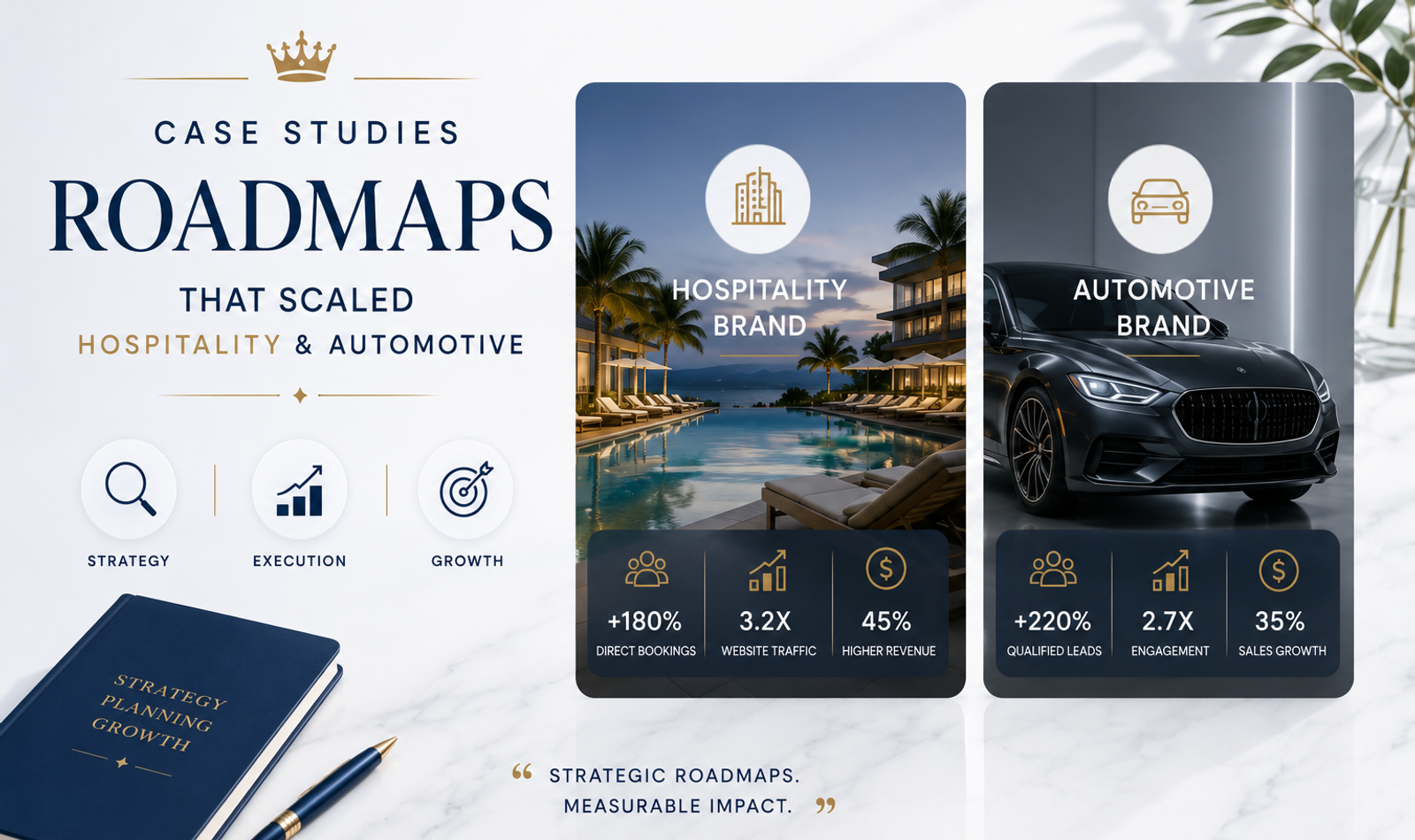
Case Studies: Roadmaps That Scaled Hospitality & Automotive Brands
A brand roadmap becomes powerful when it moves beyond planning and starts creating measurable business growth. Strategy sounds impressive on paper, but its real value appears when a brand becomes clearer, more visible, more trusted and more profitable because of it.
Hospitality and automotive brands are two industries where a roadmap can make a major difference. Both sectors depend heavily on trust, experience, timing, digital discovery, customer service and reputation. A hotel, restaurant, resort, car rental company, dealership, mobility service or chauffeur-driven brand cannot rely only on attractive visuals. Customers need confidence before they book, visit, enquire or purchase.
A hospitality customer may check Google, Instagram, reviews, food photos, ambience videos, menus, location details, influencer content and guest experiences before making a booking. An automotive customer may evaluate credibility, vehicle condition, pricing clarity, service reliability, city coverage, customer reviews, corporate trust and response time before choosing a brand.
This is why both industries need more than marketing activity. They need a strategic roadmap supported by strong PR, media and marketing, digital visibility, content and customer experience.
A roadmap connects positioning, customer experience, digital marketing, public relations, content, website performance, lead handling and measurement. It helps the brand grow with clarity instead of depending on random posts, seasonal offers or inconsistent campaigns.
This blog explores practical roadmap-style case studies showing how hospitality and automotive brands can scale through structured brand strategy. These examples are written as anonymized strategic scenarios, designed to show how the right roadmap can solve real business problems and create stronger brand growth.
Why Case Studies Matter in Brand Strategy
Case studies help brands understand strategy in action.
A framework explains what should be done. A case study shows how it works in a real-world business situation.
Many hospitality and automotive brands face similar challenges. They may have a good product but weak visibility. They may have strong service but poor communication. They may get enquiries but not the right customers. They may post regularly but fail to create trust. They may run ads but not convert because the website or customer journey is weak.
Reviewing relevant creative and digital work can also help brands understand how strategy translates into real campaigns, experiences and digital assets.
A roadmap helps identify these gaps and fix them in the correct order.
The most successful roadmaps do not begin with content or advertising. They begin with clarity. The brand must first understand its audience, positioning, promise, customer journey and growth objective. After that, marketing becomes easier, sharper and more measurable.
The Common Problem: Activity Without Direction
Hospitality and automotive brands often stay active without being strategic.
A restaurant may post food photos every day but fail to communicate why people should choose it over competitors. A resort may have beautiful rooms but weak website storytelling. A car rental brand may offer reliable service but look outdated online. A dealership may generate leads but lose customers due to slow follow-up. A chauffeur-driven mobility company may have strong city coverage but fail to communicate trust to corporate clients.
In each case, the business is doing something, but the brand is not moving forward with a clear direction.
This is where a roadmap becomes necessary.
A strong roadmap defines the brand goal, identifies the right customer, improves positioning, creates a content system, strengthens digital trust, builds PR visibility, improves customer experience and tracks performance through KPIs.
Case Study One: Boutique Hospitality Brand Looking for Premium Positioning
The first case study focuses on a boutique hospitality brand that had a beautiful property but struggled to create premium perception online.
The property had strong interiors, good service and a refined guest experience. However, its digital presence did not reflect its actual quality. The Instagram page looked inconsistent, the website had limited storytelling, room categories were not explained properly and guest experiences were not being converted into useful content.
The brand was visible, but not memorable.
Most bookings came through third-party platforms, which meant the brand had limited control over the guest relationship. Direct booking enquiries were low, and customers often compared the property mainly on price.
The roadmap objective was clear: reposition the brand as a premium boutique stay and increase direct enquiries.
Roadmap Step One: Repositioning the Hospitality Brand
The first stage focused on brand positioning.
The team reviewed the property’s strengths, guest feedback, competitor communication, local destination appeal and customer decision-making behaviour.
The brand was not positioned as just another hotel. It was repositioned around curated comfort, local culture, thoughtful hospitality and a more intimate guest experience.
This shift changed the entire communication.
Instead of only showing rooms and food, the brand started telling stories around arrival experience, local details, curated stays, personalised service, weekend escapes, celebrations and quiet luxury.
For properties that also host celebrations, private gatherings or corporate experiences, a structured events and weddings strategy can further expand the hospitality brand beyond room bookings.
The positioning helped the brand move away from price comparison and towards experience comparison.
Roadmap Step Two: Website and Booking Journey Improvement
After positioning, the website became the next priority.
A hospitality website must do more than show photographs. It must make the guest feel confident enough to enquire or book.
The website structure was improved with clearer room descriptions, experience-led copy, stronger location storytelling, high-quality visuals, direct booking calls to action, FAQs and guest trust signals.
The brand also added content around nearby attractions, weekend itineraries, celebration packages, dining experiences and private event possibilities.
This helped potential guests understand not only where they were staying but what kind of experience they could expect.
The direct booking journey was simplified.
Instead of asking guests to search through unclear information, the website guided them towards enquiry, reservation and personalised assistance.
A structured website development and digital marketing approach is particularly important here because the website needs to support brand perception, search discovery and conversion at the same time.
Roadmap Step Three: Content Pillars for Hospitality Growth
The content strategy was rebuilt around clear pillars.
The first pillar focused on stay experience. This included room details, check-in moments, views, amenities, service touches and guest comfort.
The second pillar focused on food and beverage. This included signature dishes, breakfast moments, café corners, private dining and chef-led stories.
The third pillar focused on destination storytelling. This helped the brand connect with travellers searching for experiences in the area.
The fourth pillar focused on guest proof. This included testimonials, user-generated content, celebration stories and repeat guest experiences.
The fifth pillar focused on brand atmosphere. This included visual storytelling around interiors, lighting, architecture, details, music, mood and the emotional feeling of the property.
Professional video production, short-form content and AI video and VFX can also support this content system when used strategically to extend campaign assets without compromising authenticity.
The result was a more balanced content system.
The brand no longer looked like it was posting randomly. Every post contributed to premium perception.
Roadmap Step Four: PR and Creator Strategy
The hospitality roadmap also included PR and creators.
Instead of inviting random influencers, the brand created curated experiences for travel creators, lifestyle writers, food reviewers and local culture platforms.
The PR angle focused on boutique hospitality, destination-led travel, intimate luxury and personalised guest experiences.
This created more meaningful visibility.
Creators were encouraged to experience the property naturally rather than only producing promotional reels. This made the content feel more authentic.
Media outreach focused on travel, lifestyle, food and regional platforms that matched the desired audience. A structured PR and media marketing strategy ensured that the visibility supported the property's intended positioning rather than generating disconnected mentions.
PR and creator content were then amplified through Instagram, website sections, newsletters and retargeting ads.
This turned one visit or one feature into a longer digital campaign.
Roadmap Outcome for the Hospitality Brand
The roadmap helped the brand improve clarity, direct enquiry quality, content consistency and premium perception.
The biggest shift was not only higher visibility. It was better visibility.
Customers began to understand the property’s personality and value before enquiring. The sales team received more informed leads. The website supported direct booking better. Social media became a trust-building platform rather than only a visual gallery.
The brand also gained reusable assets such as guest stories, creator content, PR mentions, destination blogs and stronger website pages.
This is the power of a roadmap.
It converts scattered hospitality marketing into a structured brand growth system.
Case Study Two: Restaurant Brand Expanding from Local Popularity to City Recognition
The second case study focuses on a restaurant brand that already had local customers but wanted stronger city-level recognition.
The restaurant had good food, loyal repeat customers and strong word-of-mouth in its neighbourhood. However, it had limited brand recall outside its immediate area. Social media content was inconsistent, delivery communication was weak and the brand did not have a clear story beyond food posts.
The business wanted to grow dine-in footfall, delivery orders and brand awareness across a larger city audience.
The roadmap objective was to transform a locally known restaurant into a stronger city-recognised food brand.
Roadmap Step One: Defining the Food Brand Story
The first step was to define what the restaurant should be known for.
Instead of trying to promote every dish equally, the brand identified its hero categories, signature flavours, dining mood and customer occasions.
The positioning was built around comfort, consistency, bold flavour and a reliable dining experience.
This allowed the content to become more focused.
Instead of saying “visit us today” repeatedly, the brand could speak about cravings, comfort meals, group dining, weekend ordering, family meals, fast delivery, chef recommendations and signature dishes.
The brand story became easier for customers to remember.
Roadmap Step Two: Menu-Led Content Strategy
The content roadmap focused on hero dishes and customer occasions.
The restaurant created content around lunch cravings, dinner plans, rainy-day food, weekend meals, delivery convenience, dine-in ambience, family ordering, office meals and festive food moments.
Short-form videos showed food texture, serving moments, plating, kitchen action, delivery packaging and customer reactions.
Static posts highlighted offers, menu categories, dish benefits and location reminders.
Stories were used for polls, quick ordering prompts, daily specials and customer reposts.
The content became practical, emotional and searchable.
It gave customers reasons to order or visit based on real situations.
Roadmap Step Three: Local SEO and Digital Discovery
For restaurant brands, local search is extremely important.
The roadmap included improvements to Google Business Profile, menu information, location details, reviews, photos, opening hours and local keywords.
The website and social profiles were updated to include clear address, delivery areas, contact options, menu links and order CTAs.
The brand encouraged satisfied customers to leave reviews and share real experiences.
This improved trust for people discovering the restaurant through search.
Local SEO helped the brand appear when customers searched for food options nearby, specific cuisine types, delivery choices or dine-in restaurants.
For hospitality businesses operating across different markets, a broader location-focused digital strategy can also help organise geographic visibility and search relevance.
The restaurant was no longer dependent only on Instagram visibility.
Roadmap Step Four: PR, Collaborations and Community Campaigns
The restaurant roadmap also included micro-collaborations.
Food bloggers, neighbourhood communities, local publications and corporate groups were engaged through tasting sessions, limited menus, festive campaigns and delivery-focused content.
PR stories focused on signature dishes, local food culture, founder story, customer favourites and seasonal menus.
Community campaigns helped create stronger local recognition.
For example, the brand could run a weekend special around its hero dish, invite local creators, create customer-generated content and support it with paid ads targeted to nearby areas.
This connected food, community, PR and digital marketing into one roadmap.
Roadmap Outcome for the Restaurant Brand
The restaurant brand improved visibility beyond its existing customer base.
More people began associating the brand with specific dishes and occasions. Delivery communication became clearer. Local search improved. Social media content became more useful and consistent. Reviews and customer content created stronger trust.
The roadmap helped the restaurant move from random posting to strategic demand creation.
It also gave the brand a repeatable system for future seasonal campaigns, festive menus and city-level promotions.
Case Study Three: Automotive Rental Brand Rebuilding Trust and Corporate Demand
The third case study focuses on an automotive rental and chauffeur-driven mobility brand.
The business had years of experience, a strong vehicle network and the ability to serve corporate clients. However, the brand looked outdated online. Its website did not clearly communicate city coverage, service categories, corporate mobility solutions or trust factors.
Most enquiries came through referrals or existing relationships. The brand wanted to attract more corporate clients, premium customers and high-value travel requirements through digital channels.
The roadmap objective was to rebuild trust, modernise the brand presence and increase qualified enquiries.
Roadmap Step One: Repositioning the Automotive Brand
The first step was repositioning.
The brand was not positioned as a basic car rental provider. It was repositioned as a reliable corporate mobility and premium travel partner.
This distinction mattered.
A basic rental company competes heavily on price. A corporate mobility partner competes on reliability, safety, professionalism, city coverage, driver quality, response time, billing structure and long-term service trust.
The messaging was rebuilt around dependable mobility, chauffeur-driven service, corporate travel support, multi-city availability and professional coordination.
This helped the brand attract a more suitable customer profile.
Roadmap Step Two: Website and Service Page Strategy
The website became central to the roadmap.
Automotive customers need clear information before enquiring. They want to know what vehicles are available, which cities are covered, what type of clients the brand serves, whether chauffeurs are trained, whether the service is suitable for corporate use and how quickly support is available.
The website was structured around service categories.
These included corporate rentals, chauffeur-driven cars, airport transfers, event transportation, executive mobility, long-term rentals and city-to-city travel.
Each page explained the service, ideal customer, benefits, process and enquiry CTA.
Trust signals were added through experience, service coverage, client types, safety standards, operational support and testimonials.
This turned the website into a serious enquiry tool instead of only a basic information page.
Roadmap Step Three: Content for Automotive Trust
Automotive content must build confidence.
The content roadmap focused on trust, professionalism and convenience.
Posts and SEO-led blog content covered topics such as corporate mobility planning, chauffeur-driven travel benefits, airport transfer convenience, event transportation coordination, executive travel standards and multi-city vehicle support.
Visual content highlighted premium cars, clean interiors, trained chauffeurs, on-time arrivals, corporate use cases and travel comfort.
The brand avoided casual or overly flashy communication.
The tone became more professional, reliable and premium.
This helped the audience understand that the brand was suitable for business owners, corporates, event planners, hospitality partners and premium travellers.
Roadmap Step Four: LinkedIn, SEO and Corporate Lead Generation
For automotive rental brands targeting corporate customers, LinkedIn and SEO are extremely important.
The roadmap used LinkedIn to build founder visibility, corporate trust, service education and B2B credibility.
Posts focused on business travel, employee mobility, event logistics, executive transportation and long-term rental benefits.
SEO content focused on service and location keywords.
Pages and blogs were created around car rental services, chauffeur-driven cars, corporate mobility, airport transfers, event transportation and city-specific travel needs.
Paid campaigns were used carefully to target corporate decision-makers and premium travel audiences.
The lead system was also improved.
Forms were made clearer, response scripts were standardised and enquiries were tracked by source and quality.
Roadmap Outcome for the Automotive Rental Brand
The automotive brand became more digitally credible.
The website communicated trust more clearly. LinkedIn helped build business authority. SEO improved discoverability for relevant services. Content helped customers understand the brand’s professional positioning. Enquiry quality improved because the messaging attracted more suitable customers.
The biggest success was the shift from price-led communication to trust-led communication.
The brand no longer appeared as just another rental company. It looked like a serious mobility partner for premium and corporate needs.
Case Study Four: Automotive Dealership Improving Lead Quality
The fourth case study focuses on an automotive dealership that generated many leads but struggled with quality and conversion.
The brand was spending on ads, posting regularly and promoting offers. However, many leads were not serious, follow-up was inconsistent and the content did not build enough trust around the buying journey.
The roadmap objective was to improve lead quality and strengthen the dealership’s digital credibility.
Roadmap Step One: Customer Journey Mapping
The first step was mapping the customer journey.
The team identified how customers discovered the dealership, what information they needed, what doubts they had and why some enquiries did not convert.
Many customers wanted clarity on vehicle availability, pricing, finance options, test drives, exchange value, delivery timeline and service support.
The content and website did not answer these questions clearly enough.
This created unnecessary sales pressure.
The roadmap focused on making the customer journey more informative before enquiry.
Roadmap Step Two: Educational Content for Buyers
The content system was rebuilt around buyer education.
Instead of only posting offers, the dealership created content around model comparisons, ownership benefits, finance explanation, test drive process, service support, exchange guidance, delivery experience and frequently asked questions.
This helped customers become more informed before contacting the sales team.
Video content explained features, interiors, safety, comfort, performance and ideal use cases.
Customer delivery moments and testimonials were used as social proof.
This improved trust and made the dealership look more helpful.
Roadmap Step Three: Lead Qualification and Follow-Up
The roadmap also improved the lead handling process.
Instead of treating every lead the same, enquiries were categorised based on seriousness, budget, vehicle interest, timeline and purchase intent.
Follow-up scripts were improved.
Sales teams received clearer talking points and customer objection responses.
Automated reminders and CRM tracking helped reduce lost leads.
This made the roadmap practical because marketing and sales were connected.
A brand roadmap cannot succeed if leads are generated but not handled properly.
Roadmap Outcome for the Automotive Dealership
The dealership improved lead quality, response consistency and customer confidence.
Content reduced repetitive questions. Sales teams received more informed enquiries. Follow-up became more organised. Website and social media began supporting the sales process more effectively.
The roadmap helped the dealership understand that digital marketing should not only generate leads. It should also educate, qualify and support customers before the sales conversation.
What Hospitality and Automotive Roadmaps Have in Common
Hospitality and automotive brands may seem different, but their roadmap needs are surprisingly similar.
Both industries depend on trust.
Both need strong digital discovery.
Both need customer experience alignment.
Both benefit from PR and local visibility.
Both require clear content that explains value.
Both need a website that converts interest into enquiries.
Both must measure quality, not only reach.
The major difference is emotional context.
Hospitality often sells experience, comfort, celebration, taste and atmosphere. Automotive brands often sell trust, safety, reliability, convenience and professional service.
A strong roadmap understands these differences and builds communication accordingly.
The Role of Website in Both Industries
For both hospitality and automotive brands, the website is a major trust platform.
A hospitality website should inspire desire and make booking easier.
An automotive website should create confidence and make enquiry easier.
Both websites should be fast, mobile-friendly, clear, visually strong and conversion-focused.
They should include service or product details, proof points, FAQs, contact options, location information, testimonials and strong calls to action.
A professional web development and marketing strategy should therefore be treated as part of the growth roadmap rather than as a separate design project.
If the website is weak, campaigns become less effective.
A roadmap should always review website readiness before increasing marketing spend.
The Role of PR in Scaling These Brands
PR helps both industries build credibility.
For hospitality brands, PR can highlight new launches, destination experiences, chef stories, design concepts, guest experiences, seasonal menus and cultural relevance.
For automotive brands, PR can highlight business growth, service innovation, corporate mobility, fleet expansion, safety standards, founder expertise and market expansion.
PR should not be random.
It should support the brand’s positioning.
A hospitality brand seeking luxury perception should appear in lifestyle, travel and premium city platforms. An automotive brand seeking corporate demand should appear in business, mobility, travel, event and trade platforms.
For selected campaigns, celebrity management can also support high-impact launches, brand appearances or experiences where the association genuinely fits the brand positioning.
The right PR makes the roadmap more credible.
The Role of Digital Marketing in Scaling These Brands
Digital marketing gives both industries visibility and measurable growth.
For hospitality brands, digital marketing can drive bookings, table reservations, event enquiries, delivery orders and destination awareness.
For automotive brands, it can generate rental enquiries, test drive bookings, corporate leads, service enquiries and customer retention.
Digital activity should include SEO, social media, paid campaigns, email, WhatsApp, landing pages, retargeting and content marketing.
However, the brand should not depend only on posting.
Digital marketing must be connected to positioning, website experience, lead handling and customer service.
That is what makes it scalable.
Metrics Used to Measure Roadmap Success
A roadmap must be measured carefully.
For hospitality brands, important metrics may include direct booking enquiries, website visits, Google Business actions, reservation calls, event enquiries, review ratings, social engagement, PR mentions, repeat guests and average booking value.
For automotive brands, important metrics may include qualified leads, service page traffic, corporate enquiries, test drive requests, rental bookings, response time, lead-to-sale rate, cost per qualified lead and repeat customers.
Both industries should also track brand-level indicators such as branded search growth, referral traffic, media quality, customer feedback and conversion rate.
The goal is not only to increase numbers.
The goal is to increase the right numbers.
Common Mistakes in Hospitality and Automotive Roadmaps
One common mistake is focusing only on visual content.
Beautiful photos are important, but they are not enough. Customers also need clarity, proof and easy next steps.
Another mistake is running ads without fixing the website.
Paid campaigns may bring traffic, but a weak website reduces conversion.
Brands also make the mistake of ignoring reviews.
Hospitality and automotive customers rely heavily on trust signals. Reviews, testimonials and customer stories should be part of the roadmap.
Another mistake is treating PR as optional.
Credible third-party visibility can strongly improve trust.
Some brands also fail to connect marketing with sales.
If enquiries are not handled properly, the roadmap cannot deliver full value.
Finally, many brands measure reach but ignore lead quality.
For premium brands, quality matters more than volume.
How to Build a Roadmap for Hospitality and Automotive Growth
A strong roadmap should begin with audit and positioning.
The brand should understand its current perception, target audience, competitors, strengths and gaps.
Next, the website should be improved to support trust and conversion.
Then the content system should be built around customer questions, brand value, proof and experience.
PR should be added to strengthen credibility.
Digital campaigns should be launched only when the brand foundation is ready.
Customer experience and response systems should be improved throughout the process.
Finally, KPIs should be reviewed monthly and quarterly to adjust the roadmap.
This structure allows both hospitality and automotive brands to grow in a more organised way.
Frequently Asked Questions
What is a brand roadmap case study?
A brand roadmap case study shows how a business uses strategy, positioning, content, PR, digital marketing and customer experience improvements to achieve growth.
Why do hospitality brands need a roadmap?
Hospitality brands need a roadmap to improve positioning, increase direct bookings, strengthen guest trust, build content, improve reviews and create consistent customer experiences.
Why do automotive brands need a roadmap?
Automotive brands need a roadmap to build trust, improve digital visibility, generate qualified leads, communicate service value and improve customer follow-up.
What should a hospitality brand roadmap include?
It should include positioning, website improvements, booking journey, content pillars, guest experience, reviews, PR, local SEO, social media and performance tracking.
What should an automotive brand roadmap include?
It should include trust positioning, service pages, SEO, lead generation, LinkedIn, customer education, sales follow-up, CRM tracking and customer experience standards.
How does PR help hospitality brands?
PR helps hospitality brands build credibility through media coverage, destination stories, chef features, launch announcements, event coverage and lifestyle visibility.
How does PR help automotive brands?
PR helps automotive brands build trust through business features, corporate mobility stories, service innovation, safety communication and founder credibility.
Which digital channels work for hospitality brands?
Useful channels include Google Search, Instagram, Google Business Profile, SEO blogs, influencer content, email, WhatsApp, paid ads and review platforms.
Which digital channels work for automotive brands?
Useful channels include Google Search, LinkedIn, service landing pages, SEO blogs, Google Ads, Meta Ads, CRM systems, email, WhatsApp and customer review platforms.
How do you measure roadmap success?
Roadmap success can be measured through qualified enquiries, bookings, website traffic, branded search, PR coverage, lead quality, conversion rate, reviews and customer retention.
Conclusion
Hospitality and automotive brands can scale faster when their growth is guided by a clear roadmap.
A roadmap helps the brand move beyond random marketing and build a connected system of positioning, website experience, content, PR, digital campaigns, customer journey improvement and performance measurement.
For hospitality brands, the roadmap helps convert ambience, service and guest experience into visible brand value. It improves direct bookings, social trust, PR visibility, local search, guest engagement and customer loyalty.
For automotive brands, the roadmap helps build credibility, attract qualified leads, communicate reliability, improve service perception, strengthen digital presence and support sales conversion.
Both industries require trust.
Both industries require clear communication.
Both industries require strong customer experience.
The brands that scale successfully are not always the ones posting the most or spending the most on ads. They are the ones that connect every activity to a strategic direction.
Double Trouble Studio helps hospitality, automotive, luxury, lifestyle, real estate, event and service-led brands build strategic roadmaps covering positioning, website development, content, PR, SEO, digital marketing, customer experience and performance tracking.
Businesses can also explore more about Double Trouble Studio, review its work and projects, or contact the team to discuss a brand growth roadmap.
With the right roadmap, brands can turn visibility into trust, trust into enquiries and enquiries into sustainable business growth.
📩 info@dtsworld.in 📞 +91 80000 06021 📍 Andheri (West), Mumbai
Related reading: Luxury brand case studies.
Need this for your brand?
Let DTS build your next campaign.
From PR, celebrity management and events to websites, social media, SEO and AI video production — Double Trouble Studio helps brands grow with strategy and execution.
Discuss Your Requirement →