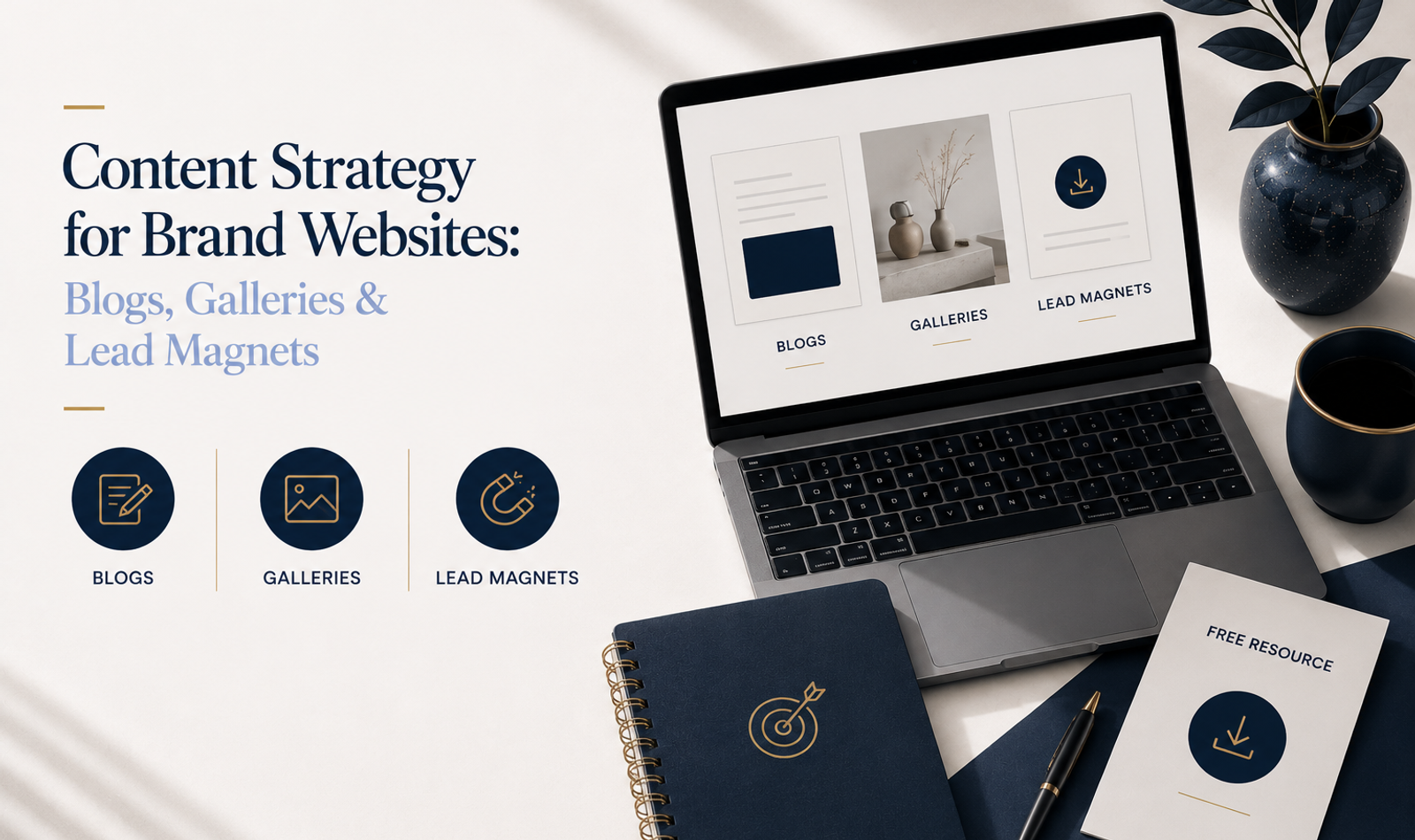
Content Strategy for Brand Websites: Blogs, Galleries & Lead Magnets
A brand website should not remain a static digital brochure.
It should continuously help the business attract the right audience, answer customer questions, demonstrate expertise, show proof of work and convert interest into qualified enquiries.
Many businesses invest heavily in website design but pay less attention to what happens after the site goes live. The homepage looks polished, the service pages explain the offer and the contact page is ready, but the website stops growing because there is no ongoing content strategy.
This creates a missed opportunity.
Potential customers are constantly searching for information before making decisions. They want to understand their options, compare providers, see previous work, evaluate expertise and find evidence that the brand can deliver what it promises.
A strong website content strategy answers these needs.
Blogs can attract relevant search demand and establish expertise. Galleries can provide visual evidence of capability and experience. Lead magnets can turn anonymous visitors into identifiable prospects who can be nurtured towards an enquiry or purchase.
Together, these assets transform a website from a collection of pages into a connected marketing system.
For premium, luxury, hospitality, lifestyle, event, real estate and service-led businesses, this is particularly important. Customers often require several interactions before they are ready to contact a brand. They may discover an article through Google, explore a project gallery, visit a service page, download a planning guide and return later to request a consultation.
A well-planned website development and digital marketing strategy should therefore consider content as part of the website architecture from the beginning.
This guide explains how to build a website content strategy using blogs, galleries and lead magnets to improve search visibility, authority, customer trust and qualified lead generation in 2026.
What Is a Website Content Strategy?
A website content strategy is a structured plan for deciding what content a brand should create, who the content is designed for, why it should exist and how it contributes to business goals.
It goes beyond deciding what to publish on a blog.
A complete website content strategy may include:
- service pages;
- product pages;
- blog articles;
- case studies;
- project galleries;
- FAQs;
- guides;
- reports;
- downloadable resources;
- landing pages;
- customer stories;
- founder insights;
- comparison content;
- location pages;
- videos; and
- lead magnets.
Each content type should have a purpose.
Some content creates discovery.
Some explains expertise.
Some builds credibility.
Some provides proof.
Some helps customers compare options.
Some creates conversion.
The strongest websites connect these different functions instead of treating every page as an isolated asset.
Why Brand Websites Need an Ongoing Content Strategy
A website launch is not the end of digital marketing.
It is the beginning.
Customer questions change. Search behaviour changes. New services are introduced. Projects are completed. New locations are entered. Competitors publish new information. Search engines discover new pages, and AI-assisted discovery systems increasingly depend on clear, useful and well-structured information.
A website that is never updated can gradually become less useful.
An ongoing content strategy gives the website reasons to keep growing.
A creative agency, for example, can continuously demonstrate expertise through articles about branding, digital marketing, events, PR, websites and AI content.
A hospitality business can publish destination guides, guest-experience information, property stories and travel planning resources.
An interior studio can publish project galleries, material guides, design insights and case studies.
An event business can publish planning guides, destination insights, guest-management resources and behind-the-scenes execution stories.
For brands that operate across experiences and events, the content can also naturally connect customers with relevant events and weddings services rather than depending only on promotional pages.
Content gives customers multiple reasons to discover and trust the brand.
The Three Core Content Assets: Blogs, Galleries and Lead Magnets
Blogs, galleries and lead magnets perform different roles within the website journey.
Blogs create discovery and authority.
They answer questions people are already searching for and help demonstrate knowledge.
Galleries create proof and desire.
They show what the brand has created, delivered or experienced.
Lead magnets create conversion opportunities.
They offer useful value in exchange for an action such as submitting an email address, requesting an audit or beginning a consultation.
A strong website uses all three strategically.
For example:
Search → Blog → Service Page → Gallery/Case Study → Lead Magnet → Enquiry
This creates a more complete journey than sending every visitor directly from an advertisement to a contact form.
Part One: Building a Strong Blog Strategy
Why Blogs Still Matter for Brand Websites in 2026
Blogs remain valuable because customers still search for information before making decisions.
The format has evolved.
Successful blog strategies are no longer based on publishing hundreds of generic keyword articles.
Useful content needs to satisfy a genuine customer need.
A potential wedding client may search for destination planning information.
A founder may search for how to reposition a luxury brand.
A business owner may research technical SEO before choosing a website agency.
A marketing manager may search for PR launch strategies before approaching an agency.
If the brand has genuinely useful content answering these questions, it can enter the customer's consideration journey much earlier.
A strong DTSWorld.in blog therefore works as more than a publishing section. It can become an expanding library around the problems and decisions relevant to potential clients.
Start With Search Intent
Every blog should begin with understanding why someone would search for the topic.
This is called search intent.
Search intent can broadly be divided into informational, commercial, transactional and navigational needs.
Someone searching:
“What are Core Web Vitals?”
is primarily looking for information.
Someone searching:
“Best website development agency for luxury brands”
has stronger commercial intent.
Someone searching:
“Luxury wedding planning services Mumbai”
may be much closer to taking action.
A content strategy should address multiple stages of this journey.
Informational articles create discovery and authority.
Commercial articles help customers evaluate solutions.
Service pages capture stronger buying intent.
Case studies and galleries provide proof.
Lead magnets create another path for visitors who are interested but not ready to enquire.
Create Content Around Customer Questions
One of the most effective ways to develop blog topics is to listen to customers.
What questions do customers ask during calls?
What objections appear during sales conversations?
What information do clients repeatedly request?
What do customers misunderstand about the service?
What do they compare before purchasing?
These questions can become content.
For example, a brand offering guest management services could create articles about RSVP management, airport coordination, hotel rooming lists, guest communication, hospitality desks and destination-wedding logistics.
These topics are useful because they reflect real planning concerns.
The best content strategies often begin with customer conversations rather than keyword tools alone.
Build Topic Clusters Instead of Random Articles
A website becomes stronger when related articles support a larger topic.
This is often described as a topic cluster.
Instead of publishing unrelated articles every week, the brand can develop several connected pieces around an important area of expertise.
For example, a website and digital marketing cluster might include:
- website strategy;
- technical SEO;
- Core Web Vitals;
- website security;
- conversion funnels;
- content strategy;
- local SEO;
- landing pages;
- AI-search optimisation; and
- website analytics.
Each article can link naturally to other useful resources.
Someone reading about content strategy may also need to understand Technical SEO Foundations: Speed, Mobile & Core Web Vitals 2026.
These connections help readers explore the subject more deeply and create a clearer website structure.
Informational Content vs Commercial Content
A website needs both.
Informational content answers questions without immediately pushing the customer to buy.
Commercial content helps customers evaluate a service, solution or provider.
An article titled:
“How Does Celebrity Management Work for Brand Events?”
may begin as educational content.
From there, a reader with an actual requirement can naturally explore the brand's celebrity management services.
This transition should feel useful rather than forced.
The blog solves the question.
The service page explains how the brand can solve the problem.
Write for People First
SEO matters, but content should still sound natural.
A common mistake is repeating the same keyword unnecessarily throughout an article.
This can make the writing awkward and reduce credibility.
Instead, explain the topic properly.
Use clear headings.
Answer questions directly.
Include relevant examples.
Explain terminology when needed.
Demonstrate genuine experience.
A well-written article should still be useful if the reader never arrived through a search engine.
That is a strong test of content quality.
Write for Search and AI Discovery
People increasingly discover information through multiple systems.
Traditional search engines remain important, but customers may also use AI-assisted search tools and conversational interfaces to research services, compare options and understand complex topics.
This makes clarity increasingly valuable.
Content should use descriptive headings and direct explanations.
Important questions should have clear answers.
Services, locations, people and topics should be named accurately.
Articles should avoid unnecessary ambiguity.
Original examples, practical frameworks and first-hand expertise can also differentiate the content from generic summaries.
For businesses building a larger digital presence, this should form part of an integrated website development and marketing approach, not a separate exercise carried out after content has already been published.
Use Internal Links Strategically
Internal links connect related pages within the website.
They help readers discover additional information and help search engines understand relationships between pages.
However, more links do not automatically mean better SEO.
Internal links should be relevant.
For example, an article about website content can naturally link to website development, SEO, PR, events or AI video when those subjects are genuinely discussed.
The anchor text should also explain what the reader will find.
Avoid repeatedly using generic phrases such as “click here.”
A strong internal-linking structure creates pathways between:
Blogs → Service Pages → Work → Related Blogs → Contact
The objective is to help both discovery and decision-making.
Update Existing Blogs
Content strategy should not focus only on publishing new articles.
Existing content can become outdated.
Statistics change.
Platform features change.
Search behaviour evolves.
New services become available.
Internal pages move.
Examples become less relevant.
A content audit can identify articles that need updating, expanding, consolidating or removing.
An older article that already has search visibility may sometimes benefit more from a thoughtful update than the website would gain from another similar new article.
Measure Blog Performance
Blog performance should not be measured only through page views.
Useful metrics include:
- organic impressions;
- search clicks;
- relevant keyword visibility;
- engaged sessions;
- time on page;
- internal link clicks;
- service-page visits;
- lead-magnet conversions;
- enquiries; and
- assisted conversions.
A blog with 500 highly relevant readers may create more business value than an article with 10,000 unrelated visitors.
The question should always be:
Is this content attracting and influencing the audience the brand actually wants?
Part Two: Galleries as Proof and Brand Storytelling
Why Galleries Matter
For visual and experience-led businesses, customers often need to see proof before making contact.
This is particularly true for:
- events;
- weddings;
- interiors;
- architecture;
- fashion;
- hospitality;
- luxury products;
- photography;
- real estate; and
- creative agencies.
A gallery allows customers to evaluate taste, execution quality, scale and consistency.
But a gallery should not simply be a grid of attractive images.
A stronger gallery tells a story.
Turn Galleries Into Project Stories
Instead of uploading 30 photographs with no context, explain the project.
A project gallery might include:
Project: Luxury Destination Wedding
Location: Udaipur
Objective: Create an intimate three-day celebration
Scope: Guest management, décor coordination, entertainment and hospitality
Challenge: Coordinating multiple venues and arriving guests
Approach: Centralised itinerary and hospitality management
Visuals: Arrival, décor, performances, dining and guest experience
Outcome: Seamless multi-day celebration
Now the images demonstrate capability rather than simply aesthetics.
This is particularly useful for businesses showcasing selected work, because potential clients can understand not only what the final result looked like but also what the team contributed.
Galleries Should Demonstrate Expertise
Visual proof becomes more powerful when it is accompanied by context.
For example, an event gallery can explain:
- guest count;
- venue;
- event format;
- creative concept;
- production challenge;
- artist management;
- hospitality;
- execution approach; and
- final outcome.
A website gallery can explain:
- original problem;
- design approach;
- user journey;
- technical requirements;
- SEO considerations;
- conversion strategy; and
- measurable improvement.
This transforms a portfolio from “look what we made” into “understand how we solve problems.”
That difference matters for high-value services.
Use Case Studies for Complex Projects
Some projects deserve more than a gallery.
A detailed case study can combine visuals with strategy, process and results.
A useful case-study structure is:
Challenge → Insight → Strategy → Execution → Result
For example, a brand launch case study could explain the positioning challenge, campaign idea, PR strategy, creator activation, event execution, website journey and results.
Readers interested in launch planning can then move into a broader strategic resource such as the 90-Day Launch or Relaunch Roadmap.
Case studies are particularly effective for service businesses because customers are often buying expertise rather than a physical product.
Galleries for Luxury Brands
Luxury galleries require restraint.
More photographs do not necessarily create more impact.
The strongest visuals should receive space.
Image quality, composition, sequencing and consistency matter.
Luxury galleries should also avoid making every project look identical.
Customers should see a recognisable standard while still understanding the individuality of each project.
For brands working to create a more distinctive premium identity, galleries should reflect the principles established through a clear luxury brand positioning strategy.
Visual proof and brand positioning should reinforce each other.
Optimise Gallery Images
High-resolution photography can make a website visually impressive, but oversized image files can make it slow.
Images should therefore be prepared for web delivery.
Consider:
- appropriate dimensions;
- modern image formats where suitable;
- compression;
- responsive images;
- lazy loading where appropriate;
- descriptive filenames; and
- useful alt text.
Alt text should describe the image meaningfully when appropriate rather than stuffing keywords.
For example:
Weak alt text: luxury event best wedding company
Better alt text: Floral dinner setup at a luxury destination wedding in Udaipur
Performance also matters. Heavy galleries should be built with the technical principles discussed in the Core Web Vitals and technical SEO guide.
Use Video Inside Galleries Carefully
Video can add another level of proof.
A project page can include:
- campaign films;
- event recaps;
- testimonials;
- venue walkthroughs;
- behind-the-scenes footage;
- product demonstrations; or
- before-and-after videos.
Brands can also incorporate professionally produced AI video and VFX content where it supports the story.
However, AI concept visuals and real project documentation should remain clearly distinguishable.
If a visual is a concept rather than actual execution, the presentation should not create a misleading impression.
Proof-based content depends on trust.
Part Three: Lead Magnets for Website Conversion
What Is a Lead Magnet?
A lead magnet is a useful resource offered to a visitor in exchange for an action, usually providing contact information such as an email address.
The resource gives the visitor immediate value.
The business gains permission to continue the relationship.
Common lead magnets include:
- checklists;
- templates;
- guides;
- reports;
- planning documents;
- worksheets;
- audits;
- calculators;
- assessments;
- webinars; and
- downloadable frameworks.
The best lead magnets solve a specific problem.
They should not exist merely because the marketing team wants email addresses.
Why Lead Magnets Work
Most website visitors are not ready to contact a business immediately.
This is particularly true for high-consideration purchases.
Someone planning a destination wedding may research for months.
A business considering a new website may compare several agencies.
A founder exploring PR may first want to understand how media positioning works.
A luxury brand considering a repositioning project may need internal discussions before hiring a partner.
If the website offers only two choices—
Enquire now or leave—
many potentially valuable visitors disappear.
A lead magnet creates a middle step.
Choose Lead Magnets Based on Customer Intent
A lead magnet should be closely related to what the customer is trying to achieve.
For an event company:
Destination Wedding Planning Checklist
For a website agency:
Website Conversion Audit Checklist
For a PR agency:
90-Day Brand Launch PR Checklist
For a luxury brand consultant:
Brand Positioning Worksheet
For an SEO agency:
Technical SEO Audit Checklist
For guest management:
Destination Event Guest Management Checklist
The closer the resource is to the customer's actual problem, the more useful the resulting lead is likely to be.
Use Guides for Complex Decisions
Guides work well when the customer needs education before purchasing.
A detailed guide might explain:
How to Plan a Luxury Brand Launch
or:
How to Prepare Your Website for SEO and Lead Generation
The guide should provide genuine value.
If every page simply tells readers to contact the company, it will feel like a brochure rather than a useful resource.
Teach first.
Then give the customer a logical next step.
Use Checklists for Action-Oriented Customers
Checklists are effective because they simplify complicated tasks.
For example:
Website Launch Checklist
- analytics installed;
- forms tested;
- mobile pages checked;
- metadata reviewed;
- redirects tested;
- sitemap submitted;
- backups configured;
- conversion tracking enabled.
A customer can use the checklist immediately.
At the same time, the list may reveal areas where professional support is required.
That creates a natural commercial opportunity without forcing the sale.
Templates and Frameworks
Templates can create particularly strong lead magnets for business audiences.
Examples include:
Annual Brand Strategy Template
Content Calendar Template
PR Campaign Planning Template
Event Guest List Framework
Website Content Planning Sheet
Marketing Funnel Worksheet
Brand Positioning Framework
These resources help prospects begin solving a problem while also demonstrating how the brand thinks.
Audits and Assessments
Not every lead magnet needs to be downloadable.
An audit can be a powerful lead-generation tool.
Examples include:
Free Website Performance Audit
Brand Positioning Assessment
SEO Health Check
Social Media Content Review
Event Planning Consultation
The advantage of an audit is that it creates a more direct relationship between the prospect and the business.
However, the promise must be realistic.
If the brand advertises a personalised audit, it should provide genuine personalised value rather than automatically sending a generic sales PDF.
Build Dedicated Lead-Magnet Landing Pages
Important lead magnets should have their own landing pages.
The page should explain:
What the resource is
Who it is for
What problem it solves
What the visitor will receive
Why it is useful
What information is required
The CTA should be clear.
For example:
Download the Website Conversion Checklist
is stronger than:
Submit
The landing page should also work properly on mobile.
Keep Lead Forms Focused
Every additional field creates friction.
If the visitor is downloading a simple checklist, asking for name, company, phone number, city, turnover, budget, industry and project timeline may be excessive.
Ask only for information that is genuinely useful at that stage.
A high-value consultation form may reasonably require more information.
A simple downloadable resource usually requires less.
The amount of information requested should match the value being offered.
Connect Lead Magnets With Blogs
This is where a content strategy becomes a funnel.
Suppose someone reads:
Technical SEO Foundations: Speed, Mobile & Core Web Vitals 2026
At the end or within the article, the website could offer:
Download the 25-Point Technical SEO Checklist
Someone reading:
How to Plan a Luxury Destination Wedding
could receive:
Download the Destination Wedding Planning Checklist
Someone reading:
Brand Positioning Workshop: Defining Your Luxury Identity in 2026
could receive:
Download the Luxury Brand Positioning Worksheet
The lead magnet becomes the natural next step after the article.
Building a Complete Website Content Funnel
Connect Discovery, Proof and Conversion
A high-performing website should create pathways.
Consider this example:
Google Search
↓
SEO Blog
↓
Relevant Service Page
↓
Project Gallery / Case Study
↓
Lead Magnet
↓
Email or CRM Follow-Up
↓
Consultation
↓
Proposal
↓
Customer
Not every visitor will follow this exact path.
Some may discover the brand through social media.
Others may arrive through PR.
Others may come through referrals.
The principle remains the same: every major content asset should help the visitor understand what to do next.
This is the foundation of building conversion-focused marketing funnels on your site.
Use PR to Amplify Website Content
Website content should not exist in isolation.
PR can increase its reach and credibility.
A brand that publishes an original industry report can pitch its findings to journalists.
A founder who writes a strong perspective article can use the topic for expert commentary.
A case study can support award submissions and media stories.
A trend report can become a press angle.
A coordinated PR and media marketing strategy can therefore amplify content that originally lives on the website.
This creates a useful cycle:
Expertise → Website Content → PR → Backlinks/Visibility → Website Discovery → Enquiries
Repurpose Website Content Across Social Media
A 3,000-word blog does not need to remain only a blog.
One strong article can become:
- an Instagram carousel;
- LinkedIn posts;
- short-form videos;
- an infographic;
- an email;
- FAQ content;
- founder commentary;
- a webinar topic; or
- a downloadable checklist.
This improves the return on the original research.
The website remains the central knowledge asset, while other channels distribute smaller pieces of that knowledge.
Use Content Across the Customer Journey
Different stages require different content.
Awareness
Use blogs, guides, educational videos and PR.
Consideration
Use service pages, comparison content, case studies and galleries.
Decision
Use testimonials, FAQs, consultations, proposals and strong proof.
Conversion
Use clear forms, booking flows and calls to action.
Retention
Use customer resources, newsletters, guides and ongoing communication.
Content strategy should therefore extend beyond attracting new website traffic.
It should support the complete relationship.
Content Strategy for Different Brand Categories
Luxury Brands
Luxury brands should avoid creating content purely for volume.
The content should reflect taste, authority and expertise.
Long-form editorial stories, craftsmanship features, founder perspectives, carefully selected galleries and premium guides may work better than constant generic publishing.
Conversion should also feel considered.
Aggressive pop-ups and repeated sales messages can conflict with a luxury experience.
The website should guide rather than chase.
Event and Wedding Brands
Event and wedding businesses have enormous content opportunities.
Potential topics include:
- destination planning;
- guest management;
- entertainment;
- celebrity bookings;
- décor;
- venue selection;
- invitations;
- event technology;
- luxury hospitality;
- wedding trends;
- event PR; and
- post-event content.
These articles can connect naturally with events and weddings expertise, galleries and project case studies.
Because events are highly visual, strong photography and video should play a major role.
Hospitality Brands
Hospitality websites can create content around destinations, local experiences, dining, wellness, celebrations, seasonal travel and guest planning.
Instead of publishing only promotional offers, the property can become a useful source of destination information.
This attracts visitors earlier in their travel-planning journey.
Galleries then help customers imagine the experience.
Lead magnets could include destination guides, wedding-planning resources or curated itineraries.
Real Estate Brands
Real estate content can address questions around location, architecture, amenities, lifestyle, buying process, investment considerations and neighbourhood infrastructure.
Project galleries should show more than renders.
They can explain design philosophy, planning, materials and lifestyle benefits.
Lead magnets could include:
- buyer guides;
- location reports;
- floor-plan collections;
- investment checklists; or
- private viewing requests.
Content can help customers make high-consideration decisions with greater confidence.
Creative and Digital Agencies
Agencies should use their website to demonstrate thinking, not only output.
Blogs can explain strategy.
Case studies can show problem-solving.
Galleries can demonstrate creative quality.
Frameworks and templates can generate leads.
The website should make potential clients think:
These people understand the problem I am trying to solve.
That perception is often more valuable than simply saying the agency is “creative” or “innovative.”
Build a 90-Day Website Content Plan
A practical content strategy does not need to begin with hundreds of pages.
Start with 90 days.
Month One: Foundation
Audit existing website content.
Identify priority services.
Research customer questions.
Create topic clusters.
Review existing galleries.
Choose potential lead magnets.
Map internal links.
Month Two: Production
Publish priority blogs.
Build or improve project galleries.
Create one high-value lead magnet.
Develop its landing page.
Add contextual CTAs.
Optimise existing content.
Month Three: Distribution and Optimisation
Promote content through social media, email and PR.
Monitor search visibility.
Review engagement.
Track lead-magnet downloads.
Analyse journeys into service pages.
Improve CTAs and internal links.
This approach also aligns well with a broader 90-day launch or relaunch strategy when the website itself is part of a new brand launch.
Measure Website Content ROI
Content should eventually contribute to measurable business value.
This does not mean every blog must directly produce a sale.
Some content assists discovery.
Some creates trust.
Some supports sales conversations.
Some attracts backlinks.
Some produces leads directly.
Useful measurements include:
Visibility: impressions, keyword visibility and organic traffic.
Engagement: time on page, scroll depth, video engagement and internal clicks.
Authority: backlinks, media citations and branded searches.
Lead generation: downloads, forms, consultation requests and calls.
Commercial impact: qualified leads, assisted conversions, proposals and revenue.
The measurement system should connect content with the wider business roadmap. A structured approach such as measuring and adjusting brand roadmap performance can help teams distinguish useful growth signals from vanity metrics.
Maintain the Content System
A growing content website also requires technical maintenance.
More blogs mean more internal links.
More galleries mean more images and videos.
More lead magnets mean more forms, integrations and customer data.
Over time, links can break, forms can fail, pages can slow down and old information can remain live.
Content growth should therefore be supported by proper website security and maintenance for e-commerce and booking sites, with the same principles applied to lead-generation websites where relevant.
Content strategy and technical website management should grow together.
Common Website Content Strategy Mistakes
One common mistake is publishing without a clear purpose.
The team produces blogs because “SEO needs blogs,” but nobody understands which audience or business goal they support.
Another mistake is creating only promotional content.
Customers do not constantly want to read about how great the company is.
They want answers.
Another mistake is producing galleries without context.
Beautiful images may create interest, but they do not always explain capability.
Brands also create weak lead magnets that provide little value.
A three-page PDF containing generic information will rarely create meaningful trust.
Another mistake is generating large volumes of low-quality AI content without expert review, original insight or brand perspective.
Speed should not replace usefulness.
Finally, brands often fail to connect their content.
Blogs, service pages, galleries and lead magnets exist separately instead of guiding customers through a journey.
A content strategy should solve this fragmentation.
Website Content Strategy Checklist
Before publishing content, ask:
Audience: Who is this for?
Intent: What is the visitor trying to understand or accomplish?
Purpose: Is the content designed for discovery, authority, proof or conversion?
Value: Does it genuinely answer the customer's question?
Expertise: Have we added something useful beyond generic information?
Structure: Is the content easy to understand?
SEO: Are title, headings, metadata and internal links appropriate?
Visuals: Do images or videos strengthen the message?
CTA: What should the reader logically do next?
Measurement: How will we know whether the content is useful?
If these questions have clear answers, the content has a stronger reason to exist.
Frequently Asked Questions
What is a content strategy for a brand website?
A website content strategy defines what content a brand should create, who it is designed for, how it should be structured and how it contributes to visibility, authority, customer trust and conversion.
Do blogs still help SEO in 2026?
Yes. Useful and original blogs can help websites address relevant search demand, develop topical depth and create pathways to commercial pages. Publishing large amounts of generic content simply for keywords, however, is not a strong strategy.
How often should a business publish blogs?
There is no universal publishing frequency. The right schedule depends on resources, competition, customer demand and content quality. Consistently publishing useful content is generally more valuable than producing large volumes of weak articles.
What should a website gallery include?
A strong gallery should include carefully selected visuals and enough context to explain the project, objective, approach, services and outcome where appropriate.
What is a lead magnet?
A lead magnet is a useful resource or experience offered to a visitor in exchange for an action, commonly providing contact information or beginning an enquiry.
What are good lead magnets for service businesses?
Useful options include checklists, guides, templates, audits, assessments, planning frameworks, reports and calculators. The best option depends on the customer's problem and stage of decision-making.
How do blogs generate leads?
Blogs attract visitors who are researching relevant topics. Strategic internal links, service pages, case studies, lead magnets and CTAs can then help interested readers move further into the customer journey.
How should luxury brands approach website content?
Luxury brands should prioritise quality, originality, expertise, visual storytelling and restraint. Content should educate and inspire without making the digital experience feel excessively promotional.
How can galleries improve conversions?
Galleries provide visual evidence of capability. When supported by project context, they can reduce uncertainty and help potential customers understand the quality, style and scale of previous work.
How can website content support AI-search visibility?
Clear answers, descriptive headings, strong subject coverage, accurate entities, useful FAQs, original expertise and logical website structure can make content easier for search and AI-assisted systems to understand.
How should website content performance be measured?
Brands should measure relevant search visibility, qualified traffic, engagement, internal journeys, lead-magnet conversions, enquiries, assisted conversions and lead quality rather than relying only on page views.
Conclusion
A strong brand website should do more than describe the business.
It should continuously create discovery, demonstrate expertise, provide proof and generate opportunities for conversion.
Blogs, galleries and lead magnets each play a different role.
Blogs help the brand get discovered and answer customer questions.
Galleries help customers see proof and understand capability.
Lead magnets help transform interest into an ongoing relationship.
The greatest value appears when these assets are connected.
A potential customer may discover the brand through an educational article, explore a related service, view a project gallery, download a useful resource and return later to request a consultation.
That is a content system.
It is very different from simply publishing blogs every week.
For premium and growing brands, the objective should not be to create the largest possible content library.
It should be to create the most useful content ecosystem for the audience the business actually wants.
Every article should have a purpose.
Every gallery should provide proof.
Every lead magnet should offer genuine value.
Every internal link should help the visitor move logically.
Every CTA should reflect the customer's stage of intent.
And every content asset should contribute to a clearer, stronger and more useful brand website.
Double Trouble Studio helps premium, luxury, hospitality, lifestyle, event, real estate and service-led brands build content-led digital ecosystems through website strategy, development, SEO, blogs, visual storytelling, conversion funnels, PR, social media and AI-led creative content.
To build a website content strategy designed for stronger visibility, authority and qualified lead generation, connect with Double Trouble Studio.
📩 info@dtsworld.in 📞 +91 80000 06021 📍 Andheri (West), Mumbai
Need this for your brand?
Let DTS build your next campaign.
From PR, celebrity management and events to websites, social media, SEO and AI video production — Double Trouble Studio helps brands grow with strategy and execution.
Discuss Your Requirement →