How Long Does SEO Take to Work? Rankings, Traffic & ROI Timeline Explained
One of the most common questions businesses ask before investing in search engine optimization is: How long does SEO take to work? Whether you are launching a new website, trying to improve Google rankings, or looking to generate more organic leads, understanding the SEO timeline is essential for setting realistic expectations.
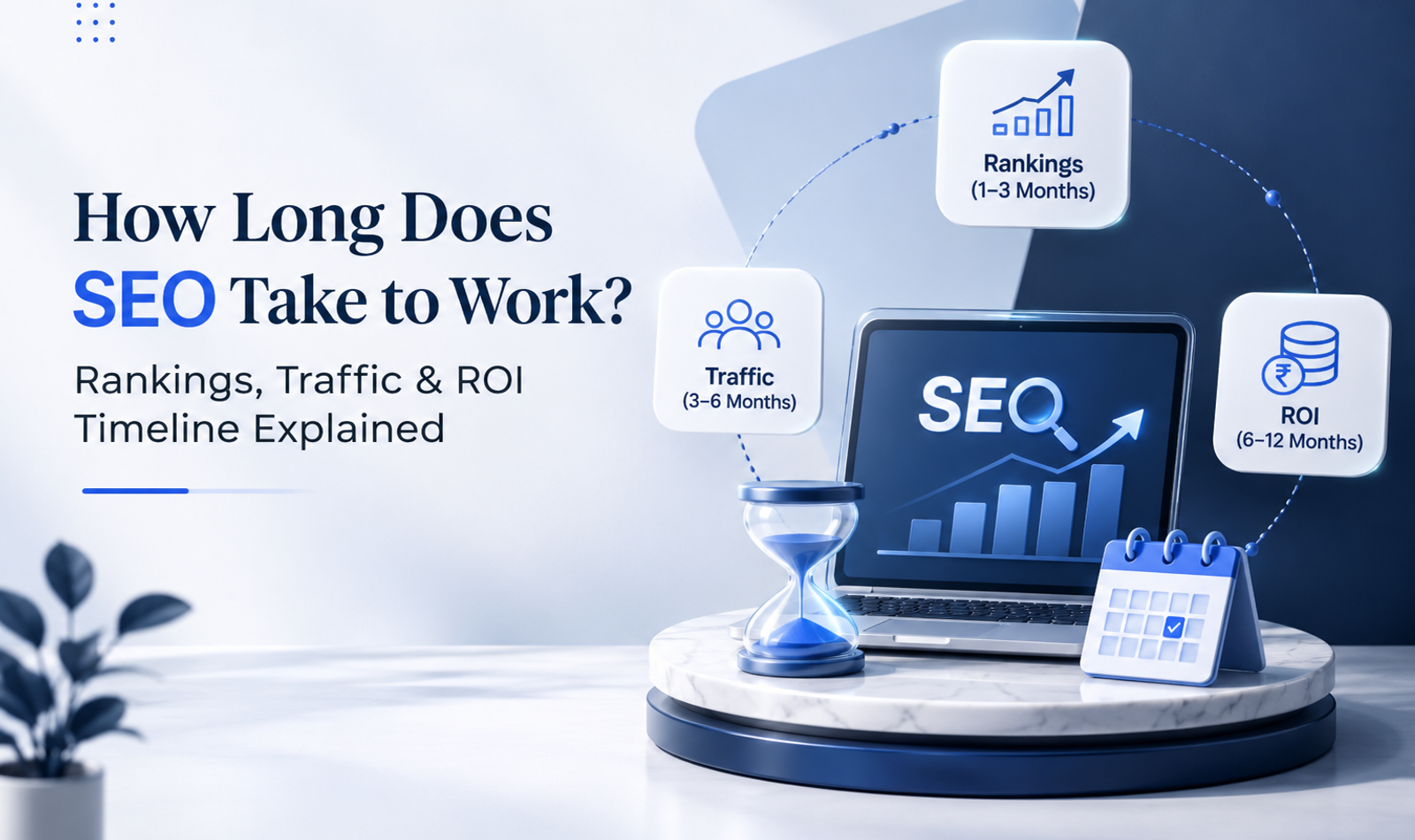
Generally, SEO may begin showing measurable improvements within 3 to 6 months, while more substantial growth in organic traffic, competitive keyword rankings, and business returns often takes 6 to 12 months or longer. However, these timelines are estimates rather than guarantees. The actual results depend on your website's current condition, industry competition, keyword difficulty, technical performance, content quality, and the consistency of your SEO strategy.
Unlike paid advertising, search engine optimization focuses on building sustainable organic visibility. It involves improving how search engines discover, understand, and evaluate your website while ensuring that visitors find useful, relevant information.
If you are new to the process, understanding what SEO is and how search engine optimization works provides a useful foundation before exploring how long measurable results may take.
In this guide, we explain the SEO results timeline, how long it may take to rank on Google, when organic traffic typically begins improving, and how businesses can measure the return on their SEO investment.
How Long Does SEO Take to Show Results?
SEO does not have a fixed timeline because every website starts from a different position. A well-established website with strong technical performance and relevant existing content may achieve improvements faster than a newly launched website with limited content and no organic search history.
For many businesses, the first three months focus primarily on building a foundation. This includes conducting an SEO audit, identifying relevant keywords, improving website structure, fixing technical issues, and optimizing existing pages. Early improvements may appear in Google Search Console through increased impressions, better indexing, or movement in keyword positions.
Between three and six months, some websites begin experiencing more noticeable changes in organic visibility. Optimized pages may start ranking for additional search queries, and relevant content may attract more visitors. However, competitive commercial keywords can require considerably more time.
Between six and twelve months, businesses with consistent SEO execution may see stronger search visibility, more qualified organic traffic, and increased opportunities for lead generation. This is also when there may be enough data to evaluate whether SEO is contributing to meaningful business outcomes.
It is important to understand that SEO progress is rarely linear. Rankings can fluctuate, traffic may increase or decrease between months, and some pages may perform better than others. Rather than expecting immediate results, businesses should evaluate long-term performance trends.
SEO Timeline: What Happens During the First 12 Months?
Month 1: SEO Audit, Keyword Research, and Website Analysis
The first month of an SEO campaign is usually dedicated to understanding the website's existing performance and developing a structured optimization strategy.
This process typically begins with a technical website audit to identify issues affecting crawling, indexing, page performance, internal linking, and overall website accessibility. SEO specialists also evaluate existing keyword rankings, competitors, organic traffic sources, and important landing pages.
Keyword research plays a particularly important role during this stage. Targeting highly competitive keywords without considering user intent or website authority can delay meaningful results. Businesses should identify a combination of informational, commercial, and relevant long-tail keywords that align with their services and customer needs.
A well-planned SEO keyword research strategy helps businesses prioritize search queries that have realistic ranking opportunities and the potential to generate qualified traffic.
By the end of the first month, the primary outcome should be a clear SEO roadmap, reliable performance benchmarks, and a prioritized list of technical and content improvements. Significant ranking growth is possible in some cases but should not be expected as a standard result.
Months 2–3: Technical SEO Improvements and Content Optimization
During the second and third months, the focus shifts from research to implementation.
Technical SEO improvements may include fixing broken links, resolving indexing problems, optimizing canonical tags, improving mobile usability, strengthening website architecture, and addressing performance issues.
These changes help search engines access and interpret website content more effectively. However, resolving a technical issue does not automatically guarantee higher rankings.
Businesses should also improve existing website content by optimizing page titles, headings, descriptions, internal links, and content relevance. Service pages should clearly explain what the business offers, who the services are for, and why potential customers should consider them.
Following a structured technical SEO website optimization approach is especially important when crawling, indexing, or website performance problems are preventing search engines from properly accessing valuable pages.
At this stage, early improvements may include additional pages being indexed, increased search impressions, and better visibility for lower-competition keywords.
Months 3–6: Keyword Ranking Improvements and Organic Traffic Growth
Between the third and sixth months, SEO campaigns may begin producing more noticeable results, particularly when the website already has an established foundation.
Search engines may have had more opportunities to crawl updated pages, discover new content, and evaluate how well the website answers relevant search queries.
During this period, some businesses observe improvements in keyword positions, a wider range of search queries generating impressions, and gradual increases in organic website visitors.
Content optimization remains important. Improving existing pages, addressing content gaps, and creating useful resources that answer customer questions can strengthen overall search relevance.
For example, a business offering professional services may benefit from optimizing individual service pages around specific customer needs rather than targeting only broad industry keywords. Clear headings, relevant content, descriptive URLs, and well-structured internal links make pages easier for users and search engines to understand.
Implementing an effective on-page SEO checklist for higher rankings helps ensure that important pages are optimized consistently.
Although traffic may begin increasing during this phase, businesses should avoid assuming that every keyword will reach the first page of Google within six months.
Months 6–9: Content Authority, Backlinks, and Lead Generation
After several months of consistent optimization, businesses may begin developing stronger topical coverage and more competitive organic search visibility.
At this stage, SEO should move beyond individual keyword optimization and focus on building connected, useful content around important business topics.
For example, an SEO service provider can develop comprehensive resources covering keyword research, technical SEO, on-page optimization, organic traffic, and return on investment. These related articles can help visitors explore a subject in greater depth while allowing the website to build a more organized content structure.
A well-developed SEO content strategy using topic clusters and topical authority can support this process by connecting related articles with relevant internal links.
Off-page SEO may also become more important as businesses compete for difficult search terms. Relevant editorial backlinks, credible brand mentions, and trustworthy third-party references can help strengthen a website's broader online presence.
However, effective link acquisition should focus on relevance and quality rather than purchasing large quantities of low-quality backlinks. Businesses can explore a sustainable link-building and backlink strategy for SEO to understand how useful content and credible references contribute to long-term visibility.
By this stage, businesses should begin evaluating not only traffic growth but also whether organic visitors are becoming qualified leads, enquiries, or customers.
Months 9–12: Stronger Organic Visibility and SEO ROI Evaluation
Between nine and twelve months, businesses that have implemented consistent SEO strategies may have enough performance data to assess longer-term trends.
Important commercial pages may be attracting more relevant traffic, informational articles may be appearing for a wider range of searches, and organic lead generation may become easier to evaluate.
However, the most important question is no longer simply whether keyword rankings have improved. Businesses should determine whether their SEO investment is contributing to measurable commercial outcomes.
This includes evaluating organic conversions, lead quality, customer acquisition costs, and revenue attributed to organic search.
A website that attracts 5,000 relevant monthly visitors and generates qualified enquiries may provide greater business value than a website receiving 20,000 visitors who have little interest in its products or services.
The objective of SEO should therefore be sustainable, commercially meaningful growth rather than traffic numbers alone.
How Long Does SEO Take to Rank on Google?
The time required to rank on Google depends heavily on keyword competition, search intent, website quality, and the strength of competing pages.
Some lower-competition, highly specific search queries may begin generating visibility within weeks or months. More competitive commercial keywords can require sustained optimization over a considerably longer period.
For example, a newly launched website targeting a broad search term such as "digital marketing agency" may face competition from established businesses with years of published content, relevant backlinks, and strong online reputations.
In contrast, a specific query describing a particular service or customer requirement may provide a more realistic early opportunity.
Businesses should also understand that ranking improvements do not always happen in a predictable sequence. A page may first appear for several long-tail keywords before gaining visibility for broader searches. Some keywords may move between positions, while others may remain relatively unchanged despite ongoing optimization.
Google does not guarantee first-page rankings within any particular timeframe. For that reason, businesses should treat guaranteed ranking promises with caution.
How Long Does SEO Take to Increase Organic Traffic?
Organic traffic growth often takes time because search visibility must translate into actual clicks.
A website may begin ranking for additional keywords without experiencing a significant increase in visitors, particularly when those keywords have limited search volume or when the page appears far below the highest search results.
Similarly, improving a keyword from position 30 to position 12 may represent meaningful ranking progress while producing only a modest increase in clicks.
Organic traffic growth depends on several factors, including keyword search demand, ranking positions, click-through rates, seasonal patterns, search result features, and the relevance of website content.
Businesses should monitor both Google Search Console impressions and clicks. Impressions indicate how frequently pages appear in eligible search results, while clicks provide a clearer indication of how often users visit the website from Google Search.
A gradual increase in impressions can be an early signal of broader search visibility, but it should not be confused with an increase in actual visitors or business revenue.
For businesses serving customers in specific geographical areas, location-based searches can provide additional organic opportunities. A company operating in Mumbai, for example, may benefit from relevant location-specific landing pages, an optimized Google Business Profile, and accurate business information.
A focused local SEO strategy for Mumbai businesses can help explain how geographical relevance and local search optimization support visibility among nearby customers.
What Factors Affect How Quickly SEO Works?
1. Website Age and Existing Search Presence
Established websites may already have useful content, relevant backlinks, and historical search visibility. These advantages can make it easier to identify optimization opportunities.
New websites often require additional time to develop content coverage, attract relevant references, and establish a consistent organic search presence.
However, website age alone does not guarantee stronger rankings.
2. Keyword Competition
The level of competition for a keyword directly affects how difficult it may be to achieve prominent visibility.
Highly competitive industries often require stronger content, more comprehensive optimization, and greater investment than niche markets with fewer established competitors.
A realistic SEO strategy should prioritize keywords based on search intent, competition, relevance, and potential business value.
3. Technical Website Performance
Technical problems can significantly delay SEO progress.
Pages blocked from indexing, incorrect canonical configurations, inaccessible navigation, broken links, and poor website architecture can prevent valuable content from performing as expected.
Identifying and resolving these issues should be a priority before investing heavily in new content.
4. Content Quality and Relevance
Search engines aim to present useful results that satisfy user queries.
Publishing numerous articles without clear purpose, originality, or relevance does not guarantee stronger rankings.
Businesses should create content that provides meaningful explanations, answers customer questions, and demonstrates appropriate subject knowledge.
5. Backlinks and Online Reputation
Relevant backlinks from trustworthy websites can help search engines discover content and evaluate its broader relevance.
However, manipulative link schemes and unrelated paid links can create unnecessary SEO risks.
A sustainable approach focuses on earning credible references through useful resources, industry relationships, original insights, and legitimate editorial coverage.
6. Consistency of SEO Execution
SEO is not a one-time activity.
Businesses need to monitor performance, update existing pages, resolve technical issues, and adapt to changes in competition and customer search behaviour.
Inconsistent execution can delay progress because important improvements may remain incomplete for extended periods.
SEO vs Google Ads: Which Produces Faster Results?
Businesses frequently compare SEO with Google Ads when deciding how to allocate their marketing budgets.
Google Ads can generate visibility shortly after a campaign is approved and begins serving advertisements. However, the business pays for advertising delivery, and traffic generally decreases when advertising expenditure stops.
SEO works differently. Instead of paying directly for each organic search click, businesses invest in technical optimization, content development, website improvements, and ongoing performance analysis.
SEO typically takes longer to develop substantial traffic, but successfully optimized pages may continue attracting visitors over time without a payment for each individual organic click.
Neither approach guarantees conversions or profitability.
For businesses seeking immediate campaign visibility, paid advertising may provide a more suitable short-term option. For businesses focused on building long-term organic search presence, SEO can form an important part of the acquisition strategy.
Many organizations benefit from combining both methods rather than treating them as competing alternatives.
A detailed comparison of SEO vs Google Ads for business growth can help businesses evaluate which approach better suits their objectives, timelines, and budgets.
How Long Does SEO Take to Generate ROI?
SEO return on investment, or SEO ROI, measures the financial value generated from organic search relative to the amount invested in SEO activities.
Although businesses often evaluate SEO over a six-to-twelve-month period, there is no universal timeframe in which an SEO campaign becomes profitable.
The break-even point depends on the total investment, conversion rate, customer value, profit margins, sales cycle, and the amount of revenue genuinely attributable to organic search.
Consider a business investing ₹30,000 per month in SEO over twelve months.
Its total SEO investment would be ₹3,60,000.
If the business generates ₹6,00,000 in attributable revenue during that period, the simplified revenue-based ROI calculation would be:
SEO ROI (%) = [(Revenue Attributed to SEO − SEO Investment) ÷ SEO Investment] × 100
SEO ROI = [(₹6,00,000 − ₹3,60,000) ÷ ₹3,60,000] × 100 = 66.7%
This example is illustrative and should not be interpreted as an expected return.
More accurate financial analysis should use attributable gross profit or contribution margin rather than revenue alone, while accounting for all relevant SEO costs.
Businesses should also distinguish between an SEO campaign producing organic traffic and generating commercially valuable outcomes. Traffic growth without qualified enquiries, sales, or meaningful customer engagement may offer limited financial value.
Budget planning matters because SEO investment can vary considerably depending on website size, competition, technical requirements, content needs, and campaign scope.
Understanding SEO costs in India can help businesses assess how pricing, scope, and long-term resource allocation affect their overall investment.
How to Measure SEO Results Properly
Measuring SEO success requires more than checking whether a few keywords have reached the first page of Google.
A reliable performance measurement approach should evaluate visibility, traffic, engagement, conversions, and commercial outcomes.
Organic Search Impressions
Google Search Console impressions indicate how frequently a website appears in Google Search results. Increasing impressions can suggest growing visibility, although they do not necessarily mean users are visiting the website.
Keyword Rankings
Tracking relevant keyword positions helps businesses understand whether important pages are becoming more competitive in search results.
However, ranking reports should focus on business-relevant queries rather than large quantities of keywords with little commercial value.
Organic Clicks and Traffic
Google Search Console measures clicks from Google Search, while Google Analytics 4 can provide broader information about organic search sessions and visitor behaviour.
Businesses should evaluate traffic trends over meaningful periods and consider seasonality when making comparisons.
Leads and Conversions
Contact form submissions, phone enquiries, bookings, purchases, and other important actions provide stronger evidence of commercial performance.
Tracking conversion rates also helps determine whether landing pages are effectively turning organic visitors into potential customers.
Revenue and Customer Acquisition
Where sales and CRM data are available, businesses should connect organic enquiries with completed transactions.
This makes it easier to evaluate customer acquisition costs, sales performance, and the contribution of SEO to business growth.
Why Is SEO Taking Longer Than Expected?
SEO campaigns sometimes take longer than anticipated because the underlying strategy does not adequately address the website's most important problems.
A business may publish new articles every week while leaving critical technical issues unresolved. Another may target highly competitive keywords without developing sufficient supporting content or relevant internal links.
In some cases, rankings improve but traffic remains limited because the targeted keywords attract very few searches. Other websites receive visitors but fail to generate leads because their landing pages do not communicate a clear value proposition or provide an effective conversion experience.
Search engine updates, competitor improvements, seasonal changes, and shifting search behaviour can also influence results.
When progress is slower than expected, businesses should review their technical SEO, keyword targeting, content relevance, internal linking, and conversion performance instead of assuming that simply waiting longer will produce better outcomes.
A successful SEO strategy requires continuous evaluation and adjustments based on reliable performance data.
Can SEO Results Be Achieved Faster?
Although there is no guaranteed shortcut to SEO success, certain improvements can create opportunities for earlier progress.
Businesses should begin by identifying pages already receiving relevant search impressions but generating relatively few clicks. Improving page titles, content relevance, and search intent alignment may help these pages perform better.
Resolving critical indexing and crawling issues should also be a priority because inaccessible pages cannot compete effectively in search results.
Updating useful existing content, improving internal linking, and targeting relevant long-tail keywords may offer more practical early opportunities than launching large quantities of new pages targeting extremely competitive searches.
For websites already receiving organic traffic, improving conversion-focused landing pages can sometimes generate additional enquiries without requiring a major increase in visitor numbers.
However, faster improvements should not come at the expense of content quality, user experience, or long-term search compliance.
Is SEO Still Worth Investing In?
SEO remains valuable for businesses that want to improve their organic discoverability, reduce exclusive dependence on paid acquisition channels, and reach customers who actively search for relevant products or services.
However, modern search behaviour is evolving. AI-powered search experiences, featured snippets, local search results, and other search features can affect how users discover information and interact with websites.
Businesses should therefore focus on more than traditional keyword rankings.
Creating genuinely helpful content, strengthening technical accessibility, improving website usability, and establishing credible brand signals can support a broader digital presence.
SEO should also be aligned with business goals. A local service provider may prioritize qualified enquiries and geographical visibility, while an e-commerce business may focus on product discovery, organic sales, and customer acquisition efficiency.
The value of SEO ultimately depends on whether it attracts the right audience and contributes to sustainable business outcomes.
How Double Trouble Studio Can Help Improve Your SEO Performance
Building a successful SEO strategy requires a combination of technical expertise, relevant content, keyword planning, and continuous performance analysis.
At Double Trouble Studio, the focus is on developing structured SEO strategies that improve website accessibility, strengthen relevant search visibility, and support long-term digital growth.
This includes evaluating technical website issues, identifying valuable keyword opportunities, improving content relevance, building effective internal linking structures, and monitoring organic search performance.
Rather than promising overnight rankings, a practical approach prioritizes measurable improvements and realistic business objectives.
Businesses looking to strengthen their search presence can explore Double Trouble Studio's professional SEO services to understand how a structured optimization strategy can support their digital marketing goals.
Frequently Asked Questions (FAQs)
1. How long does SEO take to work for a new website?
SEO for a new website may take approximately 6 to 12 months or longer to develop meaningful organic visibility. New websites often require more time to establish relevant content, resolve technical issues, and earn credible references. Early impressions or rankings may appear sooner, but consistent traffic and lead generation are not guaranteed within a fixed period.
2. Can SEO show results within 30 days?
Yes, certain SEO improvements may become visible within 30 days, particularly after fixing technical issues, updating existing pages, or improving indexing. However, substantial increases in traffic, competitive keyword rankings, and business revenue typically require more time.
3. How long does it take to rank on the first page of Google?
There is no guaranteed timeframe for reaching the first page of Google. Less competitive keywords may offer earlier opportunities, while highly competitive commercial queries can require many months or years of sustained optimization. Some pages may never achieve first-page rankings.
4. Is six months enough for SEO?
Six months can be sufficient to evaluate early and intermediate SEO progress, including improved impressions, keyword visibility, and organic traffic trends. However, it may not be enough to achieve competitive rankings or a positive return on investment, especially for newer websites or highly competitive industries.
5. How long does SEO take to generate organic traffic?
Some websites begin receiving additional organic traffic within the first few months of optimization. More meaningful traffic growth often develops over 3 to 6 months or longer, depending on search demand, ranking positions, competition, and website performance.
6. How long does SEO take to generate leads?
SEO may begin generating qualified leads once relevant pages attract users with commercial intent. For some businesses, this can happen within the first few months. Others may require 6 to 12 months or longer to develop a consistent organic lead generation channel.
7. Why is my website not ranking after three months of SEO?
A website may not show noticeable ranking improvements after three months because of high keyword competition, technical indexing problems, limited content relevance, weak internal linking, or an unrealistic keyword strategy. Reviewing Google Search Console data and conducting a technical and content audit can help identify the primary issues.
8. Does SEO require continuous investment?
SEO generally benefits from ongoing maintenance, content updates, technical monitoring, and performance optimization. Existing pages may continue attracting organic traffic after active work stops, but rankings can change as competitors improve their websites and search engines update their systems.
9. How do I know whether my SEO strategy is working?
SEO performance should be evaluated using relevant keyword rankings, organic impressions, clicks, conversions, qualified leads, and attributable revenue. Google Search Console and Google Analytics 4 can provide useful data, while CRM and sales records help connect organic search activity to business outcomes.
10. How long does it take to get a positive return on SEO investment?
There is no universal break-even timeline for SEO. Positive ROI depends on the total cost of optimization, conversion performance, profit margins, customer value, and revenue attributable to organic search. Businesses should evaluate financial performance over an appropriate period rather than relying exclusively on monthly traffic growth.
Conclusion: How Long Does SEO Really Take?
SEO typically requires 3 to 6 months to begin showing measurable improvements, while meaningful growth in rankings, organic traffic, leads, and return on investment often takes 6 to 12 months or longer. These timelines are useful for planning, but they should never be treated as guaranteed results.
The speed of SEO progress depends on several interconnected factors, including website condition, keyword competition, technical optimization, content relevance, backlink quality, and the consistency of execution.
Businesses that approach SEO as a long-term investment are generally better positioned to evaluate progress realistically, refine their strategies, and focus on meaningful commercial outcomes.
Rather than measuring success only through keyword positions, organizations should prioritize qualified organic traffic, relevant customer enquiries, conversion performance, and sustainable business growth.
At Double Trouble Studio, we believe effective SEO begins with a clear strategy, strong technical foundations, and a consistent commitment to improving search visibility and user experience.
Ready to improve your website's organic search performance? Build a stronger foundation for long-term visibility with a structured, results-focused SEO strategy from Double Trouble Studio.
📩 info@dtsworld.in 📞 +91 80000 06021📍 Andheri West, Mumbai
Need this for your brand?
Let DTS build your next campaign.
From PR, celebrity management and events to websites, social media, SEO and AI video production — Double Trouble Studio helps brands grow with strategy and execution.
Discuss Your Requirement →