What is SEO? A Beginner’s Guide to Search Engine Optimization
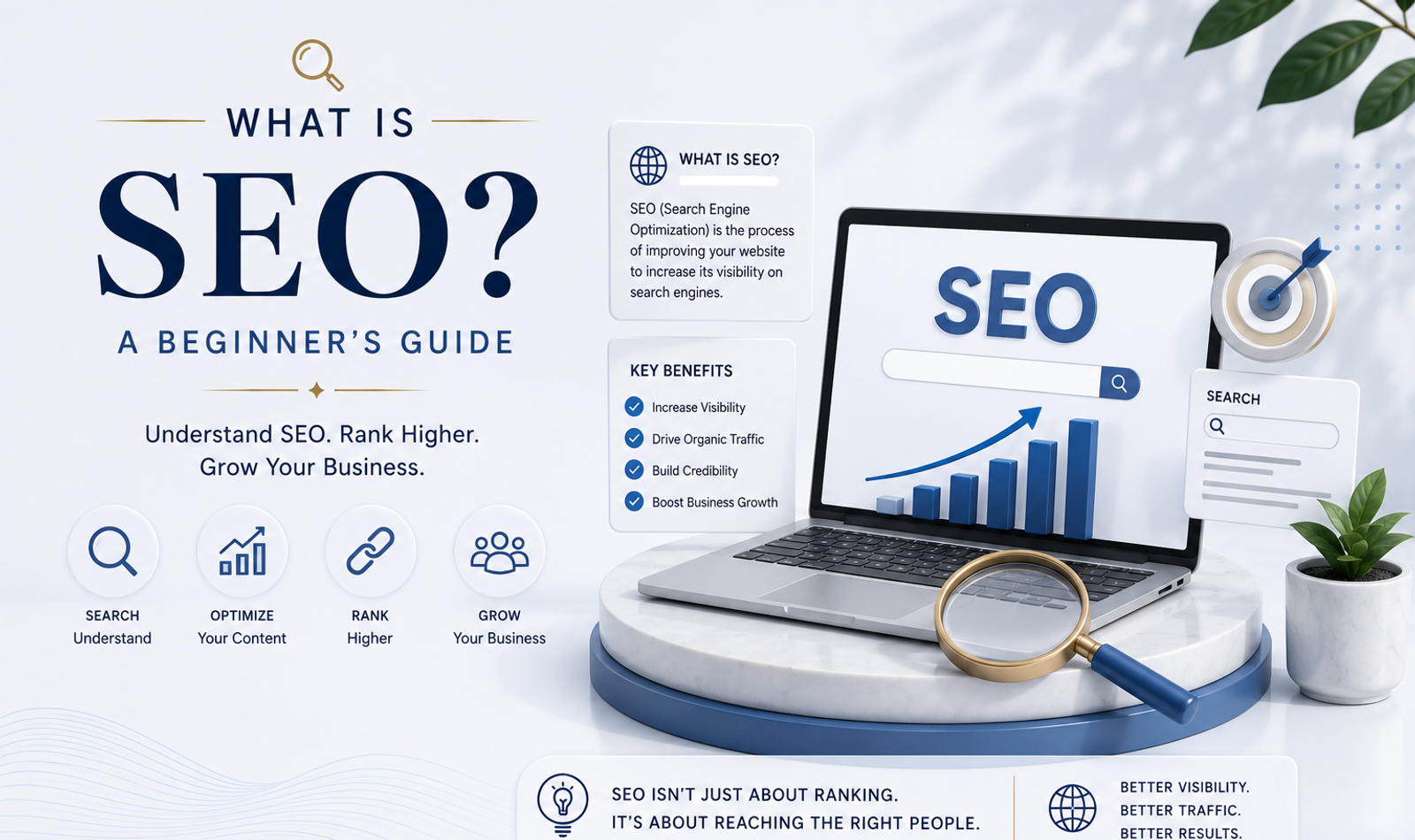
SEO stands for Search Engine Optimization. It is the process of improving a website so that search engines can understand it, rank it and show it to people searching for relevant information, products or services.
In simple words, SEO helps your website appear on Google when your target audience is actively looking for something related to your business.
For example, if someone searches “best digital marketing agency in India,” “luxury wedding planner in Chandigarh,” “website development company near me” or “how to improve website ranking,” SEO helps the right website appear in front of that searcher.
SEO is important because people use search engines with intent. They are not just scrolling casually. They are asking questions, comparing options, researching services and looking for solutions. When your website appears during that moment, it can attract qualified visitors, build trust and generate business without depending only on paid ads.
For beginners, SEO may sound technical, but the basic idea is simple. Search engines want to show helpful, trustworthy and relevant results. Your job is to create a website that clearly explains your expertise, answers user questions, loads properly, works well on mobile and gives people a good experience.
In 2026, SEO is also connected with AI Overviews, GEO, answer engine optimization and generative search visibility. But the foundation has not changed. If your content is useful, clear, well-structured and technically accessible, it has a better chance of performing across traditional Google Search and AI-powered search experiences.
This beginner’s guide explains what SEO is, how search engines work, why SEO matters, what types of SEO you need to understand and how to start optimizing your website step by step.
What is SEO?
SEO is the practice of improving your website so it can rank higher in organic search results.
Organic search results are the unpaid listings that appear on Google or other search engines. These are different from paid ads. When your website ranks organically, you do not pay for every click. You earn visibility through relevance, quality and trust.
SEO helps search engines understand what your website is about.
It also helps users find your content more easily.
A good SEO strategy includes keyword research, website structure, high-quality content, internal linking, technical improvements, mobile performance, backlinks, local visibility and user experience.
The goal is not only to get traffic.
The real goal is to attract the right traffic.
A website may get thousands of visitors, but if those visitors are not interested in the business, the traffic will not create value. Good SEO brings people who are already searching for your type of product, service or information.
Why SEO Matters for Businesses
SEO matters because search is one of the strongest discovery channels for modern businesses.
People search before they buy, book, visit or enquire. They search for solutions, reviews, comparisons, pricing, services, locations, guides and expert advice.
If your brand does not appear in search results, your competitors may capture that demand.
SEO helps businesses build long-term visibility.
Paid ads can generate traffic quickly, but the traffic usually stops when the ad budget stops. SEO takes more time, but strong content and optimized pages can continue bringing visitors for months or years.
SEO also builds trust.
When a website appears for relevant searches, users often see it as more credible. If the website also provides useful content, clear service information, case studies, FAQs and strong user experience, it can convert visitors into leads or customers.
For small businesses, premium brands, service providers, hotels, restaurants, real estate companies, event agencies, fashion labels, beauty brands and digital agencies, SEO can become a powerful growth engine.
It helps your brand become discoverable exactly when people are looking for what you offer.
How Search Engines Work
Search engines work through three main processes: crawling, indexing and ranking.
Crawling is when search engines discover pages on the internet. Search engine bots visit websites and follow links to find new or updated content.
Indexing is when search engines store and understand the content they find. If a page is indexable and useful, it may be added to the search engine’s database.
Ranking is when search engines decide which pages should appear for a search query and in what order.
When someone searches, the search engine tries to show the most relevant and helpful results.
This is why SEO is not about tricking Google. It is about making your website easier to discover, easier to understand and more useful for the searcher.
If your website has confusing structure, weak content, slow loading speed, poor mobile experience or unclear information, search engines and users may struggle to trust it.
A strong SEO foundation helps both.
What Are Keywords in SEO?
Keywords are the words and phrases people type into search engines.
For example, “what is SEO” is a keyword. “SEO agency in India” is also a keyword. “How to improve website ranking” is a long-tail keyword.
Keyword research helps you understand what your audience is searching for.
It shows the language your customers use.
Many beginners make the mistake of writing website content based only on what they want to say. SEO requires you to also understand what your audience wants to find.
There are different types of keywords.
Informational keywords are used when people want to learn something. For example, “what is SEO” or “how SEO works.”
Commercial keywords are used when people are comparing options. For example, “best SEO agency for small business” or “SEO services pricing.”
Transactional keywords are used when people are ready to take action. For example, “hire SEO agency in India” or “book SEO consultation.”
Local keywords include location intent. For example, “SEO company in Chandigarh” or “digital marketing agency near me.”
A strong SEO strategy uses a mix of these keywords.
What is Search Intent?
Search intent means the reason behind a search query.
Understanding search intent is one of the most important parts of SEO.
If someone searches “what is SEO,” they want a beginner explanation. If someone searches “SEO services India,” they may be looking for an agency. If someone searches “SEO audit checklist,” they want a practical guide. If someone searches “best SEO tools,” they want recommendations.
The content must match the intent.
If the searcher wants a beginner guide and your page only promotes your services, it may not satisfy the query. If the searcher wants to hire an agency and your page only explains theory, it may not convert.
Good SEO content answers the user’s real need.
Before writing any page or blog, ask yourself:
What is the user trying to understand, compare or do?
When you answer that clearly, your content becomes more useful.
Types of SEO
SEO has several important parts. Beginners should understand the main categories before trying to optimize a website.
The major types of SEO are on-page SEO, off-page SEO, technical SEO, local SEO and content SEO.
Each one plays a different role.
On-page SEO improves the content and structure of individual pages.
Off-page SEO builds authority through backlinks, mentions and external trust signals.
Technical SEO makes sure your website can be crawled, indexed and used properly.
Local SEO helps businesses appear for location-based searches.
Content SEO focuses on creating useful, optimized and search-friendly content.
A complete SEO strategy needs all of these areas working together.
What is On-Page SEO?
On-page SEO refers to the improvements made directly on your website pages.
This includes titles, headings, content, keywords, URLs, internal links, images, meta descriptions and page structure.
A well-optimized page should have a clear topic.
The title should include the main keyword naturally. The introduction should explain the topic quickly. Headings should break the content into easy sections. Paragraphs should answer user questions clearly. Images should have descriptive alt text. Internal links should connect related pages.
On-page SEO also includes writing for humans.
Do not stuff keywords unnaturally. Search engines are much better at understanding meaning now. Repeating the same keyword again and again can make the content feel spammy.
Instead, use the main keyword naturally and include related phrases.
For a blog about SEO, related phrases may include search engine optimization, Google ranking, organic traffic, keyword research, technical SEO and content strategy.
Good on-page SEO makes the page easy for both users and search engines to understand.
What is Off-Page SEO?
Off-page SEO refers to activities outside your website that help build authority and trust.
The most common part of off-page SEO is backlinks.
A backlink is a link from another website to your website. Search engines may treat quality backlinks as signals of trust, especially when they come from relevant and credible websites.
However, not all backlinks are valuable.
A link from a respected publication, industry blog, local business directory or trusted partner can be useful. A large number of spammy or low-quality links can hurt trust.
Off-page SEO also includes brand mentions, PR coverage, guest articles, social proof, reviews, partnerships and digital reputation.
For premium brands, public relations and digital PR can strongly support off-page SEO.
When your brand is mentioned by credible sources, it builds authority and visibility.
The goal is to earn trust, not manipulate links.
What is Technical SEO?
Technical SEO improves the technical health of a website.
It helps search engines crawl, index and understand the website properly.
It also improves user experience.
Technical SEO includes page speed, mobile-friendliness, secure HTTPS connection, XML sitemap, robots.txt, canonical tags, structured data, clean URLs, broken link fixes and proper indexing.
Beginners often ignore technical SEO because it sounds complicated.
But technical issues can seriously affect performance.
For example, if important pages are blocked from indexing, they may not appear in search results. If the website loads slowly, users may leave. If the mobile layout is broken, customers may not enquire. If there are duplicate pages, search engines may become confused.
A technically healthy website gives your content a better chance to perform.
What is Local SEO?
Local SEO helps businesses appear for searches with local intent.
This is important for businesses that serve specific cities, areas or regions.
Examples include restaurants, salons, clinics, hotels, event companies, real estate businesses, car rentals, retail stores and local service providers.
Local SEO includes optimizing your Google Business Profile, adding correct business details, collecting reviews, using location keywords, adding local content, building local citations and keeping name, address and phone number consistent.
For example, a wedding planner in Chandigarh should optimize for searches such as “luxury wedding planner in Chandigarh,” “event management company in Chandigarh” or “destination wedding planner near me.”
Reviews are especially important for local SEO.
Customers often trust businesses with strong ratings, recent reviews and clear photos.
Local SEO helps nearby customers find and contact you.
What is Content SEO?
Content SEO is the process of creating content that answers user questions and supports search visibility.
This includes blogs, service pages, product pages, guides, FAQs, case studies, landing pages and resource pages.
Good SEO content should be helpful, original and easy to read.
It should not be written only for search engines.
A strong blog should answer the topic properly, use clear headings, explain important terms, include examples and guide the reader towards the next step.
For example, a digital marketing agency may publish blogs about SEO, website development, social media marketing, AI video production, PR strategy and brand positioning. These blogs help the website rank for relevant search queries and build authority.
Content SEO also supports AI Overviews and answer engines because structured, helpful content is easier to understand and summarize.
The more useful your content is, the more likely it is to support long-term visibility.
What is GEO and AI Overview Optimization?
GEO stands for Generative Engine Optimization. It is used to describe optimization for AI-powered search experiences and generative search answers.
AEO stands for Answer Engine Optimization. It focuses on making content easy for answer engines to understand and use.
AI Overview optimization focuses on improving the chances of your content being useful for AI-generated summaries in search results.
For beginners, the key idea is simple.
Do not create content only for algorithms. Create content that clearly answers real questions.
Use direct answers, helpful headings, definitions, examples, FAQs, structured sections and original insights.
For example, if the topic is “What is SEO?” the blog should answer the question clearly at the beginning. It should then explain related concepts such as keywords, rankings, technical SEO, content SEO, backlinks and local SEO.
AI search systems prefer content that is clear, reliable and useful.
GEO and AI Overview optimization should not replace SEO. They should strengthen it.
How SEO Helps AI Search Visibility
AI-powered search experiences often pull information from indexed web content.
This means your website still needs strong SEO fundamentals.
Your content should be crawlable, indexable and useful.
It should clearly explain who wrote it, why it exists and how it helps the reader. It should include original value instead of repeating generic information already available everywhere.
For businesses, this means creating content that shows real expertise.
A basic article may explain “what is SEO.” A stronger article may include beginner examples, common mistakes, local SEO tips, AI Overview optimization, SEO checklist and practical next steps.
The goal is to become a trustworthy source.
AI search visibility depends on clarity, authority, usefulness and technical accessibility.
Important SEO Ranking Factors
Search rankings depend on many signals, and search engines do not reveal every detail. However, beginners should focus on the most practical factors.
Helpful content is important. Your content should satisfy the searcher’s need.
Keyword relevance matters. Your page should clearly match the topic people search for.
Page experience matters. Your website should load quickly, work well on mobile and be easy to navigate.
Internal linking matters. Related pages should connect logically.
Backlinks and authority matter. Credible mentions and links can support trust.
Technical accessibility matters. Search engines should be able to crawl and index your pages.
User satisfaction matters. If people quickly leave because the page is confusing or unhelpful, the website may not perform well.
SEO is not about one magic factor.
It is about many improvements working together.
Beginner SEO Checklist
A beginner SEO strategy should start with the basics.
First, identify your target audience and main services.
Then research keywords your audience is searching for.
Create separate pages for important services instead of putting everything on one page.
Write clear title tags and meta descriptions.
Use proper headings.
Add helpful content that answers customer questions.
Optimize images with descriptive alt text.
Improve page loading speed.
Make sure the website works well on mobile.
Add internal links between related pages.
Set up Google Search Console and Google Analytics.
Create a Google Business Profile if you serve local customers.
Collect reviews and testimonials.
Publish helpful blogs consistently.
Review performance monthly.
These basics can create a strong foundation.
How to Do Keyword Research
Keyword research helps you choose the right topics.
Start by thinking like your customer.
What would they search before buying from you?
A customer may search for a problem, service, comparison, location or guide.
For example, a business looking for SEO help may search “what is SEO,” “SEO services for small business,” “best SEO agency in India,” “SEO pricing,” “how to rank website on Google” or “technical SEO checklist.”
Use keyword tools, Google Search suggestions, competitor websites, customer questions and sales conversations to build a keyword list.
Then organize keywords by intent.
Some keywords are best for blogs. Some are best for service pages. Some are best for FAQs. Some are best for local landing pages.
Do not target only high-volume keywords.
Long-tail keywords may have lower search volume but stronger intent.
For example, “SEO agency for luxury brands in India” may be more valuable than a broad keyword like “SEO.”
How to Write SEO-Friendly Content
SEO-friendly content should be clear, useful and structured.
Start with a strong title that includes the main keyword.
Use an introduction that quickly explains the topic and why it matters.
Break the article into helpful sections.
Use headings that match user questions.
Answer important questions directly.
Include examples where possible.
Use related keywords naturally.
Avoid keyword stuffing.
Write in a way that beginners can understand.
Add FAQs near the end.
Include a conclusion with a clear next step.
For business blogs, the content should also connect to your services. For example, after explaining SEO, you can guide readers to consider an SEO audit, website optimization or digital marketing strategy.
The best SEO content helps first and sells second.
What Are Meta Titles and Meta Descriptions?
A meta title is the title that may appear in search results.
A meta description is a short summary that may appear below the title.
They help users understand what the page is about before clicking.
A good SEO title should include the main keyword and create interest.
A good SEO description should explain the value of the page clearly.
For example, for this blog, the SEO title is “What is SEO? Beginner’s Guide to Search Engine Optimization.”
The SEO description explains that the blog covers keywords, content, technical SEO, backlinks, local SEO, GEO and AI Overview optimization.
Meta titles and descriptions do not guarantee rankings, but they can influence click-through rate.
Better clicks can support better visibility.
What Are Backlinks?
Backlinks are links from other websites to your website.
They act like references.
When credible websites link to your content, it can signal that your website is useful or trustworthy.
However, quality matters more than quantity.
A few strong backlinks from relevant websites can be better than many low-quality links.
Good ways to earn backlinks include publishing helpful content, creating case studies, doing digital PR, guest posting on relevant platforms, building partnerships, getting listed in trusted directories and creating resources people want to reference.
Avoid buying spammy backlinks or using link schemes.
SEO should build trust, not risk it.
What Are Internal Links?
Internal links are links from one page of your website to another page on the same website.
They help users explore related content.
They also help search engines understand your website structure.
For example, a blog about SEO can link to your SEO service page, website development page, digital marketing blog and content strategy guide.
Internal links should be natural.
Do not add random links only for SEO.
Use links where they genuinely help the reader.
A strong internal linking structure can improve user experience and help important pages get discovered.
What is an SEO Audit?
An SEO audit is a review of your website’s SEO performance.
It identifies what is working, what is missing and what needs improvement.
An SEO audit usually reviews technical SEO, website speed, mobile performance, indexing, content quality, keyword usage, internal links, backlinks, metadata, images, user experience and conversions.
For beginners, an SEO audit is useful because it creates a clear starting point.
Instead of guessing, you can see exactly where the website needs work.
A basic audit may reveal that pages have missing titles, weak content, slow loading speed, broken links, duplicate pages, poor mobile layout or no clear keyword targeting.
Fixing these issues can improve performance over time.
SEO Tools Beginners Should Know
SEO tools help you measure and improve performance.
Google Search Console is one of the most important tools. It shows search queries, clicks, impressions, page performance, indexing issues and technical search data.
Google Analytics helps you understand website traffic, user behaviour and conversions.
Keyword research tools help you find search terms and content opportunities.
Page speed tools help identify loading problems.
SEO audit tools can scan your site for technical and on-page issues.
Rank tracking tools help monitor keyword positions.
Beginners do not need too many tools at once.
Start with the basics and use data to make better decisions.
Common SEO Mistakes Beginners Make
One common mistake is expecting instant results.
SEO takes time. Some improvements may show results quickly, but strong organic growth usually requires consistent effort.
Another mistake is writing only for keywords.
Content should be written for people first. Keywords should guide the topic, not control every sentence.
A third mistake is targeting the wrong keywords.
High-volume keywords are not always the best keywords. The best keywords match your business and audience intent.
Many beginners also ignore technical SEO.
A website with good content may struggle if it loads slowly, has indexing issues or works poorly on mobile.
Another mistake is publishing thin content.
Short, generic blogs that do not add value are unlikely to perform well.
Businesses also forget to update old content.
SEO is not only about publishing new pages. It is also about improving existing pages.
Finally, many websites do not track performance.
Without measurement, you cannot know what is working.
SEO for Small Businesses
SEO is extremely useful for small businesses because it helps them compete online.
A small business may not have the advertising budget of a large company, but it can still attract customers through helpful content, local SEO, strong service pages and good reviews.
For small businesses, the most important SEO steps are clear service pages, location-based keywords, Google Business Profile optimization, customer reviews, helpful blogs, mobile-friendly website design and fast enquiry options.
For example, a restaurant should optimize for local searches, menu queries, reviews and location terms.
An event company should optimize for event planning services, wedding planning, corporate events, location pages and portfolio content.
A digital agency should optimize for SEO services, website development, social media marketing, AI video production and case studies.
Small business SEO works best when it is focused and consistent.
SEO for Premium and Luxury Brands
Premium and luxury brands need SEO, but their approach should be more refined.
They should not chase every keyword or produce generic content.
The goal is to attract high-quality visitors who value premium services, expert guidance and trusted brands.
Luxury SEO should focus on positioning, authority, visual quality, customer experience and high-intent search terms.
For example, a luxury wedding planner may target keywords around destination weddings, guest management, celebrity management, luxury wedding planning and premium event execution.
A premium automotive brand may target chauffeur-driven cars, corporate car rental, airport transfers and executive mobility.
A luxury hospitality brand may target boutique stays, premium experiences, destination guides and private events.
The content should feel polished, helpful and aligned with brand identity.
SEO for luxury brands should support premium perception, not dilute it.
How Long Does SEO Take?
SEO is a long-term strategy.
Some technical fixes may improve performance quickly, but ranking growth often takes several months.
The timeline depends on competition, website age, content quality, technical health, backlinks, keyword difficulty and consistency.
A new website may take longer to build authority.
An existing website with strong content but technical issues may improve faster after fixes.
The best approach is to think of SEO as an ongoing investment.
Publish helpful content, improve service pages, fix technical issues, build authority, track results and update pages regularly.
SEO grows through consistent improvement.
How to Measure SEO Success
SEO success should be measured through meaningful metrics.
Important SEO metrics include organic traffic, keyword rankings, impressions, clicks, click-through rate, average position, indexed pages, backlinks, conversions, enquiries and revenue from organic search.
However, traffic alone is not enough.
A website may get traffic but no leads.
That means the content may be attracting the wrong audience or the page may not have a clear conversion path.
Track qualified enquiries, consultation bookings, phone calls, WhatsApp clicks, form submissions, purchases and lead quality.
For SEO to support business growth, it must bring the right visitors and guide them towards action.
SEO and User Experience
SEO and user experience are closely connected.
A website should be easy to use.
If users cannot find information, if the website loads slowly, if text is hard to read or if the contact process is confusing, they may leave.
Good user experience helps visitors stay longer and take action.
For SEO, this means your website should have clear navigation, readable content, fast pages, mobile-friendly design, strong calls to action and helpful internal links.
Search engines want to send users to pages that satisfy their needs.
If your website helps users, it also supports SEO.
SEO and Website Design
Website design affects SEO.
A beautiful website is not enough if search engines cannot crawl it or users cannot understand it.
SEO-friendly website design includes clean page structure, readable text, optimized images, fast loading speed, mobile responsiveness, clear headings, simple navigation and accessible content.
Important content should not be hidden in images.
Search engines need text to understand your page.
Design and SEO should work together.
A strong website should look premium, communicate clearly and perform technically.
For modern brands, website development and SEO should be planned together from the beginning.
SEO and Social Media
Social media and SEO are different, but they can support each other.
Social media does not directly replace SEO.
However, social content can increase brand awareness, drive website visits, support content distribution and create branded search demand.
For example, someone may see your Instagram reel and then search your brand on Google. If your website and search presence are strong, that interest can convert into an enquiry.
Social media content can also help you identify customer questions.
Those questions can become blog topics, FAQs and service page content.
A complete digital strategy connects SEO, social media, PR, content and website performance.
SEO and PR
Public relations can support SEO through brand mentions, backlinks, authority and trust.
When your brand appears in credible publications, it can improve reputation and send referral traffic to your website.
PR can also create content opportunities.
Founder interviews, expert opinions, event coverage, launch announcements and case studies can all support search visibility.
Digital PR is especially useful for premium brands.
It helps build authority beyond the brand’s own website.
A strong SEO strategy should include PR, especially when the brand wants to build trust and visibility in a competitive market.
Beginner SEO Action Plan
If you are starting SEO for the first time, begin with a simple action plan.
Define your target audience and main services.
Research the keywords your customers search.
Create clear service pages.
Write helpful blogs that answer real questions.
Optimize titles, headings and meta descriptions.
Improve website speed and mobile experience.
Set up Google Search Console and Google Analytics.
Add internal links.
Optimize images with alt text.
Build your Google Business Profile if you serve local customers.
Collect reviews.
Create backlinks through PR, partnerships and useful content.
Review results every month.
SEO becomes easier when you follow a system.
Frequently Asked Questions
What is SEO in simple words?
SEO is the process of improving a website so it can appear higher in search results when people search for relevant topics, products or services.
Why is SEO important?
SEO is important because it helps your website attract organic traffic, build trust, reach people with search intent and generate leads or sales over time.
How does SEO work?
SEO works by helping search engines crawl, index and understand your website so they can show it to users searching for relevant information.
What are the main types of SEO?
The main types of SEO are on-page SEO, off-page SEO, technical SEO, local SEO and content SEO.
What are keywords in SEO?
Keywords are the words or phrases people type into search engines. SEO uses keywords to understand what users are searching for and create relevant content.
What is the difference between SEO and paid ads?
SEO focuses on unpaid organic search visibility, while paid ads require payment for placement and clicks. SEO takes time but can create long-term traffic.
How long does SEO take to work?
SEO often takes several months to show strong results, depending on competition, website quality, content, technical health and consistency.
What is AI Overview optimization?
AI Overview optimization means creating clear, helpful, structured and trustworthy content that can support visibility in AI-powered search experiences.
What is GEO in SEO?
GEO means Generative Engine Optimization. It focuses on making content useful and understandable for AI-powered search and generative answer systems.
Can beginners do SEO?
Yes. Beginners can start SEO by learning keyword research, writing helpful content, improving page titles, optimizing website speed and tracking performance.
Conclusion
SEO is one of the most important parts of digital marketing because it helps people find your website when they are actively searching for information, products or services.
For beginners, SEO may seem complicated at first. But the foundation is simple.
Create helpful content. Use the right keywords. Make your website easy to understand. Improve technical performance. Build trust. Answer user questions. Track results. Keep improving.
SEO is not a one-time task.
It is a long-term strategy that combines content, website experience, technical health, authority, local visibility and customer intent.
In 2026, SEO is also connected with AI Overviews, GEO and answer engine optimization. But these are not separate from SEO. They depend on the same foundation: useful, clear, trustworthy and accessible content.
Businesses that invest in SEO can build long-term visibility, attract qualified traffic, reduce dependence on paid ads and create stronger digital authority.
Double Trouble Studio helps brands grow through SEO, website development, content strategy, digital marketing, PR, social media, AI video, brand positioning and performance-focused online visibility.
With the right SEO strategy, your website can become more than an online brochure. It can become a powerful discovery, trust-building and lead-generation engine for your business.
📩 info@dtsworld.in | 📞 +91 80000 06021 | 📍 Andheri West, Mumbai
Related reading: SEO services · On-page SEO checklist.
Need this for your brand?
Let DTS build your next campaign.
From PR, celebrity management and events to websites, social media, SEO and AI video production — Double Trouble Studio helps brands grow with strategy and execution.
Discuss Your Requirement →