Getting featured in premium media can transform how customers, investors, partners and industry stakeholders perceive a brand.
A well-developed feature in a respected publication can create authority that ordinary promotional communication struggles to achieve. It can introduce the organisation to a relevant audience, validate its expertise, support search visibility and strengthen trust during important commercial conversations.
However, premium media coverage is rarely secured by sending a generic press release to hundreds of email addresses.
Editors and journalists receive large numbers of pitches involving launches, products, founders, events, collaborations, research and interview requests. Most of these ideas are competing for limited editorial attention.
The brands that gain serious consideration usually offer more than a company announcement.
They offer a story with genuine relevance.
The journalist can see why the subject matters to the publication’s audience, why it is timely, what makes it distinctive and what evidence is available to support it.
A strong pitch also reaches the correct person at an appropriate time.
An excellent design story sent to a journalist covering corporate finance is unlikely to progress. A festive-season feature idea submitted after the publication has completed its seasonal planning may arrive too late, even when the concept is strong.
Relationships matter as well.
Journalists are more likely to engage consistently with public relations professionals who understand their work, communicate accurately, respect deadlines and provide useful access.
This does not mean relationships guarantee positive coverage.
Editorial independence remains essential.
A professional relationship increases trust in the quality of the information and reduces the effort required to evaluate the opportunity.
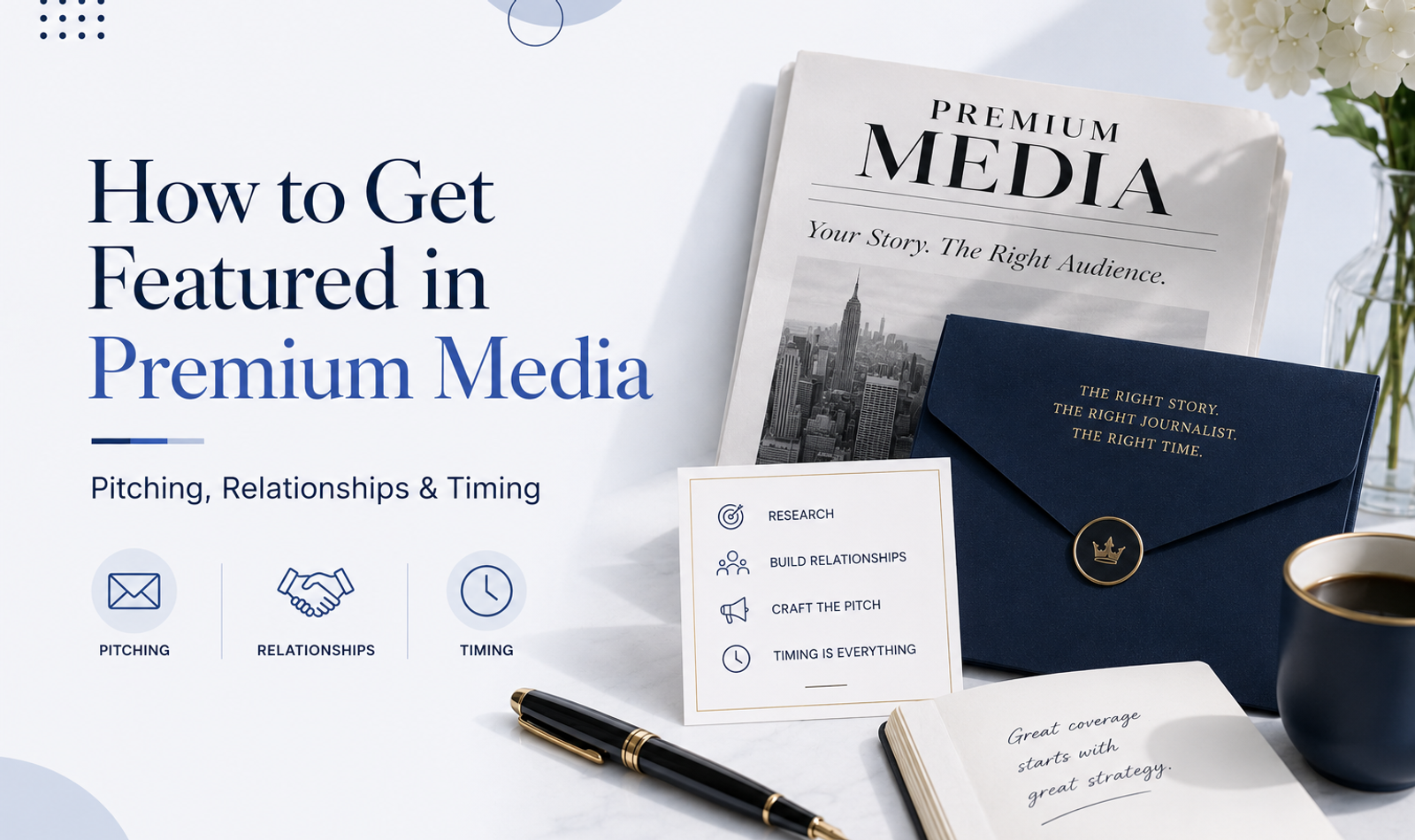
Getting featured in premium media therefore depends on three connected disciplines: pitching, relationships and timing.
Pitching turns company information into an editorially relevant idea.
Relationships create confidence between the journalist and the source.
Timing ensures that the idea arrives when the publication can realistically consider and produce it.
When these disciplines work together, PR and media outreach becomes a strategic process rather than a mass publicity exercise.
What Is Premium Media?
Premium media generally refers to publications, programmes and editorial platforms that hold strong authority, cultural influence or relevance within a particular audience.
The term does not refer only to the largest global magazine or newspaper brands.
A respected industry publication may be premium for a B2B company. A leading regional newspaper may be premium for a business entering a specific state or city. A specialised architecture journal may be more valuable to a design studio than a general entertainment platform with a much larger audience.
Premium media value can come from several factors.
The publication may have a strong editorial reputation.
Its readers may include high-value customers, decision-makers, creative professionals or influential communities.
Its coverage may rank strongly in search results.
Journalists and other outlets may regularly use it as a source.
A feature may also carry social and cultural significance because of the publication’s position within fashion, luxury, business, travel, design or technology.
The brand should define premium media according to its objectives rather than prestige alone.
Earned Media Is Different From Paid Media
Earned media is editorial coverage selected by a publication because its editors or journalists believe the story is relevant.
The brand does not purchase the editorial decision.
Paid media includes advertising, sponsored features, branded content, advertorials and commercial partnerships.
Both can be valuable, but they serve different purposes.
Paid coverage offers greater control over timing, messaging, placement and guaranteed publication.
Earned coverage provides independent editorial context but less control.
The journalist may include other sources, critical context or different conclusions from those preferred by the company.
Brands should not ask an editorial journalist to guarantee a positive feature.
They should also avoid reporting sponsored content as independent earned coverage.
Transparency protects the credibility of the brand, agency and publication.
Why Premium Media Features Matter
Premium features can influence perception at several stages of the customer journey.
At the awareness stage, they introduce the company within a trusted environment.
During consideration, they provide additional evidence that the organisation is established, relevant and worth evaluating.
During sales discussions, media coverage may support proposals, presentations and leadership credibility.
A feature can also influence people who are not immediate customers.
Potential employees may discover the organisation through a founder interview.
Event organisers may invite an executive to speak.
Other journalists may identify the company as a future source.
Partners and investors may begin conversations after encountering credible coverage.
The strongest media features create several forms of value rather than one temporary increase in website traffic.
This is why an integrated full-funnel PR and digital strategy can create more value than treating media coverage as an isolated publicity activity.
Define the Objective Before Pitching
Media outreach should begin with a clear communication and business objective.
The company may want to launch a product, enter a new market, reposition the brand, establish leadership expertise or attract high-value customers.
Different objectives require different types of coverage.
A new founder-led business may benefit from a profile explaining the market problem and vision.
An established company entering a new city may require regional business and lifestyle coverage.
A premium product may need editorial features focused on design, craftsmanship and customer relevance.
A professional service brand may create greater value through expert commentary, research and case studies than through general company profiles.
The objective should define the audience and the change the brand wants to create.
Seeking coverage without this clarity can generate articles that look impressive but contribute little to positioning or growth.
Identify the Audience That Matters
The company should understand who needs to encounter the feature.
A luxury hospitality brand may want to reach premium travellers, wedding planners, corporate organisers and travel professionals.
A technology company may need founders, information-technology leaders, operations teams and investors.
A fashion brand may want customers, buyers, stylists, editors and creative partners.
The correct publication depends on the audience.
A prominent general publication may provide broad awareness.
A specialised outlet may reach fewer people but influence more valuable decisions.
The media strategy should balance authority, relevance, geography and commercial potential.
Begin With the Story, Not the Publication Name
Many brands begin by creating a list of publications they want to appear in.
The public relations team is then expected to find an angle for each target.
A stronger approach begins by identifying the real story.
What has changed?
Why does it matter?
Who is affected?
What makes it distinctive?
What proof can the company provide?
Once the story is clear, the team can determine which publications and journalists are most likely to care.
This prevents the brand from forcing weak announcements into outlets that have little connection with the subject.
It also creates more natural personalisation.
Understand News Value
A story needs a reason to be covered now.
News value may come from a significant launch, expansion, appointment, research finding, partnership, milestone or industry development.
It may involve cultural relevance, human interest, conflict, innovation, rarity, local impact or changing customer behaviour.
A company announcement becomes stronger when it connects with one of these wider dimensions.
A hotel opening may become a design, travel, culinary or regional-development story.
A fashion collection may become a story about material innovation, craftsmanship or changing bridal preferences.
A technology service may become relevant through a new business challenge or regulatory development.
The PR team should identify the strongest editorial value rather than include every possible message in one pitch.
Separate the Announcement From the Story
The announcement is what happened.
The story explains why it matters.
A company may have launched a new premium service.
The story could be about changing customer expectations, a market gap or a new model of personalisation.
A founder may have received an award.
The story may involve the work, insight or category change that led to recognition.
An event may have attracted a high-profile guest.
The story may concern the cultural idea, business discussion or customer experience represented by the event.
Journalists need more than the company’s internal milestone.
They need an external reason for readers to care.
Develop a Clear Editorial Angle
The editorial angle is the specific perspective through which the journalist can explore the subject.
A strong angle should be understandable in one or two sentences.
For example, a broad subject may be luxury weddings.
A more precise angle could be how high-value wedding families are prioritising guest logistics and privacy over decorative scale.
A broad subject may be regional craftsmanship.
A stronger angle could examine how younger Indian designers are adapting traditional techniques for contemporary luxury customers.
A broad subject may be artificial intelligence.
A specific angle could explain how premium brands are using AI-assisted production without losing human creative direction.
The angle provides focus.
It also helps the PR team identify the right journalist and supporting evidence.
A clear angle should ultimately reinforce the brand’s wider story-led brand narrative rather than creating disconnected publicity.
Create Several Angles From One Development
One company development may support several legitimate story angles.
A new luxury resort may provide:
A destination angle
A design angle
A culinary angle
A founder angle
A business-expansion angle
A wedding and events angle
A regional tourism angle
The team should not combine all of them into one long email.
Each publication should receive the angle most relevant to its audience.
A travel editor may focus on destination and guest experience.
An architecture publication may care about design and materials.
A business journalist may examine investment, growth and market strategy.
A regional publication may focus on employment and tourism impact.
The underlying facts remain consistent while the editorial doorway changes.
Build a Strong Founder Story
Founder profiles are common, which means the personal story needs wider relevance.
Being a founder is not automatically newsworthy.
A strong founder story explains what the person recognised, what they believed needed to change and how they acted on that belief.
It may involve an unusual combination of experience, a significant category problem or a distinctive approach to growth.
The founder should be able to discuss more than personal success.
Journalists may ask about challenges, mistakes, competition, pricing, leadership and future plans.
The story becomes more valuable when readers can learn something from the founder’s experience.
Develop Thought-Leadership Angles
A brand does not always need a complete feature focused only on the company.
Executives and specialists can contribute expert commentary to wider stories.
A hospitality leader may explain changing premium-travel behaviour.
An event professional may discuss crowd communication, celebrity logistics or guest privacy.
A digital expert may discuss search behaviour, artificial intelligence or advertising performance.
Thought leadership builds authority gradually.
The spokesperson should have real experience and a clear perspective.
Generic commentary that repeats widely available information provides limited value to journalists.
Build Data-Led Stories
Original data can create strong media interest because it gives the journalist new evidence.
The brand may analyse customer behaviour, bookings, service patterns, market demand or survey responses.
A wedding company may study guest-experience priorities.
A property company may examine premium-buyer preferences.
A technology platform may analyse changing business workflows.
The methodology should be credible and clearly explained.
A small customer sample should not be presented as a universal national trend.
The company should be prepared to share relevant context and limitations.
Use Customer and Case-Study Stories
Customer stories provide human and commercial evidence.
A strong case study includes a starting point, challenge, approach and outcome.
It should explain what changed because of the company’s work.
Permission should be obtained before sharing customer information.
Luxury, financial, healthcare and B2B clients may require additional confidentiality.
Some cases can be anonymised while still providing useful operational insight.
The story should avoid exaggerated claims and unsupported transformation language.
Develop Trend Stories Carefully
Trend stories allow the brand to become part of a larger conversation.
The company may identify patterns in customer requests, sales behaviour or service delivery.
A luxury-event company may observe growing demand for private guest communication.
A hotel may see increased interest in longer, slower travel experiences.
A beauty brand may identify changing questions about ingredients or routines.
The trend should be supported by evidence.
Journalists may speak with competitors, customers and independent specialists.
The brand should be comfortable contributing as one informed source rather than insisting on complete ownership of the story.
Build Cultural and Human-Interest Angles
Premium media often values stories that connect business with identity, culture and human experience.
A designer may be reviving a local technique through contemporary work.
A hospitality company may be creating economic opportunity within an emerging destination.
A founder may have developed a service after experiencing a personal industry problem.
Human-interest stories should remain truthful and respectful.
Brands should not invent hardship or exploit private experiences for attention.
The individual involved should understand how the story may be used.
Research Publications Thoroughly
Media research should go beyond collecting publication names.
The team should understand each outlet’s audience, sections, tone, format and recent coverage.
It should examine whether the publication produces profiles, interviews, trend features, product roundups, reported investigations, opinion pieces or visual stories.
The team should also distinguish print and digital priorities.
A publication may use different editors, timelines and formats for its website and magazine.
Research helps the PR team understand where the idea fits.
It also prevents embarrassing outreach about subjects the outlet does not cover.
Study Recent Coverage
The PR professional should review recent articles related to the proposed subject.
This reveals which themes the publication values and what has already been covered.
The team can identify whether the proposed idea adds something new.
If the publication recently published a broad article on luxury travel, the brand may need a more specific development rather than repeating the same trend.
Recent bylines also help identify active journalists.
Media databases can support research, but current publication pages remain important because staff roles change.
Find the Correct Journalist
The most beautifully written pitch has limited value when sent to the wrong person.
The team should identify who regularly covers the relevant subject.
Possible contacts include section editors, feature writers, reporters, commerce editors, regional correspondents and freelance contributors.
A fashion editor may not handle hotel openings.
A business reporter may not manage product gift guides.
A culture writer may have little interest in routine corporate appointments.
The journalist’s recent work provides stronger guidance than an old contact spreadsheet.
Understand Editorial Roles
Different editorial roles carry different responsibilities.
An editor may commission and shape stories.
A staff writer may report and write within a defined subject area.
A freelance contributor may pitch ideas to several publications.
A bookings or talent editor may coordinate personalities, shoots and appearances.
A commerce editor may produce product-focused content that includes purchasing information.
The PR team should understand what it is asking from the contact.
A general feature pitch, sample submission, expert source offer and commercial partnership are not the same request.
Separate Editorial and Commercial Outreach
Premium media companies often have editorial, advertising, branded-content, event and subscription teams.
The brand should contact the appropriate department.
A request for guaranteed publication, controlled messaging or a defined campaign belongs with the commercial team.
An independent story idea belongs with editorial.
The existence of an advertising relationship does not automatically guarantee editorial coverage.
Mixing these roles can create confusion and weaken trust.
The media report should also identify paid and earned placements separately.
Understanding how digital PR and traditional PR contribute differently to visibility can also help brands decide where editorial, digital and commercial activity should sit within the wider strategy.
Create a Tiered Media List
A tiered media list helps the team prioritise effort.
Tier one may include a small number of highly desirable and strongly relevant outlets.
These pitches require the greatest research, personalisation and access.
Tier two may include respected national, specialist, trade and digital publications with strong audience alignment.
Tier three may include regional, local, niche and community outlets.
The tiers should not represent quality alone.
A regional publication may create stronger commercial impact than a prestigious national title for a location-based business.
Tiering helps the team plan exclusives, outreach timing and follow-up.
Build a Media Outreach Matrix
A media matrix can include:
Publication
Journalist
Subject area
Recent relevant work
Proposed angle
Priority tier
Contact method
Pitch date
Follow-up date
Response
Required assets
Outcome
This structure prevents duplicate and contradictory outreach.
It also creates institutional knowledge for future campaigns.
The notes should remain factual and professional.
The matrix is a planning tool, not a list for indiscriminate bulk emailing.
Decide Whether to Offer an Exclusive
An exclusive gives one publication priority or unique access.
It may involve the first announcement, first interview, first images or a distinct data set.
Exclusives can help a strong story gain deeper attention.
The brand should offer them carefully.
The same exclusive should never be promised to several publications.
The scope should be clear.
An outlet may receive the first founder interview while other media later receive the general announcement.
The organisation should also define when wider outreach may begin.
Understand Embargoes
An embargo allows journalists to receive information before a specified publication time.
It gives them time to research, interview and prepare coverage.
The journalist should agree to the embargo before sensitive information is shared.
The embargo should include the exact date, time and time zone.
It should be used when early access genuinely helps production.
Routine announcements do not always need an embargo.
An embargo is not a command imposed through a press-release heading without prior agreement.
Write a Strong Subject Line
The subject line should help the journalist understand the story immediately.
It should be accurate, specific and relevant.
Weak subject lines include:
“Exciting collaboration opportunity”
“Big announcement from our client”
“Request for media coverage”
Stronger examples include:
“Pitch: Why luxury weddings are shifting from spectacle to guest privacy”
“Interview opportunity: How regional design is reshaping premium hospitality”
“New research: What Indian founders expect from AI-led marketing in 2026”
“Exclusive: Inside a contemporary revival of Punjab’s craft traditions”
The subject line should not use false urgency or misleading claims.
Lead With the Story
The opening paragraph should focus on the editorial idea.
It should not begin with a long introduction to the agency or company.
The journalist needs to know what is happening and why it matters.
A weak opening may say that the brand is delighted to announce a new launch.
A stronger opening explains the customer or cultural change represented by the launch.
The brand’s role can be introduced after the relevance is clear.
Keep the Pitch Concise
A pitch should be easy to understand quickly.
The first short paragraph can introduce the story and its current relevance.
The second can explain the brand’s evidence, spokesperson or access.
The final line can offer the interview, data, images, sample or preview.
Long background information can be linked or attached through a concise media kit.
Brevity does not mean removing essential facts.
It means excluding information that does not help the journalist decide whether the story is relevant.
Personalise the Pitch
Personalisation should be based on genuine editorial relevance.
The email may mention the journalist’s subject area or a recent article connected with the proposed story.
The reference should be specific and brief.
Generic compliments such as “I love all your work” rarely demonstrate meaningful research.
The PR professional should not pretend to have read an article they have only seen in search results.
The best personalisation explains why this particular idea fits the journalist’s continuing coverage.
Explain Why the Story Matters Now
Timing should be visible within the pitch.
The reason may be a confirmed launch date, new research, cultural season, regulatory change, industry event or shifting customer behaviour.
The PR team should avoid artificial urgency.
A six-month-old announcement should not be described as breaking news.
When the story is evergreen, the pitch can connect it with a current discussion or offer it as a planned feature idea rather than immediate news.
Provide Evidence
Premium publications expect credible support.
Evidence may include data, customer examples, professional expertise, product details, contracts, independent recognition or access to relevant people.
Claims such as first, largest, fastest, most sustainable or industry-leading should be verifiable.
When evidence is unavailable, the language should be adjusted.
The founder can express an opinion as an opinion.
A statement about the entire market requires stronger support.
Accuracy strengthens long-term media relationships.
Provide Useful Access
Journalists may need more than a written announcement.
The brand can offer access to:
Founders
Designers
Executives
Customers
Craftspeople
Chefs
Architects
Researchers
Venues
Products
Events
Behind-the-scenes processes
The access should be relevant to the proposed story.
The spokesperson should be confirmed before the pitch is sent.
Offering an unavailable founder or unapproved customer wastes the journalist’s time.
Prepare a Professional Media Kit
A media kit should make accurate information easy to access.
It may include:
Company background
Founder biography
Fact sheet
Timeline
Product details
Research summary
High-resolution photographs
Image captions
Photographer credits
Spokesperson information
Contact details
The files should be organised clearly.
The brand should avoid sending a large unstructured folder without explaining which assets are relevant.
The media kit supports the pitch but does not replace it.
Prepare Editorial-Quality Images
Visual quality strongly influences lifestyle, fashion, hospitality, food, travel, luxury and design coverage.
The brand should provide high-resolution landscape, portrait and detail images where possible.
Photographs should not contain excessive logos, promotional text or social-media layouts.
Captions and credits should be accurate.
The brand should confirm that it owns or has permission to distribute the images for editorial use.
Different stories require different photographs.
A craftsmanship feature needs process images.
A founder profile needs a professional portrait.
A hotel feature needs architecture, interiors, destination and experience imagery.
Prepare the Spokesperson
A media opportunity can be lost when the spokesperson is unavailable or unprepared.
The person should understand the outlet, audience, story angle and likely questions.
They should know the central facts and supporting examples.
They should also be ready for challenging questions involving pricing, competition, sustainability, growth or previous setbacks.
The spokesperson should not memorise a complete script.
They should communicate naturally within clear message boundaries.
Media preparation improves clarity without attempting to control the journalist.
Build Relationships Before You Need Coverage
Media relationships should not begin and end with campaign emails.
PR professionals can build trust by following journalists’ work, understanding their beats and responding quickly when they request information.
They can offer relevant experts, data or case studies even when their client is not the main subject.
The relationship should provide value to the journalist’s work.
It should not become a transactional expectation that friendly interaction guarantees coverage.
Journalists maintain editorial independence.
Professional familiarity simply helps them understand whether the PR contact is reliable.
Become a Reliable Source
Reliability is one of the most valuable forms of media relationship capital.
The PR professional should provide accurate information, meet deadlines and confirm what they do not know.
They should not promise access that has not been approved.
When a mistake occurs, it should be corrected quickly.
Journalists often work under significant time pressure.
A source who responds efficiently and provides usable information may be contacted again for future stories.
Repeated reliability can create more long-term value than one aggressively pursued feature.
Understand the Journalist’s Constraints
Journalists may manage several stories, tight deadlines, limited resources and changing editorial priorities.
A delayed response does not necessarily indicate disrespect or rejection.
The publication may have shifted focus because of a major news event.
The story may not fit the current calendar.
The editor may need stronger evidence or a different angle.
Understanding these constraints helps PR teams follow up professionally rather than applying pressure.
Avoid Contacting Journalists Everywhere
Formal pitches are generally best sent through the journalist’s preferred professional contact channel.
A PR professional should not send the same pitch through email, phone, WhatsApp, Instagram and LinkedIn within a short period.
This can feel intrusive and damage the relationship.
Social media can support genuine professional engagement, but it should not become a tool for demanding a response.
Alternative contact methods should be used when the journalist has publicly invited them or when genuine urgency requires them.
Follow Up Respectfully
A follow-up should be brief and useful.
It may remind the journalist of the original angle and add a confirmed interview, new data or updated visual material.
It should not repeat the entire pitch.
One or two well-spaced follow-ups are generally more professional than daily messages.
The team should consider the story’s timing.
A breaking-news source offer may require faster follow-up than an evergreen profile idea.
When the journalist declines, the team should accept the answer and avoid arguing.
Know When to Stop Following Up
No response may mean the story is not suitable, the timing is wrong or the journalist is overloaded.
Repeated contact rarely changes a weak editorial fit.
After appropriate follow-up, the team should move to another relevant outlet or improve the angle.
The pitch can remain in the media database for future reference.
However, the same unchanged email should not be resent every few weeks.
Respond Professionally to Rejection
Rejection is part of media relations.
The brand should not assume that one declined pitch means the publication will never cover it.
The team can learn from the response where feedback is provided.
The story may need stronger data, a more current hook or different access.
The PR professional should thank the journalist and preserve the relationship.
A professional response to rejection may support a future opportunity.
Understand Editorial Timing
Timing influences whether a story can be commissioned, reported, photographed, edited and published.
Different formats have different planning cycles.
Print magazines may work weeks or months ahead.
Digital publications can move faster but still maintain planned calendars.
News desks respond quickly to current developments.
Gift guides, wedding issues, travel seasons and festive packages may close well before readers see them.
The PR team should research planning cycles rather than assuming every outlet can publish immediately.
Plan for Print Lead Times
Print coverage usually requires earlier outreach.
A magazine may confirm themes, shoots and contributors well before the publication date.
Products may need to be called in for photography.
Interviews may require scheduling and fact-checking.
A festive collection pitched during the week of the festival may be too late for print consideration.
The team should work backwards from the intended issue and allow time for editorial production.
Plan for Digital Timing
Digital publications can respond more quickly, but speed should not be confused with unlimited availability.
Editors still plan features, newsletters, homepage coverage and social distribution.
A timely pitch should include ready facts, images and spokesperson access.
For immediate news, the company should be prepared to respond quickly once interest is confirmed.
Delays in approvals can cause the publication to move to another source.
Use Seasonal Calendars
Seasonal planning can create strong editorial opportunities.
Relevant periods may include:
Wedding season
Festive season
Summer travel
Monsoon travel
Fashion weeks
Design fairs
Budget announcements
Industry conferences
Holiday gifting
Year-end trends
The story should connect naturally with the season.
The company should not force unrelated products into every calendar moment.
Seasonal stories should be pitched early enough for the publication’s format.
Use Cultural Moments Carefully
Cultural moments can make a story more relevant, but they also create competition.
Many brands pitch around International Women’s Day, Earth Day, festive dates and awareness months.
The brand needs a distinctive contribution.
A generic statement about empowerment or sustainability is unlikely to stand out.
The company should provide meaningful action, original evidence or a relevant spokesperson.
It should avoid using serious social issues purely as promotional opportunities.
Use Breaking News Responsibly
Newsjacking involves contributing expertise to an active news story.
The spokesperson must have genuine relevance and be available quickly.
The PR team can send a concise source offer explaining the person’s expertise and specific perspective.
It should avoid exploiting tragedy or highly sensitive events for brand visibility.
The contribution should help the journalist and audience understand the subject.
Speed is important, but accuracy remains essential.
Pitch Evergreen Stories Strategically
Not every valuable story depends on a launch or news event.
Evergreen features may involve founder lessons, craftsmanship, customer behaviour, design philosophy or professional guidance.
These stories can be pitched during quieter editorial periods or connected with recurring audience interests.
The pitch should still explain why the subject is useful now.
A strong evergreen story may remain relevant for several months, allowing more flexibility in timing.
Avoid Launch-Day Outreach
Waiting until the launch day to contact journalists limits the opportunity for meaningful coverage.
The journalist may need time for interviews, research, photography and approvals.
The PR plan should begin weeks or months earlier depending on the publication and story.
Embargoed information may be shared with agreed contacts where appropriate.
Launch day should be the result of preparation rather than the beginning of outreach.
For major launches, a structured luxury product launch event strategy can connect media outreach, physical experience and digital amplification from the beginning.
Coordinate Internal Approvals Early
Slow internal approvals can destroy a time-sensitive media opportunity.
The brand should confirm facts, claims, quotations, images, spokespersons and confidential information before pitching.
One person should coordinate approvals.
The journalist should not receive contradictory corrections from several departments.
The team should identify which details require legal or leadership review.
Pre-approved factual material helps the organisation respond quickly without sacrificing accuracy.
Prepare for Journalist Deadlines
When a journalist requests information by a particular time, the team should treat the deadline seriously.
The spokesperson may need to provide comments within hours.
Images may be required immediately.
If the brand cannot meet the deadline, it should say so honestly rather than disappearing.
Providing partial but accurate information may still be useful if the journalist agrees.
Repeated missed deadlines weaken future trust.
Manage Product Samples Properly
Fashion, beauty, technology, food and lifestyle journalists may request samples or experiences.
The brand should clarify whether the product is a review sample, loan or gift.
Returns, courier details, availability and usage should be documented.
Sending a product does not guarantee coverage.
The brand should not pressure the journalist for a positive review because a sample was provided.
Material relationships and commercial arrangements should be handled transparently.
Manage Media Events and Previews
Media previews can provide access, visuals and direct conversations.
The event should have a clear editorial purpose.
Journalists should know what they will experience and who will be available.
The brand should not invite media only to create the appearance of a crowded launch.
Check-in, information, interview schedules, photography and hospitality should be managed professionally.
Attendance does not guarantee publication.
A broader event PR strategy can help coordinate media communication before, during and after important brand events.
Create Strong Interview Opportunities
An interview opportunity should involve a spokesperson with a meaningful point of view.
The pitch should explain what the person can discuss and why their experience matters now.
A generic founder interview may have limited appeal.
A founder who can explain a category shift, provide data or discuss a significant strategic decision offers stronger value.
The spokesperson should provide examples rather than broad motivational statements.
Offer Useful Expert Sources
PR teams can build long-term value by helping journalists locate credible sources.
The source may be a customer, partner, industry specialist or internal expert.
The company should confirm the person’s expertise and availability.
The source should understand whether the conversation is on the record.
Offering relevant experts even when the client receives limited visibility can strengthen the media relationship.
The approach should remain honest and not conceal commercial connections.
Protect Confidential Information
The team should confirm which facts, images and documents can be shared.
Unreleased products, celebrity involvement, customer identities, financial information and partnership terms may be confidential.
The PR professional should not assume that marking an email confidential creates a binding agreement.
Embargoes, background discussions and off-the-record conversations should be agreed explicitly.
Spokespeople should understand these distinctions before interviews.
Handle Fact-Checking Professionally
Journalists may send specific facts or quotations for verification.
The brand should correct genuine inaccuracies promptly.
It should not attempt to rewrite the entire article or change the journalist’s interpretation.
Fact-checking is not automatic pre-publication approval.
The spokesperson should separate factual corrections from personal preferences.
Respecting editorial independence strengthens the relationship.
Do Not Demand Article Approval
Earned editorial coverage does not provide the brand with control over the final article.
The journalist may choose the headline, context, quotations and other sources.
The company can request correction of a material factual error after publication.
It cannot reasonably demand changes because the article is less promotional than expected.
Brands requiring complete message control should consider paid content or owned media.
Avoid Common Pitching Mistakes
A common mistake is sending the same press release to a large undisclosed list.
Another is pitching the wrong journalist or publication section.
Brands may begin emails with long company histories instead of the story.
Subject lines may be vague or exaggerated.
Pitches may claim that the company is the first or largest without evidence.
Some teams attach large files that are difficult to download.
Others offer interviews with people who are unavailable.
A strong idea may also fail because the brand contacts media after the relevant editorial deadline.
Avoid Overusing Follow-Ups
Persistent follow-up can weaken a good pitch.
Journalists may receive repeated calls, emails and messages from several agency team members.
The organisation should coordinate outreach internally.
One responsible contact should manage the relationship.
Follow-up should add information rather than pressure.
The goal is to make the story easier to evaluate, not to force a decision.
Avoid Buying Fake Earned Coverage
Some services may promise guaranteed features that appear editorial but are actually paid placements, syndication or low-quality contributor posts.
The brand should understand what it is purchasing.
Paid opportunities can be used strategically, but they should be reported accurately.
The company should evaluate publication credibility, audience, disclosure, indexing, permanence and content control.
A familiar logo alone does not prove editorial value.
Avoid Chasing Logos Without Relevance
A small mention in a globally recognised publication may look impressive in a presentation but create limited customer understanding.
A detailed feature in a specialist or regional outlet may produce stronger trust and enquiries.
The media plan should consider depth, audience relevance, message inclusion and long-term search value.
Prestige matters, but it should not become the only criterion.
For luxury and premium businesses in particular, media selection should reinforce the wider brand positioning strategy rather than simply collecting recognisable publication logos.
Use Regional Media Strategically
Regional media can be highly valuable for location-based businesses, events, hospitality, property, education and retail.
A regional story may involve local employment, investment, culture, tourism or a founder’s connection with the area.
The pitch should contain genuine local detail.
National messaging should not be reused unchanged with one city name inserted.
Regional-language material may be appropriate depending on the outlet.
Build Relationships With Freelancers
Freelance journalists contribute to several publications and may specialise deeply in one area.
The PR team should understand which outlets and subjects the freelancer currently covers.
A freelancer may be interested in the idea but still need to pitch it to an editor.
The brand should provide enough information to support that process.
It should not assume that the journalist can guarantee acceptance from a publication.
Maintain a Media Relationship Database
The media database should record professional information that improves future outreach.
Useful notes may include:
Subject areas
Preferred contact method
Recent relevant work
Previous interactions
Deadlines
Interests
Feedback
Coverage outcomes
The team should update roles and publication details regularly.
The database should not contain disrespectful personal commentary.
It should support professional relevance and continuity.
Share Coverage Responsibly
When coverage is published, the brand can amplify it through social media, newsletters, websites and sales material.
It should link to the original article rather than copying the complete copyrighted content.
Publication logos, headlines, screenshots and quotations should be used according to applicable permissions.
The company should not edit quotations in a way that changes meaning.
Paid, sponsored and earned coverage should be described accurately.
For suitable campaigns, influencer marketing can provide another layer of amplification, provided creator partnerships remain clearly distinguished from independent journalism.
Thank Journalists Professionally
A short thank-you message can acknowledge the journalist’s work and time.
It should not imply that the company expects favourable future coverage.
Gifts and excessive hospitality may create ethical concerns or conflict with publication policies.
The most useful way to maintain the relationship is to continue providing accurate, relevant information.
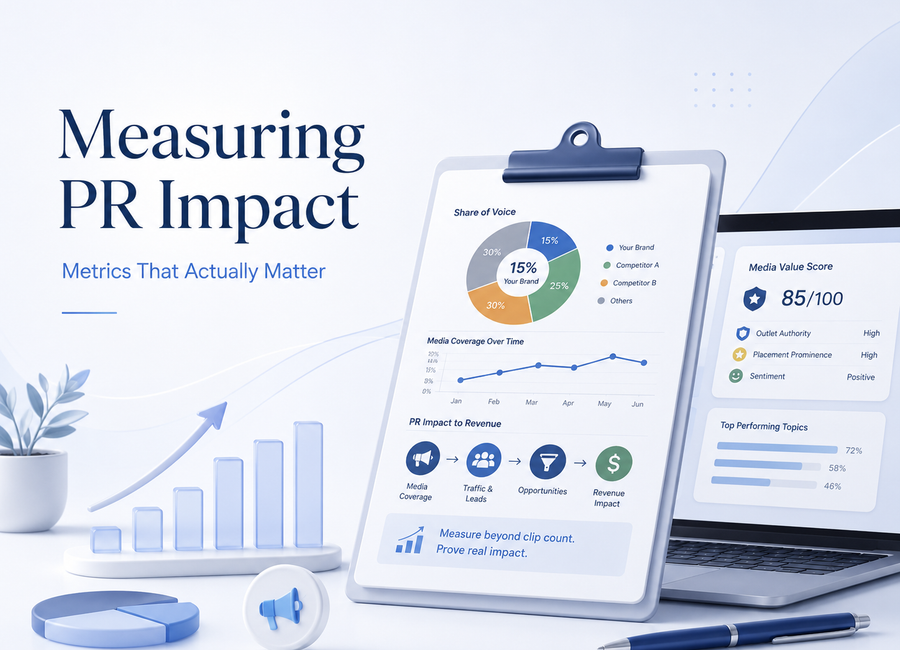
Measure Media Performance Against Objectives
Media success should be measured according to the original objective.
An awareness campaign may examine relevant reach, media prominence and branded search.
A positioning campaign may examine message pull-through and brand association.
A lead-generation campaign may examine referral traffic, enquiries and qualified opportunities.
A leadership campaign may evaluate interview quality, speaking invitations and executive search visibility.
The report should not reduce every campaign to article count.
Measure Media Quality
Media quality may include:
Publication relevance
Journalist authority
Story prominence
Headline inclusion
Message accuracy
Visual quality
Backlinks
Audience alignment
Article depth
Search visibility
One in-depth article may provide greater value than several copied press-release mentions.
Quality should be considered alongside quantity.
Measure Message Pull-Through
Message pull-through examines whether the coverage communicated the ideas the brand wanted audiences to understand.
An article may mention the company but ignore its central position.
A feature may focus entirely on a celebrity while providing little brand context.
The PR team should identify which narrative pillars and proof points appeared.
Weak message pull-through can reveal problems in the angle, pitch or spokesperson preparation.
Measure Branded Search
People often search for a brand after encountering media coverage.
The team can monitor searches for the company, founder, product and campaign.
Changes should be compared with a relevant baseline.
Other advertising, social activity and seasonal demand may influence the results.
Branded search growth supports the measurement picture but should not automatically be assigned entirely to one article.
A deliberate SEO strategy for luxury brands can help turn media-generated interest into sustained organic discoverability.
Measure Website Behaviour
Digital coverage may generate referral visits, direct traffic and search-driven sessions.
The brand can examine which pages people viewed, how long they engaged and whether they completed meaningful actions.
Traffic alone does not prove value.
A smaller number of visitors who explore services and submit qualified enquiries may be more valuable than large volumes of low-interest traffic.
Measure Qualified Enquiries
High-value brands should track whether media exposure contributes to suitable enquiries.
Sales teams can ask customers how they discovered the company and what influenced their decision.
The original media source should remain connected with the lead where possible.
The report should separate general traffic, total enquiries and qualified opportunities.
Measure Relationship Outcomes
Media relations can produce value beyond immediate coverage.
Journalists may return for future commentary.
The brand may be added to a source list.
Executives may receive panel, event or podcast invitations.
Other publications may discover the company through the initial feature.
These outcomes should be recorded while remaining separate from confirmed commercial results.
Avoid Advertising Value Equivalency
Advertising value equivalency attempts to estimate what editorial space would have cost as advertising.
It does not show customer trust, behaviour, revenue or genuine editorial value.
Advertising and independent coverage perform different functions.
A stronger report connects media quality with audience response, enquiries, search behaviour and organisational outcomes.
A structured PR ROI measurement framework provides a more useful approach to evaluating media value, visibility, leads and commercial influence.
Use an Integrated Measurement Framework
Media measurement should begin before outreach.
The organisation should define objectives, benchmarks, target audiences, activities, outputs, audience responses, outcomes and impact.
This creates a more credible reporting structure.
The number of pitches sent is an activity.
Published stories are outputs.
Audience understanding and trust are outcomes.
Qualified enquiries, partnerships and revenue may represent organisational impact.
These levels should not be confused.
Conduct a Post-Campaign Review
After the campaign, the team should examine what worked and what did not.
It should review publication fit, subject lines, angles, response rates, asset quality, spokesperson availability and timing.
Journalist feedback should be recorded.
The team should identify whether pitches were sent too late, whether data was insufficient or whether the company message was too promotional.
The review should improve the next campaign rather than simply close the report.
A Practical Premium Media Outreach Process
The process begins with a clearly defined communication and business objective.
The brand identifies the audience it needs to influence.
The PR team reviews company developments, customer insights, data, leadership expertise and cultural context to find genuine stories.
Several editorial angles are developed from the strongest subject.
Relevant premium, national, niche, trade and regional publications are researched.
Current journalists and editors are identified through mastheads, recent bylines and official publication information.
A tiered media list and outreach matrix are created.
The team decides whether the story requires an exclusive, embargo or wider release.
Spokespeople, facts, evidence, images and media materials are prepared before outreach.
Each journalist receives a concise, personalised pitch focused on editorial relevance.
The company responds quickly when media express interest.
One or two respectful follow-ups are completed where appropriate.
Interviews, samples, previews and fact-checking are managed professionally.
Published coverage is amplified responsibly through owned and digital channels.
Performance is measured through media quality, message pull-through, search interest, website behaviour, qualified enquiries and relationship outcomes.
The team conducts a formal review and updates its media knowledge for future campaigns.
When media attention creates criticism or an unexpected reputational issue, a prepared luxury brand crisis PR framework can help coordinate the response without compromising established media relationships.
Frequently Asked Questions
Q1. What is premium media coverage?
Premium media coverage refers to features, interviews, or editorial stories published in respected publications that have strong authority, relevance, or influence within a specific audience. It is not defined only by global magazine names but by the publication’s ability to shape perception among valuable readers, such as decision-makers, customers, or industry professionals.
Q2. Why is getting featured in premium media important for brands?
Premium media features build credibility that promotional content alone cannot achieve. They introduce the brand in a trusted editorial environment, validate expertise, improve search visibility, and strengthen trust during customer or investor decision-making. A strong feature can influence awareness, consideration, hiring interest, partnerships, and long-term brand perception.
Q3. Why do most press releases fail to get coverage?
Most press releases fail because they focus on announcements rather than stories. Journalists are not looking for company updates alone—they look for relevance, timing, originality, and audience value. Generic pitches sent to large media lists often lack editorial direction and do not provide a clear reason for coverage.
Q4. What makes a strong media pitch?
A strong pitch is built around a clear editorial idea rather than a company announcement. It explains why the story matters now, what makes it different, who it affects, and what evidence supports it. It is concise, personalized to the journalist’s beat, and offers useful access such as interviews, data, or visuals.
Q5. What role does timing play in media coverage?
Timing is critical because publications work on editorial calendars, seasonal planning, and production cycles. Even a strong story can fail if it arrives after a theme is closed or too close to the publication deadline. Early outreach increases the chance of inclusion, interviews, and meaningful editorial development.
Q6. How important are relationships with journalists?
Relationships improve trust and communication efficiency but do not guarantee coverage. Journalists rely on PR professionals who consistently provide accurate information, respect deadlines, and offer relevant stories. A reliable relationship increases the likelihood of future consideration and smoother editorial collaboration.
Q7. What types of stories work best for premium media?
Strong stories usually go beyond launches. They include industry trends, founder insights, craftsmanship, design innovation, customer behavior, data research, cultural relevance, or meaningful case studies. The key is connecting the brand to a larger conversation rather than focusing only on self-promotion.
Q8. What is the difference between earned and paid media?
Earned media is editorial coverage selected independently by journalists based on relevance and news value. Paid media includes sponsored articles, branded content, or advertisements where placement and messaging are controlled through commercial agreements. Both are useful but serve different purposes and should not be confused.
Q9. How should media success be measured?
Media success should be measured through quality and outcomes, not just volume. Key indicators include publication relevance, message accuracy, prominence of coverage, branded search growth, website engagement, qualified leads, and influence on business outcomes such as enquiries or partnerships.
Q10. What is the biggest mistake brands make in media outreach?
The biggest mistake is starting with the publication list instead of the story. When brands focus only on where they want to appear rather than what they have to say, pitches become generic and irrelevant. Strong media coverage always begins with a clear, compelling, and timely story.
Conclusion
Getting featured in premium media is not about volume, speed, or mass pitching—it is about clarity, relevance, and editorial value.
Strong coverage happens when a brand has a meaningful story, not just an announcement. Journalists choose ideas that connect with their audience, reflect current cultural or industry shifts, and offer credible evidence beyond promotional claims.
Success in premium media depends on three core factors working together:
a clear story, the right journalist, and the right timing.
When brands focus on positioning before publicity, build genuine editorial angles, and respect how media actually works, coverage becomes more consistent and impactful.
Ultimately, premium media is not a distribution channel—it is a trust-building system. It helps shape perception, strengthen authority, and support long-term brand growth when used strategically rather than tactically.
Brands that treat PR as storytelling rather than publicity consistently earn not just coverage, but credibility.
Final Insight
Premium media coverage is not a distribution exercise—it is a strategic storytelling process.
It works when positioning, editorial relevance, timing, and relationships align. Brands that consistently earn meaningful coverage are not louder—they are clearer about their story, more precise in their communication, and more respectful of how journalism actually works.
Build Strong Media Visibility With Strategic PR
We help brands develop media-ready stories, pitch strategies, and integrated PR and media marketing campaigns designed to secure meaningful coverage in premium publications.
For brands looking for location-specific support, explore our PR and media marketing services in Mumbai.
📩 info@dtsworld.in 📞 +91 80000 06021 📍 Andheri (West), Mumbai
Need this for your brand?
Let DTS build your next campaign.
From PR, celebrity management and events to websites, social media, SEO and AI video production — Double Trouble Studio helps brands grow with strategy and execution.
Discuss Your Requirement →