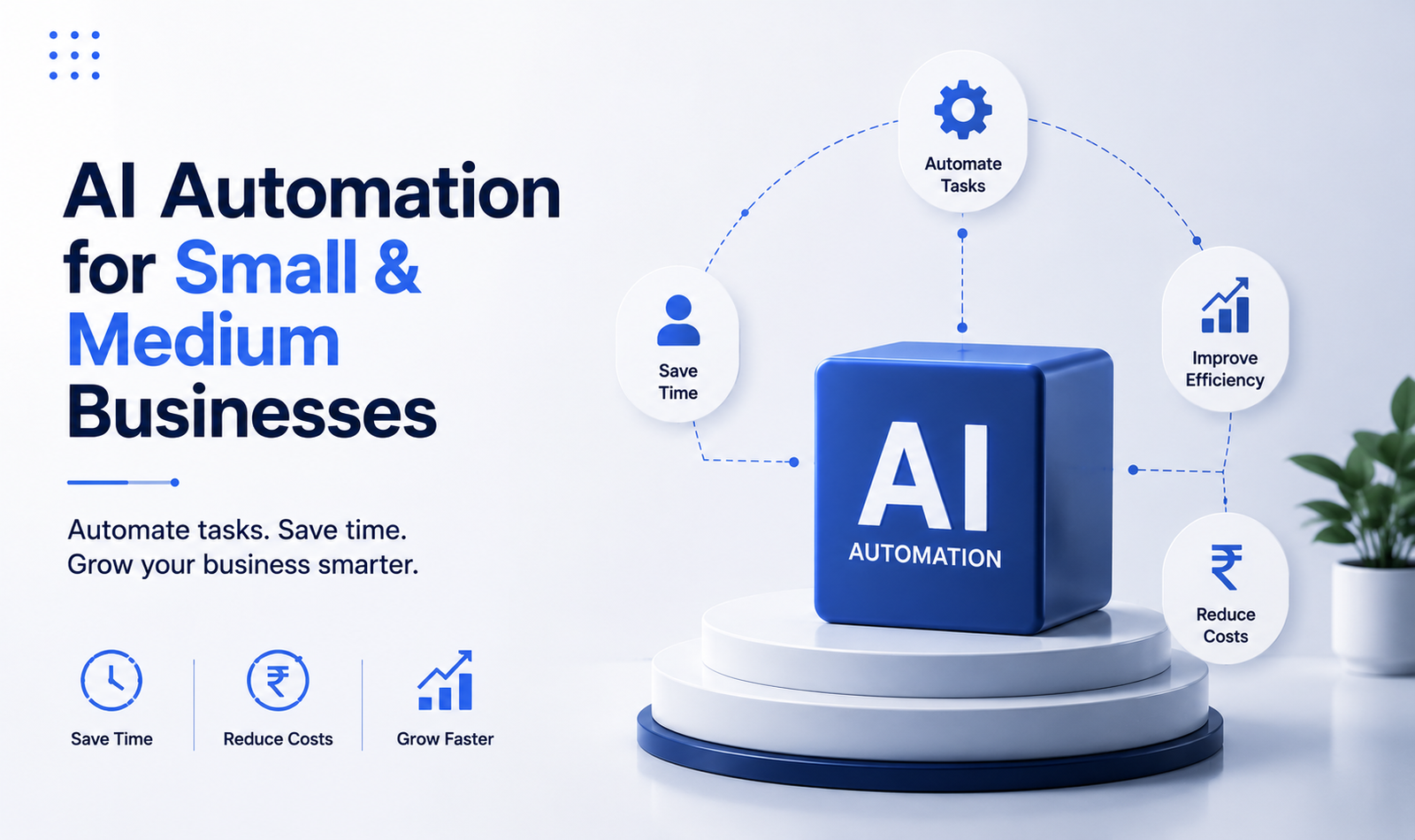
AI Automation for Small & Medium Businesses
Small and medium businesses are the backbone of every growing economy. They serve local markets, create employment, build customer relationships and often operate with limited teams and limited resources. However, in today’s fast-moving digital environment, small and medium businesses are expected to perform with the same speed, consistency and professionalism as larger companies.
Customers expect instant replies. Leads need timely follow-ups. Marketing needs regular content. Sales teams need proper tracking. Payments need reminders. Appointments need confirmation. Reports need to be reviewed. Customer questions need quick answers. Business owners are often forced to manage all these responsibilities while also handling operations, team coordination and growth planning.
This is where AI automation becomes highly valuable.
AI automation for small and medium businesses means using artificial intelligence and automated systems to reduce repetitive work, improve communication, organise workflows and make business processes faster. It allows companies to save time, reduce human error and create a smoother customer experience without needing a very large team.
AI automation is not about replacing people completely. It is about helping people work better. It supports teams by handling routine tasks so that business owners and employees can focus on strategy, sales, creativity, service quality and customer relationships.
For example, instead of manually replying to every common customer enquiry, an AI chatbot can answer frequently asked questions instantly. Instead of remembering every lead follow-up, an automated CRM system can send reminders and messages. Instead of creating marketing content from scratch every day, AI tools can assist with ideas, captions, emails and campaign drafts. Instead of checking scattered data manually, AI dashboards can help summarise performance and suggest what needs attention.
For small and medium businesses, this kind of automation can create a major difference. It helps the business become more organised, more responsive and more scalable.
One of the biggest problems small businesses face is missed opportunity. A customer sends an enquiry but does not receive a quick reply. A lead fills a form but no one follows up on time. A client asks for a quotation but the proposal is delayed. A customer is interested in booking a service but does not get proper confirmation. These small delays can result in lost revenue.
AI automation helps solve this by creating a structured system. Every enquiry can be captured. Every lead can be recorded. Every follow-up can be scheduled. Every customer can receive timely communication. Every team member can know what needs to be done next.
This improves both customer experience and business performance.
AI automation is especially useful for businesses that depend on leads and customer communication. Restaurants, salons, clinics, real estate companies, car rental businesses, event companies, coaching centres, ecommerce brands, hotels, travel agencies, service providers and local retailers can all benefit from automation.
A restaurant can use AI automation for reservation reminders, customer feedback, promotional messages and review responses. A clinic can use it for appointment confirmations, patient reminders and follow-up communication. A real estate company can automate lead qualification, property details and site visit reminders. A salon can automate booking reminders and repeat visit messages. An ecommerce brand can automate abandoned cart messages, order updates and customer support.
The possibilities are wide because every business has repeated tasks.
Marketing is one of the most important areas where AI automation helps small and medium businesses. Many businesses struggle to post regularly, write captions, plan campaigns or create ad copies. AI tools can help generate content ideas, prepare email drafts, create social media captions, write product descriptions and suggest campaign angles.
This does not mean every piece of content should be published without human review. The best results come when AI supports creative thinking and the brand team adds human judgement, tone and strategy. AI can speed up the process, but the brand voice should remain controlled and authentic.
Sales automation is another powerful use case. Many small businesses receive leads from WhatsApp, Instagram, websites, phone calls and ads. Without a proper system, these leads often get lost. AI automation can connect these enquiries to a CRM, classify them based on interest, send follow-up messages and remind the sales team to take action.
This creates a more professional sales process.
Instead of depending only on memory or manual notes, the business can track every lead from first enquiry to final conversion. It becomes easier to know which leads are hot, which customers need follow-up and which campaigns are generating real enquiries.
Customer service also becomes stronger through AI automation. Customers often ask the same questions about pricing, availability, delivery, location, timings, process and services. AI chatbots and automated response systems can handle these questions quickly and consistently.
This reduces pressure on the team and improves customer satisfaction.
However, businesses should not depend only on automation for sensitive or complex customer issues. Customers should always have the option to speak with a human when needed. AI should handle simple and repetitive communication, while human teams should manage emotional, high-value or complex conversations.
Operations can also become more efficient with automation. Internal reminders, task updates, meeting summaries, document creation, invoice follow-ups and workflow tracking can all be improved using AI-powered tools. This is especially useful for small teams where people handle multiple responsibilities.
AI automation also improves decision-making. Many businesses collect data but do not know how to use it. They may have information about leads, customers, sales, marketing campaigns and website traffic, but the data remains scattered. AI tools can help organise this information, identify patterns and provide insights.
For example, a business owner may learn which service receives the most enquiries, which marketing channel brings better leads, which customers are more likely to return or which follow-up message performs better. These insights help the business make smarter decisions.
Another major benefit of AI automation is consistency. A business may have a strong team, but manual work often leads to inconsistency. One customer receives a quick reply, another waits for hours. One lead gets proper follow-up, another is forgotten. One campaign is well planned, another is rushed.
Automation creates a standard process.
This consistency builds trust. Customers feel that the business is professional, responsive and organised. In competitive markets, this can become a major advantage.
Cost efficiency is also an important benefit. Hiring more people for every repeated task may not be possible for small and medium businesses. AI automation allows businesses to increase output without increasing team size at the same rate. It reduces time spent on manual work and helps existing teams perform better.
However, AI automation should not be implemented randomly. Many businesses make the mistake of adopting too many tools at once. They start using different platforms for chatbots, emails, CRM, social media, reporting and customer service without connecting them properly. This creates confusion instead of efficiency.
The right approach is to begin with business problems.
A business should first identify where time is being wasted. Is the team spending too much time replying to basic enquiries? Are leads not being followed up? Is content creation inconsistent? Are appointments being missed? Are payment reminders delayed? Are reports difficult to understand?
Once the main problem is clear, automation can be planned around that need.
A small business does not always need a complex automation setup. It may only need an automated enquiry system, a lead tracker, WhatsApp follow-up messages and appointment reminders. As the business grows, more automation can be added.
AI automation works best when implemented step by step. The first step can be automating customer enquiry replies. The second step can be lead capture and follow-up. The third step can be email marketing or WhatsApp campaigns. The fourth step can be reporting and analytics. Over time, these systems connect and create a stronger business workflow.
Data quality is very important in AI automation. If customer information is incomplete or poorly organised, automation may not work properly. Businesses should maintain clean customer records, correct phone numbers, updated email addresses, proper lead categories and clear service details.
Privacy and security are also important. Businesses must handle customer data responsibly. Contact numbers, emails, payment information, appointment details and private messages should be protected. Automation tools should be reliable, secure and used with proper access controls.
AI automation should also maintain brand tone. Automated messages should not sound cold, robotic or careless. A business should create response templates that feel polite, helpful and aligned with the brand personality. For luxury and premium businesses, the tone should be refined, personal and professional.
Human supervision is still essential. AI can draft, reply, summarise and suggest, but people must guide the system. The business must check accuracy, approve important messages, review customer complaints and ensure that automation supports the customer experience rather than weakening it.
AI automation also helps businesses scale. When a company grows, the number of enquiries, customers, orders and internal tasks increases. Without automation, the team may become overloaded. Processes that worked for 20 customers may fail with 200 customers.
Automation prepares the business for growth.
It creates systems that can handle larger volume without losing control. This is why businesses that want to scale should invest in automation early rather than waiting until operations become chaotic.
The future of small and medium businesses will be shaped by intelligent systems. Companies that combine human creativity with AI-powered workflows will be able to respond faster, market better, sell smarter and serve customers more professionally.
AI automation is not just a technology trend. It is a practical business tool.
It helps businesses save time, improve customer service, reduce missed leads, strengthen marketing, support sales and make better decisions. For small and medium businesses, these improvements can directly influence growth and profitability.
In simple terms, AI automation helps businesses move from manual confusion to structured growth.
It allows business owners to stop spending all their time on repeated tasks and start focusing on building the business. It gives teams better systems. It gives customers faster service. It gives sales teams better follow-up. It gives marketing teams stronger consistency.
The goal is not to make the business less human.
The goal is to make the business more efficient so that human effort can be used where it matters most.
When implemented properly, AI automation becomes one of the strongest growth tools for small and medium businesses.
Frequently Asked Questions
Q1. What is AI automation for small and medium businesses?
AI automation for small and medium businesses means using artificial intelligence tools and automated systems to handle repetitive tasks, improve communication, manage leads, support marketing, organise workflows and make daily business operations more efficient.
Q2. How can AI automation help small businesses grow?
AI automation helps small businesses grow by saving time, reducing missed follow-ups, improving customer response speed, organising sales processes and supporting consistent marketing. This allows business owners and teams to focus more on growth, service quality and customer relationships.
Q3. Is AI automation only for large companies?
No. AI automation is useful for small and medium businesses as well. Many affordable tools are available for enquiry management, WhatsApp replies, email marketing, CRM follow-ups, appointment reminders, content creation and reporting.
Q4. Can AI automation replace employees?
AI automation is not meant to replace employees completely. It supports employees by reducing repetitive manual work. Human creativity, decision-making, customer handling, strategy and relationship building remain very important.
Q5. Which tasks can small businesses automate with AI?
Small businesses can automate customer enquiries, lead capture, follow-up messages, appointment reminders, email campaigns, social media scheduling, invoice reminders, feedback collection, review responses, reporting and internal task management.
Q6. How does AI automation improve customer experience?
AI automation improves customer experience by giving faster replies, timely updates, personalised communication and smoother follow-ups. Customers feel more confident when a business responds quickly and provides clear information.
Q7. Is AI automation expensive for small businesses?
AI automation can be started with a small budget depending on the requirement. A business can begin with basic tools for customer replies, lead management or marketing automation and later add advanced features as the business grows.
Q8. Can AI automation help in sales and lead management?
Yes. AI automation can capture leads from websites, ads, social media and WhatsApp, organise them in a CRM, send follow-up reminders and help sales teams track each lead properly until conversion.
Q9. What is the first step to start AI automation?
The first step is to identify the most repetitive or time-consuming task in the business. This may be customer support, lead follow-up, appointment reminders, content planning or reporting. Once the main problem is clear, the right automation system can be built.
Q10. Why should small and medium businesses adopt AI automation now?
Small and medium businesses should adopt AI automation now because customer expectations are increasing and competition is becoming stronger. Automation helps businesses respond faster, work smarter, reduce manual errors and create a more professional customer experience.
Conclusion
AI automation has become an important growth tool for small and medium businesses.
It helps business owners reduce repetitive work, improve customer communication, manage leads better and create smoother internal processes. Instead of depending only on manual effort, businesses can use AI-powered systems to work faster and more consistently.
The real value of AI automation is not only in saving time. It is in creating structure. When enquiries are captured properly, follow-ups are sent on time, customers receive quick replies and reports become easier to understand, the entire business becomes more organised.
Small and medium businesses do not need to automate everything at once. They can start with one important area, such as lead management, customer support, appointment reminders or marketing workflows. As the business grows, more automation can be added step by step.
AI automation works best when it supports human effort. People still provide creativity, judgement, empathy and strategy. AI simply helps remove repetitive pressure so teams can focus on higher-value work.
In today’s competitive market, businesses that respond faster, communicate better and operate with clear systems will have a stronger advantage. AI automation gives small and medium businesses the power to scale with confidence, improve customer experience and build long-term growth.
Build Smarter Business Growth With AI Automation
If your business is still spending too much time on manual follow-ups, repeated customer replies, scattered leads and inconsistent workflows, AI automation can help you move faster with better control.
At Double Trouble Studio, we help small and medium businesses build AI-powered automation systems for lead management, customer communication, marketing workflows, content support and business operations — so your team can save time, improve performance and focus on real growth.
📩 info@dtsworld.in 📞 +91 80000 06021 📍 Andheri West, Mumbai
Need this for your brand?
Let DTS build your next campaign.
From PR, celebrity management and events to websites, social media, SEO and AI video production — Double Trouble Studio helps brands grow with strategy and execution.
Discuss Your Requirement →