AI Marketing Services for Business Growth
AI marketing services are reshaping how modern businesses grow, scale and compete in today’s digital ecosystem.
Marketing is no longer defined only by creativity, intuition or manual execution. It has evolved into a system driven by data intelligence, automation and predictive analytics. This transformation has changed not only how campaigns are executed but also how decisions are made across entire marketing ecosystems.
At its core, AI marketing services are designed to bring clarity, speed and precision into business-growth strategies.
Instead of relying on fragmented decision-making, brands can now operate within intelligent systems that continuously analyse user behaviour, optimise campaigns and improve performance in real time.
Professional website development and digital marketing services can help businesses connect AI tools with websites, SEO, content, paid campaigns, CRM workflows and measurable conversion systems.
This shift does not remove the importance of strategy.
Instead, it elevates it.
AI handles execution, analysis and optimisation, but human intelligence remains responsible for direction, storytelling and brand positioning.
The combination of both creates a marketing system that is not only efficient but also scalable and adaptive.
The wider impact of AI on digital marketing in 2026 shows how artificial intelligence now influences content, search, advertising, analytics, personalisation and customer communication.
AI marketing services are not a single tool or feature.
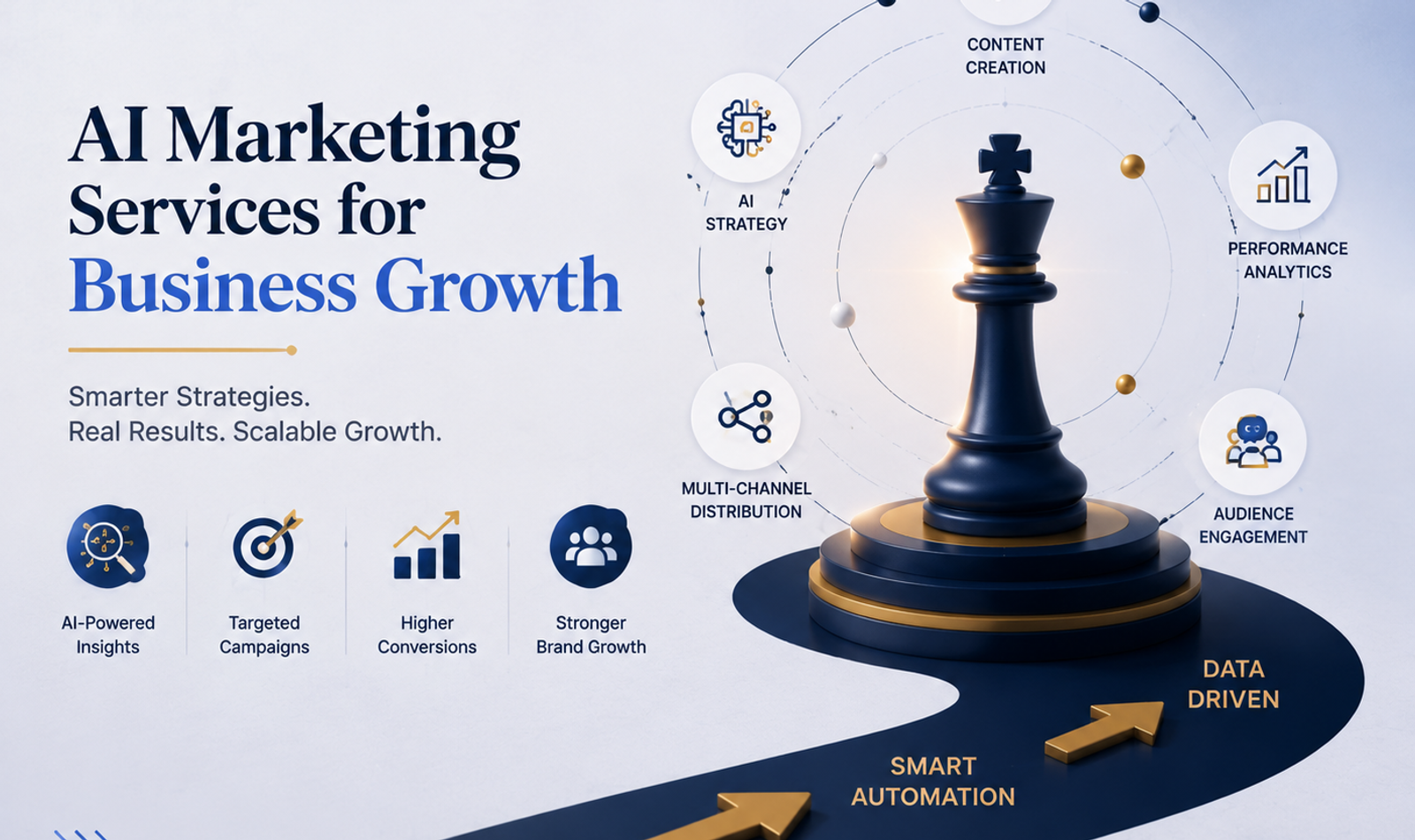
They represent a complete ecosystem that integrates:
- Content creation
- Advertising intelligence
- Customer segmentation
- Lead generation
- Search optimisation
- Marketing automation
- Customer journeys
- Performance analytics
Together, these systems allow businesses to operate with greater efficiency and consistency.
What Are AI Marketing Services?
AI marketing services use artificial intelligence to improve, automate and optimise different parts of the marketing process.
These services may include:
- AI-assisted content creation
- Social-media planning
- Advertisement-copy generation
- Audience research
- Lead scoring
- CRM automation
- SEO research
- Campaign analysis
- Personalised email marketing
- Website personalisation
- Predictive analytics
- Customer-service automation
The goal is not simply to introduce more tools.
The goal is to build an organised system that helps the business understand customers, communicate effectively and make better marketing decisions.
A successful AI-marketing system should connect strategy, creative execution, technology and sales.
Without this connection, businesses may use several AI tools without creating meaningful growth.
AI-Powered Content Creation
One of the most visible applications of AI in marketing is content creation.
Businesses can now generate structured content ideas, campaign variations and multi-platform messaging in significantly less time.
AI can assist with:
- Blog outlines
- Social-media captions
- Website copy
- Advertisement scripts
- Email drafts
- Video concepts
- Frequently asked questions
- Landing-page content
- Content calendars
However, the value of AI lies not in replacing creativity but in accelerating production.
Human input remains essential to preserve tone, emotional depth and brand identity, while AI provides speed, structure and scalability.
Businesses can follow suitable AI content-creation tools and best practices to improve output quality while maintaining originality, factual accuracy and human review.
AI-generated content should not be published automatically simply because it is quick to create.
Every piece should be reviewed for:
- Accuracy
- Relevance
- Brand tone
- Originality
- Customer value
- Commercial purpose
A fast content system is valuable only when it produces useful and credible communication.
AI in Social-Media Marketing
In social-media marketing, AI plays a critical role in understanding audience behaviour at scale.
It can identify engagement patterns, analyse content performance and detect emerging trends.
This allows brands to maintain consistency while improving visibility and interaction without relying only on manual planning.
AI can help social-media teams:
- Generate post ideas
- Build monthly calendars
- Create caption variations
- Develop Reel hooks
- Repurpose blogs
- Analyse engagement
- Identify successful formats
- Test different creative angles
A long-form article can become a carousel, short video, LinkedIn post, email and advertisement concept.
A connected content strategy for blogs, galleries and lead magnets can ensure that this repurposed content supports the wider brand journey instead of becoming disconnected platform activity.
However, social-media communication still requires human taste.
AI can identify patterns, but the brand must decide which ideas are worth publishing.
Audience understanding, cultural context, humour, timing and visual judgement remain human responsibilities.
AI Video Marketing
AI is also transforming video production and advertising.
Brands can use AI to support:
- Scriptwriting
- Storyboards
- Visual generation
- Voiceovers
- Subtitle creation
- Editing
- Content localisation
- Platform-specific variations
This allows businesses to create more video formats without repeating the same creative on every platform.
Professional AI video and video-editing services can help combine AI tools with creative direction, realistic visuals, storytelling and brand consistency.
AI video campaigns are useful for:
- Product launches
- Hospitality campaigns
- Restaurant promotions
- Real-estate marketing
- Fashion storytelling
- Event announcements
- Service advertisements
- Corporate explainers
Brands can also explore the benefits, costs and use cases of AI video advertising before selecting the most suitable production and distribution model.
AI can make video creation faster, but strong concepts, emotional pacing and visual quality still require human creative judgement.
AI-Powered Advertising
Advertising has undergone a major transformation through AI integration.
Modern advertising platforms already use machine learning for:
- Targeting
- Bidding
- Delivery
- Attribution
- Audience expansion
- Campaign optimisation
AI marketing services build on this foundation by continuously testing creative variations, analysing conversion data and reallocating attention towards higher-performing segments.
This creates a dynamic advertising system where performance can improve continuously rather than remaining static.
AI can help marketers generate:
- Multiple hooks
- Headline variations
- CTA options
- Audience-specific messages
- Creative concepts
- Landing-page recommendations
This reduces the time needed to test different campaign directions.
However, successful advertising still requires:
- A clear objective
- Correct tracking
- Relevant targeting
- Strong creative
- Suitable budget allocation
- Landing-page alignment
- Lead follow-up
Businesses comparing organic and paid acquisition can review SEO versus Google Ads for business growth to understand when each channel may be appropriate.
AI can improve campaign execution, but it cannot fix an unclear offer or weak customer proposition.
AI Marketing and SEO
Search optimisation and SEO have also evolved through AI systems.
AI tools can process large volumes of search data, identify intent-based opportunities and structure content strategies accordingly.
This can significantly reduce research time while improving targeting accuracy.
AI may help with:
- Keyword clustering
- Search-intent analysis
- Content-gap research
- Topic planning
- Metadata drafts
- FAQ development
- Internal-link suggestions
- Competitor analysis
However, long-term authority still depends on consistent publishing, strong positioning and credible content development.
A practical on-page SEO checklist for higher rankings can help businesses optimise titles, headings, URLs, internal links, images and content structure.
Technical accessibility is equally important.
A complete technical SEO website optimization guide can help ensure that AI-assisted content remains crawlable, indexable and understandable to search engines.
AI can speed up SEO planning, but it should not be used to create large quantities of thin or repetitive pages.
Useful content, expertise and originality remain essential.
AI Overviews, AEO and GEO
Search is increasingly becoming answer-driven.
AI-powered search systems may provide summaries directly within the search experience.
This means brands need to optimise for:
- Traditional SEO
- AI Overviews
- Answer Engine Optimisation
- Generative Engine Optimisation
- Entity understanding
- Direct question answering
Content should be clear, structured and specific.
Definitions, FAQs, examples, processes and supporting evidence help search and answer systems interpret the page.
AI does not remove the need for SEO.
It increases the importance of high-quality structure, technical accessibility and trustworthy information.
Brands should also develop strong branded search demand so customers actively look for their business rather than only generic solutions.
AI-Powered Personalisation
One of the most powerful aspects of AI marketing services is personalisation.
Modern customers expect communication that feels relevant to their needs.
AI enables businesses to deliver personalised:
- Advertisements
- Emails
- Product recommendations
- Website experiences
- Follow-up messages
- Service suggestions
- Content journeys
This personalisation can be based on behaviour, interests, previous interactions and buying intent.
For example, a visitor exploring luxury hotel content may later receive information about private stays, destination weddings or weekend experiences.
An ecommerce customer viewing a product may receive relevant recommendations or availability updates.
A service lead downloading a guide may enter a follow-up journey connected to the topic they selected.
This level of relevance can improve engagement and conversion because it aligns communication with individual intent.
Luxury and premium brands should apply personalisation carefully.
A suitable high-ticket conversion strategy for luxury brands can help businesses use AI while preserving privacy, exclusivity and refined customer communication.
Personalisation should feel like thoughtful service, not intrusive monitoring.
AI-Driven Lead Generation
AI enhances lead-generation systems by identifying high-intent users through behavioural signals and interaction patterns.
Instead of treating every visitor equally, businesses can focus on people who show a higher probability of conversion.
Signals may include:
- Multiple page visits
- Service-page engagement
- Brochure downloads
- Form interactions
- Product views
- Repeat website visits
- Email engagement
- Consultation interest
AI can help classify leads according to interest, readiness and potential value.
This improves sales efficiency and reduces wasted effort across marketing funnels.
However, lead scoring should support human teams rather than replace judgement completely.
A lead with limited activity may still represent a major opportunity. A highly active user may be a student, competitor or researcher rather than a genuine customer.
AI provides indicators, but sales teams must interpret the context.
Marketing Automation
Marketing automation strengthens AI systems by managing repetitive workflows.
These workflows may include:
- Email sequences
- Retargeting campaigns
- CRM updates
- Lead assignments
- Follow-up reminders
- Customer-journey triggers
- Appointment confirmations
- Abandoned-enquiry messages
Automation ensures consistent communication without requiring manual intervention at every stage.
For example, a visitor may click an advertisement, reach a landing page and submit an enquiry.
The CRM can record the lead, classify the service interest, send a confirmation and notify the sales team.
If the lead does not respond, a follow-up can be triggered automatically.
A structured conversion-focused marketing funnel can help connect these actions from awareness to enquiry and sales follow-up.
Automation is particularly valuable for businesses investing in paid advertising.
Missed or delayed follow-ups can waste the cost of the entire campaign.
Human teams should still handle complex questions, high-value opportunities and sensitive conversations.
Customer Segmentation
AI allows businesses to segment audiences according to behaviour, interest and intent.
Customers may be grouped as:
- New visitors
- Returning visitors
- Active leads
- Inactive leads
- Repeat buyers
- High-value customers
- Early researchers
- Purchase-ready users
Each group may require a different message.
A new visitor may need education.
A returning visitor may need proof or a case study.
An inactive lead may need a reminder or updated offer.
A high-value customer may benefit from private access or personalised support.
Segmentation improves both marketing efficiency and customer experience.
The goal is not to create unnecessary complexity.
It is to communicate more appropriately according to where the customer is within the journey.
AI Analytics and Predictive Insights
AI analytics can process campaign and customer data more quickly than manual reporting.
It can help businesses identify:
- High-performing creatives
- Strong audience segments
- Customer drop-off points
- Underperforming pages
- Lead-quality patterns
- Conversion bottlenecks
- Budget inefficiencies
This allows marketing teams to make decisions during a campaign rather than waiting for the final report.
AI can also simplify large dashboards into practical summaries for business owners.
For example, it may indicate that:
- Advertisement engagement is strong
- Landing-page conversion is weak
- Mobile users are leaving early
- Follow-up time is too slow
- One audience segment is generating better-quality leads
These insights help businesses prioritise changes.
However, AI conclusions are only as reliable as the available data.
Incorrect tracking, duplicate conversions and incomplete CRM updates can produce misleading recommendations.
Data quality should therefore be reviewed before major decisions are made.
AI Marketing and Website Performance
AI-supported marketing still depends on website quality.
Chatbots, personalisation scripts, tracking platforms and automation tools can add technical weight to a website.
When too many tools are installed without planning, pages may become slow or unresponsive.
Strong technical SEO foundations for speed, mobile usability and Core Web Vitals help protect the customer experience.
A successful AI-marketing website should:
- Load quickly
- Work properly on mobile
- Use clear navigation
- Keep forms simple
- Track conversions accurately
- Protect customer data
- Avoid unnecessary scripts
The website remains the central destination for many marketing journeys.
AI tools cannot produce strong results when the landing experience is slow, confusing or technically unstable.
AI Marketing for Small Businesses
AI marketing is highly relevant for small and medium-sized businesses.
It allows them to automate tasks, produce content and analyse campaigns without requiring very large teams.
A small business may use AI to:
- Plan monthly content
- Generate advertisement variations
- Draft email campaigns
- Organise leads
- Summarise analytics
- Respond to basic enquiries
- Identify customer questions
- Repurpose existing content
This can improve efficiency and help smaller businesses compete more effectively with larger brands.
However, they should avoid subscribing to too many disconnected tools.
The best approach is to begin with one clear problem.
For example:
- Slow content production
- Missed leads
- Weak campaign reporting
- Inconsistent follow-up
- Poor customer segmentation
The business can then select tools and workflows that solve that problem.
AI Marketing for Luxury and Premium Brands
Luxury brands should not use AI only to produce more content or automate every interaction.
They should use it to improve relevance, service and consistency while preserving exclusivity.
AI can support:
- Private-client journeys
- Premium campaign variations
- High-value lead qualification
- Personalised recommendations
- Editorial planning
- Customer-service workflows
- Audience segmentation
A clear luxury brand strategy roadmap can help premium businesses determine where AI should support the brand and where human interaction should remain central.
The best AI use may remain invisible to the customer.
It can help the business respond faster and understand preferences better without making the experience feel mechanical.
Luxury marketing still depends on taste, discretion and emotional intelligence.
AI Marketing for Local Businesses
Local businesses can use AI to understand regional demand, customer reviews and location-based search behaviour.
A restaurant may identify interest in:
- Delivery speed
- Hygiene
- Family dining
- Signature dishes
- Local offers
A clinic may identify common treatment and appointment questions.
A salon may analyse demand for specific services within a neighbourhood.
AI can help create location-specific content and advertisement variations, but the information must remain accurate and locally relevant.
A focused local SEO strategy for Mumbai businesses can help combine AI research with location pages, Google Business Profile optimisation and regional search intent.
Copied or generic city pages should be avoided.
Local customers need useful information about service areas, availability, proof and contact options.
The Business Benefits of AI Marketing Services
The impact of AI marketing services on business growth can be significant.
Improved Operational Efficiency
AI reduces manual workload and helps teams complete repetitive tasks faster.
Better Targeting Accuracy
AI can identify audience patterns and support more relevant campaign segmentation.
Increased Return on Investment
Continuous testing and optimisation can improve budget allocation and reduce wasted spending.
Stronger Customer Experience
Personalised communication helps customers receive more relevant information and support.
Scalable Growth
Automation allows businesses to manage more leads and campaigns without proportional increases in manpower.
Faster Decision-Making
AI analytics can convert large amounts of data into practical insights.
The commercial value comes from combining these advantages within one connected system.
Using individual AI tools without integration may provide convenience but not sustainable growth.
Limitations of AI Marketing
AI marketing also comes with limitations.
Its effectiveness depends heavily on data quality.
Inaccurate or incomplete data can produce misleading insights.
AI also lacks complete emotional intelligence.
It cannot fully replace:
- Human storytelling
- Cultural awareness
- Brand intuition
- Ethical judgement
- Customer empathy
- Strategic leadership
Overreliance on automation can create communication that feels mechanical or disconnected from the brand.
AI tools may also generate incorrect information or unsupported recommendations.
Every important output should be reviewed before it influences a public campaign or business decision.
Responsible AI and Data Security
AI marketing systems may process customer enquiries, website behaviour, CRM records and campaign information.
Businesses should protect this information responsibly.
Sensitive data should not be copied into public AI tools without suitable approval and controls.
Forms, websites and CRM platforms should use secure connections and appropriate access permissions.
Suitable website-security practices for premium clients can help businesses protect customer data while implementing AI workflows.
Brands should also avoid using AI for:
- Fake testimonials
- Misleading claims
- Unauthorised likenesses
- Hidden sponsored communication
- Manipulative personalisation
Trust remains essential to long-term growth.
The Role of Human Strategy
The most effective AI-marketing approach is based on balance.
AI should be used for:
- Execution
- Optimisation
- Analysis
- Repetitive workflows
- Variation generation
Humans should focus on:
- Strategy
- Creative direction
- Storytelling
- Positioning
- Ethical judgement
- Customer relationships
This combination supports both performance and authenticity.
The role of the marketer is therefore changing.
Modern marketers need to understand prompts, automation, data, content systems, customer journeys and creative evaluation.
They must know how to guide AI rather than depending on it blindly.
The Future of AI Marketing Services
As AI continues to evolve, marketing systems will become increasingly predictive and automated.
Campaigns will adapt in real time.
Content will become more dynamic.
Customer journeys will become more personalised across multiple touchpoints.
AI systems may identify likely customer needs before the user makes a direct enquiry.
Websites and email journeys may change according to audience behaviour.
Advertising systems may test and optimise more creative variations automatically.
However, stronger automation will make brand strategy even more important.
When every business can generate content and launch campaigns quickly, differentiation will depend on:
- Original thinking
- Customer understanding
- Brand voice
- Creative judgement
- Real expertise
- Meaningful experiences
Businesses that adopt AI marketing services effectively can gain an advantage by operating faster, testing more ideas and optimising continuously according to real-time insights.
Frequently Asked Questions
What Are AI Marketing Services?
AI marketing services use artificial intelligence to automate, optimise and improve marketing activities such as content creation, advertising, SEO, lead generation, customer segmentation and personalisation.
How Do AI Marketing Services Help Business Growth?
AI marketing services help businesses grow by improving targeting accuracy, increasing operational efficiency, optimising campaign performance and enabling personalised communication.
This can lead to better conversions, lower wasted spending and improved marketing ROI.
Can AI Replace Traditional Marketing?
AI cannot replace traditional marketing completely.
It improves marketing systems by handling automation and data analysis, while humans remain essential for creativity, storytelling, strategy and brand direction.
Is AI Marketing Suitable for Small Businesses?
Yes.
AI marketing can be valuable for small businesses because it reduces repetitive work, improves follow-up, supports content production and allows smaller teams to run more organised campaigns.
What Are the Limitations of AI Marketing?
AI marketing depends heavily on data quality and lacks complete emotional understanding.
Without human oversight, it may produce generic content, inaccurate insights or communication that feels mechanical.
Does AI Marketing Improve SEO?
AI can improve SEO research, content planning, metadata development and topic clustering.
However, strong SEO still requires helpful content, technical accessibility, authority, internal linking and long-term consistency.
Can AI Marketing Improve Lead Generation?
Yes.
AI can identify behavioural signals, score leads and automate follow-up journeys.
Human teams should still review high-value opportunities and complex enquiries.
Is Customer Data Safe in AI Marketing Systems?
Customer data can be managed safely when businesses use secure platforms, access controls, privacy policies and responsible data practices.
Sensitive information should not be entered into public tools without proper approval.
Conclusion
AI marketing services represent a major shift in how businesses approach growth in the digital era.
They introduce intelligence, automation and predictive capability into every stage of the marketing process, transforming how campaigns are created, executed and optimised.
However, the true value of AI lies not in replacing human effort but in enhancing it.
When combined with strong strategy, creative direction and clear brand positioning, AI becomes a powerful system for scalable and sustainable business growth.
Businesses that integrate AI marketing effectively can move faster, understand customers better and optimise performance continuously.
They can create more relevant campaigns, improve lead management and make stronger decisions using real-time insights.
AI should not be treated as a shortcut.
It should be treated as infrastructure that supports the complete marketing system.
The strongest results come when automation, creativity, data and customer experience operate together.
Build an AI-Powered Marketing System With Double Trouble Studio
At Double Trouble Studio, we build AI-driven marketing systems that combine automation with strategy and creativity to help brands scale intelligently within a fast-evolving digital landscape.
Our services can include AI content systems, website development, search optimisation, campaign planning, AI video, marketing automation, landing pages, CRM journeys and conversion improvement.
Businesses looking for website development and digital marketing services in Mumbai can work with our team across AI strategy, content, SEO, advertising and lead-generation workflows.
Brands can review Double Trouble Studio’s completed work to explore how strategy, websites, video, campaigns and creative execution can work together.
Contact Double Trouble Studio to discuss AI marketing services, automation, content systems, SEO, websites, video campaigns and scalable digital growth.
📩 info@dtsworld.in 📞 +91 80000 06021 📍 Andheri West, Mumbai
Need this for your brand?
Let DTS build your next campaign.
From PR, celebrity management and events to websites, social media, SEO and AI video production — Double Trouble Studio helps brands grow with strategy and execution.
Discuss Your Requirement →