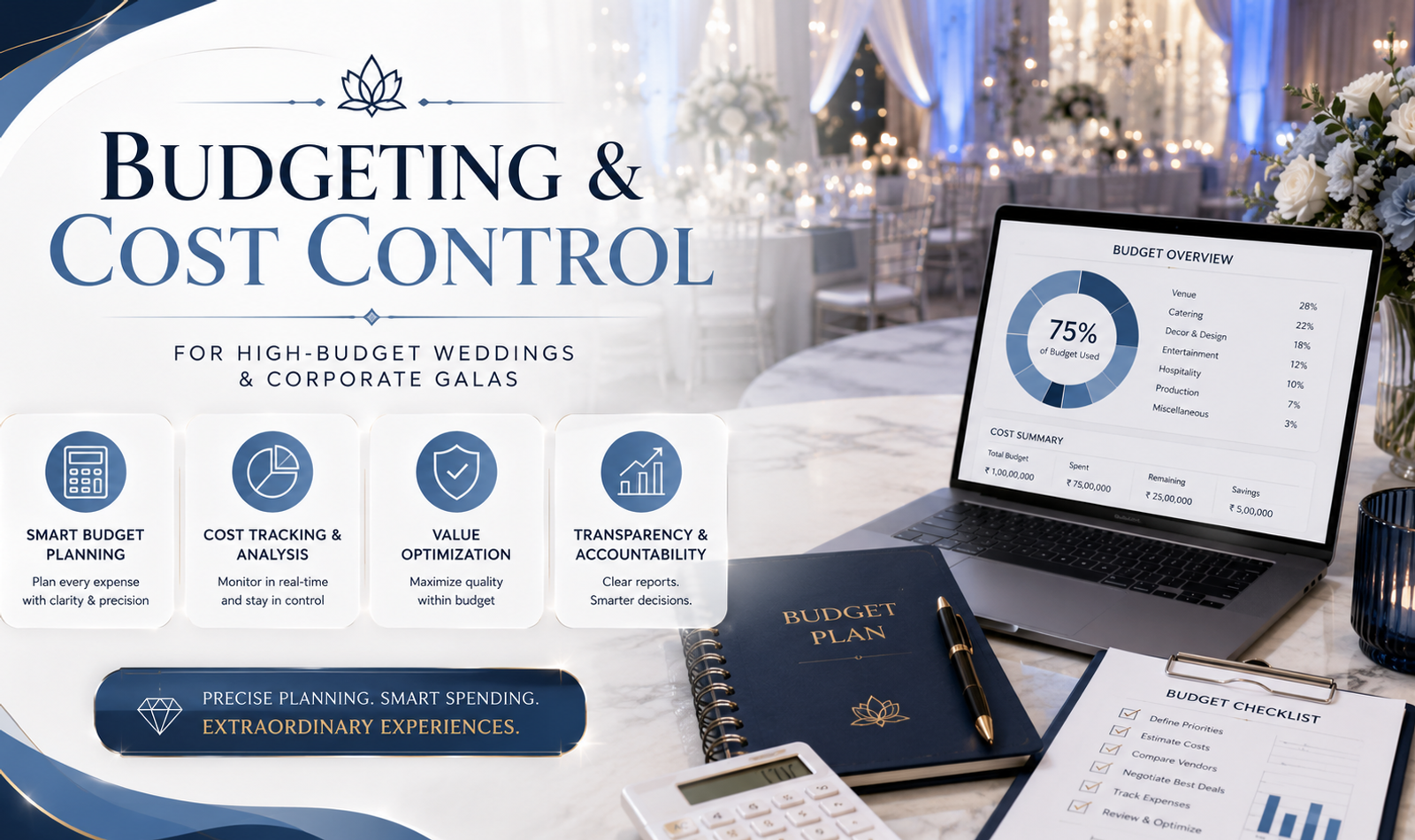
Budgeting & Cost Control for High-Budget Weddings & Corporate Galas
High-budget weddings and corporate galas require more than a generous financial allocation. They require a disciplined budgeting system that connects every creative decision, vendor appointment, guest requirement and operational change to the complete financial picture.
Luxury events often involve several venues, complex décor, entertainment, hospitality, production, travel, security, content and more than twenty specialist suppliers. Even when the initial budget is substantial, uncontrolled additions and unclear responsibilities can create financial pressure quickly.
Budgeting for a premium event is not about selecting the cheapest option or reducing the quality of the experience. It is about directing investment towards the elements that create the greatest guest, relationship or business value while controlling expenditure that does not strengthen the event.
A well-managed budget allows the organiser to make ambitious creative decisions with confidence. It provides enough visibility to understand what has been committed, what remains flexible and where contingency is available.
This guide explains how to build and control budgets for luxury weddings, corporate galas, award ceremonies, destination celebrations and high-profile private events. It covers cost allocation, forecasting, procurement, negotiations, approvals, payment tracking, contingency planning and post-event financial closure.
Quick Answer
Luxury event budgeting should begin with the event objective, realistic guest count, venue requirements and experience priorities. The total budget should then be divided into detailed categories covering venue, food, rooms, design, production, entertainment, hospitality, transport, security, content and professional fees.
Every vendor quotation should be compared against the same approved scope. Taxes, travel, labour, setup, overtime and exclusions must be added before the true cost is evaluated.
Cost control requires one central budget tracker, written change approvals and clear financial authority. No additional work should be treated as confirmed until its cost and impact have been reviewed.
A contingency reserve should remain protected for genuine unexpected requirements. It should not become an informal fund used to approve every new creative idea during the final stage.
What Is Luxury Event Budgeting?
Luxury event budgeting is the process of forecasting, allocating, approving, tracking and reconciling every cost involved in a premium event. It begins before the venue is booked and continues until final vendor accounts are closed.
The budget should show more than one estimated total. It should explain where the money is being invested, when payments are due, what assumptions have been used and which costs remain uncertain.
For weddings, the budget may include multiple functions, rooms, guest travel, hospitality, décor, artists, photography and family requirements. Corporate gala budgets may include production, branding, speakers, entertainment, media, delegate management and measurable business outcomes.
The purpose of the budget is to support decisions. It should help the host understand the financial impact of every addition, reduction and change before the event reaches execution.
Why High-Budget Events Still Exceed Their Budgets
A large budget does not protect an event from financial mismanagement. In many cases, higher budgets create more opportunities for uncontrolled expansion because each individual addition appears small compared with the total.
The event may begin with one stage concept and later add suspended installations, extra screens, artist requirements and extended setup access. Each change affects several departments and increases both direct and indirect costs.
guest-list growth is another major reason for overspending. Additional guests affect food, rooms, transport, seating, gifting and staffing at the same time.
Budget overruns also occur when early quotations exclude taxes, travel, labour, power, overtime or dismantling. The headline amount may appear acceptable while the complete financial commitment remains hidden.
Budgeting Is an Experience Strategy
A luxury event budget should express the priorities of the host or organisation. It should show what the event is designed to make guests feel and what outcomes it is expected to create.
A family may value hospitality, food, music and personalisation more than oversized decorative scale. A corporate gala may prioritise production quality, client engagement, content and sponsor value.
When priorities are unclear, expenditure becomes evenly spread across too many areas. The event may contain several expensive elements without one memorable or meaningful experience.
Strategic budgeting concentrates investment around the event’s strongest moments. It also protects guest comfort, safety and service from being reduced to support less important visual additions.
Wedding Budgets and Corporate Gala Budgets Are Different
Luxury weddings are relationship-led events involving families, traditions, hospitality and emotional expectations. The budget must often account for several functions, destination travel, room blocks, family gifting and ceremonial requirements.
Corporate galas are generally connected to business positioning, fundraising, awards, client relationships or employee recognition. Their budgets may require stronger reporting, procurement controls and measurable return.
A wedding may justify a high-cost entertainment or décor decision because it creates personal meaning. A corporate organisation may require a clearer business case before approving the same expenditure.
The budgeting system should reflect these differences. Applying one universal percentage structure to every high-budget event can produce inaccurate priorities.
Begin with the Event Objective
The budget should begin with a written event objective. The organiser should understand why the event is being held and what success will look like.
For a wedding, success may include family satisfaction, seamless hospitality and meaningful cultural celebration. For a corporate gala, it may include sponsor visibility, stakeholder engagement, employee recognition or media impact.
Every major cost should connect to the objective. This prevents spending from being driven only by trends, social comparison or last-minute enthusiasm.
When budget pressure appears, the objective helps determine what should be protected. It also helps identify costs that look impressive but contribute little to the intended outcome.
Define the Real Financial Limit
The organiser should distinguish between the preferred budget, the maximum approved budget and the emergency financial limit. These numbers should not be treated as the same amount.
The preferred budget is the target around which planning should be structured. The maximum approved budget includes controlled flexibility for justified changes.
The emergency limit should remain confidential and should not be communicated as additional available spending. If every vendor and stakeholder plans around the highest possible number, cost control becomes difficult.
The financial limit should include applicable taxes and professional fees. A pre-tax number can create a false sense of remaining capacity.
Create a Complete Budget Architecture
A strong event budget is divided into major categories and detailed subcategories. This makes it possible to identify where expenditure is increasing.
Venue rental should be separated from accommodation, catering, power and overtime. Décor should be separated from production, furniture, florals and fabrication.
Hospitality, transport, gifting and guest managementshould also have individual lines. Combining too many services into one category reduces visibility.
The budget architecture should match the scale of the project. A destination wedding or multi-day gala requires greater detail than a single-evening private dinner.
Typical High-Budget Event Allocation Table
Budget Category
Luxury Wedding Focus
Corporate Gala Focus
Common Cost Risk
Venue and spaces
Multiple functions and ceremonies
Ballroom, stage and networking areas
Setup and overtime
Food and beverages
Multi-event menus and hospitality
Delegate dining and bar service
Final guest guarantee
Accommodation
Family and guest rooms
Speakers and senior stakeholders
Unused room inventory
Décor and design
Florals, structures and styling
Brand environments and scenic design
Late concept changes
Technical production
Sound, lights, screens and power
Stage, presentations and broadcast
Additional equipment
Entertainment
Artists, bands and performances
Hosts, speakers and headline acts
Riders and travel
Guest management
RSVPs, seating and VIP care
Registration and delegate services
Guest-list expansion
Transport
Airports, hotels and venue movement
Executive and group movement
Last-minute vehicle demand
Photography and content
Films, portraits and social edits
Event content and media assets
Extended coverage
Security and compliance
VIP protection and permissions
Access, safety and venue compliance
Additional deployment
Planning and management
End-to-end coordination
Strategy and production management
Unclear scope
Contingency
Weather and guest changes
Technical and programme changes
Premature use
The allocation should not be applied as a fixed percentage template. The event objective, venue and guest profile should determine the final structure.
Build the First Cost Forecast
The first forecast should be created before major vendors are appointed. It gives the organiser a realistic understanding of what the proposed experience may cost.
The forecast can use recent vendor estimates, venue proposals and planning experience. Every assumption should be identified clearly.
Unconfirmed items may be shown as estimated ranges rather than false precision. This allows the host to see which categories still carry uncertainty.
The first forecast should also include contingency and taxes. These should not be added only after the creative concept has already consumed the available budget.
Separate Fixed and Variable Costs
Fixed costs remain largely unchanged even when the guest count changes. These may include the main venue rental, stage structure, artist fee or planning retainer.
Variable costs increase according to attendance, rooms, vehicles, gifts or service consumption. Catering is one of the most significant variable categories.
Understanding this difference helps the organiser evaluate guest-list changes. An additional fifty guests may not affect the stage cost, but they can increase food, seating, transport and gifting.
The budget tracker should identify fixed and variable lines. This makes scenario planning faster and more accurate.
Identify Semi-Variable Costs
Some event expenses are not fully fixed or fully variable. They increase when a certain capacity threshold is crossed.
Additional guests may require another dining section, extra registration counters or a larger transport fleet. A production system may need another screen only when the room layout changes.
These semi-variable costs can create unexpected budget jumps. The organiser should not assume that every additional guest carries only a simple per-person catering cost.
The planning team should identify important thresholds early. Capacity decisions can then be made with a complete understanding of their financial impact.
Create Budget Scenarios
High-budget events benefit from best-case, expected and maximum-cost scenarios. This approach shows how the total may change according to guest count and creative scope.
The expected scenario should reflect the most realistic planning assumptions. The maximum scenario may include higher attendance, extended venue hours or additional technical requirements.
Scenario planning also supports decision-making when the budget must be reduced. The planner can show which elements can be modified without rebuilding the complete event.
Corporate teams may require several formal budget options for approval. Families may also benefit from seeing the experience difference between alternatives.
Budget Scenario Checklist
• Expected guest count
• Maximum guest count
• Core experience
• Enhanced experience
• Optional additions
• Weather backup
• Tax exposure
• Contingency impact
Each scenario should use the same category structure. This makes comparison clear and prevents optional additions from being hidden inside the main total.
Set Category Limits
Each budget category should receive an approved limit based on the event priorities. The limit creates a decision framework for vendor selection and design development.
A category limit does not need to prevent creativity. It helps vendors propose solutions that are commercially suitable from the beginning.
If one category exceeds its limit, the increase should be balanced through a reduction elsewhere or approved as an increase to the complete budget.
Category limits should be reviewed when major assumptions change. A venue change or guest-list increase may require the complete allocation to be adjusted.
Protect High-Priority Categories
The organiser should identify categories that cannot be compromised without damaging the experience. These may include guest comfort, food, safety, production reliability or hospitality.
Luxury events can appear impressive but fail because essential service categories were reduced to support additional décor. Guests remember queues, poor sound and delayed transport more strongly than many decorative details.
Budget protection ensures that operational quality remains stable. Creative expenditure should not consume the funds required for safe and reliable delivery.
The priority list should remain visible during change discussions. Every addition should be evaluated against what it may force the project to reduce.
Create an Optional Enhancement List
Optional enhancements should remain separate from the core approved budget. These may include additional entertainment, upgraded florals, custom gifts or extended content coverage.
The list allows the host to consider enhancements after essential services are protected. It also creates a controlled method for using genuine budget savings.
Optional items should include complete costs and decision deadlines. Some enhancements may become more expensive or impossible when approved too late.
The existence of an optional list does not mean every item should eventually be added. It provides choice without weakening the financial foundation.
Include Taxes from the Beginning
Vendor quotations may be presented before applicable taxes and service charges. Comparing pre-tax amounts creates inaccurate budget expectations.
The central budget should show the expected final payable value. Where the exact tax treatment requires professional confirmation, the line should be identified clearly.
Corporate organisations may also need to consider input-credit treatment, withholding requirements and vendor documentation according to their finance policies. These matters should be reviewed with qualified financial professionals.
Wedding budgets should similarly include the full expected payment rather than focusing on the base quotation. Financial transparency should begin before the contract is signed.
Account for Professional Fees
Planning, design, production management, legal review, security consultancy and permission support may involve professional fees. These costs should remain visible.
Professional management is often the system that protects the much larger event expenditure. Removing this category without considering the operational impact can create higher losses elsewhere.
The scope of each professional fee should be understood. A planning retainer may not include décor design, hospitality staffing or production equipment.
Fees should be compared according to responsibility and value, not only percentage. The least expensive management option may not be suitable for a highly complex event.
Plan the Contingency Reserve
A contingency reserve protects the event from genuine uncertainty. It may cover weather changes, guest increases, technical replacements or essential emergency requirements.
For complex events, contingency should be established during the first forecast rather than created from whatever money remains at the end.
The appropriate level depends on venue, destination, weather, vendor certainty and project complexity. Events with several outdoor functions or international logistics may require stronger protection.
Contingency should have clear approval authority. Department leads should not use it independently for creative upgrades.
What Contingency Should Cover
• Weather changes
• Guest increases
• Technical replacements
• Transport emergencies
• Venue extensions
• Safety requirements
• Essential repairs
• Programme disruption
Contingency should not normally cover avoidable late planning, unapproved upgrades or repeated changes of preference.
Avoid Using Contingency Too Early
The contingency reserve often appears attractive when an early creative idea exceeds its category limit. Using it before major risks are understood weakens the project.
The reserve should remain protected until core contracts, guest estimates and technical plans become stable. Only then can the organiser understand how much flexibility genuinely remains.
If an enhancement is important, it should be approved transparently as an increased design allocation rather than hidden inside contingency.
Clear classification creates honest budget reporting. It also protects the event during the final days when unexpected costs become more likely.
Control the Guest Count
Guest count is one of the strongest drivers of a wedding or gala budget. It affects catering, rooms, transport, seating, gifts, service staff and access systems
The organiser should establish guest allocations and approval deadlines early. Informal additions should not automatically become confirmed invitations.
The budget tracker should show the cost impact of increased attendance by function. A guest attending every destination wedding event creates a different cost from someone attending one reception.
Corporate events should also distinguish invited delegates, speakers, sponsors, media and working teams. Each group may have different hospitality requirements.
Calculate Cost Per Guest Carefully
Cost per guest can be a useful management measure, but it should be interpreted properly. Dividing the total event cost by attendance may hide the difference between fixed and variable spending.
A large production investment may remain the same regardless of whether 400 or 450 guests attend. The apparent cost per guest therefore changes without the event becoming cheaper.
A more useful analysis may separate hospitality cost per guest from fixed experience investment. This provides clearer information for guest-list decisions.
Cost per guest should support planning rather than become the only measure of luxury event value.
Control the Number of Functions
Multi-day weddings often grow through the addition of welcome events, after-parties, brunches and informal gatherings. Each new function creates venue, catering, transport, staffing and design costs.
The family should define the purpose of every event. Two functions with similar audiences and experiences may be combined or differentiated more clearly.
Corporate programmes can also become overextended through additional breakout sessions, receptions and partner events. Each addition should support the business objective.
Reducing one complete function may create greater savings than making small compromises across every event.
Choose the Venue with Total Cost in Mind
Venue comparison should include more than rental. Food commitments, rooms, power, mandatory vendors, setup hours and overtime can change the total significantly.
A higher-rental venue may reduce infrastructure and transport costs. A lower-cost empty property may require temporary kitchens, power, washrooms and security.
The venue should be evaluated according to total event cost and operational risk. Headline pricing can be misleading when exclusions are substantial.
Commercial negotiations should also consider flexibility. Additional setup time or reduced room penalties may provide more value than a small rental discount.
Review Venue Minimum Commitments
Hotels and premium venues may require minimum food, beverage or room commitments. These amounts should reflect realistic guest and accommodation forecasts.
An inflated minimum can create waste or force the event to purchase services it does not need. A very low estimate may also result in higher late-stage charges.
The contract should explain how minimums are calculated and whether different event functions can be combined. It should also identify what happens when attendance changes.
Room release and catering guarantee deadlines should be tracked carefully. Missed deadlines can convert flexible estimates into fixed financial commitments.
Standardise Vendor Quotations
Vendor quotations should follow a consistent scope and cost structure wherever possible. This allows accurate comparison between suppliers.
The quotation should identify materials, quantities, labour, transport, installation, dismantling, taxes and exclusions. A single total without detail provides limited control.
Vendors should also state validity periods and payment requirements. Prices may change if materials or dates are not confirmed within the quoted period.
The planner should not force every vendor into an identical creative solution. The goal is to make commercial differences understandable.
Compare Like with Like
A lower quotation may not represent the same delivery. One production company may include backup equipment and operators, while another may quote only the primary system.
One décor proposal may include furniture and florals, while another may exclude both. Comparing the final totals without reviewing scope creates false savings.
The planner should create a commercial comparison sheet showing inclusions, exclusions, quality level and risk. This allows the host to understand why costs differ.
The decision should consider reliability, capability and completeness. The cheapest supplier can become expensive if additional vendors must later fill missing scope.
Negotiating Without Reducing Quality
Effective vendor negotiation focuses on value, scope and efficiency rather than forcing an arbitrary discount. Suppliers need enough resources to deliver safely and professionally.
The planner may negotiate through material alternatives, reused structures, adjusted quantities or combined logistics. Payment timing and multi-event volume may also create commercial flexibility.
A supplier should explain what changes when the cost is reduced. Hidden reductions in labour, backup or quality create execution risk.
Professional negotiation should produce a sustainable agreement for both parties. An unrealistic price may damage the event even if it initially appears favourable.
Negotiate Inclusions and Flexibility
Some vendors and venues may provide greater value through inclusions rather than direct discounts. Additional setup time, transport support or upgraded materials may reduce other costs.
Flexibility can also matter more than a small price reduction. Guest-count tolerance, postponement options and revised payment milestones can protect the budget under changing conditions.
All negotiated terms should appear in the final contract. Verbal assurances become unreliable when sales and operations teams are different.
Inclusions should be quantified. The words complimentary or included are not enough without quantity, timing and conditions.
Build Detailed Vendor Contracts
Vendor contracts should define scope, payment, delivery, setup, dismantling, overtime, cancellation and change procedures. They should also identify assumptions that affect cost.
The agreement should explain whether transportation, accommodation, staff meals and taxes are included. Destination events require particular clarity.
The contract should define how additional work is requested and approved. Vendors should not begin expensive changes based only on informal messages.
High-value or legally complex agreements may require professional legal review. Contract clarity is an essential part of cost control.
Use Milestone-Based Payments
Payment schedules should connect with meaningful planning and delivery stages. A typical structure may include appointment, design approval, procurement, setup and final completion.
The exact schedule depends on the vendor category. Artists, venues and specialist suppliers may require different booking terms.
The organiser should understand what value has been delivered at every milestone. Full advance payment can reduce financial protection where the contract does not provide other safeguards.
At the same time, payments should not be delayed unfairly. Vendors require funds to reserve materials, equipment and teams.
Payment Schedule Checklist
• Booking advance
• Design approval
• Procurement milestone
• Pre-event payment
• Delivery confirmation
• Final invoice
• Deposit refund
• Pending retention
Payment due dates should be included in the master financial calendar. Missing one critical vendor payment can affect event readiness.
Create a Central Payment Tracker
A payment tracker should show every supplier, contracted value, tax, invoice, paid amount and remaining balance. It should also record due dates and documentation status.
This tracker prevents duplicate payments and missed obligations. It also helps the organiser understand real cash flow.
The finance team should reconcile payments with approved contracts and changes. Personal transfers or undocumented cash payments reduce transparency.
Corporate organisations may require purchase orders and vendor registration. These processes should be started early enough to avoid operational delays.
Forecast Event Cash Flow
The total event budget may be affordable while the payment schedule still creates short-term pressure. Cash-flow forecasting shows when large amounts become due.
Venue, artist and décor advances may overlap several months before the event. Final payments may also concentrate during the wedding week.
The organiser should prepare for these periods rather than treating payments as isolated transactions. Corporate teams may need approval lead time for large disbursements.
A cash-flow forecast allows financial planning without changing the event scope unexpectedly.
Create Approval Limits
Not every financial decision should require the same level of approval. Small operational costs may be managed by the planner, while major additions require the host or finance head.
Approval limits should be defined before planning becomes intense. The thresholds may depend on amount, category and whether contingency is being used.
Vendors should know who can authorise additional work. Instructions from an unauthorised guest or family member should not create financial commitment.
The approval system should be fast enough to support live events. Excessive bureaucracy can create delays when urgent decisions are necessary.
Implement a Purchase Approval Process
Every material addition should begin with a request explaining the requirement, cost and impact. The planner or department lead should then obtain approval before confirming it.
The request should identify whether the cost is inside the category budget, requires reallocation or increases the total budget.
The process creates a record that supports final reconciliation. It also prevents decision-makers from forgetting small additions approved during busy planning periods.
A purchase approval system should remain practical. It should create control without delaying essential work unnecessarily.
Control Scope Creep
Scope creep occurs when vendor responsibilities or creative requirements expand without a formal budget revision. It is one of the most common causes of event overspending.
A décor concept may gradually add additional zones, furniture, flowers and signage. Each individual request may seem manageable, but the combined impact can be significant.
The planner should compare every new request with the approved scope. Vendors should issue revised quotations before procurement begins.
Scope creep should not be confused with necessary correction. The team must distinguish between new preferences and work required to meet the original commitment.
Create a Formal Change Log
The change log records every approved addition, deletion and substitution. It should show the requester, date, cost and affected budget category.
The log helps decision-makers understand how the budget evolved. It also prevents the same cost from being discussed repeatedly.
Changes may sometimes create savings. These reductions should also be recorded so that the budget remains accurate.
The change log should connect with contracts, schedules and floor plans where required. A financial approval may affect several operational documents.
Change-Control Checklist
• Change requested
• Business reason
• Cost impact
• Schedule impact
• Vendor dependencies
• Funding source
• Final approver
• Updated documents
No major change should remain only inside a phone conversation. Written records protect both the organiser and vendor.
Manage Décor Costs
Décor budgets can expand quickly because visual concepts are highly emotional and easy to enhance. Floral quantities, fabrication, furniture and lighting should be separated for visibility.
The design team should identify signature areas where greater investment creates the strongest impact. Secondary spaces can use more restrained solutions.
Existing venue architecture should be used intelligently. Covering every wall or ceiling may increase expenditure without creating proportional value.
Reusable structures and rental furniture can also reduce waste and cost. However, the final finish must still match the luxury standard.
Control Floral Expenditure
Floral costs depend on species, season, quantity, transport, wastage and installation complexity. Imported or delicate flowers may create additional risk.
The designer can create scale through mixed botanicals, foliage, branches and reusable structures rather than relying only on high flower volume.
The planner should confirm whether floral pricing includes labour, transport, refrigeration, installation and disposal. These costs can be significant.
Floral substitutions should require approval when they affect the agreed colour, style or quality. A budget reduction should not create unexpected visual inconsistency.
Manage Technical Production Costs
Technical production includes sound, lighting, screens, staging, power, rigging and operators. Costs can increase when creative concepts require additional equipment.
The production team should receive final venue and programme information before confirming scope. Last-minute artist riders or content changes can create major additions.
Backup equipment should not automatically be treated as unnecessary duplication. Reliability is part of the premium experience.
The planner should compare technical proposals according to coverage, quality, staffing and contingency. A lower equipment count may not support the venue properly.
Control Entertainment Costs
Entertainment fees may include performance, travel, accommodation, technical riders, hospitality, security and local transport. The artist fee alone does not represent the complete cost.
The contract should explain performance duration, number of appearances and content rights. celebrity attendance and performance should be distinguished.
The planner should review whether the entertainment supports the audience and event objective. A famous name may not create value when the format or guest profile is unsuitable.
Alternative programming can sometimes deliver stronger engagement through several curated acts rather than one expensive headline performance.
Manage Hospitality Costs
Hospitality budgets include more than hotel rooms. Airport representatives, welcome desks, luggage, room drops, guest communication and support teams may all be required.
Rooming lists should be confirmed before hotel release deadlines. Unused guaranteed rooms can create avoidable cost.
Welcome gifts should be designed according to purpose and logistics. Heavy or fragile gifts may increase transport and handling expenses.
The hospitality budget should prioritise reliability and guest comfort. Reducing critical staff can create confusion that affects the complete event.
Manage Transport Costs
Transport expenditure depends on vehicles, hours, routes, luggage and waiting time. Premium cars, coaches, airport pickups and VIP movement should be planned separately.
Vehicle assignments should reflect real occupancy. Excessive individual cars can increase cost and traffic without improving comfort.
The organiser should review minimum hours, overtime, tolls, parking and driver accommodation. Destination transport often includes empty return journeys.
Live changes should pass through one transport control desk. Uncoordinated requests can create duplicate bookings and additional charges.
Control Food and Beverage Costs
Food and beverage is often one of the largest variable categories. Menu design, guest guarantees, service format and beverage policy all influence cost.
A large number of counters does not automatically create a better dining experience. Quality, replenishment and service speed may provide greater value.
The organiser should confirm what is included in the per-person price. Water, crockery, staff meals and speciality counters may be charged separately.
Final guarantees should use realistic attendance information. Overestimating protects against shortage but can create significant waste and unnecessary expense.
Manage Bar Costs
Bar costs may involve beverage stock, corkage, bartenders, glassware, licensing and wastage. The venue’s policy should be understood before procurement.
The organiser should decide whether the bar is based on consumption, package pricing or supplied stock. Each model creates different financial risks.
Inventory should be recorded before and after the event. Premium products require stronger control and storage.
Non-alcoholic options should receive appropriate planning. They contribute to guest experience and should not be treated as an afterthought.
Manage Content and Photography Costs
Photography and content scope may include traditional coverage, candid teams, films, drones, same-day edits and social content. Each format requires different staffing.
The planner should understand the number of functions and simultaneous locations. One team may not be able to cover several areas without additional crew.
Travel, storage, editing and delivery timelines should appear in the quotation. Album design and revisions may also carry separate costs.
Content investment should match how the event will be used after completion. Corporate galas may require rapid press and social assets, while weddings may prioritise long-term films and archives.
Plan for Staffing Costs
Event staffing can include planners, coordinators, ushers, security, valet, hospitality, technical operators and housekeeping. Headcount should reflect the guest journey and event complexity.
Reducing staffing without reviewing service impact can create queues, slow issue resolution and exhausted teams.
The quotation should identify shifts, working hours, uniforms, meals, transport and overtime. Multi-day events may require accommodation.
Staffing costs should remain connected to actual responsibilities. A large number of poorly briefed people does not create better service.
Include Vendor Travel and Accommodation
Destination events often require travel and rooms for planners, artists, technicians, photographers and designers. These costs should be included during vendor comparison.
The organiser should know whether the vendor quotation includes flights, local transport, baggage and accommodation. Equipment freight may be charged separately.
Shared travel planning can reduce duplication. However, critical teams may require different schedules according to setup and rehearsal.
Vendor accommodation should remain practical, secure and close enough to support event timings. Poor logistics can create delays and overtime.
Account for Permissions and Compliance
Sound permissions, alcohol licensing, structural approvals, fire requirements and local administration may create additional costs. Requirements depend on the venue and programme.
The planner should maintain a permission budget and deadline tracker. Late applications may increase cost or threaten execution.
Security and medical support should also be included. These are essential operational categories rather than optional additions.
Compliance costs should never be removed solely to protect decorative expenditure. Safety and legality must remain protected.
Include Insurance and Risk Costs
High-value events may involve equipment, temporary structures, public liability and cancellation exposure. Suitable insurance may be considered according to the event and jurisdiction.
The organiser should obtain professional guidance regarding available coverage and exclusions. Insurance does not replace strong contracts or safety planning.
Vendor contracts may also require proof of insurance or liability responsibility. These requirements should be reviewed before appointment.
Risk-related costs can appear unnecessary until a problem occurs. Responsible budgeting considers both the likelihood and impact of disruption.
Plan for Weather Costs
Outdoor weddings and galas may require covered structures, flooring, cooling, heating, umbrellas or complete indoor alternatives. These should not remain outside the first forecast.
The backup cost may involve duplicate setup, additional labour and transport. Waiting until the weather changes can increase both price and operational risk.
A weather decision deadline should be established. The organiser should understand what expenditure becomes non-refundable after that point.
Weather contingency should support the complete guest experience, not only protect technical equipment.
Monitor Budget Performance Regularly
The budget should be reviewed throughout planning. Monthly reviews may become fortnightly and then weekly as the event approaches.
The review should compare approved budget, committed cost, paid amount and forecast final cost. These are different financial measures.
A category may appear under budget because the invoice has not arrived, even though the scope has already been approved. Commitment tracking prevents this error.
The report should also identify pending quotations and high-risk assumptions. Decision-makers need visibility before the cost becomes unavoidable.
Use Budget Variance Reporting
Budget variance shows the difference between the approved allocation and current forecast. It helps identify where corrective action is required.
The report should explain the reason for every major variance. Guest growth, design enhancement and market price changes should not be grouped together.
Positive variances or savings should also be shown. However, savings should not be treated as available spending until remaining risks are reviewed.
Variance reporting creates accountability. It allows the host or corporate finance team to understand how decisions are affecting the total.
Budget Dashboard Metrics
• Approved budget
• Contracted cost
• Paid amount
• Forecast total
• Remaining exposure
• Category variance
• Contingency balance
• Pending approvals
The dashboard should remain clear enough for senior decision-makers to review quickly. Detailed invoices can remain in supporting documents.
Run Budget Review Meetings
Budget meetings should focus on decisions, risks and upcoming commitments. Reading every budget line aloud is rarely productive.
The planner should highlight categories that are over target, uncertain or approaching payment deadlines. Optional additions should also be presented separately.
The decision-maker should understand what action is required. This may involve approving, reducing, deferring or reallocating expenditure.
Minutes should record the decision and financial impact. The central tracker should then be updated immediately.
Separate Creative and Financial Approval
A design may be creatively approved without its cost being approved. The process should make this distinction clear.
The host may like a stage concept but still need to select between material or scale options. Vendors should not begin fabrication based only on visual approval.
Similarly, financial approval should reference the correct design version. Paying an advance should not create uncertainty about what is being produced.
Connecting creative and commercial approval reduces disputes and uncontrolled scope.
Protect Against Duplicate Costs
Duplicate costs can appear when vendor responsibilities overlap. The venue, planner and production supplier may each include security, power or furniture.
The scope comparison should identify these overlaps before contracts are signed. One service should not be paid for twice unless separate delivery is genuinely required.
Changes may also create duplicate rentals when old orders are not cancelled. The procurement tracker should show substitutions and cancellations.
Centralised vendor management is essential for detecting duplication. Separate department budgets can hide repeated services.
Prevent Last-Minute Premium Pricing
Late decisions reduce negotiation power and vendor choice. Suppliers may charge higher rates for urgent materials, labour, transport or equipment.
The planning timeline should include decision deadlines for design, artists, rooms, menus and technical systems. These are also financial-control deadlines.
The organiser should understand when delay will create an additional cost. This can encourage timely approval.
Not every decision should be rushed, but the financial consequence of waiting should remain visible.
Control Event-Day Spending
Live events still require some financial flexibility. Additional vehicles, staff, equipment or venue time may become necessary.
One authorised financial controller should record all event-day additions. Vendors should receive written or recorded approval before providing chargeable work whenever possible.
A small authorised operational fund may cover urgent low-value requirements. Receipts and purpose should still be documented.
Large additions should not be approved casually in front of guests or under social pressure. The control room should assess necessity and alternatives.
Event-Day Cost Checklist
• Overtime approval
• Additional vehicles
• Extra staffing
• Equipment replacement
• Venue extensions
• Emergency purchases
• Guest increases
• Recorded authorisation
The event director and finance controller should remain aligned. Operational urgency should not remove financial accountability.
Manage Overtime Carefully
Venue, production, artist, staffing and transport contracts may all contain overtime charges. The organiser should understand how each is calculated.
A programme delay can trigger costs across several vendors simultaneously. One additional hour may therefore be significantly more expensive than expected.
The run of show should include realistic buffers and clear programme authority. Speakers, performers and family members should understand important timing limits.
The person authorised to approve overtime should be identified before the event. Vendors should not assume extension without confirmation.
Track Committed, Actual and Forecast Costs
Committed cost is the value of signed contracts and approved changes. Actual cost is the amount invoiced or paid.
Forecast cost includes commitments plus expected pending expenditure. It provides the strongest view of where the event is likely to finish.
Relying only on payments can make the budget appear healthier than it is. Many large balances become due close to the event.
The tracker should show all three values. This prevents decision-makers from spending money that has already been committed but not yet paid.
Create a Budget Freeze
A budget freeze is the point after which non-essential additions require exceptional approval. It usually occurs during the final planning stage.
The freeze protects the team from continuous scope expansion when vendors have already begun production. It also allows accurate final forecasting.
Essential safety, weather or guest requirements may still be approved. The freeze is not intended to prevent responsible action.
The date and approval rules should be communicated to all decision-makers. Vendors should understand that informal requests after the freeze are not automatically authorised.
Corporate Gala Procurement Controls
Corporate events may require formal vendor onboarding, competitive quotations, purchase orders and legal review. These processes should be included in the planning timeline.
The event team should not confirm a supplier before procurement requirements are understood. Delayed vendor registration can affect both payment and venue access.
Budget lines may also need cost-centre or sponsor allocation. Finance teams should agree on the reporting structure before invoices arrive.
Corporate cost control should remain strong without weakening creative agility. The planner can help translate event requirements into procurement-ready scopes.
Corporate Gala Return on Investment
A corporate gala should be evaluated according to its business purpose. The budget may support client engagement, fundraising, reputation, employee recognition or partner relationships.
The organiser should define measurable outcomes before expenditure is approved. Attendance, stakeholder meetings, sponsor visibility and content value may all be relevant.
Not every outcome can be reduced to immediate revenue. Relationship strength and reputation may require qualitative evaluation.
ROI analysis helps protect high-value categories and remove decorative expenditure that does not support the event objective.
Wedding Budget Value Measurement
A wedding does not require a commercial return, but its budget should still be evaluated through family and guest value.
The organiser may consider hospitality quality, cultural meaning, comfort, memories and reduced stress. These outcomes are different from financial profit but remain important.
A highly visible décor element may create less family value than better rooms, transport or food. The budget should reflect what the hosts genuinely care about.
Value measurement helps families avoid spending based only on comparison with other weddings.
Fundraising Gala Budgeting
Fundraising events require particularly clear financial discipline because event expenditure affects the net amount raised.
The budget should distinguish event delivery, donated services, sponsorship and fundraising income. Gross funds raised should not be presented as the final impact.
The organisation should evaluate whether each cost supports donor experience, storytelling or contribution. Excessive spending can weaken credibility.
Sponsor benefits and in-kind donations should be documented. Financial reporting should follow the organisation’s governance and professional accounting requirements.
Manage Sponsor Contributions
Corporate galas may receive sponsor funding, services or products. These contributions should be included transparently in the event budget.
Cash sponsorship and in-kind support should be recorded separately. A donated service still has operational requirements and may not replace the complete vendor scope.
Sponsor deliverables such as branding, tables, content or hospitality can create additional costs. These should be included when evaluating the net value of sponsorship.
The sponsor agreement should clarify payment dates and benefits. Unreceived sponsorship should not be treated as guaranteed income.
Create a Cost-Reduction Strategy
Cost reduction should begin with the event objective and guest experience. Random reductions across every category can weaken quality without producing meaningful savings.
The planner should first identify low-value additions, duplicate services and unnecessary complexity. Combining functions or simplifying logistics may create stronger savings.
Existing venue infrastructure, reusable structures and local sourcing can also reduce expenditure. Guest-list control may have a larger impact than reducing several small creative details.
Every reduction should show its operational and visual consequence. Decision-makers should understand what changes, not only how much is saved.
Smart Cost-Control Opportunities
• Control guest numbers
• Reduce duplicate functions
• Use venue architecture
• Reuse scenic structures
• Consolidate transport
• Choose seasonal florals
• Negotiate setup access
• Lock decisions early
Cost control should preserve safety, hospitality and reliability. These categories should not become the first place to reduce expenditure.
Use Existing Venue Assets
Premium venues may include furniture, lighting, stages, screens or architectural features. These assets should be evaluated before renting replacements.
Existing items may be suitable after restyling, repositioning or lighting adjustments. Using them can reduce transport, labour and setup time.
However, quality and quantity must be confirmed. The event should not rely on venue furniture that does not match the required condition.
The contract should list included assets. Verbal promises may not be available when operations begin.
Reuse Designs Across Functions
Multi-day weddings can reuse selected structures, furniture and technology across functions. The elements can be refinished, relit or rearranged.
A central scenic structure may become a welcome installation, performance backdrop and dining feature across different events.
Reuse requires planning from the beginning. Last-minute attempts to move heavy or delicate structures may create greater cost.
The objective is not to make every function look the same. It is to create transformation through intelligent design.
Choose Local Suppliers Strategically
Destination events may reduce travel and freight by using capable local suppliers. Local teams also understand venues, permissions and climate.
The decision should still consider quality and management compatibility. A lower travel cost does not justify unsuitable delivery.
Specialist design, production or content teams may travel when their expertise is essential. Local suppliers can then support labour, materials and infrastructure.
The best vendor model often combines specialist leadership with strong local execution.
Control Printing and Gifting
Invitations, stationery, signage and guest gifts can produce hidden costs through revisions, personalisation, packaging and delivery.
Quantities should be based on verified lists with a controlled reserve. Overproduction creates waste, while repeated small orders increase unit cost.
Design approval should occur before final printing. Spelling, dates and venue details should be checked carefully.
Gifts should be evaluated according to relevance, transport and guest use. Expensive items that are difficult to carry may provide limited value.
Avoid False Economies
A false economy occurs when a cheaper choice creates higher costs or greater risk later. Examples include underpowered sound systems, insufficient staffing and unreliable transport.
A low-cost vendor may require additional supervision, replacement equipment or emergency support. These costs should be considered during selection.
Reducing quality in guest-facing essentials can also damage reputation. The financial saving may be small compared with the effect on the overall experience.
Value should include reliability, professionalism and completeness. The lowest price should never be the only decision criterion.
Manage Confidentiality Around Budgets
High-budget event financial information should be shared according to responsibility. Not every vendor or family member needs access to the complete budget.
Suppliers should receive their approved scope and relevant category information. Revealing the maximum total budget can weaken negotiation and encourage unnecessary expansion.
The planning and finance teams require broader visibility. Decision-makers should receive clear reports rather than unrestricted raw documents.
Confidentiality also protects corporate procurement and private family information. Budget access should be controlled like other sensitive event data.
Conduct Pre-Event Financial Reconciliation
Before the event begins, the finance team should confirm contracts, payments, pending balances and security deposits. Critical vendors should not arrive with unresolved commercial questions.
The team should also verify that all approved additions have been included. Missing cost records can create post-event disputes.
Cash or card requirements for urgent venue services should be identified. The responsible person should understand limits and documentation.
The pre-event forecast should show the expected final cost and remaining contingency. Senior decision-makers should not enter the event without this visibility.
Post-Event Financial Closure
Financial management continues after guests leave. Vendors may submit overtime, damage, consumption and final quantity charges.
The finance team should compare every final invoice with the signed contract, approved changes and delivery record. Disputed items should be discussed with evidence.
Security deposits, refunds and unused inventory should also be tracked. The venue may require a final damage inspection.
The budget should not be considered closed until all liabilities and recoveries are confirmed.
Create the Final Event Cost Report
The final report should compare the original budget, approved revisions and actual expenditure. It should explain major differences.
The report may also include cost per guest, category percentages and unused contingency. Corporate events may connect costs with attendance, sponsorship and business outcomes.
For weddings, the report helps families understand the complete expenditure and close shared financial responsibilities.
A final report also improves future planning. Reliable historical data is more valuable than rough memory when budgeting another event.
The CONTROL Event Budgeting Framework
The CONTROL framework can help planners and hosts manage high-value event expenditure from concept to closure.
C — Clarify the Objective
Define what the event must achieve and which guest experiences deserve the greatest investment.
O — Organise the Budget
Create detailed categories, fixed and variable cost lines, taxes, professional fees and contingency.
N — Negotiate Complete Value
Compare full vendor scopes, negotiate meaningful inclusions and document every commercial term.
T — Track Every Commitment
Record contracts, payments, changes and forecast costs in one central budget system.
R — Restrict Unapproved Changes
Use approval limits, change logs and a budget freeze to prevent uncontrolled scope growth.
O — Operate with Contingency
Protect funds for weather, technical, safety and guest-related requirements instead of spending the reserve early.
L — Learn Through Closure
Reconcile final invoices, review variances and document lessons for future events.
The CONTROL framework ensures that creative ambition remains connected to financial visibility and responsible decision-making.
Complete Luxury Event Budget Checklist
Before finalising a high-budget wedding or gala, the organiser should confirm that the financial system covers every major cost and risk.
• Approved total budget
• Category allocations
• Guest-count scenarios
• Tax calculations
• Vendor contracts
• Payment calendar
• Change-control process
• Contingency reserve
• Overtime rates
• Weather costs
• Final forecast
• Closure process
Every checklist item should have a responsible owner. Financial control should not depend on one person’s memory.
Common Event Budgeting Mistakes
One common mistake is beginning with visual concepts before establishing the guest count, venue and financial limit. The design then develops without a realistic commercial foundation.
Another mistake is comparing vendor totals without comparing scope. The lowest quotation may exclude labour, transport, taxes or backup equipment.
Uncontrolled guest additions, informal vendor instructions and late decisions also create significant budget increases. These changes often affect several departments simultaneously.
Finally, some organisers use contingency for optional upgrades and then have no protection when genuine problems occur. Contingency should remain a controlled risk reserve.
Frequently Asked Questions
What is luxury event budgeting?
Luxury event budgeting is the process of forecasting, allocating, tracking and controlling all expenditure involved in a premium event.
It connects the creative plan with venue, guest, vendor, hospitality and production costs.
How do you create a high-budget wedding budget?
Begin with the guest estimate, number of functions, destination, venue and experience priorities. Divide the total into detailed categories.
Include taxes, vendor travel, professional fees, weather backup and contingency before approving major creative commitments.
What are the biggest wedding expenses?
Venue, catering, accommodation, décor, production and entertainment are often major categories. The exact balance depends on guest count and event format.
Destination travel, hospitality, photography and gifting can also become significant in multi-day weddings.
How should a corporate gala budget be planned?
The budget should begin with the business objective, audience and expected outcome. Venue, production, catering, branding, speakers and guest management should then be allocated accordingly.
Procurement, sponsorship, data reporting and content requirements should also be included.
How much contingency should an event budget include?
The appropriate reserve depends on the event’s complexity, weather, destination and vendor certainty. There is no single percentage suitable for every event.
The reserve should be established during the first forecast and protected for genuine unexpected requirements.
Why do event budgets increase?
Common reasons include guest-list growth, scope changes, late decisions, overtime and missing quotation exclusions.
Taxes, transport, labour and mandatory venue charges can also increase the final cost when they were not included initially.
How do you control wedding décor costs?
Identify a limited number of signature areas and use the venue architecture intelligently. Separate florals, fabrication, furniture and lighting for clearer control.
Reusable structures, seasonal botanicals and early approvals can also help manage cost.
How do you compare vendor quotations?
Compare the complete scope, quantities, quality, labour, transport, taxes and exclusions. The final totals are only meaningful when vendors are quoting comparable services.
Reliability, staffing and backup planning should also influence the decision.
What is scope creep in event planning?
Scope creep occurs when deliverables expand without a formal cost and timeline revision. It often develops through repeated small additions.
Every new request should be documented and approved before the vendor proceeds.
How should event payments be scheduled?
Payments should follow meaningful milestones such as booking, design approval, procurement, setup and completion.
The exact schedule depends on the vendor type and contract. Every payment should be recorded in the central tracker.
How can guest count affect the budget?
Additional guests increase catering, rooms, transport, gifts, furniture and service staffing. They may also require a larger venue or production layout.
The organiser should understand the complete cost of guest-list changes before approving them.
How can corporate events measure ROI?
Corporate galas can evaluate attendance, stakeholder engagement, sponsor value, media reach, fundraising or business opportunities.
The measures should be defined before the event so that the budget supports real objectives.
What costs are often forgotten?
Frequently missed costs include taxes, power, rigging, overtime, staff meals, vendor transport, permissions, security and waste removal.
Setup extensions, damage deposits and room cancellation charges should also be reviewed.
How should last-minute costs be approved?
One authorised financial controller should review the necessity, cost and available funding. The decision should be recorded.
Event-day urgency should not remove financial accountability unless immediate safety action is required.
What should happen after the event?
Final invoices should be compared with contracts and approved changes. Deposits, refunds, overtime and pending payments should be reconciled.
A final cost report should then compare the original budget with actual expenditure.
Does Double Trouble Studio manage event budgets?
Double Trouble Studio supports luxury weddings, corporate galas, private celebrations, launches and celebrity-attended events with complete budget planning and cost control.
The scope can include forecasting, vendor comparison, negotiation, payment tracking, change control and final financial reconciliation.
How Double Trouble Studio Controls Luxury Event Budgets
Double Trouble Studio approaches budgeting as a strategic part of event design and execution. We begin by understanding the event objective, guest profile, venue and experience priorities.
Our work can include cost forecasting, category allocation, vendor comparison, commercial negotiation, payment planning and contingency management. Every major commitment is connected to one central budget system.
During planning, we track approved scope, additions, payment milestones and category variances. During execution, event-day expenses and overtime can be managed through clear financial authority.
The objective is not to reduce the event’s ambition. It is to ensure that every major expenditure contributes meaningfully to the guest experience, relationship value or business outcome.
Conclusion
Budgeting and cost control for high-budget weddings and corporate galas require more than an approximate financial limit. They require a structured system connecting every creative and operational decision to the complete event forecast.
Detailed categories create visibility, while accurate vendor scopes and contracts reduce hidden costs. Change control prevents small additions from becoming major overruns.
Guest-list discipline, contingency planning and milestone-based payments protect the project as execution approaches. Final reconciliation then ensures that all costs, deposits and liabilities are closed responsibly.
When financial management is strong, creative teams can work with greater confidence. The event can remain ambitious, premium and memorable without losing commercial control behind the scenes.
Plan and Control Your Event Budget with Double Trouble Studio
A high-budget event should feel generous and exceptional without becoming financially unstructured. Double Trouble Studio manages complete event budgets for luxury weddings, corporate galas, brand launches, private celebrations and celebrity-attended experiences.
Our approach can include budget forecasting, venue comparison, vendor negotiation, payment tracking, contingency planning, change control and final cost reporting.
Connect with Double Trouble Studio to create a premium event in which every investment supports the experience, every cost remains visible and every major decision stays under control.
📩 info@dtsworld.in | 📞 +91 80000 06021 | 📍 Andheri East, Mumbai
Need this for your brand?
Let DTS build your next campaign.
From PR, celebrity management and events to websites, social media, SEO and AI video production — Double Trouble Studio helps brands grow with strategy and execution.
Discuss Your Requirement →