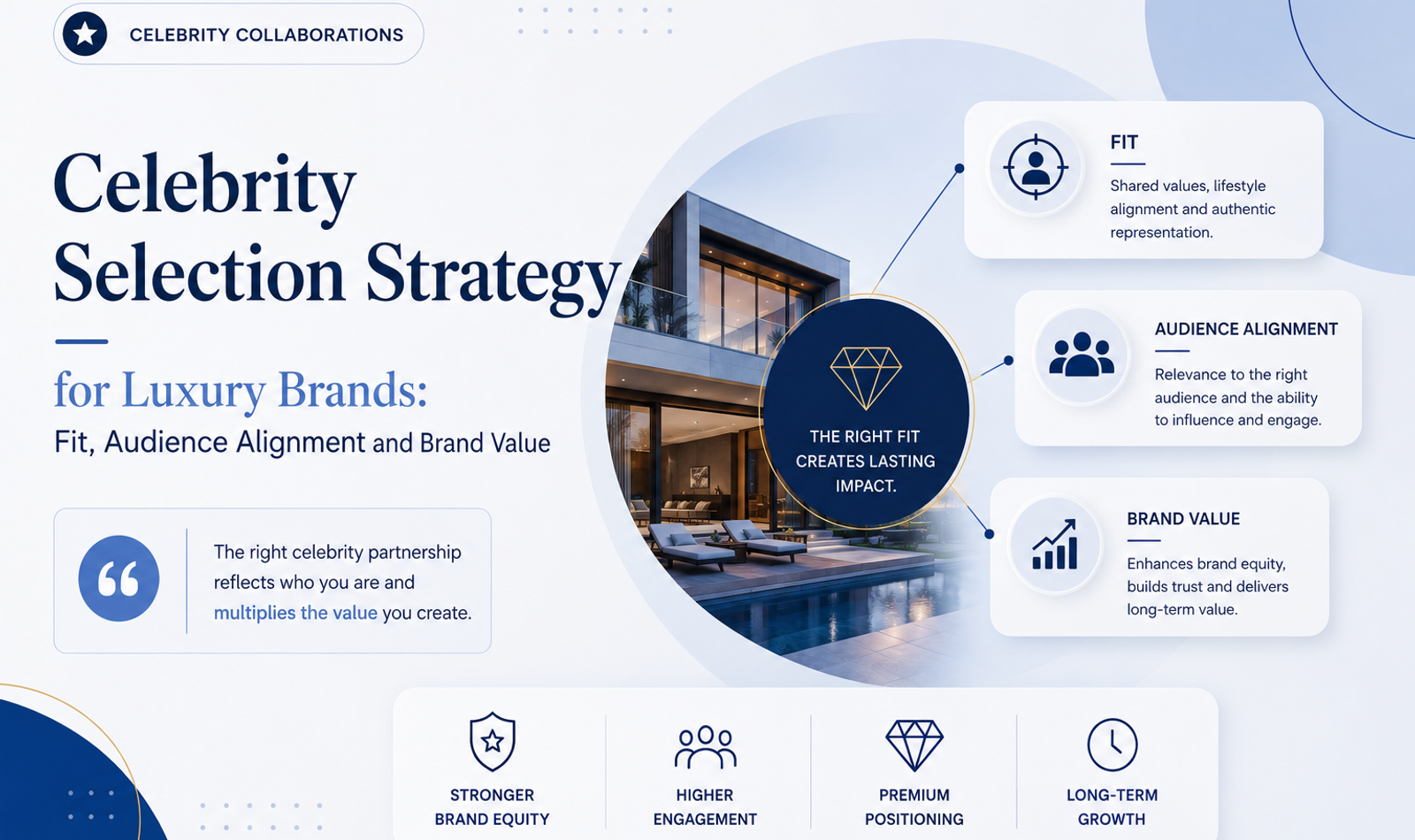
Celebrity Selection Strategy for Luxury Brands: Fit, Audience Alignment and Brand Value
Choosing a celebrity for a luxury brand is not simply a matter of finding the most famous person the available budget can secure.
A celebrity partnership affects how customers interpret the brand, who pays attention to it and what cultural meaning becomes attached to its products or services. The right celebrity can strengthen premium positioning, introduce the brand to a relevant audience and create valuable content across advertising, public relations, events and digital platforms.
The wrong celebrity can create attention without meaningful brand recall. It can also attract an unsuitable audience, weaken exclusivity, create contractual conflicts or expose the business to unnecessary reputational risk.
Luxury brands face a particularly sensitive selection challenge.
Their commercial value often depends on refinement, selectivity, heritage, craftsmanship, privacy, personalisation or specialist expertise. The celebrity must support these qualities without appearing to overpower the brand.
A celebrity with enormous reach may attract millions of views, but those views have limited value when the audience does not match the customer profile. A personality who works successfully for a mass-market consumer product may not communicate the discretion or credibility required for a premium property, bespoke service or heritage brand.
Celebrity selection should therefore be treated as a strategic business process.
The brand must assess fit, audience alignment, credibility, reputation, category history, availability, commercial terms, content potential and long-term value.
The decision should be based on evidence and clearly defined objectives rather than personal preference or temporary popularity.
The strongest celebrity partnerships occur when the audience can immediately understand why the brand and personality belong together.
Begin With the Brand, Not the Celebrity
The selection process should begin with a clear understanding of the brand.
Before preparing a list of celebrity names, the business should define its positioning, audience, commercial objective and desired cultural meaning.
Luxury is not one universal identity.
A heritage jewellery house may represent craftsmanship, continuity and timeless design. A contemporary fashion label may communicate individuality, cultural confidence and experimentation.
A private hospitality brand may focus on discretion, access and personalised service. A premium automobile company may communicate precision, technology and performance.
These businesses require different celebrity profiles.
The brand should identify the qualities it wants the public to associate with it. These may include elegance, innovation, trust, ambition, creativity, leadership or cultural relevance.
It should also identify qualities that would feel unsuitable.
A highly playful and informal celebrity may be effective for a youthful lifestyle product but less suitable for a discreet private wealth service.
Without this internal clarity, the brand may select a famous person first and attempt to invent a strategic explanation afterwards.
That usually produces a weaker campaign.
Define the Purpose of the Celebrity Partnership
The brand must decide what the celebrity is expected to accomplish.
A celebrity may be required to improve awareness, support a market launch, modernise the brand, attract a younger audience, create social content, increase event attendance or strengthen credibility.
These objectives require different selection criteria.
A brand entering a new geographic market may prioritise local familiarity and cultural relevance. A heritage company trying to become more contemporary may look for a younger personality who still respects the brand’s established identity.
A luxury property business seeking qualified buyers may value credibility and audience wealth more than broad entertainment reach.
A premium event may require a celebrity whose presence creates prestige among invited guests, even if the person has a smaller digital following.
The role must also be defined.
The celebrity may become a long-term ambassador, appear in one campaign, attend an event, curate an experience or collaborate on a product.
Long-term representation demands deeper compatibility than a single appearance.
The brand should not evaluate every opportunity through the same selection model.
Understand Brand–Celebrity Fit
Brand–celebrity fit refers to how naturally the celebrity’s image, values, expertise and lifestyle align with the brand.
Customers should be able to understand the connection without requiring a complicated explanation.
Fit may come from professional expertise.
An athlete may be credible for a performance or wellness product. A recognised chef may add value to a luxury culinary experience.
Fit may also come from lifestyle and public identity.
An actor known for refined fashion and international travel may align with a premium hospitality or designer brand.
Geographic or cultural connection can create fit as well. A public figure associated strongly with a destination may help a hotel, tourism brand or regional luxury business communicate local relevance.
Fit should be more specific than the fact that both the celebrity and brand are considered premium.
Many famous people have premium public profiles. The brand must identify why one particular personality supports its positioning better than another.
Evaluate Functional Fit
Functional fit considers whether the celebrity has a believable relationship with the product or service category.
A fitness personality promoting athletic wear has an obvious functional relationship. A chef participating in a dining campaign contributes recognisable expertise.
Functional fit is especially important when the campaign includes product claims, demonstrations or education.
Customers may expect the celebrity to possess relevant knowledge or genuine experience.
Luxury brands selling complex, high-value or specialist products should consider whether the celebrity can communicate the category credibly.
A premium automobile campaign may require comfort with driving, performance and design language. A luxury property campaign may benefit from someone associated with architecture, investment or aspirational living.
The celebrity does not need to be a technical expert in every situation, but the role should feel believable.
When functional fit is weak, the campaign must depend more heavily on emotional or symbolic alignment.
Evaluate Symbolic Fit
Symbolic fit refers to the qualities and meanings the celebrity represents.
A celebrity may symbolise achievement, rebellion, sophistication, trust, creativity, youth or tradition.
These meanings can transfer to the brand through repeated association.
A luxury brand should identify which symbolic qualities it wants to strengthen.
A heritage company may choose a respected, established personality who communicates continuity and cultural authority.
A modern luxury brand may choose someone recognised for innovation, confidence and contemporary relevance.
Symbolic fit can be powerful even when the celebrity has no direct professional connection to the product.
An actor may not manufacture watches, design hotels or build automobiles, but their public identity may communicate the emotional qualities the brand wants customers to feel.
The selection should remain authentic enough to avoid appearing purely transactional.
Evaluate Visual Fit
Luxury campaigns depend heavily on visual presentation.
The celebrity should work naturally within the brand’s design language, photography style and physical environment.
This does not mean selecting someone only because they are conventionally attractive. Visual fit includes posture, fashion identity, energy, expression and the way the person appears within a particular creative direction.
A minimalist luxury brand may require controlled, editorial imagery. A high-energy lifestyle brand may benefit from more expressive movement and colour.
The creative team should imagine the celebrity within actual campaign settings before the agreement is finalised.
Mood boards, reference frames and preliminary concepts can help determine whether the partnership has visual potential.
The brand should avoid selecting a celebrity and then forcing them into a style that conflicts with their recognised identity.
The strongest campaigns allow the celebrity and brand aesthetics to complement each other.
Evaluate Verbal and Communication Fit
A celebrity may be expected to speak in films, interviews, live events or social content.
Their communication style therefore matters.
Some personalities are highly effective in scripted advertising but less comfortable in unscripted interviews. Others create strong conversational content and audience interaction.
The brand should consider language ability, tone, public-speaking confidence and familiarity with the target market.
A luxury brand serving several regions may benefit from a celebrity who can communicate effectively across languages or cultures.
For high-value services, the celebrity may need to explain the experience with enough confidence to appear credible.
A visually suitable celebrity who cannot communicate the campaign idea naturally may limit the content strategy.
The brand should define the expected communication role before selection.
Analyse Audience Alignment
Audience alignment is one of the most important parts of celebrity selection.
The brand should evaluate whether the people who follow, admire or pay attention to the celebrity resemble the customers it wants to reach.
Follower count is only one surface-level indicator.
The audience should be examined by geography, language, age, interests, purchasing power, lifestyle and platform activity.
A celebrity with a large international audience may provide limited value to a business serving one Indian city. A regional celebrity with a concentrated, relevant audience may create stronger commercial results.
A luxury fashion brand targeting younger premium consumers may benefit from a different personality than a high-end property company targeting established investors and families.
The brand should also distinguish between fans and customers.
A celebrity may attract intense engagement from people who admire them but cannot or do not intend to purchase the brand’s offering.
This does not make the audience worthless, but it affects the type of value the partnership can create.
Examine Geographic Relevance
Geographic alignment matters when the business operates in selected cities, states or countries.
A celebrity with broad national visibility may be useful for a national campaign, but a regional personality may have deeper influence in a particular market.
Language and cultural familiarity can increase the effectiveness of the communication.
A luxury hotel opening in Punjab may benefit from a personality with genuine connection to the region. A premium property launch in Mumbai may require a different audience profile.
The brand should examine where the celebrity’s followers, media attention and public appearances are concentrated.
International fame should not be assumed to create equal relevance in every market.
The selection should reflect where the product is available and where commercial growth is expected.
Examine Audience Quality
Audience quality includes more than the number of followers or subscribers.
The brand should examine whether the audience appears real, active and relevant.
Unusual growth patterns, repetitive comments and very low engagement may indicate that headline numbers do not reflect genuine influence.
However, engagement rate should not be interpreted without context.
Large celebrities often have lower percentage engagement than smaller creators while still delivering substantial absolute reach.
The brand should analyse the types of people interacting with the content and the subjects that generate the strongest response.
A celebrity may receive high engagement for personal life or entertainment content but limited interest when promoting brands.
The team should examine previous commercial posts to understand how the audience reacts to endorsements.
Negative or indifferent responses do not automatically make the celebrity unsuitable, but they provide important context.
Distinguish Reach From Influence
Reach indicates how many people may encounter the celebrity.
Influence describes whether the celebrity can shape attention, perception or action.
A public figure may have significant reach but limited persuasive power in a particular category.
Another personality may have a smaller audience but a stronger relationship with followers and greater subject authority.
Luxury brands should determine what kind of influence they require.
For broad awareness, reach may be the priority.
For trust and qualified action, credibility and audience relevance may matter more.
For events, the celebrity’s physical presence and media appeal may be more valuable than social conversion.
The selection scorecard should not combine every type of influence into one number.
The brand should evaluate reach, credibility, engagement and commercial action separately.
Evaluate Celebrity Credibility
Credibility is created through trustworthiness, expertise and consistency.
Customers are more likely to accept an endorsement when they believe the celebrity is being honest and has a reasonable basis for the association.
A luxury brand should examine whether the celebrity’s public behaviour and previous work support the campaign message.
A personality known for disciplined performance may be credible for a premium fitness or automotive brand.
A recognised style leader may be credible for fashion, beauty or design.
Credibility can also come from personal experience.
A celebrity who has genuinely used the hotel, product or service may create more convincing content than someone reading a general script.
The brand should not manufacture personal testimonials that the celebrity cannot support honestly.
Credibility is difficult to create through production alone. It begins with the selection.
Evaluate Authenticity
Authenticity does not require the partnership to be unpaid or informal.
It means that the association feels consistent with the celebrity’s established identity and behaviour.
A celebrity who frequently discusses travel may be a natural fit for a hospitality campaign. Someone associated with environmental initiatives may be suitable for a genuine sustainability programme.
The brand should review the celebrity’s past content and public positions.
If the campaign conflicts strongly with these patterns, audiences may perceive the partnership as purely financial.
Luxury customers are often highly aware of branding and commercial communication. They may recognise when an association feels artificial.
The creative concept should provide the celebrity with a role they can perform naturally.
Authenticity increases when the celebrity contributes personal perspective rather than simply repeating brand language.
Review Previous Endorsements
The celebrity’s endorsement history can reveal both value and risk.
The brand should identify the categories and companies the celebrity has promoted recently.
Existing contracts may create legal conflicts or category exclusivity restrictions.
A celebrity who appears in a very large number of unrelated advertisements may also provide weaker distinctiveness.
Customers may remember the person but struggle to connect them with one particular brand.
This is sometimes described as overexposure.
Overexposure does not automatically make a celebrity ineffective. Some personalities maintain strong recognition across many campaigns.
The brand should assess whether the new association can still feel meaningful and whether the celebrity’s existing commercial image supports the intended premium position.
The recency and prominence of competitor campaigns are particularly important.
Consider Endorsement Saturation
Endorsement saturation occurs when a celebrity is associated with so many products that each new partnership receives less attention or credibility.
Luxury brands often benefit from selectivity.
A celebrity who appears rarely in advertising may create greater impact when the association is announced.
The brand should compare the number of endorsements with the celebrity’s overall public visibility.
It should also consider whether the person has been associated with mass-market discount communication that may conflict with the desired premium image.
This does not mean luxury brands can work only with celebrities who avoid mass-market campaigns.
The decision depends on the strength of the fit and how customers interpret the complete portfolio.
However, the brand should understand that celebrity commercial history becomes part of the campaign context.
Evaluate Cultural Relevance
Luxury brands often want to remain culturally current without appearing temporary or trend-driven.
A celebrity can help connect an established brand with new conversations, audiences and creative communities.
Cultural relevance may come from recent professional success, fashion influence, digital presence, social impact or representation of a changing customer group.
The brand should distinguish between lasting relevance and a short-lived viral moment.
A personality receiving sudden attention may create immediate reach but lack the stability required for a long-term ambassadorship.
Emerging celebrities can still be valuable, particularly when the brand wants to appear ahead of the market.
The partnership length should reflect the evidence available.
A short campaign or event may be more suitable than a multi-year agreement when the celebrity’s long-term positioning is uncertain.
Consider Cultural and Regional Sensitivity
A celebrity who is admired in one market may be interpreted differently in another.
Luxury campaigns crossing regions or countries should examine cultural meaning carefully.
Language, humour, fashion, political associations and past public statements may affect reception.
A celebrity may be suitable for one state or language market but less relevant elsewhere.
The brand should involve regional teams and local advisers in the evaluation.
Cultural analysis should not rely only on headquarters assumptions or broad audience statistics.
Local customer perception can change the effectiveness of the partnership significantly.
Conduct Reputation Due Diligence
Reputation review should be completed before the brand makes a binding offer.
The process can examine credible news coverage, public statements, professional conduct, previous campaigns and known controversies.
The objective is not to find a celebrity with no criticism. Every prominent person receives mixed attention.
The brand should identify issues that create a real conflict with its values, customers or regulatory responsibilities.
A family-focused hospitality brand may have different risk tolerances from a bold fashion label.
The review should distinguish between verified facts, unresolved allegations and unsupported rumours.
The decision should be documented and proportionate.
A celebrity should not be rejected automatically because of social media speculation, but serious warning signs should not be ignored simply because the person is commercially attractive.
Assess Reputation Stability
Some celebrities have a long and relatively stable public identity. Others are associated with rapid changes, frequent controversy or highly polarised attention.
Stability can be valuable for long-term luxury partnerships.
A brand ambassador may remain connected to the company for several years. The celebrity’s behaviour during that period can affect the brand.
However, stability should not be confused with being uninteresting.
A personality can be bold and culturally progressive while remaining professionally reliable.
The brand should evaluate consistency, judgement and the strength of the representative team.
A well-managed celebrity may respond to difficult situations more effectively than someone with weak professional support.
Evaluate Professional Reliability
Celebrity selection should include operational reliability, not only public image.
The brand should seek information about punctuality, preparation, approval discipline and working style.
A celebrity may be highly suitable creatively but difficult to schedule or manage.
This can increase production cost and campaign risk.
Previous clients, production partners or reputable management professionals may provide relevant references where appropriate.
The brand should also review whether the celebrity’s current professional schedule allows sufficient time for the engagement.
A campaign requiring several shoots, events and social posts may not be suitable for a person managing a major film, tour or sporting season.
Reliability directly affects commercial value.
Evaluate Representative Quality
The celebrity’s management team influences the complete partnership.
A professional agent or manager can provide clear commercial terms, realistic timelines and organised approvals.
A poorly managed relationship may create delays, inconsistent instructions and confusion about authority.
The brand should evaluate how quickly and clearly the representative responds, whether documentation is complete and whether commercial expectations are transparent.
The representative should understand the brand’s objective rather than focusing only on the fee.
Good management does not mean that every request will be accepted. It means that decisions and limitations are communicated professionally.
Luxury collaborations often involve complex rights and several teams. Representative quality should therefore be included in the selection score.
Consider Availability and Timing
The ideal celebrity may not be available during the required campaign period.
Availability affects shoots, launch events, content approvals and publication.
The brand should not build the complete marketing plan around an unconfirmed name.
A shortlist should include suitable alternatives.
Timing can also influence relevance.
A celebrity with an upcoming film, series, sporting event or music release may receive greater public attention. This can increase campaign reach.
However, other professional commitments may compete with the brand’s communication.
The campaign should avoid being overshadowed by unrelated publicity or several endorsements released at the same time.
The brand should understand the celebrity’s expected calendar before finalising activation dates.
Determine the Appropriate Celebrity Tier
Luxury brands can work with global stars, national celebrities, regional personalities, specialist experts, creators or emerging talent.
The correct tier depends on the objective and budget.
A global celebrity may support international positioning but require extensive rights, production and media investment.
A national film star may provide broad recognition within India.
A regional actor or musician may offer stronger relevance in a specific market.
A specialist chef, designer, athlete or entrepreneur may provide category authority.
A digital creator may offer closer audience interaction and greater content flexibility.
Luxury does not require selecting only the most famous person.
A carefully chosen specialist or emerging cultural figure may make the brand feel more credible and distinctive.
Compare Celebrities and Influencers Properly
Traditional celebrities and digital influencers create different forms of value.
Celebrities often provide broad recognition, press appeal and symbolic status.
Influencers may offer stronger platform familiarity, content frequency and audience interaction.
The distinction is becoming less clear because many actors, athletes and musicians now maintain direct digital communities, while creators increasingly achieve mainstream celebrity status.
The brand should compare actual capabilities rather than category labels.
A celebrity may have high awareness but limited willingness to create informal social content.
An influencer may create authentic content but lack the prestige required for a major luxury event.
Some campaigns benefit from a combination.
A lead celebrity can establish broad recognition, while selected creators provide specialised storytelling and repeated audience engagement.
The differences between both models can be evaluated through a detailed celebrity vs influencer marketing comparison.
Assess Content Capability
The celebrity should be evaluated according to the content formats required.
A cinematic campaign requires different performance skills from a conversational social series.
Some celebrities are highly effective in professional productions but less natural when filming direct-to-camera content.
Some creators can produce engaging social media independently but may not support a polished national advertising campaign.
The brand should review previous films, interviews, live appearances and sponsored content.
It should examine whether the celebrity can communicate the required emotion and message.
Content capability affects production time and the number of usable assets generated.
The creative concept should be adapted to the person’s genuine strengths.
Assess Event Capability
A celebrity selected for a live event should be comfortable with the required role.
Attendance, performance, public speaking, moderated conversation and guest interaction are different activities.
A recognised actor may create strong red-carpet attention but may not be the best person for a detailed business conversation.
An athlete or entrepreneur may provide stronger value at a leadership event.
A musician may be suitable when entertainment and emotional energy are central.
The brand should examine the celebrity’s stage experience, communication style and ability to engage with the audience.
Event selection should be based on the intended guest experience rather than fame alone.
For complex live participation, professional celebrity appearance logistics and security coordination becomes essential.
Assess PR Value
Some celebrities naturally attract greater media attention.
Their involvement may create entertainment, fashion, business or regional press coverage.
The brand should consider whether this media interest is relevant to the campaign.
A celebrity may generate substantial gossip or paparazzi attention but little useful coverage of the actual product.
Another personality may attract fewer publications but provide more credible editorial discussion.
The brand should identify the type of PR value it needs.
For a flagship launch, visual media attention may be useful. For a high-value service, expert interviews and business coverage may create more value.
Media appeal should support the brand story rather than distract from it.
Assess Commercial Usability
Commercial usability refers to how effectively the celebrity can be used across the planned campaign.
The brand should consider availability for shoots, social posting, events, interviews and future renewals.
It should also consider whether the celebrity’s identity can be licensed across the required media, territory and duration.
A suitable celebrity may become commercially impractical when the brand cannot afford the necessary usage rights.
Another may have conflicting endorsements or restrictions that prevent important platforms from being used.
The selection process should evaluate the complete package rather than the headline professional fee.
A celebrity who costs less but provides limited rights may create less value than a higher-fee partner offering a more useful campaign structure.
Examine Exclusivity Requirements
Luxury brands often want category exclusivity so that the celebrity is not seen promoting a direct competitor.
Exclusivity can strengthen the association but increase cost.
The brand should define the exact product category, territory and period it needs to protect.
A broad restriction may make the celebrity commercially unavailable or require a much higher fee.
The selection process should examine existing endorsements and future conflicts.
A celebrity may be strategically suitable but unable to provide the necessary exclusivity because of another agreement.
The brand should not assume that a public absence of competitor advertising means no contractual conflict exists.
The representative should confirm availability subject to final legal review.
Consider Partnership Duration
The required relationship length affects celebrity selection.
A single campaign can rely on timely relevance and strong visual fit.
A long-term ambassadorship requires deeper compatibility, reputation stability and content flexibility.
The celebrity should be able to support several creative phases without making the partnership feel repetitive.
The brand should also consider whether the person’s likely career direction supports its future positioning.
A rising celebrity may provide strong long-term potential but greater uncertainty.
An established personality may offer stability but have a higher fee and more existing associations.
The contract can begin with a limited term and include carefully structured renewal options.
This allows the brand to evaluate performance before extending the relationship.
Evaluate Brand Value Transfer
Celebrity partnerships work partly because meaning can move from the celebrity to the brand.
The selection team should identify which qualities are expected to transfer.
These may include trust, glamour, achievement, modernity, expertise or social influence.
The qualities should be relevant and beneficial.
The brand should also consider reverse transfer.
The partnership affects how people view the celebrity. A respected luxury brand may strengthen the celebrity’s premium positioning.
This mutual value can improve the relationship and creative commitment.
The strongest collaborations benefit both parties.
A partnership that offers the celebrity no reputational or creative value may remain purely transactional.
Protect the Brand From Celebrity Overshadowing
Celebrity attention can become so strong that the audience remembers the person but not the brand.
This risk is especially high when the creative concept focuses entirely on the celebrity’s existing fame.
The selection process should consider whether the brand has enough identity to remain visible.
A celebrity with a very dominant persona may require a campaign concept that connects their characteristics clearly to the product.
The brand should not simply place the logo at the end of entertainment content.
Product, service or experience integration should be meaningful.
Brand recall should be tested during creative development where possible.
The objective is not to reduce the celebrity’s impact. It is to make that impact work for the brand.
Avoid Selecting Based on Personal Preference
Founders and senior decision-makers may have favourite actors, athletes or performers.
Personal enthusiasm can help generate ideas, but it should not replace strategic evaluation.
The celebrity may appeal strongly to the decision-maker while having limited relevance to the target customer.
A selection framework creates discipline.
Each candidate can be assessed against the same criteria, including fit, audience, credibility, risk, commercial terms and content potential.
The final decision can still involve judgement and creativity, but it should be supported by evidence.
The brand should be able to explain why the chosen person is suitable beyond saying that they are popular or admired internally.
Create a Celebrity Selection Scorecard
A structured scorecard can help compare candidates objectively.
The scorecard may assess brand fit, audience alignment, credibility, cultural relevance, reputation stability, content capability, PR value, availability, exclusivity and commercial cost.
Each factor should receive a weight based on the campaign objective.
A national awareness campaign may give greater weight to reach and recognition.
A high-ticket luxury service may give greater weight to trust, audience quality and brand fit.
An event may prioritise stage capability, guest appeal and media interest.
The scorecard should not produce an automatic answer. It provides a structured basis for discussion.
Decision-makers should review both the numerical score and the strategic reasoning behind it.
Use Weighted Criteria
Not every criterion has equal importance.
A luxury property brand may weight audience purchasing power and geographic relevance more heavily than general engagement rate.
A fashion campaign may prioritise visual fit and cultural relevance.
A wellness campaign may place greater importance on credibility and genuine category connection.
The team should agree on the weighting before scoring celebrities.
Changing the criteria after a preferred celebrity has been identified can turn the framework into a justification exercise.
The scorecard should be designed to support impartial evaluation.
Build Multiple Shortlists
The selection process can create an aspirational shortlist, strategic shortlist and practical shortlist.
The aspirational list contains high-profile names with ideal symbolic value but potentially high fees or limited availability.
The strategic list contains the strongest balance of fit, audience and commercial value.
The practical list contains credible options likely to meet the timeline and budget.
This structure helps stakeholders understand trade-offs.
It also prevents the campaign from stopping when the first choice is unavailable.
Every shortlisted celebrity should meet the minimum brand and reputation requirements.
The alternatives should not be random lower-cost names.
Model the Complete Budget
The celebrity fee is only part of the investment.
The brand should model agency commission, taxes, production, media, travel, hospitality, security, styling, content adaptation and event operations.
Usage and exclusivity can create significant additional costs.
The brand must also reserve enough budget to distribute the campaign.
Hiring a major celebrity without sufficient media support may produce limited return.
A lower-fee partner combined with strong creative production and targeted distribution may generate greater overall value.
The selection decision should be based on the complete activation budget.
Estimate Potential Commercial Value
Celebrity selection should include a realistic value model.
The brand can estimate potential reach, qualified traffic, enquiries, bookings, retail interest, content value and earned media.
These estimates should be treated as scenarios rather than guaranteed results.
The team can compare conservative, expected and high-performance outcomes.
For high-ticket businesses, a small number of qualified conversions may justify the investment.
For consumer products, the campaign may require substantial sales volume.
The value model should reflect the business economics.
The brand should avoid converting every view into an unrealistic theoretical advertising value.
Evaluate Opportunity Cost
The celebrity budget could be spent on other marketing activities.
The brand should compare the partnership with alternative investments such as creators, media, events, customer experience, search marketing or product development.
A major celebrity may deliver broad recognition but leave insufficient budget for content distribution.
Several specialist personalities may provide stronger audience relevance across different markets.
The correct decision depends on the business objective.
Celebrity selection should be considered within the complete marketing plan rather than as an isolated prestige purchase.
Conduct Legal and Compliance Review
The brand should review whether the proposed celebrity can support the campaign claims legally and credibly.
Testimonials should reflect genuine, current opinions and adequate knowledge or experience.
Paid and materially connected content should include the appropriate advertising disclosure.
Sensitive categories may require additional due diligence, qualifications or regulatory approval.
The contract should define responsibility for claims, disclosures, approvals and corrections.
A celebrity should not be selected for a technical-expert role merely because of public popularity.
The person must possess any qualifications or experience required by the communication.
Compliance readiness is part of selection, not an issue to address after the creative has been produced.
Detailed contractual and compliance considerations can be reviewed through legal and PR essentials for Bollywood, influencers and celebrities.
Review AI and Digital-Likeness Expectations
Luxury campaigns increasingly involve localisation, synthetic dubbing and AI-assisted production.
The selection team should understand the celebrity’s position on these technologies.
Some celebrities may permit limited visual enhancement or translated dubbing while refusing voice cloning or generative replicas.
The brand should not assume that standard image rights include AI uses.
If the campaign requires multilingual adaptation or long-term content variation, these requirements should be discussed during selection.
A celebrity who cannot grant the necessary rights may still be suitable if the concept is adjusted.
The brand should weigh creative flexibility against identity protection and cost.
Where AI-led production is involved, the brand should also evaluate the role of professional AI video and VFX services.
Plan Crisis and Exit Scenarios
The brand should consider how it would respond if the celebrity became involved in a serious controversy or could no longer complete the campaign.
This does not mean expecting failure.
It means understanding the dependency created by the partnership.
A campaign built entirely around one person may be difficult to replace.
The contract can include postponement, termination, content withdrawal and reputation provisions.
The brand should also consider what happens when the relationship ends normally.
Will existing social posts remain visible? Can old campaigns remain in archives? Must product packaging be changed?
Selection strategy should include the practical consequences of entry and exit.
The potential reputational impact can also be addressed through a structured celebrity crisis management and brand protection strategy.
Test the Partnership Concept
Before final confirmation, the brand can develop a preliminary creative concept for leading candidates.
This helps assess whether the celebrity has a meaningful role.
The concept should not be presented publicly or developed into detailed final work before commercial availability is confirmed.
However, an internal concept test can reveal whether the brand is forcing the association.
The team can examine sample headlines, visual directions, story roles and customer actions.
It should ask whether the idea would still make sense without depending entirely on fame.
A strong concept connects the celebrity’s characteristics with a specific brand message.
Involve Multiple Departments
Celebrity selection should not be controlled only by marketing.
Public relations can assess media value and reputation. Legal teams can identify conflicts and rights issues.
Sales teams can explain the customer profile and commercial journey. Regional teams can provide cultural insight.
Production teams can assess creative and scheduling practicality. Senior leadership can evaluate long-term brand implications.
This does not mean every person should choose independently.
A small decision group should review structured input and maintain one clear selection process.
Too many informal opinions can turn the decision into a popularity contest.
Use Audience Research
The brand can test potential celebrity names with representative customers.
Research may examine recognition, relevance, trust, premium perception and expected fit.
The brand should avoid asking only whether respondents like the celebrity.
A person can be widely liked but unsuitable for the brand.
Questions should examine whether the celebrity changes the way people view the product and whether the association feels believable.
Research can be especially valuable for long-term or high-investment partnerships.
It cannot remove all uncertainty, but it provides evidence beyond internal assumptions.
Avoid Overreliance on Social Metrics
Social analytics provide useful information, but they do not capture the complete value of a celebrity.
An established actor may influence customers through films, press, television and cultural recognition beyond their direct social engagement.
A respected business personality may have a smaller following but strong credibility among high-value decision-makers.
The brand should combine digital metrics with broader recognition, media presence, reputation and customer relevance.
Social data should inform the decision rather than control it.
Match Celebrity Tier to Campaign Scale
The campaign investment should be proportionate.
A global celebrity requires production and distribution capable of supporting that level of partnership.
Using an internationally recognised star for a small, poorly distributed campaign may create weak value.
A regional luxury brand can create greater impact by choosing a well-aligned regional personality and investing properly in the concept and customer experience.
The celebrity tier should match the market, product availability and commercial ambition.
Bigger is not always more effective.
Select for Long-Term Brand Value
Immediate reach is easy to observe, but long-term value may be more important.
The brand should consider whether the celebrity can help build a distinctive association over time.
A stable partnership can create stronger memory than several disconnected celebrity campaigns.
Long-term value depends on continued fit, availability and reputation.
The celebrity should also provide enough creative range for future campaigns.
A partnership based on one temporary joke or trend may become difficult to extend.
The selection should support the brand’s direction rather than only the current launch.
A broader luxury brand strategy roadmap can help connect celebrity selection with long-term positioning.
Define Success Before Signing
The brand should establish the metrics it will use to evaluate the partnership.
These may include awareness, branded search, campaign recall, qualified website traffic, consultation requests, bookings, sales, event registrations, direct revenue or retailer interest.
Different metrics apply to different roles.
A long-term ambassador should not be judged only by one social post.
An event celebrity should not be judged by national awareness when the objective was stakeholder engagement.
The brand should also measure brand attribution.
Customers should remember which brand the celebrity represented, not only that they saw celebrity content.
Clear objectives improve both selection and later evaluation.
Common Celebrity Selection Mistakes
A common mistake is choosing the most famous person rather than the most relevant one.
Another is focusing on follower count without examining geography, audience quality or purchasing ability.
Brands may overlook previous endorsements and category conflicts.
They may also select a celebrity because of current popularity without considering long-term reputation stability.
Some partnerships depend entirely on visual appeal and provide no credible role for the celebrity.
Others ignore operational issues such as availability, approvals and representative quality.
A further mistake is allowing senior personal preference to override customer evidence.
Brands may also negotiate a large celebrity fee while leaving insufficient budget for production and distribution.
Finally, some businesses begin creative announcements before contracts, rights and disclosures have been confirmed.
A Practical Celebrity Selection Process
The process begins by defining the brand positioning, audience and commercial objective.
The team identifies the type of celebrity role required and the duration of the relationship.
Selection criteria and weightings are agreed before names are scored.
A broad talent pool is researched across film, music, sport, digital creation, culture and specialist expertise.
Candidates are assessed for brand fit, audience alignment, credibility, commercial history and reputation.
Their representatives, availability, category conflicts and expected terms are reviewed.
The team creates aspirational, strategic and practical shortlists.
Audience research and internal concept testing may be completed for the leading options.
The complete investment is modelled, including fee, rights, exclusivity, production, media and operations.
Legal and compliance teams review the proposed role and claims.
The authorised representative is then approached with a clear brief.
Commercial negotiation confirms deliverables, usage, territory, duration, exclusivity and approvals.
No announcement is made until the agreement is signed.
After launch, the brand measures performance against the objectives defined at the beginning.
Professional celebrity sourcing can also be supported through a structured guide on how to source and approach celebrities through agencies or direct contact.
Conclusion
Celebrity selection for luxury brands should be a strategic decision rather than a fame-based purchase.
The correct celebrity is not necessarily the person with the largest audience or highest current visibility.
The correct celebrity is the person whose identity, credibility and audience strengthen the brand’s intended position.
The process must begin with the brand.
The business should define what type of luxury it represents, which customers it wants to attract and what the partnership is expected to achieve.
Brand–celebrity fit should then be evaluated across functional, symbolic, visual and communication dimensions.
The audience must be examined beyond follower count.
Geography, language, interests, purchasing power, engagement quality and commercial behaviour all influence value.
Credibility and authenticity are equally important.
The celebrity should have a believable relationship with the category and enough genuine understanding to support the campaign message.
Previous endorsements, commercial saturation and category conflicts should be reviewed.
Reputation due diligence should consider credible information, professional reliability and the quality of the celebrity’s management team.
The brand should also assess practical commercial value.
Availability, content capability, event skills, media appeal, usage rights, exclusivity and total cost determine whether the celebrity can be activated effectively.
A structured scorecard helps decision-makers compare candidates using consistent criteria.
The weighting should reflect the specific campaign objective.
A national awareness campaign may prioritise broad recognition. A high-ticket luxury service may prioritise trust, audience quality and qualified conversion.
The celebrity fee must be evaluated within the complete campaign budget.
Production, media, rights, travel, hospitality and operational expenses all affect return.
Legal and compliance requirements should be reviewed before production. Endorsements must remain truthful, supportable and properly disclosed.
AI, voice and digital-likeness rights should also be addressed when the campaign requires synthetic or localised content.
The strongest celebrity partnerships produce mutual value.
The celebrity strengthens the brand’s cultural meaning, while the brand provides a credible environment that supports the celebrity’s own positioning.
When audience alignment, brand fit and commercial strategy work together, celebrity involvement can create more than temporary attention.
It can build recognition, increase trust and strengthen long-term brand value without compromising the exclusivity that makes the luxury brand distinctive.
For professional support with celebrity management, brand-fit evaluation, negotiations, contracts and campaign execution, connect with Double Trouble Studio.
📩 info@dtsworld.in 📞 +91 80000 06021 📍 Andheri West, Mumbai
Need this for your brand?
Let DTS build your next campaign.
From PR, celebrity management and events to websites, social media, SEO and AI video production — Double Trouble Studio helps brands grow with strategy and execution.
Discuss Your Requirement →