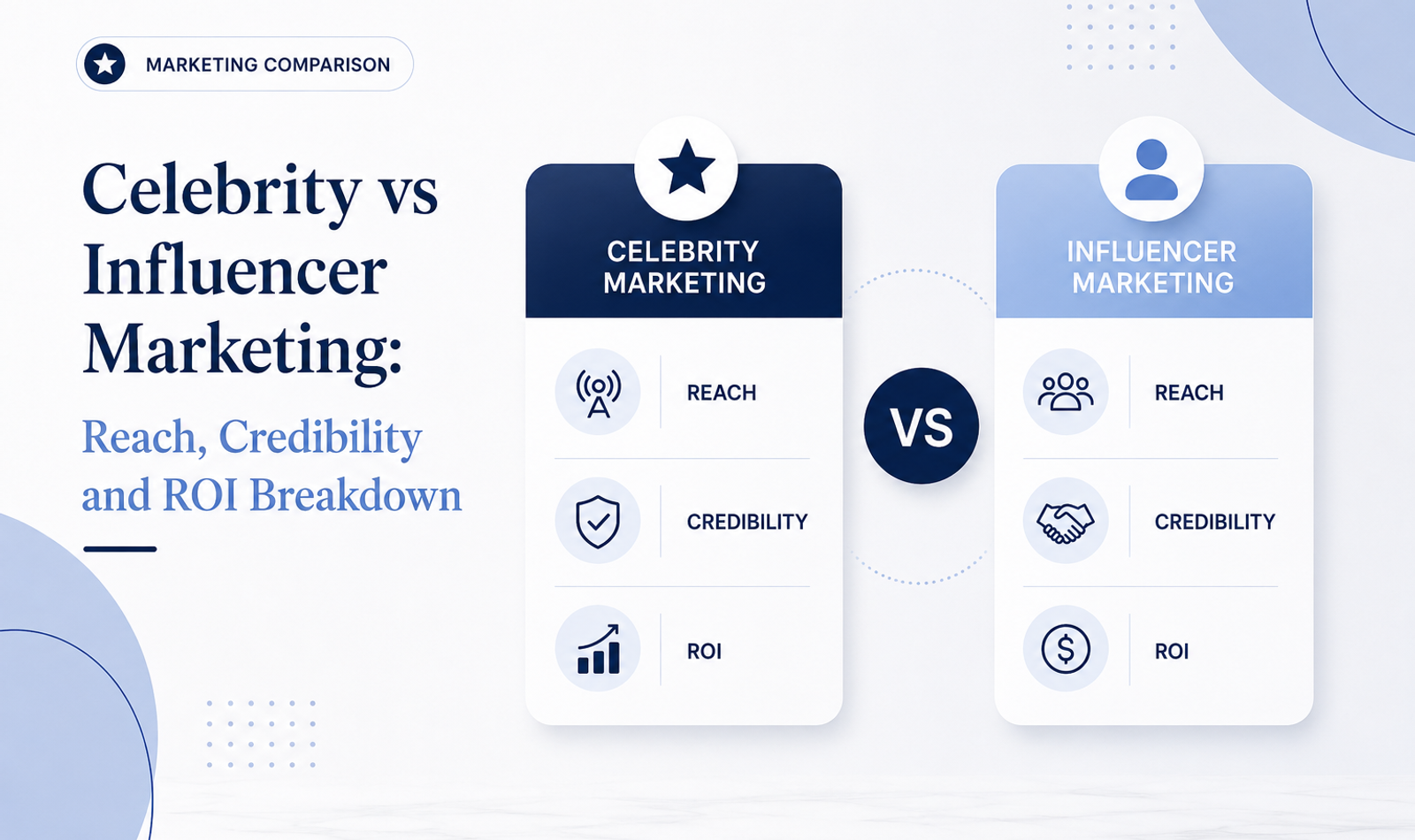
Celebrity vs Influencer Marketing: Reach, Credibility and ROI Breakdown
Celebrity marketing and influencer marketing are often discussed as though they are competing versions of the same strategy. Both use recognised personalities to attract attention, shape perception and encourage customer action, but they do not always create value in the same way.
A celebrity partnership usually provides broad public recognition, cultural relevance and prestige. A well-known actor, athlete, musician or public personality can make a campaign visible quickly and help a brand become part of a wider public conversation.
An influencer partnership usually provides closer access to a particular digital audience. Influencers build communities around subjects such as fashion, beauty, travel, food, technology, fitness, finance or business. Their value often comes from regular communication, platform expertise and perceived familiarity.
Neither model is automatically better.
A celebrity may deliver exceptional awareness but weak conversion when their audience is not relevant to the product. An influencer may generate strong engagement but insufficient scale for a national launch.
The choice depends on the campaign objective, customer profile, product category, geographic market, creative format, budget and measurement system.
Brands should also recognise that the traditional boundary between celebrities and influencers has become less clear.
Actors and athletes now create personal social content, publish Reels, participate in podcasts and communicate directly with followers. At the same time, digital creators can achieve mainstream fame, attend major events, appear in advertising campaigns and become recognised beyond their original platforms.
The more useful question is therefore not simply whether a person is a celebrity or influencer.
The brand should ask what type of influence the person provides, how relevant their audience is and whether the commercial structure can support the intended outcome.
What Is Celebrity Marketing?
Celebrity marketing uses a widely recognised public figure to promote, represent or associate with a brand.
The celebrity may be an actor, musician, athlete, television personality, entrepreneur or another person with significant public recognition.
The partnership may involve an advertising campaign, brand ambassadorship, social media post, event appearance, product launch, performance or public-relations activity.
Celebrity value often comes from awareness that already exists before the campaign begins.
The audience does not need to be introduced to the person. Their identity, achievements and public image carry established meaning.
A successful campaign transfers some of that meaning to the brand.
An athlete may communicate discipline and achievement. An actor may communicate familiarity, style or aspiration. A musician may bring cultural energy and access to fan communities.
This transfer depends on fit.
A famous person who has no believable relationship with the category may attract attention without strengthening the brand.
Celebrity marketing is therefore most effective when recognition, meaning and commercial role work together.
What Is Influencer Marketing?
Influencer marketing involves working with individuals who have developed the ability to affect the attitudes or actions of a particular audience, usually through digital platforms.
An influencer may be a specialist, creator, reviewer, educator, entertainer or lifestyle personality.
Their audience can range from a small specialised community to millions of followers.
Influencers are frequently categorised as nano, micro, mid-tier, macro or mega creators, although the follower ranges used for these labels vary across platforms and agencies.
Their commercial value is not based only on visibility.
Influencers often understand how to create content that feels natural within the platform and familiar to their audience.
A beauty creator may demonstrate a product within a routine. A travel influencer may document an actual property experience. A technology reviewer may explain product functions in detail.
This allows influencer marketing to combine promotion with entertainment, education, review or personal storytelling.
The brand is often entering an existing audience relationship rather than placing a recognisable person within a conventional advertisement.
The Difference Is Not Simply Fame
It is easy to assume that celebrities have large audiences and influencers have small audiences, but this comparison is no longer accurate.
Some creators have larger social followings and stronger platform reach than established film or television personalities.
Some celebrities maintain highly engaged digital communities and create content in a style similar to professional influencers.
The more important distinctions involve how recognition was built, how the audience relates to the person and how the content is normally consumed.
A traditional celebrity often becomes famous through film, music, sport, television or public achievement. Social media extends an identity developed elsewhere.
An influencer usually develops recognition through recurring digital content and direct community interaction.
Audiences may admire a celebrity from a greater distance. They may feel greater familiarity with an influencer whose daily routines, opinions and personal experiences they follow continuously.
These patterns affect credibility, content style and conversion potential.
Compare the Primary Sources of Value
Celebrity marketing is generally associated with mass recognition, prestige, cultural visibility and rapid awareness.
Influencer marketing is generally associated with audience specificity, relatability, content frequency and platform-native communication.
These are broad tendencies rather than fixed rules.
A specialist athlete may offer both celebrity recognition and category expertise. A luxury creator may provide strong aspiration in addition to relatability.
The brand should identify which source of value matters most.
A national launch may require instant recognition across several customer groups. A specialised skincare product may require explanation and trusted recommendations within a narrower community.
A luxury event may benefit from a celebrity whose presence creates prestige. A hotel may benefit from travel creators who can document the complete guest experience.
The best model depends on what the audience must think, feel or do after encountering the campaign.
Reach Comparison
Celebrity Reach
Celebrities can provide rapid broad awareness.
Their names may attract attention across advertising, entertainment media, newspapers, television, social platforms and public events.
A major celebrity announcement can become news before the campaign content is fully distributed.
This is useful when the brand needs to create a large public moment.
A new national product, major hospitality development, luxury campaign or flagship launch may benefit from a personality who is already widely recognised.
Celebrity reach also extends beyond direct followers.
People may know the celebrity without following their social accounts. Photographs and campaign stories may circulate through media, fan accounts and entertainment pages.
This broad recognition can help brands communicate across different age groups and platforms.
However, broad reach is not always precise.
The celebrity’s audience may contain many people who have little interest in the category or no ability to purchase the product.
Mass awareness must therefore be evaluated alongside audience relevance.
Influencer Reach
Influencer reach is often more concentrated.
An individual creator may not have national recognition, but their audience may be highly relevant to a particular interest or lifestyle.
A fashion creator can reach people actively seeking styling ideas. A food influencer can reach local diners. A business creator can reach founders and marketing professionals.
Influencer campaigns can also achieve scale by combining several creators.
Instead of investing the complete budget in one person, the brand can work with a portfolio of niche, regional and larger influencers.
This creates distributed reach across different audiences and content styles.
A multi-influencer campaign may also reduce dependence on the performance of one personality.
However, total follower numbers across several influencers should not be added without considering audience overlap.
Many creators within the same category may share followers.
The brand needs a realistic estimate of unique and relevant exposure.
Which Model Wins on Reach?
Celebrities are usually stronger for immediate public visibility and mainstream recognition.
Influencers are often stronger for targeted reach within defined interests, communities or locations.
The correct choice depends on whether the brand needs breadth or precision.
A national consumer product may prioritise broad recognition. A specialist luxury service may benefit more from a smaller group of highly relevant creators.
Reach should not be evaluated only through the number of people exposed.
The brand must ask whether those people belong to the market it wants to influence.
Credibility Comparison
Celebrity Credibility
Celebrities can bring significant credibility when their public identity matches the category.
An athlete can provide authority to a performance product. A recognised chef can strengthen a culinary experience. An established actor may provide trust and familiarity to a large consumer brand.
Celebrity credibility can also come from achievement.
Customers may associate success, discipline, elegance or expertise with the person and transfer those qualities to the brand.
However, celebrity endorsement can feel transactional when the fit is weak or the person promotes many unrelated products.
Audiences understand that major celebrities are paid for advertising.
This does not make the campaign ineffective, but the creative concept must provide a believable reason for the association.
The celebrity’s actual experience with the product can strengthen credibility.
A hospitality campaign feels more convincing when the personality is shown engaging with real aspects of the stay rather than delivering generic promotional statements.
Influencer Credibility
Influencers often build credibility through repeated content within a category.
A skincare creator may review formulas regularly. A travel creator may compare hotels and destinations. A technology creator may test products in detail.
The audience may view the influencer as a source of practical advice rather than only entertainment.
This can create stronger credibility for products that require demonstration, education or personal experience.
Smaller influencers may also appear more accessible and selective.
Their recommendations can feel closer to peer advice, particularly when the audience has followed them over time.
However, influencer credibility is not guaranteed.
Creators who accept too many unrelated sponsorships can lose trust. Undisclosed commercial relationships, scripted reviews and exaggerated claims can also damage credibility.
The brand should examine how the creator normally discusses products and how their audience responds to sponsored content.
Expertise Versus Familiarity
Credibility can come from expertise or familiarity.
A dermatologist creator may provide category expertise. A lifestyle influencer may provide familiarity and relatable experience.
A celebrity may provide symbolic authority without detailed category knowledge.
The brand should determine which form of credibility the campaign requires.
A highly technical product may benefit from expert influencers or qualified professionals.
A fashion campaign may depend more on style authority and aspiration.
A hotel may use celebrities to create prestige and travel influencers to provide detailed experience proof.
The strongest strategy may combine different forms of credibility rather than expecting one person to provide everything.
Audience Relationship
The Celebrity–Audience Relationship
Celebrity audiences are often built around admiration, entertainment and public achievement.
Fans may follow films, performances, sporting careers, interviews and public appearances.
This relationship can be emotionally strong but relatively distant.
A celebrity recommendation may attract attention because the audience admires the person or wants to identify with their lifestyle.
This aspirational effect can be highly valuable for luxury brands.
Luxury purchases are often influenced by identity, design and social meaning as well as functionality.
A celebrity can help place the brand within an aspirational cultural world.
However, admiration does not always produce direct purchase action.
The campaign must connect celebrity meaning to a clear customer benefit.
The Influencer–Audience Relationship
Influencer audiences often develop through frequent direct communication.
Creators respond to comments, share personal routines and discuss decisions in detail.
Followers may feel that they understand the influencer’s preferences and personality.
This familiarity can make recommendations feel more personal.
Influencer content also allows for ongoing questions, demonstrations and feedback.
A creator may publish a Reel, answer comments, post Stories and later provide a follow-up review.
This repeated interaction can support customer consideration more effectively than one polished advertisement.
The risk is that excessive commercial content weakens the relationship.
Brands should give creators enough freedom to communicate naturally while still protecting claims and positioning.
Content Comparison
Celebrity Campaign Content
Celebrity campaigns are frequently produced through professional advertising systems.
The brand may create campaign films, editorial photography, outdoor assets, interviews and social edits.
This provides strong visual control and consistency.
The same creative concept can be adapted across television, cinema, print, digital media, retail and ecommerce.
Celebrity content is especially valuable when the brand needs a premium hero asset or a major launch idea.
However, professional production can be expensive.
The celebrity may also require approvals for scripts, styling, edits and distribution.
The process can be slower and less flexible than creator-led production.
A single shoot may produce several assets, but future changes may require additional approval or fees.
Influencer Content
Influencer content is usually designed for the creator’s normal platform style.
It may be filmed in a home, studio, hotel, store or real-life setting.
This can make the promotion feel less like a conventional advertisement.
Influencers are often able to produce several formats quickly, including Reels, Stories, tutorials, reviews, livestreams and photographs.
The brand can also use creator-generated content in paid campaigns when the necessary rights have been negotiated.
This may provide a larger volume of assets at a lower production cost than a celebrity shoot.
However, the brand has less creative control when it wants the content to remain authentic to the creator.
Over-scripting can make influencer content feel unnatural, while too little guidance can create inaccurate messaging or inconsistent visuals.
Creative Control Versus Native Communication
Celebrity campaigns generally offer greater central creative control.
Influencer campaigns generally offer stronger platform-native communication.
The right balance depends on the brand.
A luxury house may require strict visual standards and carefully controlled art direction.
A consumer product may benefit from creators demonstrating the product in varied, everyday situations.
Premium brands can work with influencers without losing visual quality, but they should select creators whose existing style already fits the brand.
The campaign should not require the influencer to become a completely different person.
Cost Comparison
Celebrity Campaign Costs
Celebrity marketing can involve a substantial headline fee.
The complete cost may also include agency commission, taxes, production, styling, travel, accommodation, usage rights, exclusivity, security and media distribution.
A celebrity may charge separately for a campaign shoot, social posts, event appearances and renewals.
The brand should also consider the opportunity cost.
A large celebrity fee may leave insufficient budget for media placement or customer experience.
A celebrity campaign requires enough distribution to justify the investment.
Hiring a major name and publishing one post through the brand’s own account may create limited value.
Influencer Campaign Costs
Influencer pricing varies widely.
Payment may depend on audience size, platform, content format, production effort, usage rights, exclusivity and past performance.
Nano and micro influencers may accept lower fees, products or experience-based compensation, although brands should not assume that creators will work without payment.
Macro and celebrity-level creators may charge amounts comparable to traditional celebrities.
A multi-creator campaign also creates management costs.
The brand must research, contract, brief, approve and monitor several people.
Content licensing, paid amplification and agency-platform fees can increase the total investment.
Influencer marketing may be more cost-efficient, but it is not automatically inexpensive.
Cost Per Relevant Audience Member
A more useful comparison considers the cost of reaching a relevant potential customer.
A celebrity may have a high total fee but reach an enormous audience.
An influencer may cost less but reach a smaller, more relevant community.
The brand should estimate relevant reach rather than total reach.
For a luxury property, ten qualified buyer enquiries may create more value than millions of entertainment views.
For a mass consumer product, broad reach may be commercially necessary.
Cost efficiency depends on the economics of the product and the customer journey.
Engagement Comparison
Celebrity Engagement
Celebrities can generate large absolute numbers of views, likes and comments.
A campaign may trend quickly because of fan activity and entertainment-media distribution.
However, the engagement may focus more on the celebrity than the product.
Comments may discuss the person’s appearance, film or private life rather than the brand message.
The brand should examine brand-attributed engagement.
Did people mention the product, visit the website, search for the company or take the intended action?
A large volume of attention has limited commercial value when the brand remains secondary.
Influencer Engagement
Influencers, especially smaller specialised creators, may produce stronger conversation around the product.
Followers may ask about price, availability, quality, location and personal experience.
These questions indicate active consideration.
Engagement quality can therefore be more useful than the percentage alone.
A smaller post with detailed product questions may create greater value than a viral post receiving mostly general fan reactions.
The brand should examine saves, shares, profile visits, link clicks and direct messages in addition to likes.
These actions may indicate stronger intent.
Engagement Rate Is Not a Complete ROI Metric
Engagement rate can help compare content, but it should not become the only decision factor.
Different platforms and audience sizes produce different engagement patterns.
A high engagement rate may not lead to sales. A lower engagement celebrity campaign may still increase national awareness or retailer demand.
The metric should be interpreted according to the campaign objective.
Conversion Potential
Celebrity Conversion
Celebrity marketing can support conversion when broad recognition and trust are important to the purchase.
A celebrity can make customers notice a new product, remember the name or feel more confident about an unfamiliar brand.
Conversion is more likely when the product is widely available and the next step is simple.
A customer who sees an advertisement should be able to find the product, visit the correct page or locate a store easily.
High-ticket categories require a longer journey.
A celebrity may create initial interest in a luxury property, hotel or premium service, but detailed information and personal follow-up still influence the final decision.
The campaign should not expect fame alone to complete a complex sale.
Influencer Conversion
Influencer campaigns can create more direct digital conversion.
Creators can use tracked links, affiliate codes, tagged products, lead forms and platform-shopping tools.
Their content may answer practical questions before directing the audience towards purchase.
Influencers can also publish repeated reminders and different content formats throughout the decision period.
This supports lower-priced ecommerce and consideration-heavy products effectively.
However, attribution can still be incomplete.
Customers may view the influencer content, search for the brand later and purchase through another channel.
The code or final click may not capture the complete influence.
High-Ticket Conversion
For luxury and high-ticket brands, direct ecommerce conversion may not be the primary goal.
The important outcome may be a consultation, booking, private viewing, showroom visit or qualified enquiry.
A celebrity may create prestige and awareness. Influencers may provide detailed education and social proof.
A combined journey can be effective.
The celebrity introduces the brand at scale, while specialist creators explain the experience and guide customers towards action.
ROI Comparison
Celebrity Marketing ROI
Celebrity ROI may include direct revenue, increased awareness, media attention, branded search, retailer confidence and long-term brand value.
The investment should include the talent fee, rights, production, exclusivity, media and activation costs.
The return should be measured according to the role the celebrity was hired to perform.
If the objective was awareness, direct-response revenue should not be the only measurement.
The brand can examine changes in recognition, consideration, search interest and qualified website traffic.
For event appearances, the return may include attendance, sponsorship, public relations, content and high-value stakeholder engagement.
Celebrity ROI often develops across several channels rather than through one trackable link.
Influencer Marketing ROI
Influencer ROI can often be measured more directly through links, codes, affiliate sales, leads and platform analytics.
The complete investment should include creator fees, products, shipping, agency costs, content rights, paid amplification and campaign management.
The brand should measure the value of the content as well as direct sales.
Creator assets may be reused in advertising, product pages and social communication when rights permit.
Influencer campaigns can also contribute to brand awareness and consideration, even when the final purchase is not directly attributed.
A comprehensive measurement system should therefore include both immediate performance and longer-term brand effects.
Avoid Universal ROI Claims
Industry reports frequently publish an average return for influencer marketing, but these figures vary according to the definition of return, campaign category and measurement method.
Earned-media value is not the same as revenue.
A theoretical advertising value does not guarantee that the brand generated profit.
Brands should avoid applying a general benchmark directly to their own campaign.
A hospitality booking, luxury consultation and inexpensive ecommerce purchase have completely different economics.
The most credible ROI calculation uses verified business outcomes and the brand’s actual costs.
Brand Image and Prestige
Celebrity Prestige
Celebrities can help a brand appear culturally important or established.
Their participation may attract premium media, industry attention and consumer curiosity.
This is especially useful for luxury brands entering a new market or attempting to move into a higher position.
However, prestige depends on the celebrity’s own image.
A personality associated mainly with discount promotions or numerous unrelated endorsements may not strengthen exclusivity.
The brand should evaluate the complete commercial history, not only fame.
Influencer Prestige
Influencers can provide prestige within particular communities.
A respected fashion editor, designer, photographer, chef or travel expert may hold significant influence among a premium niche.
Their recognition may be lower among the general public but highly valuable among the intended customers.
Luxury brands increasingly work with cultural and specialist figures who provide taste authority rather than mass fame.
The partnership can feel more selective and editorial.
The brand should distinguish between mainstream status and niche authority.
Both can create premium value in different contexts.
Brand Safety and Reputation Risk
Celebrity Risk
A celebrity partnership creates a visible association between two public identities.
Controversy involving the celebrity can affect the brand, particularly during a long-term ambassadorship.
Due diligence should review credible news, previous endorsements, public conduct and existing conflicts.
Contracts may include reputation provisions, but legal clauses cannot remove every public effect.
The brand should also consider concentration risk.
A campaign built entirely around one celebrity may become difficult to continue if the partnership is paused.
Influencer Risk
Influencer campaigns can involve several smaller reputation risks across many creators.
A creator may have old posts, inaccurate claims, fake followers or behaviour inconsistent with the brand.
When working at scale, manual review becomes more difficult.
The brand needs a structured selection and monitoring process.
Influencers may also publish quickly and independently, increasing the risk of incorrect tags, missing disclosures or unapproved statements.
Clear briefs, contracts and approval systems remain essential.
Smaller audience size does not remove reputational risk. Digital controversy can spread beyond the original community rapidly.
Compliance and Disclosure
Both celebrity and influencer marketing involve advertising responsibilities.
A paid relationship, free product, sponsored trip, affiliate benefit or other material connection may require clear disclosure.
The disclosure should be easy for the audience to notice and understand.
It should not be hidden after a long caption or among unrelated hashtags.
The endorsement must also reflect an honest opinion or experience.
The brand should not provide unsupported claims and expect the celebrity or influencer to repeat them.
Responsibility should be included within the contract and campaign workflow.
The brand should monitor live content and request correction when necessary.
Transparent disclosure does not automatically destroy campaign performance.
Audiences may accept sponsored content when the partnership feels relevant and the communication remains useful.
Campaign Control and Flexibility
Celebrity Campaign Control
Celebrity campaigns usually involve formal approvals and carefully defined rights.
This can create consistency but reduce speed.
Changes to a script, caption or final edit may require representative approval.
Extending the campaign or adding a new platform may require additional negotiation.
The brand receives a high degree of production control within the approved concept but less flexibility outside it.
Influencer Campaign Flexibility
Influencers can often respond more quickly to trends, product updates and platform changes.
A brand may activate several creators across different moments.
However, native creator content requires greater trust.
The brand cannot control every word and movement without making the result feel artificial.
A well-designed campaign provides clear non-negotiable requirements while allowing the influencer to express the message in their own format.
This balance produces stronger content than either complete control or no guidance.
Geographic and Regional Strategy
Celebrities can create national or international recognition when they are well known across markets.
This can be useful for large launches and brands with broad distribution.
Influencers allow more precise regional activation.
A campaign can combine Hindi, Punjabi, Marathi, Tamil, Bengali or other language creators according to the target market.
Regional creators may understand local humour, culture, festivals and customer behaviour more deeply.
For location-based hospitality, restaurants, events and retail, this precision can improve relevance.
A national celebrity can introduce the brand, while regional influencers translate the message into local contexts.
Campaign Duration
Celebrity partnerships often work well as major campaign moments or long-term ambassadorships.
A single celebrity can provide continuity across several seasons when the fit remains strong.
Influencers are suitable for ongoing content programmes.
The brand can activate different creators for launches, destinations, product features and customer groups.
Long-term influencer partnerships can strengthen authenticity because the audience sees repeated genuine use rather than one isolated advertisement.
The correct duration should match the customer buying cycle.
A one-time post may be insufficient for a complex service, regardless of whether it comes from a celebrity or influencer.
When Celebrity Marketing Is Usually the Better Choice
Celebrity marketing is generally stronger when the brand needs rapid large-scale awareness.
It can be suitable for a national launch, major repositioning, premium campaign or public event.
Celebrity involvement is also useful when prestige and cultural recognition are important parts of the objective.
A broad consumer brand may benefit from a face recognised across multiple regions and media channels.
Luxury brands may use celebrities to establish aspiration and status.
However, the brand needs enough production and distribution budget to activate the partnership properly.
A major celebrity should not consume the complete campaign budget.
When Influencer Marketing Is Usually the Better Choice
Influencer marketing is generally stronger when the brand requires niche relevance, product demonstration and repeated platform-native content.
It can work especially well for beauty, fashion, food, travel, technology, fitness and location-based businesses.
Influencers can also support direct digital conversion through tracked links, affiliate programmes and shopping tools.
Smaller brands may find influencer campaigns more financially accessible and easier to test.
The brand can begin with a limited group, identify strong performers and expand the programme gradually.
However, creator selection and management require discipline.
Low cost should not become the main selection criterion.
When a Combined Strategy Works Best
Celebrity and influencer marketing can be most effective when they perform different roles within one campaign.
The celebrity creates broad awareness and establishes cultural importance.
Influencers provide detailed explanation, category credibility, local relevance and repeated social proof.
For example, a luxury hotel may use a celebrity ambassador in a national film. Travel creators can then document rooms, dining, experiences and destination access.
A beauty brand may use a celebrity for the launch campaign while specialist creators demonstrate products and answer practical questions.
A property brand may use a recognised personality for launch visibility and architecture, lifestyle or investment creators for detailed consideration content.
The campaign should not ask every person to deliver the same message.
Each tier should have a defined role.
Micro Influencers Versus Celebrities
Micro influencers are frequently compared with celebrities because they represent opposite ends of the reach spectrum.
Micro influencers generally serve smaller specialised communities.
They may offer stronger interaction, perceived accessibility and content specificity.
A brand can work with several micro influencers to cover different interests and regions.
However, managing many creators increases coordination and quality-control requirements.
Celebrities provide scale and recognition through one central relationship.
They may be easier to build into a major visual campaign but more expensive and less specialised.
The choice should depend on whether the brand values concentrated authority or distributed community relevance.
Macro Influencers Versus Celebrities
Macro influencers may provide a middle position.
They often have substantial platform reach while retaining a creator-led content style.
They can provide stronger digital familiarity than traditional celebrities and greater scale than micro creators.
However, their fees can be significant, particularly when paid-media and content rights are included.
Some macro influencers have broad entertainment audiences rather than niche communities.
The brand should evaluate them using the same fit and audience-quality standards applied to celebrities.
Selecting the Right Partner
The selection process should begin with the brand objective.
The business should define whether it needs awareness, trust, education, engagement, leads, sales, event attendance or content.
It should then describe the target audience by location, language, interests, purchasing ability and platform behaviour.
Potential celebrities and influencers can be assessed according to brand fit, audience alignment, credibility, content capability, reputation, cost and rights.
Previous sponsored content should be reviewed.
The brand should examine how the audience responded and whether the promotion felt natural.
The representative or creator should also demonstrate professional reliability.
Clear communication, realistic timelines and organised approvals are part of commercial value.
Build a Weighted Selection Scorecard
A scorecard can help compare different partnership types.
The criteria may include:
Brand fit and premium positioning.
Relevant audience reach.
Credibility within the category.
Engagement and audience-response quality.
Content-production capability.
Media and public-relations value.
Geographic and language relevance.
Reputation and compliance risk.
Usage rights and creative flexibility.
Total campaign cost.
Expected commercial outcome.
The criteria should be weighted according to the objective.
A national awareness campaign may prioritise reach and recognition. A specialist service may prioritise credibility and qualified audience relevance.
The scorecard should support judgement rather than replace it.
Measure Both Models Consistently
Celebrity and influencer campaigns should be compared through one consistent measurement framework.
The brand should define the complete investment and the expected outcome.
Awareness measures may include reach, completed views, brand recall, search interest and earned media.
Consideration measures may include website visits, product-page engagement, saves, shares and enquiries.
Conversion measures may include purchases, bookings, applications, qualified leads and affiliate sales.
Content value may include the number and quality of reusable assets.
Long-term value may include audience growth, branded search and customer acquisition.
The model should distinguish between direct, assisted and brand-building outcomes.
Use Control Groups and Baselines
Where possible, brands should compare campaign performance against a relevant baseline.
This may include previous periods, similar locations, non-exposed audiences or campaigns without personality partnerships.
The objective is to understand incremental impact.
Sales may rise because of discounts, seasonality, media spending or distribution changes.
The celebrity or influencer should not receive credit for every outcome during the campaign period.
Perfect attribution may not be possible, but structured comparison improves decision-making.
Track Direct Digital Action
Influencer campaigns can use unique links, codes, affiliate dashboards and landing pages.
Celebrity campaigns can also use dedicated URLs, campaign searches and customer surveys.
Tracking should be tested before launch.
The brand should not rely only on social-platform screenshots.
Analytics should connect traffic with meaningful actions.
For high-value services, customer relationship management records can show whether leads became qualified opportunities.
For hospitality, booking-engine and promotional-code data can help connect campaign activity with reservations.
Measure Brand Lift
Personality partnerships often influence perception before they influence purchase.
Brand-lift research can examine awareness, familiarity, relevance, consideration and preference.
The research should test whether customers remember the brand and message, not only the celebrity or influencer.
A campaign can generate high views but weak brand attribution.
This often occurs when the content focuses strongly on the personality while the product has a minor role.
The creative should integrate the brand naturally enough to remain memorable.
Evaluate Content Efficiency
Influencer marketing can provide significant content value.
The brand may receive several creator assets for use across social media and advertising.
Celebrity campaigns may produce fewer but higher-production-value assets.
The brand should evaluate how many usable assets were produced, how long they can be used and how they performed across channels.
Usage rights must be included in this assessment.
Content that cannot be reused outside the original post has a different commercial value from content licensed for paid media and ecommerce.
Common Comparison Mistakes
A common mistake is comparing one celebrity with one micro influencer as though their roles are identical.
Another is comparing celebrity reach with influencer engagement without connecting either metric to the business objective.
Brands may also ignore usage rights, production, media and management costs.
Some businesses assume influencers are always authentic and celebrities are always promotional.
Authenticity depends on fit, communication and audience perception, not professional category alone.
Another mistake is selecting creators only through engagement rate without checking audience geography and quality.
Brands may also assume that high awareness automatically produces conversion.
Both models require a clear customer journey and suitable product experience.
A Practical Decision Framework
Choose celebrity marketing when the brand requires fast, widespread recognition and has enough budget to support production and media distribution.
Choose influencer marketing when the brand requires niche relevance, platform-native storytelling, detailed demonstration or directly trackable digital activity.
Choose a celebrity-led hybrid strategy when broad awareness needs to be followed by creator-led explanation and social proof.
Choose a creator portfolio when regional, linguistic or interest-based segmentation is important.
The decision should consider the complete customer journey.
Awareness, consideration and conversion may require different personalities and content formats.
Conclusion
Celebrity marketing and influencer marketing create different forms of influence.
Celebrities generally provide broad recognition, prestige and cultural visibility.
They can help brands create major launch moments, strengthen aspiration and communicate across several media channels.
Influencers generally provide niche relevance, platform expertise, content volume and closer audience interaction.
They can demonstrate products, answer practical questions and direct followers towards trackable digital actions.
Neither option guarantees stronger ROI.
A celebrity with poor brand fit may generate attention without commercial value. An influencer with strong engagement may still reach the wrong location or customer group.
The selection should begin with the campaign objective and target audience.
Brands should evaluate relevant reach rather than total follower count.
They should examine credibility, audience quality, content capability, commercial history and reputation.
The complete cost must include fees, production, rights, media, management and amplification.
ROI should be measured through meaningful outcomes such as awareness, qualified traffic, enquiries, bookings, sales and long-term brand value.
Disclosure and claim accuracy apply to both models.
Paid and materially connected content should be transparent, and endorsements should reflect genuine opinions or experience.
For many brands, the strongest strategy is not choosing one model exclusively.
A celebrity can create broad awareness and prestige, while specialised influencers provide explanation, community relevance and repeated proof.
The roles should be designed intentionally rather than duplicated.
The best personality partnership is not the one with the largest visible audience.
It is the one that connects the right message, credible person and relevant community to a measurable business objective.
📩 info@dtsworld.in 📞 +91 80000 06021 📍 Andheri West, Mumbai
Related reading: Influencer marketing for luxury brands.
Need this for your brand?
Let DTS build your next campaign.
From PR, celebrity management and events to websites, social media, SEO and AI video production — Double Trouble Studio helps brands grow with strategy and execution.
Discuss Your Requirement →