AI Video Production & Professional Video Editing Workflow: From Concept to Final Cut
AI video production has changed how modern brands create visual content.
A brand can now move from a simple idea to a cinematic video faster than before. A campaign concept can become a script, storyboard, AI-generated scene, edited reel, social ad, website video and final brand film with a more flexible workflow.
However, speed alone does not create a strong video.
A video still needs strategy, structure, storytelling, visual direction, editing, sound, colour, quality control and platform-ready delivery.
This is why a complete AI video production and VFX and professional video editing workflow is important.
AI can generate ideas, visual scenes, animated frames, concept shots, backgrounds, product environments, voiceovers, subtitles and cutdown options.
Professional editing then shapes those assets into a polished final video.
The strongest workflow does not treat AI as a shortcut around planning.
It treats AI as a production advantage inside a structured creative process.
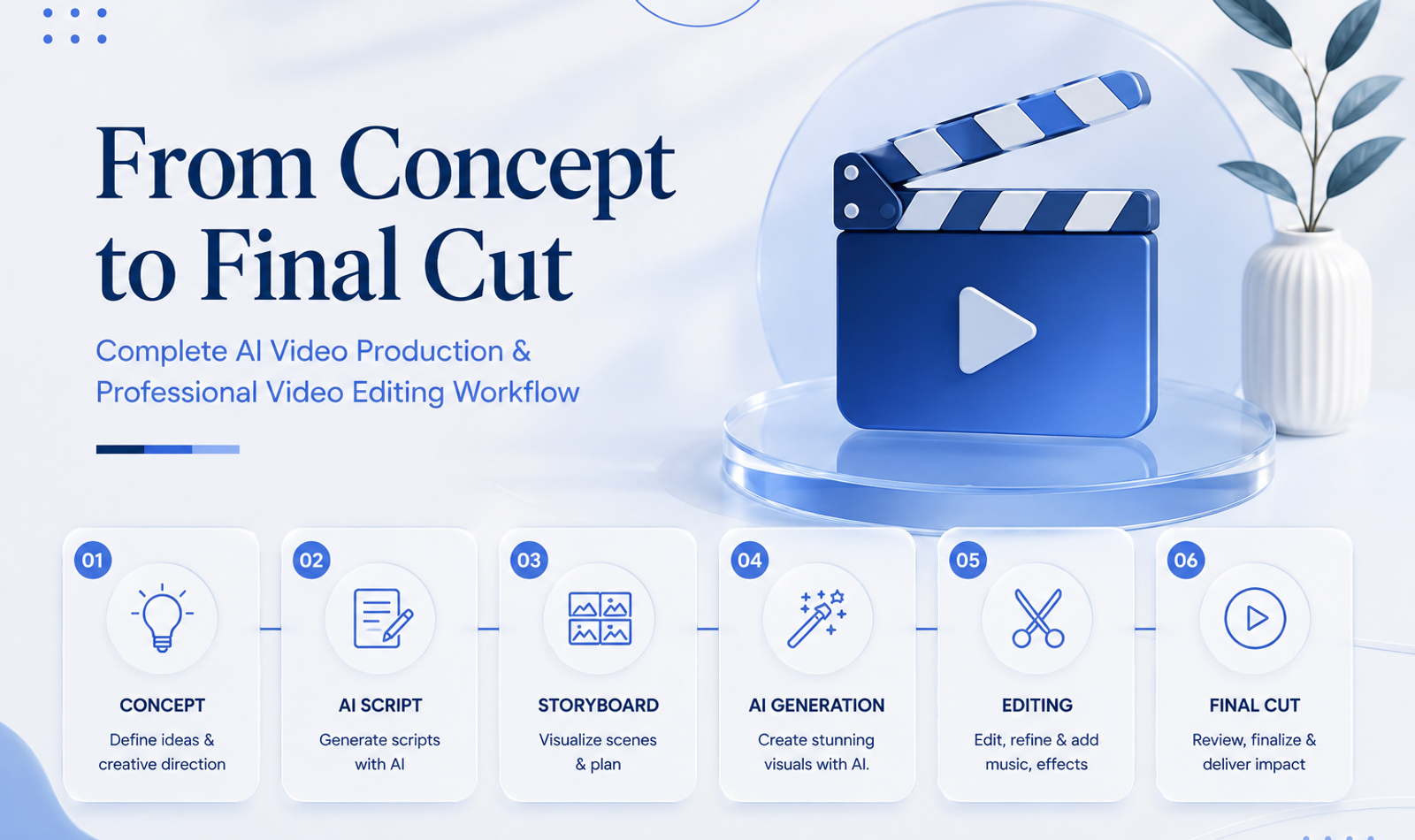
A luxury brand film, event teaser, product campaign, social reel or digital ad should not begin randomly with a prompt.
It should begin with a concept.
The concept becomes a script.
The script becomes a storyboard.
The storyboard becomes a shot plan or AI generation plan.
The assets then move into editing.
Editing creates rhythm, clarity, emotion and brand polish.
The final cut is reviewed, corrected and exported for the right platforms.
This is how a video moves from idea to final delivery.
For brands, this workflow creates consistency.
For agencies, it creates speed.
For editors, it creates clarity.
For clients, it creates a better final result.
AI video production works best when the creative team knows exactly what the video should communicate before the first frame is generated or edited.
Why a Complete Workflow Matters
Many brands use AI video tools without a proper workflow.
They generate a few visuals, add music, place a logo at the end and publish the result.
The video may look interesting for a moment, but it often lacks message, structure and brand value.
A complete workflow prevents this problem.
It ensures that every stage has a purpose.
The concept defines the direction.
The script defines the message.
The storyboard defines the visuals.
The AI generation stage creates the required assets.
The editing stage builds the final story.
The review stage protects quality and accuracy.
The delivery stage ensures the video works on the intended platform.
Without this workflow, AI video can become random.
With this workflow, AI video becomes a professional production system that can support a wider digital marketing and website strategy.
Step 1: Define the Objective
Every video should begin with a clear objective.
The brand must know why the video is being created.
The objective may be awareness, engagement, lead generation, event promotion, product education, service explanation, brand positioning or social media growth.
Different objectives require different videos.
A luxury ad should create desire and brand recall.
An event recap should show proof of execution and emotional experience.
A service explainer should make the offer clear.
A social reel should capture attention quickly.
A founder video should build trust.
A product campaign should show value and detail.
When the objective is unclear, the final video becomes weak.
It may look cinematic but fail to move the audience.
A strong objective helps the creative team decide the tone, duration, structure, platform and call to action.
Step 2: Understand the Audience
The same video cannot speak effectively to every audience.
A corporate decision-maker, luxury customer, wedding client, event sponsor, social media viewer and internal employee all need different communication.
A luxury audience may respond to restraint, detail, atmosphere and elegance.
A corporate audience may need clarity, reliability and professionalism.
A social media audience may need a faster hook and simpler message.
A PR audience may need credibility and story relevance.
An internal team may need direct explanation.
Understanding the audience helps the brand decide how the video should feel.
It also helps avoid generic content.
A video made for everyone often connects deeply with no one.
The best AI video production workflow begins by identifying who the viewer is and what they need to understand.
Step 3: Build the Core Concept
The concept is the creative idea behind the video.
It gives the video a central direction.
For example, a luxury event agency may create a concept around “where every detail becomes an experience.”
An AI video service brand may create a concept around “one idea becoming multiple video assets.”
A hospitality brand may create a concept around “arrival, privacy and escape.”
A fashion brand may create a concept around “movement, texture and identity.”
The concept should be simple enough to guide every creative decision.
It should not be a long explanation.
It should be a clear creative foundation.
When the concept is strong, scripting becomes easier.
Storyboarding becomes clearer.
AI visuals become more consistent.
Editing becomes more purposeful.
The final video feels like one story instead of many disconnected shots.
Step 4: Create the Creative Direction
Creative direction defines the mood and visual language of the video.
It includes tone, colour palette, lighting, camera movement, music style, typography, pacing and overall atmosphere.
For luxury brands, creative direction may be minimal, cinematic, elegant and controlled.
For event recaps, it may be emotional, energetic, glamorous or immersive. Brands working across events and weddings can use this direction to make video content feel connected to the physical event experience.
For digital ads, it may be direct, fast and visually bold.
For AI-generated videos, creative direction is especially important because AI can create many different visual styles.
Without direction, the output may feel inconsistent.
A creative direction should answer important questions.
Should the video feel realistic or surreal?
Should it feel premium or playful?
Should it use slow cinematic movement or fast social pacing?
Should the background be clean or dramatic?
Should the text be minimal or direct?
Once these decisions are clear, the production team can create stronger AI prompts, better footage plans and sharper edits.
Step 5: Write the Script
The script defines what the video says and how the message flows.
A script may include voiceover, dialogue, on-screen text, scene descriptions or a shot-by-shot structure.
Not every video needs spoken narration.
A luxury product film may use only a few lines of text.
An event recap may rely mostly on music and real audio.
A service explainer may need a clear voiceover.
A social reel may need a strong hook, short explanation and CTA.
AI can help create first-draft scripts quickly.
It can generate hooks, scene ideas, alternate tones, short-form versions and platform-specific scripts.
However, the final script should be refined by a human creative team.
AI scripts can sound generic if they are not edited.
The brand voice, audience, offer and emotional tone should be checked carefully.
A good script is focused.
It does not try to say everything.
It communicates the most important message clearly and memorably.
Step 6: Plan the Hook
The hook is the first moment that captures attention.
For social media and ads, the hook is critical.
The viewer decides within seconds whether to continue watching.
A hook can be visual, verbal or emotional.
A luxury ad may open with a dramatic product reveal.
An event recap may open with the most powerful stage moment.
A service video may begin with a sharp problem statement.
An AI video campaign may open with a visual transformation.
A founder video may begin with a strong belief or insight.
The hook should connect with the rest of the video.
It should not be misleading.
A shocking opening may attract attention, but if it does not support the brand message, the viewer may lose interest.
In a professional workflow, the hook is planned before editing begins.
Step 7: Create the Storyboard
Storyboarding turns the script into a visual sequence.
It shows what the audience will see from beginning to end.
A storyboard may be a detailed illustrated frame sequence, a simple written shot list or a mood board with scene descriptions.
The purpose is clarity.
The storyboard helps everyone understand the video before production begins.
For AI video, storyboarding is especially useful because it tells the team which scenes need to be generated.
For traditional footage, it tells the camera team what to shoot.
For editing, it gives the editor a roadmap.
A storyboard may include opening shot, product close-up, lifestyle moment, transition, text frame, emotional peak and final logo.
Without a storyboard, production becomes slower and more uncertain.
With a storyboard, the team knows what needs to be created.
Step 8: Build the Shot List
The shot list is more practical than the storyboard.
It identifies the exact shots required for the video.
For a luxury ad, the shot list may include hero product shot, macro detail, lifestyle use, brand atmosphere, logo reveal and CTA frame.
For an event recap, it may include venue wide shot, guest arrivals, décor details, stage moments, speeches, performances, reactions, sponsor branding and closing celebration.
Guest arrivals and hospitality moments can also demonstrate the quality of a brand's guest management, especially for luxury events and weddings.
For a founder video, it may include talking-head footage, office B-roll, team interaction, product visuals and supporting details.
For AI video, the shot list can include generated scenes, animated stills, AI backgrounds, product environments and transition shots.
A strong shot list saves time.
It helps avoid missing important visuals.
It also helps the editor receive the material needed to create a complete final cut.
Step 9: Decide What Should Be AI and What Should Be Real
Not every part of a video should be AI-generated.
The team should decide where AI adds value and where real footage is necessary.
AI is useful for concept visuals, mood films, animated backgrounds, surreal scenes, pre-launch teasers, product environments, motion graphics and visual metaphors.
Real footage is important for testimonials, event recaps, founder messages, product accuracy, customer proof, service documentation and emotional authenticity.
A luxury brand may use AI for atmosphere but real footage for product detail.
An event company may use AI for pre-event concept teasers but real footage for the final recap.
A service brand may use AI for visual explanations but real people for trust-building messages.
The best workflow is usually hybrid.
AI creates imagination.
Real footage creates proof.
Professional editing connects both.
Step 10: Generate or Capture the Assets
Once the plan is approved, production begins.
For AI assets, the team creates prompts, reference images, style directions and scene descriptions.
Each generated clip should match the storyboard.
The team may need several versions before selecting the strongest output.
AI generation requires review.
Faces, hands, product shapes, logos, text, movement and backgrounds should be checked.
For real footage, the team captures video according to the shot list.
Lighting, framing, audio, camera movement and composition should match the creative direction.
For events, the team should capture both planned and spontaneous moments.
For product shoots, accuracy and detail matter.
The production stage should not be random.
Every asset should serve the final video.
Step 11: Organise the Footage and AI Assets
Before editing begins, all assets should be organised properly.
This includes real footage, AI-generated clips, images, logos, music options, voiceovers, fonts, brand guidelines and reference files.
Good organisation saves editing time.
Assets can be divided into folders such as interviews, product shots, event details, AI scenes, audio, graphics and exports.
For event recaps, footage can be organised by moment: arrivals, décor, speeches, performances, guests, stage and closing.
For brand films, assets can be organised by scene or message.
The editor should not waste time searching through messy files.
A clean file structure improves speed, quality and revision control.
Step 12: Create the First Cut
The first cut is the initial edited version of the video.
It brings the script, storyboard, footage and AI visuals together.
The first cut does not need to be perfect, but it should show the full structure.
The editor selects the strongest shots, arranges them in order, places the main audio, adds rough text and builds the pacing.
This stage reveals whether the video works.
Sometimes a storyboard looks good but the edit needs changes.
A shot may feel too long.
A transition may not work.
A better opening may be found in the footage.
A strong editor uses the plan but remains flexible.
The first cut is where the video starts becoming real.
Step 13: Refine the Story
After the first cut, the editor improves the story.
This may involve removing weak shots, changing the sequence, tightening the opening, improving transitions and strengthening the emotional build-up.
For luxury ads, refinement often means removing anything that feels unnecessary.
For event recaps, refinement means selecting moments that communicate atmosphere and experience.
For social reels, refinement means making the video faster, clearer and more engaging.
For explainers, refinement means improving clarity.
Editing is not only about adding effects.
It is often about reducing clutter.
A refined video feels smoother, sharper and more intentional.
The viewer should not feel the editing process.
They should feel the story.
Step 14: Add Voiceover or Dialogue
Voiceover can help explain the message and add emotion.
The workflow should decide whether the voice will be real, AI-generated, founder-led, presenter-led or narration-based.
For luxury videos, voiceover should be minimal and elegant.
For explainers, it should be clear and direct.
For founder videos, the voice should feel authentic.
For event recaps, real speeches or live sound may be more powerful than recorded narration.
AI voiceovers can help with drafts, internal videos or multilingual versions.
However, real voice is often stronger when trust and emotion matter.
The editor should balance voice with music and sound design.
The voice should be easy to hear and should not compete with background audio.
Step 15: Add Music
Music shapes the emotional direction of the video.
A luxury ad may need cinematic, elegant or atmospheric music.
An event recap may need emotional, energetic or celebratory music.
A corporate film may need polished and professional music.
A social reel may need faster rhythm.
Music should be selected according to the brand and objective.
The wrong music can make a premium video feel cheap.
The editor should also check licensing.
Music used for personal posts may not be allowed for paid ads, YouTube uploads, website videos or commercial campaigns.
A professional workflow confirms music rights before final delivery.
Music should support the edit, not overpower it.
Step 16: Add Sound Design
Sound design makes the video feel complete.
It includes subtle sound effects, ambience, transitions, impacts, movement sounds, crowd reactions and texture.
In luxury ads, sound design may include soft whooshes, product movement, footsteps, fabric, metal, glass, water or city ambience.
In event recaps, sound design may include applause, crowd energy, stage audio and natural reactions.
For AI-generated clips, sound design is especially important because the visuals may otherwise feel silent or disconnected.
Good sound design makes AI scenes feel more believable.
It also makes real footage feel more immersive.
A video with good sound feels more expensive and professional.
Step 17: Add Typography and Motion Graphics
Typography and motion graphics help communicate information clearly.
They may include titles, lower thirds, captions, event names, product details, service lines, benefit points and CTAs.
For luxury videos, typography should be minimal and refined.
For social ads, text should be readable and direct.
For event recaps, graphics should identify the event without interrupting the emotion.
Motion graphics should match the brand identity.
Fonts, spacing, colours and animation style should feel consistent.
Poor typography can weaken even strong visuals.
Text should also be placed carefully for mobile formats.
It should not cover faces, products or key action.
Step 18: Colour Grade the Video
Colour grading creates visual consistency and mood.
It makes the footage and AI visuals feel part of the same world.
For luxury brands, colour grading can create depth, polish and atmosphere.
For event recaps, it can balance different lighting conditions.
For social reels, it can make the video brighter, cleaner and more platform-ready.
AI-generated clips may have different colours from real footage.
The editor or colourist should match them carefully.
Colour grading should support the brand’s identity.
Warm tones may feel emotional and celebratory.
Cool tones may feel modern and premium.
High contrast may feel cinematic.
Soft grading may feel natural and elegant.
A strong grade improves perceived quality.
Step 19: Add Subtitles and Captions
Subtitles are important because many viewers watch videos without sound.
They also improve accessibility and clarity.
For social media, subtitles can help retain attention.
For explainers, they help viewers follow the message.
For event recaps, they can highlight important speech moments.
Subtitles should be accurate, readable and well-timed.
The font should match the brand.
The placement should avoid important visuals.
For luxury brands, subtitles should feel clean and refined.
For performance ads, subtitles may be stronger and more direct.
AI can generate captions quickly, but they should always be checked manually.
Spelling errors and wrong words can make the video look unprofessional.
Step 20: Create Platform Versions
One video usually needs several versions.
A 16:9 YouTube video may not work properly as a 9:16 Instagram Reel.
A website hero video may need to be shorter, silent and loopable.
A LinkedIn video may need clearer subtitles and professional pacing.
A paid ad may need a stronger opening and earlier CTA.
A single campaign may require 9:16, 4:5, 1:1 and 16:9 formats.
It may also require 15-second, 30-second, 60-second and long-form versions.
Platform adaptation should not be careless cropping.
Important faces, products, text and logos should stay within safe areas.
Professional editing ensures each version feels designed for its platform.
Step 21: Review for Brand Accuracy
Before the final cut is approved, the brand should review accuracy.
Product visuals should match the real product.
Service claims should be correct.
Event footage should not exaggerate scale.
Logos, names, dates and captions should be accurate.
Spokesperson titles should be correct.
If AI visuals were used, they should be checked for distortions.
This stage protects brand trust.
A beautiful video can still create problems if details are wrong.
Luxury brands especially need careful review because product detail and perception matter.
A professional workflow does not treat quality control as optional.
Step 22: Review for Rights and Permissions
The team should confirm that all assets are cleared for use.
This includes music, stock footage, fonts, templates, voiceovers, AI tool outputs, product images, talent appearances, event guests and brand logos.
If real people appear in the video, permission may be required depending on the context and usage.
If a voice is cloned or AI-generated, consent and disclosure should be considered.
If the video uses AI-generated visuals, platform and client requirements should be checked.
Rights review is especially important for paid ads, public campaigns and client work.
A video should not be published until the team is confident it can be used legally and responsibly.
Step 23: Review for Brand Safety
Brand safety means ensuring the video does not create avoidable risk.
The team should check whether the content could mislead viewers, damage trust, offend audiences or create platform issues.
AI-generated people, places, events and product demonstrations should be reviewed carefully.
A synthetic testimonial should not look like a real customer unless clearly disclosed.
A concept event visual should not be presented as past execution.
A product should not be shown doing something it cannot do.
A luxury brand should not use effects that make the product feel cheap or fake.
Brand safety protects long-term reputation.
It should be part of the final review process.
Step 24: Final Cut Approval
The final cut is the approved version of the video.
By this stage, the story, visuals, sound, colour, graphics, captions and platform formats should be complete.
Feedback should be consolidated.
Too many last-minute opinions can weaken the final video.
The approval team should review the video according to the original objective.
Does it communicate the message?
Does it match the brand?
Does it work for the platform?
Does it include the required CTA?
Does it feel polished?
Does it protect accuracy and trust?
Once these questions are satisfied, the video can move to final export.
Step 25: Export and Delivery
Export settings matter.
The video should be delivered in the correct resolution, format, frame rate and aspect ratio for each platform.
Instagram Reels, YouTube Shorts, LinkedIn, websites, LED screens, paid ads and presentation decks may all require different specifications.
The file name should be clear.
Versions should be organised properly.
Final exports may include master file, compressed social version, ad version, story version, no-text version, subtitle version and thumbnail.
A professional delivery package saves time for marketing teams.
It also reduces mistakes during uploading.
The final cut should be easy to use.
Step 26: Publish With a Distribution Plan
A video is only valuable when it reaches the right audience.
Publishing should be planned.
The team should decide where the video will appear first, how it will be captioned, whether it will be boosted, which landing page it will link to and how it will support the larger campaign.
A brand film may go on the website and YouTube.
A short cutdown may go on Instagram.
A professional version may go on LinkedIn.
A paid version may run as an ad.
An event recap may be sent to clients, sponsors and media.
Campaign videos can also support PR and media marketing by giving journalists, publications, creators and partners stronger visual assets to work with.
The distribution plan should match the objective defined at the beginning.
Good production and weak distribution limit results.
Step 27: Measure Performance
After publishing, the video should be measured.
The right metrics depend on the objective.
For awareness, the brand can track reach, views and watch time.
For engagement, it can track saves, shares, comments and profile visits.
For ads, it can track clicks, leads, enquiries and conversions.
For event recaps, it can track client response, sponsor value, future enquiries and portfolio use.
For brand films, it can track website engagement, sales conversations and perception.
Measurement should also include qualitative feedback.
Are viewers remembering the brand?
Are enquiries relevant?
Are people responding to the message or only the visuals?
Performance data helps improve the next video workflow.
Step 28: Repurpose the Final Cut
A final video should not be used only once.
One master video can become several assets.
A brand film can become reels, story clips, website banners and ad cutdowns.
A founder video can become quote clips, LinkedIn posts and short explainers.
An event recap can become teaser reels, sponsor videos, venue highlights and sales presentation clips.
AI can help generate additional hooks, captions and shorter structures.
Professional editing turns these into polished versions.
Repurposing increases the value of the original production.
It also helps brands stay consistent across platforms.
A good workflow plans repurposing from the beginning.
AI Video Workflow for Luxury Ads
Luxury ads require careful planning and refined execution.
The concept should be strong but simple.
The visuals should feel premium, not cluttered.
AI can help create cinematic environments, abstract visual worlds, luxury backgrounds and product atmosphere.
Real product footage should be used when accuracy is important.
Editing should focus on rhythm, sound, colour and restraint.
Typography should be minimal.
Music should feel elegant.
The final ad should create desire without over-explaining.
AI can make the video visually powerful, but professional editing makes it feel like a luxury brand asset.
Luxury campaigns may also incorporate celebrity management when the campaign requires celebrity talent, endorsements, appearances or high-profile brand associations.
AI Video Workflow for Event Recaps
Event recaps depend on real footage and emotional storytelling.
AI can support title sequences, transitions, animated invites, pre-event teasers and social cutdowns.
However, the main recap should show the real event.
The workflow begins before the event with a shot plan.
The video team should know the schedule, VIPs, performances, décor, sponsor needs and key moments.
After the event, footage should be organised and edited into a strong emotional sequence.
Music, sound design and colour grading bring the recap to life.
The final video should make future clients feel the scale and quality of the event.
High-quality recaps can also become long-term portfolio assets within a brand's selected work, giving potential customers visual proof of execution.
AI Video Workflow for Social Reels
Social reels need speed and clarity.
The workflow should begin with a hook.
The video should quickly show the problem, idea, benefit or visual moment.
AI can create motion from stills, animated backgrounds, surreal effects and fast visual variations.
Editing should keep the pace tight.
Subtitles should be readable.
The CTA should be clear.
A reel should not feel like a shortened long video.
It should be designed for short-form viewing from the beginning.
AI helps create attention.
Editing helps maintain it.
AI Video Workflow for Service Explainers
Service explainers need structure and clarity.
The script should explain the problem, solution, process and benefit.
Storyboarding should identify supporting visuals.
AI can create simple visual metaphors, motion graphics, avatar sections or animated scenes.
Real footage may show the team, work process or client results.
Editing should be clean and professional.
The video should not feel overloaded with effects.
The final result should make the service easier to understand and trust.
For professional brands, clarity is more important than visual noise.
Service explainers can also be embedded into relevant website pages and supported by educational content through the Double Trouble Studio blog.
Common Mistakes in AI Video Workflows
One common mistake is starting with AI generation before defining the concept.
Another mistake is creating too many disconnected visuals.
Brands may also skip storyboarding and then struggle during editing.
Some teams use AI where real footage is needed.
Others use real footage without professional editing.
A major mistake is ignoring product accuracy and rights.
AI can distort products, logos and people.
Music, fonts and stock assets also need proper licensing.
Another mistake is publishing one version everywhere without platform adaptation.
A good workflow avoids these mistakes through planning, review and professional finishing.
How Double Trouble Studio Manages the Workflow
Double Trouble Studio manages AI video production and professional editing through a structured workflow.
We begin with the concept, audience and campaign objective.
Then we develop scripts, visual directions, storyboards and shot plans.
We decide which parts should be AI-generated, filmed, animated or edited traditionally.
AI is used to create cinematic visuals, motion concepts, campaign teasers and creative assets where it adds value.
Professional editing brings everything together through pacing, sound design, colour grading, typography, captions and platform-ready exports.
For luxury ads, we focus on premium visual language.
For event recaps, we focus on emotion and proof of execution.
For social campaigns, we create multiple cutdowns that support reach, engagement and enquiries.
For campaigns requiring wider visibility, video assets can also be integrated with PR, media and marketing, website content and digital acquisition.
The goal is to take a brand from concept to final cut with speed, creativity and control.
Frequently Asked Questions
What is an AI video production workflow?
An AI video production workflow is a structured process that takes a video from concept to final delivery using AI tools, real footage and professional editing. It usually includes strategy, scripting, storyboarding, AI generation, asset organisation, editing, sound, colour, captions, quality control and platform-ready exports.
Why is a workflow important for AI video production?
A workflow is important because AI-generated videos can become random without structure. A clear workflow ensures that every video has a purpose, message, visual direction and final brand polish. It helps brands create faster content without losing clarity, quality or consistency.
Does AI video production replace professional editing?
No, AI video production does not replace professional editing. AI can generate visuals, animate scenes and speed up production, but editing is where the video becomes complete. Professional editing controls pacing, emotion, sound, colour, typography, captions, transitions and final delivery.
What should come first in an AI video project?
The first step should always be the objective. The brand must define why the video is being created, who it is for, what message it should communicate and what action the viewer should take. AI generation should begin only after the strategy, concept and creative direction are clear.
Why is storyboarding important for AI video?
Storyboarding is important because it turns the script into a visual plan. It helps the team decide which scenes need to be generated, filmed, animated or edited. A storyboard prevents disconnected AI visuals and helps the final video feel consistent, intentional and professional.
What should be AI-generated and what should be real footage?
AI should be used for concept visuals, cinematic scenes, animated backgrounds, pre-launch teasers, motion graphics and visual metaphors. Real footage should be used for testimonials, founder messages, event recaps, product accuracy, customer proof and high-trust communication. The best workflow usually combines both.
How does professional editing improve AI-generated videos?
Professional editing makes AI-generated videos feel polished and brand-ready. It connects separate clips into one story, matches colours, adds sound design, improves pacing, places typography correctly, adds captions and prepares platform-specific versions. Editing gives AI visuals structure and emotional flow.
Why is quality control important in AI video production?
Quality control is important because AI can distort products, faces, logos, text, movement and backgrounds. Every video should be checked for product accuracy, brand safety, rights, music licensing, subtitles, spelling, platform format and visual consistency before publishing.
How can one AI video become multiple content assets?
One master video can be repurposed into several platform-ready assets. A brand film can become Instagram Reels, YouTube Shorts, website clips, paid ads, story versions and presentation videos. AI can help create variations, while professional editing ensures each version works properly for its platform.
Which formats should brands create for video campaigns?
Brands should usually plan multiple formats such as 9:16 for Reels and Shorts, 4:5 for social feeds, 1:1 for square posts and 16:9 for YouTube, websites or presentations. They may also need 15-second, 30-second, 60-second and long-form versions depending on the campaign objective.
What is the biggest mistake in AI video production?
The biggest mistake is starting with random AI generation before defining the concept, message and audience. AI visuals may look impressive, but without strategy, scripting, storyboarding and editing, the final video may not communicate clearly or support brand growth.
What is the best AI video workflow for brands?
The best workflow is hybrid. It combines strategy, AI-generated visuals, real footage, professional editing, sound design, colour grading, captions, quality control and platform delivery. AI provides speed and imagination, real footage provides authenticity, and editing turns everything into a polished brand story.
Conclusion
A complete AI video production and professional video editing workflow is essential for brands that want faster content without losing quality.
AI has made video production more flexible, creative and scalable, but strong videos still require strategy, planning and professional finishing.
The process should begin with a clear objective.
The brand must define what the video should achieve, who it should reach and what message it should communicate.
From there, the concept, script and storyboard create the foundation of the production.
AI can then support the workflow by generating visuals, animating scenes, creating concept assets, producing variations and speeding up technical tasks.
But AI should be used with direction.
Random AI visuals may look interesting, but they rarely create a strong brand film on their own.
Professional editing remains the stage where the video becomes complete.
Editing controls pacing, emotion, sound, colour, typography, captions and platform readiness.
It connects AI visuals, real footage and brand messaging into one polished story.
A strong workflow also decides what should be AI-generated and what should be real.
Luxury products, founder messages, customer testimonials and event recaps often need authenticity and accuracy.
AI can enhance these videos, but it should not replace real proof where trust matters.
Quality control is equally important.
Every final cut should be reviewed for product accuracy, brand safety, rights, music licensing, subtitles, platform format and visual consistency.
A video that looks cinematic can still create problems if it misrepresents the brand or contains errors.
The best workflow is hybrid.
AI provides speed and imagination.
Real footage provides authenticity.
Professional editing provides polish and structure.
Strategy connects everything to a business goal.
For modern brands, the journey from concept to final cut is no longer a slow and disconnected process.
With the right workflow, one idea can become a full video system: a brand film, social reels, paid ads, event teasers, website clips and campaign cutdowns.
This makes production faster, smarter and more valuable.
AI expands what can be created.
Professional editing decides how it should be experienced.
When both work together inside a clear workflow, brands can create videos that feel cinematic, credible, platform-ready and aligned with long-term growth.
Ready to Take Your Brand Video From Concept to Final Cut?
Your brand videos should do more than look cinematic. They should begin with strategy, follow a clear production workflow, protect brand accuracy and deliver polished content across social media, ads, websites, events, campaigns and presentations.
At Double Trouble Studio, we help brands create complete AI video and VFX and professional video editing workflows, from concept development, scripting and storyboarding to AI visuals, real footage, editing, sound design, colour grading, captions and platform-ready exports.
For AI video production, professional video editing, brand films, event recaps, social reels, paid ads, website videos, digital marketing, PR, SEO and creative strategy, connect with Double Trouble Studio today.
📩 info@dtsworld.in 📞 +91 80000 06021 📍 Andheri (West), Mumbai
Need this for your brand?
Let DTS build your next campaign.
From PR, celebrity management and events to websites, social media, SEO and AI video production — Double Trouble Studio helps brands grow with strategy and execution.
Discuss Your Requirement →