For most of the last decade, founder visibility was treated as optional — a nice-to-have for CEOs who happened to enjoy being on camera or writing LinkedIn posts, while the more reserved ones stayed comfortably behind the company logo. That assumption has quietly stopped being true. Research on executive reputation has repeatedly found that a substantial share of a company's overall reputation and market value now traces directly back to how its CEO is perceived, not just what the company sells. Investors read founder communication style as a signal of leadership judgment. Customers increasingly research the people behind a company before they research the company itself. And in B2B specifically, individual founder profiles on platforms like LinkedIn now regularly out-reach official company pages by a wide margin, because audiences trust a person's voice more than they trust a brand account.
The practical effect of this shift is that founder PR and personal branding have moved from "optional extra" to something closer to a core business function — quietly sitting alongside product, sales, and hiring as a lever that affects all three. A founder with real authority in their category raises capital more easily, because investors have already formed an impression of their judgment before the pitch meeting starts. They hire more easily, because candidates researching the company find a credible, human leader rather than a blank LinkedIn profile. And they sell more easily, particularly in categories where the buyer is choosing between vendors who look similar on paper — trust in the person behind the company becomes a genuine differentiator.
This guide lays out what founder PR and personal branding actually look like when done well in 2026 — not the version that's just "post on LinkedIn a lot," but a structured approach covering earned media, digital presence, speaking, and the judgment required to do all of it without becoming a liability instead of an asset.
Why This Matters More Now Than It Did Five Years Ago
A few shifts explain why founder visibility has become less optional over time.
Buyers and investors research people, not just companies, before engaging. This has always been somewhat true, but the amount of information now available about any individual online — a LinkedIn history, past interviews, a Google search — means that research happens whether a founder curates it or not. A founder who hasn't built any presence isn't neutral in this search; they're simply an information gap, which reads as less trustworthy than an active, consistent presence, even an imperfect one.
AI-driven search and discovery increasingly surfaces people, not just brands. As search engines, recommendation systems, and AI assistants get better at identifying genuine expertise rather than just crawling for keywords, individuals who've built a consistent, specific point of view online are more likely to surface in results than generic corporate content. A founder with a real, demonstrated specialty becomes more discoverable than a company page making generic claims.
Employees and customers alike now expect leadership to be visible. Internal research on employee sentiment has found that a large majority of employees say a company's brand image improves when its leadership is visibly active — it signals confidence and accessibility. The inverse is also true: a leadership team that's completely absent from any public conversation can read as disengaged or, worse, as having something to hide.
The bar for what counts as credible has risen, even as the volume of content has grown. This is the part most founders get wrong. More founders posting on LinkedIn doesn't mean the bar has dropped — audiences have simply gotten better at distinguishing genuine expertise from generic, interchangeable "thought leadership" content. A vague inspirational post gets scrolled past. A specific, well-argued point of view — especially one that pushes back on conventional wisdom in a category — gets remembered.
The Two Pillars: Earned Media and Owned Presence

Founder PR generally rests on two pillars that reinforce each other rather than competing for the same effort.
Earned media is third-party validation — a journalist, podcast host, or publication choosing to feature the founder because there's a genuinely interesting story, not because the founder paid for the placement. This is harder to get and slower to build, but it carries more credibility precisely because it isn't self-published.
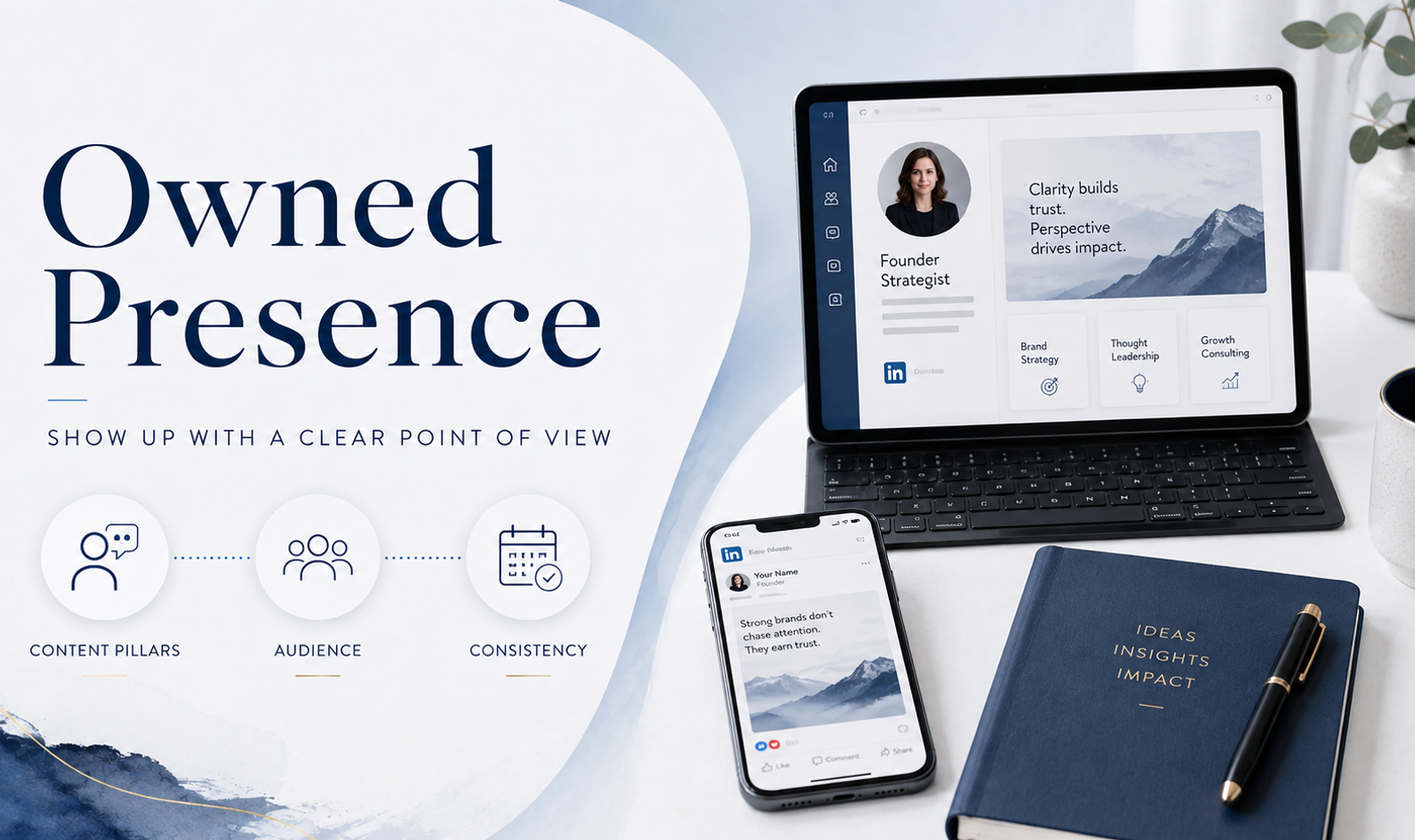
Owned presence — LinkedIn, a personal newsletter, speaking appearances, podcast guesting — is where a founder builds consistent, direct visibility without depending on an editor's approval. It's more within a founder's control, but it also carries less inherent third-party credibility unless the content itself is genuinely strong.
The founders who build real authority use these together: media coverage gives them credibility and content to share; their owned presence extends the life of that coverage and builds the ongoing relationship with an audience between media hits. A single press feature that isn't shared or referenced anywhere else has a short shelf life. A LinkedIn presence with no third-party validation behind it can start to feel like self-promotion with nothing to back it up. Together, they compound.
Building the Foundation: Positioning Before Visibility
The single most common mistake in founder PR is starting with visibility — posting, pitching, seeking interviews — before establishing what the founder actually wants to be known for. Without that foundation, activity produces noise rather than authority.
A useful starting exercise is answering a deceptively simple question: if a journalist, investor, or potential hire read three things this founder had said publicly, would they be able to accurately describe what that founder believes and knows deeply? If the honest answer is no — if three posts or interviews could have come from almost any founder in the category — there's no real positioning yet, regardless of how much content exists.
Strong founder positioning usually has a few characteristics. It's specific rather than broad — "I have a strong point of view on how early-stage companies should think about pricing" is more useful than "I'm passionate about entrepreneurship." It often includes a genuine, defensible opinion, ideally one that pushes back on something the category takes for granted, since agreement with conventional wisdom rarely generates real engagement or memorability. And it's grounded in real experience or data the founder actually has access to, rather than generic commentary anyone could produce — this is also increasingly what separates content that reads as authentic from content that reads as generated, a distinction audiences have become noticeably better at detecting.
This positioning work typically takes real reflection — sometimes uncomfortable, since it requires a founder to commit to a specific point of view rather than staying safely general. But it's the difference between a personal brand that compounds over time and one that generates a burst of posts with no lasting shape.
Earned Media: What Actually Gets a Founder Covered
Journalists don't cover founders because they're founders. They cover founders who have something specific and useful to say about a story that's already relevant to their beat. A few approaches tend to work consistently.
Data and original research. A founder who can share a genuine data point — from their own product usage, customer behavior, or market observation — gives a journalist something concrete to build a story around, rather than an opinion that's hard to verify or differentiate from a dozen similar takes.
A contrarian, well-reasoned position. Journalists are drawn to genuine disagreement, particularly when it's backed by real experience. A founder willing to say "most people in this category believe X, and here's specifically why that's wrong, based on what I've seen" is far more pitchable than a founder repeating industry consensus.
Timing relevance. A founder's expertise becomes more pitchable when it connects to something already in the news — a regulatory change, a competitor's news, a broader industry trend. Media relevance is rarely just about the founder's expertise in isolation; it's about that expertise intersecting with something a journalist's audience already cares about right now.
A specific, ongoing beat relationship rather than one-off pitching. Founders who build a habit of being a reliable, quotable source for a handful of relevant journalists — not pitching once and disappearing — tend to get covered repeatedly over time, because journalists develop a mental shortlist of people worth calling when a relevant story comes up.
Byline articles and op-eds deserve particular mention here, since they're one of the more underused tools available to founders. A well-placed op-ed in a relevant trade or business publication does double duty: it's earned media in its own right, and it produces a piece of content the founder can reference and share afterward as proof of expertise, extending its value well beyond the initial publication date.
Owned Presence: Where Founders Get LinkedIn Wrong
LinkedIn deserves specific attention because it's where most founder personal branding effort actually goes, and where most of that effort underperforms.
The most common failure isn't inconsistency — plenty of founders post regularly. It's a lack of a clear point of view running through the content. A founder profile without a discernible specialty or opinion reads as noise, even with a decent posting frequency, because there's nothing for a reader to associate with that founder specifically.
A more effective approach is choosing a small number of content pillars — typically three or four themes that sit at the genuine intersection of the founder's real expertise and what their audience actually cares about. Common, effective pillars for founders include lessons from specific failures or mistakes (which tend to outperform polished success stories, since audiences trust vulnerability more than a highlight reel), observations about where the market or category is heading, behind-the-scenes decisions and the reasoning behind them, and direct, sometimes contrarian opinions about how the industry operates.
Format and frequency matter less than most founders assume, and the trend among more established leaders in 2026 has actually moved toward fewer, more considered posts rather than daily content — a well-reasoned long-form post once a week tends to build more durable authority than a high volume of shallow daily posts. Volume without a clear point of view just produces more noise; it doesn't produce more authority.
It's also worth naming directly: audiences have gotten noticeably better at detecting generic, AI-generated-sounding content, and a founder profile that reads as outsourced or formulaic tends to damage credibility rather than build it. Tools that assist with drafting or organizing ideas are genuinely useful, but the underlying opinions and specific experience need to be real and the founder's own — this is precisely the gap audiences have learned to notice.
Speaking, Podcasts, and Extended Visibility
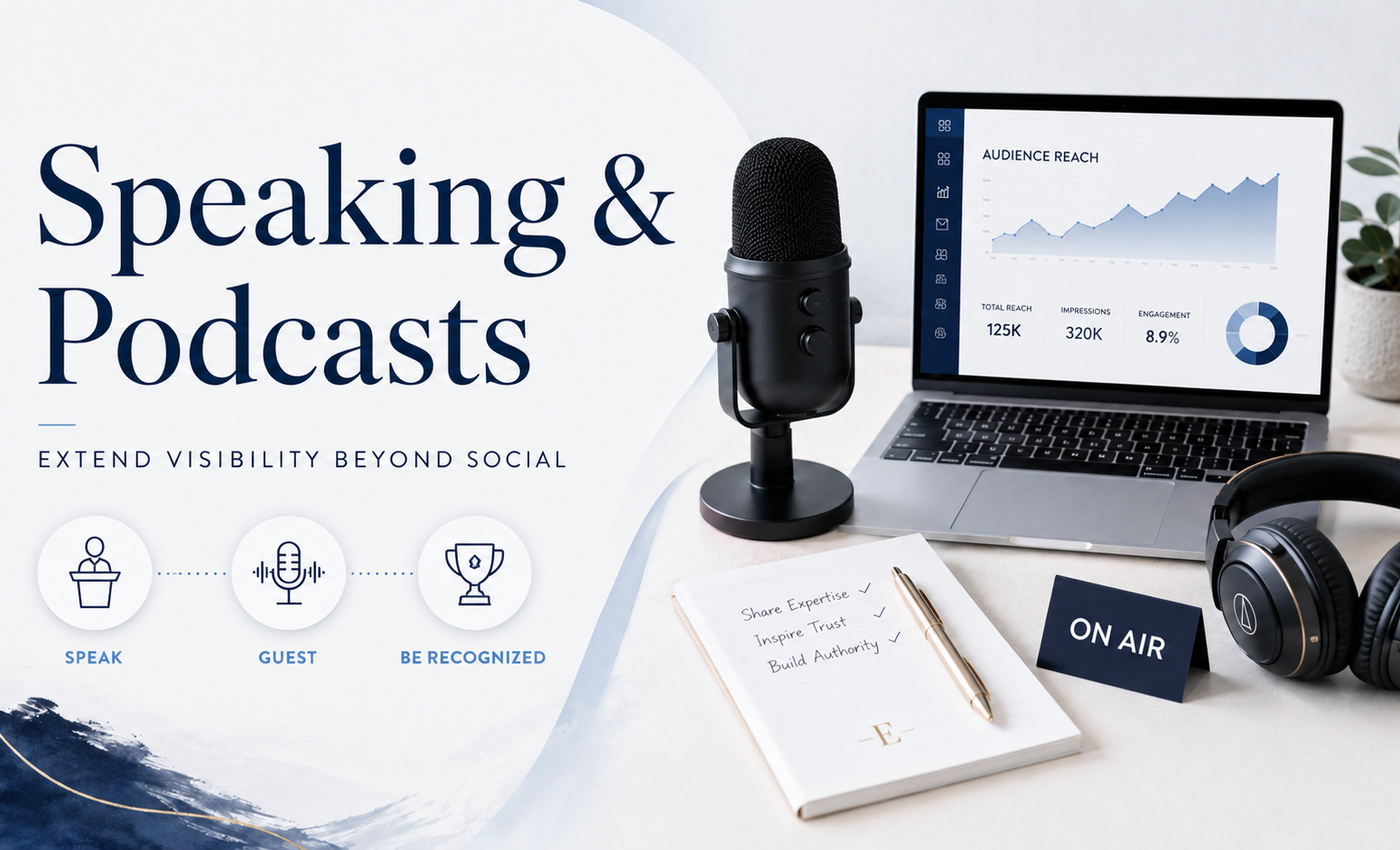
Beyond media coverage and LinkedIn, speaking opportunities — panels, conferences, podcast guest appearances — serve a distinct function: they let a founder demonstrate depth in real time, in a format that's harder to fake than a written post, and they typically reach an audience that overlaps with, but isn't identical to, the founder's existing following.
Podcast guesting in particular has become one of the more efficient channels for founder visibility, since a single strong appearance can be repurposed into short clips, quotes, and LinkedIn content for weeks afterward — effectively multiplying the value of a single hour of the founder's time. Identifying the right podcasts — ones whose audience genuinely overlaps with the founder's target customers, investors, or category peers — matters more than chasing the podcast with the largest raw audience.
Award submissions and recognition lists (industry "40 under 40"-style lists, category-specific awards) are another underused tool. They're not glamorous, but a genuine, credible award adds a layer of third-party validation that a founder can reference in bios, media pitches, and LinkedIn content going forward, and many have predictable annual deadlines worth planning a calendar around.
The Risk Side: Where Founder Visibility Can Backfire
Visibility carries real risk, and it's worth naming honestly rather than only discussing the upside. Founders who misstep publicly — an insensitive comment, a poorly handled crisis response, visible inconsistency between public statements and company behavior — face scrutiny precisely because they've built visibility in the first place. This is part of why more experienced leaders have moved toward fewer, more deliberate moments of visibility rather than constant, ad hoc commentary on everything: it reduces the surface area for misinterpretation while still building genuine authority over time.
A few practices reduce this risk meaningfully. Having a small, trusted second reader for anything sensitive before it's published catches problems a founder, too close to their own thinking, might miss. Avoiding commentary on topics genuinely outside the founder's expertise — even when there's pressure to have an opinion on everything — protects credibility in the areas where the founder's opinion actually carries weight. And having a basic, thought-through plan for how the founder would respond if a post or interview generated unexpected backlash means the first real response isn't improvised under pressure.
The goal isn't to eliminate risk by saying nothing substantive — that produces exactly the generic, forgettable content that fails to build authority in the first place. It's to be deliberate enough that the founder's visibility serves the business consistently, rather than occasionally undermining it.
Measuring Whether It's Actually Working
Founder PR is harder to measure than a performance marketing campaign, but it isn't unmeasurable. A few signals are worth tracking deliberately rather than relying on vague impressions.
Inbound interest is one of the clearest signals — an increase in inbound investor interest, partnership inquiries, or candidate applications that specifically reference something the founder said publicly is a strong indicator that the visibility is translating into real business value, not just engagement numbers.
Media momentum is another — whether journalists are starting to reach out proactively rather than the founder always initiating outreach is a meaningful sign that real authority is building, since it means the founder has become a recognized source in their category rather than someone still introducing themselves each time.
Engagement quality matters more than raw numbers — a smaller number of substantive comments from genuinely relevant people (potential customers, investors, peers in the category) is a far stronger signal than a large number of generic likes from an unrelated audience.
And simply asking, periodically, whether a stranger reading the founder's last several public appearances — posts, interviews, articles — could accurately describe what that founder is known for is a useful gut check. If the answer is still vague after months of consistent effort, the issue usually isn't a lack of activity — it's a lack of clear positioning underneath the activity.
The Bottom Line
Founder PR and personal branding aren't about becoming a full-time content creator or chasing visibility for its own sake. The founders who build genuine, lasting authority start with a specific, defensible point of view, build it through a combination of earned media and consistent owned presence, treat speaking and podcast opportunities as genuine extensions of that authority rather than one-off appearances, and stay deliberate about the real risks that come with public visibility.
Done well, it compounds. A founder who's been genuinely useful and consistent in their category for two or three years isn't rebuilding credibility from scratch with every new pitch, post, or interview request — they're already known, which is precisely the asset that makes the next round of fundraising, hiring, and selling measurably easier.
Want help building a founder PR strategy that's actually specific to your positioning, not a generic content calendar? Reach out to talk through what this looks like for you.
Need this for your brand?
Let DTS build your next campaign.
From PR, celebrity management and events to websites, social media, SEO and AI video production — Double Trouble Studio helps brands grow with strategy and execution.
Discuss Your Requirement →