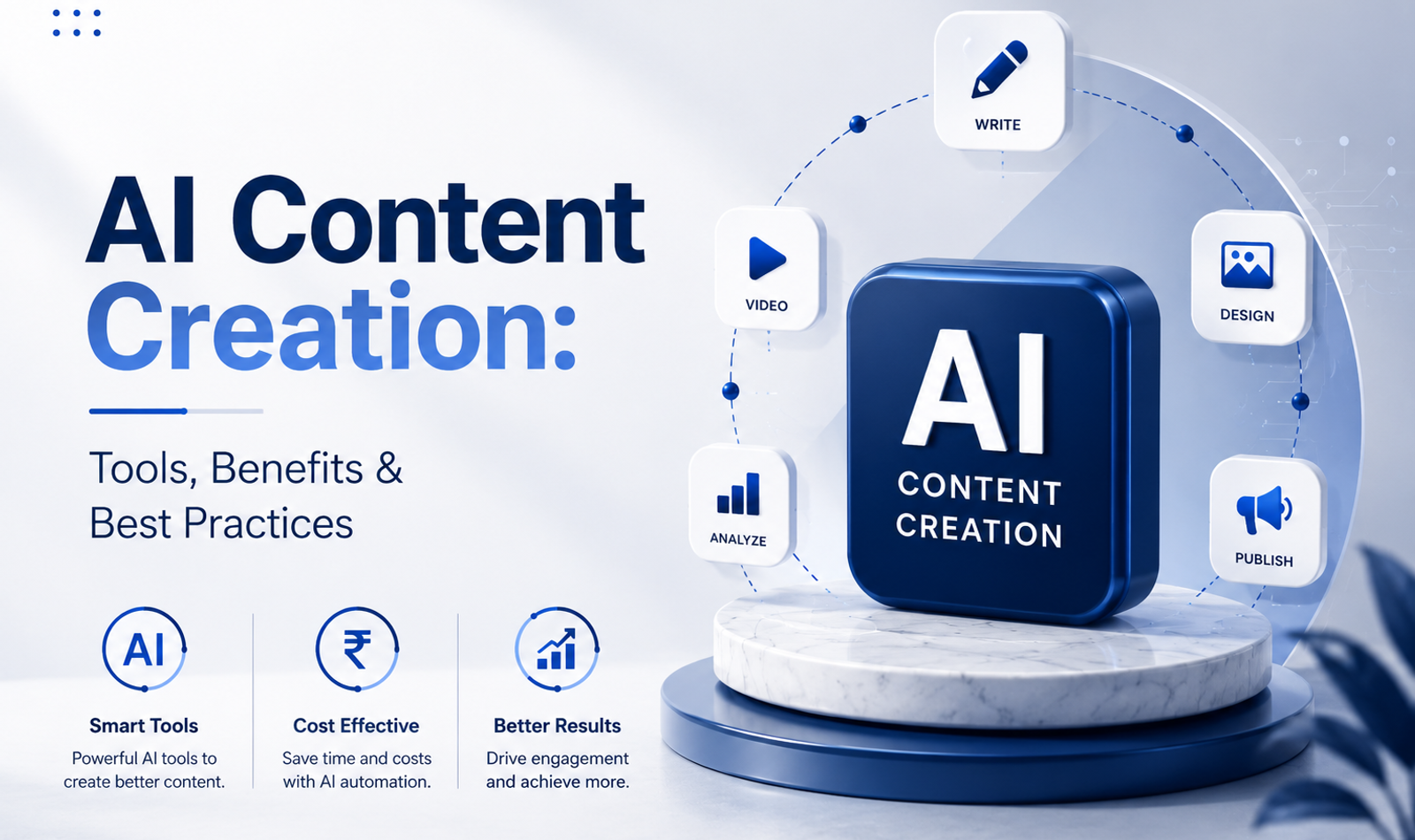
AI Content Creation: Tools, Benefits & Best Practices
Introduction
AI content creation has become one of the most important developments in modern digital marketing. In the past, content creation depended almost entirely on human writers, designers, editors, strategists and production teams. Every blog, caption, advertisement, email, video script, design concept and social media post required manual effort from start to finish.
While human creativity is still at the heart of strong content, artificial intelligence has changed the speed, scale and structure of the entire content-creation process.
Today, businesses are expected to publish high-quality content consistently across websites, Instagram, LinkedIn, YouTube, email campaigns, advertisements, landing pages and search engines.
A brand cannot depend on occasional posting or random creative ideas anymore. It needs a continuous content system that attracts attention, builds trust, educates customers and supports sales.
Professional website development and digital marketing services can help businesses connect AI content creation with websites, SEO, social media, advertising and lead-generation systems.
This is where AI content creation becomes extremely valuable.
AI content creation uses artificial-intelligence tools to assist in writing, designing, editing, researching, planning, repurposing and optimizing content.
These tools can help brands generate blog ideas, write first drafts, create social-media captions, design graphics, produce video scripts, summarize research, improve SEO structure and personalize content for different audiences.
The wider impact of AI on digital marketing in 2026 shows how these tools now influence content, advertising, search, automation, analytics and customer communication.
Platforms such as ChatGPT can support writing, editing, research and campaign planning. Canva AI can assist with design, presentations and visual-content workflows. Adobe Firefly can support generative images, video elements and other creative production.
The rise of AI does not mean that creativity is becoming less important.
In fact, it means the opposite.
Since basic content generation is now faster, brands need stronger strategy, better positioning and more original ideas to stand out.
AI can create content quickly, but only clear brand direction and human judgement can make that content meaningful, trustworthy and emotionally powerful.
For modern businesses, AI content creation is not only a trend. It is becoming a practical part of digital marketing, social-media management, website content, advertising, public relations and brand storytelling.
When used correctly, it can help businesses save time, reduce production pressure, improve consistency and create content that supports real business growth.
What Is AI Content Creation?
AI content creation refers to the use of artificial-intelligence tools to produce or improve different types of content.
This content can include:
- Blogs
- Website copy
- Social-media captions
- Advertisement scripts
- Email newsletters
- Video scripts
- Product descriptions
- Presentations
- Graphic concepts
- Image prompts
- Audio content
- Complete campaign ideas
The purpose of AI content creation is not only to write faster.
Its real value lies in helping brands organize ideas, maintain consistency, create more variations, improve quality and adapt content for different platforms.
For example, a single blog topic can be turned into a website article, Instagram carousel, LinkedIn post, YouTube script, email newsletter and advertisement copy with the help of AI.
A connected content strategy for brand websites, blogs, galleries and lead magnets can ensure that these formats support the same customer journey instead of becoming disconnected posts.
This makes content marketing more efficient and scalable.
AI works by analysing patterns and generating responses according to the input provided by the user.
When a marketer provides a topic, target audience, tone, keyword or campaign objective, the AI tool can create relevant content based on that direction.
However, the quality of the output depends heavily on the quality of the input.
A vague prompt will usually produce generic content, while a clear and detailed prompt can produce content that is far more useful.
This is why AI content creation should always be treated as a collaboration between human strategy and machine assistance.
The AI tool can help with speed, structure and variation, but the final direction must come from a human who understands the brand, audience, industry and business objective.
Why AI Content Creation Matters for Brands Today
The digital world has become extremely competitive.
Every brand is fighting for attention, and customers are constantly exposed to content from competitors, influencers, creators, advertisers and platforms.
In such an environment, businesses cannot afford to create content without planning, consistency or quality.
AI content creation matters because it helps brands meet the growing demand for content without overwhelming their internal teams.
A business may need:
- Blogs for SEO
- Captions for Instagram
- Posts for LinkedIn
- Scripts for Reels
- Newsletters for customers
- Landing pages for campaigns
- Advertisement copy for paid media
- Frequently asked questions for websites
Producing all of this manually can take considerable time, especially for small and medium-sized businesses.
AI makes this process smoother by helping teams move from idea to execution faster.
It can generate topic ideas, outline content structures, draft paragraphs, rewrite text in different tones, suggest headlines and create multiple versions of the same message.
This allows brands to publish more consistently without reducing quality.
Another reason AI content creation matters is that digital platforms reward relevance and consistency.
Search engines need informative and well-structured content. Social-media platforms need regular engagement. Advertising platforms need fresh creative variations. Email marketing needs personalized communication.
AI helps brands create content for all these channels with greater speed and coordination.
For service-based businesses, AI can also improve education-led marketing.
Instead of only promoting services, brands can create blogs, FAQs, guides and explainers that help customers understand their problems and available solutions.
This builds authority and trust over time.
Popular AI Content Creation Tools
There are many AI tools available today, and each one supports a different part of the content-creation process.
Some tools are best for writing, some are better for design, some support video creation and others help with marketing automation or content planning.
ChatGPT
ChatGPT is widely used for writing, brainstorming, editing and content strategy.
It can help create:
- Blog outlines
- Social captions
- Website copy
- Advertisement scripts
- Email drafts
- Campaign ideas
- Customer communication
- Frequently asked questions
- Content calendars
The quality of the response depends on the instructions, context and review process provided by the user.
Canva AI
Canva AI is useful for brands that need visual content alongside text.
Its tools can support design, writing, presentations, social-media graphics, carousels, banners and visual campaign concepts within one creative environment.
Adobe Firefly
Adobe Firefly is useful for creative teams that need generative visuals, image editing, video elements and audio support.
For premium brands, visual quality and brand consistency are especially important. AI-generated visuals should therefore be reviewed carefully before public use.
HubSpot AI
HubSpot’s AI tools can support marketing, sales, customer-service and CRM workflows.
This can be helpful for brands that want AI not only for writing but also for lead capture, nurturing, customer communication and marketing automation.
Video and Visual AI Tools
Apart from these platforms, there are dedicated AI tools for video editing, voiceovers, image generation, transcription, SEO research, scheduling and analytics.
Brands requiring high-quality visual campaigns can use professional AI video and video-editing services to combine generative tools with storytelling, editing, character consistency and creative direction.
The best tool depends on the brand’s goals.
A business focused on blogs may need writing and SEO tools. A fashion or hospitality brand may need visual AI tools. A digital agency may require a complete combination of writing, design, video and automation platforms.
Benefits of AI Content Creation
One of the biggest benefits of AI content creation is speed.
A task that once took several hours can now be completed much faster with the right AI workflow.
For example, a blog outline, social-media caption set or advertisement script can be generated within minutes.
This does not mean the content should be published without review, but it reduces the time needed to begin and structure the work.
Another major benefit is consistency.
Many businesses struggle with regular posting because content creation requires time and creative energy.
AI helps maintain a steady flow of ideas and drafts, making it easier to follow a content calendar.
This is especially useful for brands that want to stay active on social media, publish blogs regularly and maintain communication with customers.
AI also improves content repurposing.
One long-form blog can be converted into:
- An Instagram caption
- A LinkedIn article
- An email newsletter
- A YouTube script
- A carousel concept
- Frequently asked questions
- Short advertisement copy
This allows brands to gain more value from each central idea.
Personalization is another strong benefit.
AI can create different versions of content for different audiences.
A brand can write one message for luxury customers, another for budget-conscious buyers and another for corporate decision-makers.
This improves relevance and makes communication more effective.
AI content creation also supports SEO.
It can help identify content gaps, structure headings, create meta descriptions, improve readability and generate keyword-based topic ideas.
However, AI should not be used for keyword stuffing or low-quality mass content.
Search engines and audiences both value useful, original and trustworthy content.
Cost efficiency is another advantage.
Hiring separate teams for writing, editing, design, research and ideation can be expensive, especially for small businesses.
AI tools can reduce repetitive workloads and allow teams to produce more with fewer resources.
However, businesses should still invest in human strategy, editing and creative direction.
AI also helps overcome creative blocks.
Writers, designers and marketers often experience moments when they struggle to find the right idea or starting point.
AI can generate multiple angles and suggestions, helping teams move forward faster.
AI Content Creation for SEO
AI content creation can be extremely useful for SEO when used responsibly.
SEO is not only about keywords. It involves creating helpful, relevant and well-structured content that answers user questions and builds authority over time.
AI can support this process by helping marketers plan topics, organize headings, improve clarity and create first drafts.
For a blog strategy, AI can generate topic clusters around a main keyword.
For example, if a brand wants to rank for digital-marketing services, AI can suggest related topics such as:
- Social-media strategy
- SEO basics
- Content marketing
- Paid advertisements
- Website optimization
- Lead generation
- Marketing automation
This helps build a complete content ecosystem instead of publishing random articles.
AI can also improve readability.
Many blogs fail because they are too complicated, too thin or too promotional.
AI can simplify complex ideas, improve paragraph flow and make content easier for readers to understand.
This is especially important for service businesses whose audiences may not understand technical terminology.
Another SEO advantage is metadata creation.
AI can help draft:
- SEO titles
- Meta descriptions
- Image alt text
- Frequently asked questions
- Heading structures
- Internal-link suggestions
A practical on-page SEO checklist for higher rankings can help teams review these elements before publishing.
However, AI-generated SEO content must be reviewed carefully.
Generic content that repeats common information without adding value will not build strong authority.
Businesses should add real insights, examples, local relevance and original perspectives.
For example, a Mumbai-based agency writing about digital marketing should include practical knowledge of Indian markets, local customer behaviour and regional platform trends.
A complete technical SEO website optimization guide can also help ensure that well-written AI content remains crawlable, indexable and technically accessible.
The best SEO content uses AI for speed and structure but relies on human expertise for accuracy, originality and brand positioning.
AI Content Creation for Social Media
Social media is one of the strongest areas where AI content creation can help brands.
Platforms such as Instagram, LinkedIn, YouTube and Facebook require regular posting, creative captions, Reel scripts, hooks, content themes and campaign ideas.
Creating all of this manually every day can become difficult.
AI can help social-media teams generate:
- Monthly content calendars
- Caption variations
- Reel concepts
- Carousel structures
- Poll ideas
- Story concepts
- Engagement questions
- Advertisement variations
It can also adapt the same message into different tones.
For example, a luxury brand may need a refined caption, while a restaurant may require warmer and more conversational language.
AI can create both starting versions quickly.
For short-form video, AI can help write hooks, scene ideas, voiceovers and captions.
Since Instagram Reels and YouTube Shorts depend heavily on attention within the first few seconds, AI can generate multiple hook options for testing.
This improves the chances of finding a message that performs well.
AI can also help with content consistency.
A brand can maintain a fixed tone, style and message across posts by creating detailed brand prompts.
However, social-media content should not feel robotic.
Audiences can identify captions that are generic or emotionally empty.
Human editing is important to make the content feel natural, relevant and aligned with the brand’s personality.
AI Content Creation for Video Marketing
Video content has become one of the most powerful forms of digital communication, and AI now plays a major role in video marketing.
AI can help with:
- Scriptwriting
- Storyboard planning
- Voiceover generation
- Subtitle creation
- Editing suggestions
- Visual generation
- Scene planning
- Content repurposing
For brands producing Reels, advertisements, explainers, product videos or event recaps, AI can reduce pre-production time significantly.
Instead of spending hours brainstorming video ideas, teams can use AI to create multiple concepts based on the campaign goal.
Once the idea is selected, AI can help structure the video into:
- Hook
- Problem
- Solution
- Proof
- Call to action
AI is also useful for repurposing video content.
A long video can be converted into shorter clips, captions, Reels and social posts.
This provides more content from the same footage.
For AI video advertisements, scripts, visuals and editing can be optimized for platform performance.
A brand can test several versions of the same advertisement with different hooks, CTAs and emotional directions.
Businesses can review the benefits, costs and use cases of AI video advertising before deciding which video formats are most suitable.
Strong video content still requires human judgement.
AI can assist with structure and speed, but storytelling, emotion, visual quality and brand taste should be directed by creative professionals.
Best Practices for AI Content Creation
Begin With a Clear Strategy
Before using any AI tool, the brand should know its target audience, content objective, tone, platform and desired action.
Without clarity, AI may produce content that sounds polished but does not support a real business objective.
A clear luxury brand strategy roadmap can help premium businesses define positioning and messaging before using AI to scale production.
Write Better Prompts
AI output depends heavily on the instructions provided.
A strong prompt should include:
- Topic
- Target audience
- Tone
- Format
- Word count
- Platform
- Brand direction
- Business objective
- Words or claims to avoid
Asking AI to “write a caption” will produce a basic result.
Asking it to “write a premium Instagram caption for a luxury restaurant targeting Mumbai customers in a warm but elegant tone” will produce a more relevant starting point.
Always Edit and Humanize Content
AI can create a strong base, but it should not replace human review.
Editing helps remove repetition, improve emotional tone, verify facts and align the content with the brand voice.
Avoid Overused AI Phrases
Many AI tools produce common expressions that can make content feel generic.
Brands should add their own experiences, examples, opinions and storytelling to make content more original.
Maintain Brand Consistency
A brand should create a clear content style guide that defines tone, vocabulary, visual direction, audience profile and messaging rules.
Strong UI/UX principles for high-end brand websites can also help ensure that AI-generated website content remains readable, refined and consistent with the visual experience.
Check Accuracy
AI tools can sometimes produce inaccurate or outdated information.
Any factual claim, statistic, legal information, health-related information, financial detail or technical statement should be verified before publication.
Use AI Ethically
Brands should avoid:
- Misleading audiences
- Creating fake testimonials
- Using unauthorized likenesses
- Making unrealistic claims
- Presenting fictional experiences as real
- Hiding sponsored relationships
Ethical AI use protects brand trust.
Measure Performance
AI content should not be created only for quantity.
Brands should track:
- Engagement
- Clicks
- Leads
- Conversions
- Rankings
- Watch time
- Audience response
- Cost per acquisition
This data helps improve future content.
A structured conversion-focused marketing funnel can connect content performance with enquiries and sales outcomes.
Common Mistakes to Avoid in AI Content Creation
One common mistake is publishing AI-generated content without editing.
This often results in repetitive, generic and surface-level writing that does not connect with readers.
AI should be treated as a first-draft assistant, not a final publishing authority.
Another mistake is focusing only on quantity.
Some brands believe AI allows them to publish unlimited content, but excessive low-quality content can damage credibility.
Quality, usefulness and originality are more important than volume.
A third mistake is ignoring brand voice.
If every piece of content sounds like a general AI response, the brand loses its personality.
A luxury brand, restaurant, real-estate company and technology startup should not all sound the same.
Another mistake is using AI without understanding the audience.
Good content is not only about writing well. It is about knowing what the audience cares about, what problems they face and what language they understand.
Businesses also make the mistake of using AI for everything without human supervision.
AI is powerful, but it does not completely understand business context, customer emotion or cultural sensitivity in the way humans do.
Human review is essential.
Another mistake is ignoring originality.
AI-generated content often needs brand examples, local references, case studies and real experience to become genuinely valuable.
Without these elements, it can feel common and forgettable.
Businesses should also avoid installing too many AI tools, chatbots and tracking platforms without reviewing their effect on speed.
Strong technical SEO foundations for speed, mobile usability and Core Web Vitals help protect the performance of AI-supported websites.
The Role of Human Creativity in AI Content Creation
Human creativity remains the most important part of content creation.
AI can support execution, but it cannot fully replace taste, emotion, cultural understanding and strategic thinking.
A strong marketer knows which idea may connect with the audience.
A strong writer understands rhythm, emotion and persuasion.
A strong designer understands visual balance and brand feel.
AI is best used as a creative partner.
It can generate options, speed up drafts, improve structure and reduce repetitive work.
However, the final content should carry human judgement.
This is especially important for premium brands, luxury businesses, personal brands and service companies where trust and emotional connection matter.
A specialised approach to SEO for luxury brands can also help ensure that AI-assisted content attracts suitable audiences without weakening premium positioning.
The brands that succeed with AI will not simply produce more content.
They will use AI to create better content faster while keeping their unique voice intact.
Future of AI Content Creation
The future of AI content creation will be more personalized, visual and automated.
AI tools will become more integrated into marketing platforms, design software, video editors, CRM systems and advertising dashboards.
This means brands will be able to create, distribute and optimize content through more connected workflows.
AI will also become more brand-aware.
Tools will increasingly allow businesses to use brand guidelines, previous campaigns, customer data and visual identity as part of the creative process.
Another major development will be real-time content personalization.
Websites, advertisements and emails may adapt according to user behaviour.
A customer interested in luxury may see a different message from someone interested in affordability.
This will make content more relevant and performance-focused.
Video and visual AI will become more advanced.
Brands will be able to create cinematic visuals, product concepts, short-form videos and campaign assets faster than before.
This will be especially useful for social media, advertising and ecommerce.
However, as AI becomes more powerful, authenticity will become even more valuable.
Audiences will trust brands that use AI responsibly, communicate honestly and maintain a clear human voice.
Businesses interested in implementing these systems can explore professional AI marketing services for business growth.
AI Content Creation for Luxury Brands
Luxury and premium businesses should use AI differently from mass-market brands.
The objective should not be to produce the maximum possible volume.
It should be to improve personalization, consistency and customer relevance while protecting exclusivity.
AI can support:
- Premium campaign concepts
- Private appointment journeys
- Personalized content
- High-value lead nurturing
- Editorial storytelling
- Product recommendations
- Customer segmentation
Luxury brands should avoid content that feels rushed, repetitive or visually inconsistent.
A suitable high-ticket conversion strategy for luxury brands can help connect AI content with qualified enquiries and longer consideration journeys.
Security and Responsible Data Use
AI content systems may use customer enquiries, website behaviour, CRM information and communication history.
Businesses should protect this information carefully.
Sensitive customer information should not be copied into public AI tools without suitable approval and data controls.
Forms, websites and CRM platforms should use secure connections and appropriate access permissions.
Strong website-security practices for premium clients can help protect customer information while AI-supported workflows are implemented.
Conclusion
AI content creation is changing how brands plan, produce and scale digital content.
It helps businesses save time, reduce production pressure, create more variations, improve consistency and support marketing performance across multiple platforms.
From blogs and captions to video scripts, graphics, emails and SEO content, AI has become a practical tool for modern brand communication.
However, AI should not be used as a replacement for strategy or creativity.
The best content still needs human direction, emotional understanding, brand personality and careful editing.
AI can accelerate the process, but humans must guide the message.
For businesses that want to grow online, AI content creation offers a major opportunity.
It allows brands to remain visible, publish consistently and communicate with audiences more effectively.
When used with the right strategy, AI does not make content less human.
It gives creative teams more time to focus on ideas, storytelling and brand impact.
The future of content belongs to brands that can combine AI efficiency with human creativity.
Those that learn to use both can create content that is faster, smarter, more consistent and more powerful.
Frequently Asked Questions
What Is AI Content Creation?
AI content creation is the process of using artificial-intelligence tools to create or improve content such as blogs, captions, website copy, video scripts, emails, graphics and marketing campaigns.
It helps brands produce content faster while improving structure, consistency and creative output.
Is AI Content Creation Good for SEO?
AI content creation can be useful for SEO when used correctly.
It can help with topic planning, keyword-focused structure, meta descriptions, FAQs and readability.
However, AI-generated content should always be edited and improved with original insights, brand experience and accurate information.
Can AI Replace Content Writers?
AI cannot fully replace content writers because strong content requires creativity, emotional understanding, strategy and brand voice.
AI can help writers work faster, create drafts and generate ideas, but human editing and direction remain essential.
Which Businesses Can Benefit From AI Content Creation?
Almost every business can benefit from AI content creation, including:
- Digital agencies
- Restaurants
- Real-estate companies
- Fashion brands
- Luxury brands
- Hotels
- Startups
- Ecommerce businesses
- Healthcare brands
- Education companies
- Service providers
Any business that requires regular digital content can use AI to improve speed and consistency.
What Are the Best AI Tools for Content Creation?
Popular AI tools include ChatGPT for writing and strategy, Canva AI for design and visual content, Adobe Firefly for generative visuals and HubSpot AI for marketing workflows.
The best tool depends on the type of content the brand needs to create.
Is AI-Generated Content Safe for Brands?
AI-generated content can be used safely when it is reviewed, fact-checked and aligned with brand guidelines.
Brands should avoid misleading content, false claims, fake testimonials and unauthorized use of a person’s identity.
Responsible AI use protects brand trust and credibility.
How Can a Business Start Using AI for Content Creation?
A business can start by using AI for simple tasks such as:
- Blog ideas
- Caption drafts
- Content calendars
- Email outlines
- Video scripts
- Frequently asked questions
Once the team becomes comfortable, AI can be added to larger workflows such as SEO planning, advertisement testing, design concepts and campaign-content creation.
Create Smarter Content With Double Trouble Studio
If you want to create smarter, faster and more powerful content for your brand, Double Trouble Studio can help you build an AI-powered content strategy that supports visibility, engagement and business growth.
From blogs, social-media content and website copy to AI video scripts, advertisement campaigns and creative storytelling, we help businesses use AI with the right balance of strategy, creativity and human direction.
Brands can review Double Trouble Studio’s completed work to explore our approach across websites, content, AI visuals, campaigns and digital experiences.
Businesses looking for website development and digital marketing services in Mumbai can work with our team across AI content creation, SEO, website copy, visual campaigns and lead-generation systems.
Let’s create content that does not only fill your feed but builds your brand.
Contact Double Trouble Studio for AI content creation, website content, SEO blogs, social-media strategy, AI video and digital-marketing support.
📩 info@dtsworld.in 📞 +91 80000 06021 📍 Andheri West, Mumbai
Need this for your brand?
Let DTS build your next campaign.
From PR, celebrity management and events to websites, social media, SEO and AI video production — Double Trouble Studio helps brands grow with strategy and execution.
Discuss Your Requirement →