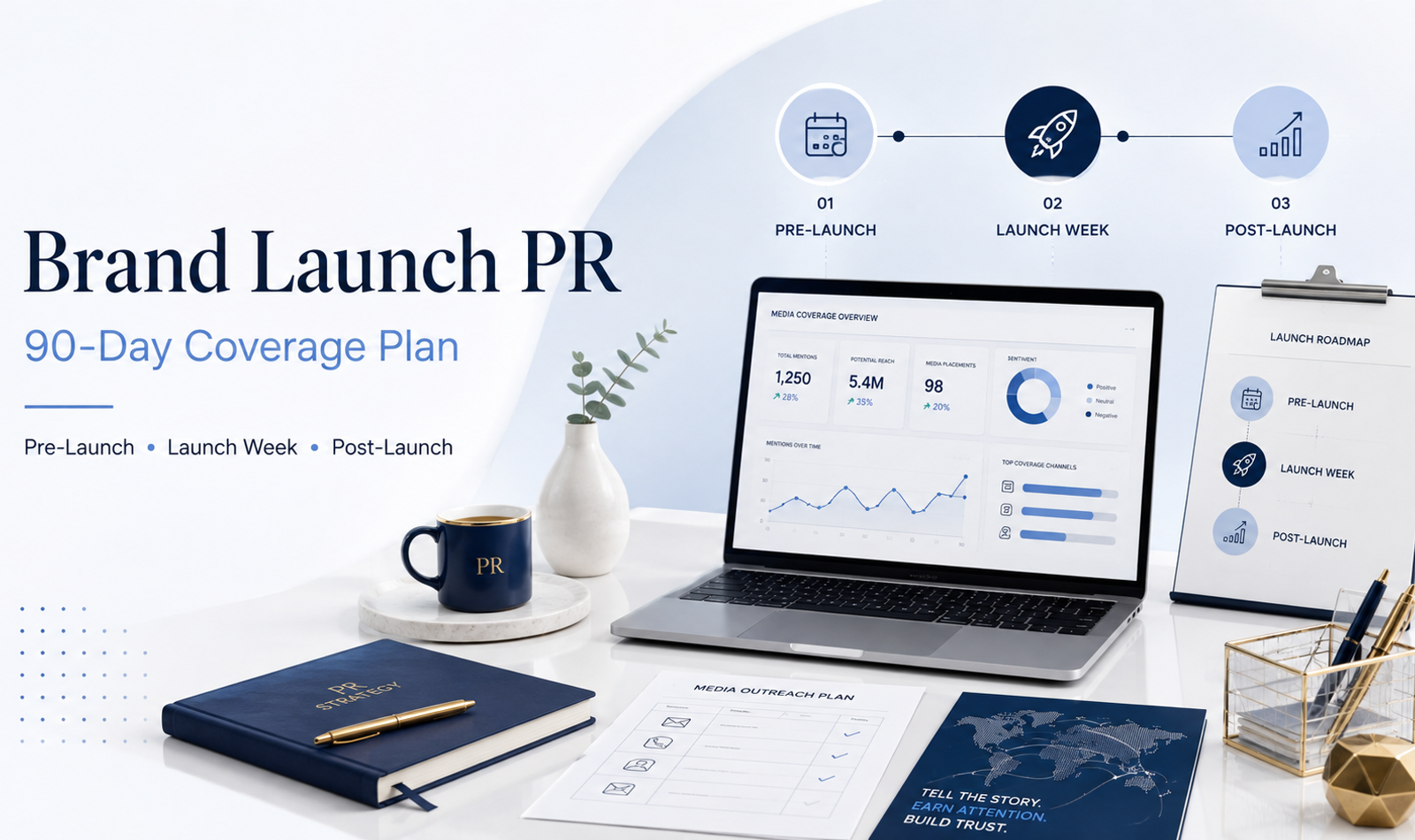
Most brand launches in India fail to get meaningful media coverage not because the product isn't good enough, but because PR gets treated as a launch-day activity instead of a 90-day campaign. A press release goes out the morning of launch, a handful of journalists get a generic pitch, and by week two, the brand has gone quiet — right when the story was just starting to build momentum.
A launch that actually earns coverage, drives credibility, and compounds into ongoing visibility needs to be planned in three distinct phases: the 30 days before launch, launch week itself, and the 60 days after. Each phase has a different job to do. Skipping any one of them is usually why launches that had real potential end up with a single press release and nothing else.
This framework breaks down exactly what to do in each phase, with realistic timelines, deliverables, and the reasoning behind why the sequencing matters.
Why Most Brand Launches Underperform on PR
Before the framework, it's worth understanding the two most common mistakes.
Mistake one: treating launch day as the starting point. Journalists need lead time — often 1–3 weeks for a considered feature, sometimes longer for print or long-form pieces. If the first pitch goes out the same day as the public launch, most journalists simply can't turn it around in time, even if they're genuinely interested.
Mistake two: one big push and then silence. A single wave of coverage on launch day creates a spike, but spikes fade fast. Without a follow-up narrative — customer traction, a founder story, an unexpected use case, a milestone — there's nothing for journalists to write about a month later, and the brand disappears from the media conversation just as quickly as it appeared.
The 90-day framework below is built specifically to avoid both mistakes.
Phase 1: Pre-Launch (Days 1–30) — Building the Foundation
This phase is invisible to the public but determines whether launch week actually lands. Skipping it is the single biggest reason PR pushes underperform.
Days 1–7: Narrative and Positioning
Before any journalist outreach begins, the brand needs a clear, specific story — not just "we're launching a product," but a genuine reason anyone outside the company should care.
Key deliverables:
A one-line positioning statement that explains what the brand does and why it's different, in language a non-expert would understand
3–4 potential story angles (market gap, founder journey, unusual insight, timing/trend relevance)
Identification of the real news hook — funding, a genuine industry-first, a gap in the market — since "we launched" alone is rarely newsworthy on its own
Why it matters: Journalists don't cover launches; they cover stories. A launch is only the occasion for the story, not the story itself. This week decides what the actual story is.
Brands that need to sharpen this stage further can also use a broader luxury brand positioning strategy to make sure the launch narrative reinforces long-term market perception rather than creating a one-off message.
Days 8–15: Media List and Relationship Mapping
Key deliverables:
A curated media list of 30–50 relevant journalists, segmented by beat (startup, industry-specific, business, lifestyle — whichever applies)
Research on each journalist's recent coverage to personalize outreach later
Identification of 5–8 "priority" targets — the outlets and journalists whose coverage would matter most, worth extra effort to secure
Why it matters: A generic list of 300 email addresses gets ignored. A researched list of 40 relevant journalists, each pitched with context specific to what they actually cover, gets responses.
For premium and luxury brands, this stage also benefits from a focused luxury brand PR strategy that connects media selection with positioning and story angles.
Days 16–23: Asset Preparation
Key deliverables:
Press release draft (embargoed, ready to send under embargo to priority journalists ahead of launch)
Founder/spokesperson bio and headshots
Product images, demo video, or screenshots in press-ready formats
A short FAQ document anticipating likely journalist questions
Any data, research, or market context that adds credibility to the story
Why it matters: When a journalist responds with interest, the speed and quality of what you can send back often determines whether they follow through. Scrambling to produce assets after a journalist replies costs the window of interest.
If the launch includes video, product demonstrations, teasers or social-first assets, an end-to-end AI video production and professional editing workflow can help prepare campaign-ready visual content before media outreach begins.
Days 24–30: Embargo Outreach to Priority Journalists
Rather than sending the press release to everyone simultaneously on launch day, the strongest approach is offering an embargoed exclusive or early briefing to a small number of priority journalists in the final week before launch — giving them time to write a considered piece that publishes on or near launch day, rather than a same-day scramble.
Key deliverables:
Personalized outreach to 5–8 priority journalists with an embargoed briefing
Scheduling any founder interviews needed for embargoed pieces
Confirmation of publish timing where possible
Why it matters: This is what produces genuine launch-day features rather than a wire-service press release nobody reads. It requires the lead time this phase is built around.
Brands trying to secure higher-quality placements should also understand how to get featured in premium media, especially when pitching selective or high-authority publications.
Phase 2: Launch Week (Days 31–37) — Coordinated Execution
By the time launch week arrives, most of the real work should already be done. This week is about execution and coordination, not scrambling to build the story from scratch.
Day of Launch
Key deliverables:
Press release distributed broadly (wire service and/or direct to the full media list)
Embargoed pieces from priority journalists go live
Social media amplification of any coverage as it publishes
Founder/spokesperson available for same-day interview requests
If the launch includes an offline event, preview, press meet or product experience, the event and communication teams should follow an integrated event PR strategy so that media activity, guest experience and content capture support one another.
Days 2–5 of Launch Week: Real-Time Follow-Up
Key deliverables:
Follow-up outreach to journalists who hadn't responded to the initial pitch, referencing the coverage that's already published as social proof
Responding quickly to any inbound journalist interest generated by the initial wave of coverage
Tracking and compiling all coverage secured so far
Why it matters: Early coverage often triggers a second wave — journalists who see a competitor outlet covering something sometimes want to cover it too, especially if there's an angle their outlet hasn't taken yet. This window is short and needs fast turnaround.
This is also where integrating PR and digital marketing can help turn earned coverage into website traffic, social proof, retargeting audiences and new enquiries rather than leaving the coverage isolated.
End of Launch Week: Coverage Audit
Key deliverables:
Full report of coverage secured: outlets, reach, tone, and links
Identification of any strong angles or quotes that emerged from coverage, which can seed follow-up stories later
Assessment of which journalists engaged but didn't publish — potential targets for Phase 3 follow-up
Brands can go beyond simple link counting by using a structured approach to measuring PR ROI, including media quality, share of voice, referral traffic and leads.
Phase 3: Post-Launch (Days 38–90) — Sustaining Momentum
This is the phase most launches skip entirely, and it's the one that determines whether the brand stays visible or disappears from the media conversation a month later.
Days 38–50: The "Second Story"
Launch-day coverage is about the announcement. The second story needs a different angle — early traction, an unexpected customer use case, a surprising data point, or a founder perspective piece.
Key deliverables:
Identification of one genuine follow-up angle (customer numbers, an interesting use case, a founder op-ed)
Outreach to a smaller, targeted list of journalists — often the ones who showed interest during launch but didn't publish
A founder byline or op-ed pitched to a relevant publication, positioning the brand as a thoughtful voice in the category rather than just "the company that launched last month"
A stronger post-launch narrative can also be supported through story-led PR, which helps transform business updates into repeatable media angles.
Days 51–70: Building Ongoing Media Relationships
Key deliverables:
Regular, low-pressure check-ins with journalists who covered the launch or showed interest — sharing relevant updates, not repeated pitches
Identifying speaking opportunities, panels, or industry events where the founder could build visibility
Beginning outreach for any award submissions relevant to the brand's category (many have quarterly or annual deadlines worth planning around)
Why it matters: PR relationships compound. A journalist who covered the launch and continues to hear relevant, useful updates — not just repeated asks — becomes a long-term contact who's more likely to cover future news without needing to be convinced from scratch each time.
Founder visibility can also be strengthened through personal branding and authority-building PR, especially when the founder has relevant expertise or a strong industry point of view.
Days 71–90: Establishing a Content Cadence
Key deliverables:
A recurring rhythm for what gets pitched going forward — monthly or bi-monthly touchpoints tied to real news (hires, milestones, partnerships, data)
A simple internal system for flagging "newsworthy" moments as they happen, so the team doesn't have to reconstruct a media strategy from scratch every time there's an update
A 90-day retrospective: what coverage was secured, what worked, what didn't, and what the ongoing PR cadence should look like beyond day 90
This phase can also connect into a larger annual brand strategy framework so PR milestones, campaigns and launches are planned against longer-term business goals rather than managed individually.
A Sample 90-Day Timeline at a Glance
Days
Phase
Focus
1–7
Pre-launch
Narrative and positioning
8–15
Pre-launch
Media list and research
16–23
Pre-launch
Asset preparation
24–30
Pre-launch
Embargoed outreach to priority journalists
31
Launch week
Broad distribution and embargoed pieces go live
32–35
Launch week
Real-time follow-up and second-wave interest
36–37
Launch week
Coverage audit
38–50
Post-launch
Second story angle and targeted follow-up
51–70
Post-launch
Ongoing relationship building, speaking ops, awards
71–90
Post-launch
Content cadence and 90-day retrospective
Common Questions About Brand Launch PR Timing
Do I need all 90 days, or can this be compressed?
It can be compressed if the launch timeline is tight, but the pre-launch phase shouldn't be cut below roughly two weeks — journalists generally need that minimum lead time to produce a considered piece rather than a rushed rewrite of the press release.
What if I don't have 30–50 relevant journalists in my category?
Smaller or highly niche categories may have a shorter realistic list — sometimes 15–20 truly relevant contacts is accurate for a narrow B2B category. Quality of fit matters far more than list size; a short list of genuinely relevant journalists outperforms a long list of loosely related ones.
Should paid or sponsored placements be part of this framework?
This framework focuses on earned media. Paid placements can supplement it, but they should be clearly distinguished from editorial coverage, both internally and in any reporting to stakeholders.
What's the single most common reason this framework fails in execution?
Skipping the pre-launch phase and starting outreach on or after launch day. It's the most common shortcut, and it's the one that most directly caps how much genuine coverage is achievable, because journalists lose the lead time they need to produce a real feature rather than a same-day mention.
The Bottom Line
A brand launch earns strong PR coverage when the story is built before launch day, executed with coordinated urgency during launch week, and sustained with a genuine follow-up narrative in the months after — not when a press release goes out once and the team moves on to the next priority.
The 90-day structure isn't arbitrary: 30 days is roughly the minimum runway needed to build real journalist relationships and secure embargoed coverage, and the 60 days after launch is what determines whether the brand fades from the media conversation or becomes a recurring name journalists think to call when the category comes up.
Planning a launch and want help building out this timeline for your specific brand? Reach out to talk through what a realistic 90-day PR plan looks like for you.
Need this for your brand?
Let DTS build your next campaign.
From PR, celebrity management and events to websites, social media, SEO and AI video production — Double Trouble Studio helps brands grow with strategy and execution.
Discuss Your Requirement →