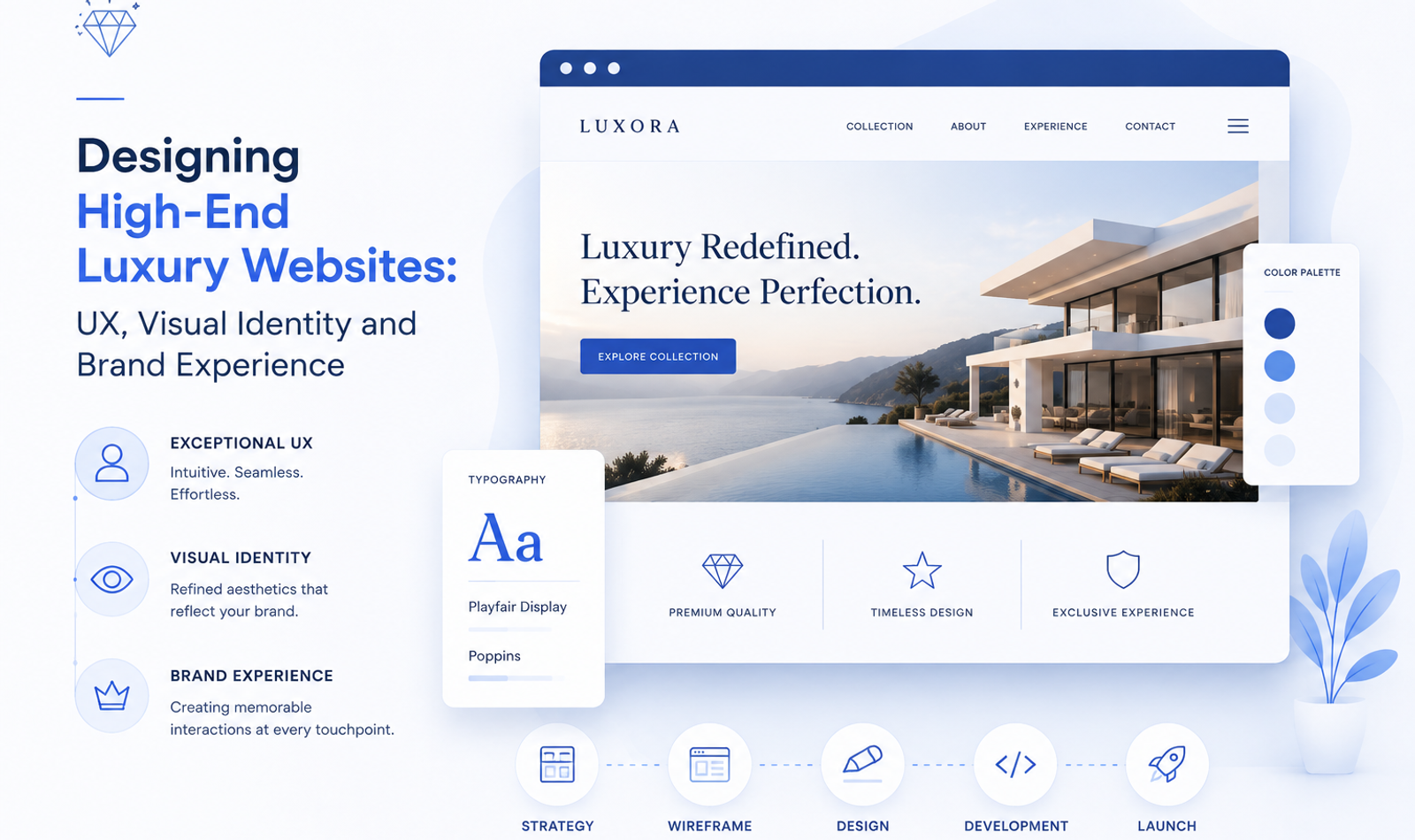
Designing High-End Luxury Websites: UX, Visual Identity and Brand Experience
A high-end luxury website is not defined by expensive-looking typography, dark backgrounds or cinematic animation alone. It is defined by how successfully every part of the digital experience communicates value, confidence, exclusivity and attention to detail.
Visitors form opinions about premium brands quickly. Before they understand the complete product range, service process or company history, they notice the quality of the visuals, the clarity of the message, the speed of the website and the ease with which they can move through it.
These early impressions influence whether the brand feels genuinely premium or simply styled to appear expensive.
Luxury website design therefore requires more than visual decoration. It requires a complete strategy that connects brand positioning, user experience, visual identity, storytelling, technology and conversion—an approach central to professional website development and digital marketing services.
The website must feel distinctive without becoming confusing. It should appear refined without becoming empty. It should communicate exclusivity without making information difficult to access.
A luxury brand may operate in fashion, hospitality, real estate, jewellery, automobiles, beauty, architecture, interiors or professional services. Each industry requires a different visual approach, but the underlying principle remains the same.
The digital experience must reflect the quality of the business.
When a customer is considering a high-value purchase or premium service, the website becomes part of the evaluation process. It provides evidence about the brand’s standards before any direct conversation occurs.
A slow, crowded or inconsistent website can create doubt. A carefully structured website can build confidence and increase the perceived value of the brand.
Designing high-end luxury websites is therefore both a creative and commercial discipline.
Understanding Luxury in a Digital Context
Luxury is not communicated by adding more elements. It is often communicated through selection, restraint and precision.
A luxury brand does not need to present every possible message on the first screen. It can allow one powerful visual, one clear statement and one intentional action to create the initial impression.
This sense of control is important.
Mass-market websites frequently use multiple promotions, countdowns, pop-ups and competing calls to action. Their objective is often to create urgency and encourage immediate action.
Luxury websites usually operate differently. They create desire through storytelling, quality, atmosphere and confidence.
This does not mean that luxury websites should avoid conversion. They still need to generate enquiries, bookings and purchases. The difference is in how the journey is presented.
A luxury hotel may use “Reserve Your Stay” instead of an aggressive discount message. A premium interior design studio may use “Begin a Private Consultation” instead of “Get a Free Quote.” A jewellery brand may invite users to “Discover the Collection” before presenting the purchase action.
The wording, pacing and visual hierarchy support the positioning.
Digital luxury is created when the experience feels thoughtful. Every detail appears to have been selected for a reason.
Begin With Brand Positioning
The design process should begin with the brand, not with a template or visual trend.
Before creating layouts, the team must understand what type of luxury the business represents.
Some premium brands are built around heritage and craftsmanship. Others are contemporary, bold and culturally progressive. A luxury wellness brand may communicate calm and purity, while a performance automobile brand may focus on power, precision and innovation.
These brands should not look or sound the same.
The website should translate the brand’s strategic qualities into a digital system. If the brand is timeless, the typography and photography may feel editorial and restrained. If it is experimental, the website may use stronger compositions and unexpected movement.
Developing a clear luxury brand strategy roadmap helps businesses define their positioning, audience, personality and competitive difference before visual design begins.
The design team should understand the audience’s expectations as well.
A wealthy private client selecting an architectural firm will evaluate the website differently from a customer purchasing an accessible luxury beauty product. The price, emotional significance and decision-making process influence the amount and type of information required.
Brand positioning should answer what the business offers, who it serves, why it is valuable and what makes it different.
Without this clarity, the website may look attractive but fail to communicate a memorable identity.
Define the Desired Brand Experience
A luxury website should create a specific emotional experience.
The business may want visitors to feel inspired, reassured, intrigued or understood. These feelings should influence the design and content.
The principles of luxury website UX help translate these intended emotions into navigation, layouts, visuals, content and interactions.
A boutique resort may want to create a sense of escape. A luxury real estate company may want to communicate exclusivity and long-term value. A premium fashion label may want to create desire and cultural relevance.
These intentions can be translated into design decisions.
A calm experience may use slower transitions, natural imagery and generous spacing. A bold experience may use strong contrast, full-screen visuals and sharper movement.
The desired emotion should remain consistent across the complete website.
If the homepage feels luxurious but the booking form appears generic and disconnected, the brand experience becomes weaker. If the product page is beautifully designed but the checkout feels confusing, the customer’s final impression may be negative.
Luxury should not exist only in the opening section. It should continue through navigation, content, forms, confirmation pages and customer communication.
Create a Clear UX Strategy
User experience is one of the most important elements of a premium website.
Luxury does not justify complexity.
Visitors should not have to work harder simply because the brand wants to appear exclusive. Difficult navigation, hidden buttons and unclear labels can create frustration rather than sophistication.
A strong UX strategy begins by identifying the visitor’s objectives.
Following established UI/UX design principles for high-end brand websites allows the design team to balance visual distinction with clarity and usability.
A potential customer may want to explore collections, understand services, view previous projects, compare options, check availability or contact the brand.
The website should support these tasks with a clear structure.
The main navigation should remain focused. A large number of categories can be organised through well-designed menus, but users should not feel lost.
Important information should be placed where visitors expect to find it. Contact details, booking actions, product information and policies should not be hidden for aesthetic reasons.
The design can remain distinctive while using familiar interaction patterns.
A luxury experience feels effortless because the complexity has been carefully managed.
Design the Customer Journey
The website should guide visitors according to their stage of awareness and intent.
This journey can be structured as a luxury brand funnel from awareness to conversion, helping visitors move naturally from discovery to evaluation and action.
A first-time visitor may need to understand the brand before viewing technical details. A returning customer may want to reach a specific collection or booking page immediately.
The website must support both journeys.
The homepage usually introduces the brand’s positioning and most important offering. It should create interest and provide clear paths into the website.
Category and service pages help visitors explore relevant options. Detail pages provide the information required for evaluation. Galleries, case studies and testimonials build confidence. Contact, booking and checkout pages enable action.
The journey should feel connected.
A luxury real estate project page can lead naturally to a private viewing request. A hotel room page can direct the user towards availability. A design portfolio can connect to a consultation.
Each page should answer the visitor’s current question and provide a logical next step.
The website should not force every visitor through the same sequence, but it should prevent journeys from ending unexpectedly.
Use Minimalism With Purpose
Minimalism is widely used in luxury website design because it can create focus and confidence.
However, minimalism should not mean removing information or making the interface difficult to understand.
Purposeful minimalism removes unnecessary distraction while preserving clarity.
A premium homepage may contain a large visual, a short headline and a carefully positioned action. The next sections can introduce the story, offering and evidence gradually.
This approach creates rhythm.
The visitor is not required to process several messages at the same time. Each section receives enough space to make an impact.
Whitespace contributes to this feeling. It allows headlines, images and products to appear more important.
The design should still provide enough information for the audience to make decisions. A luxury product page needs clear specifications, delivery information and pricing where appropriate.
A service website needs to explain the process, expertise and next step.
Minimal design is most successful when it creates simplicity for the visitor rather than silence.
Build a Distinctive Visual Identity
Visual identity is the system that makes the website recognisably connected to the brand.
It includes typography, colour, imagery, composition, icons, spacing and interaction.
The website should not feel like a generic premium template with a logo placed at the top.
Every element should support the brand’s personality.
A heritage brand may use warm neutrals, classic serif typography and archival details. A modern luxury technology brand may use a controlled monochrome palette, geometric typography and precise animation.
Consistency is essential.
The colour system should define primary, secondary and functional colours. Typography should have clear roles for headlines, body content, captions and interface elements.
Buttons, forms, cards and navigation should follow the same visual language.
Small inconsistencies can weaken the premium feeling. Different border styles, changing button shapes and random spacing make the website feel less considered.
A strong visual identity creates cohesion even when the website contains many content types.
Use Colour With Restraint
Luxury websites often use limited colour palettes.
This allows the brand’s imagery, typography and materials to receive greater attention.
Neutral colours such as white, ivory, beige, charcoal, navy and black are common because they create a controlled foundation. Metallic accents may be used to suggest warmth or prestige, but they should not become decorative clichés.
Colour should reflect the brand rather than a general idea of luxury.
A premium wellness brand may use muted natural tones. A high-end automobile website may use deeper colours and strong contrast. A luxury resort may use colours inspired by its physical environment.
Accent colours should be applied intentionally.
If every button, heading and icon uses the strongest colour, the hierarchy becomes weak. The most important actions should receive emphasis, while secondary elements remain controlled.
Contrast must also support readability. Light grey text on a white background may appear delicate, but it can be difficult to read.
A luxury website should never sacrifice usability to maintain a subtle appearance.
Make Typography a Brand Asset
Typography has a direct effect on perceived quality.
The typeface can communicate heritage, modernity, elegance or precision before the visitor understands the words.
Luxury websites frequently use a display font for expressive headlines and a highly readable font for body content.
The relationship between the two should feel intentional.
A refined serif may work well for a fashion, jewellery or hospitality brand. A clean sans-serif may be more suitable for architecture, technology or automotive brands.
The choice should support the brand’s identity.
Typography also depends on scale, line height and spacing.
Large headlines can create impact, but they must remain readable on mobile devices. Body copy should not be too small or widely stretched across the screen.
Paragraphs should have enough line spacing and a comfortable width.
Letter spacing should be used carefully. Wide uppercase text can create a premium editorial feeling in labels or short headings, but it becomes difficult to read in longer content.
A consistent typographic system helps the entire website feel more professional.
Invest in Art Direction
Luxury websites depend heavily on visual content.
The quality of the photography and video can influence the perception of the brand more strongly than the layout itself.
Generic stock images rarely create a distinctive premium identity.
High-end brands should invest in original photography, campaign production, product imagery, architectural visuals and brand films.
The visual direction should be planned according to the website.
Images need suitable negative space for text. Product details should be visible at different crops. Mobile versions may require alternative framing.
A fashion brand may use editorial imagery to create desire. A hospitality website may combine wide environmental photographs with detailed images of materials, food and service.
An automotive brand may use cinematic motion and close-up product details.
The visuals should tell a consistent story.
Lighting, colour treatment, composition and styling should feel connected.
A website containing excellent but visually unrelated images can still appear inconsistent.
Use Video to Create Atmosphere
Video can communicate movement, space and emotion in ways that static imagery cannot.
Brands considering cinematic digital campaigns can also explore the benefits, costs and use cases of AI video advertising for creating premium visual content at scale.
It is especially useful for hospitality, automotive, fashion, architecture and lifestyle brands.
A short brand film can establish atmosphere quickly. It can show a vehicle in motion, a resort at different times of day or the craftsmanship behind a product.
However, video should be used carefully.
Large background videos can slow down the website and create a poor mobile experience. Autoplay should not interfere with navigation or sound.
The video should support the page’s objective.
A cinematic homepage film may create an emotional introduction, but it should not delay access to the main content.
Compressed files, poster images and mobile alternatives can preserve the experience without creating unnecessary performance problems.
Luxury is not created by forcing every visitor to watch a long film. It is created by presenting the right visual moment at the right time.
Create Strong Visual Hierarchy
Visual hierarchy helps visitors understand what is important.
The first visible element should usually communicate the main message or product. Supporting information should appear with less emphasis.
A page without hierarchy can feel crowded even when it contains relatively few elements.
Luxury websites often use size and space to create hierarchy rather than relying on bright colours.
A large headline can establish the central idea. A dominant image can introduce the experience. Smaller labels and supporting text provide context.
Calls to action should remain visible without appearing overly promotional.
The design should also create variation.
If every section uses the same full-screen layout, the experience becomes repetitive. Some sections can be immersive, while others can use smaller editorial compositions.
This rhythm helps the visitor remain engaged.
Build a Premium Homepage
The homepage should introduce the brand clearly and create a strong first impression.
It should not attempt to communicate every detail.
A successful luxury homepage usually begins with a focused hero section. The headline should explain the brand’s value rather than using a vague statement.
The supporting visual should establish the mood.
The next sections can introduce the brand story, primary offerings, selected work or collections and relevant proof.
The sequence should feel intentional.
For premium service businesses, this sequence should also support conversion-focused marketing funnels that move qualified visitors from initial interest towards consultation or enquiry.
For a luxury service business, the homepage may begin with positioning, followed by expertise, selected projects, process and consultation.
For a product brand, it may introduce the collection, craftsmanship, featured products and brand philosophy.
The homepage should provide enough information to create confidence while encouraging visitors to explore deeper pages.
A final call to action should match the nature of the business. It may invite a consultation, reservation, visit or private enquiry.
Design Product and Service Pages Carefully
Product and service pages are often the most commercially important pages on the website.
Applying effective conversion optimisation for luxury brands can improve these pages without introducing aggressive or mass-market sales techniques.
They must preserve the premium feeling while providing practical information.
A luxury product page should include strong imagery, clear pricing where relevant, material information, sizing, availability, delivery and care details.
The purchase action should be easy to identify.
A service page should explain the value, process and intended outcome. It should also show relevant examples and evidence.
The writing should avoid generic claims.
Specific information is more persuasive than statements about excellence or quality.
The design should allow visitors to explore details without becoming overwhelmed. Expandable sections, tabs or carefully grouped content can improve readability.
The page should answer the questions that may prevent a decision.
Luxury customers still require clarity. A high price does not reduce the need for useful information.
Use Storytelling to Increase Perceived Value
Luxury brands sell meaning as well as function.
The website should explain the story behind the product, place or service.
This may include the founder’s vision, craftsmanship, materials, history, location or creative process.
Storytelling helps visitors understand why the offering is valuable.
A handmade jewellery piece becomes more meaningful when the website explains the material, inspiration and process. A boutique hotel becomes more distinctive when its relationship with the destination is communicated.
The story should be presented through a combination of text, imagery and movement.
Long paragraphs are not always necessary. A short statement supported by strong visual evidence may create greater impact.
The story should also remain authentic.
Manufactured heritage and exaggerated claims can reduce trust. The brand should communicate what is genuinely distinctive.
Present Craftsmanship and Process
Craftsmanship is a central part of many luxury brands.
The website can use the production or service process to demonstrate attention to detail.
This may involve showing materials, techniques, quality control, design development or personalisation.
A luxury interior studio may explain how it moves from consultation to concept, material selection and execution.
A fashion brand may show pattern development and finishing.
A premium event company may explain how guest experience, design and production are coordinated.
The process helps potential customers understand what they are paying for.
It also differentiates the brand from competitors that appear similar at the final-output level.
The content should remain accessible. Technical detail can add credibility, but it should not become difficult to understand.
The strongest process content connects expertise to customer benefit.
Use Social Proof Without Losing Exclusivity
Testimonials, awards, press coverage and client recognition can build trust.
A carefully selected presentation of completed work and client projects can provide stronger evidence than unsupported claims about quality or excellence.
However, social proof should be presented with restraint.
A wall of logos and badges can feel promotional. A carefully selected testimonial connected to a relevant project may be more effective.
Luxury buyers often value discretion. Some brands may not be able to display every client name or project detail.
In these cases, anonymised case studies or approved descriptions can still demonstrate expertise.
Testimonials should be specific. A statement about the quality of communication, design thinking or final experience is more useful than a general compliment.
Awards and media features should be accurate and relevant.
The purpose of social proof is to reduce uncertainty, not to overwhelm visitors with claims.
Design Calls to Action for Luxury Audiences
Luxury brands often avoid aggressive calls to action because they fear appearing too commercial.
However, unclear actions can reduce enquiries and bookings.
The solution is not to remove conversion opportunities. It is to use language and design that align with the brand.
“Begin Your Project,” “Arrange a Private Viewing,” “Book a Consultation” and “Reserve Your Experience” can feel refined while remaining clear.
Each page should have one primary action.
Secondary actions can support visitors who are still exploring.
The call to action should appear after enough information has been provided. It can also remain accessible in the navigation or through a subtle sticky element.
The design should create emphasis without using excessive animation or bright colours.
A luxury CTA should feel like a natural next step.
Design Premium Forms
Forms are often where the polished website experience becomes generic.
A standard form with crowded fields and unclear labels can reduce the premium perception.
Forms should be simple, elegant and easy to complete.
The business should request only the information needed for the next step.
A private consultation form may ask for name, contact details, service interest and a short project description.
A luxury property enquiry may request preferred location, property type and viewing availability.
The form should not feel like an interrogation.
Clear labels, generous spacing and useful error messages improve the experience.
After submission, the confirmation message should explain what happens next.
A premium brand may use a message such as: “Thank you for your enquiry. Our team will review your requirements and contact you within one business day.”
This creates confidence and sets expectations.
Maintain a Consistent Booking or Checkout Experience
Luxury ecommerce and hospitality websites often use external platforms for checkout or booking.
These platforms also require reliable ecommerce and booking website security and maintenance to protect customer information and maintain confidence throughout the transaction.
The transition should feel as consistent as possible.
Typography, colours, room names, product names and imagery should match the main website.
A sudden visual change can make customers uncertain about whether they are still using the official service.
The process should remain simple.
Luxury does not require a complicated checkout. Customers should be able to review their selection, understand costs and complete payment efficiently.
Policies, delivery terms, cancellation conditions and taxes should be explained clearly.
Unexpected information near the final step can cause abandonment.
The final confirmation should reinforce the brand experience and provide useful next steps.
Prioritise Mobile Luxury Experiences
Luxury websites are often designed on large desktop screens because the visuals appear more impressive.
However, many visitors will experience the brand through a phone.
The mobile version must receive equal strategic attention.
Large headlines need responsive scaling. Images require suitable crops. Navigation should remain simple, and important actions should be easy to reach.
Hover-based interactions should have touch-friendly alternatives.
Video and animation may need to be reduced to protect performance.
The mobile experience should not feel like a compressed version of the desktop layout. The content should be reordered according to priority.
A user should be able to explore products, view a gallery, check availability or submit an enquiry without difficulty.
Premium perception depends on consistency across devices.
Protect Website Performance
A slow website cannot feel truly luxurious.
High-resolution images, video, custom fonts and animation can create heavy pages when they are not optimised.
Performance should be considered during design and development.
Strong technical SEO foundations for speed, mobile usability and Core Web Vitals help ensure that premium visual content does not create a slow or unstable experience.
Images should be delivered at the correct dimensions and compressed carefully. Videos should use suitable formats and loading strategies.
Fonts should be limited to the styles actually required.
Third-party scripts should be reviewed according to their business value.
Chat widgets, analytics tools, personalisation systems and embedded media can collectively create significant delays.
The website should also remain visually stable as it loads. Images and videos need reserved space so that content does not move unexpectedly.
A smooth experience supports confidence.
Visitors may not understand the technical cause of a slow or unstable page, but they will notice that the website does not feel polished.
Use Animation With Discipline
Animation can make a luxury website feel immersive and modern.
It can reveal images, guide attention and create elegant transitions.
However, animation should not become a demonstration of technical ability.
The movement should support the brand’s personality.
A heritage brand may use slow, subtle transitions. A contemporary fashion brand may use stronger movement and experimental layouts.
Content should remain accessible without waiting for long sequences.
Scroll effects should not make reading difficult. Cursor interactions should not interfere with buttons or links.
The website should also account for visitors who prefer reduced motion.
Premium motion design is controlled. It makes the interface feel alive without making it unpredictable.
Make Accessibility Part of Luxury
Accessibility is compatible with premium design.
A high-end website should provide a usable experience for people with different visual, motor, auditory and cognitive abilities.
Text should have sufficient contrast. Navigation should work through a keyboard. Interactive elements should have visible focus states.
Images should include alternative text when they communicate useful information.
Video should include captions when spoken content is important.
Forms should have clear labels and error messages.
Touch targets should be large enough to select comfortably.
These decisions improve the experience for all users.
A brand that values detail should not overlook the needs of a significant part of its audience.
Inclusive design can remain elegant and distinctive.
Write Refined but Clear Content
Luxury website writing often becomes overly poetic.
Emotional language can strengthen the brand, but visitors still need to understand the offering.
The content should balance aspiration with information.
A hotel can describe the atmosphere of a suite while also explaining its size, occupancy and amenities.
An architecture studio can discuss its design philosophy while clearly outlining its services and process.
The writing should sound confident rather than complicated.
Short, specific statements often feel more premium than long paragraphs filled with abstract language.
The brand voice should remain consistent across headlines, product descriptions, forms and confirmation messages.
Clarity strengthens trust.
Support Search Visibility Without Weakening the Brand
Luxury brands sometimes use very little text because they want the website to remain visually minimal.
This can make it difficult for visitors and search engines to understand the pages.
Effective SEO for luxury brands does not require filling the website with repetitive keywords or weakening its refined visual identity.
It requires clear titles, headings, descriptions, internal links and useful content.
Each major product, service, property or collection should have a meaningful page.
Images should be supported by written context.
A gallery page can explain the project type, location or creative direction. A hotel page can describe the room and destination. A service page can explain the outcome and process.
The writing should remain aligned with the brand voice.
SEO and luxury design should support each other rather than compete.
Use Case Studies and Editorial Content
Case studies help premium service brands demonstrate expertise.
For example, detailed automotive and hospitality website transformation case studies can show how strategy, UX, content and technology improve real customer journeys.
A strong case study explains the client’s objective, the approach, the execution and the result.
It should not function only as a gallery of attractive images.
Context increases value.
Editorial content can also strengthen the website.
A structured content strategy for brand websites helps connect blogs, galleries, case studies and lead-generation resources to the wider customer journey.
Articles, interviews, journals and guides allow the brand to communicate expertise and cultural perspective.
A luxury fashion brand may publish stories about materials and design. A hotel may create destination guides. An architecture studio may discuss spatial trends and project thinking.
This content can support organic discovery while deepening the brand experience.
The topics should remain connected to the business’s positioning.
Build Trust Through Transparency
Luxury does not mean hiding practical information.
Visitors should be able to find contact details, policies, delivery information, booking conditions and service expectations.
Transparency reduces risk.
It should be supported by secure website practices for premium clients, including data protection, secure forms, visible trust signals and reliable technical infrastructure.
For high-value services, the website may explain the consultation and project process. It may not provide fixed pricing, but it can describe what influences the investment.
For ecommerce, the website should explain shipping, returns, authenticity and care.
For hospitality, it should communicate cancellation policies, check-in times and inclusions.
The information can be presented elegantly without becoming difficult to find.
Trust is strengthened when the brand appears confident enough to be clear.
Create a Scalable Design System
Luxury websites require consistency over time.
A design system defines the visual and functional rules used across the website.
It includes typography, colour, spacing, buttons, forms, galleries, cards and animation.
This helps the website remain coherent as new pages, collections and campaigns are added.
Without a system, each page may be designed differently, gradually weakening the brand identity.
The system should allow flexibility.
A campaign landing page may require a more expressive layout, while a product page needs a structured interface.
Both can still share the same design language.
A scalable system also helps developers and content teams maintain quality after launch.
Test With Real Users
A design team may understand the website perfectly because it created the structure.
New visitors do not have that knowledge.
User testing can reveal whether navigation, product information and conversion actions are clear.
Participants may be asked to find a service, compare products, book a room or submit an enquiry.
The team should observe where users hesitate or become confused.
A visitor may describe the website as beautiful while still struggling to complete an action.
Testing should include mobile devices and different connection conditions.
The results can improve the experience without weakening the creative direction.
Luxury design is successful when it feels both distinctive and effortless.
Measure More Than Visual Appeal
A luxury website should be evaluated according to its business objectives.
Useful measurements may include product views, booking-engine entry, consultation requests, form completion, qualified leads and purchases.
Engagement with galleries, films and editorial content can provide additional context.
Performance should be reviewed separately across mobile and desktop.
The quality of enquiries also matters.
A website may receive fewer enquiries after a transformation but attract customers who are more aligned with the brand’s positioning and budget.
Analytics should be combined with feedback from sales, reservation and customer-service teams.
A visually successful website should also support measurable commercial outcomes.
Common Luxury Website Design Mistakes
One common mistake is confusing luxury with emptiness.
A website may use large amounts of whitespace but fail to explain what the brand offers.
Another mistake is using excessive animation. Visitors are forced to wait for content or navigate through experimental interactions.
Poor mobile adaptation is also common. The desktop website appears impressive, while the mobile version becomes difficult to use.
Generic stock imagery can weaken authenticity.
Overly poetic copy may create atmosphere but leave visitors without practical information.
Some brands hide prices, policies and contact details so completely that the website feels secretive rather than exclusive.
Another mistake is using every visual trend at once. Glass effects, oversized typography, horizontal scrolling and 3D objects may compete with the brand.
The most effective luxury websites make selective decisions.
A Practical Structure for a Luxury Brand Website
A strong luxury website usually begins with a clear and visually powerful homepage.
The homepage introduces the positioning and provides paths towards major products, services or experiences.
An about section explains the philosophy, history or creative direction.
Product, service or property pages provide detailed information and clear actions.
Galleries and case studies demonstrate quality. Editorial content develops authority and storytelling.
Testimonials, recognition and selected clients build trust.
Contact, booking or checkout pages make the final action simple.
The footer provides practical navigation, policies and communication details.
The exact structure depends on the business, but every page should contribute to one consistent brand experience.
Frequently Asked Questions
What makes a website feel luxurious?
A luxury website feels refined, intentional and easy to use. It uses strong visual identity, premium imagery, elegant typography, balanced whitespace, clear navigation and smooth performance. A truly luxurious website does not depend only on dark colours or expensive-looking fonts. It communicates value through detail, clarity, confidence and consistency.
Why is UX important for luxury websites?
UX is important because luxury customers expect a smooth and effortless experience. If a website is confusing, slow or difficult to navigate, it can reduce trust in the brand. Good UX helps visitors explore products, services, galleries, bookings or enquiries without friction while still maintaining a premium brand feeling.
How does visual identity affect luxury website design?
Visual identity defines how the website expresses the brand through typography, colour, imagery, spacing, buttons, forms and interactions. A strong visual identity makes the website feel distinctive and memorable. It ensures that every page feels connected to the same premium brand experience.
Should luxury websites use minimal design?
Luxury websites can use minimal design, but minimalism should be purposeful. It should remove unnecessary clutter while still providing clear information. A website that looks empty but does not explain the brand, product or service properly may weaken trust. The best luxury websites use restraint while keeping the user journey clear.
Why is mobile experience important for high-end websites?
Many visitors first interact with a luxury brand through a mobile device. If the mobile version feels slow, crowded or difficult to use, the premium impression can be lost. A luxury website should maintain strong visuals, readable content, simple navigation and clear actions across all screen sizes.
How can storytelling improve a luxury website?
Storytelling helps communicate the meaning behind a product, service or brand. It can explain craftsmanship, heritage, materials, location, creative direction or the founder’s philosophy. This adds emotional value and helps visitors understand why the brand is premium beyond appearance alone.
What kind of calls to action work best for luxury brands?
Luxury calls to action should be clear but refined. Phrases such as “Arrange a Private Viewing,” “Begin Your Project,” “Book a Consultation,” “Reserve Your Experience” or “Discover the Collection” guide users without sounding aggressive. The CTA should feel like a natural next step in the brand journey.
Why is website performance important for luxury brands?
A slow website cannot feel truly premium. Large images, videos, animations and third-party scripts can make a website heavy if they are not optimised. Fast loading, stable layouts and smooth interactions make the website feel polished, reliable and professional.
How can SEO be used without weakening luxury branding?
SEO can support luxury branding by using clear titles, headings, descriptions, internal links and useful content without keyword stuffing. Luxury websites do not need repetitive or generic SEO copy. They need refined, meaningful content that helps both users and search engines understand the brand, services, products and experiences.
What is the biggest mistake in luxury website design?
The biggest mistake is focusing only on visual style while ignoring usability, content and performance. A website may look premium, but if users cannot find information, complete a booking, submit an enquiry or understand the offering, the experience fails. Luxury website design must balance beauty with clarity and function.
Conclusion
Designing high-end luxury websites requires more than applying a sophisticated visual style.
A premium website is created through the relationship between UX, visual identity, content, performance and brand strategy.
The design should communicate confidence and exclusivity while remaining clear and usable.
The visual identity should feel distinctive rather than generic. Typography, colour, imagery and animation should support the brand’s personality.
The user experience should guide visitors naturally. Navigation, product information, forms and conversion paths should feel effortless.
The website should balance emotional storytelling with practical information. Luxury customers still need clarity about products, services, policies and next steps.
Performance and mobile usability are equally important. A slow or unstable website weakens the premium experience regardless of how impressive the visual design appears.
Accessibility, consistency and trust should be treated as signs of quality.
The strongest luxury websites do not attempt to impress through excess. They create impact through restraint, precision and meaningful detail.
Every page, interaction and message contributes to the customer’s perception of the brand.
When strategy, design and technology work together, the website becomes more than a digital presentation. It becomes a complete brand experience that strengthens perceived value, builds trust and encourages high-quality enquiries, bookings and purchases.
A truly luxurious website does not simply look expensive. It feels intentional, distinctive and effortless from the first interaction to the final action.
Ready to Design a High-End Luxury Website for Your Brand?
Your website should do more than look premium. It should communicate your brand identity, build trust, guide the right audience and create meaningful enquiries, bookings or purchases.
At Double Trouble Studio, we help luxury and premium brands create high-performing websites with refined UI/UX, strong visual identity, strategic content, SEO, digital marketing, PR, AI video and complete creative growth solutions.
Businesses looking for website development and digital marketing services in Mumbai can work with our team from strategy and visual design through development, optimisation and ongoing growth.
Contact Double Trouble Studio for luxury website design, UI/UX, visual identity, website development, SEO, branding, PR, AI video, digital marketing and creative strategy.
📩 info@dtsworld.in 📞 +91 80000 06021 📍 Andheri West, Mumbai
Need this for your brand?
Let DTS build your next campaign.
From PR, celebrity management and events to websites, social media, SEO and AI video production — Double Trouble Studio helps brands grow with strategy and execution.
Discuss Your Requirement →