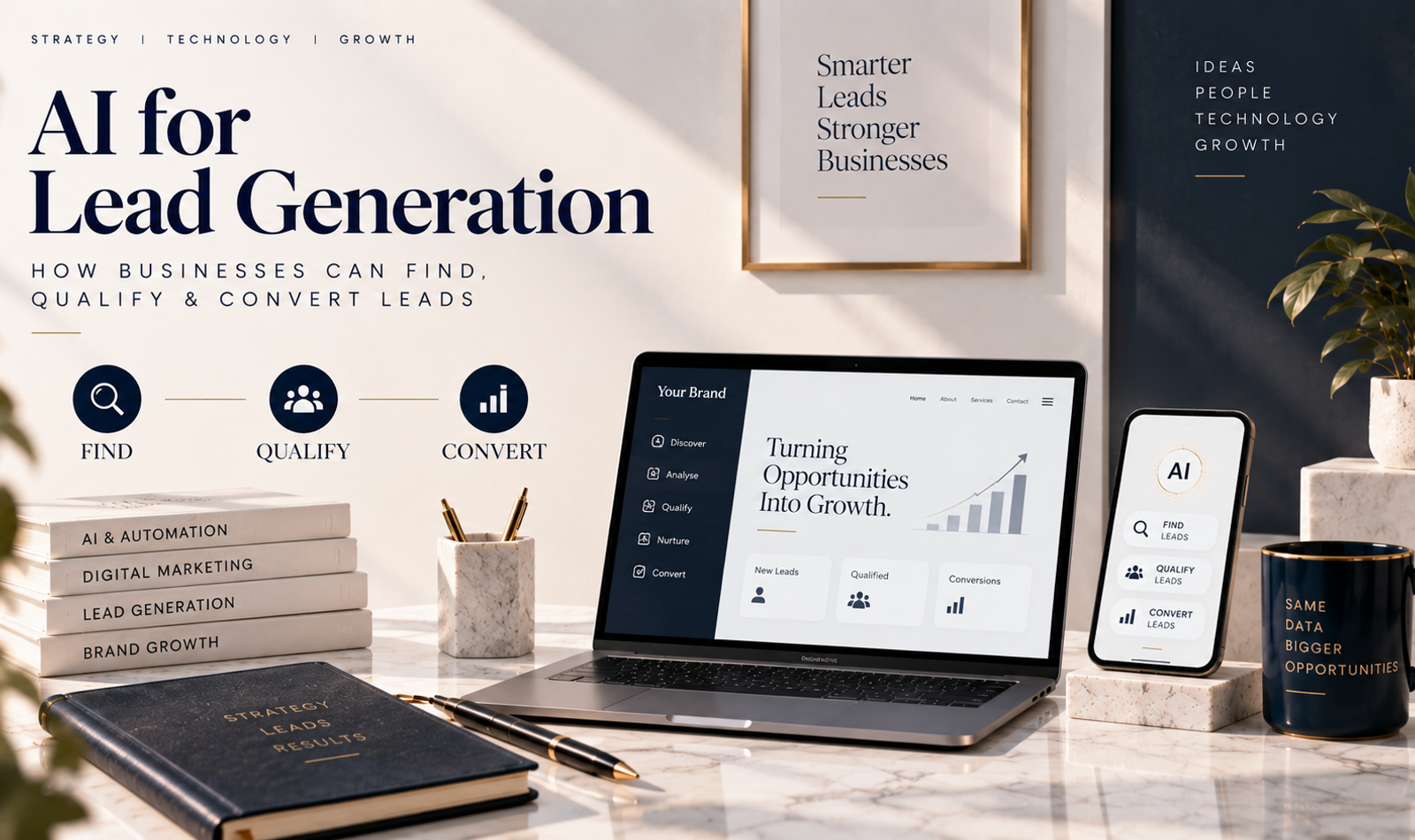
AI for Lead Generation: How Businesses Can Find, Qualify & Convert Leads
Generating leads has never been the real objective of marketing.
Generating the right leads and converting them into customers is what matters.
A business can receive hundreds of website enquiries, social media messages, form submissions and sales contacts every month. But if most of those prospects are irrelevant, unqualified or never followed up with properly, a high lead count creates very little business value.
This is where AI for lead generation is changing the way businesses approach customer acquisition.
Artificial intelligence can help companies identify potential customers, understand intent, score leads, personalise communication, automate repetitive follow-ups and give sales teams better information about which prospects deserve immediate attention.
Instead of treating every prospect equally, businesses can build a smarter system:
Find → Capture → Understand → Qualify → Score → Nurture → Convert → Learn
The objective is not to remove people from sales.
It is to use AI and automation to reduce repetitive work so marketing and sales teams can focus more attention on conversations, relationships, strategy and high-value opportunities.
This guide explains how businesses can use AI throughout the lead generation funnel—from discovering potential customers to qualifying, nurturing and converting them.
What Is AI Lead Generation?
AI lead generation is the use of artificial intelligence, machine learning, automation and data analysis to improve how businesses identify, attract, qualify and convert potential customers.
Traditional lead generation often relies heavily on manual processes.
A team may:
research prospects,
run advertising campaigns,
collect enquiries,
review forms,
update spreadsheets,
categorise leads,
send follow-ups,
and manually decide which prospects appear valuable.
AI can assist at several stages of this process.
It can help analyse patterns, organise information, personalise communication, prioritise prospects and automate routine actions.
The result can be a more structured customer acquisition system rather than a collection of disconnected marketing activities.
Why Businesses Are Using AI for Lead Generation
The biggest challenge for many businesses is not simply finding more people.
It is identifying the people most likely to become customers.
Marketing channels can generate large amounts of data:
website visits,
Google searches,
advertising clicks,
form submissions,
email engagement,
social interactions,
CRM activity,
content downloads,
and sales conversations.
Manually interpreting all of this becomes difficult as the business grows.
AI can help transform these signals into useful information.
For example, instead of giving sales representatives a list of 500 leads with no context, a system may help identify which prospects:
match the ideal customer profile,
have interacted repeatedly,
visited high-intent pages,
requested pricing,
returned to the website,
or demonstrated other buying signals.
This enables teams to prioritise more intelligently.
AI Does Not Fix a Weak Lead Generation Strategy
AI can make a good system more efficient.
It cannot automatically fix a bad strategy.
If a business has:
unclear positioning,
the wrong target audience,
a weak offer,
poor website experience,
irrelevant advertising,
or an ineffective sales process,
adding AI will not magically create qualified customers.
The foundation still matters.
Businesses should first understand:
who they want to attract,
what problem they solve,
why the customer should choose them,
what constitutes a qualified lead,
and what journey should move that person toward a purchase.
AI should then improve that system.
The AI Lead Generation Funnel
A useful AI-powered lead generation framework can be organised into seven stages:
1. Find
Identify relevant audiences and potential prospects.
2. Attract
Reach them through search, advertising, content, social media, PR and other channels.
3. Capture
Convert attention into identifiable enquiries or contacts.
4. Qualify
Determine whether the prospect is relevant.
5. Score
Prioritise leads according to fit and intent.
6. Nurture
Continue useful communication until the prospect is ready to act.
7. Convert
Move qualified prospects toward a sales conversation or purchase.
AI can support every stage differently.
Step 1: Define Your Ideal Customer Profile
Before using AI to find leads, define what a good lead looks like.
This is one of the most important parts of the process.
For a B2B company, an ideal customer profile may include:
industry,
company size,
location,
revenue range,
job role,
business challenge,
technology used,
budget,
and purchase authority.
For a consumer business, relevant characteristics may include:
location,
interests,
purchase behaviour,
needs,
price sensitivity,
and previous interactions.
Without this foundation, AI may help you find more prospects without improving their relevance.
A smaller database of well-matched prospects can be more valuable than thousands of unrelated contacts.
Step 2: Use AI for Audience and Market Research
Lead generation begins before the first advertisement is launched.
Businesses need to understand:
what customers want,
what problems they experience,
what questions they ask,
how they describe those problems,
what alternatives they consider,
and what prevents them from purchasing.
AI can help teams organise and analyse large amounts of customer information.
For example, businesses can study patterns across:
customer reviews,
sales call notes,
survey responses,
search queries,
support conversations,
website enquiries,
and CRM records.
The objective is to discover recurring themes.
These insights can then influence:
advertising,
landing pages,
content,
sales scripts,
offers,
and lead qualification criteria.
Step 3: Use AI to Identify Customer Intent
Not every website visitor has the same level of interest.
Someone reading an introductory educational article may be researching.
Someone visiting a service page may be comparing providers.
Someone repeatedly viewing pricing, case studies and contact pages may demonstrate stronger commercial intent.
AI-powered analytics and automation can help businesses organise these behavioural signals.
The goal is not to assume that every action guarantees a purchase.
Instead, businesses can use multiple signals to estimate where a prospect may be in the buying journey.
This allows marketing and sales teams to respond more appropriately.
Step 4: Attract Leads Through SEO and Content
AI-powered lead generation should not depend only on outbound prospecting.
Inbound channels remain important because they allow customers already searching for solutions to discover the business.
SEO can attract prospects at different stages of intent.
For example, someone searching:
“What is SEO?”
has different intent from someone searching:
“SEO agency in Mumbai.”
The first query is educational.
The second is much closer to commercial evaluation.
A strong strategy creates content for both informational and commercial searches.
Businesses building their organic acquisition foundation can use an on-page SEO checklist for higher rankings alongside broader technical and content optimisation.
Use AI for Content Research
AI can help marketers identify:
customer questions,
topic clusters,
content gaps,
search themes,
frequently raised objections,
and potential content angles.
However, generating large quantities of generic AI content is not a lead-generation strategy.
Content should still provide:
useful information,
real expertise,
clear differentiation,
and logical next steps.
The purpose of content is not simply to increase page count.
It is to attract the right audience and help them move through the buying journey.
DTS's guide to AI content creation tools and best practices explores how AI can support content production without replacing strategic direction.
Step 5: Use AI in Performance Advertising
Paid advertising provides another major source of leads.
Platforms can use machine learning and automated optimisation to help with areas such as:
audience delivery,
campaign optimisation,
creative testing,
and conversion-focused bidding.
Businesses can also use AI internally to analyse campaign data and identify patterns across:
creative formats,
headlines,
offers,
landing pages,
audience segments,
and lead quality.
The important metric is not simply the cheapest lead.
A campaign generating ₹100 leads that rarely convert may be less valuable than a campaign generating ₹500 leads that consistently become profitable customers.
Lead quality needs to remain connected to advertising decisions.
For businesses targeting high-value audiences, performance digital advertising across Meta, Google and LinkedIn can form an important part of the acquisition strategy.
Step 6: Improve Lead Capture With Better Landing Pages
Generating traffic is only half the challenge.
The next step is converting attention into action.
A landing page should answer:
What is being offered?
Who is it for?
Why should the visitor care?
Why should they trust the company?
What should they do next?
AI can assist teams in analysing and testing:
headlines,
CTA language,
page structure,
form length,
content hierarchy,
and conversion paths.
But the landing page still needs a strong offer and clear user experience.
Keep Lead Forms Focused
Many businesses ask for too much information too early.
A first enquiry form may request:
name,
email,
phone,
company,
job title,
budget,
location,
team size,
industry,
project timeline,
and several other fields.
Every additional requirement can create friction.
Instead, collect enough information to begin qualification and progressively gather more as the relationship develops.
The right amount depends on the business.
A high-value B2B enquiry may justify more qualification fields than a simple newsletter subscription.
Step 7: Use AI Chatbots for Lead Capture
An AI chatbot can turn a passive website visit into an interactive conversation.
Instead of requiring the user to search through several pages, the chatbot may help answer basic questions and direct the visitor toward relevant information.
It can also collect information such as:
name,
contact details,
service interest,
location,
timeline,
and enquiry type.
For businesses receiving enquiries outside office hours, this can help capture opportunities that might otherwise leave without taking action.
However, the chatbot should make it easy to reach a human when necessary.
Customers should not feel trapped inside automation.
Step 8: Qualify Leads Automatically
Once leads are captured, qualification becomes important.
Not every enquiry should immediately be sent to a senior salesperson.
A lead qualification system can assess characteristics such as:
service requirement,
budget,
location,
company size,
purchase timeline,
decision-making authority,
and problem relevance.
AI and automation can help categorise enquiries according to predefined criteria.
For example:
High Priority
Strong fit and immediate intent.
Medium Priority
Good fit but longer timeline or incomplete buying signals.
Nurture
Potentially relevant but not ready.
Low Fit
Does not match the target customer profile.
This allows teams to respond differently instead of treating every enquiry identically.
What Is AI Lead Scoring?
AI lead scoring is the process of using data and predictive signals to help estimate the relative likelihood or value of a prospect.
Traditional lead scoring usually assigns fixed points.
For example:
Visited pricing page: +10
Downloaded guide: +5
Requested demo: +30
Opened email: +2
AI-based systems can potentially evaluate more complex patterns across many variables, depending on the available data and platform.
These may include:
demographic fit,
firmographic fit,
behaviour,
engagement,
historical conversion patterns,
and recency.
The result is usually a prioritisation signal rather than a guarantee.
Fit vs Intent: Understand the Difference
A strong lead-scoring system should distinguish between fit and intent.
Fit asks:
Is this the kind of customer we want?
Intent asks:
Does this person appear interested in buying?
A large enterprise may perfectly match a B2B company's ideal customer profile but have no current purchase intent.
A small business may show extremely high intent but fall outside the company's profitable target segment.
Both dimensions matter.
A useful model can therefore evaluate:
Customer Fit × Purchase Intent = Lead Priority
Step 9: Route Leads Automatically
Once a lead is qualified, automation can determine where it should go.
For example:
Mumbai enquiries may go to one sales representative.
Enterprise enquiries may go to a senior sales manager.
Existing customers may go to account management.
Low-intent leads may enter a nurturing workflow.
High-priority leads may trigger an immediate notification.
This reduces manual administration and can shorten response time.
Response Time Matters
A lead can lose interest quickly.
They may contact several companies during the same research session.
If one company responds immediately while another responds two days later, the second business may lose the opportunity regardless of the quality of its service.
Automation can help trigger:
confirmation emails,
sales notifications,
CRM tasks,
WhatsApp workflows,
or appointment links
as soon as an enquiry is received.
The first automated response should acknowledge the prospect.
A meaningful sales conversation should follow when appropriate.
Step 10: Use AI for Personalised Lead Nurturing
Many leads are interested but not ready to buy immediately.
This is where lead nurturing matters.
A prospect may need:
more information,
case studies,
pricing clarity,
internal approval,
budget availability,
or additional trust.
Instead of repeatedly sending generic promotional messages, businesses can nurture prospects according to their interests and stage.
AI can help segment leads and personalise communication based on available data.
For example, someone interested in website development should not receive the same sequence as someone interested in event management.
Build Nurturing Around the Buying Journey
A simple nurturing structure might include:
Awareness
Educational content that helps the prospect understand the problem.
Consideration
Case studies, comparisons, guides and deeper service information.
Evaluation
Testimonials, process explanations, FAQs and consultation opportunities.
Decision
Clear proposals, next steps, availability and sales conversations.
Different leads should move through this journey at different speeds.
Automation helps businesses maintain communication without manually remembering every follow-up.
Step 11: Use AI to Personalise Sales Outreach
Generic sales messages are easy to ignore.
Personalisation becomes more valuable when it reflects genuine relevance.
AI can help sales teams prepare outreach by organising information about:
the prospect,
company,
industry,
previous interactions,
stated requirements,
and potential pain points.
This can help representatives write more relevant:
emails,
LinkedIn messages,
follow-ups,
and call preparation notes.
The purpose is not to pretend that a mass-generated message is personally researched.
It is to give salespeople better context so they can communicate more intelligently.
Avoid Fake Personalisation
Using someone's first name is not meaningful personalisation.
Real relevance comes from understanding:
what they need,
why they may need it,
what stage they are in,
and what information could help them make a decision.
Poor AI outreach often sounds like:
“I noticed your impressive company and thought our revolutionary solution would be perfect for you.”
It feels automated because there is no meaningful connection.
Strong outreach should have a reason for existing.
Step 12: Use AI to Support Sales Conversations
AI can also assist after the lead reaches sales.
Depending on the tools and permissions used, teams may be able to:
summarise conversations,
extract action items,
organise notes,
identify common objections,
prepare follow-ups,
and update CRM records.
This can reduce administrative work.
More importantly, it can create better continuity.
If the customer explains their requirements during one conversation, the next interaction should not feel as if the company has forgotten everything.
Step 13: Improve Proposals and Follow-Ups
A proposal should reflect the prospect's actual requirements.
AI can help teams organise information gathered during discovery and structure proposal drafts around:
objectives,
scope,
problems,
recommended solutions,
timelines,
and next steps.
Human review remains essential.
Pricing, commitments, deliverables and strategic recommendations should be verified before anything is sent.
The benefit is speed and consistency, not automatic decision-making.
Step 14: Use CRM Data More Effectively
A CRM becomes much more useful when information is complete and structured.
Unfortunately, many organisations have CRMs filled with:
missing fields,
duplicate records,
outdated statuses,
poor notes,
and inconsistent categorisation.
AI and automation can assist with parts of data organisation and enrichment, depending on the system.
But the organisation still needs clear CRM rules.
Define:
what information must be collected,
how stages are labelled,
when a lead becomes qualified,
who owns each opportunity,
and when inactive leads should be reviewed.
AI performs better when the underlying data is reliable.
Step 15: Re-Engage Old Leads
Businesses often focus so heavily on acquiring new leads that they ignore people already in their database.
Old leads may have gone inactive because:
the timing was wrong,
budget was unavailable,
the project was delayed,
decision-makers changed,
or priorities shifted.
Some of those opportunities may become relevant again.
AI-assisted segmentation can help identify older contacts worth revisiting based on available engagement and CRM information.
A re-engagement campaign can provide:
new information,
updated services,
relevant case studies,
or a simple opportunity to restart the conversation.
AI for B2B Lead Generation
B2B lead generation can particularly benefit from structured qualification because sales cycles are often longer and deal values can be higher.
AI can support B2B teams with:
account research,
prospect segmentation,
lead scoring,
content recommendations,
sales preparation,
follow-up automation,
and CRM organisation.
For B2B companies, the goal should usually be quality over raw volume.
Ten conversations with genuine decision-makers may be more valuable than 1,000 low-intent form submissions.
AI for Local Businesses
AI lead generation is not limited to large companies.
Local businesses can also use automation to improve:
Google-driven enquiries,
website forms,
WhatsApp leads,
appointment requests,
follow-ups,
and customer segmentation.
For a local service company, even simple automation can create value.
For example:
Website enquiry → automated confirmation → CRM entry → sales notification → follow-up task.
This removes unnecessary manual steps.
For businesses targeting local search demand, DTS's guide to local SEO for Mumbai businesses explains how local organic visibility can contribute to customer acquisition.
AI for Service Businesses
Service companies often face a qualification challenge because every enquiry is different.
A marketing agency may receive requests for:
social media,
web development,
SEO,
PR,
events,
branding,
and video production.
Without qualification, all enquiries may enter the same pipeline.
A smarter system can categorise them according to:
service,
budget,
urgency,
location,
business type,
and project scope.
The sales team can then respond with greater context.
AI for High-Ticket Businesses
High-ticket businesses should be careful not to over-automate the customer journey.
A customer considering a significant purchase may expect:
personal attention,
expertise,
consultation,
and trust.
AI can help identify and prepare the opportunity.
Humans should often handle the most important relationship-building stages.
This is especially relevant for:
luxury services,
consulting,
enterprise technology,
premium real estate,
high-value events,
and complex B2B services.
For these businesses, conversion optimisation should focus on reducing friction while maintaining trust. The DTS guide to building conversion-focused marketing funnels explores how websites can move prospects from interest toward action.
AI for Lead Generation Through Social Media
Social media can generate both direct and indirect leads.
Direct leads may come through:
DMs,
lead forms,
CTA buttons,
and campaign landing pages.
Indirect leads may discover the company through content and convert later through search or the website.
AI can support social lead generation through:
content ideation,
audience analysis,
message categorisation,
campaign optimisation,
and response workflows.
But businesses should avoid automating every conversation.
A customer asking a detailed question may need a real person.
AI UGC and Lead Generation
Creative quality also affects lead generation.
An advertisement cannot generate qualified enquiries if people ignore it.
AI-supported UGC and short-form creative workflows can help businesses test different:
hooks,
angles,
scripts,
formats,
offers,
and calls to action.
The important step is connecting creative performance with lead quality.
A video generating high engagement but poor enquiries may be useful for awareness but weak for conversion.
For businesses experimenting with this format, the DTS guide to AI UGC ads for high-converting social media creatives explains how AI-assisted UGC can support performance campaigns.
AI Video for Lead Generation
Video can play several roles throughout the funnel.
At the awareness stage, short videos can introduce the problem.
During consideration, explainers can demonstrate solutions.
During evaluation, testimonials and case-study videos can strengthen trust.
Retargeting videos can address common objections.
AI-supported production can make it easier to create and test multiple video variations.
Businesses exploring this approach can review AI video ads: benefits, cost and use cases to understand where AI-generated video can fit within a broader campaign.
Connect AI Lead Generation With Your Website
Your website should not simply receive traffic.
It should actively support qualification and conversion.
Useful elements can include:
clear service pages,
focused CTAs,
relevant case studies,
FAQ sections,
contact forms,
chat,
appointment booking,
and conversion tracking.
The website should make it easy for the right prospect to understand:
what you offer,
whether it is relevant,
why they should trust you,
and what they should do next.
Businesses developing this foundation can explore DTS's web development and marketing services for integrated website, marketing and conversion strategy.
Connect AI Lead Generation With Marketing Automation
AI and automation work best when channels are connected.
For example:
A prospect discovers a Google ad.
They visit a landing page.
They submit a form.
The CRM creates a record.
The lead is classified.
A confirmation is sent.
The sales team receives an alert.
The prospect receives relevant follow-up content.
The opportunity is updated after the conversation.
If the lead does not convert immediately, it enters a nurture workflow.
This is much more effective than storing the enquiry in someone's inbox.
A Practical AI Lead Generation Workflow
A complete system might look like:
Traffic Source
SEO → Google Ads → Meta Ads → LinkedIn → Social → PR → Referral
↓
Website / Landing Page
Relevant offer → Clear value proposition → Proof → CTA
↓
Lead Capture
Form → Chat → WhatsApp → Call → Booking
↓
CRM
Contact created → Source recorded → Requirement identified
↓
Qualification
Customer fit → Need → Budget → Timeline → Intent
↓
Lead Scoring
High → Medium → Nurture → Low Fit
↓
Routing
Correct sales representative or workflow
↓
Nurturing
Email → Content → Case studies → Follow-ups → Retargeting
↓
Sales
Discovery → Proposal → Negotiation
↓
Conversion
Customer
↓
Analysis
Channel → Lead quality → Conversion → Revenue → Optimisation
This is where AI becomes useful: not as one isolated tool, but as intelligence across the customer acquisition system.
How AI Marketing Automation Helps
Marketing automation can remove repetitive tasks such as:
sending confirmation messages,
assigning leads,
triggering follow-ups,
moving contacts between stages,
creating reminders,
and segmenting audiences.
AI can add another layer by helping interpret data and personalise certain decisions.
The combination can create more responsive marketing systems.
DTS's guide to AI automation for small and medium businesses explores broader applications of automation beyond lead generation.
Measure the Right Lead Generation Metrics
AI lead generation should be evaluated by business outcomes rather than activity alone.
Important metrics can include:
Lead Volume
How many enquiries are generated?
Qualified Lead Rate
What percentage meet your criteria?
Cost Per Lead
How much does each enquiry cost?
Cost Per Qualified Lead
How much does each relevant opportunity cost?
Lead-to-Opportunity Rate
How many qualified leads become real sales opportunities?
Conversion Rate
How many leads become customers?
Customer Acquisition Cost
What does it cost to acquire a customer?
Sales Cycle Length
How long does conversion take?
Revenue by Lead Source
Which channels generate actual business?
These metrics provide a much more useful picture than lead volume alone.
Cost Per Lead Can Be Misleading
Suppose Campaign A generates 100 leads at ₹200 each.
Campaign B generates 30 leads at ₹500 each.
Campaign A appears better based on cost per lead.
But imagine:
Campaign A produces two customers.
Campaign B produces ten.
Campaign B is clearly creating more business value despite having a higher CPL.
This is why AI-powered marketing systems should connect advertising data with CRM and sales outcomes whenever practical.
The objective should be to optimise toward qualified demand and revenue, not vanity metrics.
Use Closed-Loop Data
One of the strongest improvements businesses can make is connecting marketing and sales information.
Marketing knows:
where the lead came from.
Sales knows:
whether the lead was good.
When those systems remain disconnected, marketing may continue spending money on campaigns that generate poor opportunities.
Closed-loop reporting helps teams understand:
which campaigns produce qualified leads,
which content influences conversion,
which audiences become customers,
and which channels generate revenue.
AI can become more useful when it has access to better structured data.
Privacy and Responsible AI Lead Generation
Lead generation should respect privacy, consent and applicable regulations.
Businesses should be careful about:
how data is collected,
where it comes from,
how it is stored,
what permissions exist,
and how automated communication is used.
AI should not become an excuse for indiscriminate scraping, spam or misleading outreach.
Responsible lead generation is based on relevance and legitimate customer interest.
Businesses should also avoid inserting confidential customer data into tools without understanding how those systems handle information.
Keep Humans in High-Impact Decisions
Not every decision should be automated.
A model may score a lead as low priority while missing important context.
A salesperson may recognise strategic value that the system cannot.
Human review is particularly useful for:
large opportunities,
unusual enquiries,
strategic partnerships,
complex sales,
and high-value customers.
AI should support judgment rather than blindly replace it.
Common AI Lead Generation Mistakes
Buying More Tools Without a Strategy
Technology does not replace customer understanding.
Optimising Only for Lead Volume
More leads do not necessarily mean more revenue.
Ignoring Lead Quality
Marketing and sales need a shared definition of a qualified lead.
Automating Bad Messaging
Automation simply sends poor communication faster.
Over-Automating Sales
High-value prospects may require human attention.
Using Poor CRM Data
AI insights depend on the quality of the underlying information.
Generic AI Personalisation
Personalisation should be relevant, not superficial.
Slow Human Follow-Up
An automated acknowledgement does not replace a meaningful response.
Ignoring Privacy
Data collection and communication need appropriate safeguards and permissions.
Failing to Connect Marketing and Sales
Lead generation becomes much harder to optimise when marketing cannot see what happens after the form submission.
How to Build an AI Lead Generation Strategy
A practical implementation framework can follow these steps:
Step 1: Define the Business Goal
Decide whether the priority is:
more leads,
better leads,
lower acquisition cost,
faster response,
higher conversion,
or shorter sales cycles.
Step 2: Define the Ideal Customer
Document the characteristics of profitable customers.
Step 3: Map the Existing Funnel
Understand where prospects currently come from and where they drop off.
Step 4: Fix the Offer
Make sure the customer has a clear reason to enquire.
Step 5: Improve Acquisition
Use SEO, content, advertising, social media and other relevant channels.
Step 6: Improve Lead Capture
Optimise landing pages, forms, chat and CTAs.
Step 7: Connect a CRM
Store lead information in one structured system.
Step 8: Define Qualification Criteria
Determine what makes a lead valuable.
Step 9: Introduce Lead Scoring
Prioritise prospects using fit and intent signals.
Step 10: Automate Routing
Send leads to the appropriate person or workflow.
Step 11: Build Nurturing
Continue relevant communication with leads not ready to purchase.
Step 12: Support Sales With AI
Use AI for research, summaries, follow-up preparation and administrative support where appropriate.
Step 13: Connect Revenue Data
Identify which sources actually produce customers.
Step 14: Optimise Continuously
Use results to improve targeting, messaging, content and sales processes.
The complete model can be summarised as:
Audience → Traffic → Capture → CRM → Qualification → Scoring → Routing → Nurturing → Sales → Conversion → Revenue → Learning
Where Should a Business Start?
Do not begin by trying to automate everything.
Start with the biggest bottleneck.
If you have insufficient traffic, improve acquisition.
If traffic is strong but forms are weak, improve conversion.
If enquiries are plentiful but poor quality, improve targeting and qualification.
If good leads are being ignored, improve routing and response.
If prospects disappear after the first conversation, improve nurturing and follow-up.
If marketing cannot identify which campaigns generate customers, improve CRM and reporting.
AI creates the most value when it solves a clearly defined problem.
Frequently Asked Questions About AI for Lead Generation
What is AI for lead generation?
AI for lead generation is the use of artificial intelligence and automation to help businesses identify, attract, qualify, prioritise, nurture and convert potential customers.
How can AI generate leads?
AI can support audience research, advertising, content planning, website interactions, lead qualification, scoring, CRM workflows, personalisation and follow-up processes.
What is AI lead qualification?
AI lead qualification uses available prospect and behavioural data to help determine whether an enquiry matches predefined customer and sales criteria.
What is AI lead scoring?
AI lead scoring uses data and patterns to help prioritise leads according to characteristics such as customer fit, engagement and purchase intent.
Can AI replace sales teams?
AI can automate repetitive processes and provide useful information, but complex and high-value sales often continue to benefit from human judgment, relationship building and negotiation.
Can AI improve lead conversion?
AI can support conversion by improving qualification, response speed, personalisation, nurturing and sales prioritisation. Results still depend on the quality of the offer, targeting, customer experience and sales process.
Can small businesses use AI for lead generation?
Yes. Small businesses can start with relatively simple workflows involving forms, CRM automation, lead categorisation, email follow-ups, chat and marketing analysis.
How can AI help with B2B lead generation?
AI can assist with account research, prospect segmentation, qualification, scoring, sales preparation, nurturing and CRM organisation.
What is automated lead generation?
Automated lead generation uses software workflows to handle repetitive acquisition and lead-management tasks such as capturing contacts, assigning leads, sending responses and triggering follow-ups.
How does AI help with lead nurturing?
AI can help segment prospects, identify relevant interests and support personalised content or follow-up workflows based on the prospect's stage.
What is the difference between lead generation and lead qualification?
Lead generation attracts or captures potential customers. Lead qualification determines whether those prospects are relevant and worth pursuing.
What is the difference between lead qualification and lead scoring?
Qualification determines whether a prospect meets basic criteria. Scoring helps prioritise qualified or potentially qualified prospects according to fit and intent.
How can AI help with website leads?
AI can support chat, form optimisation, behavioural analysis, qualification, routing and personalised follow-up.
Which metrics should businesses track?
Important metrics include lead volume, qualified lead rate, cost per qualified lead, lead-to-opportunity rate, conversion rate, customer acquisition cost and revenue by source.
Is AI lead generation suitable for high-ticket businesses?
Yes, but high-ticket businesses should use AI primarily to improve research, qualification, prioritisation and follow-up while retaining human interaction during important sales decisions.
Final Thoughts
AI is changing lead generation, but the most valuable change is not simply automation.
It is better decision-making across the customer acquisition journey.
Businesses can use AI to better understand who they want to reach, identify intent signals, qualify enquiries, prioritise opportunities, personalise follow-ups and analyse which channels actually produce customers.
But technology should sit on top of a strong foundation.
The business still needs:
clear positioning,
a valuable offer,
the right audience,
credible communication,
a conversion-focused website,
a defined sales process,
and meaningful customer relationships.
The strongest AI lead generation system therefore does not look like:
AI → More Leads
It looks like:
Strategy → Right Audience → Relevant Traffic → Smart Capture → Qualification → Prioritisation → Personalised Nurturing → Human Sales → Conversion → Learning
That shift matters.
Because the future of lead generation is not about collecting the largest possible database.
It is about identifying the right opportunities earlier, responding to them more intelligently and turning more qualified demand into sustainable business.
Build a Smarter Lead Generation System With DTS
Double Trouble Studio helps businesses connect digital marketing, websites, SEO, performance campaigns, content and AI-powered workflows into a stronger customer acquisition ecosystem.
Explore DTS's AI marketing services for business growth, review our work, or contact Double Trouble Studio to discuss a lead generation and digital growth strategy for your business.
📩 info@dtsworld.in 📞 +91 80000 06021 📍 Andheri (West), Mumbai.
Need this for your brand?
Let DTS build your next campaign.
From PR, celebrity management and events to websites, social media, SEO and AI video production — Double Trouble Studio helps brands grow with strategy and execution.
Discuss Your Requirement →